Energy
Introduction
Energy is a fundamental property that enables objects and systems to perform work, produce motion, generate heat, emit light, and cause physical change. It exists in many forms and can be be transferred between objects or transformed from one form into another. Every natural process depends on energy, making it one of the most fundamental concepts in physics.
Understanding energy provides the foundation for studying matter, forces, motion, electricity, magnetism, electromagnetism, light, and many other scientific disciplines.
What is Energy?
Energy is the ability to perform work or produce change. It is a fundamental property of matter and physical systems that enables movement, interaction, and transformation.
Although energy cannot be observed directly, its presence is evident through its effects, such as motion, heat, light, sound, electricity, and electromagnetic radiation.
The International System of Units (SI) measures energy in joules (J), named after the English physicist James Prescott Joule, whose experiments established the relationship between mechanical work and heat.
History of Energy
The modern understanding of energy developed over several centuries through the work of many scientists.
Galileo Galilei and Isaac Newton laid the foundations of mechanics by studying motion and force. James Prescott Joule demonstrated the relationship between mechanical work and heat, providing experimental evidence that different forms of energy are equivalent. Julius Robert Mayer and Hermann von Helmholtz later established the Law of Conservation of Energy, which states that energy cannot be created or destroyed but can only be transferred or transformed from one form into another. In 1905, Albert Einstein introduced the mass-energy equivalence equation (E = mc²), showing that mass and energy are fundamentally related.
These discoveries established energy as one of the central concepts of modern physics.
Characteristics of Energy
Energy possesses several important characteristics.
Energy Exists in Many Forms
Energy exists in different forms, each describing how it is stored, transferred, or utilized. Although these forms differ, they all represent the same fundamental physical quantity.
Energy Can Be Transferred
Energy can move from one object or system to another without necessarily changing its form. Energy transfer occurs continuously throughout nature and engineered systems.
Energy Can Be Transformed
Energy can be converted from one form into another. Most natural phenomena and technological systems involve one or more energy transformations.
Energy Can Be Stored
Energy can be stored and released when required. Examples include chemical energy stored in batteries, gravitational energy stored in elevated objects, elastic energy stored in springs, and nuclear energy stored within atomic nuclei.
Energy is Conserved
According to the Law of Conservation of Energy, energy cannot be created or destroyed. It can only be transferred or transformed, meaning the total amount of energy within a closed system remains constant.
Classification of Energy
Energy can be classified in different ways depending on how it exists or where it originates. One common classification is based on how energy is stored or possessed by an object, while another is based on its source.
Based on the Nature of Energy
Kinetic Energy
Kinetic energy is the energy possessed by an object due to its motion. Every moving object, from a rolling ball to a moving vehicle or flowing river, possesses kinetic energy. The amount of kinetic energy depends on the object’s mass and velocity.
Potential Energy
Potential energy is stored energy possessed by an object due to its position, condition, or configuration. Examples include gravitational potential energy, elastic potential energy stored in a stretched spring, and chemical potential energy stored in fuels and batteries.
Based on the Source
Renewable Energy
Renewable energy is obtained from natural sources that are continuously replenished and do not become depleted on a human timescale. These energy sources can be used repeatedly and are considered sustainable for long-term use.
Common renewable energy sources include:
- Solar Energy
- Wind Energy
- Hydroelectric Energy
- Geothermal Energy
- Biomass Energy
- Tidal Energy
- Wave Energy
Non-Renewable Energy
Non-renewable energy is obtained from finite natural resources that are gradually depleted through consumption. These resources take millions of years to form and cannot be replenished within a human lifetime.
Common non-renewable energy sources include:
- Coal
- Petroleum (Crude Oil)
- Natural Gas
- Nuclear Fuels (Uranium)
This classification helps distinguish between sustainable energy resources and finite energy resources that are consumed faster than they are naturally replaced.
Work, Energy, and Power
Work, energy, and power are closely related physical quantities.
Work
Work is performed when a force causes an object to move through a distance. In physics, work represents the transfer of energy from one object or system to another.
Energy
Energy is the ability to perform work or produce change. Whenever work is performed, energy is transferred or transformed.
Power
Power is the rate at which energy is transferred or transformed. It describes how quickly work is performed and is measured in watts (W).
Forms of Energy
Energy exists in several forms, each representing a different way in which it is stored, transferred, or utilized.
Mechanical Energy
Mechanical energy is associated with the motion or position of an object. It is the sum of kinetic energy and potential energy.
Thermal (Heat) Energy
Thermal energy results from the continuous motion of atoms and molecules within a substance. As particle motion increases, thermal energy also increases.
Chemical Energy
Chemical energy is stored within the chemical bonds of substances and is released or absorbed during chemical reactions.
Electrical Energy
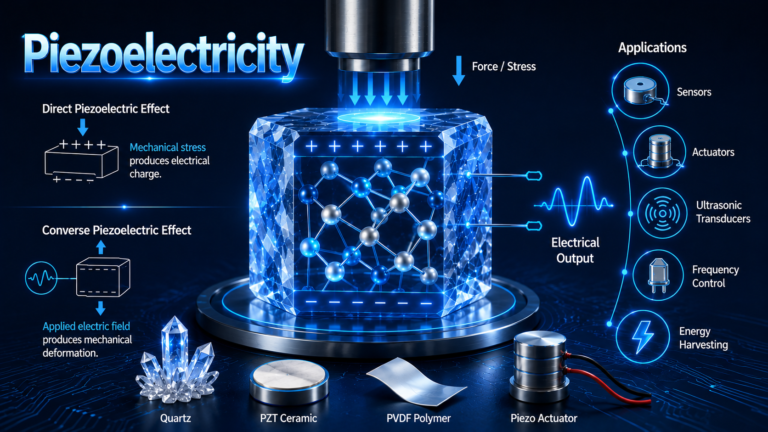
Electrical energy is associated with the movement of electric charges through a conductor or electric field.
Radiant (Electromagnetic) Energy
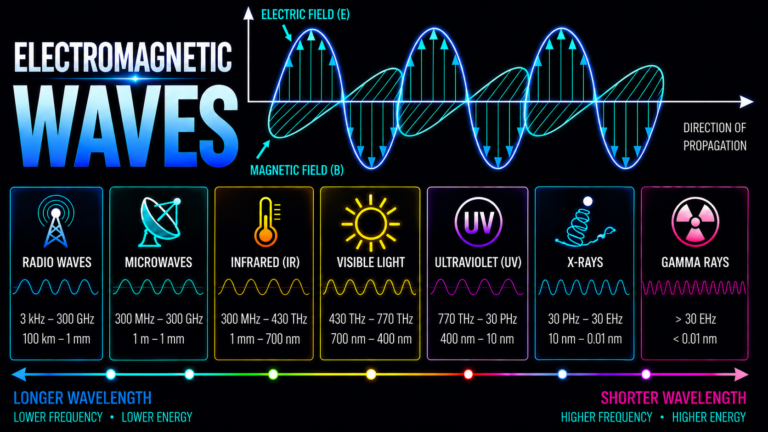
Radiant energy is carried by electromagnetic waves and includes radio waves, microwaves, infrared radiation, visible light, ultraviolet radiation, X-rays, and gamma rays.
Sound Energy
Sound energy is produced by mechanical vibrations and travels through solids, liquids, and gases. Unlike electromagnetic waves, sound requires a material medium for propagation.
Nuclear Energy
Nuclear energy is stored within the nucleus of atoms and is released during nuclear reactions such as nuclear fission and nuclear fusion.
Law of Conservation of Energy
The Law of Conservation of Energy states that energy cannot be created or destroyed; it can only be transferred or transformed from one form into another.
This principle applies to every physical process and is one of the fundamental laws of nature. Regardless of how many energy transformations occur, the total amount of energy within a closed system remains constant.
Energy Transfer
Energy can be transferred from one object or system to another in several ways.
Conduction
Conduction is the transfer of energy through direct contact between particles or objects. It is the primary method of heat transfer in solids.
Convection
Convection is the transfer of energy through the movement of liquids or gases. Warm fluids rise while cooler fluids sink, creating convection currents.
Radiation
Radiation is the transfer of energy through electromagnetic waves. Unlike conduction and convection, radiation does not require a material medium and can occur through a vacuum.
Energy Transformation
Energy transformation is the process of converting one form of energy into another. This ability allows energy to perform useful work in both natural and engineered systems.
Common energy transformations include:
- Chemical → Electrical (Battery)
- Chemical → Thermal (Burning Fuel)
- Mechanical → Electrical (Generator)
- Electrical → Mechanical (Electric Motor)
- Electrical → Light (LED Lamp)
- Electrical → Heat (Electric Heater)
- Electrical → Electromagnetic (Radio Transmitter)
- Light → Electrical (Solar Panel)
- Nuclear → Thermal (Nuclear Reactor)
- Thermal → Mechanical (Steam Turbine)
- Mechanical → Thermal (Friction)
Important Energy Equations
Several equations describe the relationships between different forms of energy.
- Kinetic Energy: KE = ½mv²
- Potential Energy: PE = mgh
- Electrical Energy: E = Pt
- Electrical Power: P = VI
- Photon Energy: E = hf
- Mass-Energy Equivalence: E = mc²
These equations are widely used to describe how energy is stored, transferred, transformed, and related to matter.
Units of Energy
Although the joule (J) is the SI unit of energy, other units are commonly used in different scientific and engineering fields.
| Unit | Symbol | Common Applications |
|---|---|---|
| Joule | J | SI unit of energy |
| Kilojoule | kJ | Chemistry and nutrition |
| Kilowatt-hour | kWh | Electrical energy consumption |
| Calorie | cal | Heat and food energy |
| Electron Volt | eV | Atomic and particle physics |
Importance of Energy
Energy is essential for every physical process in the universe. It governs motion, heat, light, electricity, chemical reactions, and nuclear processes. It enables living organisms to grow, perform biological functions, and survive. Energy also powers homes, transportation systems, industries, communication networks, computers, medical equipment, and countless technologies used in everyday life.
The study of energy forms the foundation for understanding mechanics, thermodynamics, electricity, magnetism, electromagnetism, optics, chemistry, engineering, Earth science, environmental science, and modern physics.
Conclusion
Energy is one of the most fundamental concepts in physics. It is the ability to perform work or produce change and exists in many forms, including mechanical, thermal, chemical, electrical, electromagnetic, sound, and nuclear energy. It can also be classified as kinetic or potential energy based on how it exists, and as renewable or non-renewable based on its source. Energy can be stored, transferred, and transformed, but according to the Law of Conservation of Energy, it can never be created or destroyed. Understanding energy provides the foundation for studying the physical world and serves as the basis for numerous scientific and engineering disciplines.