Electromagnetic Waves
Introduction
An Electromagnetic (EM) Wave, also known as electromagnetic radiation, is a self-propagating form of energy that travels through space without requiring a physical medium. It is generated by accelerating electrically charged particles and propagates as oscillating electric and magnetic fields. Unlike mechanical waves, electromagnetic waves can travel through both vacuum and matter while carrying energy from one location to another.
Electromagnetic waves are among the most fundamental phenomena in nature. They occur naturally throughout the universe and are also generated artificially by a wide variety of electrical and electronic systems. Collectively, these waves form the electromagnetic spectrum, which extends from low-frequency radio waves to high-frequency gamma rays.
Electromagnetic waves play a fundamental role in numerous natural phenomena and modern technologies. They enable sunlight to reach the Earth, make vision possible through visible light, transfer heat through infrared radiation, support medical imaging, facilitate scientific research, and enable wired and wireless communication systems. They also form the foundation of optics, electronics, telecommunications, networking, computing, astronomy, medicine, remote sensing, and many other scientific and engineering disciplines.
What Are Electromagnetic Waves?
Understanding Electromagnetic Waves
An electromagnetic wave is a self-propagating disturbance that carries energy through space in the form of oscillating electric and magnetic fields. These fields propagate together as a single wave without requiring a material medium.
Electromagnetic waves are generated whenever electrically charged particles accelerate. Once generated, they can travel through empty space as well as through various materials, although their speed depends on the properties of the medium.
Unlike mechanical waves, which transfer energy through the vibration of particles within a material medium, electromagnetic waves transfer energy through continuously oscillating electric and magnetic fields. This unique characteristic enables them to travel across the vacuum of space, allowing energy from distant stars, including the Sun, to reach the Earth.
Every electromagnetic wave possesses the same fundamental nature regardless of its wavelength or frequency. Radio waves, microwaves, infrared radiation, visible light, ultraviolet radiation, X-rays, and gamma rays are all electromagnetic waves. They differ only in their wavelength, frequency, and energy while obeying the same fundamental laws of electromagnetism.
Electromagnetic Radiation
The terms electromagnetic wave and electromagnetic radiation are often used interchangeably because they describe the same physical phenomenon.
The term radiation refers to the emission and propagation of energy away from a source. In the context of electromagnetism, it does not necessarily imply harmful radiation. Everyday examples include sunlight, visible light, radio broadcasting, television signals, microwave communication, Wi-Fi, Bluetooth, infrared heat, X-rays used in medical imaging, and gamma rays emitted during radioactive decay.
Collectively, all forms of electromagnetic radiation constitute the electromagnetic spectrum. Although different types of electromagnetic radiation possess different wavelengths, frequencies, and energies, they all propagate according to the same fundamental principles of electromagnetism.
Origin of Electromagnetic Waves
Electromagnetic waves originate from the behavior of electrically charged particles and the electric and magnetic fields associated with them. Understanding how electric charges produce electric fields, how moving charges produce magnetic fields, how these fields combine to form electromagnetic fields, and how changing fields generate electromagnetic waves provides the foundation for understanding electromagnetic wave generation and propagation.
Electric Charge
An electric charge is a fundamental property of matter that gives rise to electric forces and electromagnetic interactions. Every atom contains electrically charged particles. Protons carry a positive (+) charge, electrons carry a negative (−) charge, and neutrons are electrically neutral.
Electric charges exist in two forms:
- Positive charge
- Negative charge
Like charges repel one another, whereas opposite charges attract one another. This interaction is one of the fundamental forces of nature and is responsible for many electrical and electromagnetic phenomena.
Electric charge is measured in coulombs (C) and serves as the source of electric fields.
Electric Field
An electric field is the region surrounding an electric charge in which other electric charges experience an electric force.
Every electric charge, whether stationary or moving, produces an electric field. The field extends outward from the charge and gradually decreases in strength as the distance from the charge increases.
For a positively charged object, the electric field is directed away from the charge, whereas for a negatively charged object, it is directed toward the charge.
The electric field represents the influence that a charged object exerts on other nearby charges without requiring physical contact.
Magnetic Field
A magnetic field is the region surrounding moving electric charges or magnetic materials in which magnetic forces can be observed.
Unlike an electric field, which exists around every electric charge, a magnetic field is produced when electric charges move. For example, an electric current flowing through a conductor generates a magnetic field around the conductor.
Permanent magnets also produce magnetic fields due to the motion and alignment of electrons within the material.
Magnetic fields play a fundamental role in electromagnetism and are essential to the operation of electric motors, generators, transformers, communication systems, and numerous electronic devices.
Electromagnetic Field
An electromagnetic field (EM field) is the combined presence of electric and magnetic fields.
Whenever electric charges move, electric and magnetic fields exist together and influence one another. Depending on the behavior of the source, an electromagnetic field may be:
- Static, where the fields remain constant over time.
- Time-varying, where the fields continuously change over time.
Not every electromagnetic field becomes an electromagnetic wave. Many electromagnetic fields remain localized around their source without propagating through space.
For example:
- A stationary charged object produces a static electric field.
- A steady electric current produces a steady electromagnetic field around a conductor.
- An antenna carrying a rapidly changing current produces a time-varying electromagnetic field capable of generating electromagnetic waves.
Why They Are Called Electromagnetic Waves
The name electromagnetic wave reflects the two fundamental components that make up the wave: the electric field and the magnetic field. These fields oscillate together while remaining perpendicular to one another and propagate through space as a single self-sustaining wave.
The term wave describes the manner in which energy propagates through space. Rather than transporting matter, electromagnetic waves transfer energy from one location to another through the continuous oscillation of their electric and magnetic fields.
Understanding the relationship between electric fields, magnetic fields, electromagnetic fields, and electromagnetic waves is fundamental to the study of electromagnetism.
Relationship Between Electric and Magnetic Fields
Electric fields and magnetic fields are two fundamental and interconnected components of electromagnetism.
An electric field is produced by electric charges, whereas a magnetic field is produced by moving electric charges. Whenever electric charges move, both fields coexist and together form an electromagnetic field.
When the electric field changes with time, it generates a changing magnetic field. Likewise, a changing magnetic field generates a changing electric field. This continuous interaction, described by Maxwell’s equations, enables electromagnetic waves to propagate through space.
Although electric and magnetic fields are distinct physical quantities, they are fundamentally interconnected and cannot exist independently within a propagating electromagnetic wave.
How Electromagnetic Waves Are Generated
Electromagnetic waves are generated when electrically charged particles accelerate, meaning their speed or direction changes.
As a charged particle accelerates, the surrounding electric field changes continuously. This changing electric field generates a changing magnetic field, which in turn generates another changing electric field. The continuous regeneration of these fields produces a self-propagating electromagnetic wave that carries energy away from its source.
Natural sources of electromagnetic waves include the Sun, stars, lightning, and radioactive materials. Artificial sources include radio transmitters, television transmitters, mobile communication systems, radar systems, Wi-Fi routers, microwave ovens, lasers, and X-ray machines.
Self-Propagation of Electromagnetic Waves
One of the defining characteristics of an electromagnetic wave is its ability to propagate without requiring a physical medium.
As an electromagnetic wave travels, the changing electric field continuously generates a changing magnetic field, while the changing magnetic field continuously generates a changing electric field. This continuous interaction enables the wave to sustain itself throughout its propagation.
Because electromagnetic waves are self-propagating, they can travel through the vacuum of space as well as through materials such as air, glass, water, and certain solids. Their speed depends on the properties of the medium, reaching its maximum value in a vacuum.
This self-propagating nature distinguishes electromagnetic waves from mechanical waves, which require a material medium to transfer energy.
Structure and Characteristics of Electromagnetic Waves
Once generated, an electromagnetic wave propagates through space as a self-sustaining disturbance consisting of oscillating electric and magnetic fields. Regardless of their wavelength or frequency, all electromagnetic waves share the same fundamental structure and exhibit common characteristics that determine how they propagate, carry energy, and interact with matter.
Structure of an Electromagnetic Wave
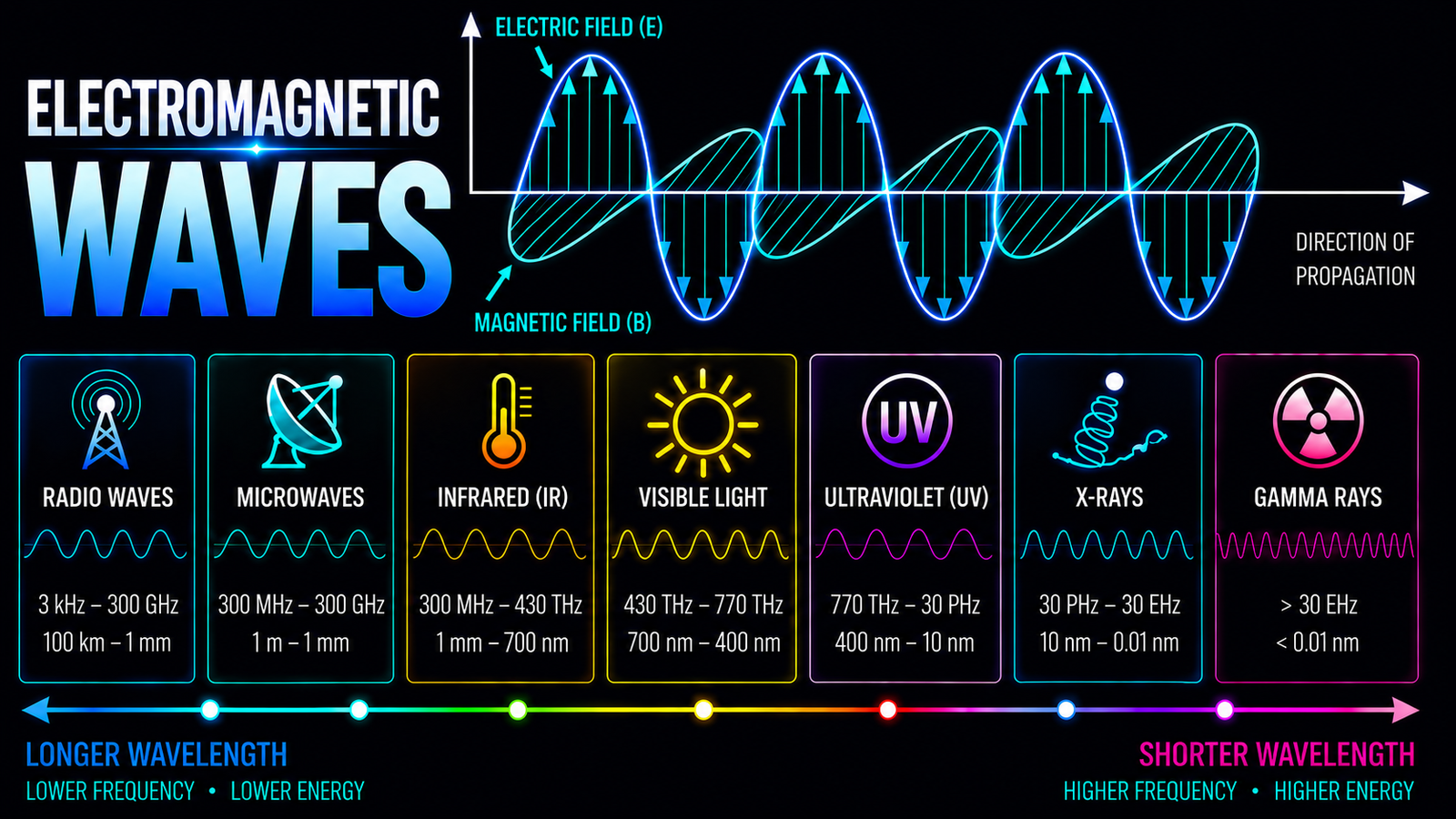
An electromagnetic wave consists of two oscillating fields:
- Electric Field (E)
- Magnetic Field (B)
These fields always exist together in a propagating electromagnetic wave. They oscillate continuously while remaining perpendicular to one another and perpendicular to the direction in which the wave travels.
This three-dimensional arrangement enables electromagnetic waves to propagate through space without requiring a material medium and is one of their defining characteristics.
Electric Field (E)
The electric field (E) is one of the two fundamental components of an electromagnetic wave. It represents the electric force produced by electric charges and oscillates continuously as the wave propagates.
Within an electromagnetic wave, the electric field repeatedly changes in magnitude and direction while remaining perpendicular to both the magnetic field and the direction of wave propagation. This oscillation contributes to the continuous transfer of energy through space.
Magnetic Field (B)
The magnetic field (B) is the second fundamental component of an electromagnetic wave. It is associated with moving electric charges and oscillates simultaneously with the electric field.
Like the electric field, the magnetic field continuously changes in magnitude and direction while remaining perpendicular to both the electric field and the direction of wave propagation. Together, the electric and magnetic fields sustain the electromagnetic wave as it propagates through space.
Direction of Wave Propagation
An electromagnetic wave propagates in a direction that is perpendicular to both its electric field and magnetic field.
This means:
- The electric field oscillates in one direction.
- The magnetic field oscillates at right angles to the electric field.
- The wave propagates in a third direction that is perpendicular to both fields.
This mutually perpendicular arrangement of the electric field, magnetic field, and direction of propagation is one of the defining characteristics of electromagnetic waves and distinguishes them from many other forms of wave motion.
Transverse Nature
Electromagnetic waves are transverse waves.
In a transverse wave, the oscillations occur perpendicular to the direction of propagation. Since both the electric field and magnetic field oscillate perpendicular to the direction in which the wave travels, every electromagnetic wave is classified as a transverse wave.
Unlike longitudinal waves, electromagnetic waves do not oscillate in the direction of propagation.
Characteristics of Electromagnetic Waves
Although electromagnetic waves differ in wavelength, frequency, and energy, they all share several fundamental characteristics that define their behavior and distinguish them from other types of waves.
Propagate Without a Physical Medium
Electromagnetic waves do not require a material medium for propagation. They can travel through the vacuum of space as well as through gases, liquids, and solids.
This unique property enables electromagnetic radiation from the Sun and other celestial bodies to travel across space and reach the Earth.
Travel at the Speed of Light
In a vacuum, all electromagnetic waves travel at the speed of light, approximately 299,792,458 metres per second (3 × 10⁸ m/s).
When electromagnetic waves propagate through materials such as air, water, or glass, their speed decreases depending on the electrical, magnetic, and optical properties of the medium.
Carry Energy and Momentum
Electromagnetic waves transport energy from one location to another without transporting matter.
In addition to energy, electromagnetic waves also carry momentum and can exert pressure on objects. This phenomenon, known as radiation pressure, plays an important role in astrophysics, laser technology, solar sails, and space science.
Polarization
Polarization describes the orientation of the oscillating electric field within an electromagnetic wave.
Depending on the source and propagation conditions, electromagnetic waves may exhibit different states of polarization, including linear, circular, and elliptical polarization. Polarization is widely used in communication systems, radar, satellite communication, optics, and imaging applications.
Parameters of Electromagnetic Waves
Electromagnetic waves are described by several measurable physical quantities, commonly referred to as wave parameters. These parameters define the physical properties of an electromagnetic wave, determine its position within the electromagnetic spectrum, and influence how it propagates, interacts with matter, and carries energy.
Wavelength
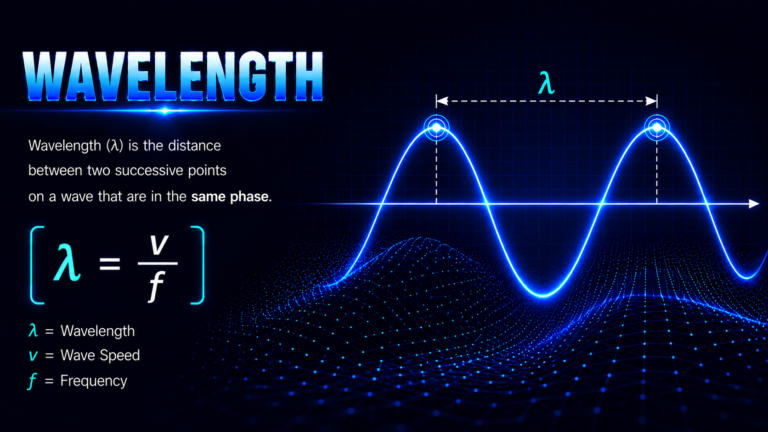
Wavelength (λ) is the distance between two successive corresponding points on a wave, such as crest to crest or trough to trough.
It is measured in metres (m) and determines the position of an electromagnetic wave within the spectrum. Longer wavelengths correspond to lower frequencies and lower energies, whereas shorter wavelengths correspond to higher frequencies and higher energies.
The relationship between wavelength, frequency, and the speed of light is expressed by the following equation:
λ = c / f
Where:
- λ = Wavelength (metres)
- c = Speed of light in a vacuum (3 × 10⁸ m/s)
- f = Frequency (hertz)
Frequency
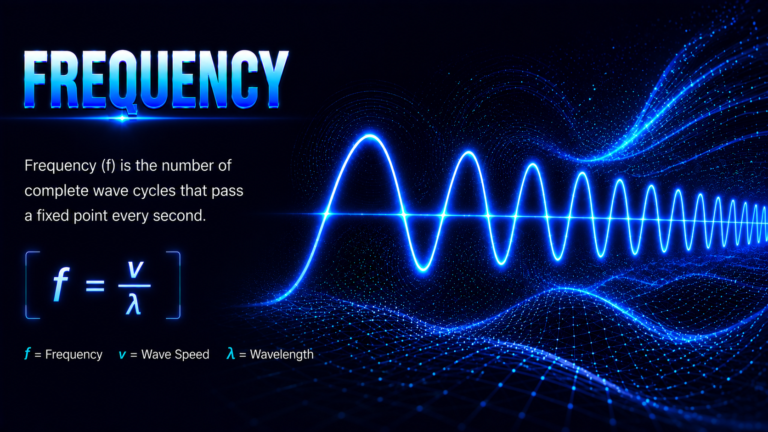
Frequency (f) is the number of complete oscillations of an electromagnetic wave that occur in one second.
It is measured in hertz (Hz). Higher frequencies correspond to more oscillations per second and generally indicate higher-energy electromagnetic waves.
The relationship between frequency, wavelength, and the speed of light is expressed by the following equation:
f = c / λ
Where:
- f = Frequency (hertz)
- c = Speed of light in a vacuum (3 × 10⁸ m/s)
- λ = Wavelength (metres)
Amplitude
Amplitude is the maximum displacement or strength of the electric or magnetic field from its equilibrium position.
Greater amplitude generally indicates that the wave carries more energy, resulting in higher intensity.
Period
The period (T) is the time required for one complete oscillation of an electromagnetic wave.
It is measured in seconds (s) and is the reciprocal of frequency. As frequency increases, the period decreases.
Velocity
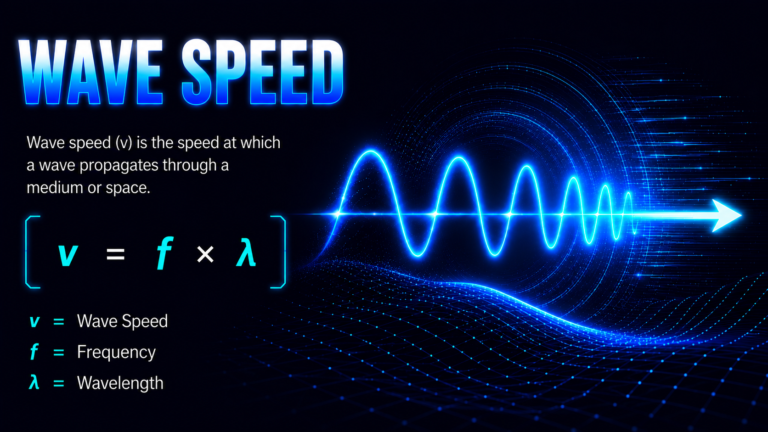
Velocity (v) is the speed at which an electromagnetic wave propagates through a medium.
In a vacuum, this velocity is equal to the speed of light. In other media, the propagation speed depends on the electrical, magnetic, and optical properties of the material.
Energy
Every electromagnetic wave carries energy.
The energy of an electromagnetic wave is directly proportional to its frequency and inversely proportional to its wavelength. Consequently, higher-frequency waves carry more energy than lower-frequency waves.
The relationship between energy and frequency is expressed by Planck’s equation:
E = hf
Where:
- E = Energy (joules)
- h = Planck’s constant (6.626 × 10⁻³⁴ J·s)
- f = Frequency (hertz)
Intensity
Intensity is the amount of electromagnetic energy transmitted through a unit area per unit time.
It indicates the strength of an electromagnetic wave and generally decreases as the distance from the source increases because the energy spreads over a larger area.
Relationship Between Wave Parameters
The measurable parameters of electromagnetic waves are closely related. A change in one parameter directly influences one or more of the others. These relationships determine the behavior of electromagnetic waves and form the basis for classifying them within the electromagnetic spectrum.
Speed, Wavelength, and Frequency
The speed of an electromagnetic wave is determined by the relationship between its wavelength and frequency.
- Increasing the frequency decreases the wavelength.
- Increasing the wavelength decreases the frequency.
- In a given medium, the propagation speed remains constant.
Frequency and Energy
The energy carried by an electromagnetic wave is directly proportional to its frequency.
Higher-frequency electromagnetic waves carry more energy than lower-frequency electromagnetic waves.
Wavelength and Energy
Wavelength and energy are inversely related.
Long-wavelength electromagnetic waves possess lower energy, whereas short-wavelength electromagnetic waves possess higher energy.
These relationships explain why different regions of the electromagnetic spectrum exhibit distinct physical characteristics, interactions with matter, and practical applications.
Electromagnetic Spectrum and Wave Behavior
Electromagnetic waves exist over an enormous range of wavelengths, frequencies, and energies. Although they all share the same fundamental nature, they are classified into different types based on these physical properties. Collectively, these types form the electromagnetic spectrum, which extends from low-frequency radio waves to high-frequency gamma rays.
Electromagnetic Spectrum
The electromagnetic spectrum is the complete range of all electromagnetic waves arranged according to their wavelength, frequency, or energy. Every type of electromagnetic wave occupies a specific region of the spectrum while obeying the same fundamental laws of electromagnetism.
The spectrum forms a continuous range rather than separate, isolated bands. The boundaries between different regions are approximate and may vary slightly depending on the scientific, engineering, or international reference standard.
The electromagnetic spectrum is commonly arranged in three ways:
- By wavelength
- By frequency
- By energy
As frequency increases, wavelength decreases. Likewise, as frequency increases, the energy carried by an electromagnetic wave also increases. Conversely, as wavelength increases, both frequency and energy decrease.
Although the electromagnetic spectrum is continuous, it is commonly divided into seven major regions based on characteristic ranges of wavelength, frequency, and energy. Each region possesses distinct physical characteristics that determine how electromagnetic waves propagate, interact with matter, and are used in scientific, industrial, medical, and communication applications.
Types of Electromagnetic Waves
Although all electromagnetic waves are manifestations of the same physical phenomenon, they are commonly classified into seven major types based on their wavelength, frequency, and energy.
The seven major types of electromagnetic waves are:
- Radio Waves
- Microwaves
- Infrared Radiation
- Visible Light
- Ultraviolet Radiation
- X-Rays
- Gamma Rays
These regions form a continuous spectrum rather than completely separate categories. As wavelength decreases, frequency and energy increase, resulting in a gradual transition from one region to the next.
Each type possesses unique propagation characteristics, interactions with matter, and practical applications.
Radio Waves
Radio waves occupy the lowest-frequency and longest-wavelength region of the electromagnetic spectrum. They are primarily used for long-distance wireless communication, broadcasting, navigation, radar, and remote sensing.
Frequency Range
3 kHz to 300 MHz
Wavelength Range
100 km to 1 m
Energy Level
Lowest
Characteristics
- Longest wavelengths in the electromagnetic spectrum.
- Lowest frequencies and energies.
- Can propagate over very long distances.
- Diffract around obstacles more effectively than higher-frequency waves.
- Can penetrate the Earth’s atmosphere efficiently.
- Suitable for long-range communication.
- Non-ionizing.
Natural Sources
- Lightning
- The Sun
- Stars
- Planets
- Astronomical radio sources
Artificial Sources
- Radio transmitters
- Television transmitters
- Cellular communication systems
- Navigation transmitters
- Radar systems
Applications
- Radio broadcasting
- Television broadcasting
- Maritime communication
- Aviation communication
- Amateur radio
- Navigation systems
- Radar
- Radio astronomy
Microwaves
Microwaves occupy the region between radio waves and infrared radiation. They have shorter wavelengths and higher frequencies than radio waves and are widely used for communication, radar, satellite systems, remote sensing, and heating applications.
Frequency Range
300 MHz to 300 GHz
Wavelength Range
1 m to 1 mm
Energy Level
Low
Characteristics
- Shorter wavelengths than radio waves.
- Higher frequencies than radio waves.
- Primarily propagate in straight lines.
- Suitable for high-bandwidth communication.
- Can penetrate clouds, smoke, and light rain.
- Non-ionizing.
Natural Sources
- Cosmic Microwave Background (CMB)
- The Sun
- Stars
- Interstellar space
Artificial Sources
- Microwave transmitters
- Radar systems
- Microwave ovens
- Satellite communication equipment
- Cellular communication systems
Applications
- Microwave communication
- Satellite communication
- Radar
- Weather radar
- Wi-Fi
- Mobile communication
- Microwave heating
- Remote sensing
Infrared Radiation
Infrared radiation occupies the region between microwaves and visible light. It is commonly associated with thermal radiation because all objects above absolute zero emit infrared energy.
Frequency Range
300 GHz to 430 THz
Wavelength Range
1 mm to 700 nm
Energy Level
Low to Medium
Characteristics
- Commonly associated with heat.
- Invisible to the human eye.
- Emitted by all objects above absolute zero.
- Can penetrate smoke better than visible light.
- Non-ionizing.
Natural Sources
- The Sun
- The Earth
- Stars
- Living organisms
- Hot objects
Artificial Sources
- Infrared LEDs
- Heating elements
- Infrared lasers
- Incandescent lamps
- Remote control transmitters
Applications
- Thermal imaging
- Night vision
- Remote controls
- Fiber-optic communication
- Temperature measurement
- Medical thermography
Visible Light
Visible light is the only region of the electromagnetic spectrum that can be detected by the human eye. It occupies the region between infrared and ultraviolet radiation and enables human vision.
Frequency Range
430 THz to 770 THz
Wavelength Range
700 nm to 400 nm
Energy Level
Medium
Visible Spectrum
- Red
- Orange
- Yellow
- Green
- Blue
- Indigo
- Violet
Characteristics
- Visible to the human eye.
- Enables vision.
- Can be reflected, refracted, diffracted, polarized, and dispersed.
- Non-ionizing.
Natural Sources
- The Sun
- Stars
- Fire
- Bioluminescent organisms
Artificial Sources
- LEDs
- Lasers
- Incandescent lamps
- Fluorescent lamps
- Display technologies
Applications
- Human vision
- Photography
- Optical instruments
- Displays
- Optical communication
- Microscopy
- Lighting
Ultraviolet Radiation
Ultraviolet (UV) radiation occupies the region between visible light and X-rays. It has higher energy than visible light and can produce chemical and biological effects.
Frequency Range
770 THz to 30 PHz
Wavelength Range
400 nm to 10 nm
Energy Level
High
Types
- UV-A
- UV-B
- UV-C
Characteristics
- Invisible to the human eye.
- Higher energy than visible light.
- Can trigger chemical reactions.
- Can damage biological tissues with prolonged exposure.
- Partially ionizing at the highest energies.
Natural Sources
- The Sun
- Stars
- Hot astronomical objects
Artificial Sources
- UV lamps
- Mercury vapor lamps
- UV LEDs
- UV lasers
Applications
- Sterilization
- Water purification
- Medical treatments
- Forensic analysis
- UV curing
X-Rays
X-rays occupy the region between ultraviolet radiation and gamma rays. Their high energy enables them to penetrate many materials, making them valuable for imaging, inspection, and scientific research.
Frequency Range
30 PHz to 30 EHz
Wavelength Range
10 nm to 0.01 nm
Energy Level
Very High
Characteristics
- Highly penetrating.
- Ionizing radiation.
- Can pass through many materials.
- Absorbed differently by different materials.
- Useful for imaging internal structures.
Natural Sources
- Cosmic objects
- Supernova remnants
- High-energy astronomical events
Artificial Sources
- X-ray tubes
- Particle accelerators
- Synchrotron facilities
Applications
- Medical imaging
- Airport security screening
- Industrial inspection
- Scientific research
- Crystallography
Gamma Rays
Gamma rays occupy the highest-energy region of the electromagnetic spectrum. They possess the shortest wavelengths and highest frequencies among all electromagnetic waves and are produced by high-energy nuclear and astrophysical processes.
Frequency Range
Above 30 EHz
Wavelength Range
Less than 0.01 nm
Energy Level
Highest
Characteristics
- Shortest wavelengths.
- Highest frequencies.
- Highest energies.
- Strongly ionizing.
- Extremely high penetrating power.
Natural Sources
- Radioactive decay
- Supernovae
- Neutron stars
- Black holes
- Gamma-ray bursts
Artificial Sources
- Nuclear reactors
- Particle accelerators
- Radioisotopes
Applications
- Cancer treatment
- Medical sterilization
- Industrial inspection
- Scientific research
- Nuclear science
Propagation of Electromagnetic Waves
Once generated, electromagnetic waves propagate away from their source while carrying energy through space or various materials. Unlike mechanical waves, they do not require a physical medium for propagation because the continuously changing electric and magnetic fields sustain one another as the wave travels.
The propagation characteristics of electromagnetic waves depend on factors such as frequency, wavelength, the properties of the medium, and environmental conditions. Different propagation mechanisms are used in communication systems depending on the operating frequency and transmission requirements.
Propagation Through Vacuum
Electromagnetic waves can travel through the vacuum of space without requiring a material medium. This unique property enables electromagnetic radiation from the Sun and other celestial objects to travel across vast distances and reach the Earth.
In a vacuum, electromagnetic waves propagate at the speed of light, approximately 299,792,458 metres per second (3 × 10⁸ m/s). Since there are no particles to absorb or scatter the wave, a vacuum provides the ideal environment for electromagnetic wave propagation.
Propagation Through Air
Electromagnetic waves also propagate through the Earth’s atmosphere. However, the atmosphere is not a perfect transmission medium, and different frequencies experience varying levels of absorption, reflection, refraction, scattering, and attenuation.
Lower-frequency radio waves can travel long distances, whereas higher-frequency waves such as microwaves generally require a clear line of sight. Atmospheric conditions such as rain, fog, humidity, and ionospheric activity can also influence propagation.
Propagation Through Different Materials
Electromagnetic waves can propagate through gases, liquids, solids, optical fibers, and numerous engineered materials. Their propagation speed decreases depending on the electrical, magnetic, and optical properties of the medium.
Some materials readily transmit electromagnetic waves, while others partially absorb, reflect, or scatter them. These interactions determine the suitability of different materials for applications such as wireless communication, optical communication, sensing, medical imaging, and industrial inspection.
Ground Wave Propagation
Ground wave propagation occurs when electromagnetic waves travel close to the Earth’s surface by following its curvature.
This mode of propagation is primarily associated with low-frequency (LF) and medium-frequency (MF) radio waves, allowing communication beyond the visible horizon. Ground waves are widely used for AM broadcasting, maritime communication, and navigation systems because of their ability to provide reliable long-distance coverage.
Skywave Propagation
Skywave propagation occurs when radio waves are refracted by the ionosphere and returned toward the Earth’s surface. This enables communication over distances far beyond the horizon without requiring satellites or intermediate repeaters.
Skywave propagation is most effective in the high-frequency (HF) band and is commonly used for international broadcasting, amateur radio, military communication, and long-distance maritime and aviation communication. Its performance varies with solar activity, time of day, season, and ionospheric conditions.
Space Wave Propagation
Space wave propagation occurs when electromagnetic waves travel directly through the atmosphere between transmitting and receiving antennas.
This propagation mode is primarily used at very high frequency (VHF), ultra-high frequency (UHF), and microwave frequencies. It forms the basis of television broadcasting, satellite communication, radar systems, cellular communication, and many wireless networking technologies.
Line-of-Sight (LOS) Propagation
Line-of-sight (LOS) propagation occurs when the transmitting and receiving antennas have a direct, unobstructed path between them.
Since higher-frequency electromagnetic waves exhibit limited diffraction around obstacles, maintaining a clear line of sight is often essential for reliable communication. Line-of-sight propagation is widely used in microwave links, satellite communication, cellular networks, Wi-Fi, and point-to-point wireless communication systems.
Interaction of Electromagnetic Waves with Matter
When electromagnetic waves encounter matter, they may undergo several physical interactions depending on the properties of both the wave and the material. These interactions determine how electromagnetic waves propagate, transfer energy, and are used in communication, imaging, sensing, medicine, astronomy, and numerous other scientific and engineering applications.
Reflection
Reflection occurs when an electromagnetic wave strikes the surface of a material and changes direction, returning into the original medium instead of passing through the material.
The amount of reflection depends on factors such as the angle of incidence, surface roughness, frequency of the wave, and the electrical properties of the material. Reflection is fundamental to mirrors, radar systems, satellite communication, radio propagation, and optical instruments.
Refraction
Refraction occurs when an electromagnetic wave enters a different medium and changes direction because its propagation speed changes.
The amount of bending depends on the properties of the two media and the angle at which the wave enters the new medium. Refraction is responsible for the operation of lenses, optical fibers, microscopes, telescopes, cameras, and many imaging systems.
Diffraction
Diffraction is the bending and spreading of electromagnetic waves as they pass around obstacles or through narrow openings.
The effect becomes more significant when the size of the obstacle or opening is comparable to the wavelength of the electromagnetic wave. Diffraction enables radio waves to travel beyond obstacles and contributes to the performance of communication systems, optical devices, and scientific instruments.
Absorption
Absorption occurs when a material absorbs part or all of the energy carried by an electromagnetic wave.
The absorbed energy is typically converted into other forms of energy, such as heat. The degree of absorption depends on the material properties and the frequency of the electromagnetic wave. Absorption is fundamental to microwave heating, solar energy conversion, thermal imaging, and many medical and industrial applications.
Transmission
Transmission occurs when an electromagnetic wave passes through a material with little or no absorption.
The amount of transmitted energy depends on the properties and thickness of the material. Transparent materials such as glass transmit visible light effectively, while optical fibers are specifically designed to transmit light over long distances with minimal loss.
Scattering
Scattering occurs when electromagnetic waves change direction after interacting with particles, molecules, or irregularities within a material or the atmosphere.
The amount of scattering depends on factors such as wavelength, particle size, and material composition. Scattering explains many natural phenomena, including the blue color of the sky and red sunsets, and plays an important role in atmospheric science, astronomy, optical communication, remote sensing, and medical imaging.
Applications of Electromagnetic Waves
Electromagnetic waves have transformed the way people communicate, explore the universe, diagnose diseases, manufacture products, and conduct scientific research. Their ability to propagate through vacuum and matter, carry energy and information, and interact with different materials makes them indispensable across numerous fields of science, engineering, medicine, industry, and everyday life.
How Electromagnetic Waves Carry Information
Electromagnetic waves serve as carriers of information by transmitting signals over short and long distances. Information such as voice, audio, video, images, sensor data, and digital data is encoded onto electromagnetic waves using various modulation and encoding techniques. At the receiving end, the transmitted information is decoded and converted back into its original form.
The choice of electromagnetic wave depends on factors such as communication distance, bandwidth requirements, propagation characteristics, frequency allocation, environmental conditions, and application requirements. This capability forms the foundation of modern wired and wireless communication systems.
Communication
Electromagnetic waves form the backbone of modern communication systems, enabling the transmission of information across local, regional, national, and global networks.
Common applications include:
- Radio broadcasting
- Television broadcasting
- Mobile communication
- Satellite communication
- Wi-Fi
- Bluetooth
- GPS and navigation systems
- Optical fiber communication
- Microwave communication
- Internet backbone networks
- Emergency communication systems
- Space communication
Computing and Information Technology
Modern computing infrastructure relies extensively on electromagnetic waves for communication, sensing, and high-speed data transmission.
Common applications include:
- Wireless networking
- Fiber-optic communication
- Data center networking
- RFID systems
- Near Field Communication (NFC)
- Infrared communication
- Wireless peripherals
- Optical storage technologies
- Hardware diagnostics
Medicine and Healthcare
Electromagnetic waves have transformed healthcare by enabling non-invasive diagnosis, advanced medical imaging, targeted therapies, sterilization, and continuous patient monitoring.
Common applications include:
- X-ray imaging
- Computed Tomography (CT)
- Magnetic Resonance Imaging (MRI)
- Radiation therapy
- Laser surgery
- Ultraviolet sterilization
- Medical thermography
- Pulse oximetry
- Endoscopy
- Medical diagnostics
Note: MRI does not use ionizing electromagnetic radiation such as X-rays or gamma rays for imaging. Instead, it uses strong magnetic fields, radio-frequency electromagnetic waves, and nuclear magnetic resonance to produce detailed images of internal body structures.
Astronomy and Space Science
Electromagnetic waves enable scientists to observe and study the universe across the entire electromagnetic spectrum. Different wavelengths reveal unique physical processes that cannot be observed using visible light alone.
Common applications include:
- Optical astronomy
- Radio astronomy
- Infrared astronomy
- Ultraviolet astronomy
- X-ray astronomy
- Gamma-ray astronomy
- Space exploration
- Planetary observation
- Solar observation
- Deep-space communication
Scientific Research
Electromagnetic waves are fundamental to scientific discovery and experimental research across numerous disciplines.
Common applications include:
- Spectroscopy
- Microscopy
- Particle physics
- Materials science
- Remote sensing
- Environmental monitoring
- Climate research
- Laboratory instrumentation
- Plasma physics
- Nuclear science
Industry
Industrial sectors rely on electromagnetic waves for manufacturing, automation, inspection, quality assurance, and process control.
Common applications include:
- Non-destructive testing
- Industrial radiography
- Laser cutting
- Laser welding
- Material processing
- Microwave heating
- UV curing
- Industrial sensing
- Automation systems
- Quality inspection
Consumer Electronics
Electromagnetic waves are integrated into countless consumer devices used in everyday life for communication, entertainment, navigation, and home automation.
Common applications include:
- Smartphones
- Television
- Radio receivers
- Wi-Fi routers
- Bluetooth devices
- GPS receivers
- Microwave ovens
- Remote controls
- Smart home devices
- Wearable devices
Conclusion
Electromagnetic waves are one of the fundamental mechanisms through which energy and information are transmitted throughout the universe. Although they differ in wavelength, frequency, and energy, all electromagnetic waves share the same underlying principles of electromagnetism and propagate as oscillating electric and magnetic fields.
From long-distance radio communication to visible light, medical imaging, satellite communication, scientific research, and space exploration, electromagnetic waves have transformed modern civilization and continue to drive advances in science, engineering, healthcare, industry, and communication technologies.
A thorough understanding of electromagnetic waves provides the foundation for studying electromagnetism, optics, networking, wireless communication, electronics, photonics, remote sensing, astronomy, and numerous other scientific and engineering disciplines. Their significance extends from the smallest electronic devices to the largest structures in the observable universe, making electromagnetic waves one of the most important concepts in physics and modern technology.