What is Discrete Mathematics
Introduction
Discrete Mathematics is one of the fundamental branches of mathematics that deals with countable, distinct, and separate mathematical structures. Unlike continuous mathematics, which studies quantities that change smoothly, discrete mathematics focuses on objects that exist as individual entities, such as integers, sets, graphs, logical statements, and algorithms. Because of its emphasis on finite and countable structures, discrete mathematics forms the mathematical foundation of computer science and many modern digital technologies.
From designing efficient algorithms and computer networks to developing cryptographic systems and artificial intelligence, discrete mathematics plays a critical role in solving problems involving discrete data and logical reasoning. Its concepts are widely used across science, engineering, finance, telecommunications, and information technology, making it one of the most practical and influential areas of modern mathematics.
What is Discrete Mathematics?
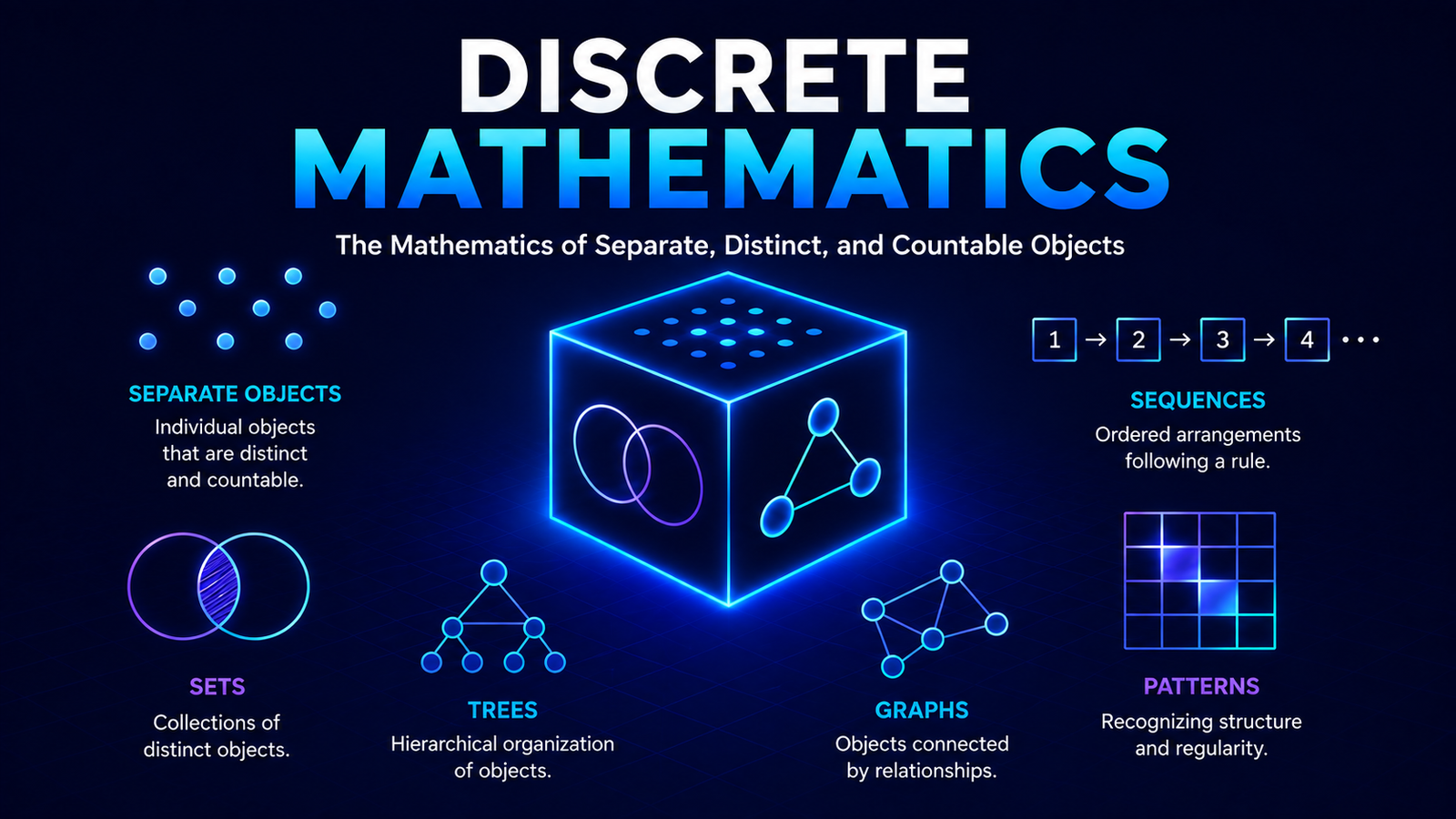
Discrete Mathematics is the branch of mathematics that studies finite or countably infinite mathematical structures. The term “discrete” refers to objects that are separate and individually distinguishable rather than continuous. These objects can typically be counted, arranged, or analyzed using logical and mathematical techniques.
Unlike branches of mathematics that deal with continuously varying quantities, discrete mathematics focuses on structures such as sets, graphs, trees, integers, Boolean values, sequences, and algorithms. These structures provide the mathematical framework for representing and solving problems involving digital systems, networks, and computational processes.
Discrete mathematics combines mathematical reasoning with logical thinking to analyze relationships, count possibilities, optimize solutions, and model complex systems. As a result, it has become an essential discipline in computer science, software engineering, cybersecurity, artificial intelligence, data science, and many other fields.
Meaning of “Discrete” in Mathematics
The word “discrete” means separate, distinct, or individually countable. In mathematics, discrete objects are those that exist as individual elements rather than forming a continuous range.
For example, the number of students in a classroom, the computers connected to a network, the pages in a book, or the possible combinations of a password are all discrete because they consist of separate, countable elements. In contrast, quantities such as time, temperature, distance, and speed are continuous because they can take any value within a given range.
This distinction makes discrete mathematics particularly suitable for representing digital systems, where information is stored and processed as individual values rather than continuous quantities.
History of Discrete Mathematics
The foundations of discrete mathematics can be traced back to ancient civilizations, where counting, arithmetic, and logical reasoning were first developed. Early mathematicians studied numbers, patterns, and methods for solving practical problems involving trade, astronomy, and measurement.
During ancient Greece, philosophers and mathematicians such as Euclid contributed significantly to mathematical logic and proof techniques. Number theory also began to emerge as an important area of study through investigations into the properties of integers and prime numbers.
The modern development of discrete mathematics accelerated during the nineteenth and twentieth centuries with advances in symbolic logic, set theory, graph theory, and combinatorics. Mathematicians such as George Boole introduced Boolean algebra, while Leonhard Euler’s work on graph theory established entirely new mathematical disciplines.
The rapid growth of computer science in the second half of the twentieth century transformed discrete mathematics into one of the most important branches of mathematics. Today, it provides the theoretical foundation for computing, networking, cryptography, digital communications, artificial intelligence, and numerous other technological fields.
Characteristics of Discrete Mathematics
Discrete mathematics possesses several characteristics that distinguish it from other branches of mathematics.
Countable Structures
Discrete mathematics focuses on objects that can be counted individually, such as integers, graphs, sets, and finite sequences.
Finite and Countably Infinite Objects
Many problems involve either finite collections or countably infinite sets, making them suitable for discrete mathematical analysis.
Logical Reasoning
Logical thinking forms the basis of discrete mathematics. Statements, propositions, and logical operators are used to establish mathematical truths and solve problems.
Mathematical Proofs
Proof techniques such as direct proof, proof by contradiction, contrapositive proof, and mathematical induction are widely used to verify mathematical statements.
Algorithmic Thinking
Many concepts in discrete mathematics emphasize step-by-step problem solving through algorithms and computational methods.
Structured Relationships
Discrete mathematics studies relationships between objects using structures such as sets, graphs, trees, relations, and functions.
Why Discrete Mathematics is Important
Discrete mathematics has become increasingly important because modern computers and digital systems operate on discrete data. Every program, algorithm, database, communication protocol, and digital device relies on concepts developed within this field.
The discipline enables efficient problem solving through logical reasoning and mathematical modeling. It provides the foundation for designing algorithms, analyzing networks, optimizing resources, securing digital communications, and managing large volumes of data.
Beyond computing, discrete mathematics is used in transportation planning, logistics, scheduling, finance, operations research, telecommunications, and scientific research. As emerging technologies such as artificial intelligence, blockchain, cloud computing, and quantum computing continue to evolve, the importance of discrete mathematics continues to expand.
Core Areas of Discrete Mathematics
Discrete mathematics consists of several interconnected fields, each addressing different types of mathematical structures and problems.
Mathematical Logic
Mathematical logic studies the principles of logical reasoning and deduction. It includes propositions, predicates, logical operators, truth tables, quantifiers, and proof techniques. Logical reasoning forms the basis of mathematical proofs, computer programming, digital circuit design, and automated decision-making systems.
Set Theory
Set theory studies collections of objects known as sets. It introduces concepts such as subsets, unions, intersections, complements, Cartesian products, and power sets. Set theory provides the foundation for many areas of mathematics and computer science by defining how mathematical objects are grouped and related.
Relations and Functions
Relations describe connections between elements of sets, while functions define mappings from one set to another. Topics include binary relations, equivalence relations, partial orders, injective, surjective, and bijective functions. These concepts are fundamental to databases, programming, and mathematical modeling.
Combinatorics
Combinatorics is the study of counting, arranging, and selecting objects. It includes counting principles, permutations, combinations, the pigeonhole principle, and inclusion-exclusion techniques. Combinatorics is widely applied in probability, optimization, scheduling, cryptography, and algorithm design.
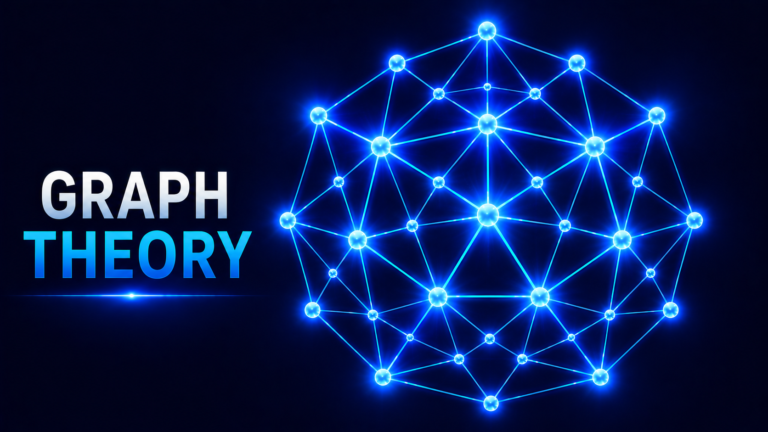
Graph Theory
Graph theory studies mathematical structures consisting of vertices connected by edges. Graphs are used to model communication networks, transportation systems, social media, computer networks, and many other interconnected systems. Important topics include trees, paths, cycles, connectivity, and graph traversal algorithms.
Number Theory
Number theory investigates the properties of integers and their relationships. Topics include divisibility, prime numbers, greatest common divisors, least common multiples, modular arithmetic, and congruence. Number theory plays a central role in cryptography and secure communications.
Boolean Algebra
Boolean algebra studies binary variables and logical operations such as AND, OR, and NOT. It provides the mathematical foundation for digital electronics, computer processors, logic gates, and programming.
Recurrence Relations
Recurrence relations describe sequences in which each term is defined using previous terms. They are widely used to analyze recursive algorithms, dynamic programming, and computational complexity.
Discrete Probability
Discrete probability studies the likelihood of outcomes within finite or countable sample spaces. Topics include events, conditional probability, random variables, probability distributions, and expected value. It is widely used in statistics, machine learning, and decision-making.
Algorithms
Algorithms are well-defined step-by-step procedures for solving computational problems. Discrete mathematics provides the mathematical tools to design, analyze, and optimize algorithms for searching, sorting, graph traversal, and many other computational tasks.
Automata Theory
Automata theory studies abstract computational machines and the mathematical principles of computation. It includes finite automata, pushdown automata, and Turing machines, forming the theoretical foundation of compiler design and formal computation.
Formal Languages
Formal language theory studies alphabets, strings, grammars, and language structures used in programming languages, compilers, and computational linguistics. It defines how symbols are organized according to formal grammatical rules.
Coding Theory
Coding theory focuses on techniques for detecting and correcting errors during data transmission and storage. It ensures reliable communication across computer networks, wireless systems, and digital storage devices.
Cryptography
Cryptography applies mathematical principles to secure information and communications. It includes encryption algorithms, digital signatures, hash functions, key exchange mechanisms, and authentication techniques that protect data confidentiality, integrity, and authenticity.
Discrete Optimization
Discrete optimization focuses on finding optimal solutions within finite or countable solution spaces. Applications include scheduling, routing, resource allocation, network optimization, and operational planning.
Applications of Discrete Mathematics
Discrete mathematics has applications across numerous scientific, engineering, and technological disciplines.
- Computer Science: Algorithms, data structures, programming languages, compiler design, and computational theory.
- Software Engineering: Program design, testing, verification, and software optimization.
- Artificial Intelligence: Search algorithms, knowledge representation, decision trees, machine learning, and reasoning systems.
- Cybersecurity: Cryptography, authentication, access control, digital signatures, secure protocols, and blockchain technologies.
- Data Science: Data modeling, graph analytics, probabilistic reasoning, and optimization.
- Computer Networks: Network topology, routing algorithms, communication protocols, and graph-based network analysis.
- Database Systems: Data relationships, relational models, indexing, and query optimization.
- Digital Electronics: Logic gates, digital circuits, Boolean algebra, and processor design.
- Telecommunications: Error detection, error correction, coding theory, and network optimization.
- Robotics: Motion planning, graph search, pathfinding, and decision-making algorithms.
- Finance: Risk analysis, portfolio optimization, cryptographic transactions, and algorithmic trading.
- Operations Research: Scheduling, logistics, transportation planning, supply chain optimization, and resource management.
Conclusion
Discrete Mathematics is a fundamental branch of mathematics that studies countable structures, logical reasoning, and finite mathematical systems. It provides the theoretical foundation for computer science and numerous modern technologies by enabling the representation, analysis, and solution of problems involving discrete data and computational processes.
Through its diverse fields including logic, set theory, combinatorics, graph theory, number theory, Boolean algebra, algorithms, cryptography, and optimization—discrete mathematics supports a wide range of applications across computing, engineering, cybersecurity, telecommunications, artificial intelligence, and data science. As digital technologies continue to advance, discrete mathematics remains an essential discipline for understanding and solving the complex challenges of the modern world.