Wave Speed
Introduction
Wave speed is a fundamental concept in mathematics, physics, engineering, and science. It describes the speed at which a wave propagates through a medium or space. Every type of wave, whether mechanical or electromagnetic, travels at a characteristic speed that depends on the properties of the wave and the medium through which it propagates.
Wave speed provides the foundation for understanding wave behaviour and the relationship between frequency and wavelength. It is widely used in the study of sound waves, electromagnetic waves, radio communication, wireless communication, telecommunications, optics, radar systems, satellite communication, and many other scientific and engineering disciplines.
What Is Wave Speed?
Wave speed is the rate at which a wave travels from one location to another. It represents how quickly a wave propagates through a medium or, in the case of electromagnetic waves, through free space (vacuum).
Wave speed does not describe the movement of individual particles within a medium. Instead, it describes the movement of the wave itself as it transfers energy from one point to another.
Wave speed is represented by the symbol v and is typically measured in metres per second (m/s).
Why Wave Speed Is Important
Wave speed is a fundamental property of every wave because it determines how quickly energy and information are transmitted from one location to another.
Understanding wave speed helps explain:
- How sound travels through different materials.
- How light travels through space.
- How radio waves enable wireless communication.
- How signals propagate through optical fibres and communication networks.
- How radar, satellite communication, and navigation systems operate.
- The relationship between frequency and wavelength.
How Wave Speed Works
A wave transfers energy by propagating through a medium or space. As the wave moves forward, the disturbance travels while the medium itself generally does not move with the wave.
The speed of a wave depends on the properties of the medium through which it propagates. For mechanical waves, factors such as elasticity, density, and temperature influence the wave speed. Electromagnetic waves, however, can travel through a vacuum without requiring a physical medium.
Although frequency and wavelength may change under different conditions, they always maintain a mathematical relationship with wave speed.
Wave Speed Formula
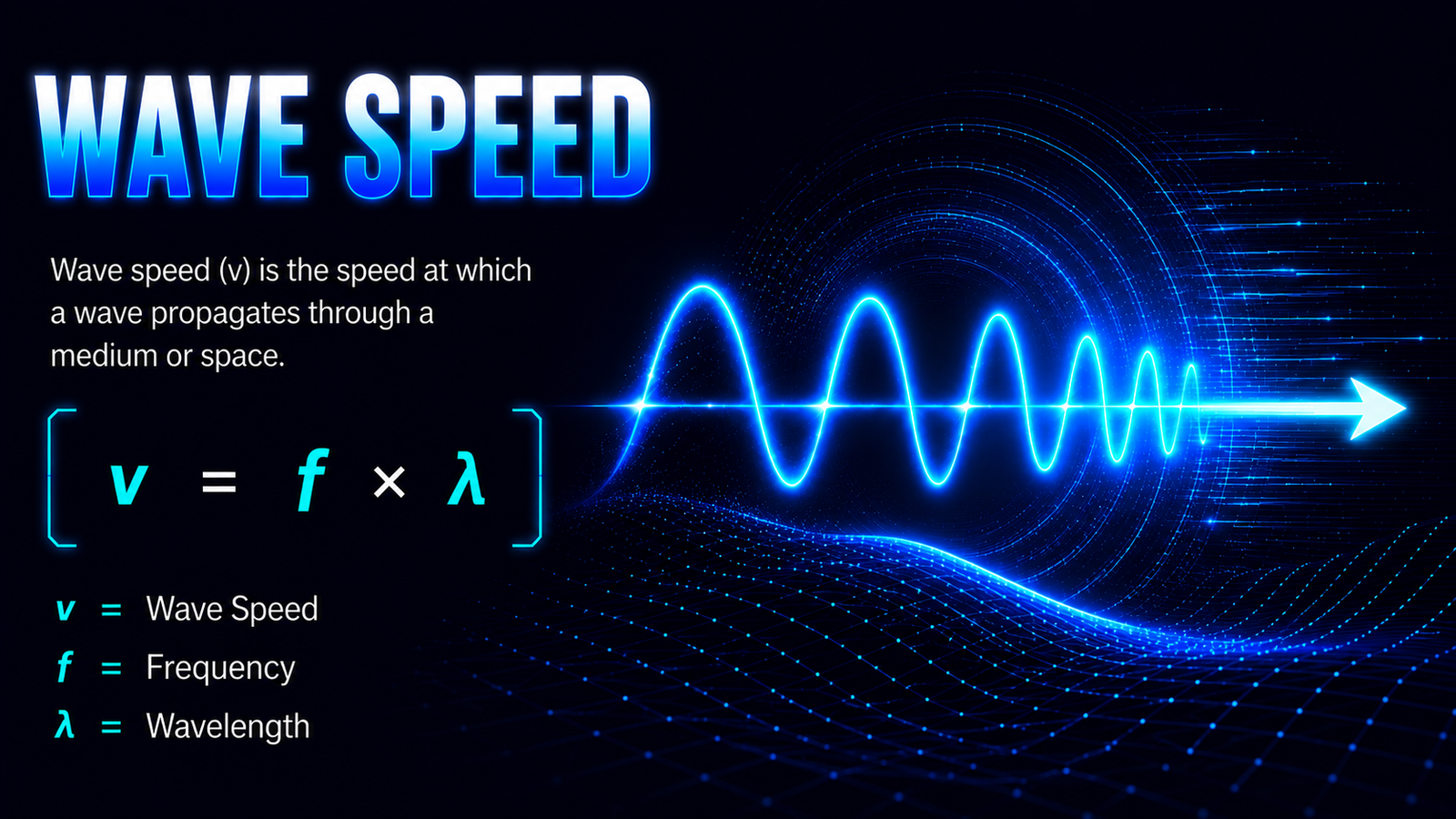
Wave speed is calculated by multiplying the frequency of a wave by its wavelength.
Wave Speed Formula:
Wave Speed = Frequency × Wavelength
Or, using symbols:
v = f × λ
Where:
- v = Wave Speed
- f = Frequency
- λ (Lambda) = Wavelength
This formula shows that wave speed depends on both the frequency and wavelength of a wave. When any two of these values are known, the third can be calculated.
Units of Wave Speed
The SI unit of wave speed is metres per second (m/s).
Depending on the application, wave speed may also be expressed using other units, including:
- Kilometres per second (km/s)
- Kilometres per hour (km/h)
- Feet per second (ft/s)
- Miles per hour (mph)
In scientific and engineering disciplines, metres per second (m/s) is the standard unit.
Relationship Between Wave Speed, Frequency, and Wavelength
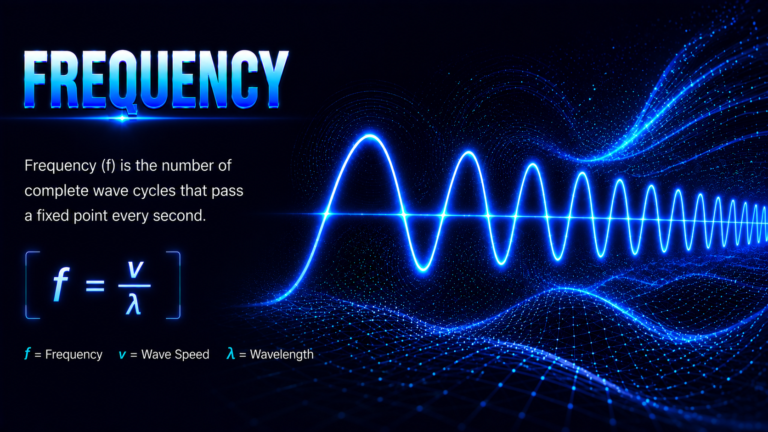
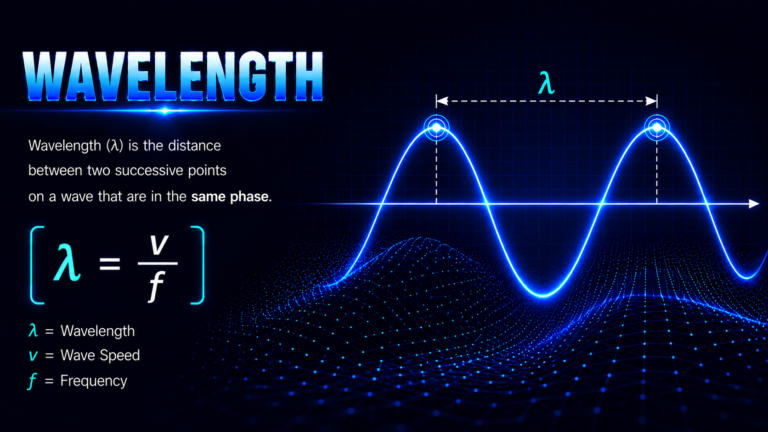
Wave speed, frequency, and wavelength are the three fundamental properties that describe how a wave propagates. They are mathematically related, meaning that a change in one affects the others.
The relationship between these properties is expressed by the following equation:
Wave Speed = Frequency × Wavelength
Where:
- v = Wave Speed
- f = Frequency
- λ (Lambda) = Wavelength
This equation shows that wave speed is determined by both the frequency and wavelength of a wave.
When the wave speed remains constant in a given medium, frequency and wavelength are inversely proportional. This means:
- As frequency increases, wavelength decreases.
- As frequency decreases, wavelength increases.
For example, if two radio waves travel through the same medium at the same speed, the wave with the shorter wavelength will have a higher frequency, whereas the wave with the longer wavelength will have a lower frequency.
Understanding the relationship between wave speed, frequency, and wavelength provides the foundation for studying wave theory, sound waves, electromagnetic waves, radio communication, wireless communication, telecommunications, radar systems, satellite communication, signal processing, and many other scientific and engineering disciplines.
Factors Affecting Wave Speed
Several factors influence the speed at which a wave propagates.
Medium
Different materials allow waves to travel at different speeds. For example, sound travels faster in solids than in liquids and gases.
Elasticity
For mechanical waves, materials with greater elasticity generally allow waves to propagate more quickly.
Density
The density of a medium influences wave speed. Depending on the type of wave, higher or lower density may increase or decrease the propagation speed.
Temperature
Temperature affects the speed of many waves, particularly sound waves. As temperature increases, sound generally travels faster through gases.
Type of Wave
Mechanical waves require a physical medium, while electromagnetic waves can travel through both materials and the vacuum of space.
Applications of Wave Speed
Wave Speed in Sound Waves
Wave speed determines how quickly sound travels through air, water, and solid materials.
Wave Speed in Electromagnetic Waves
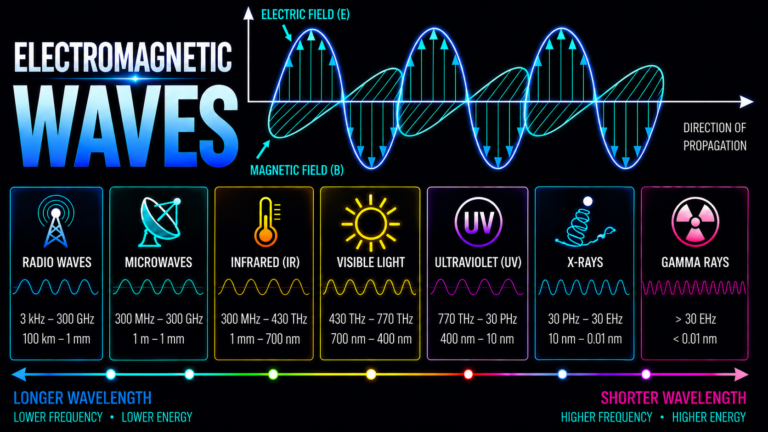
Electromagnetic waves propagate at the speed of light in a vacuum and at lower speeds in different materials.
Wave Speed in Radio Communication
Radio communication relies on the propagation speed of radio waves to transmit voice, data, and multimedia over long distances.
Wave Speed in Wireless Communication
Wireless technologies such as Wi-Fi, Bluetooth, cellular networks, and satellite communication depend on the propagation of electromagnetic waves.
Wave Speed in Optics
Wave speed is fundamental to the behaviour of light, lenses, optical fibres, lasers, and imaging systems.
Wave Speed in Telecommunications
Communication networks depend on wave propagation to transport information across cables, optical fibres, and wireless channels.
Wave Speed in Radar and Satellite Systems
Radar, navigation, satellite communication, and remote sensing systems calculate distance, position, and timing using the known propagation speed of electromagnetic waves.
Conclusion
Wave speed is a fundamental property of every wave and describes how rapidly a wave propagates through a medium or space. Together with frequency and wavelength, it forms the foundation of wave theory and is essential for understanding sound waves, electromagnetic waves, radio communication, wireless communication, telecommunications, optics, radar systems, satellite communication, and many other scientific and technological disciplines.