Crystal Oscillator
Introduction
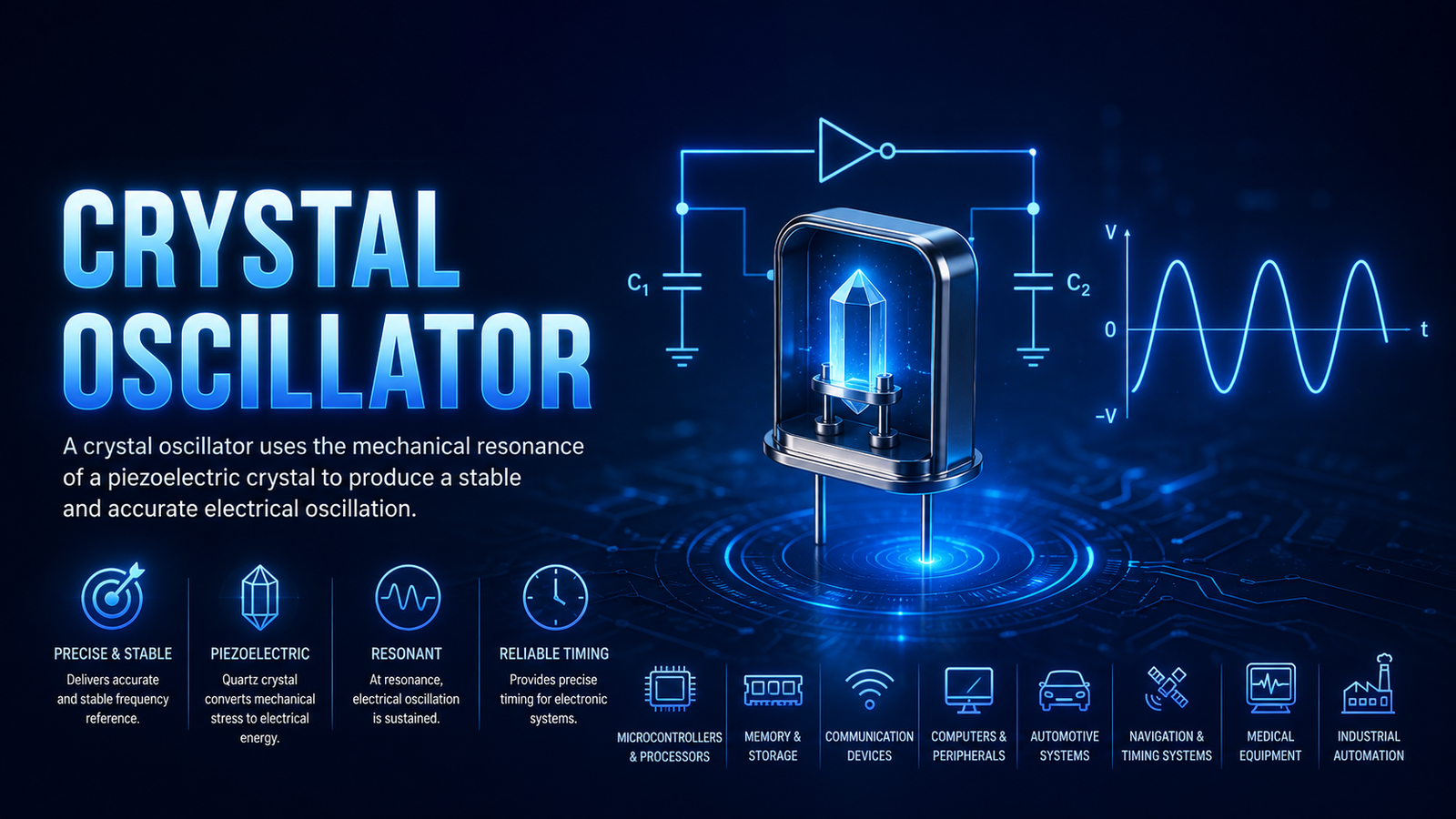
A crystal oscillator is an electronic oscillator that uses the mechanical resonance of a piezoelectric crystal to produce a periodic electrical signal with a stable and predictable frequency. Quartz is the most commonly used crystal because of its suitable mechanical properties, frequency stability, and ability to exhibit piezoelectricity.
Crystal oscillators are widely used as frequency references in electronic and digital systems where accurate timing is required. They are used in computers, communication equipment, measurement instruments, embedded systems, navigation systems, and other electronic devices.
Piezoelectric Crystal
A piezoelectric crystal is a material that exhibits a relationship between mechanical deformation and electrical charge. When an appropriate electrical signal is applied to a piezoelectric crystal, it can undergo mechanical vibration.
Quartz, a crystalline form of silicon dioxide (SiO₂), is an important piezoelectric material used in crystal oscillators. Its physical properties allow it to vibrate at characteristic resonant frequencies.
The mechanical resonance of the crystal is the fundamental property that allows a crystal oscillator to establish a stable frequency.
Crystal Resonance
A crystal has one or more characteristic resonant frequencies determined by its physical dimensions, shape, material properties, and mounting conditions. Near its resonant frequency, the crystal exhibits a strong interaction between its electrical and mechanical behavior.
When incorporated into an oscillator circuit, this resonance can be used to control the frequency of electrical oscillation. The circuit reinforces oscillation around the crystal’s characteristic frequency while limiting operation away from the desired resonant condition.
The resulting frequency is considerably more predictable than that of many oscillator circuits that rely only on conventional resistive and capacitive components.
Crystal Oscillator Circuit
A crystal oscillator generally consists of a piezoelectric crystal combined with an active electronic circuit and supporting components. The active circuit provides amplification and feedback, while the crystal determines the principal resonant frequency.
A commonly used crystal oscillator configuration includes:
- Piezoelectric crystal
- Amplifying or switching element
- Feedback network
- Capacitors and other supporting components
- Power supply
The crystal and surrounding circuit are designed so that the feedback conditions support sustained oscillation at or near the crystal’s resonant frequency.
How a Crystal Oscillator Works
An oscillator circuit applies an electrical signal to the crystal through its feedback network. The electrical excitation causes the crystal to vibrate mechanically. At a suitable resonant frequency, the electrical and mechanical characteristics of the crystal support the feedback required for sustained oscillation.
The oscillator circuit converts this behavior into a periodic electrical output. Because the crystal’s resonant characteristics strongly influence the oscillation frequency, the output can maintain a relatively stable frequency over time.
The resulting signal can then be used as a timing or frequency reference for other electronic circuits.
Frequency Stability
One of the principal characteristics of a crystal oscillator is its frequency stability. The resonant frequency of a quartz crystal is determined by physical properties that are relatively well controlled compared with many conventional electronic timing components.
Frequency stability can nevertheless be affected by factors such as:
- Temperature
- Aging of the crystal
- Mechanical stress
- Load conditions
- Manufacturing variations
- Changes in the surrounding oscillator circuit
Different crystal oscillator designs use different techniques to reduce the effects of these factors when greater frequency stability is required.
Crystal Oscillator Frequency
The operating frequency of a crystal oscillator depends on the physical characteristics of the crystal and its associated circuit. Crystal manufacturers specify operating frequencies and electrical characteristics for particular crystal designs.
Common oscillator frequencies range from relatively low frequencies used for timing references to much higher frequencies used in communication and electronic systems.
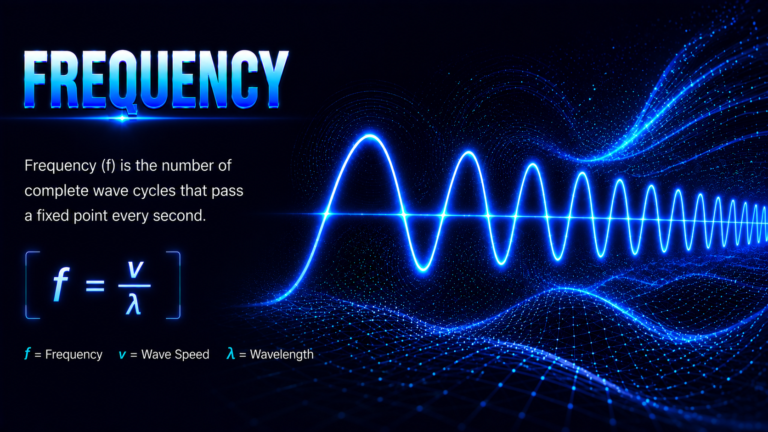
The frequency is expressed in hertz (Hz), where one hertz represents one cycle per second.
Types of Crystal Oscillators
Crystal oscillators can be designed in different forms depending on the required frequency stability, temperature characteristics, and application.
Temperature-Compensated Crystal Oscillator
A temperature-compensated crystal oscillator (TCXO) uses temperature-related compensation techniques to reduce frequency changes caused by variations in temperature.
Oven-Controlled Crystal Oscillator
An oven-controlled crystal oscillator (OCXO) maintains the crystal and associated circuitry at a controlled temperature to achieve a high level of frequency stability.
Voltage-Controlled Crystal Oscillator
A voltage-controlled crystal oscillator (VCXO) allows its output frequency to be adjusted within a specified range by varying a control voltage.
Simple Crystal Oscillator
A basic crystal oscillator provides a stable frequency reference using a crystal and an oscillator circuit without the additional compensation or temperature-control mechanisms used in specialized designs.
Crystal Oscillator and Clock Generation
Crystal oscillators are commonly used as reference-frequency sources for clock generators. The oscillator provides a stable reference signal that can be processed by clock-generation circuits to produce one or more clock frequencies.
A clock generator may use frequency multiplication, frequency division, or a phase-locked loop (PLL) to derive the frequencies required by different parts of a digital system.
In computer systems, a crystal oscillator can therefore provide the fundamental timing reference from which other clock signals are derived.
Applications
Crystal oscillators are used wherever a relatively stable and predictable frequency reference is required. Common applications include:
- Computer and processor timing
- Microcontrollers and embedded systems
- Communication equipment
- Digital clocks and timing devices
- Navigation systems
- Measurement and test equipment
- Wireless and radio systems
- Automotive electronic systems
- Industrial control equipment
Conclusion
A crystal oscillator uses the mechanical resonance of a piezoelectric crystal, commonly quartz, to establish a stable electrical oscillation frequency. Its predictable resonant characteristics make it an important frequency-reference component in electronic and digital systems, where it can provide the timing basis for clock generation, communication, measurement, and other frequency-dependent functions.
References
NIST – Quartz Crystal Oscillators with Low Acceleration Sensitivity
Provides technical information on quartz crystal oscillators and their frequency sensitivity.
IEEE – Quartz Crystals
Explains quartz crystals as piezoelectric resonators and their use for timing and frequency reference applications.