Frequency
Introduction
Frequency is the measure of how often a repeating event, cycle, or oscillation occurs within a given period of time. It is a fundamental property of periodic phenomena and is widely used to describe waves, vibrations, oscillations, alternating electrical currents, rotating systems, and electromagnetic radiation.
Frequency is used across numerous fields, including mathematics, physics, electronics, communication engineering, telecommunications, computer networking, signal processing, healthcare, astronomy, and cybersecurity. Understanding frequency provides the foundation for learning many advanced concepts, such as sound waves, electromagnetic waves, radio waves, wireless communication, digital communications, radar systems, satellite communication, and signal analysis.
What Is Frequency?
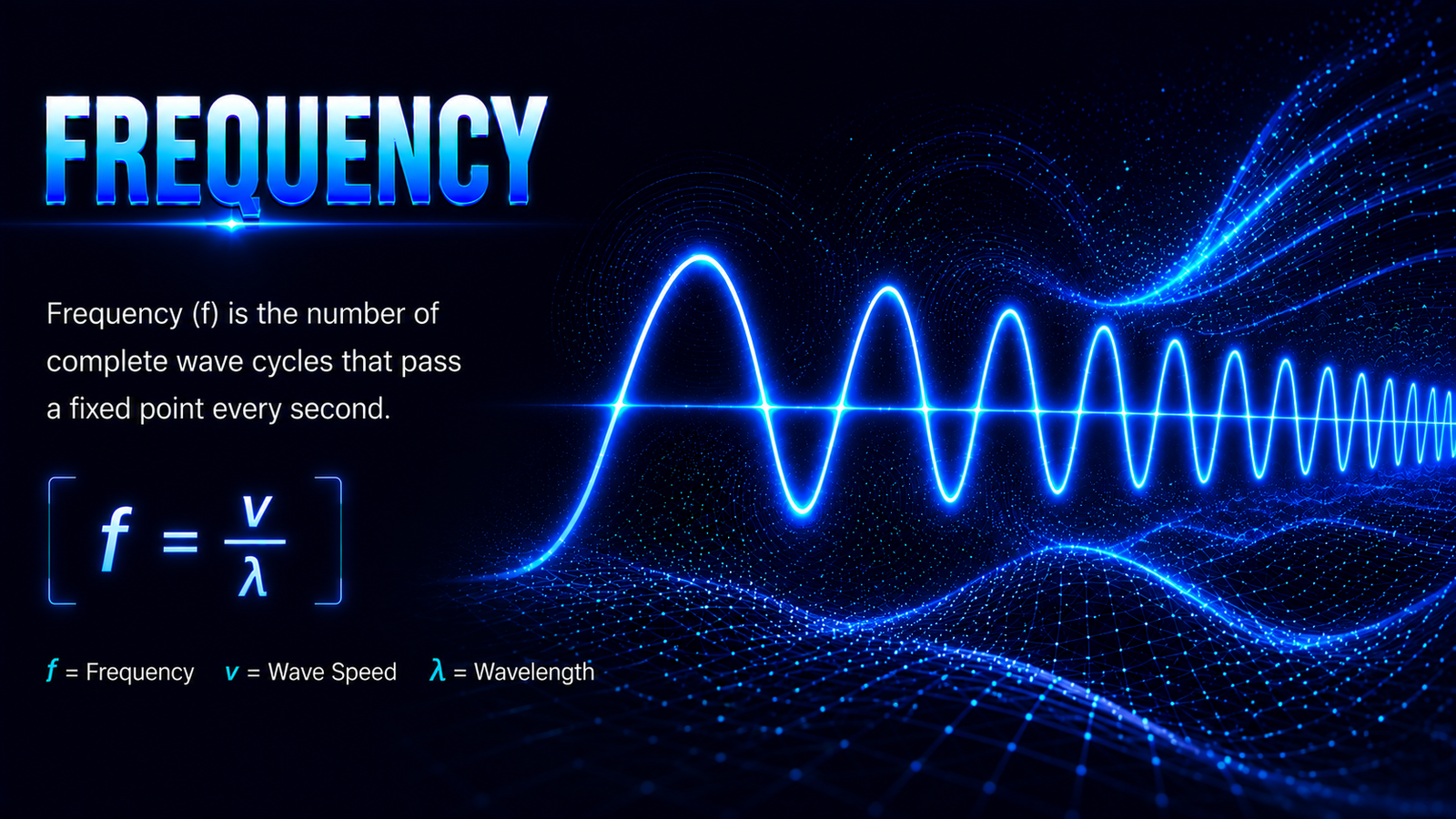
Frequency is the number of complete cycles, oscillations, or repetitions of a periodic event that occur in one second. It indicates how frequently an event repeats over time and is represented by the symbol f.
The International System of Units (SI) measures frequency in Hertz (Hz), named after German physicist Heinrich Rudolf Hertz, whose experiments confirmed the existence of electromagnetic waves.
One Hertz represents:
1 Hz = One complete Cycle per Second
Larger frequency values are commonly expressed using SI prefixes.
| Unit | Symbol | Equivalent |
|---|---|---|
| Hertz | Hz | 1 cycle per second |
| Kilohertz | kHz | 1,000 Hz |
| Megahertz | MHz | 1,000,000 Hz |
| Gigahertz | GHz | 1,000,000,000 Hz |
| Terahertz | THz | 1,000,000,000,000 Hz |
Frequency applies to any phenomenon that repeats at regular intervals, regardless of whether it is a mechanical vibration, sound wave, electromagnetic wave, electrical signal, or rotating object.
Why Frequency Is Important?
Frequency is a fundamental measurement used to describe repeating phenomena and plays a central role in understanding how natural and engineered systems behave. It determines how rapidly waves oscillate, electrical signals alternate, machines rotate, and many other periodic processes occur.
The concept of frequency is essential in numerous scientific and engineering disciplines because it influences the behavior, performance, and characteristics of physical systems. In communication systems, frequency determines how signals are transmitted and received. In electronics, it defines the operation of alternating current (AC) circuits and digital clocks. In physics, it helps describe waves and electromagnetic radiation. In computing and telecommunications, frequency is used to measure processor clock speeds, wireless transmissions, and communication channels.
Understanding frequency provides the foundation for studying topics such as:
- Waves and oscillations
- Sound waves
- Electromagnetic waves
- Radio waves
- Electronics
- Communication systems
- Wireless networking
- Signal processing
- Computing
- Telecommunications
How Frequency Works
A cycle is one complete repetition of a periodic event. Whenever an object vibrates, rotates, oscillates, or produces a repeating wave, it continuously completes cycles. Frequency measures how many of these complete cycles occur every second.
For example:
- A pendulum that completes one full swing every second has a frequency of 1 Hz.
- A loudspeaker vibrating 1,000 times every second produces a sound with a frequency of 1 kHz.
- A radio wave oscillating 100 million times every second has a frequency of 100 MHz.
The greater the number of cycles completed each second, the higher the frequency.
Wave Cycles
A wave cycle is one complete repetition of a wave pattern. It begins at a reference point, passes through one crest and one trough, and returns to the starting position. Frequency measures how many complete wave cycles pass a fixed point every second.
Oscillations
An oscillation is the repeated movement of an object or system about its equilibrium position. Oscillations occur in pendulums, springs, vibrating strings, electrical circuits, and electromagnetic waves. Each complete oscillation represents one cycle.
Period and Frequency
The period (T) is the time required to complete one full cycle, while frequency (f) is the number of cycles completed in one second.
These two quantities are inversely related:
- A shorter period results in a higher frequency.
- A longer period results in a lower frequency.
Understanding the relationship between period and frequency is fundamental to the study of waves, oscillations, electronics, communication systems, and signal processing.
Frequency Formula
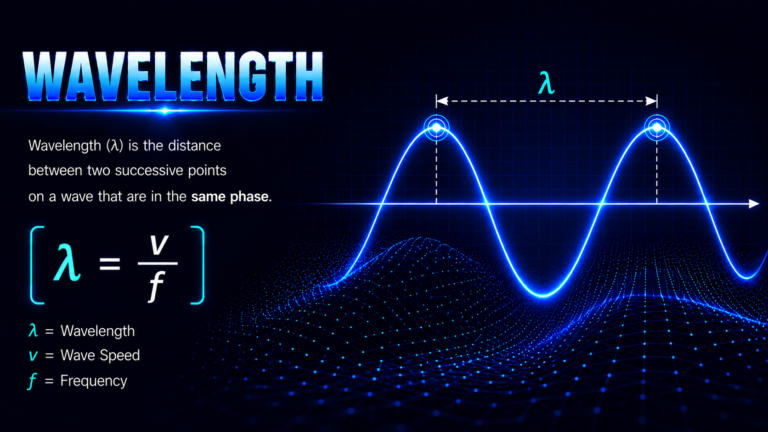
The frequency of a wave can be calculated using its wave speed and wavelength. The formula is derived from the fundamental relationship between wave speed, frequency, and wavelength.
Frequency Formula:
f = v / λ
Where:
- f = Frequency
- v = Wave Speed
- λ (Lambda) = Wavelength
This formula shows that the frequency of a wave is determined by dividing the wave speed by its wavelength. For a wave travelling at a constant speed, shorter wavelengths produce higher frequencies, while longer wavelengths produce lower frequencies.
Relationship Between Frequency, Wavelength, and Wave Speed
Frequency, wavelength, and wave speed are the three fundamental properties that describe how a wave behaves as it travels through a medium or space. These properties are mathematically related, meaning that a change in one affects the others.
- Frequency (f) is the number of complete wave cycles that pass a fixed point every second.
- Wavelength (λ) is the physical distance occupied by one complete wave cycle.
- Wave Speed (v) is the speed at which a wave propagates through a medium or space.
The relationship between these properties is expressed by the following equation:
Wave Speed = Frequency × Wavelength
Where:
- v = Wave Speed
- f = Frequency
- λ (Lambda) = Wavelength
From this fundamental wave equation, the frequency formula can be derived:
Frequency = Wave Speed / Wavelength
Or, using symbols:
f = v / λ
This derived equation is used to calculate the frequency of a wave when its wave speed and wavelength are known.
When the wave speed remains constant in a given medium, frequency and wavelength are inversely proportional. This means:
- As frequency increases, wavelength decreases.
- As frequency decreases, wavelength increases.
For example, if two radio waves travel at the same speed, the wave with the shorter wavelength will have a higher frequency, whereas the wave with the longer wavelength will have a lower frequency.
Understanding the relationship between frequency, wavelength, and wave speed provides the foundation for studying wave theory, sound waves, electromagnetic waves, radio communication, wireless communication, telecommunications, radar systems, satellite communication, signal processing, and many other scientific and engineering disciplines.
Frequency in Science and Technology
Frequency is a universal concept used to describe periodic phenomena across science, engineering, and technology. It plays an essential role in understanding how waves propagate, how electronic systems operate, how information is transmitted, and how natural processes occur. Different fields use frequency in different ways, but the underlying principle remains the same—the measurement of how often a repeating event occurs in one second.
Frequency in Sound
Sound is produced by vibrating objects that create pressure waves in a medium such as air, water, or solids. The frequency of a sound wave determines its pitch. Low-frequency sound waves produce deeper tones, while high-frequency sound waves produce higher-pitched sounds. The typical range of human hearing extends from approximately 20 Hz to 20 kHz.
Frequency in Electromagnetic Waves
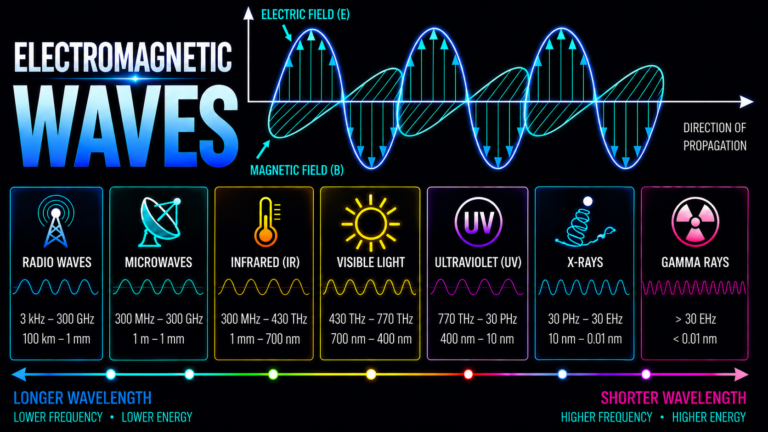
All electromagnetic waves are classified according to their frequency. The electromagnetic spectrum ranges from low-frequency radio waves to high-frequency gamma rays. The frequency of an electromagnetic wave determines many of its physical properties, including its wavelength, energy, and practical applications.
Frequency in Radio Communication
Radio communication uses electromagnetic waves of different frequencies to transmit information wirelessly over short and long distances. Specific frequency bands are allocated for services such as AM and FM broadcasting, television broadcasting, aviation, maritime communication, satellite communication, radar, navigation systems, and mobile communication.
Frequency in Electronics
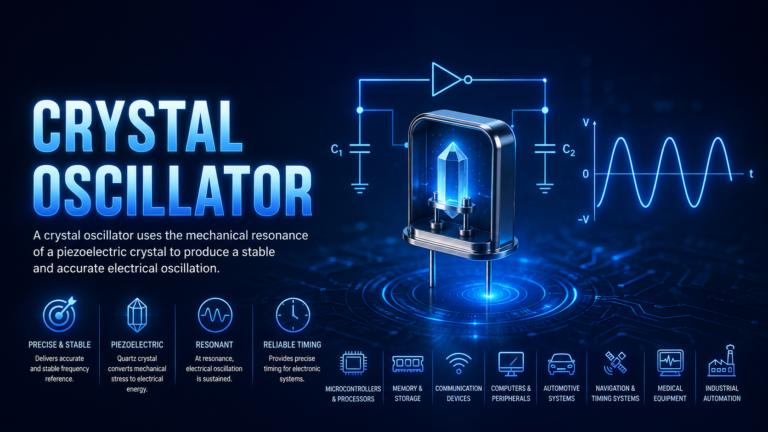
Electronic circuits rely on frequency to perform many functions. Alternating current (AC) power systems operate at fixed frequencies, while oscillators generate stable frequencies used in clocks, signal generators, filters, and digital electronic circuits. Frequency is also an important parameter in testing and designing electronic systems.
Frequency in Computing
Modern computers rely on clock signals that operate at specific frequencies to synchronize processor operations. Processor clock speed is commonly measured in megahertz (MHz) or gigahertz (GHz) and indicates the number of clock cycles generated every second. Frequency also plays an important role in memory systems, digital communication buses, and data synchronization.
Frequency in Communication Networks
Communication networks use different frequencies to carry voice, video, and data across wired and wireless communication systems. Wi-Fi, Bluetooth, cellular networks, satellite communication, microwave links, and many other communication technologies operate within assigned frequency bands to minimize interference and maximize communication efficiency.
Frequency in Nature
Frequency is observed throughout nature wherever periodic events occur. Examples include vibrating strings, ocean waves, earthquakes, biological rhythms, planetary motion, rotating objects, and many other natural phenomena. Scientists and engineers use frequency to study, analyze, and predict the behavior of these repeating systems.
Conclusion
Frequency is one of the fundamental measurements used to describe repeating phenomena throughout science, engineering, and technology. It explains how often cycles, oscillations, or waves occur and provides a common framework for understanding periodic events in both natural and engineered systems.
From sound waves and electromagnetic radiation to electronics, computing, telecommunications, and wireless communication, frequency is an essential concept that underpins countless technologies used in everyday life. A solid understanding of frequency provides the foundation for learning more advanced topics such as wavelength, electromagnetic waves, radio waves, wireless communication, signal processing, networking, and modern communication systems.