Wavelength
Introduction
Wavelength is the physical distance between two corresponding points of consecutive wave cycles. It is one of the fundamental properties of waves and is used to describe sound waves, water waves, electromagnetic waves, seismic waves, and many other wave phenomena.
Wavelength is widely used in mathematics, physics, electronics, communication engineering, telecommunications, computer networking, signal processing, optics, astronomy, healthcare, and cybersecurity. Understanding wavelength provides the foundation for learning advanced concepts such as electromagnetic waves, radio waves, wireless communication, optical communication, radar systems, satellite communication, and signal analysis.
What Is Wavelength?
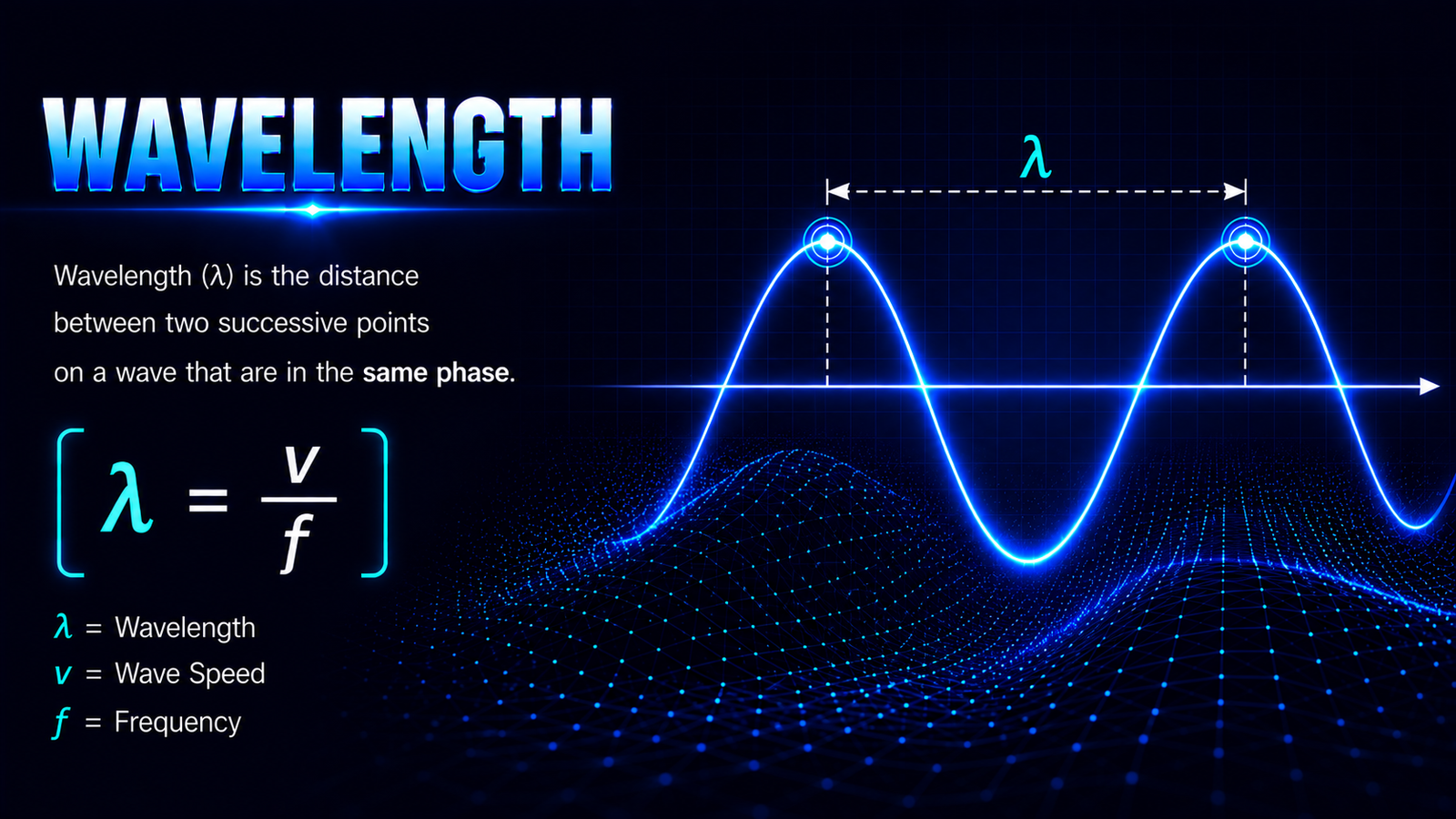
Wavelength is the distance between two identical points on successive wave cycles, such as two consecutive crests or two consecutive troughs. It represents the length of one complete wave cycle and is commonly represented by the Greek letter λ (lambda).
The International System of Units (SI) measures wavelength in metres (m). Depending on the size of the wave, wavelength may also be expressed in kilometres (km), centimetres (cm), millimetres (mm), micrometres (µm), or nanometres (nm).
Wavelength applies to every type of wave, including mechanical waves, sound waves, electromagnetic waves, water waves, and seismic waves.
Why Wavelength Is Important
Wavelength is a fundamental measurement used to describe the size of a wave and plays a significant role in understanding how waves behave, propagate, and interact with objects and the surrounding environment.
The wavelength of a wave influences its characteristics, including propagation distance, penetration capability, diffraction, reflection, and interaction with matter. Different wavelengths are suitable for different applications. For example, long-wavelength radio waves can travel over great distances, while shorter wavelengths are commonly used for high-speed wireless communication and optical technologies.
Understanding wavelength provides the foundation for studying topics such as:
- Waves and oscillations
- Sound waves
- Electromagnetic waves
- Radio waves
- Optics
- Wireless communication
- Radar systems
- Satellite communication
- Signal processing
- Telecommunications
How Wavelength Works
A wave cycle consists of one complete oscillation of a wave. The wavelength represents the physical distance occupied by that complete cycle.
As a wave propagates through a medium or space, identical points on successive cycles remain separated by one wavelength. This distance remains constant for a wave travelling in a uniform medium.
For example:
- The distance from one crest to the next crest is one wavelength.
- The distance from one trough to the next trough is also one wavelength.
Long wavelengths produce waves that are spread farther apart, while short wavelengths produce waves that are more closely spaced.
Wave Cycle
A wave cycle is one complete repetition of a wave pattern. Each cycle begins at a reference point, passes through a crest and a trough, and returns to the same position. The wavelength is the length occupied by one complete cycle.
Wave Crest
A crest is the highest point of a wave above its equilibrium or resting position. Measuring the distance between two consecutive crests gives one wavelength.
Wave Trough
A trough is the lowest point of a wave below its equilibrium position. Measuring the distance between two consecutive troughs also gives one wavelength.
Measuring Wavelength
Wavelength is measured by determining the distance between two corresponding points on consecutive wave cycles, such as:
- Crest to crest
- Trough to trough
- Any identical point on adjacent cycles
The measurement is taken in the direction in which the wave travels.
Wavelength Formula
The wavelength of a wave can be calculated using its wave speed and frequency. The formula is derived from the fundamental relationship between wave speed, frequency, and wavelength.
Wavelength Formula:
λ = v/f
Where:
- λ (lambda) = Wavelength
- v = Wave speed
- f = Frequency
This formula shows that wavelength is determined by dividing the wave speed by its frequency. For a wave travelling at a constant speed, increasing the frequency decreases the wavelength, while decreasing the frequency increases the wavelength.
Units of Wavelength
The SI unit of wavelength is the metre (m). Depending on the application, smaller or larger units are commonly used.
| Unit | Symbol | Equivalent |
|---|---|---|
| Kilometre | km | 1,000 m |
| Metre | m | Base SI unit |
| Centimetre | cm | 0.01 m |
| Millimetre | mm | 0.001 m |
| Micrometre | µm | 0.000001 m |
| Nanometre | nm | 0.000000001 m |
Relationship Between Wavelength, Frequency, and Wave Speed
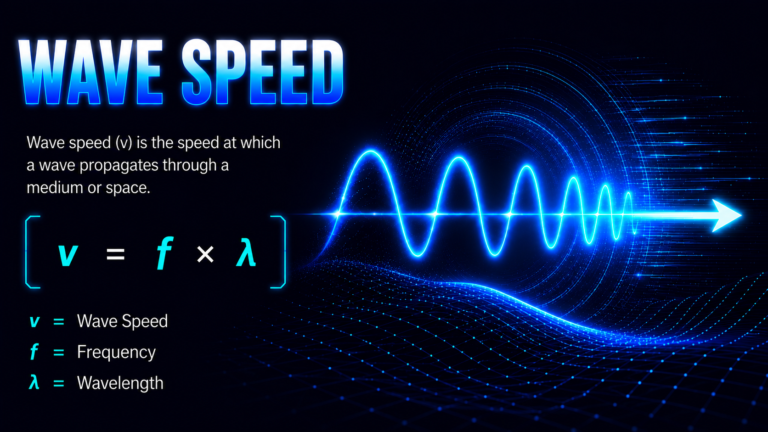
Wavelength, frequency, and wave speed are three fundamental properties of every wave. They are closely related and together describe how a wave propagates through a medium or space.
- Wavelength (λ) is the physical distance occupied by one complete wave cycle.
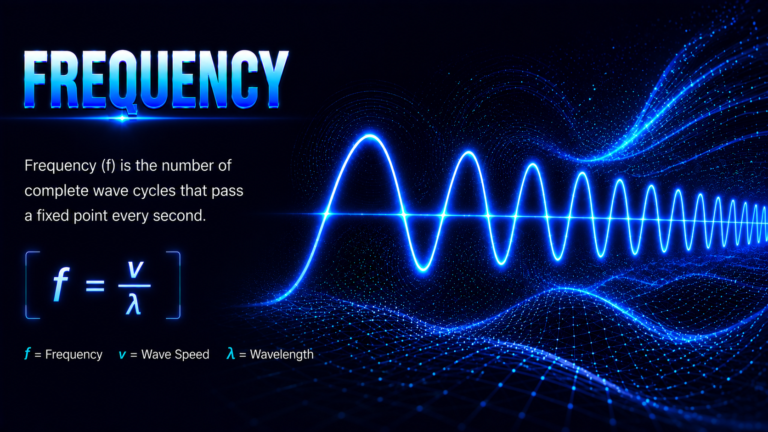
- Frequency (f) is the number of complete wave cycles that pass a fixed point in one second.
- Wave Speed (v) is the speed at which the wave travels through a medium or space.
The relationship between these three properties is expressed by the following equation:
Wave Speed = Frequency × Wavelength
Where:
- v = Wave speed
- f = Frequency
- λ (lambda) = Wavelength
From this relationship, the formulas for calculating each quantity can be derived:
- Wavelength (λ) = Wave Speed ÷ Frequency
- Frequency (f) = Wave Speed ÷ Wavelength
- Wave Speed (v) = Frequency × Wavelength
When the wave speed remains constant in a given medium, wavelength and frequency are inversely proportional. This means:
- As wavelength increases, frequency decreases because fewer wave cycles pass a fixed point each second.
- As wavelength decreases, frequency increases because more wave cycles pass the same point each second.
For example, long-wavelength radio waves have lower frequencies, while short-wavelength radio waves have higher frequencies.
Understanding the relationship between wavelength, frequency, and wave speed provides the foundation for studying wave theory, sound waves, electromagnetic waves, radio communication, wireless networking, telecommunications, optics, radar systems, satellite communication, and many other scientific and engineering disciplines.
Factors Affecting Wavelength
Several factors influence the wavelength of a wave, including:
- Wave frequency
- Wave speed
- Medium through which the wave travels
- Physical properties of the medium
Changes in any of these factors can alter the wavelength while the wave continues to propagate.
Applications of Wavelength
Wavelength in Sound Waves
The wavelength of a sound wave affects how sound propagates through air and other media. Low-frequency sounds have longer wavelengths, while high-frequency sounds have shorter wavelengths.
Wavelength in Electromagnetic Waves
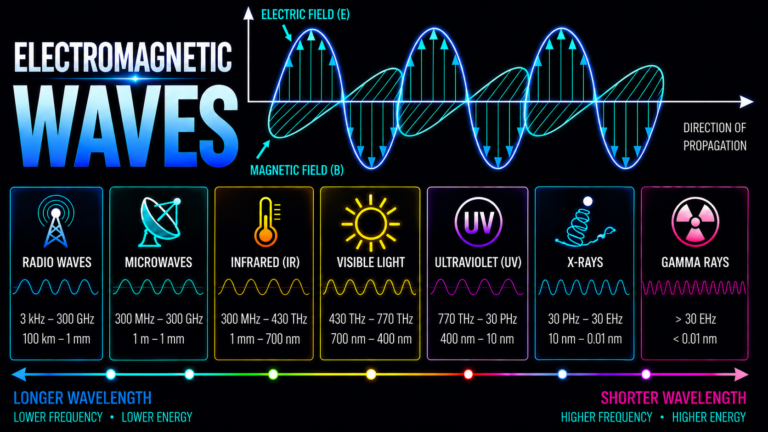
Electromagnetic waves are classified according to their wavelengths, ranging from long-wavelength radio waves to extremely short-wavelength gamma rays.
Wavelength in Radio Communication
Radio communication uses different wavelengths for different services. Long wavelengths are commonly used for long-distance communication, while shorter wavelengths support higher-frequency communication systems.
Wavelength in Optics
Visible light consists of different wavelengths, with each wavelength corresponding to a different perceived colour. Optical systems such as microscopes, telescopes, cameras, and fibre-optic communication rely on the properties of wavelength.
Wavelength in Electronics
Electronic systems generate and process signals with different wavelengths and frequencies, depending on the application.
Wavelength in Communication Systems
Wireless communication technologies, satellite systems, radar, broadcasting, and navigation systems are designed to operate at specific wavelength ranges that best suit their intended applications.
Wavelength in Nature
Wavelength is observed throughout nature in ocean waves, seismic waves, sound waves, and electromagnetic radiation emitted by natural and astronomical sources.
Conclusion
Wavelength is one of the fundamental properties used to describe waves and represents the physical length of one complete wave cycle. It is closely related to frequency and wave speed and plays an essential role in understanding how waves propagate and interact with their surroundings.
A clear understanding of wavelength provides the foundation for studying wave theory, electromagnetics, optics, electronics, telecommunications, networking, wireless communication, and many other scientific and engineering disciplines. As a fundamental property of all waves, wavelength remains an essential concept in mathematics, physics, and engineering.