Data vs Information vs Intelligence
Introduction
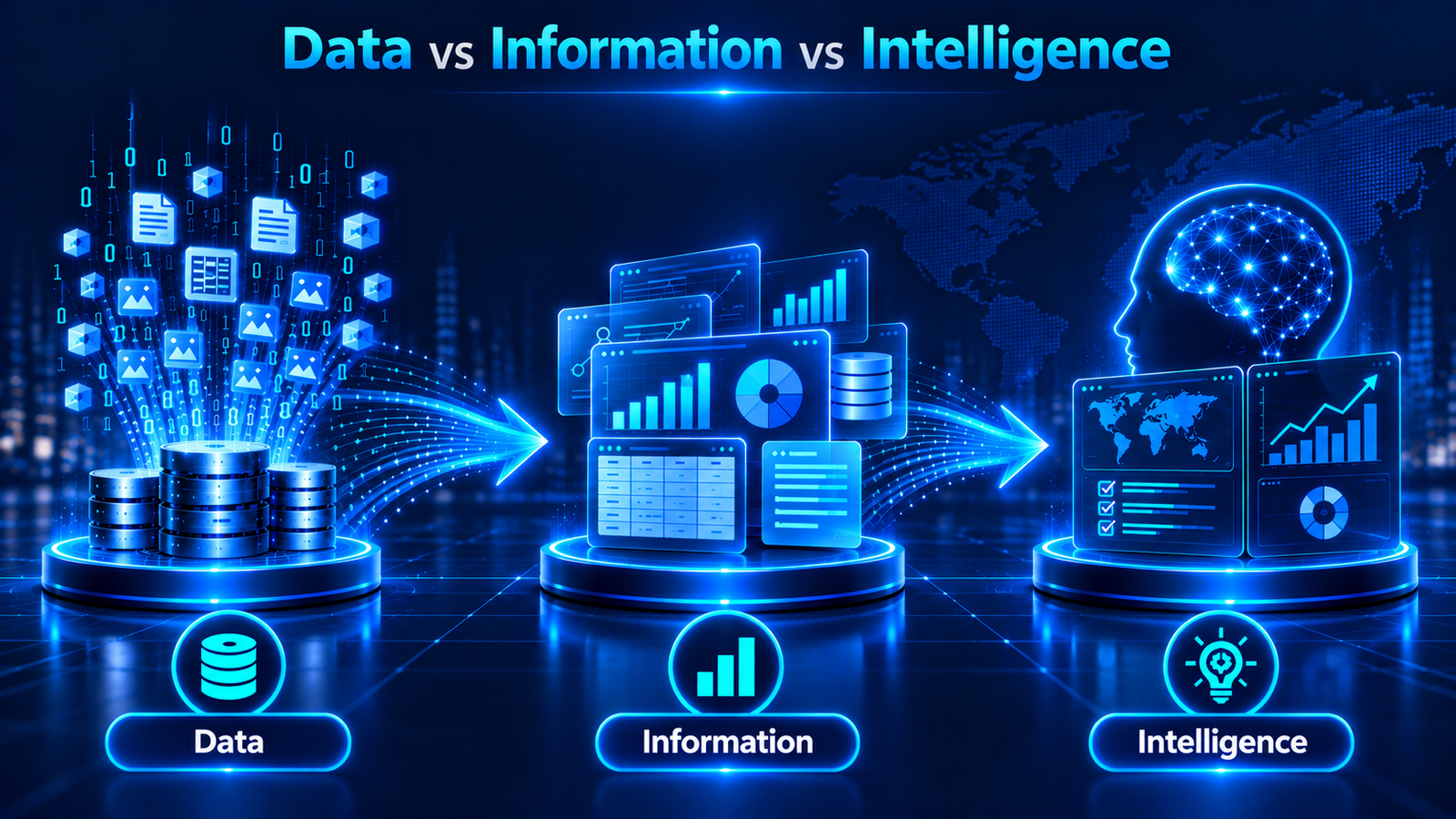
In the digital world, data, information, and intelligence play an important role in how knowledge is created, understood, and used. Although closely connected, they are not interchangeable and represent different levels of meaning and analytical value in the process of turning observations into understanding and informed decisions.
Data represents raw facts, observations, measurements, or recorded events. It is the basic material collected from various sources and may have limited meaning on its own because it does not necessarily contain sufficient context or interpretation.
Information is data that has been organized, processed, combined, and placed into context so that it becomes meaningful and understandable. It provides greater clarity by showing relationships, patterns, characteristics, and circumstances associated with the underlying data.
Intelligence is information that has been analyzed, evaluated, and interpreted to provide insight into its significance. It is generally developed for a specific purpose or requirement and can help explain implications, assess possible outcomes, and support informed decisions or actions.
The progression from data to information to intelligence is therefore not simply about increasing the amount of processing. Each stage introduces a different level of meaning, context, analysis, interpretation, and purpose. Data provides the underlying observations, information provides structure and understanding, and intelligence provides evaluated insight that can support informed decision-making.
Understanding these distinctions provides a foundation for examining how data is transformed into information and how information can be further analyzed to develop meaningful intelligence.
Understanding Data
Definition of Data
Data is a collection of raw facts, observations, measurements, or recorded events. It may exist in the form of numbers, text, timestamps, identifiers, records, images, or other machine-readable or human-readable representations.
Data does not necessarily explain what happened, why it happened, or what should be done. It represents the basic material from which information can be developed.
Characteristics of Data
Data commonly has the following characteristics:
- Raw: It may not have been processed or interpreted.
- Specific: It records a particular value, event, or observation.
- Machine-generated or human-generated: Data may come from automated systems or people.
- Structured or unstructured: It may be stored in databases, documents, images, or other formats.
- Context-dependent: Its meaning may not be clear without additional information.
- High-volume: Large systems can generate substantial amounts of data.
The quality of data depends on its accuracy, completeness, consistency, timeliness, and reliability. Poor-quality data can lead to incorrect information and unreliable intelligence.
Understanding Information
Definition of Information
Information is data that has been processed, organized, combined, or interpreted so that it has meaning within a particular context.
Processing may involve sorting, filtering, classifying, combining, summarizing, or adding relevant details. Information helps answer basic questions such as:
- What happened?
- When did it happen?
- Where did it happen?
- Which person, object, or system was involved?
- How frequently did it occur?
- What pattern can be observed?
Information is more useful than isolated data because it provides context and relationships.
How Data Becomes Information
Data becomes information when it is placed into a meaningful structure. This may involve combining several data points, applying a time range, identifying the relevant subject, or comparing activity against a baseline.
The processing may include:
- Collecting related data points.
- Removing duplicates or irrelevant records.
- Organizing records by time, source, subject, or category.
- Identifying patterns or unusual activity.
- Adding context about the surrounding environment.
The result is information that can be reviewed and analyzed more effectively.
Characteristics of Information
Information generally has the following characteristics:
- Meaningful: It has context and relevance.
- Organized: Related data has been grouped or structured.
- Interpretable: A person or system can understand what it represents.
- Contextualized: It includes details that help explain the observation.
- Useful for analysis: It supports further investigation.
- More focused: It reduces the difficulty of interpreting raw data.
Information can still be incomplete or misleading. Processing data does not automatically make the result accurate. The methods used, the quality of the source data, and the context applied all affect the reliability of the information.
Understanding Intelligence
Definition of Intelligence
Intelligence is information that has been evaluated, analyzed, and interpreted to provide insight and support a decision or action.
Intelligence goes beyond describing what happened. It attempts to explain what the activity may mean, why it matters, what could happen next, and what response may be appropriate.
Intelligence is closely connected to purpose. Information becomes intelligence when it is analyzed against a specific requirement or decision-making need.
How Information Becomes Intelligence
Information becomes intelligence through analysis, evaluation, and interpretation. This process may involve:
- Identifying the question or requirement.
- Reviewing the reliability of the available information.
- Comparing information with known patterns and historical activity.
- Combining information from multiple sources.
- Assessing possible explanations.
- Estimating potential impact or likelihood.
- Developing conclusions and recommendations.
The conclusion is considered intelligence because it provides an assessment that can support an informed decision or action.
Characteristics of Intelligence
Intelligence generally has the following characteristics:
- Purpose-driven: It addresses a specific question or requirement.
- Analyzed: It includes interpretation and evaluation.
- Context-rich: It considers the wider environment.
- Action-oriented: It supports decisions or responses.
- Evidence-based: It should be supported by reliable information.
- Evaluated: Its confidence, limitations, and uncertainty should be considered.
- Audience-specific: It may be prepared differently for specialists, managers, executives, or operational teams.
Intelligence is not always certain. It may include confidence levels, assumptions, alternative explanations, and gaps in knowledge. Good intelligence communicates both what is known and what remains uncertain.
From Data to Information to Intelligence
Importance of Context
Context plays an important role in understanding the meaning and significance of data and information. An observation cannot always be interpreted correctly in isolation. Its meaning may depend on factors such as time, location, purpose, surrounding circumstances, and related observations.
Adding relevant context helps distinguish between isolated observations and meaningful patterns. It allows information to be understood within the circumstances in which it was collected and provides a stronger foundation for further analysis.
Correlation and Interpretation
Correlation involves identifying relationships between related data points or pieces of information. Relationships may be identified based on factors such as:
- Time
- Location
- Identifier
- Category
- Sequence
- Relationship
- Frequency
- Source
- Status
- Historical pattern
Correlation can reveal relationships that may not be visible when observations are considered individually. However, correlation does not by itself establish a conclusion. The identified relationships must be interpreted within the appropriate context and considered alongside other available information.
Human and Analytical Judgment
Analysis can be supported by automated systems that collect, filter, organize, and correlate large volumes of data. However, meaningful interpretation may also require human judgment, experience, contextual understanding, and evaluation of uncertainty.
Analytical judgment becomes particularly important when:
- Evidence is incomplete.
- Several explanations are possible.
- An observation is unusual but not clearly significant.
- Context affects the interpretation.
- Available information contains contradictions.
- A decision could have significant consequences.
Good analysis should distinguish between observations, interpretations, assumptions, and conclusions. This helps ensure that conclusions are based on available evidence rather than unsupported assumptions.
Quality and Reliability
The quality and reliability of data and information influence the quality of the intelligence developed from them. Information derived from inaccurate, incomplete, inconsistent, or outdated data may lead to unreliable conclusions.
Important considerations include:
- Accuracy
- Completeness
- Timeliness
- Source reliability
- Confidence level
- Relevance
- Consistency
- Corroboration
- Potential bias
- Known limitations
Reliable intelligence therefore depends not only on the information available but also on the quality of the context, analysis, interpretation, and evidence used to develop it.
Relationship Between Data, Information, and Intelligence
| Aspect | Data | Information | Intelligence |
|---|---|---|---|
| Meaning | Raw facts or observations | Processed and contextualized data | Analyzed information that supports decisions |
| Perspective | What was recorded? | What does the recorded activity show? | What does it mean and what should be done? |
| Processing | Collection and recording | Organization, filtering, and correlation | Analysis, evaluation, and interpretation |
| Context | Usually limited | Added through processing | Considered in depth |
| Purpose | Record events or values | Understand events and patterns | Support decisions and action |
Data, information, and intelligence are connected, but they are not interchangeable.
Data provides the raw observations. Information organizes those observations and gives them meaning. Intelligence evaluates the information and explains its possible significance in relation to a specific requirement.
Not every data point becomes intelligence. Some data may remain useful for recordkeeping, reporting, troubleshooting, or historical analysis. Similarly, information may be sufficient for routine decisions without requiring a formal intelligence product.
Conclusion
Data, information, and intelligence represent different levels of meaning and analytical value. Data records observations, information organizes and contextualizes those observations, and intelligence evaluates their significance to support decisions.
Understanding these distinctions helps organizations and individuals manage information more effectively, improve analytical processes, communicate findings clearly, and make decisions based on evidence, context, and informed judgment.
References
Online Sources
IBM – What Is Data?
A general explanation of data, its forms, sources, and how data processing and analysis create useful insights.
IBM – What Is Data Intelligence?
An overview of how data is organized, managed, analyzed, and transformed into insights that support decision-making.
NIST – Data
Definitions of data as a representation of facts, concepts, or information suitable for communication, interpretation, or processing.
NIST – Information
Definitions of information as facts, ideas, or knowledge represented in a form that can be communicated, interpreted, or processed.
NIST – Intelligence
Definitions describing intelligence as information that has been collected, processed, evaluated, analyzed, and interpreted to provide insight.