What is Clock Rate
Introduction
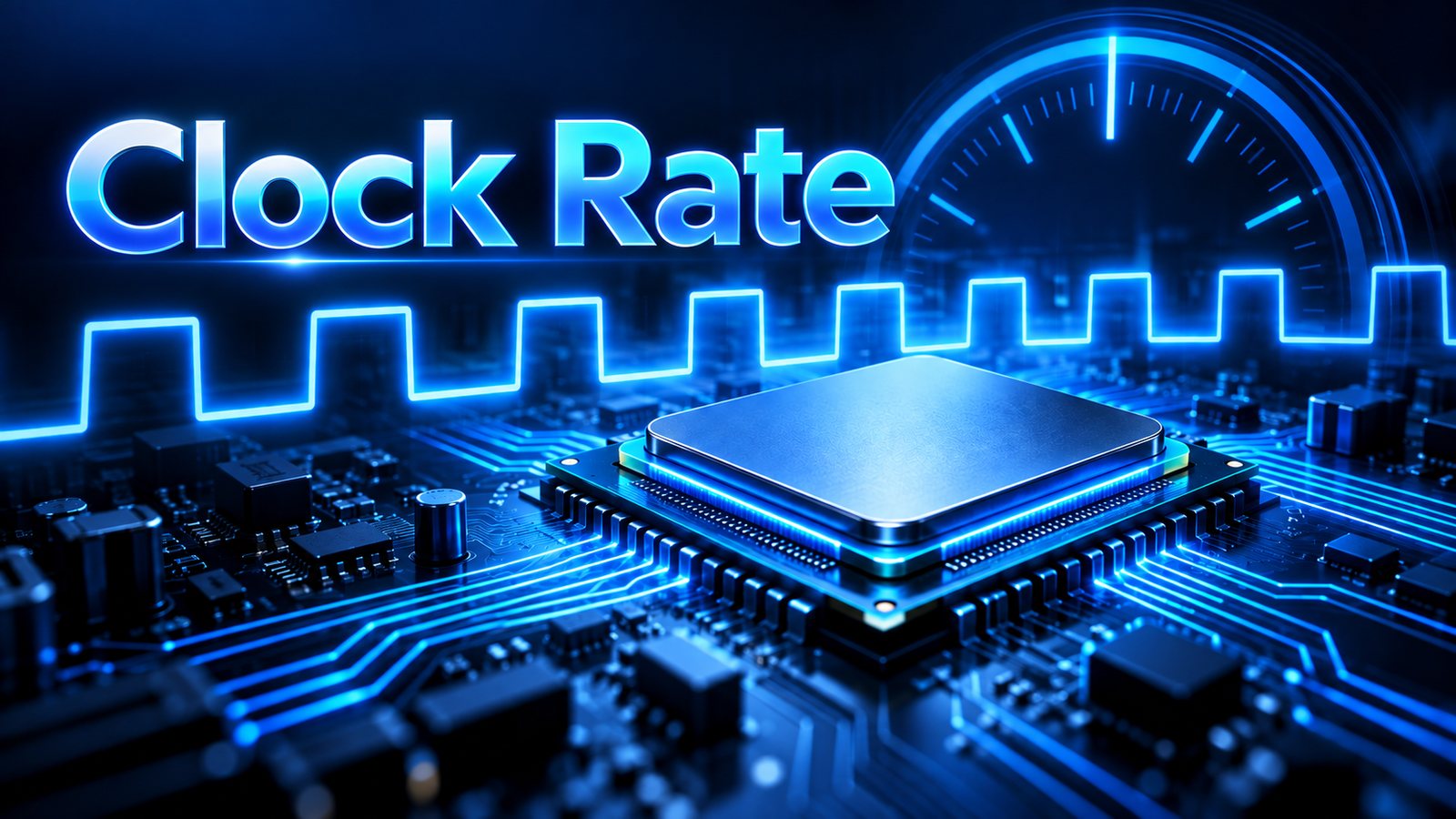
Clock rate is a fundamental concept in computing and digital electronics. It describes the frequency at which a processor or other synchronous digital circuit receives its clock signal and is commonly expressed in hertz (Hz), megahertz (MHz), or gigahertz (GHz).
In processors, clock rate provides a timing reference that coordinates the execution of operations within the processor. A higher clock rate means that more clock cycles occur within a given period, but it does not by itself determine how much useful work a processor can perform.
Understanding clock rate requires distinguishing it from related concepts such as clock frequency, clock cycle, clock cycle time, clock generator, and processor performance.
Understanding Clock Cycles
A clock cycle is one complete period of a periodic clock signal.
Digital processors use clock signals as timing references. During each clock cycle, different parts of the processor can perform or advance through specific stages of their operations.
The duration of one clock cycle depends on the clock rate. A higher clock rate corresponds to a shorter clock cycle.
For example, a processor with a clock rate of 1 GHz has a clock signal that completes one billion cycles per second, while a processor with a clock rate of 3 GHz has a clock signal that completes three billion cycles per second.
A clock cycle should not be interpreted as meaning that the processor completes one instruction during every cycle. Modern processors can execute instructions through multiple stages and may process multiple instructions simultaneously or complete some instructions in fewer or more cycles depending on the architecture and instruction.
Measuring Clock Rate
Clock rate is measured in hertz (Hz), which represents cycles per second.
Common units include:
- Hertz (Hz) — one cycle per second
- Kilohertz (kHz) — one thousand cycles per second
- Megahertz (MHz) — one million cycles per second
- Gigahertz (GHz) — one billion cycles per second
For example:
2 GHz = 2 billion cycles per second
3.5 GHz = 3.5 billion cycles per second
The terms clock rate and clock frequency are often used interchangeably because both describe the frequency of the clock signal.
Clock Rate and Clock Cycle Time
Clock rate and clock cycle time describe the same timing characteristic from two different perspectives.
Clock rate tells us how many cycles occur per second, while clock cycle time tells us how long one cycle takes.
Clock Cycle Time Formula:
T = 1 / f
Where:
- T = Clock Cycle Time
- f = Clock Rate
For a processor operating at 1 GHz:
T = 1 / (1 × 10⁹)
T = 1 nanosecond
For a processor operating at 3 GHz:
T = 1 / (3 × 10⁹)
T ≈ 0.333 nanoseconds
Therefore, as clock rate increases, the duration of each clock cycle decreases.
Role of Clock Rate in a Processor
A processor contains many synchronous digital circuits that operate according to a common timing reference. The clock signal provides this timing reference, allowing different parts of the processor to perform operations in a coordinated manner.
The clock rate determines how many clock cycles occur each second. These clock cycles provide the timing intervals used by the processor as it performs its operations.
The processor’s clock can be used to coordinate activities such as:
- Moving data between internal registers
- Advancing instruction-processing stages
- Updating processor state
- Coordinating arithmetic and logical operations
- Synchronizing different sections of the processor
A higher clock rate means that more clock cycles occur within the same amount of time. However, a clock cycle does not necessarily represent one completed instruction or one specific processor operation. The amount of work performed during each cycle depends on the processor’s architecture.
The clock signal is generated and managed by dedicated timing circuitry. A clock generator can generate and distribute clock signals at the required frequencies, while a crystal oscillator can provide a stable frequency reference for timing circuits. Crystal oscillators use the piezoelectric effect, in which a quartz crystal vibrates at a stable frequency when an electrical signal is applied.
Clock Rate and CPU Performance
Clock rate is an important processor specification, but it is not a complete measure of processor performance.
Two processors operating at the same clock rate can perform different amounts of work because their architectures may differ.
Processor performance can be influenced by factors such as:
- Instructions per cycle (IPC)
- Instruction set architecture
- Microarchitecture
- Number of processor cores
- Cache organization
- Memory performance
- Pipeline design
- Branch prediction
- Execution units
- Workload characteristics
For example, consider two processors operating at 3 GHz. If one processor can execute more useful instructions per clock cycle than the other, it may provide greater performance even though both operate at the same clock rate.
A simplified conceptual relationship can be expressed as:
Performance Relationship:
Performance ∝ Clock Rate × Instructions per Cycle
Where:
- Performance = Amount of useful work performed over a given period
- Clock Rate = Number of clock cycles per second
- Instructions per Cycle (IPC) = Average number of instructions completed or retired per clock cycle
This is a conceptual relationship rather than a complete performance equation because real processor performance depends on many additional architectural and workload-specific factors.
Clock Rate and Instructions Per Cycle
Instructions per cycle (IPC) describes how many instructions a processor can complete, on average, during each clock cycle under a particular workload.
For example, if two processors operate at 3 GHz but one achieves a higher IPC for a given workload, the two processors can deliver different levels of performance.
This is why comparing processors solely by their advertised clock rates can be misleading.
Base Clock and Boost Clock
Many modern processors can operate at different clock rates depending on workload, temperature, power conditions, and processor design.
Two commonly specified frequencies are the base clock and boost clock.
Base Clock
The base clock is the nominal operating frequency associated with the processor’s defined baseline operating conditions.
It provides a reference point for the processor’s normal operating frequency.
Boost Clock
A processor may increase its operating frequency above the base clock when conditions allow it.
The maximum boost frequency depends on factors such as:
- Processor workload
- Temperature
- Power limits
- Current conditions
- Processor architecture
- Number of active cores
Therefore, a processor advertised with a particular maximum clock rate does not necessarily operate continuously at that frequency.
Factors That Affect Clock Rate
The clock rate of a processor is influenced by both processor design and operating conditions.
Processor Architecture
Different processor architectures are designed to operate at different frequencies and can perform different amounts of work per cycle.
A newer or different architecture may achieve greater performance without requiring a proportionally higher clock rate.
Power
Increasing clock frequency generally increases the switching activity within digital circuits and can increase power consumption.
Processor designs therefore balance frequency, performance, power consumption, and thermal limits.
Temperature
Processor temperature can affect the frequency at which the processor can operate.
When thermal conditions become restrictive, processor systems may reduce operating frequency to control temperature and power.
Manufacturing Characteristics
Semiconductor manufacturing involves physical variations between individual chips. Processor manufacturers account for these characteristics when determining operating frequencies, voltage ranges, and other specifications.
Clock Rate in Multicore Processors
A multicore processor contains multiple processing cores.
Clock rate and core count describe different characteristics.
For example, a processor might have:
8 cores × 3.5 GHz
This does not mean that the processor has a single 28 GHz clock.
Instead, it means the processor contains eight cores, each capable of operating around the specified frequency under the applicable conditions.
The actual performance of a multicore processor also depends on how effectively a workload can use multiple cores.
Some workloads can be divided across many cores, while others may depend heavily on the performance of one or a small number of cores.
Clock Rate, Frequency, and the Clock Generator
Clock rate is closely related to the concept of frequency because both describe the number of cycles occurring per unit of time.
A processor receives a clock signal that provides a timing reference. Clock-generation circuitry produces, conditions, distributes, or modifies timing signals as required by the system.
The underlying timing source can involve components such as crystal oscillators.
These subjects are related but distinct:
- Frequency describes the rate of repetition of a periodic event.
- Clock rate describes the frequency of a clock signal used for timing.
- Clock cycle is one period of that clock signal.
- Clock cycle time is the duration of one cycle.
- Clock generator refers to circuitry that generates and manages clock signals.
- Crystal oscillator is a type of oscillator that uses the mechanical resonance of a crystal to provide a stable frequency reference.
References
Online Sources
Intel – What Is CPU Clock Speed?
Explains CPU clock speed, clock cycles, frequency, base frequency, boost frequency, and the relationship between clock speed and processor performance.
Arm – CPU Architecture
Provides information on CPU architecture and microarchitecture, including their relationship to processor performance, pipelines, cache, and processor design.
Arm – What Is IPC and Why It Matters to Mobile
Explains Instructions per Cycle (IPC) and why processor performance cannot be assessed from clock frequency alone.
Books
Computer Architecture: A Quantitative Approach, 7th Edition
John L. Hennessy, David A. Patterson, and Christos Kozyrakis
Morgan Kaufmann, 2025
Computer Organization and Design: The Hardware/Software Interface, 6th Edition
David A. Patterson and John L. Hennessy
Morgan Kaufmann, 2020
Computer Organization and Architecture: Designing for Performance, 11th Edition
William Stallings
Pearson, 2019
Structured Computer Organization, 6th Edition
Andrew S. Tanenbaum and Todd Austin
Pearson, 2022
Computer System Architecture, 3rd Edition
M. Morris Mano and Rajib Mall
Pearson, 2017