Understanding Enterprise
Introduction
Enterprises are established to achieve common goals and strategic objectives by bringing together people, business functions, processes, information, technology, and governance into a coordinated system. They exist across every sector of society, including commercial businesses, government agencies, educational institutions, healthcare providers, financial institutions, non-profit organizations, and multinational corporations.
Regardless of their size, industry, or purpose, enterprises coordinate diverse capabilities to deliver products, services, and outcomes that create value for customers, stakeholders, and society. They operate as interconnected systems where every business function, process, and stakeholder contributes to achieving shared objectives. This enterprise-wide perspective emphasizes integration, coordination, and alignment across the entire organization.
The concept of an enterprise extends beyond individual departments, business units, or organizational boundaries by providing a holistic view of how all organizational components work together to achieve common objectives. This broader perspective forms the foundation for understanding how enterprises are structured, governed, and managed to achieve long-term success.
What is an Enterprise?
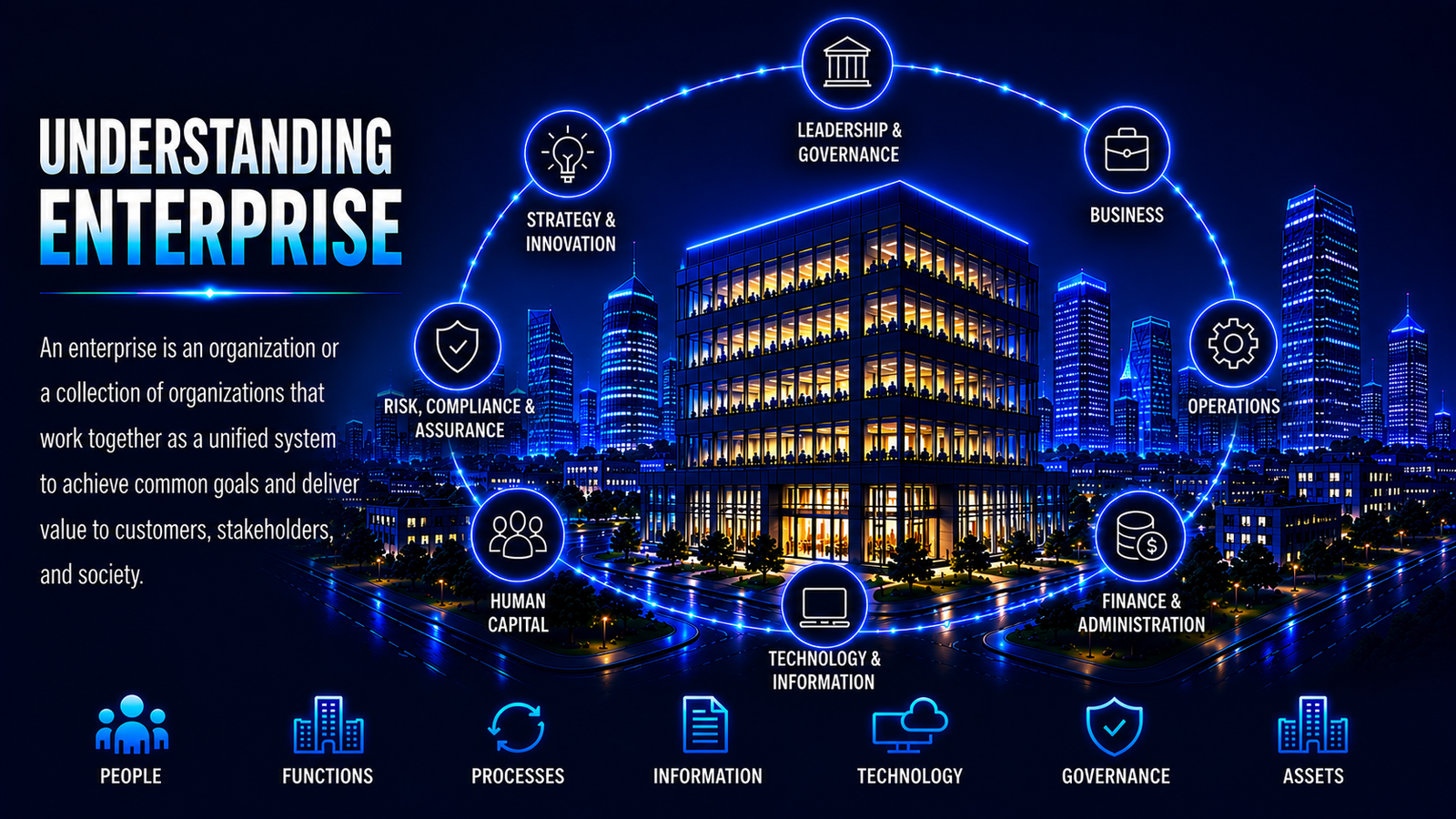
An enterprise is an organization or a collection of organizations that operate together to achieve common goals and strategic objectives. It represents a unified system that integrates people, business functions, processes, information, technology, governance, and organizational capabilities to create value and deliver products or services to customers, stakeholders, and society.
An enterprise encompasses the entire scope of an organization’s operations rather than focusing on individual departments or business units. It provides a holistic view of how all organizational components work together to support strategy, governance, decision-making, and operational execution. This integrated approach enables enterprises to coordinate activities, optimize operations, manage risks, and respond effectively to changing business and technological environments.
An enterprise may consist of a single organization or multiple organizations operating under common ownership, governance, or strategic direction. For example, a multinational corporation with subsidiaries in different countries, a government with multiple ministries and agencies, or a university system comprising several campuses can each be viewed as an enterprise because they function as integrated entities pursuing shared objectives.
The enterprise perspective is widely adopted across business management, enterprise architecture, governance, risk management, information technology, and cybersecurity because it promotes enterprise-wide coordination, alignment, and decision-making. Rather than viewing departments or business units in isolation, it considers the organization as a connected system where every component contributes to achieving the enterprise’s mission, vision, and strategic objectives.
Relationship Between Organization and Enterprise
The terms organization and enterprise are closely related and are often used interchangeably. However, they represent different perspectives. An organization refers to the entity itself, while an enterprise represents the broader view of how that entity operates as an integrated system. Understanding the relationship between these concepts provides the foundation for enterprise governance, enterprise architecture, enterprise risk management, enterprise security, and other enterprise disciplines.
Organization as the Foundation
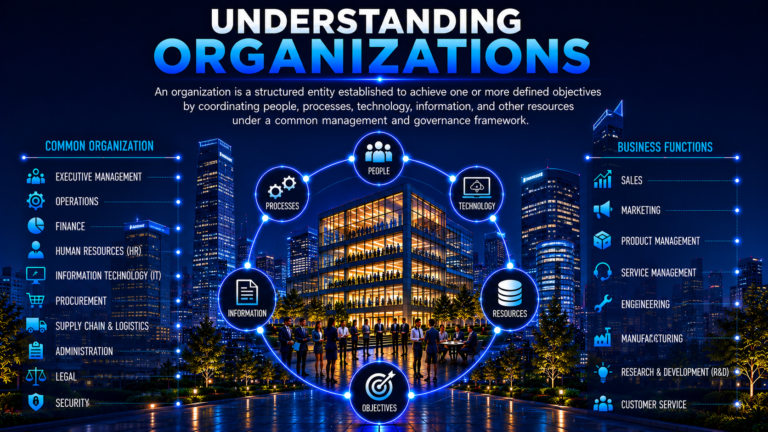
An organization serves as the foundation of an enterprise. It is a structured entity established to achieve specific goals and objectives by coordinating people, processes, information, technology, and governance. Every organization operates within a defined framework of governance, leadership, policies, roles, responsibilities, and organizational structures that enable it to function effectively and deliver value to its stakeholders.
Organizations provide the environment in which business activities are performed, decisions are made, and products or services are delivered. They establish the mission, vision, objectives, operating model, and governance framework that guide all organizational activities. Regardless of their size or purpose, organizations provide the structure upon which all enterprise activities are built.
As organizations grow in size, complexity, and operational scope, managing individual departments or business units independently becomes increasingly challenging. A broader perspective is required to coordinate all organizational components and align them with common strategic objectives. This broader perspective gives rise to the concept of an enterprise.
Enterprise as the Integrated View
An enterprise represents the integrated view of an organization. Instead of focusing on individual departments, business units, or functions, it considers the organization as a unified system in which people, business functions, processes, information, technology, and governance work together to achieve common strategic objectives.
This enterprise-wide perspective promotes coordination, collaboration, and alignment across the entire organization. It enables leadership to make decisions that consider the impact on the enterprise as a whole rather than on individual departments. By integrating business capabilities, enterprises improve operational efficiency, strengthen governance, optimize operations, and support the successful execution of strategic initiatives.
Organization and Enterprise in Perspective
Although the terms organization and enterprise are often used interchangeably, they represent different perspectives rather than different entities. An organization refers to the entity itself—its purpose, structure, governance, people, business functions, and operations. An enterprise represents the broader, integrated view of how that organization operates by aligning its people, business functions, processes, information, technology, and governance to achieve enterprise-wide goals and strategic objectives.
In simple terms, an organization describes what the entity is, whereas an enterprise describes how the entity operates as a unified whole. Together, these perspectives provide a more complete understanding of how organizations are managed, governed, and aligned to achieve their strategic objectives.
Characteristics of an Enterprise
Although enterprises vary in size, industry, ownership, and purpose, they share several common characteristics that distinguish them from smaller organizational units such as departments, teams, or business functions. These characteristics enable enterprises to operate as integrated systems capable of achieving long-term strategic objectives.
Strategic Purpose
Every enterprise is established with a defined mission, vision, and strategic objectives. These objectives provide direction for decision-making, resource allocation, and business operations while ensuring that all activities contribute to the enterprise’s long-term goals.
Integrated Operations
An enterprise operates as a unified system in which multiple business functions, processes, technologies, and capabilities work together. Rather than functioning independently, these components are coordinated to achieve enterprise-wide objectives and deliver value efficiently.
Governance and Leadership
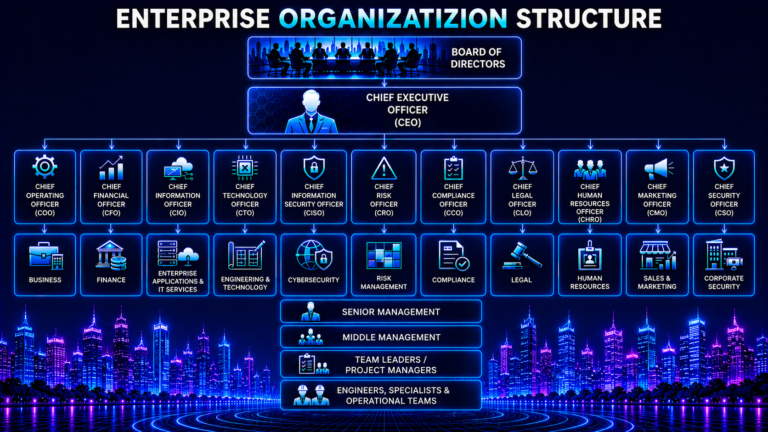
Every enterprise requires governance and leadership to establish direction, define policies, allocate responsibilities, oversee performance, and ensure accountability. Effective governance enables informed decision-making, strategic alignment, and responsible management of enterprise operations and assets.
Shared Resources
Enterprises rely on a wide range of shared resources, including people, information, technology, facilities, financial assets, intellectual property, and infrastructure. These resources are managed collectively to support business operations and achieve strategic objectives.
Stakeholder-Centric
Enterprises create value for multiple stakeholders, including customers, employees, shareholders, partners, suppliers, regulators, and society. Balancing stakeholder expectations is essential for maintaining trust, sustainability, and long-term success.
Dynamic and Adaptive
Enterprises operate in constantly changing business, economic, technological, legal, and regulatory environments. They must continuously adapt to new opportunities, emerging risks, market demands, technological advancements, and competitive pressures while maintaining operational resilience.
Interdependent Business Functions
Business functions within an enterprise are interconnected and dependent on one another. Functions such as finance, human resources, operations, marketing, information technology, procurement, and enterprise security collaborate to support enterprise objectives. Decisions made in one function often influence the performance and outcomes of others.
Continuous Improvement
Successful enterprises continuously evaluate and improve their strategies, processes, technologies, governance practices, and operational performance. Continuous improvement enables enterprises to increase efficiency, enhance quality, strengthen resilience, and remain competitive in evolving business environments.
Types of Enterprises
Enterprises can be broadly classified based on their ownership, purpose, and objectives. Although they operate across numerous industries and sectors, most enterprises fall into one of three primary categories: commercial enterprises, government enterprises, and non-profit enterprises.
Commercial Enterprises
Commercial enterprises are established primarily to generate profit by producing goods or delivering services to customers. They operate across virtually every sector of the economy and may range from small businesses to large multinational corporations. Depending on the industry in which they operate, commercial enterprises may include:
- Retail Enterprises
- Banking and Financial Services Enterprises
- Manufacturing Enterprises
- Energy and Utilities Enterprises
- Healthcare Enterprises
- Educational Enterprises
- Technology Enterprises
- Telecommunications Enterprises
- Transportation and Logistics Enterprises
- Hospitality and Tourism Enterprises
- Media and Entertainment Enterprises
- Real Estate Enterprises
- Agriculture Enterprises
- Pharmaceutical and Life Sciences Enterprises
- Professional Services Enterprises
- Construction and Infrastructure Enterprises
- Mining and Natural Resources Enterprises
- Automotive Enterprises
- Aerospace and Defense Enterprises
- Consumer Goods Enterprises
- E-commerce Enterprises
While these enterprises operate in different industries, they all aim to create value for customers, achieve sustainable growth, remain competitive, and generate profits for their owners or shareholders.
Government Enterprises
Government enterprises are owned, operated, or controlled by national, regional, state, or local governments to deliver public services and support economic and social development. Their primary objective is to serve the public interest rather than maximize profits. Government enterprises commonly operate in areas such as public administration, defense, public safety, healthcare, education, transportation, utilities, infrastructure, taxation, and regulatory services.
Non-Profit Enterprises
Non-profit enterprises are established to pursue social, charitable, educational, religious, cultural, environmental, scientific, or humanitarian objectives. Rather than distributing profits to owners or shareholders, any surplus generated is reinvested to support the enterprise’s mission and long-term sustainability. Examples include charities, foundations, non-governmental organizations (NGOs), professional associations, research institutions, community organizations, and international humanitarian organizations.
Enterprise Functions
Business functions are the major functional areas of an enterprise that perform specific activities required to achieve its objectives. Each business function is responsible for a distinct set of activities, processes, and responsibilities that contribute to the enterprise’s overall success. Working together, these functions enable the enterprise to create value, deliver products and services, support business operations, and achieve its strategic goals.
Although the structure, scope, and responsibilities of business functions vary depending on the enterprise’s size, industry, and business model, most enterprises perform many of the following business functions.
Business Function
A business function is a specialized area of responsibility within an enterprise that performs a specific set of related activities to support the achievement of business objectives. Each business function focuses on a particular aspect of the enterprise, such as strategy, operations, finance, human resources, information technology, sales, or customer service. While each function has defined responsibilities, all business functions work together as an integrated system to support the enterprise’s overall mission, strategy, and long-term success.
Executive Management
Provides strategic leadership, establishes the enterprise’s vision, mission, and objectives, makes executive decisions, allocates resources, and oversees overall enterprise performance.
Operations
Manages the day-to-day activities involved in producing products or delivering services while ensuring operational efficiency, quality, productivity, and customer satisfaction.
Finance and Accounting
Manages financial planning, budgeting, accounting, financial reporting, treasury, taxation, auditing, financial controls, and overall financial performance.
Human Resources (HR)
Manages workforce planning, recruitment, employee onboarding, training, performance management, compensation, benefits, employee relations, and organizational culture.
Sales and Marketing
Develops marketing strategies, promotes products and services, manages customer relationships, identifies market opportunities, and drives business growth and revenue generation.
Customer Service
Provides customer support, resolves service requests, manages customer interactions, handles complaints, and improves customer satisfaction and retention.
Information Technology (IT)
Designs, implements, and manages enterprise technology infrastructure, business applications, data centers, networks, cloud services, end-user computing, and IT operations.
Procurement and Supply Chain
Acquires goods and services, manages supplier relationships, oversees sourcing, inventory, warehousing, logistics, distribution, and supply chain operations to support business continuity.
Research and Development (R&D)
Develops new products, services, technologies, and innovations while improving existing capabilities to enhance competitiveness and support long-term growth.
Legal
Provides legal advice, manages contracts, intellectual property, litigation, regulatory matters, and ensures compliance with applicable laws, regulations, and contractual obligations.
Risk Management
Identifies, assesses, evaluates, treats, monitors, and reports enterprise risks that may affect strategic objectives, business operations, financial performance, or regulatory compliance.
Governance, Risk, and Compliance (GRC)
Establishes governance frameworks, develops enterprise policies, manages compliance obligations, coordinates risk management activities, and supports informed decision-making across the enterprise.
Quality Management
Establishes quality standards, monitors performance, drives continuous improvement, and ensures that products and services consistently meet customer expectations and regulatory requirements.
Facilities Management
Manages enterprise buildings, workplaces, utilities, physical infrastructure, maintenance, environmental controls, workplace safety, and supporting facilities.
Business Continuity and Disaster Recovery (BCDR)
Develops and maintains capabilities that enable the enterprise to prepare for, respond to, recover from, and continue operating during disruptive events while minimizing operational impact.
Corporate Communications
Manages internal and external communications, public relations, media engagement, corporate branding, stakeholder communications, and reputation management.
Enterprise Security
Protects the enterprise’s people, physical assets, facilities, information, technology, and business operations through an integrated approach that combines physical security, cybersecurity, governance, risk management, resilience, and protective controls.
Although each business function has distinct responsibilities, they operate as interconnected components of a single enterprise. Effective collaboration among business functions enables the enterprise to achieve its strategic objectives, improve operational efficiency, manage risks, ensure regulatory compliance, and deliver sustainable value to its stakeholders.
Enterprise Stakeholders
Enterprise stakeholders are individuals, groups, or organizations that have an interest in, influence over, or are affected by the enterprise and its activities. Stakeholders play an important role in the success of an enterprise by contributing expertise, investments, services, or support, making decisions, receiving value, or being impacted by business operations.
Understanding stakeholder expectations enables enterprises to make informed decisions, build trust, manage risks, maintain compliance, and achieve long-term strategic objectives.
Enterprise stakeholders are generally classified into two broad categories: internal stakeholders and external stakeholders.
Internal Stakeholders
Internal stakeholders are individuals and groups that are part of the enterprise and directly contribute to its operations and decision-making. They typically include:
- Owners or Shareholders
- Board of Directors
- Executive Management
- Business Leaders
- Managers and Supervisors
- Employees
- Business Units and Departments
Internal stakeholders establish enterprise objectives, manage enterprise operations, execute business processes, and support the day-to-day operation of the enterprise.
External Stakeholders
External stakeholders are individuals, groups, or organizations outside the enterprise that influence or are influenced by its activities. They typically include:
- Customers
- Suppliers and Vendors
- Business Partners
- Investors
- Government Agencies
- Regulatory Authorities
- Auditors
- Financial Institutions
- Industry Associations
- Local Communities
- Society
External stakeholders influence enterprise decisions through business relationships, legal and regulatory requirements, market expectations, investments, partnerships, and public confidence.
Effective stakeholder management helps enterprises build strong relationships, improve collaboration, support informed decision-making, manage expectations, reduce business risks, and create sustainable value for all parties involved.
Enterprise Operating Model
An enterprise operating model defines how an enterprise organizes and coordinates its people, business functions, processes, information, technology, and governance to execute its strategy and achieve its objectives. It provides a high-level framework that translates enterprise strategy into day-to-day business operations, ensuring that all parts of the enterprise work together as an integrated system.
The operating model begins with the enterprise’s strategic direction established through executive leadership and governance. Business objectives are translated into policies, plans, processes, and operational activities that are executed by various business functions. These functions collaborate continuously to deliver products and services, support customers, manage finances, develop people, maintain technology, manage risks, and ensure regulatory compliance.
Business processes connect multiple business functions by defining how work flows across the enterprise. Information and technology enable communication, automation, collaboration, and decision-making, while people and organizational capabilities enable business activities to be performed efficiently and effectively.
Throughout its operations, the enterprise continuously monitors performance, manages risks, complies with legal and regulatory obligations, adapts to changing business conditions, and pursues opportunities for improvement and innovation. Feedback from customers, employees, partners, regulators, and other stakeholders enables the enterprise to refine its strategies, optimize operations, and achieve sustainable growth.
An effective enterprise operating model ensures that governance, business functions, people, processes, information, and technology remain aligned with the enterprise’s strategic objectives. This integrated approach enables the enterprise to operate efficiently, respond to change, deliver value to stakeholders, and achieve sustainable long-term success.
Enterprise Governance
Enterprise governance is the system by which an enterprise is directed, controlled, and monitored to achieve its objectives while balancing the interests of its stakeholders. It establishes the framework for decision-making, accountability, oversight, and strategic direction, ensuring that the enterprise operates responsibly, ethically, and effectively.
Effective governance aligns the enterprise’s vision, mission, strategy, business objectives, and operational activities. It defines roles and responsibilities, establishes policies and standards, oversees performance, manages risks, ensures compliance with legal and regulatory requirements, and promotes transparency across the enterprise.
Governance involves multiple stakeholders, including the board of directors, executive management, business leaders, and governance committees, each of whom plays a role in guiding the enterprise and ensuring that decisions support its long-term success.
Enterprise governance also provides the foundation for specialized governance disciplines such as information technology governance, cybersecurity governance, data governance, artificial intelligence governance, and environmental, social, and governance (ESG) governance. Together, these governance domains help ensure that different aspects of the enterprise operate in alignment with its strategic objectives.
Conclusion
An enterprise is an integrated system that aligns people, business functions, processes, information, technology, and governance to achieve common objectives and deliver value to its stakeholders. Regardless of its size, industry, or ownership model, every enterprise depends on effective leadership, collaboration, governance, and coordinated business functions to operate efficiently and achieve its strategic objectives.
As enterprises continue to evolve in an increasingly interconnected and technology-driven world, they must adapt to changing business environments, embrace innovation, manage risks effectively, and respond to evolving stakeholder expectations. By integrating governance, business functions, people, processes, information, and technology into a unified operating model, enterprises can remain resilient, competitive, and sustainable while creating long-term value for customers, stakeholders, and society.