What Is Data Provenance?
Introduction
Organizations increasingly depend on data to analyze information, make decisions, operate systems, and develop artificial intelligence. From traditional analytics and machine learning to Generative AI and intelligent applications, the quality of the underlying data has a direct influence on the reliability of the results produced.
As data moves between applications, databases, analytics platforms, cloud environments, and AI systems, it may be collected from different sources, transformed, combined with other datasets, processed through multiple systems, and used for different purposes.
This creates an important requirement: organizations need to understand where their data came from, how it was created or collected, what happened to it, and how it reached its current state.
Data provenance provides this visibility.
Data provenance establishes a record of the origin, history, derivation, and processing of data. It helps organizations understand the context surrounding data and provides evidence that can support data governance, quality assessment, accountability, auditing, cybersecurity, and AI governance.
As AI systems increasingly depend on large and diverse datasets, understanding data provenance has become particularly important for building confidence in the data used to develop and operate AI systems.
What Is Data Provenance?
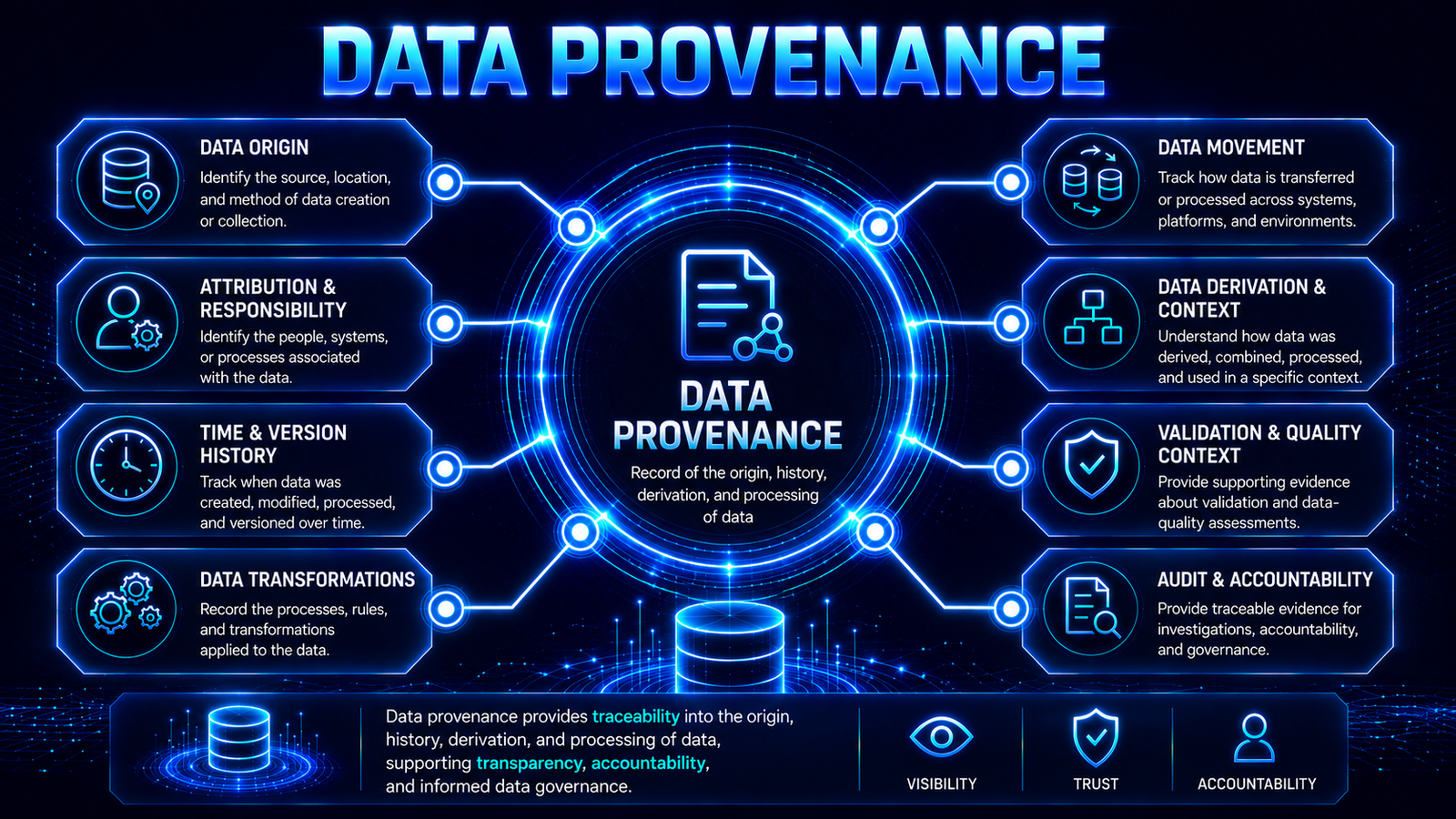
Data provenance is the record of the origin, history, derivation, and activities associated with data.
It provides information about how data was created or collected, where it came from, what processes interacted with it, how it was transformed, and how it reached its current form.
In simple terms, data provenance helps answer questions such as:
- Where did the data come from?
- How was the data created or collected?
- Which source or system provided it?
- What processing or transformation occurred?
- Which datasets or sources contributed to it?
- When was it created or modified?
- What version of the data was used?
- Who or what processes handled the data?
- What context surrounds its creation and use?
Data provenance can therefore be viewed as a record of the history and context associated with data.
It is important to understand that provenance does not automatically make data accurate or trustworthy. Instead, it provides evidence that helps organizations assess the reliability, authenticity, quality, and suitability of data.
Understanding Data Provenance Through an Example
Consider a customer dataset used by an organization’s analytics platform.
The original information may have been collected through a customer registration application. The data may then have been transferred to an integration platform, validated, standardized, combined with information from another system, and eventually stored in a data warehouse.
A provenance record could provide information such as:
| Provenance Attribute | Example |
|---|---|
| Source System | Customer Registration Portal |
| Data Origin | Customer-submitted information |
| Created By | Web Application |
| Creation Date | 15 January 2026 |
| Processing Activity | Data validation and normalization |
| Transformation | Address and contact fields standardized |
| Processing System | Customer Data Integration Platform |
| Dataset Version | Version 3.2 |
| Data Owner | Customer Services Team |
| Data Classification | Confidential |
Suppose an analyst later discovers an unexpected value in the dataset.
Without provenance, the organization may have to investigate multiple systems to determine where the value originated and how it was changed.
With appropriate provenance information, investigators can trace the relevant source and processing activities, helping them determine where the issue may have been introduced.
The example illustrates an important principle:
Data provenance provides context about how data came to exist in its current form.
What Does Data Provenance Capture?
The specific information captured by provenance depends on the organization, system, and use case. However, provenance may include several categories of information.
Data Source and Origin
Provenance can identify the source from which data originated.
The source could be:
- An application
- A database
- A sensor
- A business process
- A user
- An external dataset
- An API
- Another data source
Knowing the origin provides important context for evaluating the data.
Data Creation and Collection
Provenance can record how and when data was created or collected.
This may include:
- Creation date and time
- Collection date and time
- Collection method
- Creating application
- Collection process
- Source organization or system
This information can help establish the context in which the data was generated.
Data Processing and Transformation
Data frequently changes as it moves through an organization’s systems.
It may be:
- Validated
- Cleaned
- Normalized
- Filtered
- Enriched
- Aggregated
- Combined with other data
- Converted into another format
Provenance can record these activities and help establish how the current dataset was derived.
Data Ownership and Stewardship
Organizations may associate provenance information with the individuals, teams, or functions responsible for managing data.
Ownership and stewardship are not the same as provenance itself, but they can provide important context around accountability and governance.
For example, provenance records may identify:
- Data owner
- Data steward
- Responsible system
- Managing function
- Approval authority
Data Version and History
Data may exist in multiple versions over time.
Provenance can help identify which version was created, processed, modified, or used at a particular point in time.
This becomes especially important when organizations need to reproduce an analysis, investigate an incident, or understand how a particular result was produced.
Data Usage and Context
Provenance may also provide information about how data was used or incorporated into another dataset, analysis, model, or output.
This helps organizations understand not only where data originated but also the context in which it was processed and applied.
Why Is Data Provenance Important?
Modern data environments are increasingly complex. Information can originate from numerous sources and pass through many systems before it is used for analytics, operations, or AI.
Without sufficient provenance, organizations may have difficulty determining whether data is appropriate, reliable, current, or suitable for a particular purpose.
Data provenance supports several important areas.
Building Trust in Data
Organizations need confidence in the information they use for analysis, decision-making, and automated systems.
Provenance provides evidence about the source and history of data, helping organizations assess whether the information is appropriate and reliable.
It does not guarantee data quality, but it provides valuable context for evaluating it.
Improving Data Quality
Data quality problems can originate at different points in the data environment.
A value may be entered incorrectly at the source, altered during processing, incorrectly transformed, or combined with another dataset in an unintended way.
Provenance can help organizations identify the systems and processes associated with the data, making it easier to investigate potential sources of quality problems.
Supporting Data Governance
Effective data governance requires organizations to understand how data is created, managed, processed, and used.
Provenance contributes to governance by providing information that can support:
- Data accountability
- Data stewardship
- Data classification
- Data quality management
- Data usage oversight
- Data policy enforcement
- Auditability
Strengthening Accountability
When data contributes to an important report, decision, model, or AI output, organizations may need to determine where the underlying information originated and which processes were involved.
Provenance provides supporting evidence for establishing responsibility and accountability.
Supporting Compliance and Auditing
Organizations may need to demonstrate how information was obtained, processed, managed, and used.
Provenance records can provide supporting evidence during:
- Internal audits
- Regulatory reviews
- Investigations
- Data governance assessments
- AI governance assessments
The exact requirements depend on the applicable laws, regulations, policies, and organizational controls.
Strengthening Cybersecurity
Data provenance can also contribute to cybersecurity investigations.
When security teams investigate suspicious data activity, provenance can help establish:
- Where the data originated
- Which systems processed it
- What changes occurred
- When relevant activities occurred
- Which processes interacted with the data
This can provide useful context during incident response, forensic analysis, and investigations involving data manipulation or unauthorized activity.
Enabling Data Reproducibility
Reproducibility is particularly important in analytics, research, machine learning, and AI.
Suppose an organization produces an important analytical result or trains a model using a particular dataset.
Later, someone may need to determine:
- Which dataset was used?
- Which version was used?
- What transformations were applied?
- Which sources contributed to the dataset?
- Which processing activities occurred?
Provenance can provide the information needed to reconstruct the relevant data history and improve reproducibility.
Data Provenance and Artificial Intelligence
Artificial Intelligence systems depend heavily on data.
Machine learning models learn from training data, while AI applications may also depend on data retrieved during operation, information stored in knowledge bases, external sources, or data supplied through applications and users.
The reliability of these systems can therefore be affected by the quality, suitability, and trustworthiness of the data involved.
Data provenance provides visibility into this data.
For AI, provenance can be relevant across several areas, including training data, model development, and AI-generated outputs.
AI Training Data
Training datasets may contain information collected from many sources.
Provenance can help establish:
- Where the data originated
- How it was collected
- How it was processed
- What filtering occurred
- How datasets were combined
- Which version of a dataset was used
This information can be valuable when evaluating the suitability and risks associated with training data.
AI Model Development
AI model development can involve multiple datasets, preprocessing activities, experiments, model versions, and configurations.
Provenance can help establish the relationship between these inputs and the resulting model.
For example, an organization may need to determine which dataset and processing pipeline were used to train a particular model version.
This supports traceability and reproducibility during model development and review.
AI-Generated Outputs
AI systems can generate predictions, classifications, recommendations, text, images, code, and other outputs.
Where technically available, provenance information can help establish the sources or data involved in generating an output.
However, data provenance should not be confused with AI explainability.
Knowing the source and history of data used by an AI system does not necessarily explain why a particular model produced a specific output.
Provenance and explainability are complementary capabilities.
Data Quality and Reliability
AI systems can produce unreliable results when they depend on inaccurate, incomplete, inappropriate, or biased data.
Provenance provides information that can help organizations evaluate the origin and processing history of datasets before they are used by AI systems.
This can support better data-quality assessment and risk management.
Bias and Data Risk
The way data is collected, selected, labeled, filtered, and transformed can influence AI outcomes.
Provenance can provide contextual information that helps organizations investigate potential sources of bias and other data-related risks.
However, provenance alone does not identify or eliminate bias. It provides evidence that can support broader fairness, quality, and risk-assessment activities.
Transparency and Accountability
AI systems may influence decisions in areas where organizations require greater transparency and accountability.
Knowing the origin and history of relevant data can help organizations establish a clearer record of the information associated with AI development and operation.
This can contribute to broader AI governance and responsible AI practices.
Data Provenance and AI Governance
AI governance establishes the policies, responsibilities, controls, and oversight mechanisms used to manage AI responsibly.
Data is a fundamental component of AI governance because AI systems depend on data throughout their development and operation.
Data provenance can therefore support AI governance by providing greater visibility into the data associated with AI systems.
AI Data Governance
AI governance requires organizations to understand the data used by AI systems.
Provenance can support:
- Dataset accountability
- Data-quality assessment
- Data-source identification
- Dataset traceability
- Data-use oversight
- Documentation
AI Risk Management
AI risks can originate from the data used to train, develop, or operate AI systems.
Provenance can provide evidence that helps organizations investigate risks related to:
- Data quality
- Data origin
- Data suitability
- Data bias
- Unauthorized data use
- Unintended transformations
Responsible AI
Responsible AI requires organizations to consider factors such as fairness, transparency, accountability, safety, and appropriate use.
Data provenance can contribute to these objectives by improving visibility into the data supporting AI systems.
It should, however, be treated as one component of a broader responsible AI framework rather than a complete solution.
Auditability and Traceability
Organizations may need to demonstrate how a particular AI system, model, dataset, or output relates to its underlying data.
Provenance can provide supporting evidence for these assessments and improve the traceability of AI-related data.
Regulatory Compliance
AI-related regulatory requirements may require organizations to maintain appropriate documentation, controls, and evidence around AI systems and their data.
The specific requirements vary by jurisdiction and use case.
Data provenance can contribute to the evidence needed to demonstrate appropriate data management and governance.
Data Provenance vs Data Lineage
Data provenance and data lineage are closely related concepts, and the terms are sometimes used interchangeably. However, they emphasize different aspects of data history.
| Data Provenance | Data Lineage |
|---|---|
| Focuses on the origin, history, and derivation of data | Focuses on the movement and transformation of data |
| Helps explain where data came from and how it was produced | Helps explain how data moves between systems and processes |
| Provides context around data creation and processing | Provides visibility into data dependencies and flows |
| Supports traceability, accountability, and verification | Supports impact analysis, troubleshooting, and governance |
A simple way to distinguish them is:
Data provenance explains the origin and history of data.
Data lineage explains the journey and transformation of data.
The two concepts complement each other and are often used together within modern data governance environments.
Data Provenance vs Metadata
Metadata is information that describes data.
Examples include:
- Data name
- Data type
- File format
- Database table
- Creation date
- Classification
- Owner
- Description
Provenance can use metadata as part of its record, but provenance is concerned specifically with the history, origin, derivation, and activities associated with data.
For example, the metadata for a dataset might identify it as a confidential customer dataset.
Its provenance could additionally describe where the dataset originated, how it was collected, which datasets contributed to it, and what transformations were performed.
Therefore:
Metadata describes data.
Provenance describes the history and context associated with data.
Data Provenance, Data Integrity, and Data Authenticity
These concepts are related but represent different characteristics of data.
Data Provenance
Describes the origin, history, derivation, and processing associated with data.
Data Integrity
Concerns whether data remains accurate, complete, and protected from unauthorized or unintended modification.
Data Authenticity
Concerns whether data can be established as genuine and attributable to its claimed source.
Data Quality
Concerns whether data is accurate, complete, consistent, timely, valid, and suitable for its intended purpose.
Provenance can provide evidence that supports the assessment of these characteristics, but it does not automatically guarantee them.
For example, provenance may show that data came from a particular system, but that does not necessarily mean the source data was accurate.
This distinction is important when designing data governance and AI governance controls.
Challenges of Data Provenance
Implementing and maintaining useful provenance can become difficult as data environments grow more complex.
Distributed Data Sources
Organizations may have data distributed across applications, databases, cloud platforms, external services, and third-party sources.
Maintaining provenance across these environments can be challenging.
Data Volume and Complexity
Large-scale data environments can generate enormous amounts of provenance information.
Organizations must determine which provenance information is important enough to capture and retain.
Incomplete Provenance Records
If provenance is not captured consistently across systems, gaps may occur.
These gaps can make it difficult to establish a complete history of data.
Privacy and Security
Provenance records can themselves contain sensitive information.
For example, provenance may reveal information about data sources, users, systems, processing activities, or organizational processes.
Provenance information therefore needs appropriate security and access controls.
Maintaining Provenance Across Transformations
Data may pass through multiple processing stages, platforms, and applications.
Maintaining accurate provenance as data is transformed or combined can be technically and operationally challenging.
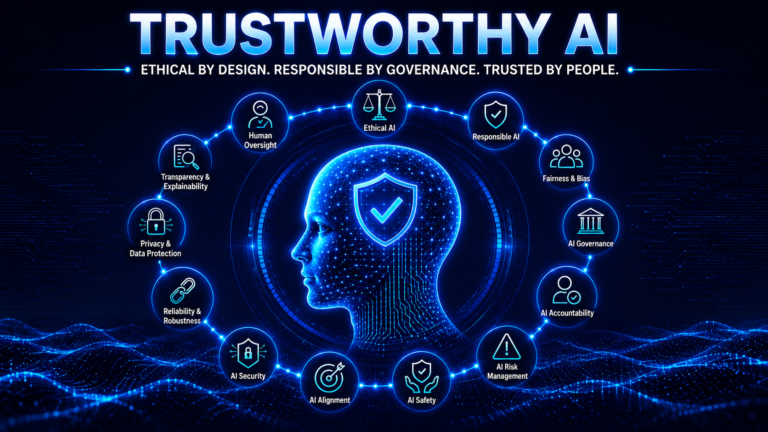
The Role of Data Provenance in Trustworthy AI
Trustworthy AI depends on more than model performance.
Organizations also need confidence in the data used to develop and operate AI systems.
Data provenance contributes to this confidence by providing visibility into the origin, history, derivation, and processing of relevant data.
It can help organizations investigate where data came from, understand how it was transformed, evaluate its context, support accountability, and improve the traceability of AI-related data.
However, trustworthy AI requires a broader set of capabilities, including appropriate governance, data quality management, security, privacy, risk management, model evaluation, monitoring, and human oversight.
Data provenance is therefore best understood as an important supporting capability for trustworthy AI, rather than a complete solution by itself.
Future of Data Provenance
As AI systems become more sophisticated and organizations rely on increasingly complex data ecosystems, the importance of data traceability is likely to increase.
AI development may involve large datasets assembled from multiple sources, continuously updated information, synthetic data, retrieval systems, external data services, and other forms of machine-generated or machine-processed information.
In these environments, organizations will increasingly need to understand:
- Where relevant data originated
- How datasets were assembled
- What transformations occurred
- Which data versions were used
- How data contributed to AI development
- How data-related risks can be investigated
- How AI-related data decisions can be demonstrated during audits
Data provenance can provide an important foundation for this visibility.
Its role will likely become increasingly connected with data governance, AI governance, risk management, responsible AI, cybersecurity, compliance, and trustworthy AI.
Conclusion
Data provenance provides a structured record of the origin, history, derivation, and processing associated with data.
It helps organizations understand how data came to its current state and provides evidence that can support data quality assessment, governance, accountability, auditing, cybersecurity, and reproducibility.
For Artificial Intelligence, provenance becomes particularly important because AI systems depend heavily on data. Understanding the sources and processing history of AI-related data can help organizations evaluate data quality, investigate risks, support accountability, and improve traceability.
Data provenance does not guarantee data quality, integrity, authenticity, or trustworthy AI. Instead, it provides the evidence and context needed to assess these characteristics as part of broader governance and risk-management practices.
As data and AI ecosystems continue to become more complex, data provenance will remain an important foundation for understanding, governing, and trusting the data that supports modern AI systems.