Open Worldwide Application Security Project (OWASP)
Introduction
The Open Worldwide Application Security Project (OWASP) is a nonprofit organization and global community focused on improving the security of software and applications. OWASP provides freely available standards, guidance, documentation, tools, educational resources, and community-driven projects that support developers, security professionals, architects, testers, and organizations.
OWASP is widely recognized for resources such as the OWASP Top 10, Application Security Verification Standard (ASVS), Software Assurance Maturity Model (SAMM), Web Security Testing Guide (WSTG), API Security Top 10, and OWASP Cheat Sheet Series.
These resources serve different purposes. Some provide security requirements, some provide risk awareness, some support security testing and verification, while others provide maturity models, implementation guidance, or security tools.
Understanding OWASP
What Is OWASP?
OWASP is an open community dedicated to improving the security of software and applications. It develops and maintains application-security resources covering software development, application architecture, security testing, secure coding, APIs, mobile applications, and other areas of software security.
The OWASP Foundation supports the OWASP community, projects, and activities. OWASP resources are generally made freely available to the security and software-development community.
OWASP is not a commercial security vendor, regulatory authority, or government agency. Its resources are developed through community participation and are intended to provide vendor-neutral application-security knowledge and practices.
History and Purpose of OWASP
OWASP was established to create an open environment for sharing knowledge about application security and improving the security of software.
Its scope has expanded beyond traditional web application security to cover a broad range of software-security topics, including:
- Web application security
- API security
- Mobile application security
- Secure software development
- Application security testing
- Software assurance
- Security architecture
- Security requirements
- Security maturity
- Developer education
OWASP maintains numerous projects that provide standards, guidance, testing methodologies, maturity models, documentation, and open-source security tools.
OWASP as an Application Security Organization
OWASP is best understood as an application-security organization and open community, rather than simply as a standards body.
Its resources have different purposes and classifications. For example, the OWASP Top 10 is an awareness document, ASVS is a security verification standard, SAMM is a maturity model, the Web Security Testing Guide provides testing guidance, and OWASP ZAP is a security testing tool.
This distinction is important because OWASP provides a broad ecosystem of complementary resources rather than a single type of standard.
OWASP and Application Security
Web Application Security
Web applications expose functionality and data through browsers, web services, and other interfaces. Their security depends on controls such as authentication, authorization, session management, input validation, cryptography, configuration, logging, and secure application design.
OWASP provides several resources for web application security. The OWASP Top 10 provides awareness of major web application security risks, while ASVS provides detailed security requirements and verification criteria. The Web Security Testing Guide provides guidance for testing web applications and web services.
API Security
Application Programming Interfaces (APIs) expose application functionality and frequently provide access to sensitive data and business processes. API security therefore requires controls covering authentication, authorization, resource consumption, configuration, inventory, and interactions with other services.
The OWASP API Security Top 10 focuses specifically on security risks associated with APIs and provides a common reference for developers and security professionals.
Mobile Application Security
Mobile applications introduce security considerations associated with mobile operating systems, application storage, device capabilities, application interfaces, authentication, cryptographic material, and communication with backend services.
OWASP provides mobile security resources including the Mobile Top 10, Mobile Application Security Verification Standard (MASVS), and associated testing guidance.
Software Security
Software security extends beyond individual vulnerabilities. It includes the architecture, design, implementation, testing, deployment, and operational practices used to produce and maintain secure software.
OWASP addresses software security through resources covering:
- Security requirements
- Secure architecture and design
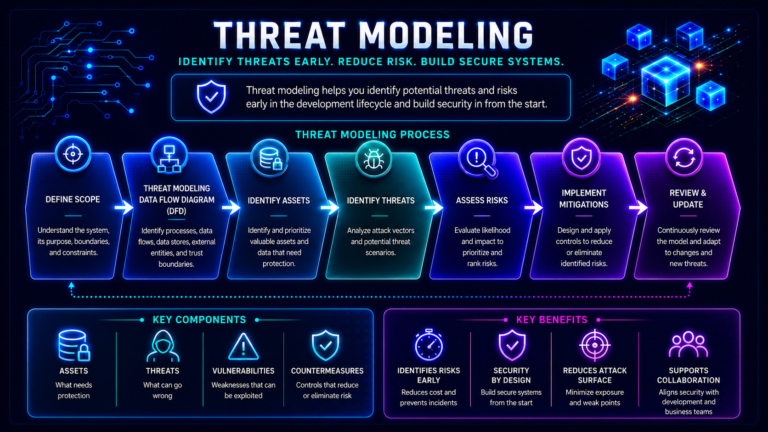
- Threat modeling
- Secure coding
- Application security testing
- Software assurance
- Dependency security
- Vulnerability management
- Security maturity
- Developer education
Secure Software Development
Security should be incorporated throughout the software development lifecycle rather than being treated only as a final testing activity.
OWASP resources can support security activities during requirements definition, architecture, design, implementation, verification, deployment, and operations.
For example, ASVS can help define security requirements and verification criteria, while SAMM can be used to assess and improve software-security practices across the lifecycle. The Web Security Testing Guide provides testing guidance, and the Cheat Sheet Series provides practical implementation advice.
Major OWASP Standards, Guidance, and Projects
OWASP Top 10
The OWASP Top 10 is an awareness document addressing major web application security risks. It provides a common language for discussing important application-security risks and helps organizations prioritize security awareness and development activities.
The OWASP Top 10 should not be treated as a complete list of all application vulnerabilities or as a comprehensive application-security testing methodology.
OWASP API Security Top 10
The OWASP API Security Top 10 focuses specifically on security risks associated with APIs.
The 2023 edition includes:
- Broken Object Level Authorization
- Broken Authentication
- Broken Object Property Level Authorization
- Unrestricted Resource Consumption
- Broken Function Level Authorization
- Unrestricted Access to Sensitive Business Flows
- Server Side Request Forgery
- Security Misconfiguration
- Improper Inventory Management
- Unsafe Consumption of APIs
The project helps developers and security professionals understand and address security risks that are particularly relevant to APIs.
OWASP Mobile Top 10
The OWASP Mobile Top 10 provides security awareness for mobile application development and security assessment.
Mobile applications have security characteristics that differ from traditional web applications because they interact with mobile operating systems, local storage, device capabilities, application packages, and backend services.
OWASP also provides additional mobile security resources, including the Mobile Application Security Verification Standard and mobile security testing guidance.
OWASP Application Security Verification Standard (ASVS)
The OWASP Application Security Verification Standard (ASVS) provides a basis for testing web application technical security controls and establishes security requirements for secure development.
ASVS covers areas such as:
- Architecture and design
- Authentication
- Session management
- Access control
- Input validation
- Cryptography
- Error handling
- Data protection
- Communications
- Business logic
- Files and resources
- API and web-service security
ASVS can therefore be used during application development, architecture reviews, security assessments, and verification activities.
OWASP Software Assurance Maturity Model (SAMM)
The OWASP Software Assurance Maturity Model (SAMM) provides a framework for assessing and improving an organization’s software-security practices.
SAMM organizes software assurance around five business functions:
- Governance
- Design
- Implementation
- Verification
- Operations
Each function contains security practices that organizations can use to assess their current capabilities and establish improvement objectives.
OWASP Web Security Testing Guide (WSTG)
The OWASP Web Security Testing Guide (WSTG) provides a comprehensive framework for testing web applications and web services.
It covers areas such as:
- Information gathering
- Configuration and deployment management
- Identity management
- Authentication
- Authorization
- Session management
- Input validation
- Error handling
- Cryptography
- Business logic
- Client-side security
The WSTG can support security professionals performing assessments as well as organizations establishing application-security testing programs.
OWASP Cheat Sheet Series
The OWASP Cheat Sheet Series provides concise and practical application-security guidance.
The series covers individual security topics and provides implementation-oriented information for developers and security practitioners.
Examples include guidance relating to:
- Authentication
- Authorization
- Session management
- Cryptography
- Input validation
- Secure design
- API security
- File security
- Logging
- Mobile application security
OWASP ZAP
OWASP ZAP, or Zed Attack Proxy, is an open-source web application security testing tool.
ZAP can be used to inspect and analyze HTTP traffic and support activities such as application discovery, passive analysis, automated testing, and manual security assessment.
ZAP is a security testing tool, rather than a standard, framework, or maturity model.
OWASP in the Software Development Lifecycle
Security Requirements
Security requirements define the security properties that an application is expected to satisfy.
OWASP ASVS can provide a structured source of security requirements for web applications. These requirements can be adapted according to the application’s architecture, risk profile, regulatory obligations, and business requirements.
Secure Design and Architecture
Security considerations should be incorporated into application architecture and design before implementation begins.
Security architecture activities can include:
- Identifying trust boundaries
- Defining authentication and authorization mechanisms
- Protecting sensitive data
- Designing secure API interactions
- Applying least privilege
- Addressing security assumptions
- Performing threat modeling
- Establishing appropriate security controls
OWASP resources such as ASVS and SAMM can support these activities.
Secure Coding
Secure coding aims to reduce vulnerabilities introduced during software implementation.
Developers need to consider areas such as:
- Input validation
- Output encoding
- Authentication
- Authorization
- Cryptographic operations
- Error handling
- Secure session management
- Secure file handling
- Dependency management
- Secure API consumption
The OWASP Cheat Sheet Series provides practical guidance for many of these areas.
Security Testing
Security testing validates whether an application implements the intended security controls and identifies weaknesses introduced during development.
Testing may include:
- Automated security testing
- Manual application testing
- Code review
- Vulnerability assessment
- Penetration testing
- API security testing
- Configuration testing
- Authentication and authorization testing
The OWASP Web Security Testing Guide provides a structured approach to web application and web-service security testing.
Dependency and Component Security
Applications frequently depend on third-party libraries, frameworks, packages, APIs, and other software components.
A vulnerability in a dependency can affect applications that incorporate the vulnerable component. Software teams therefore need processes for identifying dependencies, monitoring vulnerabilities, evaluating risk, and updating affected components.
OWASP’s software-security resources can be used alongside dependency-analysis tools and organizational vulnerability-management processes.
Vulnerability Management
Application vulnerability management involves identifying, analyzing, prioritizing, remediating, and validating security weaknesses.
OWASP resources can support different parts of this activity. The Top 10 provides risk awareness, ASVS provides security requirements and verification criteria, and WSTG provides testing guidance.
An organization’s vulnerability-management process should also consider its application portfolio, threat environment, business impact, regulatory requirements, and risk tolerance.
OWASP Resources and Community
OWASP Projects
OWASP maintains a broad ecosystem of projects covering application-security standards, documentation, tools, research, testing, education, and other security topics.
Projects have different classifications and maturity levels. Some are designated as flagship projects, while others have different project statuses within the OWASP project ecosystem.
Documentation and Guidance
OWASP provides extensive documentation covering application-security principles, requirements, testing methodologies, implementation practices, and specialized security topics.
Its resources are intended for different audiences, including:
- Developers
- Security engineers
- Security architects
- Penetration testers
- Application-security professionals
- DevSecOps teams
- Technology managers
- Organizations establishing security programs
Chapters and Community
OWASP operates through a global community that includes local chapters, project teams, contributors, volunteers, and security professionals.
Chapters provide opportunities for local participation, while project teams develop and maintain individual OWASP projects.
This community-based model is an important part of OWASP because many of its resources are developed and maintained collaboratively.
Training and Education
OWASP supports application-security education through documentation, training resources, conferences, community events, presentations, projects, and other educational material.
These resources can support individual learning as well as organizational developer training, application-security awareness, and security engineering education.
Using OWASP in Cybersecurity Practice
Application Security Assessment
OWASP resources can provide a structured foundation for application-security assessments.
Organizations may use:
- OWASP Top 10 for risk awareness
- ASVS for security requirements and verification
- WSTG for security testing
- API Security Top 10 for API-specific risks
- Mobile security resources for mobile applications
- Cheat Sheets for focused implementation guidance
The appropriate resources depend on the application’s architecture, technology, risk profile, and assessment objectives.
Secure Software Development
OWASP resources can be integrated into secure software-development practices.
For example, development and security teams can use ASVS to establish security requirements, apply secure coding guidance during implementation, conduct security testing before release, and use SAMM to assess the maturity of organizational software-security practices.
The objective is to incorporate security throughout software development rather than relying only on vulnerability identification after development.
Application Security Testing
OWASP provides multiple resources for application-security testing.
The WSTG provides testing guidance, while ASVS defines security requirements and verification criteria. ZAP can support technical testing activities as an open-source security testing tool.
These resources serve different purposes and should not be treated as interchangeable.
Security Architecture and Design
Application-security architecture establishes how security controls are incorporated into an application’s technical design.
OWASP resources can support architectural activities such as:
- Threat modeling
- Authentication architecture
- Authorization design
- Secure API design
- Data protection
- Cryptographic requirements
- Security control verification
- Secure communication
- Trust-boundary analysis
ASVS can be particularly useful when translating architectural security expectations into verifiable requirements.
Security Requirements and Governance
Application security also requires organizational governance.
Security governance can establish:
- Security policies
- Application-security standards
- Security requirements
- Development responsibilities
- Security testing requirements
- Risk acceptance processes
- Vulnerability-management responsibilities
- Security metrics
- Compliance expectations
OWASP resources can contribute to these activities, but they do not replace an organization’s governance framework, regulatory obligations, risk-management process, or applicable laws and standards.
SAMM can help organizations evaluate and improve the maturity of software-security practices across governance, design, implementation, verification, and operations.
Conclusion
OWASP is an important source of application-security standards, guidance, testing methodologies, maturity models, documentation, and open-source tools.
Its resources address different parts of the software-security lifecycle. The OWASP Top 10 provides broad awareness of important web application security risks, ASVS provides security requirements and verification criteria, SAMM supports software-security maturity assessment, WSTG provides testing guidance, and the Cheat Sheet Series provides focused practical guidance.
OWASP therefore serves as an important reference for secure software development, application security architecture, application security testing, software assurance, and application-security governance.
References
Online Sources
OWASP – OWASP Top 10:2025
Provides an awareness document covering critical web application security risks and serves as an introductory reference for application security.
OWASP – OWASP Application Security Verification Standard (ASVS)
Provides a basis for testing web application technical security controls and provides developers with security requirements for secure development.
OWASP – OWASP Software Assurance Maturity Model (SAMM)
Provides a framework for assessing and improving software security practices across the software development lifecycle.
OWASP – OWASP Web Security Testing Guide (WSTG)
Provides a comprehensive framework and practical guidance for testing web applications and web services.
OWASP – OWASP API Security Top 10
Provides the OWASP API Security Top 10 and supporting guidance for understanding and mitigating security risks associated with APIs.
OWASP – OWASP Mobile Top 10
Provides awareness of prevalent security risks affecting mobile applications and associated security controls.
OWASP – OWASP Cheat Sheet Series
Provides concise, practical guidance on specific application security topics, including authentication, authorization, cryptography, API security, and secure development.
OWASP – OWASP ZAP
Provides an open-source web application security testing tool that supports automated and manual security assessment activities.
OWASP – OWASP Mobile Application Security Verification Standard (MASVS)
Provides security requirements and controls for assessing the security of mobile applications.