Understanding Trustworthy AI
Introduction
Artificial Intelligence is becoming increasingly capable and is being used across a growing range of applications and environments. AI systems can support decision-making, generate and analyze information, automate tasks, detect patterns, create content, and assist people in many areas of work and daily life.
As AI becomes more capable and more widely adopted, the ability to trust these systems becomes increasingly important.
Trustworthy AI is concerned with ensuring that AI systems are developed and used in ways that are appropriate, responsible, safe, secure, reliable, and accountable.
Trustworthiness is not a single technology, feature, or control. It involves the principles, practices, safeguards, governance mechanisms, and human oversight that influence how AI systems are developed and used.
An AI system does not become trustworthy simply because it performs well or produces accurate results. Trust also depends on the data it uses, the objectives it follows, the risks associated with its use, the safeguards applied to it, and the people responsible for its operation and outcomes.
Trustworthy AI therefore needs to be considered from the beginning and throughout the use of an AI system.
The objective is to enable AI systems to provide their intended benefits while managing the risks and potential consequences associated with their use.
What Is Trustworthy AI?
Trustworthy AI refers to Artificial Intelligence systems that can be relied upon to operate in an ethical, safe, secure, reliable, transparent, and accountable manner while remaining aligned with their intended objectives and human values.
Trustworthiness is broader than the technical performance of an AI model. An AI system may produce accurate results and still create risks if it uses inappropriate data, operates without sufficient safeguards, lacks adequate security, or produces outcomes that cannot be appropriately understood or governed.
Trustworthy AI considers both the AI system and the environment in which it is developed and used. This includes the data used by the system, the objectives defined for it, the methods used to develop and evaluate it, the controls applied to manage its risks, and the human oversight provided throughout its use.
The context in which AI is used is also important. An AI system supporting a low-risk activity may require a different level of control and oversight from a system used in healthcare, finance, cybersecurity, critical infrastructure, or other areas where incorrect or harmful outcomes can have significant consequences.
Trustworthiness is therefore not achieved by a single technology, feature, control, or assessment. It results from the combination of technical, organizational, ethical, and governance measures applied to the AI system and its surrounding environment.
A trustworthy AI system should be appropriate for its intended purpose, operate within defined boundaries, and have its capabilities and limitations understood. Its risks should be identified and managed, appropriate safeguards should be established, and clear responsibility should exist for its use and outcomes.
Trustworthy AI should therefore be considered throughout the development and use of an AI system rather than treated as something that can be added after deployment.
The objective is to enable AI systems to provide their intended benefits while managing the risks and potential consequences associated with their use. will always be correct or free from failure. Instead, the objective is to understand its capabilities and limitations, manage its risks, establish appropriate safeguards, maintain accountability, and ensure that the system remains suitable for its intended purpose.
Principles of Trustworthy AI
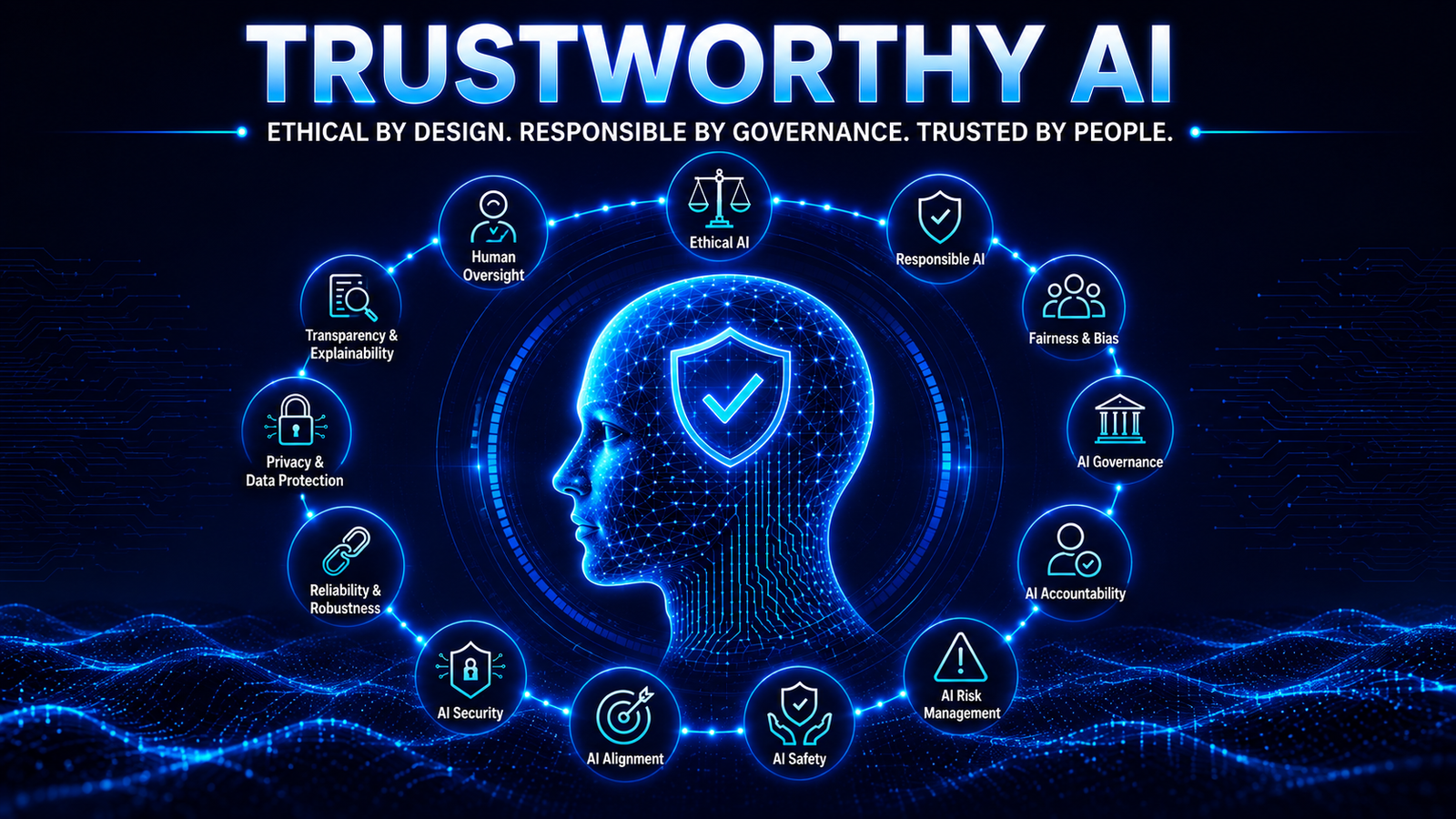
Trustworthy AI is based on a set of interconnected principles that guide how Artificial Intelligence systems are designed, developed, deployed, governed, and used. These principles address not only the technical behavior of AI systems, but also the ethical, organizational, security, and human considerations surrounding them.
Ethical AI
Ethical AI focuses on the principles and values that should guide the development and use of Artificial Intelligence.
It considers whether AI systems respect:
- Human rights
- Fairness
- Privacy
- Human dignity
- Cultural values
- Moral principles
As AI becomes involved in decisions that affect people, ethical considerations become increasingly important. An AI system may be technically capable of performing a task, but that does not automatically mean that the task should be performed in a particular way or in a particular context.
Ethical AI therefore provides a foundation for considering whether the purposes, decisions, and outcomes associated with AI are appropriate.
Responsible AI
Responsible AI focuses on putting ethical principles into practice.
While Ethical AI establishes principles and values, Responsible AI translates them into practical activities such as:
- AI development practices
- Organizational policies
- Governance processes
- Risk management
- Design decisions
- Testing and evaluation
- Human oversight
Responsible AI helps ensure that ethical considerations are incorporated throughout the development, deployment, and use of AI rather than being treated as a separate activity.
In simple terms, Responsible AI is ethics in practice.
AI Fairness and Bias
AI systems can produce unfair outcomes when bias exists in their data, design, development processes, objectives, or operating environment.
Bias can enter an AI system through historical data, incomplete or unrepresentative datasets, assumptions made during development, or the way a system is designed and used.
AI fairness focuses on ensuring that AI systems do not produce inappropriate or discriminatory outcomes and that their behavior is evaluated in the context in which they are used.
Fairness is therefore not simply a property of an AI model. It can depend on the data, purpose, users, affected groups, decision process, and environment surrounding the system.
Managing AI bias requires organizations and developers to consider potential sources of bias, evaluate outcomes appropriately, and address identified issues where necessary.
AI Governance
AI Governance refers to the policies, standards, processes, roles, and oversight mechanisms used to manage Artificial Intelligence.
Governance provides the structure needed to ensure that AI is developed and used in a controlled and responsible manner.
AI Governance can help establish:
- AI policies and standards
- Roles and responsibilities
- Approval and oversight processes
- AI risk management
- Acceptable use requirements
- Monitoring and review mechanisms
- Compliance requirements
- Accountability structures
AI Governance is important because AI can affect multiple functions, stakeholders, and areas of an organization or society. Clear governance helps ensure that decisions about AI are made with appropriate authority and consideration of risk.
AI Accountability
AI Accountability establishes clear responsibility for AI systems, their use, and their outcomes.
An AI system should not become a substitute for human or organizational responsibility. When an AI system produces an incorrect result, contributes to an unintended consequence, or causes harm, there should be clear ownership of the system and the decisions surrounding its use.
Accountability includes determining:
- Who owns the AI system
- Who is responsible for its use
- Who approves its deployment
- Who manages its risks
- Who monitors its performance
- Who responds when problems occur
Clear accountability helps ensure that responsibility does not become unclear simply because AI is involved in a decision or process.
AI Risk Management
AI systems can introduce risks related to accuracy, safety, security, privacy, fairness, reliability, compliance, and unintended use.
AI Risk Management involves identifying, assessing, treating, and monitoring risks associated with AI throughout its use.
Risk management should consider both the capabilities of an AI system and the environment in which it operates.
This includes understanding:
- The intended purpose of the AI system
- Potential failure modes and unintended outcomes
- People and systems that could be affected
- The potential impact of identified risks
- Controls available to reduce those risks
- Remaining risks that require monitoring
AI Risk Management helps ensure that AI systems are evaluated not only according to their capabilities and benefits, but also according to the risks associated with their use.
AI Safety
AI Safety focuses on preventing unintended harmful outcomes and ensuring that AI systems operate within appropriate safety boundaries.
AI systems can encounter unexpected situations, produce incorrect outputs, or behave differently from what was intended. Safety considerations therefore need to be incorporated into how AI systems are designed, tested, deployed, and monitored.
AI Safety may involve:
- Identifying potential harmful outcomes
- Testing AI behavior
- Establishing safety controls
- Defining operating boundaries
- Monitoring system behavior
- Providing mechanisms for intervention
The objective is to ensure that AI systems remain safe and controllable for their intended uses.
AI Alignment
AI Alignment focuses on ensuring that AI system behavior and objectives remain consistent with intended human goals and requirements.
An AI system can successfully optimize for a defined objective while still producing an undesirable outcome if the objective is incomplete, ambiguous, or poorly defined.
Alignment therefore considers whether the system is pursuing the intended objective and whether its behavior remains consistent with the goals and values established for its use.
As AI systems become more capable and autonomous, alignment becomes increasingly important because the consequences of poorly defined objectives can also increase.
AI Security
AI Security focuses on protecting AI systems, models, data, applications, infrastructure, and supporting components from unauthorized access, manipulation, misuse, and other security threats.
AI systems can introduce or encounter security risks throughout their development and use.
Security considerations can include:
- Protection of AI models
- Protection of training and operational data
- Access control
- Protection against manipulation
- Secure integration with applications and systems
- Monitoring for malicious activity
- Protection of supporting infrastructure
AI Security is an important component of Trustworthy AI because a system cannot be considered trustworthy if its security can be easily compromised or its outputs can be manipulated.
AI Reliability
AI Reliability refers to the ability of an AI system to perform its intended functions consistently and predictably over time.
A reliable AI system should provide reasonably consistent behavior under expected operating conditions.
Reliability can be influenced by:
- Data quality
- Model performance
- System design
- Infrastructure
- Integration with other systems
- Changes in the operating environment
Reliability is important because users need confidence that an AI system will continue to perform its intended function as expected.
AI Robustness
AI Robustness refers to the ability of an AI system to continue functioning appropriately when faced with unexpected conditions, changes, or challenging inputs.
Real-world environments are rarely completely predictable. AI systems may encounter incomplete information, unusual inputs, environmental changes, system failures, or deliberate attempts to manipulate their behavior.
A robust AI system should be designed and evaluated with such conditions in mind.
Robustness therefore complements reliability. Reliability focuses on consistent performance under expected conditions, while robustness considers the system’s ability to maintain appropriate behavior under more challenging conditions.
AI Privacy
AI Privacy focuses on protecting individuals and their information when AI systems collect, process, store, analyze, or generate information.
AI systems may process large amounts of personal or sensitive information, creating privacy considerations throughout their development and use.
AI Privacy can involve:
- Appropriate collection and use of information
- Data minimization
- Protection of sensitive information
- Access controls
- Appropriate retention
- Prevention of unauthorized disclosure
- Consideration of privacy risks associated with AI outputs
Privacy should be considered from the design of an AI system through its deployment and continued operation.
Data Protection
Data Protection focuses on protecting information throughout its lifecycle and ensuring that data is handled appropriately.
For AI systems, this can include information used for training, testing, validation, operation, monitoring, and evaluation.
Appropriate data protection measures can help prevent:
- Unauthorized access
- Data loss
- Unauthorized disclosure
- Improper use
- Unintended exposure of sensitive information
Data protection is closely connected to AI Privacy, but the two concepts are not identical. Privacy focuses primarily on the appropriate handling and protection of information relating to individuals, while data protection encompasses the broader measures used to protect data from unauthorized or inappropriate use.
AI Transparency
AI Transparency refers to providing appropriate information about how AI systems are developed, deployed, and used.
Transparency can include information about:
- The purpose of an AI system
- Its intended uses
- Its capabilities
- Its limitations
- The types of data it uses
- Its role in a decision or process
- The responsibilities associated with its use
Transparency helps users and other stakeholders understand what an AI system is intended to do and where its limitations may exist.
Transparency does not necessarily mean exposing every technical detail of an AI model. The appropriate level of transparency depends on the system, its purpose, its users, and the potential impact of its use.
Explainable AI
Explainable AI, commonly referred to as XAI, focuses on making AI-generated decisions, predictions, recommendations, or outputs understandable to relevant stakeholders.
Some AI systems can be difficult to interpret because of the complexity of their models and the processes used to generate their outputs.
Explainability can help stakeholders understand why a system produced a particular result and can support:
- Trust
- Review
- Accountability
- Error identification
- Decision-making
- Risk management
The level and form of explainability required will depend on the AI system and the consequences associated with its outputs.
Human-in-the-Loop
Human-in-the-Loop, or HITL, involves incorporating human involvement directly into an AI process.
A human may review, approve, modify, reject, or otherwise intervene in AI-generated outputs before an action is taken.
HITL can be particularly important where AI outputs may have significant consequences.
The appropriate level of human involvement depends on factors such as:
- The risk associated with the AI system
- The type of decision being made
- The potential impact of an incorrect outcome
- The level of autonomy given to the system
Human involvement should be meaningful rather than simply being present as a formal step in a process.
Human-on-the-Loop
Human-on-the-Loop refers to a model in which humans oversee AI systems while allowing the systems to operate with a greater degree of autonomy.
Instead of reviewing every individual AI output, human operators monitor the system, establish boundaries, review performance, and intervene when necessary.
This approach can be appropriate when AI systems need to operate at a scale or speed that makes continuous human review impractical.
The distinction between Human-in-the-Loop and Human-on-the-Loop is primarily the level and timing of human involvement.
Human-in-the-Loop generally involves direct human intervention within the decision or action process, while Human-on-the-Loop emphasizes ongoing human supervision and the ability to intervene when required.
AI Due Care and Due Diligence
Trustworthy AI requires more than establishing principles and controls. It also requires people and organizations involved in developing, deploying, governing, and using AI to act with appropriate due care and due diligence.
These concepts emphasize the responsibility to understand AI systems, consider their potential risks, and take reasonable steps to manage those risks.
AI Due Care
AI Due Care refers to taking reasonable precautions and implementing appropriate measures when developing, deploying, and using AI systems.
It involves acting responsibly based on the known risks and circumstances associated with an AI system.
AI Due Care can include:
- Establishing appropriate safeguards
- Protecting AI systems and data
- Testing and monitoring AI systems
- Managing identified risks
- Providing appropriate human oversight
- Responding to identified problems
- Maintaining appropriate policies and controls
The level of due care required can depend on the purpose, capabilities, risks, and potential impact of the AI system.
A low-risk AI application may require relatively limited controls, while an AI system used in a high-impact environment may require substantially greater safeguards and oversight.
AI Due Diligence
AI Due Diligence refers to taking reasonable steps to understand an AI system, its capabilities, limitations, risks, dependencies, and intended use before and during its deployment.
Due diligence helps ensure that decisions involving AI are based on an appropriate understanding of the technology and its potential consequences.
AI Due Diligence can include:
- Understanding the intended purpose of an AI system
- Evaluating its capabilities and limitations
- Assessing relevant risks
- Reviewing data sources and dependencies
- Evaluating providers and supporting technologies
- Considering security and privacy implications
- Assessing how AI may affect people and processes
- Reviewing whether appropriate safeguards are available
Due diligence is particularly important when adopting AI systems developed or provided by third parties. Organizations should understand what they are adopting and the risks associated with integrating the technology into their environment.
AI Due Care and Due Diligence Together
AI Due Diligence and AI Due Care are closely related but address different aspects of responsible AI use.
Due diligence focuses on understanding and evaluating.
Due care focuses on acting responsibly based on that understanding.
Both should continue throughout the use of an AI system rather than being treated as activities performed only before deployment.
Together, they help translate the principles of Trustworthy AI into practical responsibility and support the responsible development, deployment, governance, and use of Artificial Intelligence.
Why Trustworthy AI Matters
As Artificial Intelligence becomes more capable and more widely used, the consequences of how AI systems are developed and deployed also become more significant.
Trustworthy AI helps ensure that AI systems are used in ways that are appropriate for their intended purposes while the associated risks are understood and managed.
Trustworthy AI matters because AI systems can influence decisions, processes, services, and people. An inaccurate, insecure, biased, unsafe, or poorly governed AI system can create consequences that extend beyond the technology itself.
Trustworthy AI can help:
- Reduce AI-related risks by identifying and addressing potential problems.
- Improve reliability and safety by establishing appropriate controls and evaluation practices.
- Protect information and systems through appropriate privacy and security measures.
- Support fairness and responsible use by considering how AI affects different people and groups.
- Improve transparency and understanding by communicating appropriate information about AI systems and their limitations.
- Establish accountability by defining responsibility for AI systems and their outcomes.
- Support regulatory and governance requirements through appropriate policies, controls, and oversight.
- Build confidence in AI by ensuring that systems are developed and used responsibly.
Trustworthy AI is particularly important when AI is used in areas where its outputs can have significant consequences. The level of trust, oversight, safeguards, and risk management required should reflect the purpose and potential impact of the AI system.
Trust should not be based solely on the performance of an AI model. It should also consider the data, technology, processes, people, governance, security, and controls surrounding the system.
Ultimately, Trustworthy AI provides a foundation for using Artificial Intelligence in a way that balances its capabilities and benefits with the responsibilities and risks associated with its use.
Conclusion
Trustworthy AI is not defined by a single technology, model, control, or standard. It is a broader approach to ensuring that Artificial Intelligence is developed and used in an ethical, responsible, safe, secure, reliable, transparent, and accountable manner.
Trustworthiness depends on the principles applied throughout the development and use of AI. It also depends on understanding the system’s purpose, capabilities, limitations, risks, and operating environment.
As AI becomes more capable and more widely adopted, these considerations become increasingly important. AI systems may influence decisions, process sensitive information, interact with people, and become integrated into critical processes and services.
Building trust therefore requires more than technical performance. It requires appropriate governance, risk management, security, privacy, human oversight, and accountability, together with due care and due diligence.
Trustworthy AI provides a foundation for realizing the benefits of Artificial Intelligence while managing the risks and responsibilities associated with its use.
The goal is not to create AI systems that are assumed to be perfect, but to develop and use systems whose capabilities, limitations, risks, and responsibilities are understood and appropriately managed.