Understanding Large Language Models (LLMs) and Their Role in AI
Introduction
Large Language Models (LLMs) are a type of Artificial Intelligence (AI) model designed to understand, interpret, and generate human language. Built using deep learning techniques and trained on vast collections of textual data, they learn the patterns, grammar, context, semantics, and relationships within language, enabling them to process and generate text that is coherent, contextually relevant, and human-like.
Unlike traditional Natural Language Processing (NLP) systems that rely on predefined rules or task-specific models, Large Language Models learn from data and can perform a wide variety of language-related tasks using a single general-purpose model. These tasks include answering questions, generating content, summarizing documents, translating languages, writing software, extracting information, classifying text, and supporting reasoning and decision-making.
The emergence of Large Language Models represents a significant milestone in the evolution of Artificial Intelligence and Natural Language Processing. Their ability to generalize across diverse language tasks has expanded the capabilities of intelligent systems, enabling more natural human-computer interaction and supporting a broad range of applications across individuals, organizations, industries, governments, critical infrastructure, and society.
Large Language Models continue to evolve through advancements in model architectures, training methodologies, reasoning capabilities, multimodal learning, and integration with external knowledge and software systems. Together, these advancements have established LLMs as one of the foundational technologies driving the continued evolution of Artificial Intelligence.
What are Large Language Models (LLMs)?
Large Language Models (LLMs) are advanced artificial intelligence (AI) models designed to understand, generate, interpret, and manipulate human language. They are built using deep learning techniques, particularly the Transformer architecture, and are trained on massive collections of text from books, websites, articles, research papers, technical documentation, and other publicly available sources. By learning statistical patterns, grammar, context, and relationships between words, phrases, and sentences, LLMs can generate coherent and contextually relevant responses to a wide variety of prompts.
Unlike traditional software that follows predefined rules, LLMs learn from data during the training process. This enables them to perform many language-related tasks without requiring separate programming for each task. A single LLM can answer questions, summarize documents, translate languages, generate content, write computer code, explain complex concepts, and engage in natural conversations.
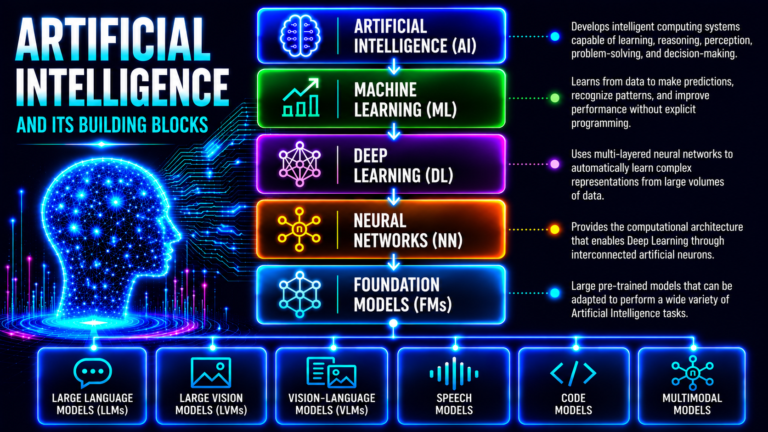
Modern LLMs are based on Foundation Models, which are pre-trained on large-scale datasets and can be adapted to a wide range of downstream tasks through prompting, fine-tuning, or integration with external knowledge sources. This flexibility has made LLMs the foundation of many modern AI applications, including conversational assistants, enterprise AI solutions, search systems, coding assistants, and intelligent automation platforms.
While the term Large Language Model emphasizes the model’s ability to process and generate language, modern LLMs are increasingly evolving into multimodal AI systems that can understand and generate not only text but also images, audio, video, and other forms of data.
Importance of Large Language Models in Artificial Intelligence
Large Language Models (LLMs) play a significant role in the broader Artificial Intelligence (AI) landscape by enabling computing systems to understand, interpret, and generate human language. Their ability to process natural language allows AI systems to communicate more naturally with people, analyze information, generate knowledge, and perform a wide range of language-related tasks across diverse applications.
Large Language Models (LLMs) are one of the building blocks of Artificial Intelligence, extending the capabilities of Foundation Models through natural language understanding and generation. Together with Machine Learning (ML), Deep Learning (DL), Artificial Neural Networks (ANNs), and Foundation Models (FMs), they form the Artificial Intelligence and Its Building Blocks technology stack.
Within this technology stack, Large Language Models specialize in natural language understanding and generation. They enable AI systems to process unstructured text, understand context, recognize relationships between concepts, generate coherent responses, and communicate using natural language. These capabilities make LLMs the language intelligence behind many AI-powered systems.
Large Language Models support a broad range of Artificial Intelligence applications, including conversational assistants, intelligent search, document analysis, translation, content generation, software development, knowledge management, Retrieval-Augmented Generation (RAG), AI agents, and decision support systems. By extending the capabilities of Foundation Models with advanced language processing, LLMs have become a fundamental technology that enables intelligent systems to interact with people and information more effectively across individuals, organizations, industries, governments, critical infrastructure, and society.
Evolution of Large Language Models
Large Language Models (LLMs) are the result of decades of research and technological advancements in Artificial Intelligence (AI), Natural Language Processing (NLP), Machine Learning (ML), and Deep Learning (DL). Their development reflects the continuous pursuit of improving how computers understand, interpret, and generate human language with greater accuracy, contextual awareness, and adaptability.
The earliest language processing systems relied on manually defined linguistic rules, making them effective only within narrowly defined domains. As the availability of digital text and computational resources increased, researchers introduced statistical methods that enabled computers to learn language patterns directly from data. This shift marked the beginning of data-driven Natural Language Processing and laid the foundation for more sophisticated language models.
The introduction of neural networks transformed language modeling by enabling computers to learn complex linguistic patterns without relying solely on manually engineered features. This advancement was followed by the Transformer architecture, which significantly improved the ability of models to process context, understand relationships between words, and scale to unprecedented sizes. These innovations ultimately led to the development of Foundation Models and, subsequently, Large Language Models capable of performing a wide variety of language-related tasks using a single general-purpose model.
The evolution of Large Language Models represents a continuous progression of technological innovations, with each development building upon the strengths of its predecessors while addressing their limitations. Together, these advancements have shaped the capabilities of modern language models and continue to drive the broader evolution of Artificial Intelligence.
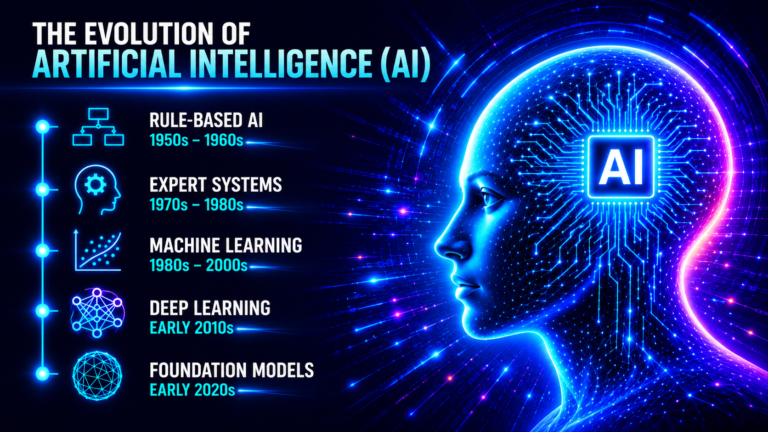
The evolution of Large Language Models can be understood through the following major technological developments:
- Rule-Based Natural Language Processing (NLP)
- Statistical Language Models
- Neural Language Models
- Transformer-Based Language Models
- Foundation Models
- Reasoning and Thinking Models
Each of these technological developments introduced new concepts, learning approaches, architectures, and capabilities that collectively contributed to the development of modern Large Language Models.
Rule-Based Natural Language Processing (NLP)
Rule-Based Natural Language Processing (NLP) represents one of the earliest approaches to enabling computers to process and understand human language. Instead of learning from data, rule-based systems relied on manually defined linguistic rules, grammar, dictionaries, and vocabulary that were explicitly designed and programmed to interpret language and generate responses.
These systems analyzed language by applying predefined rules to identify words, sentence structures, and grammatical relationships. For example, a rule-based system could recognize specific keywords, match sentence patterns, or apply grammatical rules to determine the meaning of a sentence. Since every decision was based on predefined logic, the quality of the system depended entirely on the completeness and accuracy of the rules created by its developers.
Rule-based NLP systems performed well in environments where language was predictable and the range of possible inputs was limited. They were commonly used in applications such as grammar and spell checking, command-line interfaces, information extraction, keyword-based search, simple question-answering systems, and early conversational agents.
Despite their usefulness, rule-based systems faced significant limitations. Human language is highly complex, context-dependent, and constantly evolving. A single word can have multiple meanings depending on its context, and people often express the same idea using different words or sentence structures. Capturing every possible variation through manually written rules proved to be extremely difficult and time-consuming.
As language processing requirements became more sophisticated, maintaining and expanding large rule sets became increasingly challenging. Rule-based systems also struggled to understand ambiguity, infer meaning from context, adapt to new vocabulary, or generalize beyond the scenarios for which they had been explicitly programmed.
These limitations highlighted the need for approaches that could automatically learn language patterns from data rather than relying entirely on handcrafted rules. This transition led to the development of Statistical Language Models, marking the beginning of data-driven Natural Language Processing.
Statistical Language Models
Statistical Language Models represent the transition from rule-based Natural Language Processing (NLP) to data-driven language processing. Instead of relying on manually defined linguistic rules and grammar, these models learn the statistical relationships between words by analyzing large collections of textual data. This enables computers to identify language patterns and estimate the probability of words and phrases occurring together based on observations from the training data.
The fundamental principle behind Statistical Language Models is that language follows observable patterns. Words do not appear randomly; instead, they occur in predictable sequences and contexts. By analyzing the frequency and probability of word occurrences, statistical models estimate the likelihood of a word appearing before or after another word, enabling computers to predict the next word in a sequence and generate meaningful text.
One of the earliest and most widely adopted statistical approaches was the N-gram Language Model. An N-gram is a sequence of N consecutive words used to estimate the probability of the next word based on the words that precede it.
For example, consider the sentence:
Artificial Intelligence is transforming technology.
The sentence can be represented using different N-gram sequences:
- Unigrams (1-grams): Artificial, Intelligence, is, transforming, technology
- Bigrams (2-grams): Artificial Intelligence, Intelligence is, is transforming, transforming technology
- Trigrams (3-grams): Artificial Intelligence is, Intelligence is transforming, is transforming technology
By analyzing the frequency of these word sequences across large text corpora, N-gram models estimate the probability of the next word in a sequence. For example, if the phrase “Artificial Intelligence is” frequently appears with the word “transforming” in the training data, the model assigns a higher probability to “transforming” as the next word.
Compared to rule-based systems, Statistical Language Models require significantly fewer manually defined rules and can automatically learn language patterns from data. This enables them to adapt more effectively to different writing styles, vocabularies, and application domains while reducing the need for extensive manual rule creation.
Despite these advantages, Statistical Language Models have important limitations. Their predictions rely primarily on the statistical probability of nearby words, making it difficult to understand the broader context or capture long-range relationships within a sentence or document. As sentences become longer, the number of possible word combinations increases significantly, resulting in sparse data where many valid word sequences occur too infrequently—or not at all—in the training data.
Although Statistical Language Models represented a significant advancement in Natural Language Processing, their limited ability to understand context and semantic relationships restricted their performance on complex language tasks. These limitations motivated the development of Neural Language Models, which use artificial neural networks to learn richer language representations and capture more meaningful relationships between words.
Neural Language Models
Neural Language Models represent the next major advancement in the evolution of language modeling. Unlike Statistical Language Models, which rely primarily on the probability of word sequences, Neural Language Models use Artificial Neural Networks (ANNs) to learn language patterns directly from large collections of textual data. This enables them to understand grammatical structures, semantic relationships, and contextual information more effectively than earlier statistical approaches.
Rather than estimating language based solely on word frequency, Neural Language Models learn meaningful representations of words and their relationships. As a result, they can recognize similarities between words, interpret context more accurately, and generate more natural and coherent text. This ability significantly improved the performance of language-related tasks such as machine translation, speech recognition, question answering, text summarization, and text generation.
Several neural network architectures contributed to the evolution of Neural Language Models. Early approaches used Feedforward Neural Networks (FNNs) to learn word representations and predict the next word in a sequence. These were followed by Recurrent Neural Networks (RNNs), which introduced the ability to process sequential data by retaining information from previous words. To overcome the limitations of RNNs in capturing long-range dependencies, researchers developed Long Short-Term Memory (LSTM) networks and Gated Recurrent Units (GRUs), which improved the ability to retain contextual information across longer sequences.
Although these architectures represented a significant advancement over Statistical Language Models, they still processed text sequentially, making training computationally expensive and limiting their ability to capture relationships across very long documents. As language models continued to grow in size and complexity, a more efficient architecture became necessary.
These limitations led to the development of Transformer-Based Language Models, which introduced a fundamentally new approach to processing language. By enabling parallel processing and more effective handling of long-range contextual relationships, Transformer architectures laid the foundation for Foundation Models and the Large Language Models used today.
Transformer-Based Language Models
Transformer-Based Language Models represent one of the most significant breakthroughs in the evolution of language modeling. Introduced through the Transformer architecture, these models fundamentally changed how computers process and understand human language. Unlike earlier Neural Language Models, which processed text sequentially, Transformer-Based Language Models process entire sequences of text simultaneously. This parallel processing significantly improves training efficiency while enabling models to capture both short-range and long-range relationships between words more effectively.
A key innovation of Transformer-Based Language Models is the attention mechanism, which allows the model to determine the importance of every word in relation to all other words within a sentence or document. Instead of relying only on nearby words or previous hidden states, the model can focus on the most relevant parts of the input regardless of their position. This enables a much deeper understanding of grammar, context, semantic relationships, and the overall meaning of language.
The improved efficiency and contextual understanding provided by Transformer-Based Language Models allowed researchers to train increasingly larger models on massive collections of text. As model size, training data, and computational resources continued to expand, these models demonstrated remarkable capabilities across a wide range of language-related tasks, including text generation, translation, summarization, question answering, code generation, and conversational AI.
The success of Transformer-Based Language Models marked a turning point in Artificial Intelligence. Their ability to learn general language representations from large-scale datasets laid the foundation for the development of Foundation Models, which can be adapted to perform many different tasks using a single pre-trained model. These advancements ultimately led to the emergence of modern Large Language Models (LLMs).
Foundation Models
Foundation Models represent a significant milestone in the evolution of Artificial Intelligence and language modeling. Built upon the Transformer architecture, these models are trained on massive collections of diverse data to learn general-purpose knowledge and capabilities rather than being designed for a single, specific task. Instead of developing separate models for translation, summarization, question answering, or text generation, a single Foundation Model can be adapted to perform many different tasks with little or no additional training.
Unlike earlier Transformer-Based Language Models that were often developed for specific applications, Foundation Models are designed to serve as a common foundation for a broad range of downstream tasks. Through large-scale pre-training, they learn the statistical patterns, structures, and relationships present in language, enabling them to understand context, generate coherent responses, and transfer their knowledge across different domains and applications.
The introduction of Foundation Models transformed the way Artificial Intelligence systems are developed and deployed. Rather than building new models from scratch for every application, developers can adapt an existing Foundation Model using techniques such as prompting, fine-tuning, or Retrieval-Augmented Generation (RAG). This significantly reduces development time while improving scalability, flexibility, and performance across diverse use cases.
The success of Foundation Models led directly to the development of Large Language Models (LLMs). By scaling Transformer architectures with larger datasets, greater computational resources, and billions of parameters, Foundation Models evolved into highly capable language models that can understand, reason, and generate human language across an extensive range of tasks.
Large Language Models (LLMs)
Large Language Models (LLMs) represent the latest evolution of language modeling, building upon decades of advancements in Natural Language Processing, Neural Networks, Transformer architectures, and Foundation Models. They are large-scale, transformer-based Artificial Intelligence models trained on enormous collections of textual data to understand, interpret, generate, and reason about human language across a wide range of tasks.
Unlike earlier language models that were often developed for specific applications, Large Language Models are general-purpose models capable of performing multiple language-related tasks without requiring a separate model for each task. By learning the patterns, grammar, semantics, context, and relationships present in vast amounts of text, they can answer questions, generate content, summarize documents, translate languages, write software, analyze information, and assist with complex problem-solving.
The capabilities of Large Language Models are primarily driven by three factors: the Transformer architecture, massive training datasets, and large numbers of model parameters. Together, these enable LLMs to capture complex linguistic patterns, maintain contextual understanding over long passages, and generalize their knowledge across diverse domains and applications.
Modern Large Language Models continue to evolve through improvements in training methodologies, reasoning capabilities, multimodal learning, Retrieval-Augmented Generation (RAG), tool integration, and AI agent technologies. These advancements have significantly expanded their ability to support research, education, software development, business operations, scientific discovery, healthcare, cybersecurity, and numerous other fields.
Reasoning and Thinking Models
Reasoning and Thinking Models represent the latest advancement in the evolution of Large Language Models. While traditional Large Language Models are highly effective at understanding and generating human language, Reasoning and Thinking Models are designed to perform more structured, deliberate, and multi-step problem-solving. Rather than producing responses based primarily on learned language patterns, these models are optimized to analyze complex problems, evaluate multiple possibilities, and generate more accurate and logical solutions.
These models incorporate advanced reasoning capabilities that enable them to solve mathematical problems, write and analyze software, interpret complex instructions, perform scientific analysis, and assist with strategic decision-making. By breaking complex tasks into smaller logical steps, they improve consistency, reduce reasoning errors, and produce more reliable responses across a wide range of domains.
Modern Reasoning and Thinking Models also integrate with external tools, software applications, databases, web services, and Retrieval-Augmented Generation (RAG) systems to access up-to-date information and perform actions beyond language generation. This enables them to combine learned knowledge with real-time data, making them more effective for enterprise applications, research, automation, and intelligent decision support.
The continued advancement of Reasoning and Thinking Models represents a significant step toward more capable Artificial Intelligence systems that can understand, reason, plan, and solve increasingly complex problems. These developments are expected to play a central role in the next generation of AI-powered assistants, autonomous agents, scientific research, cybersecurity, healthcare, engineering, and many other domains.
Principles of Large Language Models (LLMs)
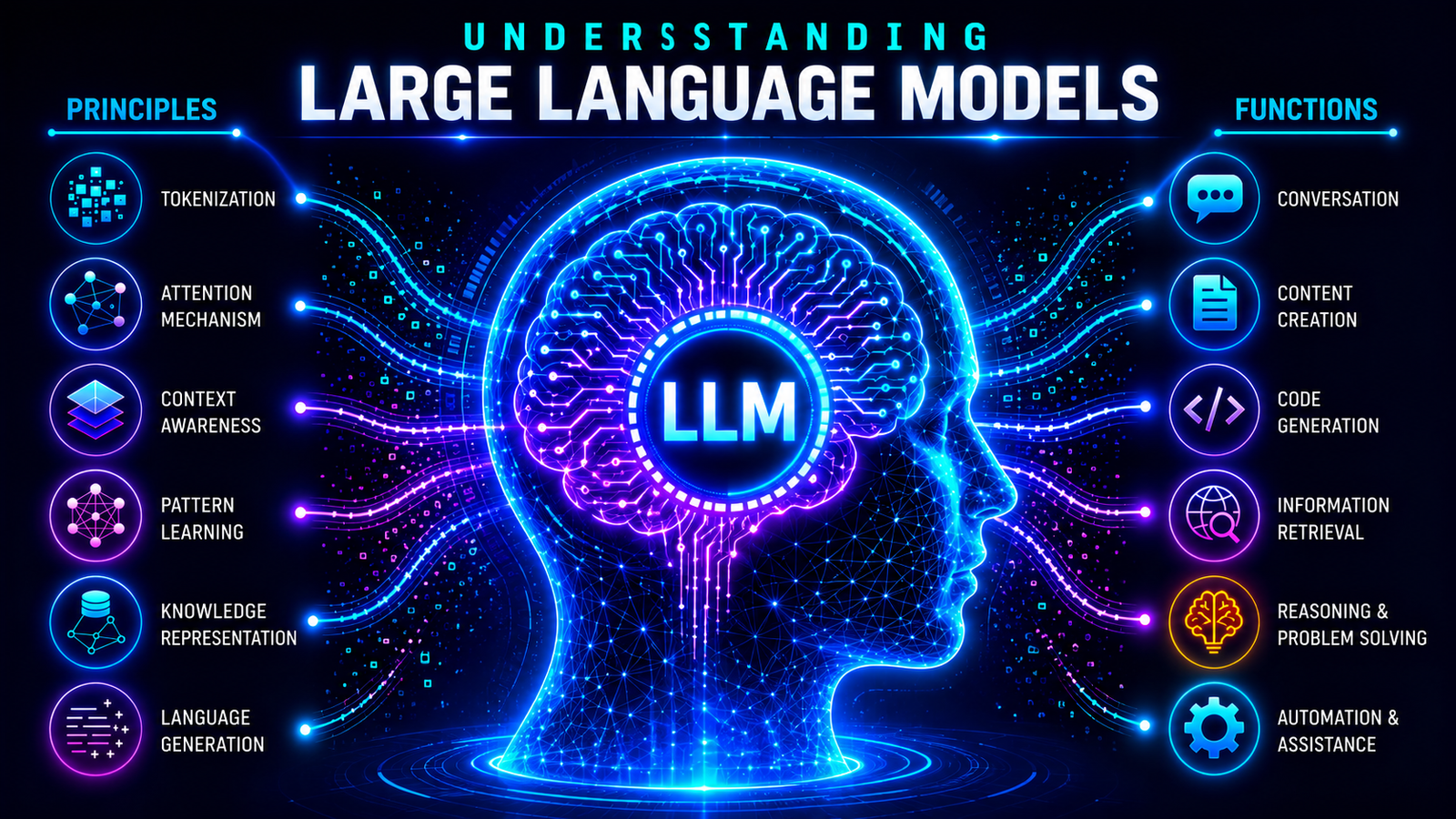
Large Language Models (LLMs) are built on a set of fundamental principles that enable them to understand, process, and generate human language. These principles define how LLMs interpret text, identify relationships between words, retain context, learn from massive datasets, and produce meaningful responses. Together, they form the conceptual foundation of modern language models and distinguish them from traditional rule-based language processing systems.
Tokenization
Before an LLM can process language, the input text is divided into smaller units called tokens. A token may represent a word, part of a word, punctuation mark, or special character. Tokenization transforms human-readable text into a format that the model can understand and process efficiently. Every prompt entered into an LLM is first converted into tokens before any further computation takes place.
Attention Mechanism
The attention mechanism enables an LLM to identify and focus on the most relevant words and phrases within a sequence of text. Rather than treating every token equally, the model determines which parts of the input are most important for understanding meaning. This selective focus allows the model to capture relationships between words that may be located far apart in a sentence or document, resulting in more accurate comprehension and response generation.
Context Awareness
Language derives meaning from context rather than from individual words alone. LLMs analyze surrounding words, phrases, and sentences to interpret the intended meaning of the input. This contextual understanding helps the model distinguish between different meanings of the same word, maintain coherence throughout a conversation, and generate responses that are relevant to the user’s request.
Pattern Learning
LLMs learn by identifying statistical patterns within enormous collections of text gathered from books, articles, websites, research papers, source code, and other language resources. During training, the model discovers relationships between words, phrases, grammar, sentence structures, and concepts. Instead of memorizing predefined rules, it learns how language is naturally used and applies these learned patterns to new inputs.
Knowledge Representation
As the model learns patterns from training data, it develops internal representations of language, facts, concepts, and relationships. This knowledge is encoded within the model’s parameters, allowing it to recognize similarities, infer relationships, and connect related ideas. Although LLMs can represent vast amounts of information, they do not store knowledge in the same way as traditional databases and may not always reflect the latest or perfectly accurate information.
Language Generation
The ultimate objective of an LLM is to generate coherent and meaningful language. After analyzing the input and its context, the model predicts the most probable next token based on everything it has learned during training. This prediction process repeats token by token until a complete response is produced. The result is natural language that can answer questions, write content, generate code, summarize documents, translate languages, and perform many other language-related tasks.
Bringing the Principles Together
These principles work together to enable the intelligent behavior of Large Language Models. Tokenization prepares the input for processing, the Attention Mechanism identifies important information, Context Awareness preserves meaning, Pattern Learning enables the model to recognize linguistic patterns, Knowledge Representation organizes learned information, and Language Generation produces coherent responses. Collectively, these principles form the foundation upon which modern Large Language Models are built and explain how they understand and interact with human language so effectively.
How Large Language Models Work
Large Language Models (LLMs) process and generate human language by learning patterns, relationships, and contextual information from vast amounts of textual data. Rather than storing predefined answers or following fixed rules, LLMs predict the most probable sequence of tokens based on the input they receive. This capability is made possible through the Transformer architecture, which enables the model to analyze language efficiently, understand context, and generate coherent, contextually relevant responses.
The operation of an LLM involves several interconnected components that work together to transform human-readable text into meaningful predictions. Input text is first broken into smaller units called tokens, which are then converted into numerical representations that capture their meaning. Positional information is added to preserve the order of tokens before they are processed through multiple Transformer layers that use attention mechanisms to understand relationships within the text. Finally, the model predicts and generates the next token repeatedly until a complete response is produced.
Understanding how Large Language Models process language provides valuable insight into how they interpret input, understand context, and generate meaningful responses. Although the underlying computations are highly complex, the overall process can be understood by examining each stage of the language processing pipeline. From converting human-readable text into numerical representations to analyzing contextual relationships and generating coherent responses, this process involves the following key components:
Input Processing with Tokenization
Tokenization is the process of breaking input text into smaller units called tokens, which serve as the basic units of data that a Large Language Model can understand and process. Since computers cannot interpret raw human language directly, text must first be converted into a format suitable for numerical computation. Tokenization transforms sentences into manageable pieces before they are converted into numerical representations known as embeddings.
A token does not always represent a complete word. Depending on the tokenization method, a token may be an entire word, part of a word (subword), an individual character, a punctuation mark, or even a special symbol. Modern Large Language Models primarily use subword tokenization, allowing them to efficiently represent common words while also handling rare words, technical terminology, names, abbreviations, and multiple languages without requiring an excessively large vocabulary.
For example, the sentence:
Artificial Intelligence is transforming cybersecurity.
may be tokenized into the following tokens:
- Artificial
- Intelligence
- is
- transforming
- cyber
- security
Each token is then assigned a unique numerical identifier called a Token ID, which serves as the input for the next stage of processing. These Token IDs are subsequently converted into numerical vectors known as embeddings, enabling the model to perform mathematical computations and understand the relationships between tokens.
Tokenization provides several advantages over processing complete words. It reduces the vocabulary size, improves the model’s ability to handle unfamiliar words, supports multilingual text, and enables efficient processing of large datasets. This flexibility allows Large Language Models to understand and generate text across diverse languages, domains, and applications.
Embeddings
Once the input text has been tokenized, each token is converted into a numerical representation known as an embedding. Since Large Language Models cannot process text directly, embeddings transform tokens into vectors of numbers that capture their meaning and relationships. These numerical vectors enable the model to perform mathematical computations while preserving the semantic and contextual information associated with each token.
Unlike Token IDs, which are simply unique identifiers assigned to tokens, embeddings contain meaningful numerical values that represent the characteristics of each token. Tokens with similar meanings or that frequently appear in similar contexts tend to have embeddings that are positioned closer together in a high-dimensional vector space. For example, the embeddings for doctor and physician are typically closer together than those for doctor and mountain, reflecting their semantic similarity.
Embeddings also enable Large Language Models to understand relationships between words beyond their literal meanings. They capture semantic similarities, contextual usage, grammatical relationships, and other linguistic patterns learned during training. This allows the model to recognize that different words or phrases can express similar concepts, even when they are not identical.
As the input passes through multiple Transformer layers, these embeddings are continuously refined based on the surrounding context. This process produces contextual embeddings, allowing the same word to have different representations depending on how it is used within a sentence. These dynamic representations significantly improve the model’s ability to understand language, interpret meaning, and generate contextually appropriate responses.
Positional Encoding
After text has been tokenized and converted into embeddings, every token is represented as a numerical vector that captures its semantic meaning. However, embeddings alone do not provide any information about the order in which the tokens appear. Since the Transformer processes all tokens simultaneously rather than sequentially, it has no inherent understanding of the position of each token within a sentence.
The order of words plays a fundamental role in determining meaning. Consider the following sentences:
- The firewall blocked the malicious traffic.
- The malicious traffic blocked the firewall.
Although both sentences contain the same words, their meanings are entirely different because the positions of the words have changed. Without positional information, a language model would struggle to distinguish between them.
To address this limitation, Transformers use Positional Encoding, a technique that incorporates information about the position of each token into its embedding before processing begins. By combining semantic information with positional information, the model can understand not only what each token represents but also where it appears within the sequence.
Rather than replacing the token embedding, positional information is added to it, creating a richer representation that preserves both meaning and word order. This enables the model to recognize grammatical structure, sentence organization, and relationships between tokens that depend on their positions.
The original Transformer architecture introduced sinusoidal positional encoding, which uses mathematical sine and cosine functions to generate unique positional vectors for every position in the sequence. Because these values follow predictable mathematical patterns, the model can recognize both absolute and relative positions without learning additional parameters.
Many modern Large Language Models instead use learned positional embeddings, where the positional vectors are learned during the training process. Other advanced approaches, such as Rotary Positional Embeddings (RoPE) and Attention with Linear Biases (ALiBi), improve the model’s ability to handle longer context windows while preserving positional relationships more effectively.
Although these techniques differ in implementation, they all serve the same purpose: enabling the model to understand the sequence and structure of language.
Once positional information has been incorporated into every token, the sequence is passed into the Transformer, where the model begins identifying relationships between tokens using the Attention Mechanism.
Self-Attention Mechanism
Once each token contains both semantic and positional information, the Transformer begins determining how every token relates to the others in the input sequence. This process is performed by the Attention Mechanism, one of the most significant innovations in modern Natural Language Processing and the foundation of Large Language Models.
Traditional sequence models, such as Recurrent Neural Networks (RNNs) and Long Short-Term Memory (LSTM) networks, process words one at a time in sequential order. As the sequence becomes longer, these models may struggle to retain information from earlier words, making it difficult to capture long-range dependencies.
The Transformer overcomes this limitation by allowing every token to examine every other token in the sequence simultaneously. Instead of processing words one after another, the model evaluates the relationships between all tokens in parallel, enabling it to build a comprehensive understanding of the entire context.
The Attention Mechanism determines which tokens are most relevant when interpreting the meaning of a particular token. Rather than treating every word equally, it assigns different levels of importance to different tokens based on their contextual relevance.
For example, consider the sentence:
The cybersecurity analyst investigated the incident because it was reported by multiple users.
To understand the sentence correctly, the model must determine that it refers to the incident, not the cybersecurity analyst. The Attention Mechanism enables the model to establish this relationship by assigning greater importance to the relevant tokens while reducing the influence of unrelated ones.
Similarly, in the sentence:
The firewall blocked the malicious traffic after it detected suspicious activity.
The model recognizes that it refers to the firewall, allowing it to interpret the sentence accurately.
By continuously evaluating relationships between tokens, the Attention Mechanism enables the model to understand context, resolve references, identify dependencies, and capture semantic relationships across an entire sequence.
Self-Attention
The specific form of attention used within the Transformer is known as Self-Attention. In Self-Attention, every token compares itself with every other token in the same input sequence, including itself.
Rather than considering only neighboring words, Self-Attention enables each token to gather contextual information from any other token, regardless of its position within the sentence.
For example, consider the sentence:
The engineer updated the firewall configuration after reviewing the security audit report.
To understand the meaning of reviewing, the model considers related tokens such as engineer, updated, firewall configuration, and security audit report. Although these words are separated within the sentence, Self-Attention allows the model to connect them directly.
This ability to establish long-distance relationships is one of the primary reasons why Transformer-based models significantly outperform earlier sequential language models.
Multi-Head Attention
Rather than using a single attention process, modern Transformers employ Multi-Head Attention, where multiple Self-Attention mechanisms operate simultaneously.
Each attention head learns to focus on different types of relationships within the same input sequence. For example, one attention head may learn grammatical relationships, another may identify semantic similarities, while others may recognize subject-object relationships, contextual references, or long-range dependencies.
Consider the sentence:
The cybersecurity engineer updated the firewall configuration after reviewing the security audit report.
Different attention heads may independently focus on different aspects of the sentence, such as:
- The relationship between engineer and updated.
- The connection between firewall and configuration.
- The dependency between reviewing and security audit report.
- The overall sequence of actions described in the sentence.
After all attention heads complete their analysis, their outputs are combined to produce a richer contextual representation of every token. Because multiple linguistic relationships are analyzed simultaneously, Multi-Head Attention provides a more comprehensive understanding of language than a single attention mechanism.
This parallel analysis allows Large Language Models to recognize complex grammatical structures, understand contextual nuances, resolve ambiguous references, and capture semantic relationships across long passages of text.
How Attention Contributes to Language Understanding
The Attention Mechanism enables Large Language Models to move beyond simple word matching and develop a contextual understanding of language. By dynamically determining which tokens are most relevant for interpreting each part of the input, the model can understand meaning based on the surrounding context rather than individual words alone.
This capability supports a wide range of language tasks, including:
- Understanding sentence structure.
- Resolving pronouns and references.
- Capturing long-range dependencies.
- Recognizing semantic relationships between words.
- Interpreting context-sensitive meanings.
- Supporting reasoning across complex passages.
Because every token can interact directly with every other token, the model develops a holistic understanding of the input sequence before generating its response.
The contextual representations generated by the Attention Mechanism are then passed through multiple layers of the Transformer Architecture, where they are progressively refined into increasingly sophisticated representations that enable the model to understand language and generate coherent responses.
Transformer Architecture
The Transformer Architecture is the deep learning architecture that powers modern Large Language Models (LLMs). Introduced in the research paper Attention Is All You Need in 2017, the Transformer revolutionized Natural Language Processing (NLP) by replacing sequential processing with a parallel processing approach based on the Attention Mechanism.
Building Blocks of the Transformer
A Transformer consists of multiple computational layers known as Transformer Blocks. Each block progressively refines the representation of every token, allowing the model to develop a deeper understanding of the input as it passes through successive layers.
Although implementations vary across different models, a typical Transformer block contains several core components that work together to process language efficiently:
- Multi-Head Attention
- Feed-Forward Neural Network (FFN)
- Residual Connections
- Layer Normalization
Each Transformer block receives contextual representations generated by the previous layer, performs a series of computations, and passes increasingly refined representations to the next layer. By stacking many Transformer blocks, the model gradually learns complex linguistic structures, semantic relationships, reasoning patterns, and contextual dependencies.
Multi-Head Attention
The first major component within every Transformer block is Multi-Head Attention. This layer enables each token to examine its relationship with every other token in the sequence, allowing the model to gather contextual information before further processing. Instead of relying on a single attention calculation, multiple attention heads operate simultaneously, with each head learning different grammatical, semantic, and contextual relationships.
The outputs generated by all attention heads are combined into a single contextual representation for every token. This enables the Transformer to understand multiple aspects of language simultaneously, producing richer and more informative representations than a single attention mechanism could achieve.
Feed-Forward Neural Network (FFN)
After the Multi-Head Attention layer has enriched the contextual representation of each token, the output is passed to a Feed-Forward Neural Network (FFN).
The Feed-Forward Neural Network processes each token independently using fully connected neural network layers and non-linear activation functions. While the Multi-Head Attention layer determines how tokens relate to one another, the FFN transforms these contextual representations into higher-level feature representations that capture increasingly complex language patterns.
Every token passes through the same Feed-Forward Network, ensuring consistent processing across the entire sequence. As information flows through multiple Transformer blocks, these repeated transformations enable the model to learn sophisticated semantic relationships, abstract concepts, and reasoning patterns.
Residual Connections
As neural networks become deeper, important information may gradually weaken while passing through numerous computational layers, making training more difficult. To overcome this challenge, the Transformer incorporates Residual Connections, also known as Skip Connections.
Rather than replacing the original representation with the output produced by a layer, the Transformer combines the original input with the newly computed output before passing it to the next stage. This allows valuable information from earlier layers to continue flowing through the network while preserving the improvements introduced by each successive layer.
Residual Connections improve gradient flow during training, reduce information loss, accelerate convergence, and enable the successful training of extremely deep Transformer models containing dozens or even hundreds of layers.
Layer Normalization
After each major computation within a Transformer block, the model applies Layer Normalization.
Layer Normalization standardizes the numerical values of the token representations before they are passed to the next component. By maintaining stable numerical distributions throughout the network, it helps prevent large fluctuations during training that could otherwise slow learning or reduce model stability.
This normalization process contributes to faster convergence, improved numerical stability, better generalization, and more reliable model performance during both training and inference. Together with Residual Connections, Layer Normalization enables modern Large Language Models to scale efficiently to billions or even trillions of parameters.
Decoder-Only Transformer Architecture
The original Transformer architecture introduced in 2017 consisted of two primary components: an Encoder and a Decoder. While both components remain important in many machine learning applications, most modern Large Language Models use only the Decoder portion of the architecture.
A Decoder-Only Transformer is specifically designed for autoregressive language modeling, where the model predicts one token at a time based on all previously processed or generated tokens. After generating each token, it is added to the context and used to predict the next token, allowing the model to generate coherent sentences, paragraphs, and entire documents sequentially.
This architecture is particularly well suited for generative AI applications such as conversational AI, text generation, summarization, question answering, programming assistance, reasoning, and content creation.
Many widely used Large Language Models, including GPT, Llama, Claude, Gemini, Mistral, and Qwen, are built using decoder-only Transformer architectures, although they may differ in scale, training methodology, and implementation details.
Context Window
The Context Window is the maximum amount of information a Large Language Model (LLM) can consider at one time while processing input and generating responses. It defines the number of tokens the model can retain and use as context during a single interaction.
Every prompt submitted to an LLM, including user input, system instructions, uploaded content, and the model’s previous responses, occupies part of the available context window. As new tokens are added, older tokens may eventually fall outside the context window and are no longer considered when generating subsequent responses.
The size of the context window directly influences the model’s ability to understand long conversations, analyze lengthy documents, summarize large amounts of text, write complex code, and maintain consistency across extended interactions.
Modern Large Language Models support a wide range of context window sizes, from a few thousand tokens to hundreds of thousands or even millions of tokens, depending on the model architecture and implementation.
How the Context Window Works
When a prompt is submitted, the input text is first converted into tokens through the tokenization process. These tokens, along with any previous conversation history or retrieved information, are placed within the available context window. The Transformer processes all tokens within this window simultaneously using the Attention Mechanism, allowing every token to consider the relevant information from other tokens before predicting the next token.
As the conversation grows, newly generated tokens are continually added to the context. Once the maximum context length is reached, the oldest tokens are typically removed to make room for new ones. Consequently, information that falls outside the context window is no longer available to the model unless it is reintroduced in a later prompt.
Factors Affecting Context Window Performance
Although a larger context window enables the model to process more information, it also increases computational complexity, memory usage, and inference time. Model developers therefore balance context length with processing efficiency and overall performance.
In practical applications, techniques such as Retrieval-Augmented Generation (RAG), context management, and prompt optimization are often used to provide relevant information without relying solely on an extremely large context window.
Inference and Text Generation
Inference
Inference is the process by which a trained Large Language Model (LLM) generates responses to user input. Unlike the training phase, where the model learns patterns from vast amounts of data, inference uses the knowledge already stored within the trained model to predict and generate new text.
When a user submits a prompt, the input is first converted into tokens through the tokenization process. These tokens are transformed into embeddings, enriched with positional information, and processed through multiple Transformer layers using the Attention Mechanism. Based on the contextual representations produced by these layers, the model predicts the most likely next token.
Text Generation
Text generation is the process of producing coherent and meaningful output by repeatedly predicting the next token during inference. Instead of generating an entire response at once, an LLM generates text one token at a time. After each token is produced, it is appended to the existing context and becomes part of the input for predicting the next token.
This autoregressive process continues until the model reaches a stopping condition, such as generating an end-of-sequence token, reaching the maximum output length, or satisfying another predefined stopping criterion. By repeatedly predicting and appending tokens, the model constructs complete words, sentences, paragraphs, computer code, or even entire documents that are contextually relevant to the user’s prompt.
Token Selection Strategies
During inference, the model calculates a probability distribution for all possible next tokens. Different decoding strategies determine which token is selected, influencing the quality, diversity, and creativity of the generated response.
Common decoding strategies include:
- Greedy Decoding, which always selects the token with the highest probability.
- Beam Search, which evaluates multiple possible token sequences simultaneously to identify the most likely overall output.
- Sampling, which introduces controlled randomness by selecting tokens based on their probability distribution rather than always choosing the highest-probability option.
- Temperature, which adjusts the randomness of token selection by making predictions more deterministic or more diverse.
- Top-k Sampling, which limits token selection to the top k most probable candidates.
- Top-p (Nucleus) Sampling, which selects tokens from the smallest set of candidates whose cumulative probability exceeds a specified threshold.
These decoding techniques allow LLMs to generate responses that range from highly predictable and factual to more creative and varied, depending on the requirements of the application.
Training Large Language Models
Training is the process through which a Large Language Model (LLM) learns to understand and generate human language. Rather than being programmed with explicit rules, LLMs learn by analyzing vast amounts of text and identifying statistical patterns, relationships, grammar, context, and semantic meaning.
Modern LLMs are typically developed through multiple stages. The model is first trained on massive datasets to acquire general language understanding, then refined for specific tasks or domains, aligned with human preferences, and, when necessary, augmented with external knowledge to improve the accuracy and relevance of its responses.
Pre-training
Pre-training is the first and most computationally intensive stage of training an LLM. During this phase, the model is exposed to enormous collections of publicly available text, including books, articles, websites, research papers, technical documentation, and other textual sources.
Instead of memorizing information, the model learns the statistical relationships between words and tokens by repeatedly predicting missing or subsequent tokens within a sequence. Through billions or even trillions of training examples, it gradually develops an understanding of grammar, sentence structure, facts, reasoning patterns, writing styles, and contextual relationships.
The result of this stage is a Foundation Model that possesses broad language knowledge and can perform many general-purpose tasks, although it has not yet been optimized for specific applications or user interactions.
Fine-Tuning
After pre-training, the model can be further refined through Fine-Tuning to improve its performance for particular tasks, industries, or domains.
Fine-tuning uses smaller, carefully curated datasets that teach the model specialized knowledge or desired behaviors. For example, a general-purpose LLM may be fine-tuned for healthcare, finance, legal research, software development, customer support, or scientific applications.
Modern fine-tuning techniques such as Parameter-Efficient Fine-Tuning (PEFT) and Low-Rank Adaptation (LoRA) enable organizations to customize large models efficiently by updating only a small subset of model parameters rather than retraining the entire model. This significantly reduces computational cost while preserving the model’s general capabilities.
Model Alignment
Although pre-trained and fine-tuned models possess strong language capabilities, they do not always generate responses that align with human expectations. Model Alignment is the process of improving a model’s behavior so that its responses are more helpful, accurate, safe, and consistent with human preferences.
One widely used approach is Reinforcement Learning from Human Feedback (RLHF), where human evaluators assess multiple model responses, allowing the model to learn which outputs are generally preferred. More recent approaches, such as Direct Preference Optimization (DPO), achieve similar alignment by learning directly from human preference data without using reinforcement learning.
Model alignment plays an important role in reducing harmful outputs, improving response quality, and making LLMs more reliable for real-world applications.
Retrieval-Augmented Generation (RAG)
Large Language Models rely primarily on the knowledge acquired during training. As a result, they may lack information about recent events or organization-specific data that was unavailable during the training process.
Retrieval-Augmented Generation (RAG) addresses this limitation by retrieving relevant information from external knowledge sources during inference. These sources may include enterprise document repositories, databases, knowledge bases, APIs, vector databases, or search systems.
Instead of relying solely on its internal knowledge, the LLM combines the retrieved information with the user’s prompt to generate responses that are more accurate, up-to-date, and contextually relevant. Because RAG retrieves information dynamically rather than modifying the model itself, organizations can keep AI applications current without retraining the underlying model. This makes RAG particularly valuable for enterprise AI systems that depend on frequently changing or proprietary information.
Prompt Engineering
Prompt Engineering is the practice of designing and structuring prompts to guide a Large Language Model (LLM) toward generating accurate, relevant, and useful responses. Since LLMs generate outputs based on the instructions and context provided, the quality of a prompt significantly influences the quality of the response.
A prompt may consist of a simple question, a detailed instruction, contextual information, examples, reference documents, or a combination of these elements. Well-crafted prompts help the model better understand the user’s intent, reduce ambiguity, and produce more consistent and reliable outputs.
Although modern LLMs are capable of understanding natural language, effective prompt engineering enables users to maximize the capabilities of the model across a wide range of applications, including content creation, software development, data analysis, research, education, and business automation.
Components of an Effective Prompt
An effective prompt provides sufficient information for the model to understand the task while minimizing ambiguity. Depending on the complexity of the request, a prompt may include one or more of the following components:
- Instruction – Clearly defines the task the model should perform.
- Context – Provides background information that helps the model understand the situation.
- Input Data – Supplies the information that the model should analyze or process.
- Constraints – Specifies requirements such as format, length, style, language, or scope.
- Examples – Demonstrates the expected input-output pattern to improve response quality.
Not every prompt requires all of these components. Simple questions may require only an instruction, while more complex tasks often benefit from additional context and examples.
Common Prompting Techniques
Different prompting techniques help users guide LLMs for various types of tasks.
- Zero-Shot Prompting – The model performs a task using only the instruction without any examples.
- One-Shot Prompting – A single example is provided to illustrate the expected output.
- Few-Shot Prompting – Multiple examples are included to help the model learn the desired pattern before generating a response.
- Role Prompting – The model is assigned a specific role, such as a teacher, software engineer, legal advisor, or cybersecurity analyst, to influence the style and context of its response.
- Chain-of-Thought Prompting – Encourages the model to reason through complex problems by breaking them into intermediate steps. Modern reasoning models may perform this reasoning internally without exposing every intermediate step.
Different techniques are suitable for different tasks, and combining multiple approaches often produces better results.
Prompt Engineering Best Practices
Following good prompting practices helps improve response quality and consistency.
- Clearly define the objective.
- Provide sufficient context.
- Use precise and unambiguous language.
- Break complex tasks into smaller steps.
- Specify the desired output format.
- Include examples when appropriate.
- Review and refine prompts based on the generated results.
Prompt engineering is often an iterative process. Small changes to wording, context, or instructions can significantly influence the quality, accuracy, and usefulness of the generated response.
AI Agents and Tool Use
Large Language Models (LLMs) are designed to understand and generate human language, but they cannot perform actions outside the knowledge contained within the model unless they are connected to external tools or systems. AI Agents extend the capabilities of LLMs by enabling them to reason, make decisions, interact with external resources, and perform tasks on behalf of users.
An AI agent combines the reasoning abilities of an LLM with additional components such as memory, planning, and tool integration. Rather than simply responding to a single prompt, an agent can execute multiple steps, retrieve information, call external services, and adapt its actions based on the results obtained during execution.
Components of an AI Agent
Although implementations vary, most AI agents consist of several key components that work together to accomplish tasks.
- Large Language Model (LLM) – Serves as the reasoning engine that understands user requests, plans actions, and generates responses.
- Memory – Stores information from previous interactions or ongoing tasks, allowing the agent to maintain context over time.
- Planning – Breaks complex objectives into smaller, manageable tasks and determines the sequence of actions required.
- Tools – Enables the agent to interact with external systems such as search engines, databases, APIs, calculators, code interpreters, and enterprise applications.
Together, these components allow an AI agent to perform tasks that extend beyond the capabilities of a standalone language model.
Tool Calling
A standalone LLM generates responses based on the information available within its training data and the current context window. When external information or actions are required, the model can use Tool Calling, also known as Function Calling, to interact with external systems.
Examples of tools that an AI agent may use include:
- Web search services
- Databases and knowledge bases
- APIs
- File systems
- Email and messaging platforms
- Calendar and scheduling applications
- Calculators
- Code execution environments
Rather than generating an answer solely from its internal knowledge, the LLM determines when a tool is needed, invokes the appropriate tool, processes the returned information, and incorporates the results into its final response.
Agent Workflows
Unlike traditional prompt-response interactions, AI agents can execute multi-step workflows to accomplish more complex objectives.
For example, an AI agent tasked with preparing a business report might:
- Search for recent information.
- Retrieve relevant documents.
- Analyze the collected data.
- Generate a summary.
- Create charts or tables.
- Produce a formatted report.
Throughout this process, the agent uses reasoning to determine the next action based on the results of previous steps, allowing it to complete tasks that require planning, decision-making, and coordination across multiple tools.
Multi-Agent Systems
Some applications use Multiple AI Agents that collaborate to solve complex problems. Instead of assigning every responsibility to a single agent, different agents specialize in specific tasks.
For example:
- A research agent gathers information.
- An analysis agent evaluates the findings.
- A writing agent prepares the final document.
- A review agent checks accuracy and consistency.
By distributing responsibilities among specialized agents, multi-agent systems can improve scalability, efficiency, and task specialization for complex workflows.
Key Characteristics
- AI agents extend the capabilities of Large Language Models by combining reasoning with planning, memory, and external tools.
- Agents can perform multi-step tasks rather than responding to a single prompt.
- Tool calling enables LLMs to retrieve information and interact with external systems.
- Memory helps maintain context across multiple interactions.
- Planning allows agents to break complex objectives into manageable tasks.
- Multi-agent systems enable specialized agents to collaborate on solving complex problems.
Capabilities of Large Language Models
Large Language Models (LLMs) have transformed the way humans interact with computers by enabling machines to understand, process, and generate natural language. Trained on vast amounts of text, LLMs can perform a wide range of language-related tasks across different domains without requiring task-specific programming. Their versatility has made them valuable tools for individuals, businesses, researchers, educators, and software developers.
Natural Language Understanding
LLMs can understand the meaning, context, and intent of human language. They are capable of interpreting questions, instructions, conversations, and documents while recognizing relationships between words, phrases, and sentences. This enables them to respond appropriately even when queries are expressed in different styles or levels of complexity.
Text Generation
One of the primary capabilities of LLMs is generating coherent and contextually relevant text. They can produce articles, reports, emails, documentation, marketing content, creative writing, and conversational responses while maintaining consistency with the provided prompt.
Summarization
LLMs can analyze lengthy documents and produce concise summaries that capture the key ideas while preserving the overall meaning. This capability is valuable for processing research papers, business reports, technical documentation, legal documents, and meeting transcripts.
Translation
Modern LLMs support multilingual communication by translating text between numerous languages while preserving context and meaning. Beyond direct translation, they can also adapt tone, style, and terminology to suit different audiences.
Question Answering
LLMs can answer factual, conceptual, and analytical questions by combining their learned knowledge with the context provided in a prompt. When integrated with external knowledge sources, they can also generate responses based on current or organization-specific information.
Reasoning and Problem Solving
Advanced LLMs can perform logical reasoning, analyze complex situations, compare alternatives, identify patterns, and assist with decision-making. Modern reasoning models are particularly effective at solving multi-step problems involving mathematics, programming, scientific concepts, and structured analysis.
Code Generation
LLMs can assist with software development by generating source code, explaining programming concepts, identifying bugs, suggesting improvements, converting code between programming languages, and creating technical documentation. They support numerous programming languages and development frameworks.
Multimodal Capabilities
Many modern LLMs have evolved into multimodal AI systems capable of processing and generating multiple forms of data, including text, images, audio, and video. This enables users to interact with AI using different types of content rather than relying solely on text-based prompts.
Key Characteristics
- Understand and generate human language.
- Produce coherent and contextually relevant text.
- Summarize large volumes of information.
- Translate content across multiple languages.
- Answer factual and analytical questions.
- Assist with reasoning and problem solving.
- Generate, analyze, and explain computer code.
- Support multimodal interactions involving text, images, audio, and other data types.
Limitations and Challenges of Large Language Models
Although Large Language Models (LLMs) have demonstrated remarkable capabilities, they are not without limitations. Their responses are based on patterns learned during training rather than true understanding, reasoning, or consciousness. As a result, LLMs may produce inaccurate information, reflect biases present in training data, or struggle with tasks that require current knowledge or specialized expertise.
Understanding these limitations is essential for using LLMs responsibly and effectively in both personal and professional settings.
Hallucinations
One of the most well-known limitations of LLMs is hallucination, where the model generates information that appears accurate and convincing but is factually incorrect, misleading, or entirely fabricated.
Hallucinations can occur when the model lacks sufficient knowledge, misinterprets a prompt, or predicts plausible text without verifying its accuracy. For this reason, information generated by an LLM should be validated before being used in critical decision-making or high-risk applications.
Knowledge Cutoff
An LLM’s knowledge is generally limited to the information available during its training. Events, discoveries, technologies, or regulations that emerged after the training period may not be reflected in the model’s responses.
Many modern AI systems address this limitation by integrating external data sources through techniques such as Retrieval-Augmented Generation (RAG) or web search, allowing them to access more recent information during inference.
Context Window Limitations
Although modern LLMs support increasingly large context windows, they can process only a finite number of tokens within a single interaction.
When the available context is exceeded, older information may no longer be considered while generating new responses. This can affect the model’s ability to maintain continuity during lengthy conversations or process extremely large documents without additional context management techniques.
Bias and Fairness
LLMs learn from vast collections of publicly available data, which may contain cultural, social, or historical biases. Consequently, the model may occasionally produce biased, stereotypical, or unbalanced responses that reflect patterns present in the training data.
Developers use various techniques to reduce these biases, but completely eliminating them remains an ongoing challenge.
Privacy and Security
Users should exercise caution when submitting sensitive, confidential, or personally identifiable information to LLMs. Depending on the deployment model and organizational policies, data may be processed by external services or stored for operational purposes.
Organizations often implement privacy controls, access restrictions, and governance policies to protect sensitive information when deploying LLM-based applications.
Explainability
LLMs are often considered black-box models because they do not explicitly explain how they arrive at a particular response. Although they can provide reasoning or explanations, these explanations may not accurately reflect the internal decision-making process of the model.
This lack of transparency can make it difficult to verify outputs or understand why a particular response was generated.
Computational Cost
Training and operating modern LLMs require significant computational resources, including specialized hardware, large-scale storage, and substantial energy consumption. As model size and context windows increase, the computational cost of inference also grows.
Organizations must balance model capability with infrastructure requirements, operational costs, and environmental considerations.
Applications of Large Language Models
Large Language Models (LLMs) have become a foundational technology across numerous industries by enabling machines to understand, generate, and process human language. Their ability to perform a wide range of language-related tasks makes them valuable for improving productivity, automating workflows, supporting decision-making, and enhancing user experiences.
As LLMs continue to evolve, their applications are expanding across business, education, healthcare, software development, research, and many other domains.
Conversational AI
LLMs power intelligent conversational systems such as virtual assistants, AI chatbots, and customer support agents. These systems can understand user queries, provide natural responses, maintain conversational context, and assist users with a wide variety of tasks.
Content Creation
LLMs assist individuals and organizations in creating articles, reports, blogs, emails, marketing materials, product descriptions, technical documentation, and creative content. They can also help improve grammar, readability, tone, and writing style.
Software Development
Software developers use LLMs to generate source code, explain programming concepts, identify bugs, suggest code improvements, create documentation, generate test cases, and assist throughout the software development lifecycle.
Education and Learning
LLMs serve as personalized learning assistants by explaining concepts, answering questions, generating study materials, summarizing educational content, and supporting learners across different subjects and skill levels.
Research and Knowledge Discovery
Researchers use LLMs to summarize research papers, analyze technical documents, extract key insights, compare information from multiple sources, and accelerate literature reviews across scientific and academic disciplines.
Healthcare
Healthcare professionals use LLMs to assist with clinical documentation, medical transcription, patient communication, medical literature review, and administrative workflows. LLMs can also support healthcare research and medical education, although clinical decisions should always involve qualified healthcare professionals.
Business and Enterprise
Organizations use LLMs to automate routine tasks, improve customer engagement, analyze business documents, generate reports, support knowledge management, and enhance employee productivity across departments such as finance, human resources, legal, sales, and operations.
Cybersecurity
LLMs assist cybersecurity professionals by summarizing threat intelligence, analyzing security logs, explaining vulnerabilities, generating security documentation, supporting incident investigations, assisting with secure coding, and improving security awareness and training.
Scientific Research
Scientists use LLMs to analyze publications, organize research findings, generate hypotheses, summarize experimental results, and support collaboration across multidisciplinary research projects.
Key Characteristics
- Enable natural language interaction across diverse applications.
- Improve productivity through task automation and intelligent assistance.
- Support content creation, research, education, and software development.
- Enhance business processes through document analysis and knowledge management.
- Assist professionals across industries, including healthcare and cybersecurity.
- Continue to expand into new domains as models become more capable and multimodal.
Future of Large Language Models
Large Language Models (LLMs) continue to evolve at a rapid pace, driving advancements in artificial intelligence across research, industry, and everyday applications. Ongoing improvements in model architectures, training techniques, reasoning capabilities, and multimodal processing are enabling LLMs to become more capable, efficient, and adaptable.
Future developments are expected to focus not only on improving performance but also on making LLMs more reliable, trustworthy, and accessible for a broader range of applications.
More Advanced Reasoning Models
Recent advances have shifted the focus from traditional text generation toward models capable of deeper reasoning and problem solving. Future LLMs are expected to perform increasingly complex analytical tasks, support multi-step decision-making, and solve problems that require planning, logical reasoning, and domain-specific expertise.
Longer Context Windows
As model architectures improve, LLMs are becoming capable of processing increasingly larger amounts of information within a single interaction. Longer context windows will enable more effective analysis of lengthy documents, extended conversations, software projects, and enterprise knowledge repositories while maintaining greater contextual consistency.
Native Multimodal AI
Modern AI systems are rapidly evolving beyond text-only capabilities. Future LLMs will increasingly integrate text, images, audio, video, and other forms of data within a single model, allowing users to communicate naturally using multiple input and output modalities.
Autonomous AI Agents
Future AI systems are expected to move beyond simple conversational assistants toward autonomous agents capable of planning, reasoning, using external tools, collaborating with other agents, and executing complex workflows with minimal human intervention.
More Efficient and Accessible Models
Advances in model optimization, hardware, and training techniques are making LLMs smaller, faster, and more energy-efficient. These improvements will enable high-performance AI models to run on a wider range of devices, including personal computers, mobile devices, and edge computing platforms.
Responsible AI and Governance
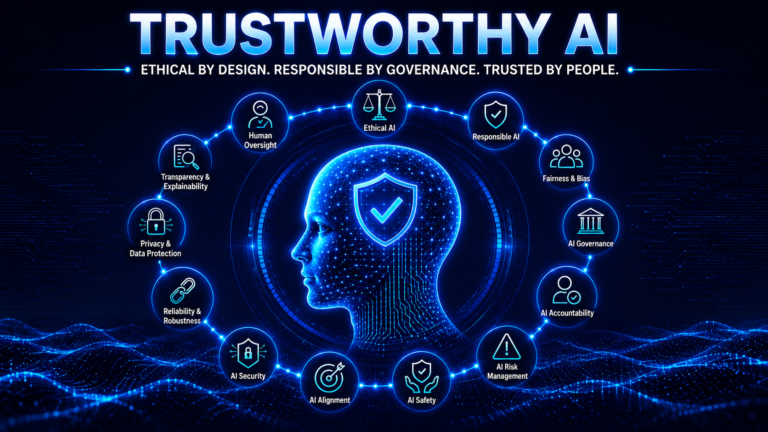
As LLM adoption continues to grow, increasing emphasis is being placed on developing AI systems that are safe, transparent, fair, secure, and accountable. Organizations, researchers, and governments are working to establish governance frameworks, ethical guidelines, regulatory requirements, and technical safeguards that promote the responsible development and deployment of AI technologies.
Key Characteristics
- Future LLMs will demonstrate stronger reasoning and decision-making capabilities.
- Larger context windows will improve long-document and long-conversation understanding.
- Multimodal AI will support seamless interaction across text, images, audio, and video.
- Autonomous AI agents will perform increasingly complex tasks using external tools.
- Continued optimization will make LLMs more efficient and widely accessible.
- Responsible AI practices and governance will play a central role in the future development of LLMs.
Conclusion
Large Language Models (LLMs) have fundamentally transformed the field of artificial intelligence by enabling machines to understand, generate, and interact using human language. Built on the Transformer architecture and trained on vast amounts of textual data, LLMs can perform a wide range of tasks, from answering questions and generating content to assisting with software development, research, education, and business operations.
Understanding how LLMs evolved, how they work, how they are trained, and how they are applied provides a solid foundation for exploring the broader field of AI. While these models continue to improve in capability, they also present challenges related to accuracy, bias, privacy, transparency, and responsible use that require careful consideration.
As research continues to advance, LLMs are expected to become more intelligent, efficient, multimodal, and autonomous, expanding their role across industries and everyday life. A strong understanding of their capabilities, limitations, and future direction enables individuals and organizations to adopt these technologies more effectively and responsibly.