The Industrial Revolution
Introduction
The Industrial Revolution refers to a series of major transformations in the way goods are produced, resources are used, people work, and economies develop. Rather than being a single event, it represents a continuing process of industrial change driven by advances in technology, energy, production methods, communication, infrastructure, and human capabilities.
The first major transformation began with mechanization and steam power. Later phases were associated with electricity, mass production, electronics, computing, automation, connectivity, and intelligent systems. Each phase built upon capabilities developed during earlier periods while introducing new ways to organize and improve industrial activity.
The terms Industry 1.0 through Industry 5.0 are commonly used as a framework for describing major stages or paradigms in industrial transformation. However, these phases should not be understood as completely separate periods with precise boundaries or as complete replacements for one another.
In particular, Industry 5.0 builds upon and complements the capabilities associated with Industry 4.0 while placing greater emphasis on human-centricity, sustainability, and resilience. The European Commission specifically describes Industry 5.0 as complementary to Industry 4.0 rather than simply a chronological continuation of it.
Understanding this progression provides a foundation for understanding how industry has changed over time and why industrial systems continue to evolve as technology, economic conditions, environmental requirements, and societal needs change.
What Is the Industrial Revolution?
The Industrial Revolution is the broad transformation of industrial production and economic activity through significant changes in technology, energy sources, manufacturing methods, infrastructure, communication, and organizational practices.
Each industrial phase is characterized by a combination of technological capabilities and changes in the way those capabilities are applied. A new phase does not necessarily replace everything from the previous one. Instead, new technologies and methods are integrated with existing industrial systems, creating new forms of production and economic activity.
The major industrial phases can therefore be understood as stages or paradigms of cumulative development:
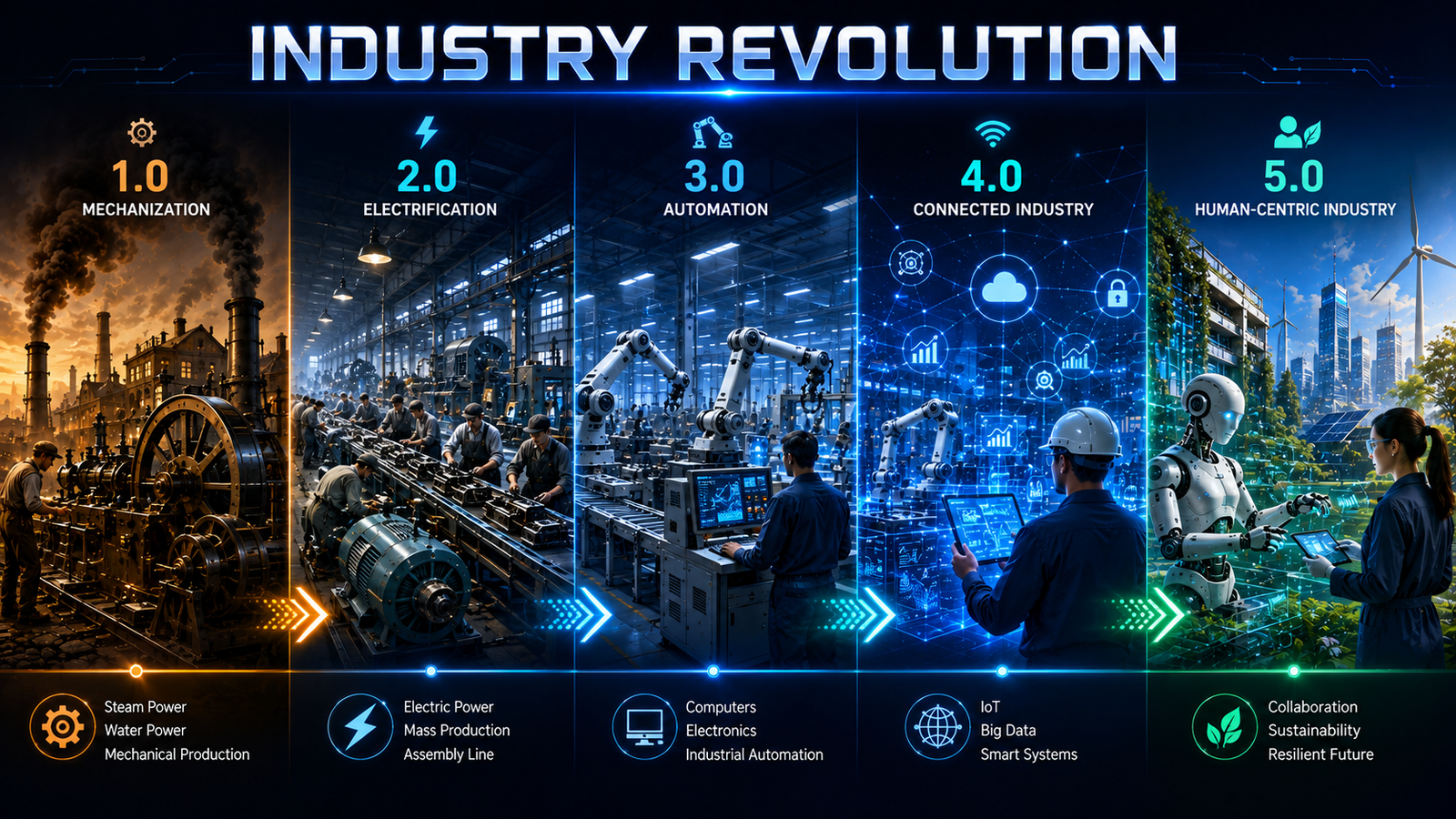
- Industry 1.0 was associated with mechanization through water and steam power.
- Industry 2.0 was associated with electricity, mass production, standardization, and major advances in transportation and communication.
- Industry 3.0 introduced electronics, computers, programmable systems, and industrial automation.
- Industry 4.0 introduced increasingly connected, data-driven, cyber-physical, and intelligent industrial systems.
- Industry 5.0 builds upon Industry 4.0 while placing greater emphasis on human-centricity, sustainability, and resilience.
These phases provide a framework for understanding the long-term evolution of industry rather than representing completely separate periods with precise starting and ending dates.
Why Industrial Revolutions Occur
Industrial transformation occurs when significant technological, economic, environmental, and societal changes create new possibilities or requirements for production and industrial organization.
Several factors commonly contribute to industrial transformation.
Technological Innovation
Major advances in technology can fundamentally change how industrial activities are performed. Steam engines, electrical systems, computers, networking technologies, robotics, and artificial intelligence have each introduced capabilities that have influenced industrial processes and created new possibilities for industrial development.
New Sources of Energy
Changes in the way energy is generated, distributed, and used have historically played an important role in industrial development. Steam power enabled mechanization, while electricity enabled more flexible and scalable industrial operations. Changes in energy availability and requirements can also influence the development of new industrial systems.
Advances in Production
Industrial transformation is also associated with changes in production methods. Mechanized manufacturing, assembly-line production, automation, and connected production systems have progressively increased the speed, flexibility, precision, and scalability of industrial operations.
Communication and Connectivity
The ability to communicate and exchange information more rapidly has increasingly connected industrial operations. Telegraph and telephone networks were followed by computer networks, the Internet, industrial connectivity, and interconnected cyber-physical systems. Greater connectivity has enabled industrial systems to coordinate activities and exchange information across increasingly complex environments.
Changing Human and Societal Needs
Industrial development is influenced not only by technology but also by changing workforce expectations, consumer requirements, economic conditions, environmental concerns, resource constraints, and broader societal priorities. These changing requirements can create new demands on how industries produce goods, use resources, organize work, and interact with society.
Integration of Existing Technologies
New industrial capabilities often emerge through the integration of technologies that previously operated independently. Computing, networking, sensors, automation, cloud infrastructure, data analytics, robotics, and artificial intelligence can combine to create capabilities that were not possible through any single technology alone.
For this reason, industrial evolution should be viewed as a continuous process of technological, economic, environmental, and societal transformation, rather than a sequence of completely isolated revolutions.
Evolution of the Industrial Revolution
The Industrial Revolution represents a long process of transformation rather than a single historical event. Each phase emerged as new technologies, energy sources, production methods, and organizational approaches changed the way industries operated.
The significance of these phases lies not only in the technologies they introduced but also in the broader changes they produced in manufacturing, transportation, communication, employment, trade, economic activity, and society.
Industry 1.0: The Transformation to Mechanized Production
Industry 1.0 marked the transition from predominantly manual production to mechanized production. Beginning in the late 18th century, the increasing use of water and steam power enabled machines to perform work that had previously depended largely on human and animal labor.
The development of mechanized textile production, steam-powered machinery, and factory-based production changed the scale and organization of industrial activity. Production increasingly moved from small workshops and traditional methods toward centralized factories where machinery, workers, materials, and processes could be brought together.
The transformation also extended beyond manufacturing. Steam-powered transportation contributed to the development of railways and steamships, allowing people and goods to move more efficiently across greater distances.
Industry 1.0 therefore established a new model of industrial production in which mechanical power became a central component of economic activity.
Industry 2.0: The Transformation to Electrified Mass Production
Industry 2.0 brought another major transformation through the widespread adoption of electricity and the development of more systematic production methods.
Electricity provided industries with a more flexible source of power and enabled factories to redesign production environments around electrically powered machinery. Production could be divided into specialized stages, making it possible to manufacture standardized products at much larger volumes.
The development of assembly-line production further changed industrial organization. Standardized components, specialized tasks, and coordinated production processes increased manufacturing scale and consistency while reducing the time required to produce many goods.
This period was also associated with major advances in transportation and communication. Railways expanded, automobiles became increasingly important, and technologies such as the telegraph and telephone improved the movement of information.
Industry 2.0 transformed industry toward increasingly electrified, standardized, and scalable production systems.
Industry 3.0: The Transformation to Automated and Digital Production
Industry 3.0 introduced electronics, computing, and digital control into industrial environments. The transformation was significant because industrial systems increasingly gained the ability to process information and execute programmed instructions.
Electronic control systems, computers, programmable logic controllers, industrial robots, and other forms of automation allowed many production processes to operate with less continuous manual intervention.
Digital technologies also changed how organizations planned, monitored, and managed industrial activities. Computers could support engineering, inventory management, production planning, process control, and other activities that previously depended heavily on manual information processing.
The industrial transformation therefore expanded beyond machines performing physical work. Information became an important industrial resource, enabling greater automation, precision, control, and coordination.
Industry 3.0 established much of the digital and automated foundation on which later connected industrial systems would be built.
Industry 4.0: The Transformation to Connected and Intelligent Industry
Industry 4.0 represents a broader transformation in which industrial systems become increasingly connected, data-driven, and capable of interacting with digital systems.
The major change is not simply the introduction of individual technologies. It is the integration of machines, sensors, software, networks, data, computing resources, and people into increasingly connected industrial environments.
Industrial equipment can generate operational data, connected systems can exchange information, and analytical technologies can use that information to support monitoring, optimization, prediction, and decision-making. Physical processes can increasingly be represented and managed through digital systems.
Industry 4.0 is closely associated with concepts such as cyber-physical systems, Industrial Internet of Things, automation, data analytics, and smart manufacturing. NIST describes the convergence of cyber-physical systems, systems engineering, and manufacturing innovation as an important aspect of smart manufacturing.
This transformation has enabled new approaches to manufacturing, maintenance, supply-chain management, quality management, logistics, and industrial services.
Industry 4.0 therefore represents the transition from largely automated and digitally controlled industrial processes toward connected, integrated, data-driven, and increasingly intelligent industrial ecosystems.
Industry 5.0: The Transformation Toward Human-Centric Industry
Industry 5.0 builds upon the technological capabilities associated with Industry 4.0 while broadening the objectives of industrial development.
The European Commission describes Industry 5.0 as a vision that goes beyond efficiency and productivity as the sole objectives of industry. It identifies three core priorities: human-centricity, sustainability, and resilience.
Human-centricity places people, their wellbeing, skills, participation, and empowerment at the centre of industrial systems. Advanced machines, robotics, artificial intelligence, and other intelligent technologies can work alongside people, supporting human expertise, creativity, decision-making, and specialized capabilities rather than treating automation and productivity as the only objectives.
Sustainability gives greater importance to the environmental consequences of industrial activity. Industrial systems can increasingly consider resource efficiency, energy use, circular approaches, waste reduction, and the environmental impact of production. The objective is to align industrial development with broader environmental requirements rather than evaluating industrial progress only through production and economic measures.
Resilience concerns the ability of industrial systems to withstand, adapt to, and recover from disruptions. Industrial resilience can involve the robustness of production systems, supply chains, infrastructure, workforce capabilities, and organizational processes. The increasing interdependence of physical and digital systems also makes resilience an important consideration in industrial transformation.
Industry 5.0 emphasizes the potential for people and intelligent technologies to work together. Human knowledge and judgement can complement machine capabilities such as computation, automation, sensing, precision, and data processing. This approach can support new forms of work and production in which technology augments human capabilities.
Advanced industrial technologies can also support greater personalization and customization of products while retaining the benefits of sophisticated production systems. This is an example of how Industry 5.0 capabilities can broaden industrial possibilities beyond highly standardized, high-volume production.
Industry 5.0 can therefore be understood as a broader approach to industrial transformation in which technology supports human, environmental, and organizational objectives alongside technological and economic performance.
It is important to distinguish this from the idea that Industry 5.0 simply represents a chronological replacement for Industry 4.0. The European Commission explicitly describes Industry 5.0 as complementing and extending Industry 4.0, rather than being a strictly chronological continuation of it.
Future Phases of the Industrial Revolution
The Industrial Revolution should not be considered a process that necessarily ends with Industry 5.0. Industrial development can continue as technologies, economic conditions, environmental requirements, workforce expectations, and societal priorities change.
However, the emergence of a new technology does not automatically create a new industrial revolution. A future industrial phase would generally require a significant and sustained transformation across multiple dimensions of industry.
Factors that may contribute to the emergence of a future phase include:
- Major technological breakthroughs
- New approaches to industrial production
- Significant changes in energy generation and resource utilization
- New forms of automation and human-machine collaboration
- Major advances in computing, artificial intelligence, robotics, or other emerging technologies
- Fundamental changes in industrial infrastructure and connectivity
- Changing workforce and societal requirements
- Environmental and sustainability pressures
- New economic and business models
- Significant changes in the relationship between physical, digital, and biological systems
A future industrial phase should therefore be recognized based on the breadth, significance, and sustained impact of industrial transformation, rather than simply the emergence of a new technology or trend.
Impact and Transformation of the Industrial Revolution
The Industrial Revolution has transformed far more than the way goods are manufactured. Across its different phases, industrial development has changed transportation, communication, employment, trade, infrastructure, economic activity, and everyday life.
Although each phase introduced different technologies and production methods, their combined effect has been a continuous expansion of industrial capability and a gradual transformation of society.
Transformation of Manufacturing and Production
Industrial revolutions have progressively changed how goods are produced.
Mechanization reduced dependence on manual labor for many tasks. Electrification enabled larger and more coordinated production systems. Automation introduced programmable control and reduced the need for continuous human intervention in repetitive processes. Connected and intelligent systems have further enabled industries to monitor, analyze, and optimize production in increasingly integrated environments.
These changes have generally increased production capacity, consistency, precision, efficiency, and flexibility while also creating new requirements for technical expertise and industrial management.
Transformation of Transportation
Industrial development has continuously influenced how people and goods move.
Steam power contributed to the expansion of railways and steamships. Electrification supported the development and expansion of transportation systems. Automotive manufacturing expanded personal and commercial transportation, while aviation transformed long-distance travel and global trade.
Digital technologies have subsequently improved transportation through computerized control, navigation, logistics systems, connected infrastructure, and increasingly intelligent transportation applications.
Transformation of Communication
Communication has evolved alongside industrial development.
The telegraph and telephone significantly reduced the time required to exchange information across long distances. Radio and television expanded mass communication, while computers and digital networks introduced increasingly rapid electronic information exchange.
The Internet further connected organizations, industries, markets, and individuals globally, creating an information environment in which industrial operations can increasingly depend on rapid communication and data exchange.
Transformation of the Workforce
Every industrial phase has changed the nature of work.
Mechanization reduced the need for certain forms of manual labor while creating demand for workers who could operate and maintain machines. Mass production introduced specialized industrial roles and standardized work processes. Automation reduced some repetitive tasks while increasing demand for technical, engineering, and control-system expertise.
Digitalization and intelligent technologies have expanded the need for skills involving computing, data, software, automation, systems engineering, and technology management.
Industrial transformation therefore does not simply eliminate or create jobs. It changes the composition of work, shifts skill requirements, and creates new forms of human-machine interaction.
Transformation of Economic Activity
Industrial revolutions have increased the scale and complexity of economic activity.
Greater production capacity enabled the growth of national and international markets. Mass production reduced the cost of many manufactured goods and supported the development of large consumer markets. Digital technologies have further expanded global business networks, electronic commerce, digital services, and data-driven economic activity.
Industrial development has also contributed to the emergence of new industries while changing or reducing the importance of others.
Transformation of Infrastructure
Industrial progress has required corresponding changes in infrastructure.
Factories required transportation networks, energy systems, warehouses, and communication infrastructure. Electrification expanded power-generation and distribution systems. Digitalization introduced computing infrastructure, telecommunications networks, data centers, and increasingly connected industrial environments.
As industrial systems become more interconnected, infrastructure itself becomes an increasingly important part of industrial capability and resilience.
Transformation of Society
The effects of industrialization extend into everyday life.
Industrial development contributed to urbanization, changes in living and working patterns, expanded access to manufactured goods, increased mobility, and changes in education and skill requirements.
At the same time, industrialization has created challenges, including environmental impacts, resource consumption, changes in employment patterns, economic inequality, and the need to manage the social consequences of technological disruption.
Transformation of the Environment
Industrial development has provided significant economic and technological benefits but has also increased the use of natural resources and energy.
The extensive use of coal, oil, and other fossil fuels contributed to industrial growth while also producing environmental consequences. Later industrial development has increasingly focused on energy efficiency, resource conservation, cleaner technologies, circular approaches, and sustainability.
Industry 5.0 places greater emphasis on ensuring that industrial progress considers environmental responsibility alongside productivity and economic objectives.
The Broader Significance of Industrial Transformation
The Industrial Revolution is therefore not simply a history of machines and factories. It represents a continuing transformation in the relationship between technology, production, people, resources, infrastructure, and society.
Each phase has expanded what industries can produce and how they can operate, while simultaneously creating new opportunities, risks, skills, responsibilities, and societal challenges.
Understanding these broader effects is important because future industrial development will continue to be shaped not only by what technology can achieve, but also by what economies, people, and societies require from industry.
Understanding the Continuing Evolution of Industry
The Industrial Revolution is best understood as a continuing process rather than a sequence of completely separate events. Each phase introduced new capabilities while retaining and building upon technologies, infrastructure, and knowledge developed during earlier phases.
Comparing the Industrial Revolution Phases
| Industrial Phase | Primary Transformation | Defining Characteristics |
|---|---|---|
| Industry 1.0 | Mechanized production | Water and steam power, machinery, factories |
| Industry 2.0 | Electrified mass production | Electricity, assembly lines, standardization |
| Industry 3.0 | Automated and digital production | Electronics, computers, programmable systems |
| Industry 4.0 | Connected and intelligent industry | Connectivity, data, cyber-physical systems, intelligent technologies |
| Industry 5.0 | Human-centric, sustainable and resilient industry | Human-machine collaboration, human-centricity, sustainability, resilience |
The phases should not be interpreted as completely independent periods. Technologies from earlier phases often remain in use while newer technologies are introduced. A factory, for example, may contain mechanical equipment, electrical systems, automated controls, connected devices, and intelligent software at the same time.
The distinction between phases therefore reflects the dominant direction and scale of industrial transformation, rather than the complete replacement of one technological generation by another.
Common Drivers of Industrial Change
Although each industrial phase has its own characteristics, several recurring factors have contributed to industrial transformation.
Technological innovation creates new capabilities that can change how industrial activities are performed.
Energy development influences the scale, efficiency, and flexibility of industrial operations.
Production innovation changes how goods and services are designed, produced, distributed, and delivered.
Information and communication enable organizations and industrial systems to coordinate activities across increasing distances and levels of complexity.
Economic requirements encourage industries to improve productivity, reduce costs, increase quality, respond to competition, and develop new markets.
Human needs and societal expectations influence the direction of industrial development, including requirements for safety, personalization, sustainability, and better working environments.
Environmental and resource considerations increasingly influence how industries use energy, materials, and infrastructure.
These factors often interact rather than acting independently. A major industrial transformation generally occurs when several of them converge and create conditions for widespread change.
Industrial Evolution Is Cumulative
Industrial development is cumulative. Later phases depend on foundations established during earlier phases.
Mechanization created the basis for large-scale machinery. Electrification enabled more flexible industrial production. Electronics and computing introduced programmable control and digital information processing. Connectivity brought industrial systems together, while advanced computing and intelligent technologies expanded their ability to analyze information and support decisions.
This cumulative development means that industrial progress is not simply a replacement process. Older technologies can remain valuable, while new technologies are added, integrated, and adapted to existing environments.
The Continuing Evolution of Industry
The industrial transformation associated with Industry 5.0 is not necessarily the endpoint of industrial development. As new technologies mature and economic, environmental, and societal requirements change, industries will continue to adapt.
Future industrial transformation may involve combinations of technologies and capabilities that are not yet sufficiently established to define a new industrial phase. The significance of such developments will depend on their ability to create broad and sustained changes across industrial production, infrastructure, workforce requirements, economic activity, and society.
A future industrial phase should therefore be evaluated by its overall industrial impact, rather than by the novelty of individual technologies.
When a sufficiently broad and sustained transformation emerges and becomes recognized as a distinct phase or paradigm of industrial development, it can be incorporated into the broader framework of industrial evolution.
Conclusion
The Industrial Revolution represents an ongoing transformation in how people produce, communicate, work, use resources, and organize economic activity.
From the mechanization associated with Industry 1.0 to the connected and intelligent systems associated with Industry 4.0, industrial development has continuously expanded the capabilities of production and society.
Industry 5.0 extends this evolution by placing greater emphasis on human-centricity, sustainability, and resilience while building upon the technological foundations associated with Industry 4.0. It therefore provides a broader perspective on the role of industry in relation to people, the environment, and society.
The history of industrialization demonstrates that technological progress is closely connected with economic conditions, human needs, infrastructure, environmental considerations, and societal change. Future industrial transformations will similarly be shaped by the interaction of these factors.
The Industrial Revolution should therefore be viewed not simply as a historical period, but as a continuing process of industrial transformation whose future development will depend on how technology, industry, people, resources, and society evolve together.
References
Online Sources
European Commission – Industry 5.0
A framework describing Industry 5.0 as a forward-looking vision that builds on Industry 4.0 and focuses on human-centricity, sustainability, and resilience.
European Commission – Industry 5.0: Towards a Sustainable, Human-Centric and Resilient European Industry
A foundational publication explaining the Industry 5.0 concept and its relationship with the Industry 4.0 paradigm.
European Commission – Industry 5.0: Towards More Sustainable, Resilient and Human-Centric Industry
An overview of the Industry 5.0 approach, including its emphasis on sustainability, resilience, and human-centric industrial development.
NIST – A Survey on Industrial Internet of Things: A Cyber-Physical Systems Perspective
Provides background on the Industrial Internet of Things, industrial connectivity, automation, and cyber-physical systems associated with Industry 4.0.
NIST – Cyber-Physical Systems Engineering for Manufacturing
Provides background on cyber-physical systems engineering and its application to manufacturing and industrial systems.