The Evolution of Artificial Intelligence (AI)
Introduction
Artificial Intelligence (AI) is one of the fastest-evolving fields in computer science. Over the past several decades, it has progressed from simple rule-based systems that followed predefined instructions to intelligent models capable of learning from data, understanding language, generating content, reasoning through complex problems, and interacting with the physical world. This remarkable journey reflects decades of research, innovation, and technological breakthroughs that have continuously expanded the capabilities of intelligent computing systems.
The evolution of AI is not defined by a single invention but by a series of major technological advancements that transformed how machines process information and solve problems. From Rule-Based AI and Expert Systems to Machine Learning, Deep Learning, and Foundation Models, each phase addressed the limitations of its predecessor while expanding the capabilities of intelligent systems. These advancements established the foundation for many of the emerging AI technologies and continue to shape the future of artificial intelligence.
Understanding the evolution of AI provides the historical and technological context needed to appreciate modern AI systems. It reveals how advances in algorithms, data, computing power, and model architectures have shaped the AI landscape and continue to drive future innovations. By exploring this progression, we gain a clearer understanding of where AI originated, how it reached its current capabilities, and the direction in which it is evolving.
The Birth of Artificial Intelligence
Artificial Intelligence (AI) emerged as a formal field of study in the mid-20th century, although the idea of creating intelligent machines had existed for centuries in philosophy, mathematics, and science fiction. Advances in computing, mathematical logic, and information theory during the 1940s and 1950s laid the foundation for machines capable of performing tasks that were once thought to require human intelligence.
One of the earliest milestones came in 1950, when British mathematician and computer scientist Alan Turing published the landmark paper Computing Machinery and Intelligence. In the paper, Turing explored whether machines could think and introduced the Turing Test, a method for evaluating whether a machine could exhibit intelligent behavior that is indistinguishable from that of a human.
The term Artificial Intelligence was coined by John McCarthy in 1955 while preparing the proposal for the Dartmouth Summer Research Project on Artificial Intelligence, which took place in 1956 at Dartmouth College in the United States. Organized by John McCarthy, Marvin Minsky, Nathaniel Rochester, and Claude Shannon, the workshop brought together leading researchers to explore how machines could simulate learning, reasoning, and other aspects of human intelligence. The Dartmouth Conference is widely regarded as the birth of AI as an academic discipline.
The researchers believed that every aspect of human intelligence could eventually be described precisely enough for a machine to simulate it. Although this vision proved far more challenging than anticipated, it established the direction of AI research for decades to come. From this point onward, artificial intelligence evolved through successive technological breakthroughs, each building upon the achievements and limitations of its predecessors.
The Progression of Artificial Intelligence
Artificial Intelligence has progressed through several major technological stages, with each building upon the achievements and addressing the limitations of its predecessors. From systems that relied on predefined rules to models capable of learning from data and developing general-purpose intelligence, each stage introduced new concepts and techniques that significantly expanded the capabilities of intelligent computing. Together, these advancements have transformed how machines solve problems, recognize patterns, make predictions, and support decision-making across a wide range of applications.
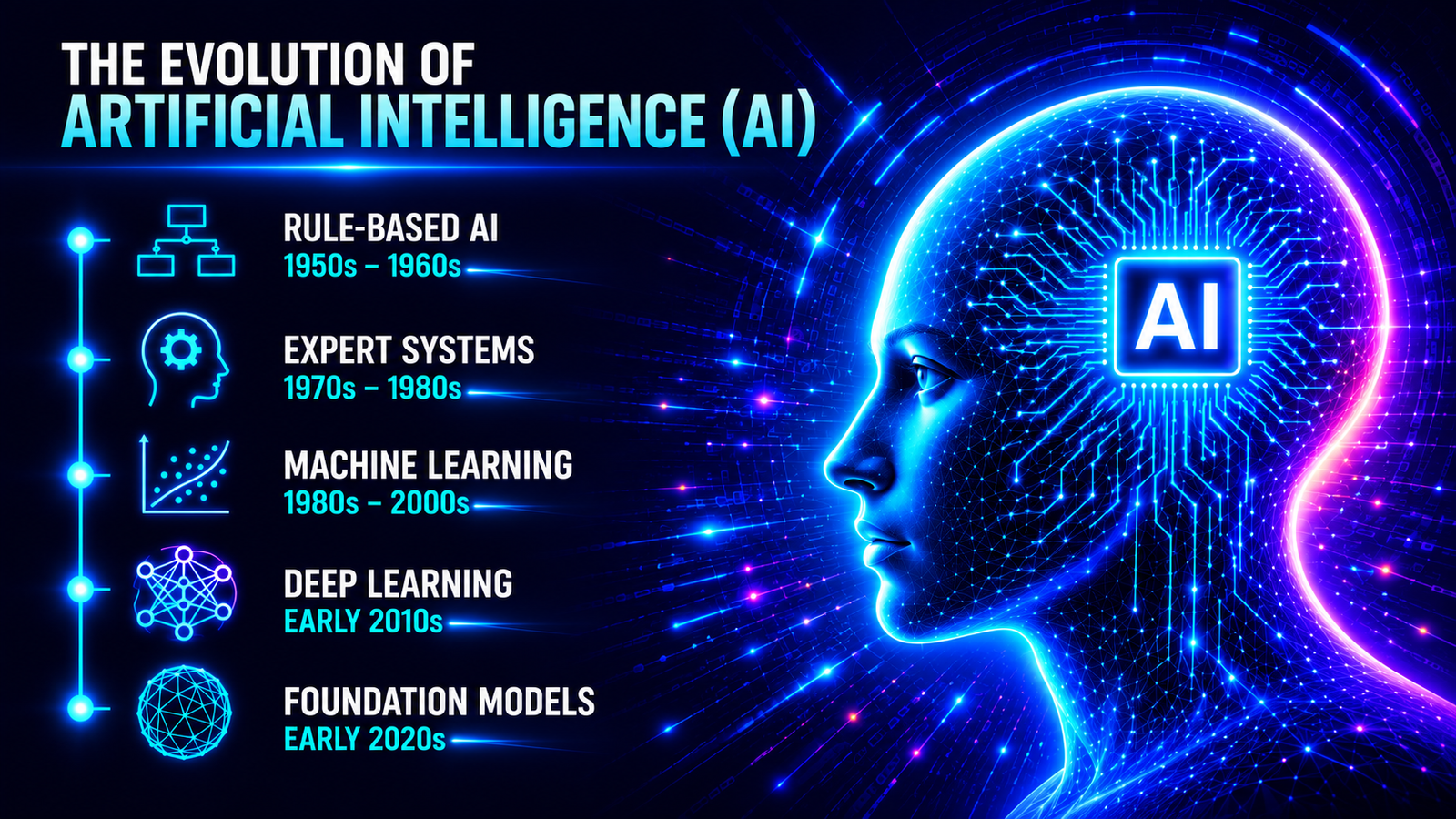
The evolution of AI can be broadly divided into the following major stages:
- Rule-Based AI (Symbolic AI)
- Expert Systems
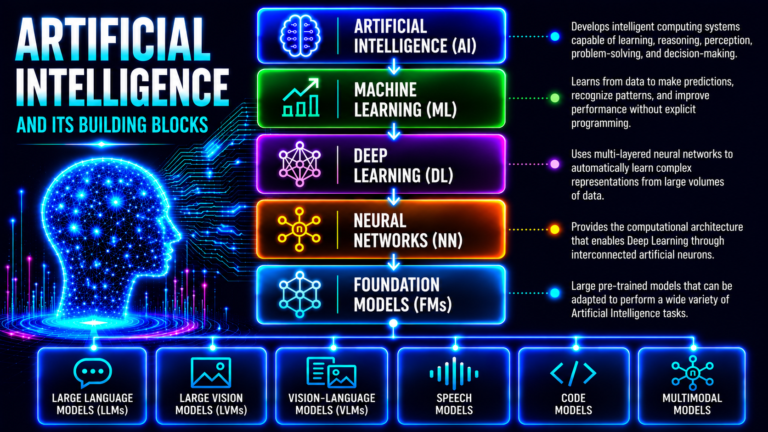
- Machine Learning
- Deep Learning
- Foundation Models
Together, these stages represent several decades of AI research, spanning from symbolic reasoning in the 1950s to the development of large-scale Foundation Models that underpin many modern AI applications. Each stage represents a significant milestone in the evolution of artificial intelligence, introducing new approaches that enabled AI systems to become increasingly capable, adaptable, and scalable. Collectively, these advancements established the technological foundation for many modern AI capabilities, including Generative AI, Large Language Models (LLMs), Multimodal AI, AI Agents, and other emerging technologies. The following sections explore each stage in detail, highlighting the key innovations and breakthroughs that have shaped the evolution of artificial intelligence.
Rule-Based AI (Symbolic AI)
Rule-Based AI, also known as Symbolic AI or Good Old-Fashioned Artificial Intelligence (GOFAI), represents the first major stage in the evolution of artificial intelligence. Emerging during the 1950s and 1960s, this approach was founded on the belief that human intelligence could be replicated by representing knowledge as symbols and applying logical rules to solve problems. Rather than learning from data or experience, Rule-Based AI relied entirely on knowledge explicitly defined by human experts.
The central idea behind Symbolic AI was that intelligent behavior could be achieved if a computer possessed sufficient knowledge about a problem domain and a logical mechanism for reasoning with that knowledge. Researchers believed that many aspects of human reasoning, including problem solving, decision-making, planning, and theorem proving, could be expressed through formal logic, mathematical symbols, and predefined rules. By manipulating these symbolic representations, computers could derive conclusions, answer questions, and solve structured problems.
Rule-Based AI became the foundation of early artificial intelligence research and led to several important achievements. It demonstrated that computers could perform logical reasoning, solve mathematical problems, play strategy games, and support decision-making within well-defined environments. Many of the concepts introduced during this period, including knowledge representation, search algorithms, inference engines, and logical reasoning, continue to influence modern AI systems.
Despite its early successes, Rule-Based AI had significant limitations. Every rule had to be manually created, making knowledge bases difficult to build, maintain, and expand as problems became increasingly complex. These systems were unable to learn from new experiences, adapt to changing conditions, or effectively handle uncertainty. As AI applications grew more sophisticated, researchers began seeking approaches that could capture expert knowledge more efficiently and eventually learn directly from data.
What is Rule-Based AI?
Rule-Based AI is an approach to artificial intelligence in which a computer makes decisions by applying a predefined set of logical rules to known facts. Instead of discovering patterns through learning, the system follows explicit instructions created by human experts to determine the appropriate outcome for a given situation.
Knowledge within a Rule-Based AI system is represented using facts, relationships, and logical rules. These rules are commonly expressed as IF–THEN statements that describe how the system should respond when specific conditions are satisfied.
For example:
IF a customer has placed more than 10 orders
AND the total purchase value exceeds $5,000
THEN classify the customer as a Premium Customer.
When new information is provided, the AI system evaluates the applicable rules using an inference engine. If the specified conditions are met, the corresponding action or conclusion is produced. This process continues until the system reaches a final decision or no additional rules can be applied.
Unlike modern AI techniques, Rule-Based AI does not improve through training or experience. Its effectiveness depends entirely on the completeness, accuracy, and quality of the rules defined by its designers.
How Rule-Based AI Works
A Rule-Based AI system operates by combining predefined knowledge with logical reasoning. Rather than learning from examples, it follows a structured decision-making process based on explicit rules.
The process typically involves the following steps:
- Facts about a problem are entered into the system.
- The inference engine compares these facts against the available rules.
- Matching rules are identified and executed.
- New facts or conclusions may be generated.
- The process continues until a final decision is reached.
This logical reasoning process enables the system to solve structured problems in a predictable and explainable manner.
Key Components of Rule-Based AI
A typical Rule-Based AI system consists of several core components that work together to perform logical reasoning.
Knowledge Base
The Knowledge Base stores domain-specific information, including facts, concepts, relationships, and rules provided by human experts.
Rule Base
The Rule Base contains the collection of IF–THEN rules that define how decisions should be made under different conditions.
Inference Engine
The Inference Engine is the reasoning component of the system. It evaluates available facts, identifies applicable rules, applies logical reasoning, and derives conclusions.
Working Memory
Working Memory contains the current facts and intermediate results being processed while solving a particular problem.
User Interface
The User Interface allows users to provide input, receive recommendations, and interact with the AI system.
Characteristics of Rule-Based AI
Rule-Based AI possesses several defining characteristics that distinguish it from later generations of artificial intelligence.
- Knowledge is explicitly represented using symbols and logical relationships.
- Decisions are governed by predefined IF–THEN rules.
- Human experts manually encode all domain knowledge.
- The system produces deterministic and predictable outcomes.
- Decision-making is transparent and easily explainable.
- Performance is strongest within structured and well-defined problem domains.
These characteristics made Rule-Based AI highly suitable for environments where accuracy, consistency, and explainability were more important than adaptability.
Advantages of Rule-Based AI
Rule-Based AI introduced several important benefits that made it the dominant approach during the early years of artificial intelligence.
- Easy to understand and explain.
- Produces consistent and predictable decisions.
- Effective for solving structured problems.
- Easy to verify and validate.
- Suitable for regulatory and compliance-driven environments.
- Requires relatively low computational resources compared to modern AI models.
Because every decision is based on predefined logic, Rule-Based AI remains valuable in situations where transparency and auditability are essential.
Limitations of Rule-Based AI
Although Rule-Based AI achieved significant early success, several limitations prevented it from addressing increasingly complex real-world problems.
- Unable to learn from experience.
- Every rule must be manually created and maintained.
- Difficult to scale as the number of rules increases.
- Cannot effectively handle uncertainty or incomplete information.
- Performs poorly in dynamic and changing environments.
- Knowledge acquisition is time-consuming and expensive.
- Limited ability to generalize beyond predefined scenarios.
These challenges became more pronounced as organizations attempted to apply AI to larger and more complex domains.
Applications of Rule-Based AI
Despite its limitations, Rule-Based AI remains useful in situations where decisions are governed by well-defined rules and regulations.
Common applications include:
- Business rule automation
- Tax and financial calculations
- Eligibility verification
- Medical decision support
- Configuration management
- Network troubleshooting
- Industrial process control
- Compliance checking
- Diagnostic systems
- Policy enforcement
Many modern software applications still incorporate rule engines alongside machine learning models to handle deterministic business logic.
The First AI Winter
Despite its early successes, Rule-Based AI faced significant challenges as researchers attempted to apply it to increasingly complex real-world problems. Although symbolic AI demonstrated that computers could perform logical reasoning and solve structured tasks, these systems struggled with uncertainty, common-sense reasoning, incomplete information, and the computational limitations of the time. As expectations for artificial intelligence continued to grow, the technology was unable to deliver the transformative capabilities that many had anticipated.
During the mid-1970s, disappointing research outcomes and limited practical applications led governments, funding agencies, and industry to reduce their investment in artificial intelligence. This period, known as the First AI Winter (1974–1980), marked the first major decline in AI research and commercial interest. Many research projects were cancelled or postponed, and progress across the broader field of artificial intelligence slowed considerably.
Although the First AI Winter reduced momentum, it did not end AI research. Instead, it highlighted the limitations of purely symbolic reasoning and encouraged researchers to explore new ways of building intelligent systems that could solve increasingly complex problems more effectively.
Why AI Needed to Evolve Beyond Rule-Based AI
The limitations exposed during the Rule-Based AI era demonstrated that logical rules alone were insufficient to model the complexity of human expertise. Researchers recognized that many real-world decisions depend not only on predefined rules but also on the specialized knowledge and experience of domain experts. Rather than developing generic rule-based systems, they sought to create AI systems capable of capturing, organizing, and applying expert knowledge within specific domains such as medicine, engineering, finance, and manufacturing.
This shift in focus led to the emergence of Expert Systems, the next major stage in the evolution of artificial intelligence. Expert Systems built upon the principles of Rule-Based AI by introducing structured knowledge bases and inference engines that enabled computers to emulate the decision-making abilities of human experts within specialized fields.
Expert Systems
Expert Systems represent the second major stage in the evolution of artificial intelligence. Developed during the 1970s and 1980s, they were designed to emulate the knowledge and decision-making abilities of human experts within specific domains. Rather than relying solely on general logical reasoning, Expert Systems focused on capturing specialized expertise and applying it to solve complex real-world problems.
The emergence of Expert Systems was driven by the limitations of Rule-Based AI. While Rule-Based AI demonstrated that computers could reason using predefined rules, building and managing large collections of rules for complex domains became increasingly difficult. Researchers sought a more structured approach that could organize expert knowledge, separate it from the reasoning process, and provide practical decision support for fields such as medicine, engineering, manufacturing, and finance.
Expert Systems became one of the earliest commercially successful applications of artificial intelligence. They demonstrated that computers could assist professionals by providing recommendations, diagnoses, and solutions based on the knowledge of experienced specialists. Although they remained dependent on manually acquired knowledge, Expert Systems represented a significant advancement over earlier rule-based approaches and paved the way for more sophisticated AI systems.
What are Expert Systems?
An Expert System is an AI system designed to simulate the decision-making process of a human expert within a specific domain. It uses a collection of facts, rules, and specialized knowledge to analyze information, reason through problems, and provide recommendations or decisions.
Unlike traditional software, which follows fixed procedures, Expert Systems attempt to replicate how experts apply their experience and knowledge when solving complex problems. Their primary objective is not to replace human experts but to make expert knowledge consistently available whenever needed.
Expert Systems are typically designed for narrow domains, where knowledge can be clearly defined and represented using logical rules. Examples include medical diagnosis, equipment troubleshooting, credit evaluation, tax advisory, and industrial process control.
How Expert Systems Work
Expert Systems operate by combining domain knowledge with logical reasoning. When a user provides information about a problem, the system compares that information against its stored knowledge and applies reasoning techniques to determine the most appropriate conclusion.
The general workflow is as follows:
- The user submits facts or information about a problem.
- The system stores the information in working memory.
- The inference engine searches the knowledge base for applicable rules.
- Matching rules are executed to derive conclusions.
- The system presents recommendations, diagnoses, or decisions, often accompanied by an explanation of how the conclusion was reached.
Because every recommendation is based on explicit knowledge and logical reasoning, Expert Systems are highly transparent and explainable.
Key Components of an Expert System
An Expert System consists of several core components that work together to replicate expert-level decision-making.
Knowledge Base
The Knowledge Base stores the specialized knowledge of human experts, including facts, concepts, relationships, heuristics, and decision rules relevant to a particular domain.
Inference Engine
The Inference Engine serves as the reasoning component of the system. It evaluates the available facts, applies logical rules, resolves conflicts, and derives conclusions based on the knowledge stored in the Knowledge Base.
Working Memory
Working Memory temporarily stores the facts and intermediate results associated with the current problem being solved.
Knowledge Acquisition Module
This component facilitates the collection, validation, and updating of knowledge obtained from human experts. Acquiring and maintaining expert knowledge proved to be one of the most challenging aspects of developing Expert Systems.
Explanation System
One of the distinguishing features of Expert Systems is their ability to explain how a conclusion was reached. The Explanation System provides users with the reasoning behind recommendations, increasing transparency and user confidence.
User Interface
The User Interface enables users to interact with the system by entering information, reviewing recommendations, and requesting explanations.
Characteristics of Expert Systems
Expert Systems possess several characteristics that distinguish them from earlier Rule-Based AI systems.
- Built around specialized domain knowledge.
- Simulate expert-level decision-making.
- Use logical reasoning to evaluate information.
- Produce consistent and explainable recommendations.
- Separate knowledge from the reasoning process.
- Operate effectively within narrow, well-defined domains.
- Require manually acquired and maintained knowledge.
These characteristics made Expert Systems valuable tools for organizations seeking to preserve and distribute specialized expertise.
Advantages of Expert Systems
Expert Systems offered several significant benefits that contributed to their widespread adoption during the 1980s.
- Capture and preserve expert knowledge.
- Provide consistent and reliable recommendations.
- Reduce dependence on individual experts.
- Improve decision-making speed.
- Deliver explanations for recommendations.
- Operate continuously without fatigue.
- Support training and knowledge sharing.
They became particularly useful in industries where experienced specialists were scarce or where consistent decision-making was critical.
Limitations of Expert Systems
Despite their success, Expert Systems also faced significant challenges.
- Knowledge must be manually collected from experts.
- Acquiring expert knowledge is time-consuming and expensive.
- Updating knowledge bases requires continuous maintenance.
- Systems cannot learn from new experiences.
- Performance is limited to narrow problem domains.
- Difficulty handling uncertainty and rapidly changing environments.
- Scalability becomes increasingly difficult as knowledge grows.
These limitations became known as the knowledge acquisition bottleneck, one of the most significant obstacles to the continued advancement of Expert Systems.
Real-World Examples of Expert Systems
Several Expert Systems demonstrated the practical potential of AI during this period.
- MYCIN – Assisted physicians in diagnosing bacterial infections and recommending antibiotic treatments.
- DENDRAL – Helped chemists identify molecular structures from mass spectrometry data.
- XCON (R1) – Configured computer systems for Digital Equipment Corporation (DEC), reducing configuration errors and improving operational efficiency.
- PROSPECTOR – Assisted geologists in mineral exploration by evaluating geological evidence.
These systems proved that AI could successfully support expert decision-making in highly specialized fields.
The Second AI Winter
Although Expert Systems achieved considerable commercial success during the 1980s, their limitations became increasingly evident as organizations attempted to deploy them at scale. Building and maintaining large knowledge bases required significant time, effort, and domain expertise, while rapidly changing business environments demanded frequent updates to rules and expert knowledge. In addition, many Expert System projects proved costly to develop and maintain, often failing to deliver the expected return on investment.
During the late 1980s and early 1990s, these challenges, combined with unrealistic expectations, declining commercial confidence, and the collapse of the specialized Lisp machine market, led to a significant reduction in funding and investment across the broader field of artificial intelligence. This period became known as the Second AI Winter (1987–1993), during which many AI projects were discontinued, research slowed, and public confidence in AI declined.
Despite this setback, the Second AI Winter encouraged researchers to rethink how intelligent systems should be built. Rather than relying solely on manually encoded knowledge, attention shifted toward developing algorithms capable of learning directly from data, adapting to new information, and improving their performance over time.
Why AI Needed to Evolve Beyond Expert Systems
The limitations of Expert Systems demonstrated that manually encoding human knowledge alone was insufficient to build intelligent systems capable of handling the complexity, scale, and dynamic nature of real-world environments. Researchers recognized that intelligent systems should be able to learn from experience, identify patterns, adapt to new information, and improve their performance without requiring constant human intervention.
This shift in thinking led to the exploration of statistical methods and learning algorithms that enabled computers to discover relationships within data, make predictions, and continuously refine their models through training. Rather than depending entirely on predefined rules and expert knowledge, these systems could automatically improve as they processed more data.
These advancements marked a fundamental shift in artificial intelligence—from knowledge-driven systems based on handcrafted rules to data-driven systems capable of learning from experience. This transformation gave rise to Machine Learning, the next major stage in the evolution of artificial intelligence, enabling computers to automatically learn patterns from data and solve increasingly complex real-world problems.
Machine Learning
Machine Learning (ML) represents the third major stage in the evolution of artificial intelligence and marks one of the most significant paradigm shifts in the field. Unlike Rule-Based AI and Expert Systems, which relied on manually programmed rules and expert knowledge, Machine Learning enables computers to learn patterns directly from data and improve their performance through experience. This shift transformed AI from a knowledge-driven discipline into a data-driven one, allowing intelligent systems to solve increasingly complex problems without requiring explicit programming for every possible scenario.
The emergence of Machine Learning was driven by the growing limitations of Expert Systems. As knowledge bases expanded, manually creating, maintaining, and updating thousands of rules became impractical. Researchers realized that instead of teaching computers every rule, it would be more effective to allow them to discover patterns, relationships, and decision boundaries automatically by analyzing large volumes of data.
Advances in statistics, mathematics, computer science, and the increasing availability of digital data accelerated the development of Machine Learning during the 1980s and 1990s. Improved computing power and more efficient algorithms enabled computers to process larger datasets, identify meaningful patterns, and make accurate predictions across a wide range of applications.
Machine Learning forms the foundation of many modern AI systems. From recommendation engines and fraud detection to medical diagnosis and autonomous vehicles, Machine Learning has become one of the most widely adopted technologies in artificial intelligence and serves as the basis for many later advancements, including Deep Learning and Foundation Models.
What is Machine Learning?
Machine Learning is a branch of artificial intelligence that enables computers to learn from data without being explicitly programmed for every task. Instead of relying on predefined rules, Machine Learning algorithms analyze historical data, identify patterns, build predictive models, and use those models to make decisions or predictions on new, unseen data.
Rather than asking, “What rules should the computer follow?”, Machine Learning asks, “What can the computer learn from the available data?”
For example, instead of manually writing thousands of rules to detect spam emails, a Machine Learning algorithm can analyze millions of legitimate and spam messages, learn the characteristics of each category, and automatically classify future emails with high accuracy.
The quality of a Machine Learning model depends largely on the quality and quantity of the data used for training, as well as the choice of algorithm and model architecture.
How Machine Learning Works
Machine Learning systems learn by identifying patterns within data and using those patterns to make predictions or decisions. Although different algorithms operate in different ways, the overall learning process generally follows a similar workflow.
- Data is collected from relevant sources.
- The data is cleaned, organized, and prepared for analysis.
- A Machine Learning algorithm is selected.
- The algorithm is trained using historical data.
- The trained model is evaluated using validation data.
- The model is optimized to improve accuracy and reduce errors.
- Once deployed, the model predicts outcomes for new data.
Unlike Rule-Based AI, where intelligence is manually programmed, Machine Learning allows the model to develop its own decision boundaries based on statistical analysis of the training data.
Types of Machine Learning
Machine Learning can be broadly categorized into four primary learning approaches.
Supervised Learning
Supervised Learning uses labeled datasets where both the input and the correct output are known. The objective is to learn the relationship between inputs and outputs so the model can accurately predict outcomes for new data.
Common applications include:
- Spam detection
- Credit scoring
- Medical diagnosis
- Image classification
- Sales forecasting
Unsupervised Learning
Unsupervised Learning works with unlabeled data. Instead of predicting known outputs, the algorithm identifies hidden patterns, similarities, or structures within the data.
Common applications include:
- Customer segmentation
- Market basket analysis
- Anomaly detection
- Data clustering
- Pattern discovery
Semi-Supervised Learning
Semi-Supervised Learning combines a small amount of labeled data with a larger amount of unlabeled data. This approach improves model performance while reducing the cost and effort required to label large datasets.
It is commonly used in image recognition, speech processing, and natural language processing where obtaining labeled data is expensive.
Reinforcement Learning
Reinforcement Learning enables an intelligent agent to learn by interacting with its environment. The agent receives rewards for desirable actions and penalties for undesirable ones, gradually learning strategies that maximize long-term rewards.
Applications include:
- Robotics
- Autonomous vehicles
- Industrial automation
- Game playing
- Resource optimization
Key Characteristics of Machine Learning
Machine Learning introduced several capabilities that fundamentally distinguished it from earlier AI approaches.
- Learns patterns directly from data.
- Improves performance through training and experience.
- Adapts to changing data over time.
- Makes probabilistic rather than deterministic decisions.
- Generalizes knowledge to previously unseen data.
- Handles complex relationships that are difficult to express as explicit rules.
These characteristics enabled Machine Learning to solve problems that were impractical for Rule-Based AI and Expert Systems.
Advantages of Machine Learning
Machine Learning offers several advantages that have driven its widespread adoption across industries.
- Eliminates the need to manually program every decision rule.
- Continuously improves as more training data becomes available.
- Handles large and complex datasets efficiently.
- Identifies hidden patterns and relationships.
- Supports predictive analytics and intelligent decision-making.
- Scales effectively across diverse applications.
- Enables automation of tasks that are difficult to define using explicit rules.
These advantages have made Machine Learning the foundation of many modern AI applications.
Limitations of Machine Learning
Despite its strengths, Machine Learning also presents several challenges.
- Requires large amounts of high-quality training data.
- Performance depends heavily on data quality.
- Can inherit biases present in training datasets.
- Many models operate as “black boxes,” making decisions difficult to interpret.
- Requires significant computational resources for large-scale training.
- Performance may degrade when applied to data significantly different from the training data.
These limitations motivated researchers to develop more powerful neural network architectures capable of automatically learning increasingly complex representations from massive datasets.
Applications of Machine Learning
Machine Learning has transformed numerous industries and continues to drive innovation across a wide range of applications.
Common applications include:
- Recommendation systems
- Fraud detection
- Cybersecurity threat detection
- Medical diagnosis
- Financial forecasting
- Customer behavior analysis
- Search engines
- Predictive maintenance
- Autonomous vehicles
- Natural language processing
Its ability to learn from experience has made Machine Learning one of the most widely adopted technologies in artificial intelligence.
Why AI Needed to Evolve Beyond Machine Learning
Although Machine Learning significantly advanced artificial intelligence by enabling computers to learn from data, traditional algorithms still relied heavily on human-engineered features and often struggled with highly complex, unstructured data such as images, speech, natural language, and video. As datasets grew larger and more diverse, manually designing features became increasingly time-consuming and limited the ability of Machine Learning models to capture complex patterns.
Researchers sought methods that could automatically learn hierarchical representations directly from raw data without requiring extensive feature engineering. Advances in neural networks, increased computational power, the availability of massive datasets, and the widespread use of Graphics Processing Units (GPUs) made this possible.
These advancements led to the emergence of Deep Learning, the next major stage in the evolution of artificial intelligence. By using multi-layered neural networks to automatically learn increasingly complex features and representations, Deep Learning enabled unprecedented breakthroughs in computer vision, speech recognition, natural language processing, and many other AI applications.
Deep Learning
Deep Learning represents the fourth major stage in the evolution of artificial intelligence and one of its most significant technological advancements. Emerging in the early 2010s, it built upon the principles of Machine Learning by introducing a new approach that enables computers to automatically learn complex features and hierarchical representations directly from large volumes of data. By using artificial neural networks with multiple hidden layers, Deep Learning significantly improved AI’s ability to process unstructured data such as images, speech, text, audio, and video.
Unlike many traditional Machine Learning algorithms that rely on manually engineered features, Deep Learning automatically discovers meaningful patterns during the training process. This capability allows Deep Learning models to solve highly complex problems with greater accuracy while reducing the need for extensive human intervention in feature extraction and model design.
The rapid growth of computing power, the availability of massive datasets, and advancements in Graphics Processing Units (GPUs) enabled Deep Learning models to become increasingly larger and more sophisticated. These developments led to major breakthroughs in computer vision, natural language processing, speech recognition, autonomous systems, healthcare, robotics, cybersecurity, and many other fields.
Deep Learning not only transformed how AI systems learn from data but also established the technological foundation for modern AI innovations, including Foundation Models, which further expanded AI’s ability to learn general knowledge and support a wide variety of applications.
What is Deep Learning?
Deep Learning is a subset of Machine Learning that enables computers to automatically learn complex features and representations from data using artificial neural networks with multiple hidden layers. Rather than relying on manually designed features, Deep Learning models identify and refine meaningful patterns during the training process, allowing them to solve problems that are too complex for many traditional Machine Learning algorithms.
The term “deep” refers to the use of multiple layers of interconnected artificial neurons. Each layer extracts increasingly abstract representations of the input data. For example, when analyzing an image, the early layers may detect edges and textures, intermediate layers may identify shapes and objects, and deeper layers may recognize complete scenes or specific objects.
This hierarchical learning process enables Deep Learning models to automatically extract relevant information from raw data, significantly reducing the need for manual feature engineering and improving performance across a wide range of applications.
How Deep Learning Works
Deep Learning models are built using Artificial Neural Networks (ANNs), which are inspired by the structure and functioning of the human brain. A neural network consists of interconnected nodes, known as artificial neurons, organized into multiple layers that process information sequentially.
A typical Deep Learning workflow includes the following steps:
- Raw data is collected and prepared for training.
- The data is passed through the input layer of the neural network.
- Hidden layers progressively extract and transform features from the data.
- The output layer generates predictions or classifications.
- The model compares its predictions with the expected results and calculates the error.
- Using backpropagation and optimization algorithms, the model adjusts its internal parameters to reduce errors.
- The training process is repeated over many iterations until the model achieves the desired level of accuracy.
Through repeated training, Deep Learning models continuously refine their internal representations, enabling them to recognize increasingly complex patterns.
Key Components of Deep Learning
A Deep Learning model consists of several fundamental components that work together during training and inference.
Artificial Neurons
Artificial neurons are the basic computational units of a neural network. Each neuron receives one or more inputs, applies mathematical operations, and produces an output that is passed to the next layer.
Layers
Neural networks typically consist of three types of layers:
- Input Layer
- Hidden Layers
- Output Layer
The hidden layers are responsible for learning increasingly complex representations of the input data.
Weights and Biases
Weights determine the importance of each input connection, while biases help adjust the output of neurons. During training, these parameters are continuously updated to improve model performance.
Activation Functions
Activation functions determine whether a neuron should produce an output and introduce non-linearity into the network, enabling it to model complex relationships.
Common activation functions include:
- ReLU
- Sigmoid
- Tanh
- Softmax
Loss Function
The loss function measures the difference between the model’s predictions and the actual expected outputs. Training aims to minimize this error.
Optimizer
The optimizer updates the model’s parameters to minimize the loss function. Popular optimization algorithms include Gradient Descent and Adam.
Characteristics of Deep Learning
Deep Learning introduced several capabilities that distinguish it from traditional Machine Learning.
- Automatically learns features from raw data.
- Handles highly complex and unstructured datasets.
- Uses multiple hidden layers to learn hierarchical representations.
- Continuously improves through iterative training.
- Scales effectively with larger datasets and increased computational resources.
- Achieves state-of-the-art performance across many AI tasks.
These characteristics have made Deep Learning the dominant approach for solving many modern AI problems.
Advantages of Deep Learning
Deep Learning offers several significant advantages over traditional Machine Learning approaches.
- Eliminates the need for extensive manual feature engineering.
- Learns highly complex patterns from raw data.
- Delivers exceptional accuracy for image, speech, and language tasks.
- Scales effectively with large datasets.
- Supports end-to-end learning.
- Enables breakthroughs across diverse AI applications.
Its ability to automatically learn hierarchical representations has significantly expanded the capabilities of artificial intelligence.
Limitations of Deep Learning
Despite its success, Deep Learning also presents several challenges.
- Requires very large datasets for effective training.
- Demands substantial computational resources.
- Training can be time-consuming and expensive.
- Many models operate as “black boxes,” making their decisions difficult to interpret.
- Model performance is highly dependent on data quality.
- Developing and tuning deep neural networks requires specialized expertise.
These limitations encouraged researchers to explore approaches that could leverage massive pre-trained models capable of adapting to multiple tasks without requiring a separate model for every application.
Applications of Deep Learning
Deep Learning powers many of the most advanced AI applications.
Common applications include:
- Image recognition
- Facial recognition
- Medical image analysis
- Speech recognition
- Natural language processing
- Machine translation
- Autonomous vehicles
- Recommendation systems
- Robotics
- Cybersecurity threat detection
Its ability to process complex, high-dimensional data has made Deep Learning a cornerstone of modern artificial intelligence.
Why AI Needed to Evolve Beyond Deep Learning
Although Deep Learning achieved remarkable success across many domains, most models were designed and trained for specific tasks. Organizations often needed separate models for image classification, speech recognition, machine translation, question answering, and countless other applications. Training and maintaining individual models for every task required significant computational resources, large labeled datasets, and specialized expertise.
Researchers sought a more general approach that could learn broad knowledge from massive amounts of diverse data and then be adapted to perform a wide variety of downstream tasks with minimal additional training. At the same time, advances in transformer architectures, self-supervised learning, large-scale computing infrastructure, and model scaling demonstrated that a single model could serve as the foundation for many different AI applications.
These advancements led to the emergence of Foundation Models, the next major stage in the evolution of artificial intelligence. Foundation Models introduced a new paradigm in which large pre-trained models could be adapted to perform multiple tasks, significantly reducing the need to build and train separate models for every individual application.
Foundation Models
Foundation Models represent the fifth major stage in the evolution of artificial intelligence and one of its most significant technological milestones. The early 2020s marked a major shift from task-specific Deep Learning models to large, general-purpose models that could be adapted to perform a wide variety of tasks. Instead of training separate models for image recognition, language translation, question answering, or code generation, a single Foundation Model can learn broad knowledge from massive datasets and serve as the foundation for numerous downstream applications.
This shift was driven by breakthroughs in transformer architectures, self-supervised learning, large-scale distributed computing, and the availability of enormous datasets. These advancements enabled researchers to train models containing billions, and later trillions, of parameters capable of learning rich representations of language, images, audio, video, code, and other forms of data. Once trained, these models can be adapted to new tasks through techniques such as fine-tuning, prompt engineering, or retrieval-based methods, significantly reducing the time and resources required to develop AI applications.
Foundation Models serve as the technological backbone of modern artificial intelligence by providing reusable, general-purpose models that can be adapted to a wide range of tasks. They support AI systems across natural language processing, computer vision, speech recognition, software development, scientific research, healthcare, cybersecurity, robotics, and many other domains. Rather than replacing Deep Learning, Foundation Models extend its capabilities by introducing reusable models that can be efficiently adapted across diverse applications and industries.
What are Foundation Models?
A Foundation Model is a large-scale pre-trained artificial intelligence model that learns general knowledge and representations from vast amounts of diverse data. Unlike traditional Deep Learning models that are trained for a single task, Foundation Models are designed to support multiple downstream tasks with little or no additional training.
The defining characteristic of a Foundation Model is its ability to generalize across domains. After being pre-trained on extensive datasets, the model develops a broad understanding of patterns, relationships, and structures within the data. This general knowledge can then be adapted to perform a wide range of tasks, making Foundation Models highly flexible and reusable.
Foundation Models can be trained on different types of data, including text, images, audio, video, code, and multimodal datasets, enabling them to support diverse AI applications across industries.
Why Foundation Models Emerged
Although Deep Learning achieved remarkable success across many domains, most Deep Learning models were still designed to perform a single task. Organizations often needed separate models for image classification, speech recognition, machine translation, recommendation systems, and numerous other applications. Developing, training, and maintaining these individual models required significant computational resources, large datasets, and specialized expertise.
Researchers sought a more scalable approach that would enable a single model to learn broad knowledge from diverse data and then be adapted to many different tasks. Advances in transformer architectures, self-supervised learning, distributed computing, and model scaling demonstrated that increasingly larger models could capture general and transferable knowledge across multiple domains.
These advancements led to the emergence of Foundation Models, fundamentally changing how AI systems are developed. Rather than creating a new model for every problem, organizations can now build upon a single pre-trained model and adapt it efficiently for a wide variety of applications.
How Foundation Models Work
Foundation Models are typically developed using a two-stage process.
During the pre-training stage, the model is exposed to massive datasets containing billions or even trillions of tokens or data samples. Using self-supervised learning techniques, the model learns statistical relationships, patterns, and representations without requiring manually labeled data.
After pre-training, the model can be adapted for specific applications using techniques such as:
- Fine-tuning
- Prompt Engineering
- Retrieval-Augmented Generation (RAG)
- Parameter-Efficient Fine-Tuning (PEFT)
- Low-Rank Adaptation (LoRA)
This approach enables developers to reuse a single Foundation Model across multiple applications instead of training separate Deep Learning models for every individual task.
Key Characteristics of Foundation Models
Foundation Models differ from traditional AI models in several important ways.
- Large-scale pre-trained neural networks
- Built upon Deep Learning architectures, particularly Transformers
- Trained using massive and diverse datasets
- Learn general knowledge rather than task-specific knowledge
- Can be adapted to numerous downstream tasks
- Support multiple data modalities, including text, images, audio, video, and code
- Reusable across different industries and applications
These characteristics have established Foundation Models as the underlying technology for many AI systems.
Types of Foundation Models
Foundation Models can be categorized according to the primary type of data they are designed to understand, process, or generate. Although they share the same principles of large-scale pre-training and adaptation, each category is optimized for different modalities and application domains.
Text Foundation Models
Text Foundation Models are trained on extensive collections of text to understand, interpret, summarize, translate, and generate human language. They support applications such as conversational systems, document analysis, search, translation, question answering, and content creation.
Vision Foundation Models
Vision Foundation Models are trained on images and visual data to understand and interpret visual information. They support applications such as image classification, object detection, image segmentation, facial recognition, medical imaging, quality inspection, and autonomous systems.
Speech and Audio Foundation Models
Speech and Audio Foundation Models are trained to process spoken language and other audio signals. They support speech recognition, speech synthesis, speaker identification, multilingual translation, audio understanding, and voice-enabled applications.
Code Foundation Models
Code Foundation Models are trained on programming languages and software repositories. They assist developers with code generation, code completion, debugging, documentation, software testing, and software maintenance.
Multimodal Foundation Models
Multimodal Foundation Models are trained using multiple forms of data, including text, images, audio, video, and code. By learning relationships across different modalities, they can understand and generate information that combines multiple types of input and output.
Domain-Specific Foundation Models
Domain-Specific Foundation Models are developed or adapted using specialized datasets for particular industries or knowledge domains. These models provide deeper expertise in areas such as healthcare, finance, cybersecurity, legal services, scientific research, engineering, and manufacturing.
Applications of Foundation Models
Foundation Models provide a reusable AI platform that supports a wide range of applications across industries. Their adaptability enables organizations to build intelligent solutions without developing separate AI models for every individual task.
Common applications include:
- Natural language processing
- Computer vision
- Speech recognition and synthesis
- Software development
- Healthcare
- Scientific research
- Cybersecurity
- Financial services
- Education
- Manufacturing
- Robotics
- Business process automation
By serving as reusable building blocks, Foundation Models reduce development effort, improve scalability, and accelerate the deployment of AI solutions across diverse domains.
Foundation Models: A Major Milestone in AI Evolution
Foundation Models represent a major phase in the evolution of artificial intelligence. From Rule-Based AI and Expert Systems to Machine Learning and Deep Learning, each phase expanded AI’s ability to solve increasingly complex problems. Foundation Models built upon these advancements by introducing reusable, general-purpose models capable of learning broad knowledge and adapting to a wide variety of downstream tasks.
Unlike earlier AI models that were typically developed for a single purpose, Foundation Models provide a common foundation that can support multiple applications across different domains. This shift has transformed the way AI systems are developed by enabling organizations to leverage a single pre-trained model for diverse use cases rather than building separate models for every problem.
As a major phase in AI evolution, Foundation Models demonstrate the progression from specialized, task-oriented intelligence toward more adaptable and reusable AI systems. They establish the technological foundation upon which many advanced AI capabilities are built, while continuing the broader evolution of artificial intelligence toward increasingly versatile and scalable solutions.
The Future of AI Evolution
The evolution of artificial intelligence is an ongoing journey driven by advances in research, computing technologies, and our understanding of intelligence itself. While Foundation Models represent a major milestone in AI evolution, researchers continue to explore new approaches that extend beyond current capabilities. The next phase of AI is expected to focus not only on increasing model size but also on improving reasoning, adaptability, efficiency, autonomy, and interaction with the physical world.
Several research areas are shaping the future direction of AI evolution:
- Artificial General Intelligence (AGI): Developing AI systems capable of learning, reasoning, and performing a broad range of intellectual tasks across multiple domains with minimal human guidance.
- Neuro-Symbolic AI: Combining neural networks with symbolic reasoning to improve logical inference, knowledge representation, explainability, and decision-making.
- World Models: Building AI systems that develop internal representations of the physical world, enabling planning, prediction, and more effective interaction with real-world environments.
- Continual Learning: Enabling AI systems to continuously learn from new experiences without forgetting previously acquired knowledge, allowing them to adapt throughout their operational lifetime.
- Embodied AI: Integrating AI with robots, autonomous vehicles, and intelligent machines that learn by interacting with the physical world through sensors and actions.
- Cognitive AI: Designing AI systems inspired by human cognitive processes such as memory, reasoning, planning, abstraction, and problem-solving to create more adaptive and context-aware intelligence.
- Self-Improving AI: Researching methods that allow AI systems to optimize their own performance, refine learning strategies, and adapt to changing environments with progressively less human intervention.
The future of AI evolution is unlikely to be defined by a single technology or breakthrough. Instead, it is expected to emerge from the convergence of multiple disciplines, combining advances in machine learning, reasoning, memory, perception, planning, robotics, and human-AI collaboration. As these technologies mature, they have the potential to shape the next major phase in the evolution of artificial intelligence while expanding its capabilities across scientific, industrial, and societal applications.
Conclusion
Artificial intelligence has advanced through a series of transformative milestones, with each major phase expanding the capabilities of intelligent systems. From Rule-Based AI and Expert Systems to Machine Learning, Deep Learning, and Foundation Models, AI has progressed from executing predefined instructions to learning from data and developing reusable, general-purpose intelligence that can be adapted across a wide range of tasks.
Rather than replacing earlier approaches, each phase has built upon the strengths of its predecessors, creating increasingly capable, adaptable, and scalable AI systems. This continuous progression has been driven by advances in algorithms, computing power, data availability, and learning techniques, enabling AI to solve increasingly complex problems across diverse industries and applications.
Modern artificial intelligence is the result of decades of continuous innovation, with each major phase contributing new capabilities while building upon earlier advancements. Foundation Models represent a major milestone by introducing reusable models that support a broad spectrum of applications while extending the capabilities established by previous generations of AI.
As artificial intelligence continues to advance, new approaches will build upon these foundations, further expanding AI’s ability to learn, reason, interact, and solve increasingly complex problems. This ongoing progress will continue to shape technology, business, scientific research, and society, opening new opportunities for innovation across virtually every domain.