Understanding Economy
Introduction
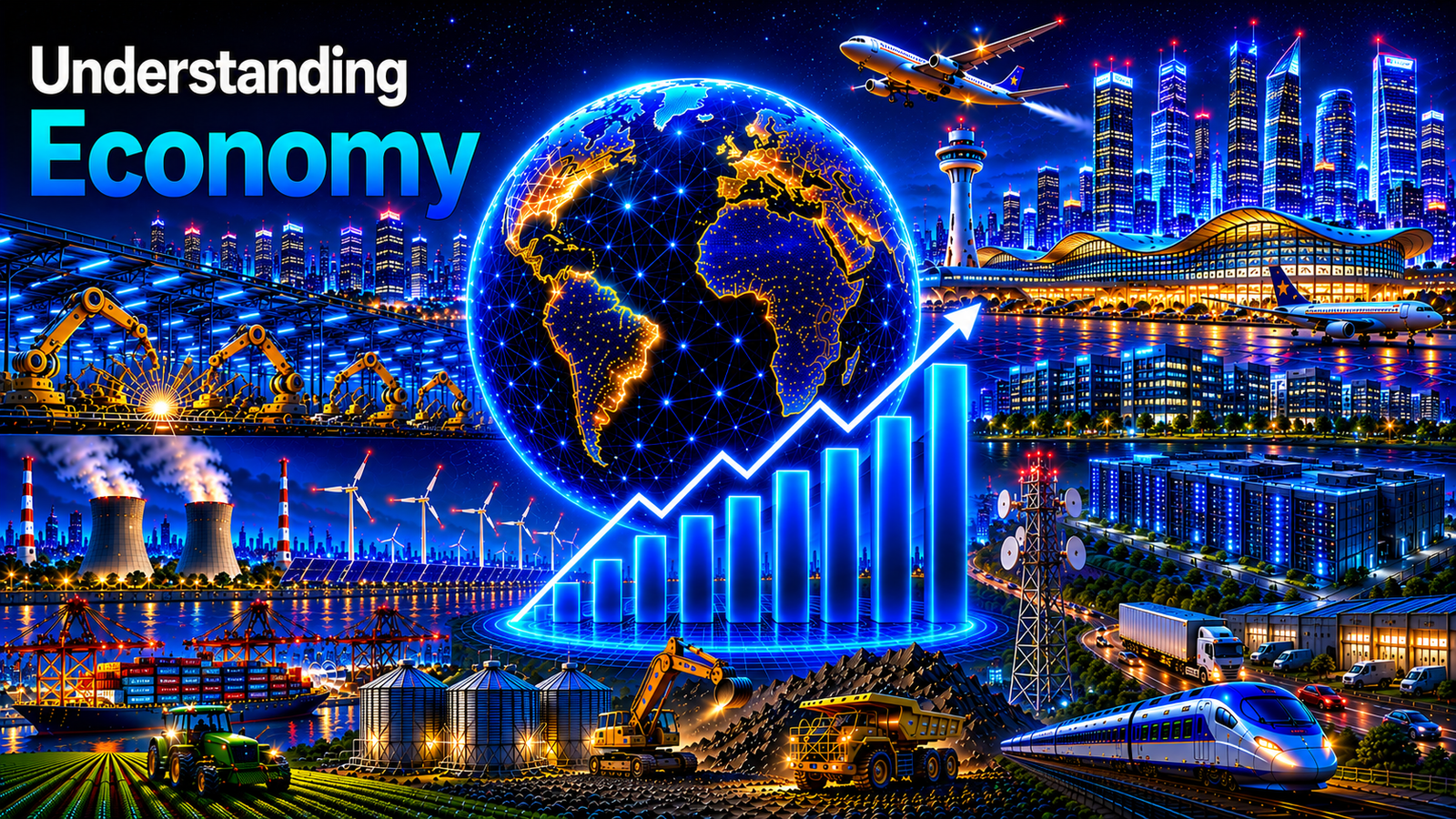
The economy is the foundation of every nation and society. It encompasses all activities involved in producing, distributing, exchanging, and consuming goods and services that satisfy human needs and contribute to economic development. From agriculture and manufacturing to banking, healthcare, education, transportation, and digital services, every economic activity forms part of an economy.
Economies exist at local, regional, national, and global levels. They continuously evolve as populations grow, technologies advance, markets expand, and new industries emerge. Today, economies are increasingly interconnected through trade, digital technologies, communication networks, and the Internet, enabling the movement of goods, services, information, capital, and people across geographical boundaries.
A well-functioning economy creates employment, generates wealth, improves living standards, encourages innovation, and supports sustainable development. Understanding how an economy functions provides the foundation for learning about industries, enterprises, organizations, and the digital ecosystems that power modern businesses.
What Is an Economy?
An economy is the system through which individuals, businesses, organizations, governments, and other participants produce, distribute, exchange, and consume goods and services by utilizing resources such as labor, capital, technology, infrastructure, and natural resources. It encompasses all economic activities within a country, region, or the world that create value, generate wealth, and support the well-being of society.
Every economy operates through the interaction of multiple participants who make decisions about producing goods, providing services, investing resources, conducting trade, creating employment, and consuming products. These activities occur continuously and collectively determine the growth, stability, and prosperity of an economy.
Although economies vary in size and complexity, they all perform the same fundamental functions of allocating resources, facilitating trade, supporting investment, and enabling economic development. Modern economies have expanded beyond traditional agriculture and manufacturing to include service industries, knowledge-based sectors, digital platforms, and globally connected markets.
Building Blocks of an Economy
An economy is built upon several interconnected building blocks that collectively enable economic activities to function efficiently. Each building block performs a specific role while interacting with the others to create, distribute, exchange, and consume goods and services.
Economic Agents
Economic agents are the participants that make economic decisions and carry out economic activities. They produce goods and services, consume products, invest resources, regulate markets, and contribute to economic growth.
The primary economic agents include:
- Individuals (Households) – Supply labor, earn income, purchase goods and services, save money, and make investment decisions.
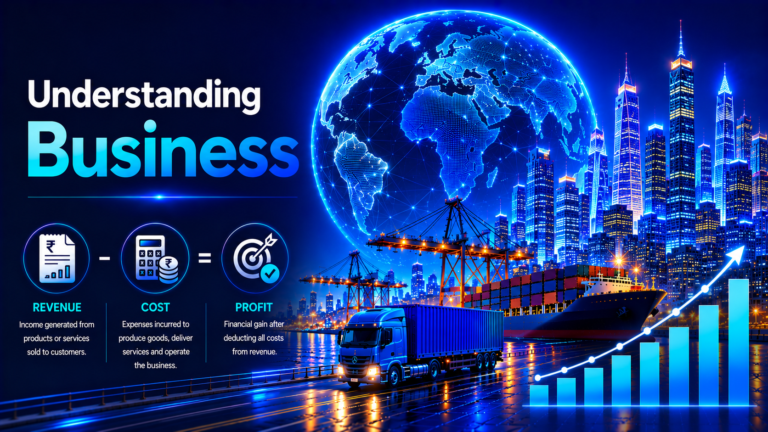
- Businesses – Produce goods and services, employ workers, generate profits, and create economic value.
- Organizations – Educational institutions, healthcare providers, non-profit organizations, and other entities that deliver services supporting society and the economy.
- Governments – Establish economic policies, regulate markets, collect taxes, invest in public infrastructure, and provide essential public services.
- Financial Institutions – Banks, insurance companies, investment firms, and other financial organizations that facilitate savings, lending, investments, payments, and capital allocation.
Together, these economic agents interact continuously to drive economic activities and support national and global development.
Markets
Markets are the environments where buyers and sellers exchange goods, services, labor, capital, and financial assets. They facilitate trade, establish prices through supply and demand, encourage competition, and enable the efficient allocation of resources.
Markets may be physical, such as retail stores and wholesale markets, or digital, such as e-commerce platforms, online marketplaces, and electronic financial exchanges.
Industries
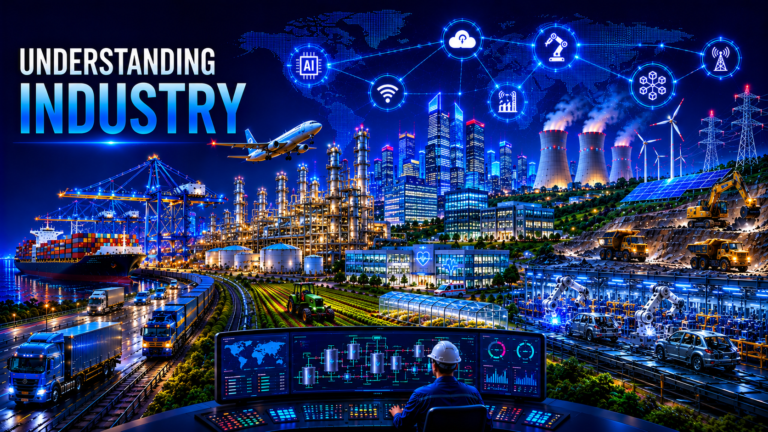
Industries consist of businesses that produce similar goods or provide similar services. They organize economic activities into specialized sectors such as agriculture, manufacturing, healthcare, banking, transportation, telecommunications, education, and information technology.
Industries improve productivity through specialization, create employment opportunities, encourage innovation, and contribute significantly to economic growth.
Enterprises
An enterprise is an organization established to achieve specific business or economic objectives. Enterprises combine people, processes, technology, information, and financial resources to develop products, deliver services, create value, and compete within industries.
Enterprises range from small local businesses and startups to large multinational corporations operating across multiple industries and countries.
Infrastructure
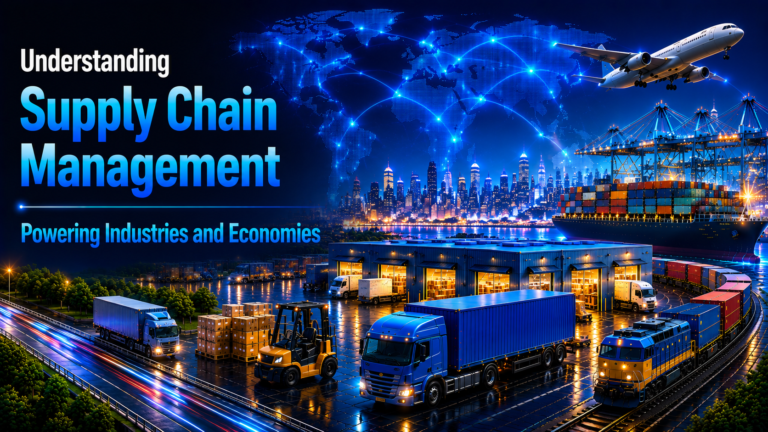
Infrastructure provides the physical and digital foundations that support economic activities. It includes transportation networks, power generation and distribution, water systems, telecommunications, Internet connectivity, ports, airports, logistics networks, and public facilities.
Reliable infrastructure enables businesses to operate efficiently, facilitates trade, improves productivity, and supports long-term economic development.
Natural Resources
Natural resources provide the raw materials required for economic production. These include land, water, forests, minerals, oil, natural gas, renewable energy sources, and agricultural resources. Their availability and sustainable management have a significant influence on industrial development and economic growth.
Energy
Energy is a fundamental resource that powers every economy. It enables industries to manufacture goods, businesses to deliver services, transportation systems to move people and products, communication networks to operate, and critical infrastructure to function efficiently.
Economies rely on a combination of electricity, fossil fuels, nuclear energy, and renewable energy sources such as solar, wind, hydroelectric, geothermal, and biomass. Reliable, affordable, and sustainable energy supports productivity, innovation, investment, employment, and long-term economic growth.
Technology
Technology is a fundamental driver of modern economies. It increases productivity, improves efficiency, enables innovation, supports automation, facilitates communication, and transforms how businesses operate.
Technologies such as cloud computing, artificial intelligence (AI), the Internet, big data, automation, and digital platforms continue to reshape industries and economic activities, making technology one of the most important building blocks of today’s digital economy.
Ownership Sectors of the Economy
An economy comprises organizations and enterprises operating under different ownership structures. Based on ownership and control, economic activities are broadly categorized into the public sector, private sector, and public-private partnerships (PPP). Each ownership sector plays a distinct role in supporting economic growth, delivering goods and services, creating employment, developing infrastructure, and promoting innovation. Together, these ownership sectors contribute to a balanced economy by combining public welfare objectives with market-driven efficiency and investment.
Public Sector
The public sector consists of organizations and enterprises that are owned, controlled, or funded by the government. Its primary purpose is to deliver essential public services, develop and maintain critical infrastructure, protect national interests, and promote social and economic well-being. Rather than focusing on profit maximization, the public sector emphasizes public value, accessibility, stability, and long-term national development. It is responsible for areas such as public administration, healthcare, education, transportation, public utilities, defense, law enforcement, and public safety.
Private Sector
The private sector comprises organizations and enterprises that are owned and managed by individuals or private entities. Its primary objective is to create value by producing goods and delivering services while generating profits through innovation, competition, efficiency, and investment. The private sector is a key driver of entrepreneurship, employment, technological advancement, productivity, and economic growth. It operates across a wide range of industries, including manufacturing, retail, banking and financial services, information technology, telecommunications, healthcare, logistics, transportation, agriculture, construction, and professional services.
Public-Private Partnership (PPP)
A Public-Private Partnership (PPP) is a collaborative arrangement between the government and private organizations to finance, develop, operate, or manage public infrastructure and services. By combining public oversight with private-sector expertise, technology, and investment, PPPs enable the delivery of large-scale projects while balancing public interests with operational efficiency. This model is commonly adopted for initiatives involving transportation infrastructure, airports, seaports, energy, water supply, waste management, healthcare, education, and smart city development, where long-term collaboration and shared investment are essential.
Relationship Between Ownership Sectors
The public sector, private sector, and public-private partnerships complement one another in achieving sustainable economic development. While the public sector focuses on governance, public welfare, and national priorities, the private sector drives innovation, investment, productivity, and market competitiveness. Public-private partnerships combine the strengths of both sectors to improve the development and delivery of infrastructure and public services. Together, these ownership sectors contribute to a resilient, efficient, and inclusive economy.
The Economic Process
The economic process is the continuous cycle through which goods and services are created, distributed, exchanged, and consumed to satisfy human needs and support economic growth. Every economy, regardless of its size or type, follows this fundamental process by transforming available resources into products and services that create value for individuals, businesses, and society.
The economic process is not a one-time sequence but an ongoing cycle. As goods and services are consumed, businesses invest in producing new products, workers earn income, consumers create new demand, and economic activities continue. This continuous flow of resources, products, services, and capital keeps an economy functioning and enables long-term growth.
The economic process consists of six major activities.
Production
Production is the process of creating goods and services by combining resources such as labor, capital, technology, infrastructure, entrepreneurship, and natural resources. It is the starting point of economic activity and creates value that can be exchanged in the marketplace.
Examples include growing crops, manufacturing automobiles, developing software, generating electricity, providing healthcare, and delivering education.
Distribution
Distribution is the movement of goods and services from producers to businesses and consumers. It includes transportation, logistics, warehousing, wholesalers, retailers, and digital delivery platforms that ensure products reach the right place at the right time.
Efficient distribution improves accessibility, reduces costs, and supports economic growth.
Exchange
Exchange is the process through which buyers and sellers trade goods and services. Most exchanges occur using money as the medium of exchange, although barter systems continue to exist in certain communities and situations.
Markets facilitate exchange by connecting producers with consumers and determining prices through supply and demand.
Consumption
Consumption is the use of goods and services to satisfy the needs of individuals, businesses, and governments. Consumer demand influences production decisions, encourages innovation, and drives continuous economic activity.
Investment
Investment is the allocation of financial and physical resources to increase future production and productivity. Businesses invest in factories, equipment, technology, research, and workforce development, while governments invest in infrastructure, education, healthcare, and public services.
Investment enables economies to expand, improve efficiency, and support long-term development.
Trade
Trade is the exchange of goods and services between individuals, businesses, regions, and countries. Domestic trade supports economic activity within a nation, while international trade enables countries to specialize, access global markets, and obtain resources and products from around the world.
Modern trade has become increasingly interconnected through transportation networks, digital platforms, and the Internet.
Together, production, distribution, exchange, consumption, investment, and trade form a continuous economic cycle that creates employment, generates income, supports businesses, and contributes to national prosperity.
Economic Sectors
Economic sectors are broad classifications of economic activities based on the nature of the goods and services they produce. They provide a structured way of organizing an economy and understanding how value is created as resources move through different stages of economic activity.
The order of the economic sectors is significant because it represents the progression of value creation within an economy. The process begins with the extraction of natural resources, followed by the transformation of those resources into products, the delivery of services that support economic activities, the creation of knowledge and innovation that improve productivity, and finally the leadership and strategic decision-making that guide the overall direction of the economy.
Although all sectors operate simultaneously and are closely interconnected, this sequence illustrates how economic activities evolve and build upon one another.
Primary Sector
The primary sector forms the foundation of the economy by extracting and harvesting natural resources directly from the environment. It supplies the raw materials required by all other sectors. This sector comprises agriculture, fishing, forestry, mining, oil and gas extraction, livestock farming, and quarrying.
Secondary Sector
The secondary sector builds upon the primary sector by converting raw materials into finished or semi-finished goods through manufacturing, processing, and construction. It increases the value of natural resources by transforming them into products used by consumers and businesses. This sector comprises manufacturing, food processing, automobile production, textile manufacturing, steel production, chemical processing, construction, and industrial assembly.
Tertiary Sector
The tertiary sector provides services rather than physical goods. It supports individuals, businesses, industries, and governments by delivering essential commercial, financial, and professional services. This sector comprises transportation, logistics, banking, insurance, healthcare, education, retail, hospitality, tourism, telecommunications, media, legal services, accounting, and professional consulting.
Quaternary Sector
The quaternary sector focuses on knowledge, information, research, innovation, and technology. It drives scientific advancement, digital transformation, and productivity improvements across all other sectors of the economy. This sector comprises research and development, scientific research, software development, artificial intelligence, data analytics, information technology services, engineering design, biotechnology research, cybersecurity, digital innovation, and knowledge-based consulting.
Quinary Sector
The quinary sector represents the highest level of economic activity and focuses on executive leadership, strategic decision-making, governance, and public policy. It includes individuals and institutions responsible for shaping the direction of organizations, industries, and national economies. This sector comprises corporate governance, executive leadership, public administration, policymaking, strategic planning, judicial administration, diplomatic relations, university leadership, international organizations, and strategic advisory services.
Together, these sectors form the foundation of a modern economy, with each sector supporting and complementing the others throughout the economic value chain. Each contributes to the economy by creating value, generating employment, producing goods and services, facilitating trade and commerce, driving innovation, and improving productivity. Collectively, they strengthen industries, promote sustainable economic growth, and enhance the overall prosperity and competitiveness of a nation.
Types of Economy
Countries organize their economies in different ways depending on their political systems, economic policies, cultural values, and historical development. While every economy is unique, they are generally classified into four major types based on how economic decisions are made and how resources are allocated.
Traditional Economy
A traditional economy is based on customs, traditions, and long-established practices. Economic activities are typically centered around agriculture, fishing, hunting, and small-scale trade, with production primarily intended to meet local needs.
Traditional economies are commonly found in rural and indigenous communities where economic decisions are guided by cultural practices rather than market forces.
Market Economy
A market economy is driven primarily by supply and demand. Individuals and businesses make most decisions regarding production, pricing, investment, and trade, while competition encourages innovation, efficiency, and consumer choice.
Government intervention is generally limited, allowing market forces to determine the allocation of resources.
Command Economy
A command economy is centrally planned and controlled by the government. Decisions regarding production, pricing, investment, and resource allocation are made by the state to achieve national objectives.
While this model provides greater government control, it generally offers less economic freedom to businesses and consumers.
Mixed Economy
A mixed economy combines elements of both market and command economies. Private businesses operate freely in many sectors, while governments regulate markets, provide essential public services, invest in infrastructure, and implement policies to promote economic stability and social welfare.
Today, most countries operate as mixed economies because they balance market competition with government oversight and public investment.
Gross Domestic Product (GDP): An Indicator of an Economy
What Is Gross Domestic Product (GDP)?
Gross Domestic Product (GDP) is one of the most widely used indicators for measuring the size and overall performance of an economy. It represents the total monetary value of all final goods and services produced within a country’s borders during a specific period, usually a quarter or a year.
GDP provides an overview of a country’s economic activity and is commonly used by governments, economists, businesses, and international organizations to assess economic growth, compare economies, and support policy and investment decisions.
Why GDP Is Important
GDP serves as a key indicator of economic performance and helps measure how well an economy is functioning.
A growing GDP generally indicates that businesses are producing more goods and services, employment opportunities are increasing, consumer spending is rising, and economic activity is expanding. Conversely, a declining GDP may indicate slowing economic activity or economic recession.
Governments use GDP to develop economic policies, allocate public resources, and evaluate national development. Businesses use GDP trends to support investment planning, market expansion, and strategic decision-making. Financial institutions and investors also use GDP to assess economic conditions and investment opportunities.
GDP per Capita
While GDP measures the overall size of an economy, GDP per capita provides an estimate of the average economic output per person. It is calculated by dividing a country’s GDP by its total population.
GDP per capita is commonly used to compare the relative economic performance and standard of living between countries with different population sizes. Although it does not measure individual income or wealth distribution, it provides a useful indicator of average economic productivity and prosperity.
Gross Domestic Product (GDP) provides a high-level view of a country’s economic performance and remains one of the most widely recognized indicators of economic activity. It helps governments, businesses, investors, and policymakers understand the overall health of an economy, monitor economic growth, and make informed decisions. As economies expand and GDP grows, opportunities for industries, enterprises, and organizations also increase, contributing to employment, innovation, investment, and overall economic development.
Relationship Between Economy, Industry, Enterprise, and Organization
The economy, industries, enterprises, and organizations are closely related and together form the foundation of economic activity. Although these terms are often used interchangeably, each represents a distinct level within the broader economic system. Understanding their relationship provides a structured view of how economic activities are organized and how value is created throughout society.
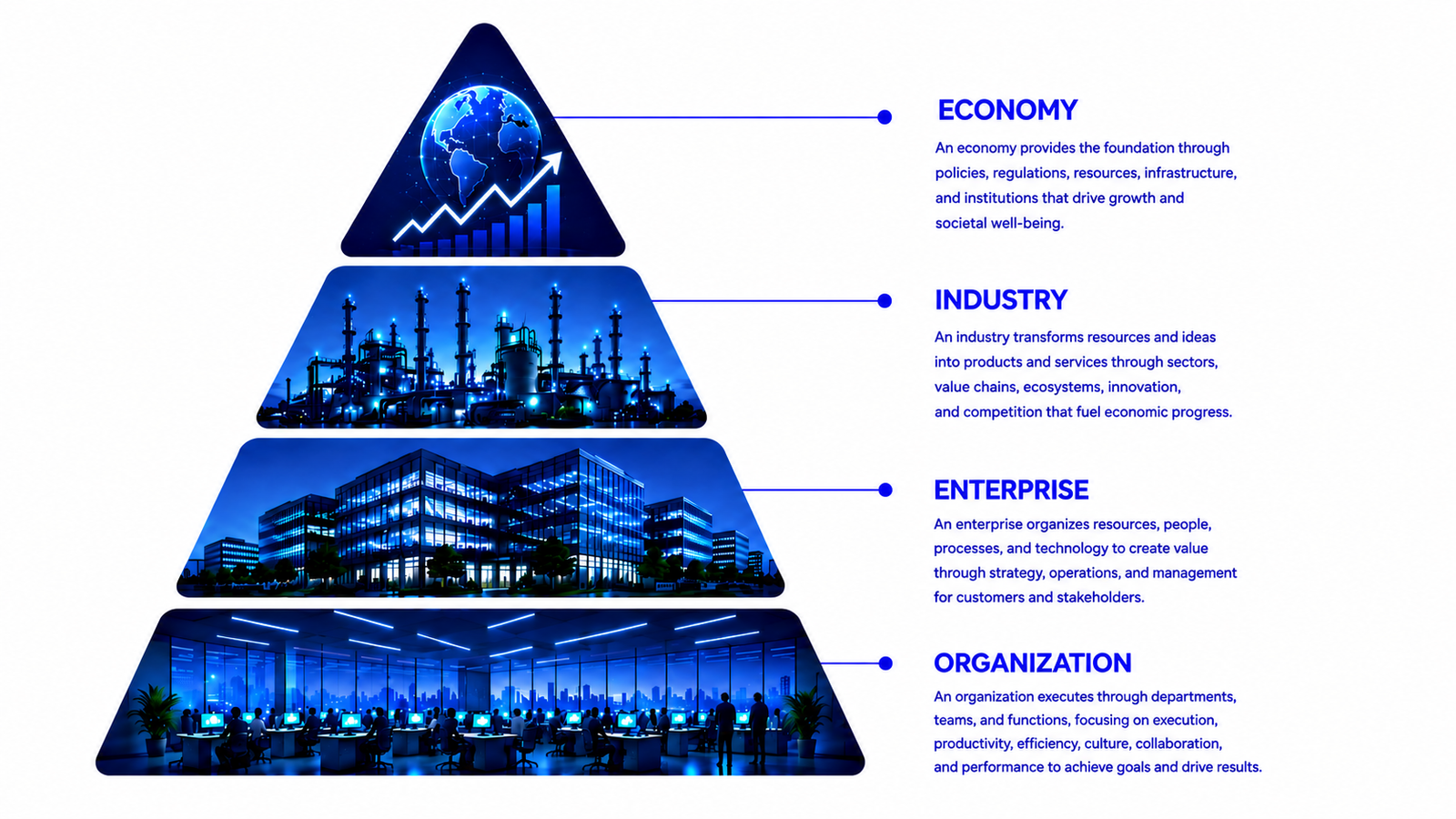
At the highest level is the economy, which encompasses all economic activities within a country or region. Within an economy, activities are organized into economic sectors, which are further divided into industries. Within each industry, enterprises operate by producing goods or delivering services, and every enterprise functions through one or more organizations that provide the people, governance, processes, and resources necessary to achieve their objectives.
Economy
An economy is the broadest level of economic activity. It encompasses the production, distribution, exchange, and consumption of goods and services within a country or region. It includes people, businesses, governments, industries, markets, infrastructure, technology, financial systems, and natural resources that collectively contribute to economic development.
The economy provides the overall environment in which all businesses and organizations operate.
Industry
An industry is a collection of enterprises that produce similar goods or provide similar services. Industries organize economic activities into specialized areas such as agriculture, manufacturing, banking, healthcare, transportation, telecommunications, energy, retail, and information technology.
Industries play a vital role in creating employment, fostering innovation, supporting trade, and contributing to national economic growth.
Enterprise
An enterprise is an organization established to carry out economic activities by producing goods or delivering services. Enterprises combine people, technology, capital, processes, and information to create value for customers and society.
Enterprises may operate as private companies, public corporations, government-owned enterprises, partnerships, or non-profit organizations.
Organization
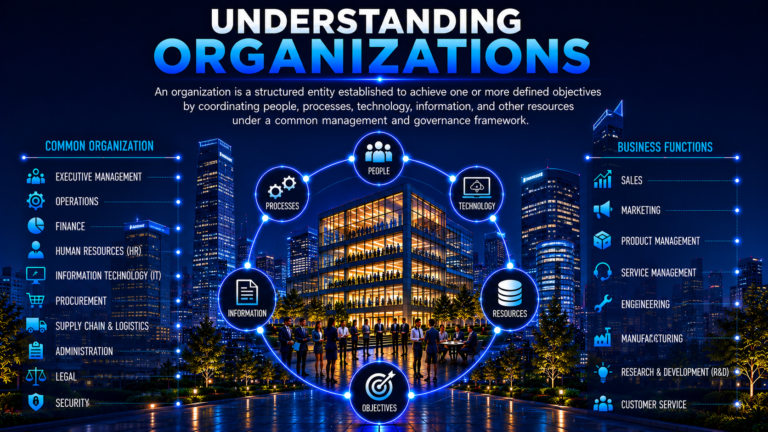
An organization is a structured entity consisting of people, leadership, governance, processes, and resources working together to achieve defined objectives. Organizations exist in various forms, including businesses, government agencies, educational institutions, healthcare providers, charities, international organizations, and professional associations.
While many organizations operate as enterprises, organizations may also exist for educational, governmental, scientific, charitable, or social purposes without a primary commercial objective.
Understanding the Relationship
The relationship between the economy, industries, enterprises, and organizations represents a hierarchy of increasing specialization. The economy provides the overall framework within which economic activities take place. These activities are grouped into industries based on the goods and services they produce. Enterprises operate within those industries to conduct business, while organizations provide the structure, governance, people, and resources that enable enterprises to function effectively.
Understanding this relationship establishes the foundation for the next chapter, Industry, where we will explore how industries are classified, organized, and contribute to economic development.
The Digital Economy
The digital economy refers to economic activities that are enabled, supported, or transformed through digital technologies, the Internet, and connected digital infrastructure. Unlike traditional economies, where most transactions and business operations occur through physical interactions, the digital economy enables individuals, businesses, governments, and organizations to exchange information, deliver services, conduct business, and create value electronically across geographical boundaries.
Today, digital technologies have become an integral part of almost every industry. Businesses rely on digital platforms to communicate, collaborate, manufacture products, manage supply chains, provide customer services, process financial transactions, and make business decisions. As a result, the digital economy has become one of the primary drivers of economic growth, innovation, and global competitiveness.
Evolution of the Digital Economy
The economy has evolved significantly over time as technology transformed the way people work and conduct business.
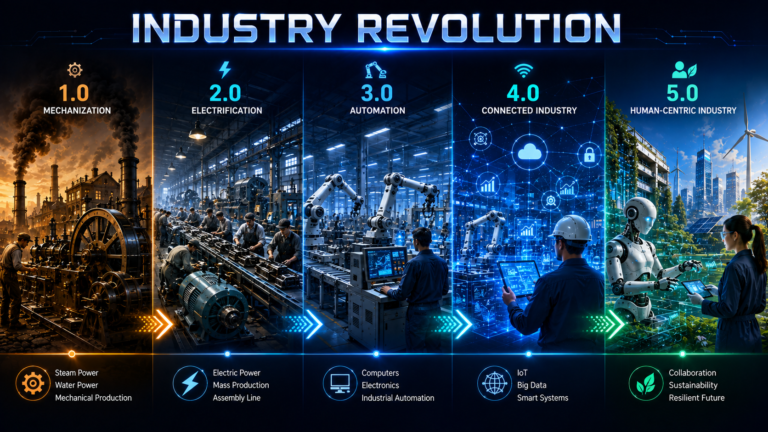
Initially, economic activities relied primarily on manual labor and physical trade. The Industrial Revolution introduced mechanization and large-scale manufacturing, enabling industries to produce goods more efficiently. The widespread adoption of computers then transformed business operations by automating many administrative and industrial processes.
The emergence of the Internet marked a major turning point. It enabled businesses to communicate globally, exchange information instantly, and conduct electronic commerce across borders. Today, cloud computing, mobile technologies, artificial intelligence (AI), big data, automation, and the Internet of Things (IoT) continue to reshape industries, creating a highly connected global digital economy.
Digitalization of Economic Activities
Digitalization is the process of integrating digital technologies into economic and business activities to improve efficiency, productivity, collaboration, and customer experience.
Many activities that were once performed manually are now carried out digitally, including:
- Banking and financial services
- Retail and e-commerce
- Manufacturing and industrial automation
- Healthcare and telemedicine
- Education and online learning
- Government services
- Transportation and logistics
- Communication and collaboration
- Entertainment and digital media
Digitalization enables organizations to operate more efficiently, reduce costs, improve decision-making, and deliver products and services faster and at greater scale.
Digital Infrastructure and Connectivity
The digital economy depends on reliable digital infrastructure that enables information to move securely and efficiently between users, organizations, and systems.
Key components of digital infrastructure include:
- Internet connectivity
- Telecommunications networks
- Data centers
- Cloud computing platforms
- Fiber-optic networks
- Mobile communication networks
- Satellite communication systems
- Computing devices and digital platforms
Together, these technologies form the foundation upon which modern digital services, businesses, and economies operate.
Critical Infrastructure and Economic Continuity
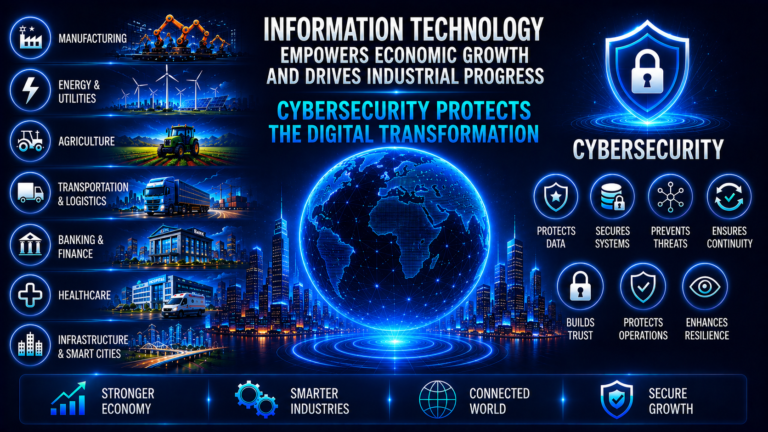
Many sectors that support the economy rely heavily on digital technologies and interconnected systems. Services such as electricity, telecommunications, banking, transportation, healthcare, water supply, and government operations are increasingly dependent on reliable digital infrastructure.
Disruptions to these essential services can significantly affect businesses, public services, supply chains, and economic activities. Maintaining the availability, resilience, and reliability of critical infrastructure is therefore essential for ensuring economic continuity and supporting the functioning of modern society.
Global Interconnected Economy
The Internet has transformed national economies into a globally interconnected economic system. Businesses can source raw materials from one country, manufacture products in another, sell them worldwide, and manage operations through globally distributed teams connected by digital platforms.
This interconnected environment enables:
- International trade
- Cross-border investments
- Global supply chains
- Digital services
- International collaboration
- Worldwide financial transactions
- Rapid innovation and knowledge sharing
While this connectivity creates significant opportunities for growth and innovation, it also increases interdependence among economies. As a result, secure, resilient, and reliable digital infrastructure has become essential for sustaining economic growth and ensuring the uninterrupted operation of businesses and critical services.
Conclusion
The economy is the foundation of every nation, providing the framework within which people, businesses, industries, and governments produce, distribute, exchange, and consume goods and services. It brings together natural resources, labor, capital, technology, infrastructure, and markets to create value, generate employment, improve living standards, and support sustainable development.
As economies have evolved, technological innovation and digital transformation have reshaped the way economic activities are performed. Today, the digital economy plays a vital role in enabling global trade, connecting industries and enterprises, and driving innovation through advanced technologies and interconnected digital infrastructure.
Understanding the structure and functioning of an economy provides a solid foundation for understanding how industries operate, how enterprises create value, and how organizations contribute to economic growth. These concepts also serve as the basis for exploring enterprise operations, critical infrastructure, and cybersecurity, where protecting digital systems, information, and essential services has become increasingly important in supporting modern economies.