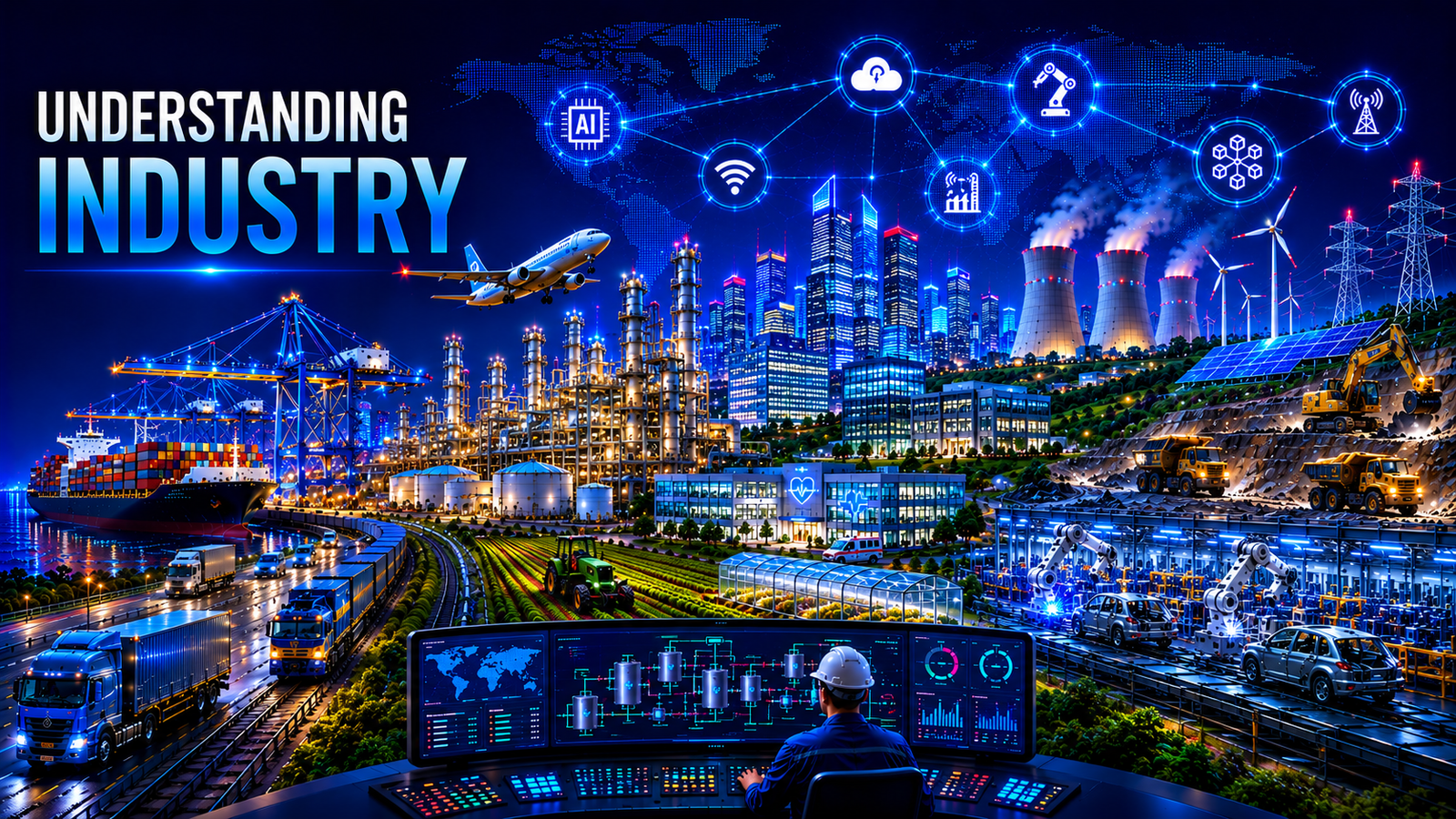
Understanding Industry
Introduction
Industries are a fundamental component of every economy. They produce the goods and services that support individuals, businesses, and governments while creating employment, generating income, driving innovation, and contributing to national development. By transforming natural resources, labor, capital, and technology into valuable products and services, industries improve quality of life and support sustainable economic growth.
As economies continue to evolve through globalization, technological advancements, and digitalization, industries continuously adapt by embracing innovation, improving operational efficiency, and adopting modern business practices. Understanding industry provides the foundation for learning how goods and services are produced, how economic activities are organized, and why industries are essential to business, society, and cybersecurity.
What Is an Industry?
An industry is a segment of the economy that consists of organizations engaged in producing similar goods or providing similar services. Organizations within an industry typically share common business activities, production processes, technologies, customers, supply chains, regulations, and market characteristics.
Industries organize economic activities based on the nature of the goods produced or services delivered. While organizations within an industry may compete with one another, they collectively contribute to meeting market demand, fostering innovation, and supporting economic development.
Industries vary in size, complexity, and economic significance, but all play an essential role in creating value, generating employment, facilitating trade, and promoting sustainable growth.
Industry: The Foundation of the Economy
Industries are the productive foundation of an economy. They transform natural resources, labor, capital, knowledge, and technology into goods and services that satisfy the needs of individuals, businesses, and governments.
By producing goods and delivering services, industries create employment, generate income, stimulate innovation, facilitate domestic and international trade, attract investment, and contribute to Gross Domestic Product (GDP). They also support infrastructure development, improve living standards, strengthen national competitiveness, and promote long-term economic resilience.
Industries play a vital role in the sustainable growth and development of every nation. A strong industrial base enables an economy to expand production, increase exports, encourage technological advancement, and improve the overall standard of living. As industries continue to evolve through innovation and digitalization, they remain one of the primary drivers of economic progress and prosperity.
Why Industries Exist
Industries exist to organize economic activities efficiently and meet the growing needs of society. They bring together people, resources, technology, and capital to produce goods, deliver services, and create value for individuals, businesses, and governments.
Industries exist to:
- Produce goods and deliver essential services.
- Meet the needs of consumers, businesses, and governments.
- Create employment opportunities and support skilled workforces.
- Generate income, wealth, and economic value.
- Drive innovation, research, and technological advancement.
- Improve productivity through specialization and efficient resource utilization.
- Support domestic and international trade.
- Contribute to national economic growth and sustainable development.
- Improve the quality of life by providing products and services that support modern society.
Without industries, economies would be unable to satisfy the demands of society or sustain long-term growth and development.
Energy in Industry
Energy is one of the fundamental resources that enables industries to operate. Every stage of industrial activity, from extracting raw materials and manufacturing products to transporting goods and delivering services, depends on a reliable supply of energy.
Industries use energy to power machinery, manufacturing equipment, industrial automation systems, transportation networks, heating and cooling systems, lighting, communication infrastructure, and information technology. Without energy, factories cannot operate, supply chains cannot function, and essential services cannot be delivered efficiently.
Industries obtain energy from a variety of sources, including electricity, fossil fuels, nuclear power, and renewable energy such as solar, wind, hydroelectric, geothermal, and biomass. The choice of energy source depends on operational requirements, availability, cost, efficiency, environmental impact, and regulatory considerations.
As industries continue to modernize, improving energy efficiency, adopting cleaner energy technologies, and reducing environmental impact have become important priorities. Digital technologies such as smart grids, industrial automation, artificial intelligence, and the Industrial Internet of Things (IIoT) are helping organizations monitor, optimize, and manage energy consumption more effectively.
Characteristics of an Industry
Although industries differ in size, purpose, and sector, they share several common characteristics.
- Produce similar goods or provide similar services.
- Consist of organizations engaged in related economic activities.
- Utilize labor, capital, technology, and natural resources.
- Follow industry-specific regulations, standards, and best practices.
- Operate through interconnected supply chains and distribution networks.
- Compete based on quality, cost, innovation, efficiency, and customer value.
- Continuously adapt to technological, economic, regulatory, and market changes.
- Contribute to employment, investment, innovation, and economic development.
These characteristics distinguish industries from other forms of economic activity and highlight their importance in supporting economic growth, technological progress, and societal well-being.
Classification of Industries
Industries can be classified in different ways depending on the nature of the economic activities they perform. The most widely recognized classification is the Five-Sector Model, which groups industries into Primary, Secondary, Tertiary, Quaternary, and Quinary sectors based on how they contribute to the economy.
Primary Industry
The primary industry involves the extraction and harvesting of natural resources directly from the environment. It provides the raw materials required for manufacturing, energy production, and many other economic activities. Industries within this classification include:
- Agriculture
- Forestry
- Fishing
- Mining
- Oil and Gas Extraction
Secondary Industry
The secondary industry transforms raw materials into finished products or semi-finished goods through manufacturing, processing, and construction activities. It adds value to natural resources by converting them into products used by consumers, businesses, and governments. Industries within this classification include:
- Manufacturing
- Construction
- Food Processing
- Automobile Manufacturing
- Steel Production
- Chemical Manufacturing
- Textile Manufacturing
Tertiary Industry
The tertiary industry focuses on providing services rather than producing physical goods. It supports individuals, businesses, governments, and other industries by delivering commercial, financial, healthcare, educational, transportation, and hospitality services. Industries within this classification include:
- Banking and Financial Services
- Healthcare
- Education
- Retail
- Hospitality and Tourism
- Transportation and Logistics
- Telecommunications
Quaternary Industry
The quaternary industry is the knowledge-based sector of the economy. It focuses on research, innovation, information management, technology, and intellectual services that drive scientific and technological advancement. Industries within this classification include:
- Research and Development (R&D)
- Information Technology
- Artificial Intelligence
- Data Analytics
- Scientific Research
- Engineering
- Consulting Services
Quinary Industry
The quinary industry represents the highest level of leadership, decision-making, and specialized professional services. It focuses on governance, strategic planning, policymaking, executive management, and other activities that shape industries, economies, and society. Industries within this classification include:
- Government Leadership
- Senior Executives
- Public Administration
- International Organizations
- Academic Leadership
- Strategic Advisory Services
Types of Industries
Industries can also be categorized based on the specific goods they produce or the services they provide. Each industry plays a unique role in supporting economic development, creating employment, driving innovation, and meeting the needs of society.
Agriculture Industry
The agriculture industry cultivates crops, raises livestock, and produces food, fiber, and other agricultural products. It forms the foundation of food production and supplies raw materials to numerous industries.
Fishing Industry
The fishing industry harvests fish and other aquatic resources from oceans, rivers, lakes, and aquaculture farms. It supports food production, livelihoods, international trade, and the seafood processing industry.
Mining Industry
The mining industry extracts minerals, metals, coal, and other geological resources from the earth. These resources are essential for manufacturing, construction, infrastructure development, and energy production.
Petroleum Industry
The petroleum industry explores, extracts, refines, transports, and distributes crude oil and petroleum products. It supplies fuel and raw materials used across transportation, manufacturing, energy generation, and chemical industries.
Chemical Industry
The chemical industry manufactures industrial and consumer chemicals used in agriculture, pharmaceuticals, manufacturing, construction, and consumer products. It provides essential materials for numerous industries.
Food Processing Industry
The food processing industry converts agricultural products into safe, packaged, and consumable food and beverages through processing, preservation, packaging, and distribution. It helps improve food quality, safety, and availability.
Textile Industry
The textile industry produces fibers, fabrics, clothing, and other textile products used in fashion, home furnishings, healthcare, and industrial applications. It combines traditional manufacturing with modern production technologies.
Automobile Industry
The automobile industry designs, manufactures, assembles, sells, and services motor vehicles, including passenger cars, commercial vehicles, motorcycles, and electric vehicles. It also supports a large ecosystem of suppliers, manufacturers, and dealerships.
Construction Industry
The construction industry plans, designs, and builds residential, commercial, industrial, and public infrastructure projects such as buildings, roads, bridges, airports, and utilities. It plays a significant role in infrastructure development and economic expansion.
Energy Industry
The energy industry generates, transmits, and distributes electricity and other forms of energy, including renewable and conventional energy sources. It powers homes, businesses, industries, transportation systems, and critical infrastructure.
Transportation Industry
The transportation industry moves people and goods through road, rail, air, and sea transportation networks. It supports trade, commerce, tourism, and supply chain operations.
Shipping Industry
The shipping industry transports goods and cargo across oceans, seas, rivers, and ports. It plays a vital role in facilitating international trade and global supply chains.
Aviation Industry
The aviation industry encompasses the design, manufacturing, operation, and maintenance of aircraft, commercial airlines, airports, air cargo services, and aviation support organizations. It enables the rapid movement of people and goods worldwide.
Information Technology Industry
The information technology industry develops, implements, and manages software, hardware, networking, cloud computing, cybersecurity, artificial intelligence, and other digital technologies. It enables digital transformation, supports business operations, and drives innovation across industries.
Finance Industry
The finance industry provides banking, lending, investment, insurance, payment processing, wealth management, and other financial services. It facilitates financial transactions, supports businesses, and contributes to economic growth.
Healthcare Industry
The healthcare industry provides medical services, diagnostics, treatment, rehabilitation, pharmaceuticals, medical devices, and preventive healthcare. It focuses on protecting and improving human health and well-being.
Education Industry
The education industry provides learning, training, and skill development through schools, colleges, universities, vocational institutions, and online learning platforms. It develops the knowledge and skilled workforce required across every sector.
Hospitality Industry
The hospitality industry provides accommodation, food and beverage services, event management, and customer experiences through hotels, resorts, restaurants, and related businesses. It supports tourism, travel, and economic development.
Entertainment Industry
The entertainment industry creates and delivers content and experiences through film, television, music, gaming, live events, theme parks, and digital entertainment platforms. It supports culture, recreation, and creative expression.
Pharmaceutical Industry
The pharmaceutical industry researches, develops, manufactures, and distributes medicines, vaccines, and therapeutic products used to prevent, diagnose, and treat diseases.
Industry Operating Model
Industry Operating Model
An industry operating model describes the end-to-end processes, activities, and functions involved in producing goods or delivering services. Although industries differ in the products they manufacture, the services they provide, and their business models, they generally follow a structured operational workflow that transforms resources into products or services that meet customer and market demand. The key stages of a typical industry operating model are described below.
Resource Planning and Procurement
Organizations identify business requirements, forecast demand, and procure the raw materials, components, equipment, and services required for production or service delivery. Effective planning helps optimize costs, ensure resource availability, and minimize operational disruptions.
Research, Design, and Development
Products, services, or processes are researched, designed, developed, and tested to meet customer needs, market trends, and regulatory requirements. Continuous innovation enables industries to remain competitive and improve operational efficiency.
Production or Service Delivery
Manufacturers produce goods, while service-based industries deliver services using skilled personnel, technology, and standardized operating procedures. This stage transforms resources into products or services that create value for customers.
Quality Assurance and Testing
Products and services are inspected, tested, and validated to ensure they meet quality standards, safety requirements, regulatory obligations, and customer expectations. Effective quality management helps reduce defects and improve reliability.
Packaging and Storage
Finished products are packaged, labeled, and stored until they are ready for distribution. Proper packaging protects products during handling and transportation, while efficient storage supports inventory management and order fulfillment.
Transportation and Distribution
Products are transported through logistics networks to distributors, retailers, business partners, or customers. Efficient transportation and distribution ensure timely delivery while minimizing costs and maintaining product availability.
Sales and Customer Delivery
Products and services are marketed, sold, and delivered through retail stores, online platforms, distributors, or direct sales channels. Organizations focus on meeting customer demand while providing a seamless purchasing experience.
Customer Support and Continuous Improvement
Organizations provide customer support, maintenance, warranty services, and issue resolution after products or services are delivered. Customer feedback and operational insights are used to continuously improve products, services, and business processes.
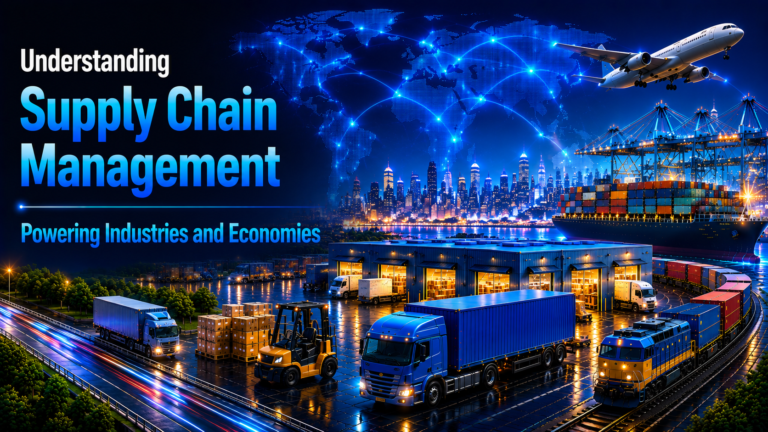
Industry Supply Chain
An industry supply chain is the network of organizations, people, activities, resources, technologies, and processes involved in producing and delivering goods or services from their origin to the end customer. It ensures the efficient flow of materials, products, information, and services throughout the production and distribution lifecycle.
Raw Material Suppliers
Raw material suppliers provide the natural resources, basic materials, and components required for production. They ensure a reliable supply of quality inputs that support continuous manufacturing and service delivery.
Manufacturers or Producers
Manufacturers or producers transform raw materials into finished products or deliver services through production, processing, assembly, and quality control. They add value by creating products that meet customer and market requirements.
Distributors
Distributors transport and distribute products from manufacturers to wholesalers, retailers, or business customers. They manage logistics, warehousing, and inventory to ensure products are available in the right place at the right time.
Wholesalers
Wholesalers purchase products in bulk from manufacturers or distributors and supply them to retailers or commercial customers. They simplify product distribution by maintaining inventory and serving as intermediaries within the supply chain.
Retailers
Retailers sell products or services directly to consumers through physical stores, online platforms, or other sales channels. They provide customer service, manage sales, and help manufacturers understand consumer demand.
Customers or End Users
Customers or end users are the final recipients who purchase and use products or services. Their feedback, preferences, and purchasing behavior influence future product development, production planning, and business strategies.
A well-managed supply chain improves operational efficiency, reduces costs, ensures product availability, and enables industries to deliver value to customers while supporting sustainable business growth.
Evolution of Industry
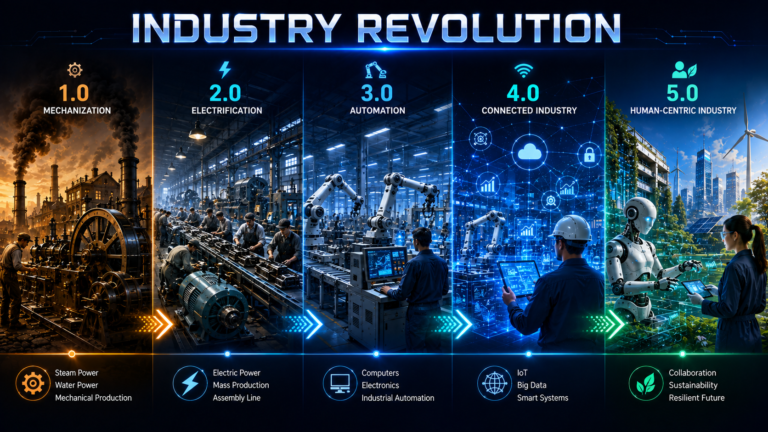
Industries have continuously evolved in response to technological advancements, changing economic conditions, and growing societal needs. From manual production methods to intelligent, connected, and sustainable operations, each stage of industrial evolution has improved productivity, efficiency, product quality, and the way goods and services are delivered.
Industry 1.0 – Mechanization
The First Industrial Revolution began in the late 18th century with the introduction of water and steam power. Mechanized equipment replaced manual labor in many industries, leading to increased production capacity, improved efficiency, and the establishment of modern factories.
Industry 2.0 – Mass Production
The Second Industrial Revolution introduced electricity, assembly lines, and standardized manufacturing processes. Mass production enabled industries to manufacture goods at a larger scale, reduce production costs, improve consistency, and make products more accessible to consumers.
Industry 3.0 – Automation
The Third Industrial Revolution was driven by electronics, computers, and information technology. Automation, programmable logic controllers (PLCs), and industrial control systems improved manufacturing precision, operational efficiency, and production speed while reducing human intervention.
Industry 4.0 – Smart Manufacturing
Industry 4.0 integrates digital technologies such as the Internet of Things (IoT), artificial intelligence (AI), cloud computing, robotics, big data analytics, and digital twins into industrial operations. Connected systems enable real-time monitoring, predictive maintenance, intelligent automation, and data-driven decision-making across manufacturing and service environments.
Industry 5.0 – Human-Centric and Sustainable Industry
Industry 5.0 builds upon Industry 4.0 by combining advanced technologies with human creativity, expertise, and collaboration. It emphasizes sustainability, resilience, personalization, and responsible innovation while creating greater value for businesses, society, and the environment.
Role of Digitalization in Industries
Digitalization has transformed industries by integrating digital technologies into business processes, production systems, supply chains, and customer interactions. Organizations across various industries are adopting digital solutions to improve operational efficiency, increase productivity, enhance customer experiences, and support data-driven decision-making.
Digitalization enables industries to automate routine tasks, optimize resource utilization, monitor operations in real time, and respond quickly to changing market demands. It also improves collaboration across business functions, streamlines workflows, enhances supply chain visibility, and supports continuous innovation through new products, services, and business models.
Key technologies driving digitalization in industries include:
Artificial Intelligence (AI)
Artificial Intelligence (AI) enables computer systems to perform tasks that typically require human intelligence, such as learning, reasoning, decision-making, and problem-solving. Industries use AI to automate processes, improve decision-making, enhance customer experiences, predict trends, and optimize operations.
Cloud Computing
Cloud computing provides on-demand access to computing resources such as servers, storage, databases, networking, and software over the internet. It helps industries reduce infrastructure costs, improve scalability, support remote access, accelerate innovation, and increase business agility.
Internet of Things (IoT)
The Internet of Things (IoT) connects physical devices, sensors, machines, and equipment to the internet, enabling them to collect, exchange, and analyze data in real time. Industries use IoT to monitor assets, improve operational efficiency, enable predictive maintenance, and optimize resource utilization.
Big Data and Analytics
Big Data and Analytics involve collecting, processing, and analyzing large volumes of structured and unstructured data to generate meaningful insights. Industries use analytics to support data-driven decision-making, identify trends, improve forecasting, optimize business processes, and better understand customer behavior.
Robotics and Automation
Robotics and automation use programmable machines and automated systems to perform repetitive, complex, or hazardous tasks with minimal human intervention. They help industries increase productivity, improve accuracy, reduce operational costs, enhance workplace safety, and maintain consistent quality.
Blockchain
Blockchain is a distributed digital ledger technology that securely records transactions across multiple systems without relying on a central authority. Industries use blockchain to improve transparency, strengthen security, enhance traceability, reduce fraud, and streamline business transactions and supply chain operations.
Networking and Communications
Networking and communications technologies enable devices, systems, applications, and people to exchange data securely and efficiently across local and global networks. They provide the connectivity required for cloud computing, IoT, remote operations, digital collaboration, and real-time communication, forming the foundation of modern digital infrastructure.
The adoption of digital technologies provides several benefits to industries, including:
- Improved operational efficiency and productivity
- Better decision-making through real-time data and analytics
- Enhanced product quality and service delivery
- Faster innovation and product development
- Greater supply chain visibility and resilience
- Reduced operational costs and optimized resource utilization
- Improved customer satisfaction and business competitiveness
- Increased business agility and adaptability to changing market conditions
As digital technologies continue to evolve, digitalization remains a key driver of industrial transformation. By leveraging these technologies, industries can operate more efficiently, innovate continuously, strengthen competitiveness, and adapt to the demands of an increasingly connected and digital economy.
Conclusion
Industries are the driving force behind economic growth, innovation, and societal development. They produce the goods and services that meet human needs, create employment opportunities, support trade, and contribute to national and global economies. From traditional sectors such as agriculture and manufacturing to modern industries driven by digital technologies, every industry plays a vital role in improving productivity and enhancing the quality of life.
As industries continue to evolve through technological advancements and digital transformation, they are becoming more connected, efficient, and resilient. Understanding how industries are classified, operate, and adapt to changing business and technological landscapes provides a strong foundation for exploring organizations, enterprises, business operations, information technology, and cybersecurity in greater depth.