Understanding Information
Introduction
Information plays an essential role in human life, communication, learning, and decision-making. It consists of facts, observations, measurements, and messages that convey meaning about a particular subject, event, object, or situation. Information can exist in different forms, including written documents, spoken language, numerical records, images, audio, and video. It can be communicated and preserved through physical records, analog media, and digital systems.
The importance of information has increased with the development of digital technologies and the Internet. Digital systems enable information to be created, processed, stored, retrieved, and exchanged across geographical boundaries. The Internet connects individuals, organizations, and systems, allowing information to be shared rapidly and supporting communication, collaboration, research, and access to services on a global scale.
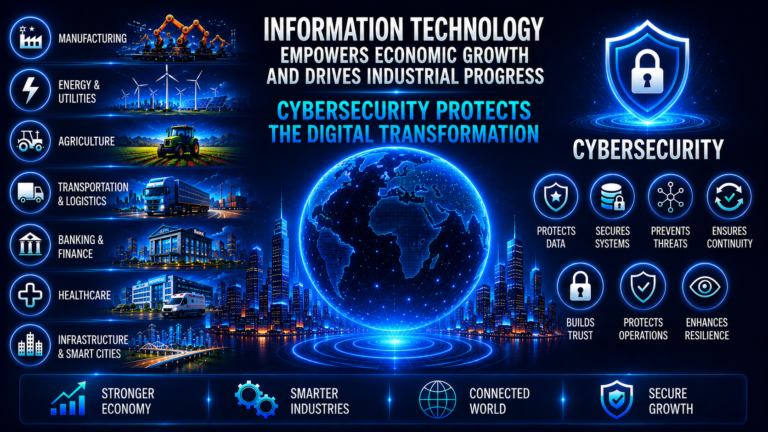
The increasing adoption of digital technologies is transforming how industries operate and how businesses deliver products and services. Digital transformation involves the use of digital technologies to change business processes, services, operating models, and customer experiences. Across every industry, businesses rely on information to manage operations, coordinate activities, understand customer requirements, evaluate performance, manage risks, and make informed decisions.
In banking and financial services, information supports financial transactions, payment processing, risk assessment, and customer services. In healthcare, it enables the management of patient records, diagnostic results, medical research, and clinical services. In manufacturing, information supports production planning, quality control, supply chain coordination, and equipment monitoring. In retail and e-commerce, it helps organizations manage inventory, understand purchasing behavior, process orders, and deliver customer services. In telecommunications, information supports network operations, service delivery, and communication services. Similarly, in education, transportation, energy, and government, information supports service delivery, resource management, planning, and coordination.
The growth of cloud computing, mobile computing, Internet of Things (IoT), artificial intelligence (AI), and data analytics has further increased the volume and variety of information generated and used by individuals and organizations. Digital platforms process information from multiple sources to support automation, analysis, forecasting, and decision-making. The Internet also serves as a major source of information through websites, digital publications, online databases, and communication platforms.
Understanding information therefore involves examining what information means, how it differs from data and knowledge, the characteristics and forms it can take, and the methods used to represent, process, store, and communicate it. These concepts provide a foundation for understanding the role of information in everyday life, scientific research, business activities, and digital systems.
Definition of Information
Information is a collection of facts, observations, data, or messages that conveys meaning about a particular subject, event, object, or situation.
Information helps individuals and systems understand circumstances, identify relationships, evaluate alternatives, and make decisions. It can originate from observations, measurements, experiments, records, communications, or other sources.
The meaning and usefulness of information depend on factors such as context, accuracy, relevance, completeness, and the needs of the recipient.
For example, the numbers 28, 30, and 32 are individual data values. When they are identified as the daily temperatures recorded in degrees Celsius over three consecutive days, they convey information about temperature conditions and changes over time.
Information can exist in physical or digital forms. Printed documents, books, charts, photographs, electronic records, and digital messages are examples of representations through which information can be stored or communicated.
Understanding Information
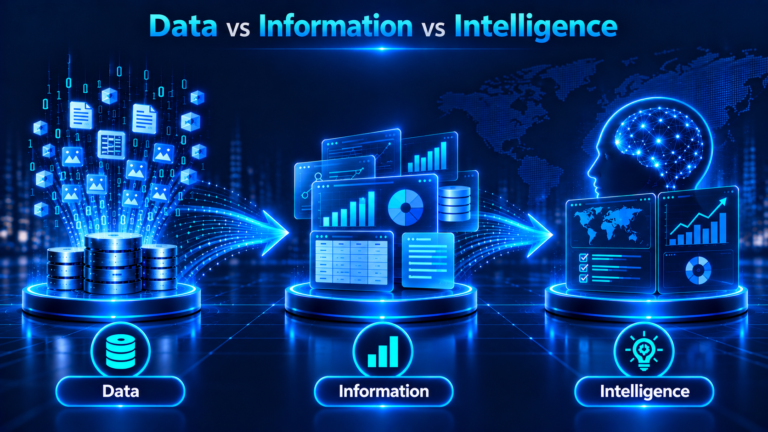
Information is closely related to data, knowledge, and intelligence. Although these concepts are connected, each has a distinct meaning.
Data and Information
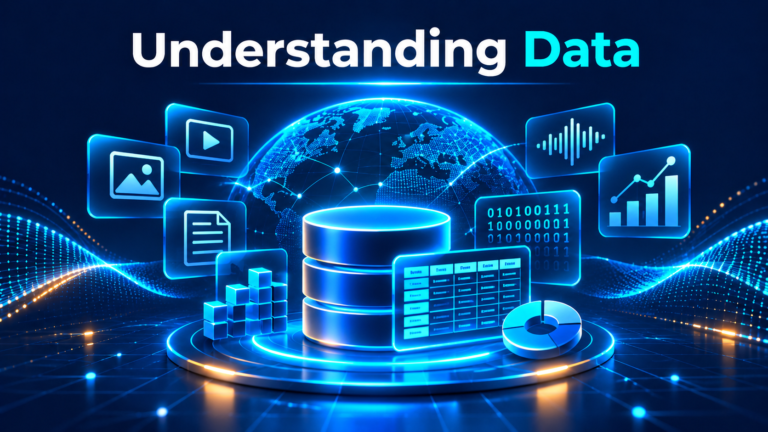
Data refers to raw facts, observations, measurements, symbols, or recorded values that have not necessarily been interpreted in a particular context.
Information refers to data that has been organized, processed, or interpreted to convey meaning.
Data provides the underlying values or observations, while information helps explain what those values represent.
For example, the values 25, 28, and 31 constitute data. When these values are identified as the number of products sold on three consecutive days, they become information that describes daily sales activity.
The transformation of data into information may involve classification, calculation, comparison, summarization, visualization, or other forms of processing.
However, the distinction between data and information depends on context. Data can already convey meaning, and information can become data when it is recorded for further processing.
Information and Knowledge
Knowledge refers to an understanding developed through learning, experience, observation, interpretation, and the integration of information.
Information provides facts and context about a subject, while knowledge involves understanding how those facts relate to one another and how they can be applied.
For example, a weather report indicating a high probability of rainfall provides information. Understanding the implications of that forecast for agriculture, transportation, or outdoor activities involves applying knowledge.
Knowledge can be developed through formal education, practical experience, research, experimentation, and the interpretation of information from multiple sources.
Unlike an individual piece of information, knowledge often involves broader understanding, relationships, experience, and the ability to apply what has been learned.
Information and Intelligence
Intelligence refers to information that has been collected, evaluated, analyzed, and interpreted to provide insights that support a particular purpose or decision.
The term has different meanings across disciplines. In general analytical contexts, intelligence involves deriving useful conclusions from available information. In fields such as national security and cybersecurity, it often refers to analyzed information developed to support specific operational or strategic objectives.
For example, a report listing unusual network connections provides information. An analysis that correlates those connections with known attack patterns and assesses their potential significance may produce cybersecurity intelligence.
Information does not automatically become intelligence merely because it has been analyzed. Intelligence generally requires interpretation in relation to a defined question, objective, or decision-making requirement.
Data, Information, Knowledge, and Intelligence (DIKI)
Data, Information, Knowledge, and Intelligence are related concepts that can be considered as stages in an analytical process. Their relationship is sometimes described through a conceptual progression from raw observations to meaningful understanding and actionable insight.
| Aspect | Data | Information | Knowledge | Intelligence |
|---|---|---|---|---|
| Meaning | Recorded facts, values, or observations | Data interpreted in context | Understanding developed through learning and experience | Analyzed information that provides relevant insights |
| Purpose | Record observations | Explain facts and relationships | Develop understanding | Support decisions or actions |
| Context | May have limited context | Placed in a meaningful context | Integrated with existing understanding | Interpreted against specific objectives |
| Example | Daily temperature readings | A report showing temperature changes | Understanding seasonal temperature patterns | An assessment of how expected temperature changes may affect crop production |
This progression is a useful conceptual model, but it is not a universal sequence. Information, knowledge, and intelligence can be developed through interconnected processes, and the distinctions between them vary across disciplines.
Characteristics of Information
Information can be evaluated using several characteristics that influence its meaning, reliability, and usefulness.
Accuracy
Accuracy refers to the degree to which information correctly represents the facts, observations, or conditions it describes.
Accurate information reflects the underlying reality as closely as possible and minimizes errors caused by incorrect measurements, calculations, recording, or interpretation.
For example, a financial report containing correctly recorded transactions and calculated totals demonstrates accuracy. Incorrect figures or calculation errors reduce its accuracy.
The level of accuracy required depends on the intended use. Scientific research, financial reporting, and medical applications may require different methods and levels of precision.
Completeness
Completeness refers to the extent to which information contains the necessary facts and details for its intended purpose.
Incomplete information may omit important observations, relevant conditions, or contextual details, potentially leading to incorrect interpretations.
For example, a weather report that provides temperature but omits precipitation information may be insufficient for someone planning an outdoor activity.
Completeness is relative to the requirements of a particular task. Information does not need to contain every available detail to be considered complete for its intended purpose.
Relevance
Relevance refers to the degree to which information relates to a particular subject, question, objective, or decision.
Relevant information helps address the matter being investigated, while irrelevant information may add unnecessary detail without improving understanding.
For example, historical sales figures may be relevant when evaluating business performance but less relevant when assessing the technical specifications of a computer.
The relevance of information depends on the context, the needs of the recipient, and the purpose for which it is used.
Timeliness
Timeliness refers to whether information is available and current enough to meet the requirements of its intended use.
Some activities require information immediately, while others can use historical information without difficulty.
For example, traffic conditions are time-sensitive because road conditions can change rapidly. Historical population records, however, may remain useful for studying long-term demographic trends.
Timeliness does not always mean that information must be recent. Historical information can remain valuable when the objective is to understand past events, identify trends, or compare conditions over time.
Reliability
Reliability refers to the degree to which information can be trusted based on the credibility of its source, the methods used to produce it, and the consistency of its results.
Reliable information is supported by appropriate evidence, dependable collection methods, or credible sources.
For example, a scientific finding supported by a documented methodology and reproducible observations may be considered more reliable than an unsupported claim.
Reliability and accuracy are related but distinct. Accuracy concerns whether information is correct, while reliability concerns the extent to which the information and the processes producing it can be trusted.
Types of Information
Information can be categorized according to its structure, organization, representation, content, or intended use. One common classification distinguishes structured, semi-structured, and unstructured information.
Structured Information
Structured information is organized according to a predefined format or schema that establishes how individual elements are represented and related.
Structured information commonly appears in relational databases, spreadsheets, transaction records, and tabular datasets.
For example, a customer database may contain separate fields for customer identification, name, contact details, and registration date. Each record follows a consistent structure, making the information easier to search, sort, compare, and process.
Structured information is particularly useful when data elements follow predictable formats and require consistent processing.
Semi-Structured Information
Semi-structured information contains organizational elements or identifiable markers but does not necessarily follow a rigid tabular schema.
It may use tags, keys, metadata, labels, or hierarchical structures to organize information.
Examples include JSON documents, XML documents, and certain email formats containing identifiable headers and message content.
For example, a JSON document can contain a person’s name, age, and address using named fields while allowing the structure to vary between records.
Semi-structured information combines some of the organizational advantages of structured data with greater flexibility in representing different kinds of content.
Unstructured Information
Unstructured information does not follow a predefined schema that organizes all its content into consistent fields.
Examples include free-form text documents, photographs, audio recordings, videos, scanned documents, and many email messages.
For example, a recorded interview contains spoken language, pauses, tone, and contextual details that cannot be fully represented by a simple set of fixed fields.
Unstructured information may require techniques such as text analysis, image recognition, speech recognition, or natural language processing to identify and extract relevant details.
The distinction between structured and unstructured information depends partly on how the information is represented and processed. A document that is unstructured in its original form may be converted into a structured representation through extraction and classification.
Forms of Information
Information can be expressed through different forms of representation. These forms influence how information is created, communicated, interpreted, and stored.
Textual Information
Textual information represents information through written or printed language, symbols, and characters.
Examples include books, reports, letters, articles, emails, and text messages.
Textual information is widely used to communicate explanations, descriptions, instructions, arguments, and records. Its interpretation may depend on language, terminology, context, and the knowledge of the reader.
Text can be represented physically on paper or electronically through character encoding systems.
Numerical Information
Numerical information represents quantities, measurements, counts, values, or relationships using numbers and mathematical notation.
Examples include temperatures, financial figures, population counts, percentages, and scientific measurements.
Numerical information supports calculations, comparisons, statistical analysis, and mathematical modeling.
Its interpretation depends on the units, measurement scales, precision, and context associated with the values. For example, a temperature value of 30 has different meanings depending on whether it is expressed in degrees Celsius or degrees Fahrenheit.
Visual Information
Visual information communicates meaning through images, diagrams, illustrations, symbols, maps, charts, and other visual representations.
Visual information can help explain spatial relationships, patterns, comparisons, and complex concepts.
For example, a line chart can show changes in temperature over time, while a map can represent geographical locations and distances.
Visual information may communicate meaning independently or complement textual and numerical information. Its interpretation can depend on visual conventions, labels, scale, and context.
Audio Information
Audio information is conveyed through sound, including speech, music, environmental sounds, and recorded signals.
Examples include spoken conversations, podcasts, audio recordings, announcements, and sound measurements.
Audio information can communicate language, emotion, rhythm, timing, and environmental conditions. It is commonly recorded, transmitted, stored, and reproduced through audio technologies.
Speech recognition and audio analysis can be used to convert audio signals into textual representations or extract other meaningful features.
Video Information
Video information represents visual activity over time, often accompanied by audio.
Examples include recorded meetings, instructional videos, surveillance recordings, films, and live broadcasts.
Video can communicate movement, sequences of events, spatial relationships, and interactions that may not be captured in a single image.
Digital video is typically represented as a sequence of frames, often combined with an audio stream and associated metadata. Analyzing video may involve examining individual frames, movement, sound, and the relationships between events.
Information Representation
Information can be represented using different methods depending on how it is created, stored, transmitted, and interpreted. Analog and digital representations are two important categories.
Analog Information
Analog information is represented through continuously varying physical quantities or signals.
Examples include sound represented by changes in air pressure, traditional analog audio recordings, and measurements displayed through analog instruments.
In an analog system, a physical property such as voltage, position, or pressure can vary continuously within a range. These variations correspond to the information being represented.
Analog representations can provide a direct relationship between a physical quantity and its representation. However, they may be affected by noise, degradation, and interference during storage or transmission.
Digital Information
Digital information is represented using discrete values that can be stored, processed, and transmitted by digital systems.
Computers commonly represent digital information using binary digits, known as bits, with each bit having a value of either 0 or 1.
Text, numerical values, images, audio, and video can all be encoded into digital representations. These representations allow computers to perform operations such as storage, searching, copying, calculation, analysis, and communication.
Digital information can be reproduced without necessarily losing quality when the data is copied correctly. However, its integrity and usability can still be affected by corruption, encoding errors, damaged storage media, incompatible formats, or other technical problems.
Analog information can be converted into digital form through processes such as sampling and quantization. Conversely, digital information can be converted into analog signals for applications such as audio playback and communication over certain transmission systems.
Information Processing
Information processing refers to the activities through which information is collected, organized, transformed, analyzed, stored, retrieved, and communicated.
These activities can be performed manually, mechanically, electronically, or through combinations of different methods.
Information Collection
Information collection involves gathering facts, observations, measurements, or records from relevant sources.
Sources may include direct observation, surveys, experiments, interviews, sensors, databases, documents, and electronic systems.
The methods used depend on the nature of the subject, the objectives of the activity, and the type of information required.
For example, a scientific study may collect measurements using instruments, while a customer survey may collect responses through questionnaires.
The quality of the resulting information depends partly on the suitability of the collection methods and the reliability of the source material.
Information Organization
Information organization involves arranging information according to a logical structure that supports interpretation, comparison, storage, and retrieval.
Common methods include categorization, classification, indexing, sorting, labeling, and the use of metadata.
For example, a library organizes books according to classification systems and catalog records so that users can locate relevant materials.
Effective organization makes information easier to navigate and can reveal relationships between individual items.
Information Processing and Analysis
Information processing and analysis involve transforming information into forms that support understanding, comparison, interpretation, or further use.
Processing activities may include calculations, aggregation, filtering, validation, summarization, and conversion between formats.
Analysis goes further by examining information to identify patterns, relationships, differences, trends, or potential explanations.
For example, analyzing several years of sales records may reveal seasonal demand patterns and changes in customer purchasing behavior.
Depending on the task, processing and analysis may involve human reasoning, mathematical techniques, statistical methods, algorithms, or computer-based tools.
Information Storage and Retrieval
Information storage involves recording and maintaining information in a form that allows it to be retained for future use.
Information can be stored in physical media, such as books and paper records, or in digital systems, such as files, databases, storage devices, and cloud-based services.
Information retrieval involves locating and accessing stored information in response to a particular need.
Retrieval methods include searching, indexing, querying, filtering, and browsing.
For example, a database query can retrieve customer records that match specified conditions, while a library catalog helps users locate books by title, author, or subject.
The effectiveness of storage and retrieval depends on factors such as organization, accessibility, preservation, and the methods used to identify relevant information.
Information Communication and Sharing
Information communication and sharing involve transferring information between individuals, groups, organizations, or systems.
Communication may occur through speech, writing, printed documents, telephone calls, broadcasts, computer networks, and digital messaging platforms.
Effective communication requires information to be represented in a suitable form and transmitted through a channel that the recipient can access and interpret.
The meaning received may depend on language, context, shared knowledge, and the quality of the communication process.
Information sharing can support collaboration, education, coordination, research, and decision-making across different environments.
Importance of Information
Information is important because it supports understanding, learning, communication, problem-solving, and decision-making.
Its significance can be observed across individual, social, scientific, and technological activities.
Knowledge and Learning
Information provides the facts, explanations, and observations used in education and learning. Books, research papers, lectures, and digital resources help people develop understanding and acquire new skills.
Communication
Information enables individuals and groups to exchange ideas, convey experiences, explain events, and coordinate activities. Communication systems make it possible to share information across geographical distances and different time periods.
Decision-Making
Information helps individuals and organizations evaluate alternatives, identify constraints, estimate consequences, and select appropriate actions. The usefulness of information depends on its relevance, reliability, and suitability for the decision being made.
Scientific Research
Scientific activities depend on information collected through observation, experimentation, measurement, and the study of existing research. Researchers analyze information to develop explanations, test hypotheses, compare findings, and refine scientific understanding.
Technology and Computing
Information is central to computing systems, which store, process, transmit, and retrieve representations of data. Databases, information systems, communication networks, and analytical applications use information to perform tasks and support different services.
Business and Economic Activities
Businesses use information to understand customer needs, monitor operations, evaluate performance, manage resources, and assess market conditions. Financial records, operational reports, and market research provide information relevant to planning and business decisions.
Society and Public Services
Information supports public administration, healthcare, transportation, education, environmental monitoring, and other services. Access to relevant and reliable information can improve coordination, transparency, public awareness, and the delivery of services.
The value of information is not determined solely by its quantity. Its usefulness also depends on how well it addresses a particular need, how accurately it represents the subject, and how effectively it can be understood and applied.
References
Online Sources
Encyclopaedia Britannica – Information Theory
Provides an overview of information theory and the mathematical study of information and communication.
Stanford Encyclopedia of Philosophy – Information
Explores the concept of information and its interpretations in philosophy, science, and related disciplines.
National Institute of Standards and Technology (NIST) – Information Technology Laboratory
Provides research, technical publications, and resources relating to information technology, computing, and information systems.
Books
Information Theory, Inference, and Learning Algorithms
David J. C. MacKay
Cambridge University Press, 2003
An Introduction to Information Theory
John R. Pierce
Dover Publications, 1980
Information Theory: A Tutorial Introduction
James V. Stone
Sebtel Press, 2015
The Information: A History, a Theory, a Flood
James Gleick
Pantheon Books, 2011
Information: A Very Short Introduction
Luciano Floridi
Oxford University Press, 2010