How Information Technology Drives Economic Growth and Why Cybersecurity Matters
Introduction
The economy is built on a complex network of industries that produce goods, provide services, create employment, generate income, support trade, and contribute to economic development. From agriculture and manufacturing to healthcare, financial services, transportation, telecommunications, and information technology, industries perform activities that support economic life.
Industries depend on people, physical infrastructure, machinery, processes, information, and communication to perform their activities. Technology has increasingly become integrated into these elements, creating new ways to produce goods, deliver services, manage resources, communicate, and make decisions.
Understanding the relationship between the economy and industries provides the foundation for understanding how Information Technology supports economic activity, transforms industries, and creates opportunities for growth. It also establishes why protecting the technology and information on which these activities depend is important for industries and the economy.
What Is an Economy?
An economy is the system through which goods and services are produced, distributed, exchanged, and consumed. It includes the people, organizations, institutions, resources, markets, and activities involved in creating and exchanging economic value.
An economy includes many participants, including:
- Individuals
- Businesses
- Industries
- Governments
- Financial institutions
- Workers
- Consumers
- Service providers
These participants interact through activities such as production, employment, investment, trade, consumption, and the exchange of goods and services.
Economic Activity
Economic activity includes the production, distribution, exchange, and consumption of goods and services.
Production creates goods and services. Distribution moves them through supply and delivery networks. Exchange allows goods and services to be traded. Consumption represents their use by individuals, businesses, governments, and other participants.
These activities are interconnected. A manufacturing industry, for example, depends on raw materials, energy, transportation, financial services, workers, technology, and customers.
The economy therefore operates as an interconnected system rather than as a collection of isolated activities.
Economic Growth and Development
Economic growth generally refers to an increase in the production of goods and services within an economy over time.
Economic development is broader and can include improvements in productivity, employment, infrastructure, technology, living standards, access to services, and the overall capacity of an economy to create value.
Industries play a central role in both economic growth and development because they transform resources and capabilities into goods and services that create economic value.
Industries: The Building Blocks of an Economy
What Is an Industry?
An industry is a group of economic activities involved in producing similar goods or providing related services.
Industries form the productive foundation of an economy by converting resources, labor, knowledge, capital, and other inputs into goods and services.
For example, agriculture produces food and raw materials, manufacturing converts materials into products, transportation moves people and goods, healthcare provides medical services, and financial services support economic transactions.
Industries can include organizations of different sizes and structures, from small businesses to large enterprises and public-sector entities.
Role of Industries in the Economy
Industries are essential to the functioning and growth of an economy. Their activities generate products, services, employment, income, investment, trade, and innovation.
Producing Goods and Services
The fundamental role of an industry is to produce goods or provide services that satisfy economic and societal needs.
Agriculture produces food and raw materials. Manufacturing produces physical products. Healthcare provides medical services. Telecommunications provides communication services. Financial services support banking, payments, investment, and other financial activities.
The combined output of industries forms a major part of economic activity.
Creating Employment
Industries create employment by requiring people with different skills to perform production, management, technical, administrative, operational, and support activities.
Employment provides individuals with income while giving industries access to the skills and capabilities required to operate and grow.
The emergence of new industries can also create new professions and areas of specialization.
Generating Income and Economic Value
Industries generate economic value through the production and exchange of goods and services.
Businesses generate revenue by providing products and services. Employees receive wages and salaries. Governments receive taxes and other revenues. Investors may receive returns on capital.
Economic value therefore flows between different participants through industrial activity.
Supporting Trade and Commerce
Industries depend on trade and commerce to obtain resources, reach customers, and exchange goods and services.
Manufacturers require raw materials. Retailers require products from suppliers. Transportation companies move goods between locations. Financial institutions facilitate payments and financing.
This creates interconnected economic networks that can extend across regions and countries.
Driving Innovation
Industries are important sources of innovation.
Competition, changing customer requirements, resource constraints, scientific discoveries, and technological developments encourage industries to improve products, processes, services, and methods of production.
Innovation can increase productivity, reduce costs, improve quality, create new markets, and introduce new forms of economic activity.
Contributing to Economic Growth
When industries increase production, improve productivity, create employment, attract investment, develop new products, and expand into new markets, they contribute to economic growth.
The strength and diversity of an economy therefore depend significantly on the performance and evolution of its industries.
Types of Industries
Industries can be classified in different ways. One traditional approach is the Three-Sector Model, which groups economic activities into primary, secondary, and tertiary industries.
Primary Industries
Primary industries are involved in extracting or collecting natural resources directly from the environment.
Examples include:
- Agriculture
- Fishing
- Forestry
- Mining
- Oil and gas extraction
These industries provide raw materials used by other industries.
Secondary Industries
Secondary industries transform raw materials into finished or semi-finished goods.
Examples include:
- Manufacturing
- Construction
- Food processing
- Textile production
- Chemical manufacturing
- Automobile manufacturing
- Energy generation
These industries add value by processing resources obtained from primary industries.
Tertiary Industries
Tertiary industries primarily provide services rather than physical goods.
Examples include:
- Banking
- Financial services
- Healthcare
- Education
- Transportation
- Retail
- Hospitality
- Telecommunications
- Information technology
- Professional services
Tertiary industries support individuals, businesses, governments, and other industries through specialized services.
Major Industries and Their Purpose
Economies contain numerous industries that are interconnected through supply chains, infrastructure, information, finance, and services.
Agriculture
Agriculture produces crops, livestock, and other agricultural products. It provides food for populations and raw materials for industries such as food processing, textiles, and other manufacturing activities.
Energy and Utilities
Energy and utility industries generate and distribute essential resources and services such as electricity, water, gas, and other forms of energy.
They provide foundational services required by households, businesses, industries, and critical infrastructure.
Manufacturing
Manufacturing transforms raw materials and components into finished or semi-finished products.
It includes activities such as automobile production, electronics manufacturing, machinery, industrial equipment, chemicals, textiles, and consumer products.
Construction
Construction develops and maintains physical infrastructure such as buildings, roads, bridges, industrial facilities, and other structures.
It provides the physical environments in which individuals, businesses, and industries operate.
Mining
Mining extracts minerals, metals, and other geological resources from the earth.
These resources provide essential inputs for manufacturing, construction, energy production, electronics, and numerous other industries.
Oil and Gas
The oil and gas industry explores, extracts, processes, transports, stores, and distributes petroleum and natural gas resources.
These resources support energy production, transportation, manufacturing, chemicals, and other economic activities.
Transportation and Logistics
Transportation and logistics move people, goods, materials, and resources between locations.
Road, rail, aviation, maritime transportation, warehousing, distribution, and supply-chain services connect industries with suppliers and customers.
Healthcare
Healthcare provides medical services, diagnosis, treatment, patient care, health management, and related services.
The industry also depends on pharmaceuticals, medical devices, biotechnology, information systems, communications, and specialized infrastructure.
Pharmaceutical and Biotechnology
The pharmaceutical industry develops and produces medicines and healthcare products.
Biotechnology applies biological sciences to healthcare, agriculture, industrial processes, research, and other areas.
These industries depend heavily on scientific research, specialized infrastructure, information, and technology.
Financial Services
Financial services support economic activity through banking, payments, lending, investment, insurance, asset management, and financial markets.
Financial systems allow money and capital to move between individuals, businesses, governments, and markets.
Retail and E-Commerce
Retail connects products and services with consumers.
Traditional retail operates through physical stores and distribution networks, while e-commerce uses digital platforms to support product discovery, ordering, payment, and delivery.
Telecommunications
Telecommunications provides communication infrastructure and services that allow information to move between people, systems, organizations, and locations.
Telecommunications networks provide essential connectivity for economic activity.
Information Technology
Information Technology provides computing, software, information systems, digital services, data processing, networking, and other technology capabilities used across industries.
Unlike many traditional industries, IT does not simply support one sector. Its technologies increasingly enable the operations of many sectors of the economy.
This expanding role of IT becomes particularly important as industries increase their use of digital systems and services.
Education
Education provides learning, training, research, and knowledge-development services.
It contributes to economic development by developing the skills and knowledge required by individuals and industries.
Government and Public Services
Government and public services provide administration, public infrastructure, regulatory functions, public safety, healthcare, education, transportation, and other essential services.
Government operations increasingly depend on information systems and digital infrastructure to deliver and manage these services.
Interdependence Between Industries
Industries do not operate independently. An economy is a network of interconnected industries in which the activities of one industry can influence and support the activities of others.
| Industry | Relationship With Other Industries |
|---|---|
| Agriculture | Provides food and raw materials for food processing, manufacturing, retail, and other industries. |
| Energy and Utilities | Provides electricity, water, gas, and other essential utility services required by industries and consumers. |
| Manufacturing | Converts raw materials and components into products used by businesses, industries, and consumers. |
| Construction | Develops buildings, facilities, transportation infrastructure, and other physical assets used across industries. |
| Mining | Provides minerals, metals, and other raw materials used in manufacturing, construction, energy, and technology. |
| Oil and Gas | Provides energy resources and industrial materials used across transportation, manufacturing, energy, and other sectors. |
| Transportation and Logistics | Moves people, materials, goods, and resources between suppliers, producers, distributors, and consumers. |
| Healthcare | Provides healthcare services while relying on pharmaceuticals, biotechnology, medical equipment, IT, telecommunications, and other industries. |
| Financial Services | Provides banking, payments, lending, investment, insurance, and other financial services that facilitate economic activity. |
| Retail and E-Commerce | Connects products and services from producers and suppliers with consumers through physical and digital channels. |
| Telecommunications | Provides communication and connectivity services that enable businesses, industries, governments, and consumers to exchange information. |
| Information Technology | Provides computing, software, data, networking, and digital capabilities used across industries. |
| Education | Develops knowledge and skills required by individuals, businesses, industries, and the wider economy. |
| Government and Public Services | Provides administration, regulation, public infrastructure, and essential services that support economic and industrial activity. |
These relationships create interconnected economic chains. For example:
Agriculture → Food Processing → Manufacturing → Transportation → Retail → Consumers
Similarly:
Energy → Manufacturing → Transportation → Commerce → Consumers
Information Technology and telecommunications have a particularly broad relationship with other industries because their capabilities support information management, communication, automation, transactions, and digital services across the economy.
This interdependence means that disruption in one industry can influence others. A disruption in energy supply can affect manufacturing, while a transportation disruption can affect supply chains. A financial disruption can affect commerce, and a disruption in telecommunications or information systems can affect industries that depend on digital connectivity.
As industries become increasingly interconnected, the technologies supporting them also become increasingly important to economic activity.
The Evolution of Information Technology in Industries
Industries have always relied on information to plan activities, coordinate resources, communicate, maintain records, and make decisions. As the scale and complexity of industrial and economic activity increased, the ability to collect, process, store, communicate, and use information became increasingly important.
Information Technology evolved through successive stages of computing, information systems, networking, telecommunications, digital services, automation, and intelligent systems. Each stage expanded the ability of industries to manage information, coordinate activities, automate processes, communicate across locations, and support their operations.
The evolution of IT in industries can therefore be understood as a progression from manual information processing to computerized systems, connected networks, digital services, automation, and intelligent systems.
How Industries Traditionally Operated
Before widespread adoption of digital technologies, many industrial and business activities relied heavily on people, physical records, direct communication, mechanical equipment, and manual processes.
Common activities included:
- Recording and maintaining information
- Preparing financial and operational records
- Performing calculations
- Managing inventory
- Scheduling activities
- Processing transactions
- Preparing reports
- Communicating instructions
- Monitoring physical operations
Physical machinery and equipment supported activities such as manufacturing, transportation, agriculture, construction, and energy production.
Information was often maintained in paper documents or separate records, while communication depended on direct interaction, written correspondence, telephone systems, and other communication methods.
These approaches supported industrial and economic activity, but processing large volumes of information, coordinating activities across locations, and obtaining information quickly could be difficult.
From Manual Processes to Computing
The introduction of electronic computing changed how information could be processed.
Computers enabled calculations, data processing, record keeping, and repetitive activities to be performed faster and with greater consistency.
Early applications of computing included:
- Accounting
- Payroll
- Inventory management
- Financial calculations
- Engineering calculations
- Record keeping
- Statistical processing
Computing gradually moved beyond individual tasks and became integrated into broader business and industrial processes.
The progression can be represented as:
Manual Processing → Computerized Processing → Integrated Information Systems
This transition established computing as an important component of industrial and business activity.
The Rise of Business Information Systems
As computing capabilities expanded, information systems were developed to support specific business and industrial functions.
These systems allowed information to be collected, processed, stored, retrieved, and shared within different areas of an organization.
Examples include:
- Financial systems
- Accounting systems
- Human resource systems
- Inventory management systems
- Supply-chain systems
- Customer management systems
- Production management systems
- Enterprise resource planning systems
Business information systems reduced dependence on manual information processing and improved the availability and consistency of information used for operational and management activities.
The Development of Computer Networks
Individual computers could process information, but industries and organizations also needed systems to communicate and share information.
Computer networks enabled multiple systems to exchange information and share resources.
Networks made it possible to:
- Share information
- Share computing resources
- Communicate between locations
- Access shared applications
- Transfer files
- Connect users and systems
- Support distributed operations
Networking therefore extended computing from individual systems to interconnected environments.
The Internet and Global Connectivity
The Internet expanded connectivity beyond individual computers and organizational networks.
It created a global communication and information environment through which individuals, businesses, governments, and other organizations could exchange information and provide services across geographic boundaries.
Internet connectivity enabled activities such as:
- Electronic communication
- Web-based services
- Online commerce
- Digital payments
- Remote collaboration
- Digital content distribution
- Online education
- Information sharing
Connectivity became an important component of industrial and economic activity.
Enterprise Computing
As dependence on information systems increased, computing environments expanded to support larger numbers of users, applications, transactions, and business processes.
Enterprise computing brought together computing infrastructure, networks, databases, applications, storage, and other technology components to support organizational activities.
Enterprise systems enabled information to be integrated across different business functions.
For example:
Finance → Procurement → Operations → Supply Chain → Sales → Customers
Information could be shared across these activities rather than remaining isolated within individual functions.
Mobile and Digital Technologies
Mobile computing expanded access to information and digital services beyond fixed computing environments.
Mobile devices enabled people to communicate, access applications, process information, conduct transactions, and use digital services from different locations.
Mobile technologies also created new channels through which industries could interact with customers, employees, suppliers, and service providers.
Activities that previously required physical interaction could increasingly be performed through digital channels.
Cloud Computing
Cloud computing changed how computing resources are provided, accessed, and consumed. Instead of relying entirely on computing infrastructure located within a particular physical environment, organizations can access computing capabilities through shared and remotely accessible infrastructure.
Cloud computing can provide a range of capabilities, including computing power, data storage, databases, networking, applications, development platforms, and digital services. These capabilities can be provisioned according to requirements and accessed across different locations and devices.
Computing resources can provide processing capacity for applications and workloads without requiring every organization to maintain all of the underlying physical infrastructure. Cloud storage can provide scalable repositories for applications, business information, operational data, backups, and other digital assets. Cloud databases can support the storage and processing of structured and unstructured information.
Cloud-based applications and development platforms can support business processes, software development, collaboration, analytics, and digital services. Cloud networking connects users, applications, systems, and data across different environments.
Cloud computing also supports the delivery of digital services that can be accessed through networks from different locations and devices. This allows industries to use computing capabilities as part of their operational and service-delivery models.
The adoption of cloud computing can provide scalability, flexibility, resource availability, and access to computing capabilities without requiring every physical component of the underlying infrastructure to be owned and operated directly. It has therefore become an important component of IT infrastructure and digital service delivery across industries.
Artificial Intelligence and Intelligent Systems
Artificial Intelligence extends the capabilities of information systems by enabling systems to perform tasks that involve capabilities commonly associated with human intelligence.
These capabilities can include:
- Pattern recognition
- Classification
- Prediction
- Natural language processing
- Image and speech analysis
- Decision support
- Automation
- Content generation
AI can be applied across industries to analyze information, automate activities, support decisions, improve processes, and create new products and services.
Its role represents another stage in the evolution of Information Technology:
Data → Information → Analysis → Intelligence → Action
How Information Technology Supports Industries
Information Technology provides capabilities that allow industries to manage information, coordinate activities, communicate across locations, automate processes, support decisions, and deliver services.
Managing Information and Data
Industries generate and use large volumes of information.
IT provides systems for collecting, storing, processing, organizing, retrieving, and analyzing this information.
Examples include:
- Customer information
- Financial records
- Operational information
- Inventory information
- Employee information
- Production data
- Supply-chain information
- Research data
Reliable access to information allows activities to be coordinated and decisions to be supported more effectively.
Automating Business Processes
IT can automate repetitive, structured, and rule-based activities.
Examples include:
- Transaction processing
- Billing
- Payroll
- Inventory management
- Order processing
- Reporting
- Workflow management
- Customer interactions
Automation can reduce manual effort, improve consistency, increase processing speed, and allow people to focus on activities that require judgment, expertise, and interaction.
Improving Communication and Collaboration
IT provides communication and collaboration capabilities that allow people and systems to exchange information.
These capabilities include:
- Messaging
- Voice and video communication
- Collaboration platforms
- Shared information systems
- Digital workflows
Communication technologies allow activities to be coordinated across departments, locations, organizations, and supply chains.
Supporting Decision-Making
IT provides information and analytical capabilities that support operational, tactical, and strategic decision-making.
Data can be collected from different systems, processed, analyzed, and presented through reports, dashboards, analytical applications, and other decision-support tools.
This can provide information about:
- Operational performance
- Financial performance
- Customer activity
- Resource utilization
- Supply-chain conditions
- Market information
- Risks and opportunities
Connecting Customers and Businesses
Digital technologies provide channels through which businesses can interact with customers.
These include:
- Websites
- Mobile applications
- E-commerce platforms
- Digital payment systems
- Customer service platforms
- Online communication channels
These capabilities have changed how products and services can be discovered, purchased, delivered, and supported.
Managing Supply Chains
Supply chains involve multiple organizations, locations, processes, and transactions.
IT helps coordinate activities such as:
- Procurement
- Inventory management
- Production planning
- Warehousing
- Transportation
- Distribution
- Order management
Information can flow between suppliers, producers, logistics providers, retailers, and customers, improving visibility and coordination across supply chains.
Improving Operational Efficiency
IT can improve the efficiency of business and industrial processes by connecting information, systems, people, and workflows.
Organizations can use IT to identify inefficiencies, monitor performance, automate activities, optimize resources, and coordinate operations.
This can contribute to improvements in:
- Productivity
- Quality
- Processing speed
- Resource utilization
- Service delivery
- Operational visibility
Enabling Digital Services
IT enables products and services to be delivered through digital channels.
Examples include:
- Online banking
- Digital payments
- E-commerce
- Online education
- Digital government services
- Telemedicine
- Digital media
- Cloud-based services
These capabilities expand the ways in which industries can provide products and services and interact with customers and other participants in the economy.
Information Technology Across Industries
Information Technology is not limited to the Information Technology industry itself. Its capabilities are applied across almost every area of economic activity.
The specific use of IT differs between industries because each industry has different processes, information requirements, physical activities, customers, regulatory requirements, and operating environments.
IT in Agriculture
Agriculture depends on information about land, crops, weather, resources, equipment, markets, production, and supply chains. IT can help collect, process, analyze, and communicate this information.
Agricultural Information Management
IT systems can maintain information about farms, fields, crops, soil conditions, production activities, inventory, equipment, and resources.
Digital records make agricultural information easier to store, retrieve, analyze, and share.
Data-Based Agriculture
Data from sensors, geographic information systems, satellite imagery, weather services, and other sources can provide information about environmental and production conditions.
This information can support decisions related to:
- Crop planning
- Irrigation
- Fertilization
- Pest management
- Resource utilization
- Yield estimation
Equipment and Operational Management
IT can support the management and monitoring of agricultural equipment and machinery.
Information systems can help track equipment usage, maintenance requirements, fuel consumption, operating conditions, and other operational information.
Supply Chain and Market Access
IT can connect agricultural producers with suppliers, processors, distributors, financial services, marketplaces, and consumers.
Digital platforms can support product information, pricing, transactions, logistics, and market access.
IT in Manufacturing
Manufacturing depends on the coordination of materials, machinery, people, processes, information, suppliers, production activities, and customers. IT provides capabilities that connect many of these activities.
Production Planning
IT systems can support production planning by coordinating orders, materials, production schedules, resources, and capacity.
Production information can be used to align manufacturing activities with demand and available resources.
Inventory and Materials Management
IT can track raw materials, components, work in progress, and finished products.
Inventory systems can provide information about stock levels, material movements, procurement requirements, and product availability.
Supply Chain Integration
Manufacturing systems can exchange information with suppliers, logistics providers, distributors, and customers.
This can improve visibility across procurement, production, transportation, warehousing, and distribution.
Quality Management
IT can support quality management by recording inspection results, production information, defects, test results, and corrective actions.
Data analysis can help identify recurring quality problems and support process improvement.
Industrial and Operational Systems
Manufacturing also uses technology to monitor and control physical production processes.
This creates an important relationship between Information Technology and Operational Technology, particularly where enterprise systems interact with industrial control systems, production equipment, sensors, and automated machinery.
IT in Healthcare
Healthcare depends heavily on accurate information, timely communication, specialized applications, clinical systems, research data, and administrative processes. IT supports activities from patient registration and clinical documentation to diagnostics, treatment, research, and healthcare administration.
Patient Information Management
Healthcare information systems can maintain patient information, medical histories, diagnoses, treatment information, laboratory results, medication records, and other clinical data.
Electronic health records and related systems allow authorized healthcare professionals to access relevant information when providing care.
Clinical Applications
IT supports applications used by physicians, nurses, laboratories, pharmacies, imaging departments, and other healthcare professionals.
These systems can support:
- Clinical documentation
- Medication management
- Laboratory management
- Medical imaging
- Appointment management
- Clinical workflows
- Patient monitoring
Diagnostics and Medical Information
IT supports the processing, storage, transmission, and analysis of diagnostic information.
Medical imaging systems, laboratory information systems, diagnostic applications, and analytical tools can help healthcare professionals access and interpret information.
Communication and Information Exchange
Healthcare involves many participants, including patients, physicians, nurses, laboratories, pharmacies, insurers, hospitals, and other providers.
IT enables information to be exchanged between these participants through secure communication and information-sharing systems.
Healthcare Administration
IT supports administrative activities such as:
- Patient registration
- Appointment scheduling
- Billing
- Insurance processing
- Resource management
- Workforce management
- Medical records administration
This reduces manual administrative effort and helps coordinate healthcare services.
Research and Medical Knowledge
Healthcare research generates and uses large volumes of information.
IT supports research databases, statistical analysis, scientific collaboration, clinical research, data management, and access to medical knowledge.
Remote and Digital Healthcare Services
Digital technologies can support remote consultations, electronic prescriptions, patient portals, health information access, and other digitally delivered healthcare services.
These capabilities can extend healthcare services beyond traditional physical facilities.
IT in Financial Services
Financial services depend fundamentally on information, transactions, communication, data processing, and interconnected systems. IT therefore provides core capabilities for banking, payments, lending, investment, insurance, and financial markets.
Transaction Processing
IT systems process financial transactions such as payments, transfers, deposits, withdrawals, purchases, and settlements.
These systems must process large volumes of transactions accurately and efficiently.
Banking and Digital Banking
IT supports banking applications, online banking, mobile banking, account management, customer services, and digital payment channels.
Customers can access financial services through digital interfaces without requiring every transaction to occur through a physical branch.
Payments and Electronic Transactions
Payment systems connect customers, merchants, banks, payment providers, and other financial participants.
IT supports transaction authorization, processing, settlement, reconciliation, and reporting.
Financial Analysis and Decision-Making
Financial institutions use IT to process financial information and support activities such as:
- Credit assessment
- Investment analysis
- Financial forecasting
- Risk analysis
- Fraud detection
- Customer analysis
Insurance
IT supports insurance activities including policy administration, claims processing, underwriting, customer management, risk analysis, and payments.
Financial Markets
Financial markets depend on interconnected information systems for market information, trading, transaction processing, settlement, reporting, and regulatory activities.
Because financial services depend heavily on information systems and digital transactions, availability, integrity, confidentiality, and security are particularly important.
IT in Transportation and Logistics
Transportation and logistics depend on the movement and coordination of people, goods, vehicles, infrastructure, schedules, routes, and information. IT connects these activities and provides visibility across transportation networks and supply chains.
Scheduling and Planning
IT systems can support the planning and scheduling of vehicles, shipments, routes, personnel, and infrastructure.
This can help coordinate transportation activities and improve resource utilization.
Navigation and Routing
Digital mapping, navigation, positioning, and route-planning systems provide information that supports transportation planning and movement.
Fleet Management
Fleet management systems can collect and process information about vehicles, routes, maintenance, fuel consumption, location, and operating conditions.
Shipment and Delivery Management
IT enables tracking and coordination of shipments from origin to destination.
Information can be exchanged between suppliers, logistics providers, warehouses, distributors, retailers, and customers.
Warehousing and Distribution
Warehouse management systems can support inventory tracking, storage, picking, packing, dispatch, and distribution activities.
Passenger Services
Transportation providers use IT for ticketing, reservations, scheduling, passenger information, payments, and service communication.
IT in Energy and Utilities
Energy and utility industries depend on infrastructure, physical assets, operational systems, information, monitoring, communications, and customer services. IT supports many of the business and information processes surrounding these activities.
Asset Management
IT systems can maintain information about generation facilities, transmission infrastructure, distribution assets, pipelines, water systems, equipment, and other infrastructure.
Monitoring and Analysis
Information systems can collect and analyze operational information to support performance monitoring, maintenance, planning, and resource management.
Demand and Resource Management
Data can support forecasting of energy or resource demand and help coordinate supply and distribution activities.
Customer Services
IT supports customer accounts, billing, service requests, usage information, payments, and communication.
Maintenance and Planning
Asset information and operational data can support maintenance planning, inspection, resource allocation, and infrastructure management.
The use of IT alongside industrial control and operational systems also creates an important relationship between IT and Operational Technology.
IT in Retail and E-Commerce
Retail connects producers and suppliers with consumers. IT supports product information, inventory, transactions, customer interactions, payments, supply chains, and digital commerce.
Inventory Management
IT systems track product availability, stock movements, orders, warehouses, and stores.
This provides information needed to manage inventory and replenish products.
Point-of-Sale Systems
Point-of-sale systems process purchases, payments, receipts, product information, and transaction records.
E-Commerce
E-commerce platforms provide digital channels through which customers can discover products, place orders, make payments, and receive delivery information.
Customer Management
IT systems can maintain information about customer interactions, purchases, preferences, service requests, and other relevant information.
Digital Payments
Retail systems integrate with payment services to support electronic transactions and payment processing.
Supply Chain Integration
IT connects retailers with manufacturers, suppliers, warehouses, logistics providers, and payment services.
This allows information about products, orders, inventory, and deliveries to flow across the retail supply chain.
IT in Telecommunications
Telecommunications provides connectivity between people, systems, organizations, and locations. IT supports many of the systems required to manage telecommunications services and their associated business activities.
Network Management
IT systems support the monitoring, configuration, management, and analysis of telecommunications networks.
Service Provisioning
IT can automate the creation, modification, activation, and management of communication services.
Customer Management
Customer information systems support accounts, service plans, billing, support requests, and customer interactions.
Billing and Charging
IT systems process usage information and support billing, charging, invoicing, and payment activities.
Analytics and Performance Management
Network and service data can be analyzed to understand performance, capacity, usage patterns, and service quality.
Telecommunications also provides the connectivity on which many other industries depend for digital communication and services.
IT in Education
Education depends on information, knowledge, communication, learning resources, administration, research, and collaboration. IT provides digital capabilities across these activities.
Learning Management
Learning management systems can support course materials, assignments, assessments, student communication, and learning activities.
Digital Learning Resources
IT enables access to digital books, multimedia content, educational applications, research resources, and online learning materials.
Communication and Collaboration
Students, teachers, researchers, and administrators can communicate and collaborate through digital platforms.
Administration
IT supports student records, admissions, scheduling, attendance, examinations, finance, and other administrative activities.
Research and Knowledge Management
Research systems support data management, collaboration, analysis, publication, information retrieval, and access to knowledge resources.
IT in Government and Public Services
Government and public services depend on information, records, communication, administration, infrastructure, and interactions with citizens and organizations. IT supports these activities through information systems and digital services.
Government Information Management
IT systems maintain records relating to citizens, public services, finances, infrastructure, regulations, programs, and administrative activities.
Digital Public Services
Government services can be delivered through digital platforms for activities such as applications, registrations, payments, certificates, information requests, and other public services.
Public Administration
IT supports budgeting, procurement, human resources, document management, workflow management, communication, and other administrative activities.
Public Infrastructure Management
Information systems can support the management of transportation infrastructure, utilities, public facilities, environmental information, and other public assets.
Communication and Citizen Services
Digital communication channels allow government institutions to provide information and interact with citizens, businesses, and other organizations.
IT Across Other Industries
IT also supports industries such as construction, mining, pharmaceuticals, biotechnology, hospitality, media, professional services, and other sectors.
Construction
IT supports project planning, design, document management, scheduling, procurement, cost management, collaboration, and construction information.
Mining
IT supports geological information management, resource planning, equipment management, production analysis, logistics, and operational monitoring.
Pharmaceuticals and Biotechnology
IT supports research, laboratory information, clinical research, regulatory information, manufacturing processes, supply chains, and data analysis.
Hospitality
IT supports reservations, customer management, payments, property management, service operations, and digital communication.
Media and Entertainment
IT supports content creation, editing, storage, distribution, streaming, digital publishing, audience management, and digital platforms.
Professional Services
IT supports document management, collaboration, client management, financial administration, research, analytics, and digital service delivery.
Across these industries, the specific use of IT differs, but the underlying capabilities remain similar: information management, communication, processing, integration, automation, analysis, and digital service delivery.
How IT Transforms Industries
The role of IT extends beyond supporting existing activities. Information Technology can change how industries design processes, deliver services, interact with customers, manage resources, and create value.
Digitization and Process Transformation
Digitization involves converting physical or analog information into digital form, while process transformation involves using digital technologies to redesign and improve the processes that use that information.
For example, paper records can be converted into digital records, after which digital workflows can be used to capture, validate, process, store, retrieve, and exchange the information.
This combination creates the foundation for broader industrial transformation by enabling:
- Digital records and information
- Electronic workflows
- Automated information exchange
- Integrated business processes
- Faster information processing
- Improved visibility and traceability
- Data-based analysis and decision-making
Digitization therefore provides the digital information foundation, while process transformation uses that foundation to change how activities are performed.
Automation of Activities
Once information and processes are represented digitally, many activities can be automated.
Automation can involve software systems, workflow engines, robotics, control systems, and other technologies.
Examples include:
- Automated transaction processing
- Automated inventory management
- Automated manufacturing processes
- Automated payments
- Automated customer interactions
- Automated monitoring
Automation reduces the need for manual intervention in activities that can be performed according to defined rules or processes.
Integration of Systems
IT allows separate systems and functions to exchange information.
Integration can connect:
Customers → Applications → Business Processes → Supply Chains → Operations → Financial Systems
This reduces information silos and allows activities to be coordinated across functions.
Integration can also connect organizations through digital supply chains, electronic transactions, application interfaces, and shared information services.
Data-Driven Operations
The increasing availability of digital information allows industries to analyze data to understand processes, identify patterns, measure performance, and support decisions.
Data can be used for:
- Forecasting
- Planning
- Performance analysis
- Resource optimization
- Demand analysis
- Risk analysis
- Quality management
- Decision support
This changes information from a record of past activity into a resource that can support ongoing operations and planning.
Digital Products and Services
IT can change the products and services that industries provide.
Some products and services can be delivered entirely through digital channels, while physical products can be combined with digital services.
Examples include:
- Digital banking
- Streaming services
- Online education
- Cloud services
- Digital marketplaces
- Software services
- Connected products
This creates new ways for industries to deliver value to customers and other participants in the economy.
New Business and Operating Models
Digital technologies can enable new ways of organizing economic activity.
Examples include:
- Platform-based services
- Digital marketplaces
- Subscription services
- On-demand services
- Remote service delivery
- Software-based services
- Data-driven services
These models can change relationships between producers, service providers, intermediaries, and consumers.
From Supporting Activities to Transforming Industries
The role of Information Technology has expanded through several stages.
From Manual Processes to Computerization
Computing replaced or supplemented many manual information-processing activities, improving speed, consistency, and the ability to handle larger volumes of information.
From Information Systems to Networked Systems
Information systems evolved from isolated applications into interconnected systems that could exchange information and support activities across functions and locations.
From Connectivity to Digital Services
The Internet and digital platforms enabled industries to provide services, communicate with customers, conduct transactions, and exchange information through digital channels.
From Digital Services to Automation
Automation enabled systems to perform increasingly complex and repetitive activities with limited manual intervention.
From Automation to Intelligent Systems
Artificial Intelligence and related technologies extended automation by enabling systems to analyze information, identify patterns, generate outputs, support decisions, and perform tasks involving more complex forms of information processing.
The Expanding Role of IT in Industry
The evolution of IT has changed its role from supporting individual tasks to enabling interconnected activities across industries.
The progression can be represented as:
Manual Processes → Computerization → Information Systems → Networked Systems → Internet Connectivity → Digital Services → Automation → Intelligent Systems
Through this progression, IT has become an important enabler of productivity, communication, coordination, information management, innovation, and service delivery.
The growing role of IT also means that economic activity increasingly depends on the availability, reliability, integrity, and security of information systems, networks, applications, data, and digital infrastructure.
This growing dependency provides the foundation for the next discussion: how Information Technology contributes to productivity, innovation, industry transformation, and economic growth.
How Information Technology Contributes to Economic Growth
Information Technology has become an important contributor to economic activity by improving productivity, enabling innovation, reducing transaction costs, expanding access to markets, supporting employment, and creating new forms of goods and services.
Improving Productivity
IT can increase the amount of output that can be produced from available resources by improving how information, people, equipment, and processes are coordinated.
Information systems can provide timely information about operations, resources, demand, inventory, financial activity, and performance. Automation can also reduce the time required to perform repetitive activities.
Higher productivity allows industries to make better use of available resources and can contribute to increased economic output.
Reducing Operational Costs
IT can reduce the cost and effort associated with many business and industrial activities.
Electronic transactions, automated workflows, digital communication, integrated systems, and centralized information can reduce manual processing, paperwork, duplication of activities, and unnecessary delays.
For example, electronic transactions can reduce the time and resources required to process information between customers, businesses, suppliers, financial institutions, and other participants.
Enabling Innovation
IT provides capabilities that allow industries to develop new products, services, processes, and methods of operation.
Access to computing, data, networks, software, cloud infrastructure, analytics, and artificial intelligence can support experimentation, research, product development, process improvement, and new forms of service delivery.
Technology can therefore contribute not only to improving existing activities but also to creating new ways of generating economic value.
Creating New Industries and Services
IT has enabled the development and expansion of industries and services that depend heavily on digital technologies.
Examples include:
- Software and application services
- Cloud computing services
- Digital payment services
- E-commerce
- Digital marketplaces
- Online media
- Digital education
- Technology-enabled professional services
- Artificial intelligence services
These activities create new sources of revenue, employment, investment, and economic value.
Expanding Markets and Trade
Internet connectivity and digital platforms allow businesses and service providers to reach customers and markets beyond their immediate geographic locations.
Digital channels can connect producers, suppliers, service providers, intermediaries, and consumers across regions and countries.
This can expand market access and create opportunities for businesses to participate in broader economic networks.
Supporting Employment and Skills
The growth of technology-enabled industries creates demand for technical, professional, analytical, creative, operational, and other skills.
IT also changes the nature of existing occupations by introducing new tools, systems, workflows, and methods of working.
As industries adopt new technologies, workers may require new knowledge and skills to operate, manage, develop, and secure technology-enabled systems.
Improving Access to Services
Digital technologies can expand access to financial services, healthcare, education, government services, communication, commerce, and other forms of economic and social activity.
Digital channels can allow services to reach people and locations that may not have the same access to traditional physical service channels.
This can increase participation in economic activity and improve the reach of essential services.
Supporting Supply Chains
Modern economic activity depends on interconnected supply chains involving suppliers, manufacturers, logistics providers, distributors, retailers, financial institutions, and customers.
IT enables information to move across these networks.
Systems can provide information about:
- Orders
- Inventory
- Production
- Shipments
- Deliveries
- Demand
- Payments
- Supplier activities
Better information sharing can improve coordination, visibility, planning, and resource utilization across supply chains.
Enabling Financial and Commercial Transactions
Economic activity depends on the ability to exchange value between participants.
IT supports banking systems, electronic payments, accounting systems, financial markets, billing systems, point-of-sale systems, e-commerce platforms, and other transaction-processing environments.
These systems allow financial and commercial transactions to be processed, recorded, communicated, reconciled, and managed across different participants.
Supporting Investment and Capital Formation
Technology infrastructure and digital capabilities can support investment by providing industries with systems for financial management, research, planning, operations, analytics, and communication.
Technology-enabled industries can also create new opportunities for investment in infrastructure, products, services, research, and innovation.
Increasing Economic Connectivity
IT connects businesses, industries, financial systems, governments, service providers, and consumers through networks and digital platforms.
An economic activity that once depended on a local physical interaction can increasingly involve participants distributed across multiple locations.
This connectivity allows information, services, transactions, and resources to move across economic networks.
Increasing Economic Interdependence
The increasing use of IT also creates greater interdependence between industries.
Financial services depend on telecommunications and computing infrastructure. Manufacturing depends on IT, energy, logistics, and digital supply chains. Healthcare depends on information systems, telecommunications, pharmaceuticals, and specialized technology. Retail depends on digital payments, logistics, IT systems, and telecommunications.
As these relationships become more interconnected, the operation of one industry can increasingly depend on the availability and reliability of technology used by other industries.
From Industry Productivity to Economic Growth
The contribution of IT to economic activity can be viewed as a progression:
IT Infrastructure → Industry Capability → Productivity → Innovation → New Services and Markets → Economic Activity → Economic Growth
The impact of IT is therefore not limited to improving individual business processes. When technology capabilities are adopted across multiple industries, their combined effects can influence productivity, innovation, trade, employment, investment, service delivery, and the overall capacity of an economy to create value.
However, increasing dependence on IT also creates a corresponding dependency on the availability, reliability, integrity, confidentiality, and security of the technology and information supporting economic activity.
Why Cybersecurity Matters to Industries and the Economy
As industries become increasingly dependent on Information Technology, cybersecurity becomes an essential part of protecting the systems, information, infrastructure, services, and processes that support economic activity.
Cybersecurity is not limited to protecting computers or preventing unauthorized access. It encompasses the protection of information, applications, networks, computing infrastructure, industrial systems, digital services, and the processes that depend on them.
The importance of cybersecurity increases as the consequences of technology disruption extend beyond individual systems and organizations to connected industries, supply chains, financial systems, public services, and broader economic activity.
Growing Dependence on Information Technology
Industries increasingly depend on IT for day-to-day operations, communication, transactions, information management, supply chains, customer services, and decision-making.
A manufacturing operation may depend on enterprise applications, production systems, networks, databases, and supply-chain platforms. Financial services depend on transaction-processing systems, payment networks, customer applications, and financial information. Healthcare depends on clinical systems, patient information, medical applications, and communication systems.
This dependence means that the availability and reliability of technology have become closely connected with the ability of industries to operate.
As dependence increases, disruption to IT systems can result in operational delays, service interruptions, financial losses, loss of information, and reduced confidence in digital services.
Protecting Information and Data
Information is one of the fundamental resources used by industries and economic systems.
Organizations process financial information, customer information, employee information, intellectual property, operational data, research information, transaction records, and other forms of business and industrial data.
Cybersecurity helps protect this information against unauthorized access, alteration, disclosure, destruction, misuse, and loss.
Protection of information is commonly considered through the Confidentiality, Integrity, and Availability (CIA) principles:
- Confidentiality protects information from unauthorized access or disclosure.
- Integrity protects information from unauthorized modification or destruction.
- Availability ensures that authorized users and systems can access information when required.
Maintaining these properties is important because inaccurate, unavailable, exposed, or manipulated information can affect operational and economic activity.
Protecting Digital Infrastructure
Industries depend on infrastructure such as networks, servers, databases, cloud environments, applications, endpoints, communication systems, and data centers.
Cybersecurity helps protect this infrastructure from threats that can compromise systems, disrupt services, or provide unauthorized access.
Infrastructure protection includes areas such as:
- Network security
- Endpoint security
- Application security
- Cloud security
- Identity and access security
- Data security
- Security monitoring
- Vulnerability management
- Security architecture
Protecting this technology foundation helps maintain the systems on which industrial and economic activities depend.
Maintaining Availability of Critical Services
Many services depend on continuous or highly reliable access to IT systems.
Financial transactions, telecommunications, healthcare services, transportation systems, energy services, digital commerce, and public services can all depend on technology availability.
A cybersecurity incident that makes an important system unavailable can interrupt services even when the underlying physical infrastructure remains intact.
Cybersecurity therefore contributes to the resilience and continuity of technology-enabled services.
Protecting Business and Industrial Operations
Cybersecurity also protects the systems that support operational activities.
In many industries, IT environments interact with operational technologies, industrial control systems, machinery, sensors, automation systems, and physical infrastructure.
A cyber incident affecting these environments can potentially disrupt production, transportation, energy distribution, healthcare operations, or other physical processes.
Cybersecurity therefore extends beyond traditional information systems to include the protection of technology that supports physical and industrial operations.
Protecting Financial Transactions
Financial activity increasingly depends on digital systems.
Banks, payment providers, financial institutions, merchants, businesses, and customers rely on interconnected systems to process payments, transfers, settlements, account information, and other transactions.
Cybersecurity helps protect these systems from fraud, unauthorized transactions, manipulation, service disruption, and other threats.
Maintaining the security and integrity of financial systems is important not only to individual participants but also to confidence in the broader financial system.
Maintaining Trust in Digital Services
Digital services depend on trust.
Customers, businesses, governments, and other participants need confidence that digital systems will protect their information, process transactions correctly, provide reliable services, and operate as expected.
A significant cybersecurity incident can damage this trust.
Loss of trust can affect:
- Customer confidence
- Use of digital services
- Business relationships
- Investment decisions
- Adoption of new technologies
- Reputation
- Market participation
Cybersecurity therefore contributes to the trust required for continued use and adoption of digital technologies.
Protecting Supply Chains and Connected Industries
Industries rarely operate in isolation.
Organizations depend on suppliers, service providers, logistics companies, financial institutions, telecommunications providers, cloud services, technology providers, and other external participants.
These relationships create interconnected digital and operational dependencies.
A cybersecurity weakness in one participant can potentially affect other participants through shared systems, applications, networks, information, or services.
Supply-chain cybersecurity therefore becomes an important part of protecting interconnected economic activity.
Supporting Business Continuity and Resilience
Cybersecurity contributes to the ability of industries to continue operating during and after disruptive events.
Resilience involves more than preventing attacks. It also includes the ability to detect incidents, respond to them, recover affected systems, restore services, and learn from events.
Cybersecurity therefore works together with capabilities such as:
- Security monitoring
- Incident response
- Backup and recovery
- Disaster recovery
- Business continuity
- Crisis management
- System restoration
These capabilities help reduce the potential operational and economic impact of cybersecurity incidents.
Managing Cybersecurity Risks
Cybersecurity is fundamentally a risk-management activity.
Industries face different cybersecurity risks depending on their technologies, information, operations, connectivity, dependencies, and threat environment.
Cybersecurity risk management involves understanding what needs to be protected, identifying threats and vulnerabilities, assessing potential impacts, implementing appropriate controls, monitoring changes, and responding when incidents occur.
Controls can include:
- Administrative controls
- Technical controls
- Physical controls
- Preventive controls
- Detective controls
- Corrective controls
- Recovery controls
Effective cybersecurity therefore requires a combination of governance, risk management, architecture, technology, operations, people, processes, and controls.
Cybersecurity and Economic Stability
The importance of cybersecurity extends beyond individual industries because industries are interconnected.
A major disruption affecting an important financial institution, telecommunications provider, energy service, transportation system, healthcare service, or other critical economic function can have consequences for other dependent activities.
For example:
Energy → Manufacturing → Transportation → Commerce → Consumers
A disruption affecting one component of this chain can influence activities elsewhere.
Similarly:
Telecommunications → Digital Services → Financial Transactions → Businesses → Consumers
The interconnected nature of economic activity means that cybersecurity can contribute to the stability and resilience of broader economic systems.
Cybersecurity as an Enabler of Digital Growth
Information Technology creates opportunities for productivity, innovation, digital services, connectivity, and economic growth. Cybersecurity helps create the conditions in which these technologies can be used with greater confidence and resilience.
Secure technology environments can support the continued adoption of:
- Cloud computing
- Digital payments
- E-commerce
- Artificial Intelligence
- Connected systems
- Digital platforms
- Remote services
- Data-driven operations
Cybersecurity should therefore not be viewed only as a defensive activity. It is also an enabling capability that supports the reliable and trusted use of Information Technology across industries.
From IT Dependence to Cybersecurity
As IT becomes more deeply integrated into industries and economic activity, cybersecurity becomes increasingly important for protecting the information, systems, infrastructure, services, and relationships that support that activity.
Cybersecurity therefore forms an important part of the foundation on which technology-enabled industries and economic activity operate.
The Relationship Between IT, Cybersecurity, Industry and Economy
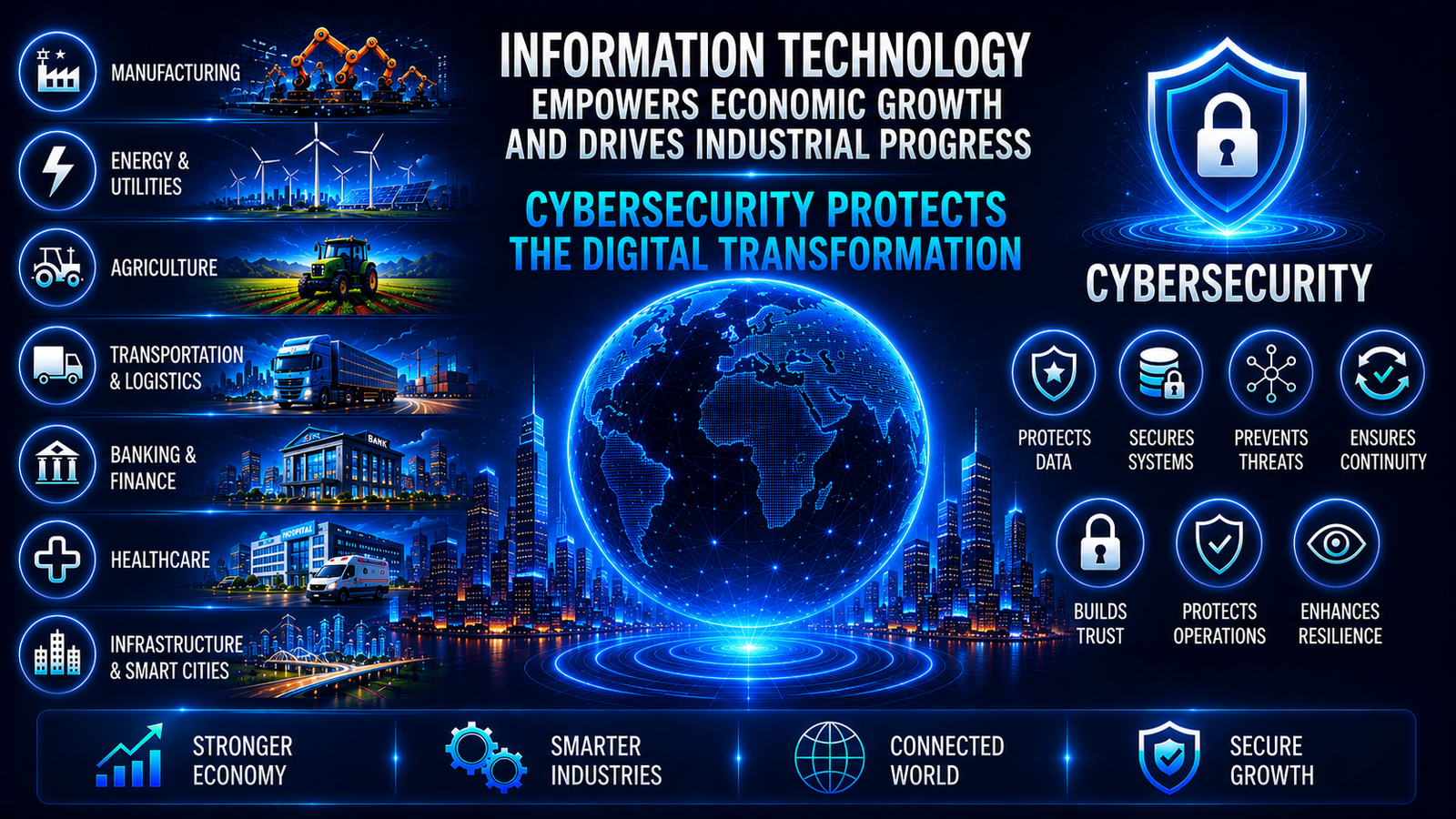
Information Technology has become deeply connected with industrial and economic activity. Industries use IT to manage information, operate processes, connect participants, deliver products and services, and support decision-making. As this dependence increases, cybersecurity becomes increasingly important for protecting the technology and information that enable these activities.
IT as an Enabler of Industry
Information Technology provides capabilities through which industries manage information, automate activities, communicate, integrate systems, analyze data, and deliver products and services.
IT is therefore not limited to a supporting function. It can influence how industries operate, how resources are used, how services are delivered, and how value is created.
Industries as Drivers of Economic Activity
Industries transform resources, knowledge, labour, capital, and technology into goods and services.
Agriculture, manufacturing, healthcare, financial services, transportation, energy, telecommunications, retail, education, government, and other industries contribute to economic activity through production, services, employment, trade, investment, and consumption.
IT strengthens many of these activities by improving coordination, productivity, connectivity, and access to information.
Cybersecurity as a Foundation for Digital Operations
As industries become increasingly dependent on IT, cybersecurity becomes an essential foundation for reliable digital operations.
Cybersecurity helps protect:
- Information and data
- Applications
- Networks
- Computing infrastructure
- Digital services
- Industrial systems
- Financial systems
- Supply chains
Without appropriate cybersecurity, the benefits created through digital technologies can be undermined by disruption, unauthorized access, data compromise, fraud, and other cyber risks.
The Interdependence of Technology and Economic Activity
The relationship between technology and the economy is increasingly interconnected.
Energy depends on technology for generation, distribution, monitoring, and management. Manufacturing depends on IT for production, supply chains, inventory, and coordination. Financial services depend on digital systems for transactions and communication. Retail depends on IT for commerce, payments, inventory, and customer services.
As these relationships become interconnected, a disruption affecting one technology-dependent activity can influence other industries and economic activities that depend on it.
This interdependence means that the reliability and security of technology can have implications beyond an individual system or industry.
The Importance of Trust and Resilience
Economic activity increasingly depends on trust in digital systems.
Businesses and consumers need confidence that information will be protected, transactions will be processed correctly, services will remain available, and systems will operate as expected.
Cybersecurity contributes to this trust by protecting the confidentiality, integrity, and availability of information and systems.
Cybersecurity also contributes to resilience by supporting the ability to detect incidents, respond to threats, recover affected systems, and continue important activities during disruptive events.
From Digital Transformation to Economic Growth
Information Technology can contribute to economic growth by improving productivity, enabling innovation, expanding market access, creating new services, supporting employment, and connecting economic participants.
As these capabilities are adopted across industries, their combined contribution can influence the wider economy.
Cybersecurity supports this growth by helping protect the technology, information, infrastructure, and digital services on which increasingly interconnected economic activities depend.
The Broader Economic Role of Secure Technology
Information Technology provides capabilities that enable industries and economies to operate, connect, innovate, and grow. Cybersecurity protects the information, systems, infrastructure, and digital relationships that support these capabilities.
IT and cybersecurity therefore have complementary roles. Information Technology enables digital and economic activity, while cybersecurity helps protect the technology, information, and services on which that activity depends.
As technology becomes increasingly embedded across industries, cybersecurity becomes increasingly important to maintaining the reliability, resilience, and trust required for continued economic activity and growth.
Conclusion
Information Technology has become an integral part of industrial and economic activity. Its evolution from basic computing and information processing to interconnected systems, cloud computing, automation, and intelligent technologies has changed how industries operate, communicate, produce goods, deliver services, and participate in economic activity.
The impact of IT extends beyond individual organizations. When technology capabilities are adopted across industries, they can improve productivity, support innovation, expand markets, enable new services, strengthen supply chains, and contribute to broader economic growth.
At the same time, increasing dependence on technology creates greater dependence on the availability, integrity, confidentiality, and reliability of information systems and digital infrastructure. A disruption to technology can therefore affect not only an individual organization but also connected industries and economic activities.
Cybersecurity is consequently an important part of the technology foundation supporting industry and the economy. Protecting information, systems, networks, applications, infrastructure, and digital services helps maintain operational continuity, trust, and resilience.
The relationship between IT and cybersecurity is therefore complementary. Information Technology provides the capabilities that enable industries and economic activity, while cybersecurity helps protect those capabilities and the information on which they depend.
As technology continues to evolve, the ability to use it securely, reliably, and responsibly will remain important to the continued development and resilience of industries and economies.