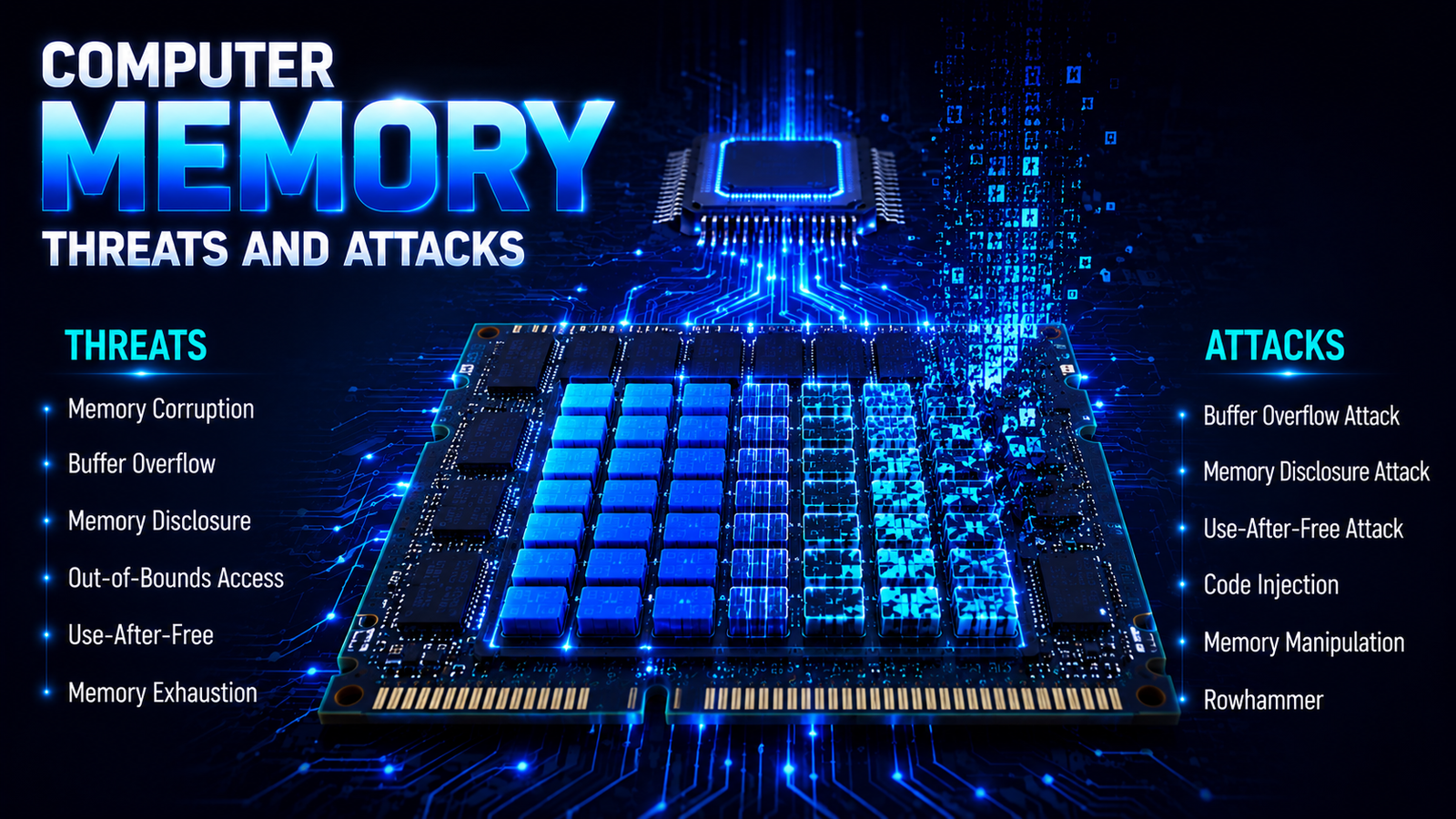
Computer Memory Threats and Attacks
Introduction
Computer memory is an essential component of every computing system because it provides the working space required to execute instructions and process data. During operation, a computing system continuously uses memory to hold program instructions, application data, operating-system data, temporary results, and other data required for processing.
Because memory contains data that is actively being used by the processor and applications, its security is an important part of overall system security. A weakness that allows unauthorized access to memory can expose sensitive information, while a weakness that allows memory to be modified can affect application behavior or influence program execution.
Memory-related security problems can originate from software vulnerabilities, incorrect memory management, insufficient isolation, malicious manipulation, or weaknesses in underlying hardware.
Understanding Computer Memory and Its Security Implications
What Is Computer Memory?
Computer memory is the working area of a computing system where instructions, data, and temporary information are held so that the processor and other system components can access them during operation.
Unlike persistent storage, which primarily retains data for later use, memory supports the active execution of programs and processing of data. Data can be loaded into memory from persistent storage, processed by the processor, modified during execution, and eventually written back to storage or transferred to another system component.
The exact architecture and organization of memory vary between computing systems. However, its fundamental role remains the same: providing accessible storage for data and instructions required during computation.
Computer memory can contain different types of data depending on what the computing system is doing at a particular time. Instructions, application data, operating-system data, temporary processing data, and security-sensitive information may all exist in memory during system operation.
The Role of Memory in a Computing System
A computing system may be a physical computer, server, virtual machine, or another system capable of processing information.
Memory acts as the active working area of the computing system.
When a system is operating, the processor and software continuously interact with memory.
The operating system and applications are loaded into memory so that their instructions can be executed. Data required by applications is also placed in memory while it is being processed.
A simplified view of memory’s role during operation includes:
- The operating system establishes the execution environment.
- Application instructions and required data are loaded into memory.
- The processor retrieves instructions and data as required.
- Applications create, modify, and process data in memory.
- Temporary results and application state remain available in memory while operations continue.
- Data may subsequently be written to persistent storage, transmitted to another system component, or released from memory.
Memory is therefore an active component of computation rather than simply a passive location for storing data.
Memory also provides the environment in which processes maintain their execution state. Operating systems use memory-management mechanisms to provide processes with appropriate address spaces and control how memory resources are used.
What Data Can Exist in Memory?
The data present in memory depends on the applications and system activities taking place at a particular time.
A computing system may temporarily contain:
- Program instructions
- Application data
- User credentials
- Authentication tokens
- Session information
- Encryption keys
- Personal data
- Database records
- Network communication data
- Operating-system data
- Configuration data
- Temporary processing data
Not all data remains in memory for the same amount of time. Some data may exist only briefly, while other data may remain available throughout the lifetime of a process.
The security significance comes from the fact that some of this data may be sensitive.
If an attacker gains an unauthorized ability to read memory, sensitive information that was never intended to be exposed may become accessible.
What Happens When Memory Is Compromised?
Memory compromise occurs when an unauthorized party is able to improperly access, modify, manipulate, or otherwise interfere with memory or data held in memory.
The consequences depend on what memory is affected and what capabilities the unauthorized party obtains.
Unauthorized Memory Reading
If an unauthorized party can read memory that should be inaccessible, sensitive information may be exposed.
For example, credentials, authentication tokens, session information, application data, or cryptographic keys may potentially be recovered.
This primarily creates a confidentiality concern.
Unauthorized Memory Modification
If an unauthorized party can modify memory, data, application state, or other information used during program execution may be altered.
Depending on what is modified, this can affect the behavior or integrity of an application.
This creates an integrity concern and, in some circumstances, may also lead to further compromise.
Memory Corruption
If memory contents or memory structures are corrupted, applications may behave unpredictably or terminate unexpectedly.
Memory corruption can affect data, program state, or information used to control execution.
In some circumstances, memory corruption can create conditions that enable further security compromise.
Memory Manipulation
Unauthorized manipulation of memory can alter data, application state, or execution-related information.
Such manipulation can affect application behavior, bypass intended security controls, or interfere with the normal operation of a process.
The consequences depend on the vulnerability, operating system, processor architecture, application, and security controls in place.
Memory Exhaustion
Excessive consumption of memory resources can prevent legitimate processes from obtaining the resources they require.
This can result in degraded performance, application failures, system instability, or denial of service.
Why Memory Security Is Important
Memory security is important because memory sits at the center of active computation.
The processor depends on memory for instructions and data, while applications depend on memory to maintain their working state. As a result, unauthorized access to memory can affect more than individual pieces of data.
A memory compromise can potentially affect:
- Confidentiality by exposing sensitive information
- Integrity by modifying data or program state
- Availability by exhausting memory or causing applications to fail
- Authentication by exposing credentials or authentication tokens
- Session security by exposing session information
- Cryptographic security by exposing encryption keys
- Application security by influencing program behavior
- System security by affecting processes or security boundaries
Memory security therefore contributes directly to the security of applications, operating systems, and computing systems.
Memory Security and the CIA Triad
The security of computer memory can be understood through the Confidentiality, Integrity, and Availability (CIA) triad.
Confidentiality
Memory must be protected against unauthorized access.
If sensitive information stored in memory can be read by an unauthorized process or party, confidential information may be exposed.
Integrity
Memory contents must be protected against unauthorized modification.
Changes to application data, instructions, or execution-related information can cause incorrect behavior or potentially enable further compromise.
Availability
Memory resources must remain available to legitimate applications and system processes.
Excessive memory consumption, memory corruption, or other memory-related conditions can prevent applications from operating correctly.
Memory security therefore contributes to all three fundamental security objectives.
Computer Memory Threats
A computer memory threat is a vulnerability, weakness, condition, or potential source of harm associated with the use, management, protection, or operation of computer memory.
Memory threats can affect data stored in memory, processes using memory, or mechanisms that control memory access.
They can potentially create conditions that allow unauthorized parties to:
- Read data from memory
- Modify memory contents
- Corrupt application data
- Access memory outside permitted boundaries
- Expose sensitive information
- Consume excessive memory resources
- Influence program behavior
Memory threats can originate from software development weaknesses, incorrect memory management, insufficient isolation, operating-system issues, or hardware characteristics.
The presence of a memory threat does not mean that a system has already been compromised. It indicates that a condition exists that could create security risk if exploited or otherwise allowed to cause harm.
The following are common computer memory threats.
Memory Corruption
Memory corruption occurs when memory contents or memory structures are altered in an unintended or unauthorized manner.
Applications rely on assumptions about where data is stored, how much memory has been allocated, and how long a memory object remains valid.
When these assumptions are violated, memory may be overwritten, accessed incorrectly, or interpreted in an unexpected way.
Memory corruption can affect:
- Application data
- Program state
- Memory structures
- Execution-related information
- Application stability
Depending on the affected memory and surrounding conditions, memory corruption may result in application crashes, incorrect behavior, data corruption, or security compromise.
Buffer Overflow Vulnerabilities
A buffer overflow occurs when an application writes more data into a memory buffer than the allocated space can hold.
The additional data can overwrite adjacent memory locations.
The security impact depends on what is located next to the affected buffer and how the overwritten information is subsequently used.
A buffer overflow may result in data corruption, application instability, or modification of information associated with program execution.
Buffer overflow vulnerabilities can occur in different memory regions, including the stack and heap.
Stack-Based Memory Corruption
Stack-based memory corruption affects memory associated with the program’s execution stack.
The stack commonly contains information associated with function calls, local variables, and other execution-related data.
If an application writes beyond the boundary of a stack-based memory object, information stored nearby may be overwritten.
Depending on the application and architecture, this can affect program behavior, application stability, or execution-related information.
Heap-Based Memory Corruption
Heap-based memory corruption affects dynamically allocated memory.
Applications use the heap when they need memory whose size or lifetime is determined during program execution.
Incorrect handling of dynamically allocated objects can cause data to be written outside an intended region or cause memory structures to become inconsistent.
Heap corruption can result in application instability, data corruption, or security compromise.
Memory Disclosure
Memory disclosure occurs when data contained in memory becomes accessible to an unauthorized party.
A vulnerability may cause an application to return data outside the intended memory region or expose data that should have remained inaccessible.
The security impact depends on the nature and sensitivity of the exposed information.
Sensitive Data Exposure
Applications may temporarily hold sensitive data in memory while processing requests or performing operations.
If a memory disclosure condition exposes this data, an unauthorized party may obtain information that was never intended to leave the application’s memory space.
Credential and Token Exposure
Authentication credentials, session identifiers, and access tokens may exist in memory while applications perform authentication and authorization operations.
If these values are exposed, they may potentially be used to impersonate users or access protected resources.
Cryptographic Key Exposure
Cryptographic operations may require keys to be present in memory.
If an unauthorized party obtains a cryptographic key from memory, the security of information protected by that key may be compromised.
The consequences depend on the type of key, its purpose, its privileges, and the cryptographic system in which it is used.
Memory Access Violations
Memory access violations occur when an application attempts to access a memory region outside the boundaries it is permitted to use.
Such violations can involve reading or writing beyond the intended boundaries of a memory object.
Out-of-Bounds Read
An out-of-bounds read occurs when an application reads beyond the valid boundary of a memory object.
The unintended memory contents may include unrelated application data or sensitive information.
Out-of-bounds reads therefore commonly create information-disclosure risks.
Out-of-Bounds Write
An out-of-bounds write occurs when an application writes beyond the valid boundary of a memory object.
An out-of-bounds write can directly alter unintended memory contents.
Depending on what is overwritten, the result may include data corruption, application instability, or modification of execution-related information.
Use-After-Free
A use-after-free vulnerability occurs when an application continues to use a memory object after the memory allocated to that object has been released.
Once memory has been released, the associated region may be reused for another purpose.
If the application continues to access the old reference, it may interact with data belonging to another object or with memory whose contents have changed.
This can lead to unpredictable behavior, memory corruption, application instability, or security compromise.
Double-Free
A double-free occurs when an application attempts to release the same dynamically allocated memory region more than once.
This can cause inconsistencies in memory-management structures and may result in memory corruption, application instability, or security compromise.
Memory Leaks
A memory leak occurs when allocated memory is no longer required but remains allocated because the application fails to release it.
Repeated memory leaks can gradually consume available memory.
Although memory leaks are primarily resource-management problems, they can become security concerns when an attacker can deliberately trigger them to exhaust system resources.
Uninitialized Memory
Uninitialized memory is memory that has been allocated but has not been assigned an appropriate initial value before being used.
Reading such memory can produce unpredictable values and, in some situations, may expose data left behind by previous operations.
If the resulting data becomes accessible to an unauthorized party, an uninitialized-memory condition can contribute to information disclosure.
Memory Exhaustion
Memory exhaustion occurs when available memory resources are consumed to the point that legitimate applications or system components cannot obtain the resources they require.
It can result from software defects, excessive workloads, memory leaks, or deliberate attempts to consume system resources.
Severe memory exhaustion can cause application failures, system instability, or denial of service.
Hardware Memory Threats
Memory threats are not limited to software vulnerabilities.
The physical characteristics and implementation of memory technologies can also introduce security concerns.
Hardware-level memory threats may involve physical access, memory-cell behavior, electrical characteristics, implementation weaknesses, or other properties of the underlying memory system.
Rowhammer
Rowhammer is a hardware-level memory disturbance phenomenon associated with certain DRAM technologies.
Repeatedly accessing particular memory rows can, under certain conditions, influence the contents of nearby rows.
The resulting bit changes can potentially affect the integrity of data stored in memory.
Rowhammer demonstrates that memory security can extend below the application and operating-system layers into the physical behavior of memory hardware.
Memory Faults and Reliability Issues
Memory hardware can experience faults caused by physical degradation, manufacturing defects, environmental conditions, electrical disturbances, or other factors.
Such faults can cause incorrect data or unexpected system behavior.
Computing systems can use error-detection and error-correction mechanisms to identify or correct certain classes of memory errors.
Although a hardware memory fault is not necessarily a cyber attack, it can become security-relevant when it affects the integrity or availability of security-sensitive data or system operations.
Computer Memory Attacks
A computer memory attack is a deliberate attempt to exploit a memory-related vulnerability or manipulate memory in a way that compromises the confidentiality, integrity, or availability of a computing system.
Memory attacks can target applications, operating systems, processes, memory-management mechanisms, or the underlying memory hardware. The objective may be to obtain sensitive data, alter application behavior, disrupt system operation, influence program execution, or gain unauthorized access.
A memory threat represents a potential source of harm, while a memory attack represents an intentional attempt to exploit a weakness or cause harm.
Memory attacks can take different forms depending on the vulnerability being targeted, the memory region involved, the operating environment, and the attacker’s objective.
Buffer Overflow Attacks
A buffer overflow attack attempts to exploit a buffer overflow vulnerability by causing an application to process more data than the allocated memory region can safely contain.
When excess data overwrites adjacent memory, it may alter data, application state, or execution-related information.
The impact depends on the location of the affected buffer, the surrounding memory contents, the application’s behavior, and the security controls protecting the system.
A successful buffer overflow attack may result in:
- Application crashes
- Data corruption
- Unauthorized modification of application state
- Bypass of certain security controls
- Unauthorized code execution
- Potential compromise of the affected process
Buffer overflow attacks can target both stack-based and heap-based memory.
Stack-Based Buffer Overflow Attacks
Stack-based buffer overflow attacks target buffers located in memory associated with the execution stack.
An attacker may attempt to cause data written to a stack buffer to overwrite adjacent stack information.
Depending on the application and its protections, this may affect function execution, application state, or other execution-related information.
Heap-Based Buffer Overflow Attacks
Heap-based buffer overflow attacks target dynamically allocated memory.
An attacker may attempt to cause data to be written beyond the boundaries of an allocated heap object.
The resulting memory corruption may affect adjacent objects or memory-management structures and can potentially influence application behavior.
Memory Corruption Attacks
Memory corruption attacks deliberately exploit conditions that cause memory contents or memory structures to be altered in an unintended manner.
The attacker may seek to influence application behavior, modify data, interfere with execution, or obtain control over a vulnerable process.
Memory corruption attacks can involve different underlying vulnerabilities, including buffer overflows, out-of-bounds writes, use-after-free conditions, and other memory-management weaknesses.
The potential impact depends heavily on the application, operating system, processor architecture, memory layout, and available security protections.
Memory Disclosure Attacks
Memory disclosure attacks attempt to obtain information from memory that should not be accessible to the attacker.
The exposed data may belong to the affected application, another process, the operating system, or another component of the computing environment.
Depending on the information exposed, a memory disclosure attack may reveal:
- Credentials
- Authentication tokens
- Session information
- Personal data
- Application data
- Configuration information
- Cryptographic keys
- Program information
Memory disclosure can therefore provide information that may support further unauthorized activity.
Out-of-Bounds Memory Attacks
Out-of-bounds memory attacks exploit vulnerabilities that allow an application to access memory beyond the intended boundary of an object or allocated region.
The attack may involve either reading from or writing to memory outside the permitted region.
Out-of-Bounds Read Attacks
An out-of-bounds read attack attempts to cause an application to read memory beyond the intended boundary of an object.
The resulting data may contain information belonging to another object, another part of the application, or another memory region.
Depending on the affected memory, the attack may result in information disclosure.
Out-of-Bounds Write Attacks
An out-of-bounds write attack attempts to cause an application to modify memory beyond the intended boundary of an object.
This can alter data or memory structures that were not intended to be modified by the application.
Depending on what is overwritten, an out-of-bounds write may cause application instability, data corruption, or manipulation of execution-related information.
Use-After-Free Attacks
A use-after-free attack exploits a condition in which an application continues to use a memory object after the associated memory has been released.
After memory is released, the same region may be allocated for another object.
If an application continues to use a reference to the previously released object, an attacker may attempt to influence how that memory is reused or interpreted.
A successful use-after-free attack can potentially result in:
- Memory corruption
- Data manipulation
- Application instability
- Unauthorized access to data
- Manipulation of application behavior
- Potential unauthorized code execution
The impact depends on how the affected application manages dynamically allocated memory and how the vulnerable object is subsequently used.
Double-Free Attacks
A double-free attack exploits a condition in which the same dynamically allocated memory region is released more than once.
Improper memory management can cause inconsistencies in the application’s memory-management structures.
An attacker may attempt to trigger such a condition to influence how memory is allocated or reused.
Depending on the affected memory-management mechanism and application behavior, a double-free condition may lead to memory corruption, application instability, or further security compromise.
Code Injection Through Memory
Code injection through memory involves placing or introducing instructions into a memory region and attempting to cause those instructions to execute in an unauthorized manner.
Historically, memory corruption vulnerabilities have sometimes been used to place attacker-controlled data in memory and influence program execution.
Modern systems implement multiple protections to make unauthorized execution from data regions and manipulation of execution flow more difficult.
The security impact of successful code injection can be significant because execution within a compromised process may provide access to the privileges and resources available to that process.
Memory Manipulation Attacks
Memory manipulation attacks attempt to deliberately modify information held in memory to influence application behavior or system operation.
The targeted information may include:
- Application variables
- Process state
- Configuration values
- Authentication state
- Security-related flags
- Execution-related data
The objective may be to alter the behavior of an application, bypass a security check, change an application’s state, or interfere with normal system operation.
Memory manipulation can be particularly significant when an application relies on memory-resident values to make security decisions.
Memory Exhaustion Attacks
Memory exhaustion attacks attempt to consume available memory resources until legitimate applications or system components cannot obtain sufficient memory to operate normally.
An attacker may generate conditions that cause excessive memory allocation or prevent memory from being released.
The resulting impact may include:
- Application degradation
- Application crashes
- System instability
- Reduced system capacity
- Denial of service
Memory exhaustion attacks primarily affect availability, although secondary effects may occur when critical security or system processes are unable to operate normally.
Hardware-Based Memory Attacks
Some memory attacks target characteristics of the underlying memory hardware rather than vulnerabilities in application software.
These attacks may exploit physical properties of memory cells, memory access behavior, hardware implementation characteristics, or weaknesses in memory isolation.
Hardware-based memory attacks demonstrate that memory security extends beyond application code and operating-system controls.
Rowhammer Attacks
Rowhammer attacks exploit a memory disturbance phenomenon associated with certain DRAM technologies.
Repeated access to particular memory rows can, under certain conditions, cause changes in nearby memory cells.
An attacker may attempt to use these changes to alter data belonging to another process or security boundary.
The significance of Rowhammer is that it demonstrates how physical memory behavior can potentially affect the integrity of information across software isolation boundaries.
Cold Boot Attacks
Cold boot attacks take advantage of the fact that some information may remain temporarily present in RAM after a system loses power or is restarted.
Under certain conditions, an attacker with appropriate physical access may attempt to recover residual data from memory before it disappears.
Sensitive information such as cryptographic keys or other memory-resident data may be at risk.
The feasibility and effectiveness of such attacks depend on the memory technology, system configuration, physical conditions, and available protections.
Impact of Computer Memory Threats and Attacks
Computer memory threats and attacks can affect multiple security objectives and may have consequences that extend from exposure of sensitive data to compromise of applications and system privileges.
Impact on the CIA Triad
Computer memory threats and attacks can affect the three fundamental security objectives of Confidentiality, Integrity, and Availability (CIA). The extent of the impact depends on the type of memory weakness, the memory region affected, the privileges of the affected process, and the nature of the attack.
Confidentiality
Unauthorized access to memory can expose sensitive data that applications or operating systems temporarily hold during processing.
This may include:
- Credentials
- Authentication tokens
- Session information
- Personal data
- Application data
- Configuration data
- Cryptographic keys
Memory disclosure can therefore expose information that is not intended to be accessible to an unauthorized party.
Integrity
Memory manipulation and corruption can alter application data, program state, or execution-related information.
Changes to memory can result in:
- Incorrect processing
- Data corruption
- Application instability
- Unauthorized changes in application behavior
- Manipulation of security-sensitive values
A successful integrity compromise can affect the reliability and trustworthiness of the affected application or process.
Availability
Memory exhaustion, memory corruption, and certain hardware-related conditions can prevent applications and system components from obtaining or correctly using required memory resources.
This can result in:
- Application failures
- System instability
- Resource exhaustion
- Service disruption
- Denial of service
Credential and Session Compromise
Credentials, authentication tokens, and session information may exist in memory during authentication and application operations.
If these values are exposed through a memory vulnerability or attack, they may potentially be used to impersonate users or access protected resources.
The impact depends on the type of credential or token exposed, its privileges, its validity period, and the resources it protects.
Cryptographic Key Exposure
Cryptographic keys may temporarily reside in memory while cryptographic operations are performed.
Unauthorized access to these keys can undermine the protection provided by encryption and other cryptographic mechanisms.
The impact depends on the type of key, its purpose, its privileges, and the information or systems protected by it.
Process Compromise
A memory attack may affect the integrity or behavior of a vulnerable process.
If an attacker gains sufficient control over a process, the attacker may potentially access the data and system resources available to that process.
The severity of process compromise depends on the privileges assigned to the affected process and the resources it can access.
Unauthorized Code Execution
Certain memory vulnerabilities can potentially be exploited to influence program execution.
If an attacker succeeds in causing unauthorized instructions to execute within a vulnerable process, the resulting impact depends on the privileges and resources available to that process.
Unauthorized code execution can therefore become a significant step toward further system compromise.
Privilege Escalation
Memory vulnerabilities may sometimes contribute to privilege escalation when an attacker is able to manipulate a privileged process or interfere with security-sensitive memory structures.
Successful privilege escalation can increase the attacker’s access beyond the permissions initially available and may allow access to additional data, processes, or system resources.
Memory Security and Protection
Protecting memory requires controls across hardware, operating systems, applications, and software development practices.
Memory Isolation
Memory isolation separates the memory spaces used by different processes and system components.
Effective isolation helps prevent one process from accessing or modifying memory belonging to another process without authorization.
Data Execution Prevention (DEP)
Data Execution Prevention helps prevent memory regions intended for data from being executed as program code.
This reduces the ability of certain memory-based attacks to execute attacker-controlled data.
Address Space Layout Randomization (ASLR)
Address Space Layout Randomization randomizes the locations of important memory regions and components within a process address space.
By making memory locations less predictable, ASLR can make certain memory exploitation techniques more difficult.
Stack Canaries
Stack canaries are values placed near certain control data on the stack.
Security mechanisms can check whether the expected value has changed before allowing execution to continue.
An unexpected change can indicate that memory corruption has occurred.
Memory Access Controls
Operating systems and processors can enforce permissions that determine whether memory regions can be read, written, or executed.
Appropriate memory permissions help limit unauthorized access and reduce the impact of memory-related vulnerabilities.
Hardware-Assisted Memory Protection
Processors and memory-management hardware provide mechanisms that support memory isolation, access control, privilege separation, and other protections.
These mechanisms provide a foundation for operating-system and application-level memory security.
Memory-Safe Programming Languages
Memory-safe programming languages provide mechanisms designed to prevent or reduce common classes of memory-management vulnerabilities.
These mechanisms can help reduce risks associated with buffer overflows, use-after-free conditions, invalid memory access, and other memory-safety problems.
Secure Memory Management
Secure memory management includes practices that ensure memory is correctly allocated, accessed, initialized, and released throughout the lifecycle of an application.
Appropriate memory management reduces the likelihood of vulnerabilities caused by incorrect handling of memory.
Secure Software Development
Secure software development practices can identify and reduce memory-related vulnerabilities during the design, development, testing, and maintenance of applications.
Source-code analysis, security testing, vulnerability management, and appropriate programming practices can contribute to stronger memory security.
Conclusion
Computer memory is fundamental to the operation of computing systems and plays an important role in security because applications and operating systems continuously process and temporarily hold data in memory.
Memory threats can arise from weaknesses in software, memory management, process isolation, operating systems, and hardware. When these weaknesses are deliberately exploited, memory attacks can affect confidentiality, integrity, and availability and may contribute to data exposure, process compromise, unauthorized code execution, privilege escalation, or denial of service.
Protecting memory therefore requires multiple layers of security, including memory isolation, access controls, execution protections, secure memory management, hardware-assisted protections, and memory-safe software development practices.
Understanding how memory functions, how memory-related threats arise, how attacks exploit those weaknesses, and how appropriate protections reduce risk provides an important foundation for understanding the security of computing systems.