What is Threat Modeling? Why It Matters in Cybersecurity
Introduction
As organizations increasingly rely on digital technologies, protecting applications, systems, and data has become a critical business requirement. Cyber attackers continuously look for weaknesses in software, networks, cloud environments, and infrastructure to gain unauthorized access, steal sensitive information, disrupt services, or compromise business operations.
To build secure systems, organizations must identify potential security risks before they become exploitable vulnerabilities. This proactive approach is known as Threat Modeling.
Threat modeling enables organizations to anticipate how attackers may target a system, identify security weaknesses early, and implement appropriate safeguards during the design and development stages rather than after an attack occurs. By integrating threat modeling into the Software Development Lifecycle (SDLC), organizations can significantly reduce security risks, lower remediation costs, and build secure, resilient, and trustworthy applications.
What is Threat Modeling?
Threat Modeling is a structured and systematic process used to identify, analyze, prioritize, and mitigate potential security threats to a system, application, network, cloud environment, infrastructure, or business process before those threats can be exploited.
Rather than reacting to security incidents after deployment, threat modeling helps organizations build security into systems from the beginning by understanding what needs protection, how attackers may target it, and which security controls should be implemented.
Threat modeling helps security teams, architects, developers, and business stakeholders answer important questions such as:
- What are we building?
- What assets need protection?
- What could go wrong?
- What threats exist?
- How can those threats be mitigated?
- Have all significant risks been addressed?
By answering these questions early, organizations can prioritize security investments and significantly reduce the likelihood of successful cyber attacks.
What is a Threat Model?
A Threat Model is a structured representation of a system from a security perspective. It identifies the assets that require protection, analyzes potential threats and attack paths, assesses associated risks, and defines the security controls needed to reduce those risks. It provides a clear understanding of how a system could be attacked and helps guide security decisions throughout its lifecycle.
A threat model typically includes:
- System scope and architecture
- Data Flow Diagram (DFD)
- Assets requiring protection
- External entities and trust boundaries
- Identified threats and attack scenarios
- Risk assessment and prioritization
- Security controls and mitigation strategies
- Assumptions, dependencies, and residual risks
A threat model should be reviewed and updated whenever new features are introduced, architectures change, third-party integrations are added, or new threats emerge. Maintaining an up-to-date threat model helps ensure that security decisions remain aligned with the evolving system and threat landscape throughout the Software Development Lifecycle (SDLC).
Why is Threat Modeling Important?
Identifies Security Risks Early
Identifying vulnerabilities during the design phase is significantly less expensive and easier than fixing security issues after deployment. Early detection helps organizations avoid costly security incidents and reduces development rework.
Improves Security by Design
Threat modeling integrates security into architecture and design decisions rather than treating it as a final testing activity. This Security by Design approach results in stronger and more resilient systems.
Reduces the Attack Surface
By identifying potential attack paths, exposed interfaces, insecure configurations, and trust boundaries, organizations can eliminate unnecessary risks before systems become operational.
Supports Regulatory Compliance
Many security standards, regulatory frameworks, and industry best practices encourage or require organizations to perform structured risk assessments and threat analysis during system development.
Enhances Team Collaboration
Threat modeling encourages collaboration between developers, architects, security professionals, operations teams, and business stakeholders, ensuring everyone shares a common understanding of security risks and mitigation strategies.
Key Components of Threat Modeling
Assets
Assets are anything of value that an organization needs to protect. These include information, applications, systems, infrastructure, services, and business processes.
Examples include:
- Customer data
- Financial records
- Authentication credentials
- Intellectual property
- Business applications
- Cloud infrastructure
- Source code
- API keys
Threats
Threats are events or actions that may compromise the confidentiality, integrity, or availability of assets. Threats can originate from external attackers, malicious insiders, third-party suppliers, or accidental human errors.
Examples include:
- Data breaches
- Malware attacks
- Unauthorized access
- Insider threats
- Denial-of-Service (DoS) attacks
- API abuse
- Credential theft
Vulnerabilities
Vulnerabilities are weaknesses that attackers can exploit to compromise a system.
Examples include:
- Weak passwords
- Unpatched software
- Misconfigured servers
- Insecure APIs
- Poor access controls
- Outdated libraries
- Insecure coding practices
Security Controls (Countermeasures)
Security controls, also known as countermeasures, are administrative, technical, or physical safeguards implemented to reduce identified risks.
Examples include:
- Multi-factor Authentication (MFA)
- Encryption
- Role-Based Access Control (RBAC)
- Security monitoring
- Network segmentation
- Secure coding practices
- Web Application Firewalls (WAF)
- Regular security testing
Trust Boundaries
A Trust Boundary is a point within a system where the level of trust changes between users, applications, systems, networks, or environments. It separates components that operate under different security assumptions and identifies where additional security controls are required to protect data and resources.
When information crosses a trust boundary, it may move from a less trusted environment to a more trusted one, or vice versa. These transition points are common targets for attackers because they often involve user input, authentication, authorization, data exchange, or communication between different systems. Identifying trust boundaries helps organizations recognize potential attack paths and implement appropriate safeguards before systems are deployed.
Common examples of trust boundaries include:
- Internet to a web application
- User device to an application server
- Application server to a database
- Public cloud to an on-premises environment
- Internal network to a third-party service
- API communication between two applications
Trust boundaries play a fundamental role in threat modeling because they help security teams identify where threats are most likely to occur and where security controls such as authentication, authorization, encryption, input validation, logging, and network segmentation should be applied. By analyzing how data and users cross these boundaries, organizations can better understand potential security risks and strengthen the overall security of the system.
Threat Modeling Process
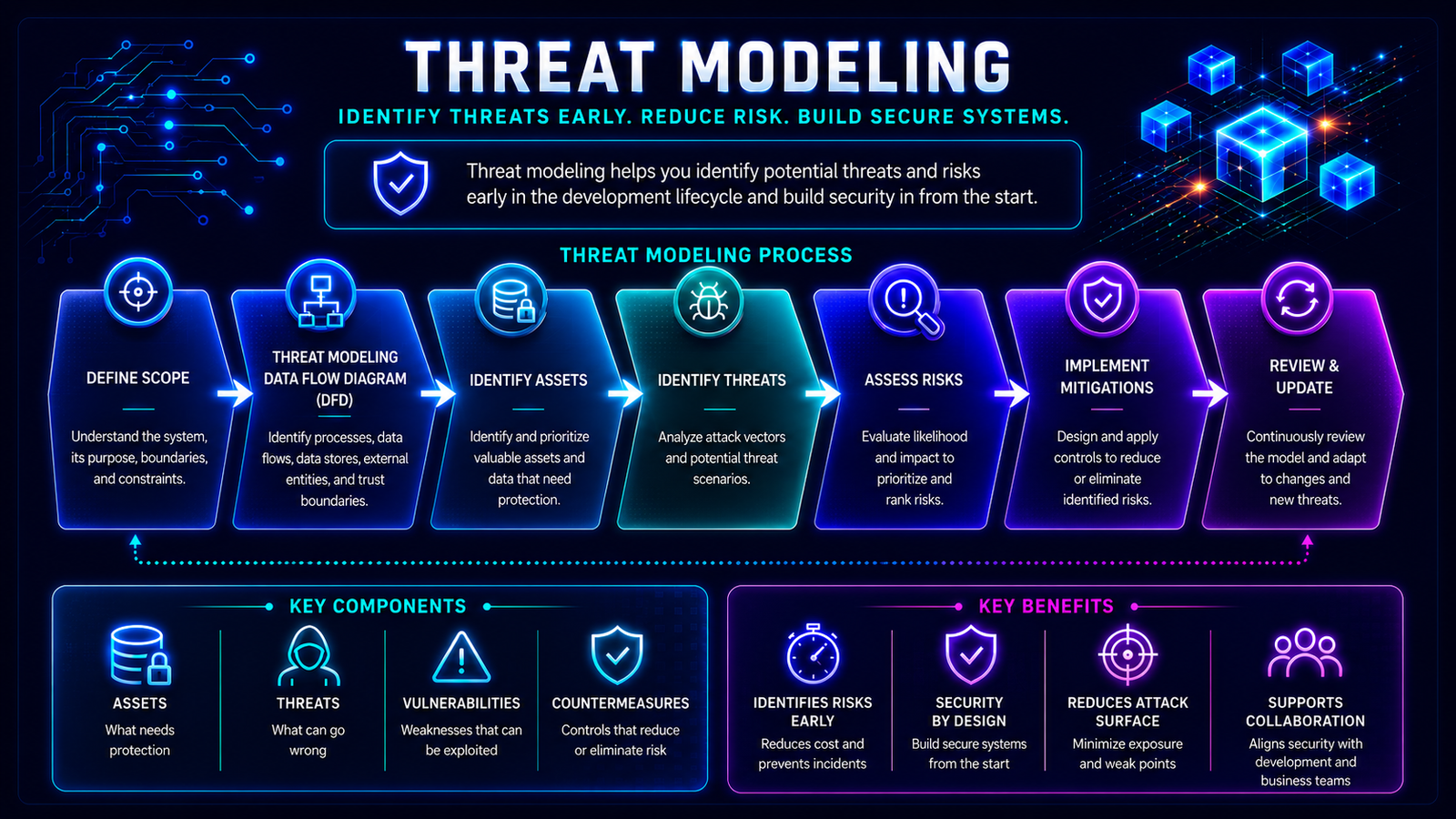
Threat modeling is an iterative security process that should be revisited whenever systems evolve, new features are introduced, architectures change, or the threat landscape evolves. Rather than being a one-time activity, it helps organizations continuously identify, analyze, assess, and mitigate security risks throughout the Software Development Lifecycle (SDLC). The process typically includes the following activities.
Define the Scope
Clearly define the scope of the system, application, cloud environment, infrastructure, or business process being analyzed.
Questions to consider:
- What is the purpose of the system?
- What components are included?
- What data is processed?
- Who are the users?
- What external systems are connected?
Create a Threat Modeling Data Flow Diagram (DFD)
A Threat Modeling Data Flow Diagram (DFD) is used to visualize how data moves through the system and identify the components, interactions, and trust boundaries that are essential for threat modeling.
The diagram should include:
- External entities (users and third-party systems)
- Processes (applications, services, and APIs)
- Data stores (databases and storage systems)
- Data flows
- Trust boundaries
A Threat Modeling Data Flow Diagram helps security teams understand how information flows through the system, identify trust boundary crossings, discover potential attack paths, and uncover security weaknesses before implementation.
Identify Assets
Determine which assets require protection.
Examples include:
- Customer information
- Payment data
- Authentication tokens
- Business secrets
- Intellectual property
- Configuration files
Identify Threats
Analyze possible attack scenarios and identify potential threats that could affect the identified assets.
Threats may be identified using methodologies such as STRIDE, which categorizes threats into:
- Spoofing
- Tampering
- Repudiation
- Information Disclosure
- Denial of Service
- Elevation of Privilege
Assess Risks
Evaluate each identified threat based on its likelihood of occurrence, potential impact, and business consequences.
Examples of risk ratings include:
- Low
- Medium
- High
- Critical
Risk assessment helps organizations prioritize mitigation efforts.
Implement Mitigations
Design and implement appropriate security controls to reduce or eliminate identified risks.
Examples include:
- Strong authentication
- Encryption
- Input validation
- Secure session management
- Access controls
- Logging and monitoring
The objective is to reduce the likelihood or impact of identified threats before deployment.
Review and Update
Threat modeling is not a one-time exercise. Review and update threat models whenever:
- New features are introduced
- System architecture changes
- Third-party integrations are added
- Cloud migrations occur
- New attack techniques emerge
- Significant business or regulatory changes occur
Popular Threat Modeling Methodologies
STRIDE
Developed by Microsoft, STRIDE categorizes threats into Spoofing, Tampering, Repudiation, Information Disclosure, Denial of Service, and Elevation of Privilege.
DREAD
DREAD is a historical risk-ranking methodology that evaluates risks based on Damage Potential, Reproducibility, Exploitability, Affected Users, and Discoverability. Although it influenced many modern risk assessment approaches, it is now less commonly used due to the subjectivity of its scoring model.
PASTA
PASTA (Process for Attack Simulation and Threat Analysis) is a risk-centric methodology that evaluates threats from both business and attacker perspectives.
OCTAVE
Operationally Critical Threat, Asset, and Vulnerability Evaluation (OCTAVE) is a risk-based methodology that focuses on organizational risk management and the protection of critical assets.
Threat Modeling vs Risk Assessment
Threat Modeling and Risk Assessment are complementary cybersecurity practices that help organizations identify and manage security risks. Although they are closely related, they serve different purposes and are performed at different stages of the security lifecycle.
Threat Modeling is a proactive security practice that identifies potential threats, attack paths, and security weaknesses during the design and development of a system. Its primary objective is to understand how a system could be attacked and determine the security controls required to reduce those threats before implementation.
Risk Assessment is a broader process that evaluates identified threats and vulnerabilities to determine their likelihood, potential impact, and overall level of risk. It enables organizations to prioritize risks, allocate resources effectively, and make informed decisions about risk treatment based on business objectives and risk tolerance.
| Threat Modeling | Risk Assessment |
|---|---|
| Identifies potential threats and attack scenarios. | Evaluates the likelihood and impact of identified risks. |
| Primarily performed during system design and development. | Performed throughout the system and business lifecycle. |
| Focuses on how a system could be attacked. | Focuses on the business impact and priority of identified risks. |
| Helps define security controls during system design. | Helps determine appropriate risk treatment strategies. |
| Supports Secure by Design by identifying security requirements early. | Supports risk management by prioritizing security efforts and investments. |
Threat Modeling and Risk Assessment work together to strengthen cybersecurity. Threat Modeling identifies what could go wrong and how it might happen, while Risk Assessment determines which risks require the greatest attention. Together, they enable organizations to build secure systems, prioritize security investments, and improve their overall cybersecurity posture.
Threat Modeling in the Software Development Lifecycle (SDLC)
Requirements Phase
Identify security requirements, business objectives, regulatory obligations, and compliance requirements.
Design Phase
Develop the Threat Modeling Data Flow Diagram (DFD), identify trust boundaries, analyze data flows, and evaluate potential threats.
Development Phase
Implement secure coding practices and the recommended security controls.
Testing Phase
Validate mitigations through security testing, code reviews, and vulnerability assessments.
Deployment Phase
Verify secure configurations, logging, monitoring, infrastructure hardening, and access controls before production deployment.
Maintenance Phase
Continuously reassess threats, review architecture changes, evaluate newly discovered vulnerabilities, and update threat models to address evolving risks.
Best Practices for Effective Threat Modeling
- Start threat modeling during the earliest stages of the project.
- Integrate threat modeling into DevSecOps workflows.
- Involve developers, architects, security professionals, operations teams, and business stakeholders.
- Focus on identifying and protecting high-value assets.
- Use established methodologies such as STRIDE or PASTA.
- Maintain accurate architecture and data flow diagrams.
- Review threat models after significant architectural or business changes.
- Document identified threats, mitigation strategies, and residual risks.
- Continuously improve threat models based on new threats and lessons learned.
Conclusion
Threat modeling is a proactive cybersecurity practice that enables organizations to identify potential threats, understand security risks, and implement appropriate safeguards before systems are deployed. Rather than reacting to security incidents after they occur, it helps organizations build security into applications, infrastructure, and business processes from the very beginning.
As cyber threats continue to evolve and software ecosystems become increasingly complex, integrating threat modeling into every stage of the Software Development Lifecycle (SDLC) has become an essential security practice. Organizations that adopt threat modeling can reduce security risks, improve compliance, strengthen collaboration between development and security teams, and build secure, resilient, and trustworthy systems.
By identifying valuable assets, understanding how attackers may target them, assessing risks, and implementing appropriate security controls, organizations can stay one step ahead of evolving cyber threats while significantly improving their overall cybersecurity posture.