Understanding Cyber Risk Management
Introduction
Risk is a fundamental concept that exists across every economy, industry, sector, and technology domain. It arises whenever uncertainty creates the possibility that an event or circumstance may adversely affect people, assets, systems, services, processes, or infrastructure. Understanding risk enables individuals and organizations to anticipate potential adverse events, evaluate their consequences, and make informed decisions to reduce their impact.
The modern world has undergone a significant digital transformation. Computing devices, communication networks, software applications, cloud platforms, artificial intelligence, and the Internet have become integral to governments, businesses, critical infrastructure, and everyday life. As organizations become increasingly dependent on digital technologies, they are exposed to a growing range of cyber threats and operational challenges. Events affecting digital systems, information, applications, or services can result in financial losses, business interruption, operational disruption, data compromise, regulatory consequences, and reputational damage.
Understanding the fundamental concept of risk provides the foundation for identifying, assessing, and managing cyber risks within today’s digital ecosystem.
What Is Risk?
Risk is the possibility that an event or circumstance may affect an asset, system, service, process, or infrastructure. It exists whenever uncertainty creates the possibility of an event whose occurrence may lead to harm, loss, damage, disruption, or other adverse consequences.
Depending on its nature and impact, a risk event may result in financial loss, operational disruption, technology failures, environmental damage, health emergencies, or the interruption of essential services.
Risk may arise from natural events, human activities, process failures, technology failures, changing economic conditions, or malicious actions. Effective risk management enables organizations to identify potential risks, assess their significance, and implement appropriate measures to reduce their likelihood, impact, or both.
Risk is commonly calculated using two key factors:
- Likelihood – The probability that an event or circumstance will occur.
- Impact – The consequence or severity if the event occurs.
Conceptual Risk Formula
The relationship between likelihood and impact is commonly expressed as:
Risk = Likelihood × Impact
Where:
Likelihood represents the probability that a risk event will occur.
Impact represents the potential business, operational, financial, legal, regulatory, reputational, environmental, or safety consequences if the event occurs.
Together, likelihood and impact determine the overall level of risk. Different risk management frameworks and assessment methodologies may use different approaches to evaluate and express risk.
What is Cyber Risk
Cyber risk refers to risk within the digital environment. Just as risk exists wherever uncertainty may affect assets, systems, services, or infrastructure, cyber risk exists wherever uncertainty may affect digital systems, information, applications, communication networks, cloud platforms, connected technologies, or digital services.
The increasing adoption of cloud computing, artificial intelligence, mobile technologies, operational technology, industrial control systems, Internet of Things devices, and digital platforms has significantly expanded the digital environment. As digital technologies continue to evolve, cyber risk extends beyond information technology systems and affects almost every sector that depends on digital services and interconnected technologies.
Cyber risk is not limited to cyber attacks. It also includes technology failures, human error, process deficiencies, software defects, system misconfigurations, third party dependencies, natural events, and other circumstances that may affect digital operations or digital information.
Characteristics of Cyber Risk
Cyber risk possesses several characteristics that distinguish it within the broader risk landscape.
- Dynamic – Cyber risk continuously evolves as technologies, threats, and digital environments change.
- Interconnected – A cyber incident affecting one system can quickly affect other connected systems, organizations, or sectors.
- Borderless – Cyber risks are not restricted by geographical boundaries and may originate from anywhere in the world.
- Complex – Multiple technologies, processes, users, and external dependencies contribute to cyber risk.
- Rapidly Evolving – New technologies, vulnerabilities, and attack techniques continually reshape the cyber risk landscape.
- Difficult to Predict – Emerging technologies and evolving threats create uncertainty within digital environments.
- Cascading – A single cyber event may trigger business, operational, economic, or critical infrastructure impacts.
Cyber Risk in the Economy
Digital technologies play a vital role in banking, financial services, digital payments, commerce, manufacturing, trade, logistics, taxation, and public services. Cyber incidents affecting these sectors can disrupt economic activities, interrupt financial transactions, reduce productivity, impact investor confidence, and result in significant financial losses. Because modern economies are highly interconnected, cyber risk has become an important consideration for economic stability and sustainable growth.
Cyber Risk in Enterprises
Enterprises rely on digital technologies to support business operations, communication, manufacturing, supply chains, finance, customer services, and decision making. Cyber risk can interrupt business operations, compromise sensitive information, affect business continuity, damage reputation, reduce customer confidence, and result in financial, legal, or regulatory consequences.
Cyber Risk in Critical Infrastructure
Critical infrastructure sectors such as energy, water, transportation, healthcare, telecommunications, emergency services, and manufacturing depend on reliable and secure digital technologies. Cyber incidents affecting these sectors can interrupt essential services, affect public safety, disrupt national operations, and impact economic stability and national resilience.
Cyber risk is not confined to information technology systems. It extends across economies, enterprises, businesses, governments, and critical infrastructure because digital technologies have become an integral part of modern society.
Impact of Cyber Risk on the CIA Triad
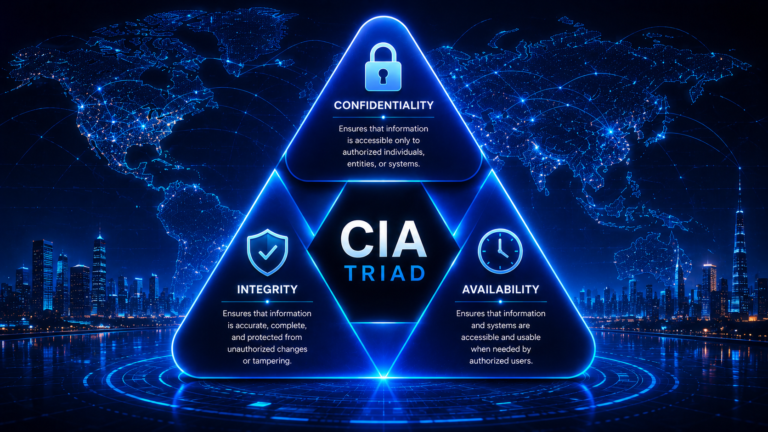
The CIA Triad is a fundamental cybersecurity model that consists of Confidentiality, Integrity, and Availability. These three principles form the foundation for protecting information, systems, applications, and digital services from cyber risks. Cyber risk can affect one or more of these principles depending on the nature and impact of the event or circumstance.
Confidentiality
Confidentiality ensures that information is accessible only to authorized individuals, systems, or processes. It protects sensitive information from unauthorized access, disclosure, or exposure, helping preserve privacy, intellectual property, business information, financial records, and other confidential data. Cyber risk can compromise confidentiality through unauthorized access, credential theft, data breaches, insider misuse, malware, or system misconfigurations, resulting in financial loss, identity theft, privacy violations, regulatory penalties, reputational damage, and loss of trust.
Integrity
Integrity ensures that information, systems, and digital records remain accurate, complete, consistent, and protected from unauthorized modification or destruction. It provides confidence that information has not been altered, corrupted, or manipulated. Cyber risk can compromise integrity through unauthorized modifications, malware, ransomware, software defects, configuration errors, insider actions, or malicious manipulation of information and systems, leading to inaccurate information, incorrect decisions, operational disruption, financial losses, and reduced confidence in digital systems.
Availability
Availability ensures that information, systems, applications, and digital services remain accessible and usable whenever they are required by authorized users. It supports the continuous delivery of business operations, public services, and critical infrastructure. Cyber risk can compromise availability through ransomware, distributed denial of service attacks, hardware failures, software failures, network outages, natural disasters, power disruptions, or other events that interrupt digital services, resulting in service outages, business interruption, productivity loss, financial impact, disruption of essential services, and reduced resilience.
Cyber risk may affect one or all three principles of the CIA Triad. A single cyber incident can simultaneously compromise confidentiality, integrity, and availability, resulting in widespread operational, financial, legal, and reputational consequences. Protecting the CIA Triad is one of the fundamental objectives of Cyber Risk Management.
What Is Cyber Risk Management?
Cyber Risk Management is the systematic process of identifying, assessing, analyzing, evaluating, treating, monitoring, and communicating cyber risks that may affect digital systems, information, applications, networks, cloud platforms, connected technologies, and digital services. It enables informed decision making by understanding cyber risks, implementing appropriate controls, and reducing risk to an acceptable level while supporting the secure and resilient operation of digital environments.
Cyber Risk Management is not about eliminating every cyber risk. Every digital environment contains inherent risks that cannot be completely removed. The objective is to understand those risks, prioritize them based on their likelihood and impact, implement appropriate safeguards, and continuously monitor changes in the cyber risk landscape.
An effective Cyber Risk Management program combines governance, people, processes, and technology to establish a structured approach for managing cyber risks throughout their lifecycle. It supports informed decision making, strengthens cyber resilience, and enables organizations to prepare for, respond to, and recover from cyber incidents.
Why Cyber Risk Management Is Important
Digital technologies have become essential to economies, businesses, governments, public services, and critical infrastructure. As reliance on interconnected digital systems continues to increase, cyber incidents can have far reaching consequences that extend well beyond technology.
Cyber Risk Management enables informed decision making by identifying potential cyber risks before they become significant incidents. It helps prioritize resources, strengthen security controls, improve resilience, support business continuity, protect digital services, and reduce the likelihood and impact of cyber incidents.
A structured Cyber Risk Management approach also supports regulatory compliance, protects sensitive information, maintains customer and stakeholder confidence, and contributes to the stability of digital ecosystems that support modern society.
Purpose of Cyber Risk Management
The primary purpose of Cyber Risk Management is to identify, assess, analyze, evaluate, treat, monitor, and communicate cyber risks that may affect the digital environment. This is achieved through the following processes:
- Identify cyber risks affecting digital systems, information, applications, and services.
- Understand the likelihood and potential impact of cyber risks.
- Assess and prioritize cyber risks based on their significance.
- Reduce cyber risk to an acceptable level through appropriate risk treatment.
- Protect information, systems, applications, and digital services.
- Support the Confidentiality, Integrity, and Availability of digital assets.
- Strengthen cyber resilience and business continuity.
- Enable informed risk based decision making.
- Continuously monitor changes in the cyber risk landscape.
- Improve the overall cyber security posture of the digital environment.
Cyber Risk Management is a continuous process rather than a one time activity. As digital technologies, business requirements, threat landscapes, and operating environments evolve, cyber risks also change. Effective Cyber Risk Management requires continuous monitoring, periodic assessment, regular review, and ongoing improvement to ensure that cyber risks remain within acceptable levels.
Cyber Risk Management Lifecycle
Cyber Risk Management follows a structured and continuous lifecycle that enables organizations to identify, assess, analyze, treat, communicate, and continuously monitor cyber risks throughout the digital environment. Although organizations and cybersecurity frameworks may use different terminology or additional activities, the fundamental lifecycle remains largely consistent.
The Cyber Risk Management lifecycle typically consists of the following phases:
- Cyber Risk Identification – Identify the assets that require protection, the threats that may affect those assets, the vulnerabilities that may be exploited, the existing controls that provide protection, and the potential cyber risks that require management.
- Cyber Risk Assessment and Analysis – Assess identified cyber risks by analyzing their likelihood, potential impact, overall level of risk, and priority. Risk analysis may be performed using qualitative, quantitative, or semi-quantitative methods to support informed decision making.
- Cyber Risk Treatment – Select and implement appropriate risk treatment strategies, such as risk avoidance, risk mitigation, risk transfer, or risk acceptance, to reduce cyber risks to an acceptable level.
- Cyber Risk Monitoring and Review – Continuously monitor the digital environment, review the effectiveness of implemented controls and treatment activities, identify emerging cyber risks, and reassess existing risks to ensure that cyber risks remain within acceptable levels.
Cyber Risk Management is a continuous and iterative process rather than a one-time activity. As digital technologies, business operations, threats, vulnerabilities, and the external environment evolve, cyber risks also change. Continuous monitoring and periodic review ensure that new cyber risks are identified, existing risks are reassessed, and the Cyber Risk Management process remains effective over time.
Cyber Risk Identification
Cyber Risk Identification is the first phase of the Cyber Risk Management lifecycle. It is the process of systematically identifying potential cyber risks that may affect the digital environment.
The objective of Cyber Risk Identification is to identify potential cyber risks that may affect the digital environment. This is achieved by identifying the assets that require protection, the threats that may affect those assets, the vulnerabilities that could be exploited, and the existing controls that provide protection.
Cyber Risk Identification establishes the foundation for the Cyber Risk Management process. Risks that are not identified cannot be assessed, analyzed, treated, communicated, monitored, or reviewed effectively.
Elements of Cyber Risk
Cyber Risk Identification is based on four fundamental elements that collectively enable organizations to identify potential cyber risks. These elements establish what requires protection, what could adversely affect it, where weaknesses exist, and what safeguards are currently in place.
The fundamental elements of cyber risk include:
- Assets
- Threats
- Vulnerabilities
- Existing Controls
Assets
Assets are anything of value that require protection from cyber risks. They represent the resources that support digital operations and are essential to economies, enterprises, businesses, governments, and critical infrastructure. Identifying and understanding assets establishes what requires protection before cyber risks can be identified and managed.
People
People are one of the most valuable assets within the digital environment. They include employees, customers, contractors, partners, administrators, and other individuals who interact with digital systems and services. Cyber risks affecting people may result in identity theft, privacy violations, financial loss, disruption of services, or compromise of sensitive information.
Information and Data
Information and data are valuable assets that support business operations and decision making. They include personal information, business information, financial records, customer information, operational data, databases, digital documents, and other forms of structured and unstructured information.
Intellectual Property
Intellectual property includes trade secrets, patents, copyrights, trademarks, proprietary algorithms, source code, research, designs, and other valuable intellectual assets. Protecting intellectual property helps preserve innovation, competitive advantage, and business value.
Hardware
Hardware assets include servers, desktop computers, laptops, mobile devices, storage systems, network devices, operational technology (OT), industrial control systems (ICS), Internet of Things (IoT) devices, and other physical computing resources that support digital operations.
Software
Software assets include operating systems, enterprise applications, web applications, mobile applications, databases, middleware, application programming interfaces (APIs), and other software components that enable business operations and digital services.
Technology
Technology assets include communication networks, cloud platforms, virtualization platforms, cybersecurity technologies, identity services, and other technology infrastructure that supports the digital environment.
Digital Services
Digital services include email services, collaboration platforms, customer portals, digital payment services, cloud services, online business applications, and other digital services that support business operations and user interactions.
Critical Infrastructure
Critical infrastructure assets include digital systems and technologies supporting sectors such as energy, water, transportation, healthcare, telecommunications, finance, manufacturing, and emergency services. Cyber incidents affecting these assets may have significant operational, economic, and societal consequences.
Threats
Threats are events, circumstances, or threat actors that have the potential to adversely affect identified assets. They may originate from internal or external sources and may exploit vulnerabilities to compromise digital assets or disrupt digital operations.
Internal Threats
Internal threats originate from within the organization or digital environment. They may involve employees, contractors, administrators, trusted third parties, human error, negligence, misuse of privileges, or malicious insider activities.
External Threats
External threats originate outside the organization or digital environment. They include cybercriminals, nation-state actors, organized crime groups, hacktivists, competitors, malware, ransomware, phishing campaigns, distributed denial of service (DDoS) attacks, supply chain attacks, and natural events that may affect digital operations.
Vulnerabilities
Vulnerabilities are weaknesses or deficiencies in systems, applications, networks, technologies, processes, configurations, or human practices that may be exploited by identified threats. They may arise from software defects, insecure configurations, inadequate security controls, weak authentication mechanisms, unpatched systems, or insufficient security awareness.
Controls
Existing controls are the administrative, technical, and physical safeguards currently implemented to protect identified assets and reduce cyber risks. Identifying existing controls enables organizations to understand their current security posture, determine the effectiveness of existing safeguards, and identify control gaps that may require additional protection.
Identifying Cyber Risk Scenarios
After identifying the assets, threats, vulnerabilities, and existing controls, organizations analyze how these elements interact to identify potential cyber risk scenarios.
A cyber risk scenario describes a situation in which one or more threats could exploit identified vulnerabilities affecting specific assets while considering the effectiveness of existing controls. Each scenario represents a potential cyber risk that may adversely affect the organization’s business operations, digital services, information, technology, or critical infrastructure.
Cyber risk scenarios provide the primary input to the Cyber Risk Assessment and Analysis phase, where the identified risks are assessed to determine their likelihood, impact, and overall level of risk.
Approaches to Cyber Risk Identification
Organizations may adopt different approaches to identify cyber risks depending on their business objectives, operational requirements, and assessment scope.
Top Down Approach
The Top Down Approach begins with a broad view of the digital environment and progressively moves toward more detailed components. It starts by identifying high level areas that require protection and then examines the systems, information, technologies, threats, vulnerabilities, and security controls associated with those areas to identify potential cyber risks. This approach focuses on understanding cyber risks from the overall environment before examining individual components.
Bottom Up Approach
The Bottom Up Approach begins with individual components of the digital environment, such as hardware, software, applications, communication networks, cloud platforms, databases, and other technology resources. It then works upward by identifying the threats, vulnerabilities, existing security controls, and potential cyber risks associated with those components. This approach builds an understanding of cyber risks by starting with detailed technical elements before considering the broader environment.
Hybrid Approach
The Hybrid Approach combines both the Top Down and Bottom Up approaches to provide a more comprehensive understanding of cyber risks. The Top Down Approach identifies cyber risks by moving from the overall digital environment to its supporting components, while the Bottom Up Approach identifies cyber risks by moving from individual components to the broader digital environment. Together, these approaches provide a balanced perspective for identifying cyber risks across different levels of the digital environment.
Risk Register
The identified cyber risks and cyber risk scenarios are documented in a Risk Register. The Risk Register serves as a centralized repository for recording, tracking, monitoring, and managing cyber risks throughout their lifecycle. It provides the pri
Cyber Risk Assessment and Analysis
Cyber Risk Assessment and Analysis is the second phase of the Cyber Risk Management lifecycle. It builds upon the cyber risks identified during the Cyber Risk Identification phase and determines their significance to the organization.
The purpose of Cyber Risk Assessment and Analysis is to evaluate identified cyber risks, determine their likelihood and potential impact, establish the overall level of risk, and prioritize them for appropriate treatment. This enables organizations to make informed decisions and allocate resources to protect their digital environment effectively.
Cyber Risk Assessment and Analysis combines structured methodologies, analytical techniques, and assessment approaches to evaluate cyber risks consistently. Depending on the organization’s business objectives, regulatory requirements, industry, and cybersecurity maturity, assessments may use qualitative, quantitative, or semi-quantitative analysis methods.
What Is Cyber Risk Assessment?
Cyber Risk Assessment is the process of evaluating identified cyber risks to understand their significance to the organization. It involves selecting an appropriate assessment methodology, analyzing identified risks, evaluating their likelihood and potential impact, determining the overall level of risk, and prioritizing risks for treatment.
The results of a Cyber Risk Assessment enable organizations to make informed decisions regarding cybersecurity investments, resource allocation, and risk treatment strategies.
Cyber Risk Assessment Methodologies
Cyber Risk Assessment Methodologies provide structured approaches for identifying, analyzing, evaluating, and prioritizing cyber risks. Each methodology defines a systematic process for assessing cyber risks and helps organizations perform risk assessments consistently and repeatedly. The choice of methodology depends on the organization’s business objectives, industry, regulatory requirements, cybersecurity maturity, and assessment scope.
Operationally Critical Threat, Asset, and Vulnerability Evaluation (OCTAVE)
OCTAVE is a qualitative, scenario based Cyber Risk Assessment methodology developed by the Software Engineering Institute (SEI) at Carnegie Mellon University. It focuses on identifying critical assets, evaluating threats and vulnerabilities, developing cyber risk scenarios, and prioritizing risks from a business perspective.
OCTAVE Allegro
OCTAVE Allegro is a streamlined version of OCTAVE, also developed by the Software Engineering Institute (SEI) at Carnegie Mellon University. It focuses primarily on information assets and simplifies the assessment process while maintaining a structured approach to identifying, analyzing, and prioritizing cyber risks.
Facilitated Risk Analysis Process (FRAP)
FRAP is a qualitative, workshop based Cyber Risk Assessment methodology developed by Thomas R. Peltier. It brings together business and technical stakeholders to rapidly identify, analyze, and prioritize cyber risks through facilitated discussions.
NIST Special Publication 800-30
NIST Special Publication (SP) 800-30 is a Cyber Risk Assessment guide developed by the National Institute of Standards and Technology (NIST). It provides guidance for conducting Cyber Risk Assessments by evaluating threats, vulnerabilities, likelihood, impact, and overall cyber risk. It supports qualitative, quantitative, and semi quantitative analysis approaches.
ISO/IEC 27005
ISO/IEC 27005 is an international standard developed jointly by the International Organization for Standardization (ISO) and the International Electrotechnical Commission (IEC). It provides guidance for Information Security Risk Management and supports the implementation of ISO/IEC 27001 by providing a structured approach for identifying, assessing, evaluating, treating, and monitoring information security risks.
CCTA Risk Analysis and Management Method (CRAMM)
CRAMM is a comprehensive Cyber Risk Assessment methodology developed by the Central Computer and Telecommunications Agency (CCTA). It combines asset valuation, threat assessment, vulnerability assessment, and control selection to determine appropriate security measures for protecting information systems.
Failure Mode and Effects Analysis (FMEA)
Failure Mode and Effects Analysis (FMEA) is a structured methodology originally developed by the United States Department of Defense (DoD). It is used to identify potential failure modes, evaluate their effects, and prioritize risks based on severity, occurrence, and detection. Although originally developed for engineering and reliability analysis, it is also applied to technology and process related cyber risks.
Factor Analysis of Information Risk (FAIR)
Factor Analysis of Information Risk (FAIR) is a quantitative Cyber Risk Assessment methodology developed by Jack A. Jones, a pioneer in quantitative cyber risk analysis, and is now maintained by The Open Group. It measures cyber risk in financial terms by estimating the probable frequency and probable magnitude of loss events, enabling cyber risk to be analyzed using business and financial metrics.
MEHARI
MEHARI (Méthode Harmonisée d’Analyse de Risques) is an Information Security Risk Assessment methodology developed by CLUSIF (Club de la Sécurité de l’Information Français), the French Information Security Association. It provides structured guidance for identifying, assessing, and managing cyber risks while supporting governance, compliance, and risk management activities.
EBIOS Risk Manager
EBIOS Risk Manager is a scenario based Cyber Risk Assessment methodology developed by ANSSI (Agence Nationale de la Sécurité des Systèmes d’Information), the French National Cybersecurity Agency. It emphasizes threat scenarios, business assets, and risk based decision making to identify and prioritize cyber risks in complex digital environments.
No single methodology is suitable for every organization. Organizations often select or adapt one or more methodologies based on their business objectives, regulatory requirements, industry practices, organizational maturity, and assessment scope.
What Is Cyber Risk Analysis?
Risk Analysis is the process of examining identified cyber risks to determine their likelihood of occurrence, potential impact, and overall level of risk. It provides the analytical foundation for understanding the significance of cyber risks before decisions are made regarding their treatment.
Risk Analysis transforms identified cyber risks into measurable and actionable information that supports risk prioritization and decision making.
Types of Cyber Risk Analysis
Organizations use different approaches to analyze cyber risks depending on the availability of information, assessment objectives, organizational maturity, and selected risk assessment methodology.
Qualitative Cyber Risk Analysis
Qualitative Risk Analysis evaluates cyber risks using descriptive ratings such as Very Low, Low, Medium, High, or Very High. It relies on expert judgment, workshops, interviews, questionnaires, brainstorming sessions, and risk matrices when precise numerical data is unavailable.
Quantitative Cyber Risk Analysis
Quantitative Risk Analysis evaluates cyber risks using numerical values, financial estimates, mathematical models, and statistical techniques to estimate potential financial losses and support data driven decision making.
Risk Formula
Asset Value (AV)
Asset Value (AV) represents the financial value of an asset. It may include replacement cost, business value, revenue contribution, regulatory implications, and other financial considerations.
Exposure Factor (EF)
Exposure Factor (EF) represents the percentage of asset value expected to be lost during a single cyber incident.
Single Loss Expectancy (SLE)
Single Loss Expectancy estimates the financial loss resulting from one occurrence of a cyber risk event.
Annualized Rate of Occurrence (ARO)
Annualized Rate of Occurrence estimates how frequently a cyber risk event is expected to occur within one year.
Annualized Loss Expectancy (ALE)
Annualized Loss Expectancy estimates the expected annual financial loss associated with a cyber risk.
ALE = SLE × ARO
These calculations help organizations estimate potential financial losses and support cost benefit decisions for cybersecurity investments.
Semi-Quantitative Cyber Risk Analysis
Semi-Quantitative Risk Analysis combines qualitative ratings with numerical scoring systems to provide more consistent and objective risk assessments. It assigns numerical values to likelihood and impact to determine an overall risk rating.
Cyber Risk Discovery Techniques
Risk Discovery Techniques help organizations identify technical weaknesses, attack paths, and security deficiencies that contribute to cyber risks and provide valuable inputs to the risk assessment process.
Vulnerability Assessment
Vulnerability Assessment identifies weaknesses across hardware, software, applications, networks, cloud environments, and other technology assets.
Common activities include:
- Software Vulnerability Scanning
- Hardware Vulnerability Assessment
- Network Vulnerability Assessment
- Cloud Vulnerability Assessment
- Configuration Assessment
Threat Modeling
Threat Modeling is a structured approach used to identify potential threats, attack paths, and security weaknesses during the design, development, or assessment of systems and applications.
STRIDE
STRIDE is a threat modeling methodology developed by Microsoft that categorizes threats into six categories:
- Spoofing
- Tampering
- Repudiation
- Information Disclosure
- Denial of Service
- Elevation of Privilege
DREAD
DREAD is a threat rating methodology developed by Microsoft that prioritizes threats based on Damage Potential, Reproducibility, Exploitability, Affected Users, and Discoverability. Although Microsoft no longer recommends DREAD, it remains an important historical model for understanding threat prioritization.
Attack Trees
Attack Trees provide a hierarchical representation of possible attack paths that an attacker may follow to compromise a system or achieve a specific objective.
PASTA
Process for Attack Simulation and Threat Analysis (PASTA) is a risk centric threat modeling methodology that combines business objectives, technical analysis, and attacker perspectives to identify and prioritize cyber risks.
LINDDUN
LINDDUN is a privacy focused threat modeling methodology used to identify and assess privacy related threats within systems and applications that process personal or sensitive information.
Likelihood Assessment
Likelihood Assessment estimates the probability that an identified cyber risk event will occur by considering threat capability, vulnerability exposure, existing controls, historical incidents, and the operating environment.
Impact Assessment
Impact Assessment determines the potential consequences if a cyber risk materializes. Impact may include financial loss, operational disruption, legal liability, regulatory penalties, reputational damage, privacy violations, or disruption to critical infrastructure.
Cyber Risk Matrix
A Risk Matrix compares likelihood against impact to classify cyber risks into categories such as Low, Medium, High, or Critical. It provides a visual representation of risk levels and supports risk prioritization.
Cyber Risk Rating
Risk Rating represents the overall level of cyber risk based on the results of the risk analysis. Organizations may express risk ratings using descriptive categories, numerical scores, or financial values depending on the selected assessment methodology.
Cyber Risk Evaluation
Cyber Risk Evaluation is the process of determining the significance of the analyzed cyber risks based on the organization’s risk appetite, risk tolerance, risk acceptance criteria, business objectives, and regulatory requirements. The objective is to prioritize cyber risks and support informed risk based decision making.
During Cyber Risk Evaluation, the identified cyber risks are accepted, mitigated, transferred, or avoided based on the organization’s defined risk criteria.
Cyber Risk Treatment
Cyber Risk Treatment is the process of selecting and implementing appropriate measures to address identified cyber risks based on the results of Cyber Risk Evaluation. The purpose of Cyber Risk Treatment is to reduce cyber risks to an acceptable level while supporting the organization’s business objectives, regulatory requirements, and operational resilience.
Cyber Risk Treatment does not eliminate every cyber risk. Instead, it enables organizations to make informed decisions regarding how each identified cyber risk should be managed through an appropriate treatment approach and the implementation of suitable security controls, methods, and techniques.
Different cyber risks require different treatment approaches depending on their nature, likelihood, potential impact, business objectives, regulatory requirements, available resources, and the organization’s defined risk appetite and risk tolerance. In many cases, organizations apply a combination of treatment approaches to effectively manage cyber risks across their digital environment.
Objectives of Cyber Risk Treatment
The primary objectives of Cyber Risk Treatment include:
- Reduce cyber risks to an acceptable level.
- Select appropriate cyber risk treatment approaches.
- Implement appropriate security controls.
- Reduce the likelihood and impact of cyber risks.
- Protect digital systems, information, applications, and services.
- Support business continuity and organizational resilience.
- Meet legal, regulatory, and contractual requirements.
- Enable informed risk based decision making.
- Improve the organization’s overall cybersecurity posture.
Cyber Risk Treatment Approaches
Once cyber risks have been evaluated, organizations determine the most appropriate approach for treating each identified cyber risk. The selected approach depends on factors such as the level of cyber risk, business objectives, risk appetite, risk tolerance, legal and regulatory requirements, operational impact, cost of implementation, and the effectiveness of existing security controls.
There is no single treatment approach that is suitable for every cyber risk. Different cyber risks require different approaches depending on their nature, likelihood, potential impact, and the organization’s ability to manage them. Organizations often implement a combination of treatment approaches to reduce cyber risks to an acceptable level.
The four primary Cyber Risk Treatment approaches are Risk Acceptance, Risk Mitigation, Risk Transfer, and Risk Avoidance.
Risk Acceptance
Risk Acceptance is the decision to retain a cyber risk without implementing additional controls because the level of risk falls within the organization’s defined risk appetite and risk tolerance, or because the cost of further treatment outweighs the potential benefits.
For example, an internal business application may contain a low severity vulnerability that has minimal business impact and is accessible only within a secured internal network. Since the level of cyber risk is considered acceptable, the organization may decide to accept the risk rather than invest in additional security controls. The decision should be formally documented, approved by the appropriate management authority, and periodically reviewed to ensure that the cyber risk remains within acceptable limits.
Risk Mitigation
Risk Mitigation is the process of reducing the likelihood, impact, or both by implementing appropriate security controls.
For example, an Internet facing web application may contain critical software vulnerabilities that could be exploited to gain unauthorized access to sensitive customer information. Rather than accepting the risk, the organization may mitigate it by implementing appropriate administrative, technical, and physical security controls. These controls reduce the likelihood of exploitation, minimize the potential business impact, and lower the overall level of cyber risk.
Risk Transfer
Risk Transfer is the process of shifting all or part of the financial or operational consequences of a cyber risk to another party without eliminating the underlying cyber risk.
For example, an organization providing online financial services may determine that a successful cyber attack could result in significant financial losses despite implementing appropriate security controls. The organization may transfer part of the financial risk through cyber insurance, contractual agreements, managed security service providers, cloud service providers, or outsourcing arrangements. Although certain financial or operational responsibilities may be transferred, accountability for managing cyber risk remains with the organization.
Risk Avoidance
Risk Avoidance is the process of eliminating a cyber risk by discontinuing or avoiding the activity, technology, process, or service that creates the risk.
For example, an unsupported legacy application may contain multiple critical vulnerabilities and cannot be patched or adequately secured. Rather than continuing to operate the application, the organization may avoid the cyber risk by decommissioning the application and replacing it with a supported and secure solution. By removing the source of the cyber risk, the organization eliminates the associated risk.
Security Controls for Cyber Risk Treatment
Cyber Risk Treatment is implemented through the application of appropriate security controls. While Risk Acceptance, Risk Transfer, and Risk Avoidance involve management decisions, Risk Mitigation primarily relies on the implementation of security controls to reduce the likelihood and impact of cyber risks.
Security controls are safeguards designed to protect digital systems, information, applications, communication networks, cloud platforms, connected technologies, and critical infrastructure from cyber threats. Effective Cyber Risk Treatment typically involves implementing multiple security controls that work together to provide defense in depth and reduce cyber risks to an acceptable level.
Security controls are commonly classified into Administrative, Technical, and Physical controls.
Administrative Controls establish the governance, policies, standards, procedures, and management practices that direct cybersecurity activities. These controls define security responsibilities, establish acceptable use requirements, support security awareness, and ensure cybersecurity is managed consistently throughout the organization.
Technical Controls are implemented through hardware, software, and security technologies to prevent, detect, monitor, respond to, and recover from cyber threats. These controls protect digital assets through technology-based mechanisms.
Physical Controls protect people, facilities, equipment, and supporting infrastructure from unauthorized physical access, theft, damage, sabotage, and environmental hazards.
Security controls may also be classified according to the role they perform during the cybersecurity lifecycle.
Preventive Controls reduce the likelihood of cyber incidents by preventing threats from exploiting vulnerabilities before an incident occurs.
Detective Controls identify cyber incidents, suspicious activities, or security violations as early as possible.
Corrective Controls minimize the impact of cyber incidents by correcting vulnerabilities, restoring affected systems, and returning operations to a secure state.
Directive Controls establish policies, standards, procedures, guidelines, and other governance requirements that direct secure behavior throughout the organization.
Deterrent Controls discourage malicious activities by increasing the perceived likelihood of detection or the consequences of violating security requirements.
Compensating Controls provide alternative safeguards when primary security controls cannot be implemented or are not practical.
Recovery Controls restore systems, information, and business operations following a cyber incident to ensure business continuity and operational resilience.
Organizations rarely rely on a single security control. Effective Cyber Risk Treatment typically involves implementing multiple administrative, technical, and physical controls across different control types to reduce cyber risks to an acceptable level.
Methods and Techniques for Cyber Risk Treatment
After selecting an appropriate Cyber Risk Treatment approach and the required security controls, organizations implement specific methods and techniques to manage the identified cyber risks. The selected methods and techniques depend on the nature of the cyber risk, the affected assets, business objectives, regulatory requirements, and the organization’s defined risk appetite and risk tolerance.
The following table provides representative examples of how different cyber risks can be treated using various security controls together with appropriate methods and techniques. These examples are illustrative and may vary depending on organizational requirements, the technology environment, and the nature of the identified cyber risks.
| Cyber Risk | Security Control | Methods and Techniques |
|---|---|---|
| Unauthorized access to sensitive information | Administrative | Information Security Policy, Access Control Policy, Security Standards, Security Procedures, Security Awareness Training |
| Malware infection | Technical | Endpoint Protection Platform (EPP), Endpoint Detection and Response (EDR), Anti Malware, Security Patching |
| Unauthorized physical access to facilities | Physical | Biometric Access Control, Smart Card Access, CCTV Surveillance, Security Guards, Perimeter Fencing |
| Regulatory non compliance | Directive | Security Policies, Standards, Procedures, Guidelines, Security Baselines |
| Unauthorized attempts to access facilities or systems | Deterrent | Warning Signage, Security Guards, Security Lighting, CCTV Surveillance, Perimeter Barriers |
| Suspicious user or network activity | Detective | Security Information and Event Management (SIEM), Intrusion Detection System (IDS), User and Entity Behavior Analytics (UEBA), Log Monitoring |
| Unauthorized system or network access | Preventive | Multi Factor Authentication (MFA), Firewalls, Network Segmentation, Access Control Lists (ACLs), Secure Configuration |
| Ransomware attack | Corrective | Incident Response, Malware Removal, System Restoration, Vulnerability Remediation, Security Patching |
| Failure or unavailability of primary security controls | Compensating | Alternative Authentication Mechanisms, Manual Approval Process, Additional Monitoring, Temporary Access Controls |
| Business disruption following a cyber incident | Recovery | Backup and Restore, Disaster Recovery, Business Continuity Plan (BCP), System Failover, Data Recovery |
Implementing Cyber Risk Treatment
Once the appropriate Cyber Risk Treatment approach has been selected and the required security controls, methods, and techniques have been identified, organizations implement the planned treatment activities to reduce cyber risks to an acceptable level.
Typical implementation activities include:
- Developing a Cyber Risk Treatment Plan.
- Assigning risk owners.
- Selecting and implementing security controls.
- Applying appropriate methods and techniques.
- Defining implementation priorities and timelines.
- Allocating people, technology, and financial resources.
- Updating security policies, standards, and procedures.
- Monitoring implementation progress.
- Verifying the effectiveness of implemented security controls.
- Updating the Cyber Risk Register.
Cyber Risk Treatment should be documented, monitored, and periodically reviewed to ensure that implemented controls continue to reduce cyber risks effectively and remain aligned with the organization’s business objectives, regulatory requirements, and overall cyber risk posture.
Residual Cyber Risk
After implementing the selected Cyber Risk Treatment approaches, some level of cyber risk may still remain. This remaining level of cyber risk is known as Residual Cyber Risk.
Residual Cyber Risk represents the cyber risk that remains after appropriate security controls have been implemented and are operating effectively. While Cyber Risk Treatment aims to reduce cyber risks as much as possible, it is rarely possible to eliminate every cyber risk completely. The objective is to reduce cyber risks to a level that falls within the organization’s defined risk appetite and risk tolerance.
Residual Cyber Risk is commonly represented using the following conceptual formula:
Residual Cyber Risk = Inherent Cyber Risk − Control Effectiveness
Where:
Inherent Cyber Risk is the level of cyber risk that exists before any administrative, technical, or physical security controls have been implemented. It represents the organization’s natural exposure to cyber risk assuming no safeguards are in place.
Control Effectiveness represents the extent to which implemented administrative, technical, and physical security controls reduce the likelihood and impact of cyber risks. Effective controls reduce cyber risk by preventing, detecting, correcting, responding to, deterring, compensating for, or recovering from cyber incidents.
Residual Cyber Risk is influenced by several factors, including the effectiveness of implemented security controls, emerging cyber threats, newly discovered vulnerabilities, technology changes, business changes, human behavior, and changes to legal or regulatory requirements.
Organizations should evaluate the Residual Cyber Risk to determine whether it falls within the organization’s defined risk appetite and risk tolerance. If the Residual Cyber Risk remains unacceptable, additional treatment measures, security controls, or alternative treatment approaches should be implemented until the remaining cyber risk reaches an acceptable level.
Residual Cyber Risk should be continuously monitored and periodically reviewed because cyber risks evolve over time as technologies, business processes, threat landscapes, and organizational environments change.
Cyber Risk Monitoring and Review
Cyber Risk Monitoring and Review is the continuous process of monitoring cyber risks, reviewing implemented security controls, evaluating the effectiveness of Cyber Risk Treatment activities, and identifying changes that may affect the organization’s overall Cyber Risk posture.
Cyber risks are dynamic and continuously evolve as organizations adopt new technologies, implement digital transformation initiatives, migrate to cloud environments, introduce new business processes, and respond to emerging cyber threats. Continuous monitoring and periodic reviews enable organizations to identify changes in the cyber risk landscape, reassess existing cyber risks, verify the effectiveness of implemented security controls, and ensure that Cyber Risk Management remains aligned with business objectives, legal and regulatory requirements, and the organization’s defined risk appetite and risk tolerance.
Cyber Risk Monitoring and Review is performed throughout the Cyber Risk Management lifecycle and supports continuous improvement by ensuring that cyber risks remain effectively managed as the organization’s business, technology, and threat landscape evolve.
Objectives of Cyber Risk Monitoring and Review
The primary objective of Cyber Risk Monitoring and Review is to ensure that Cyber Risk Management remains effective throughout the organization. This includes continuously monitoring identified cyber risks, evaluating the effectiveness of implemented security controls, reviewing Cyber Risk Treatment activities, and ensuring that Residual Cyber Risk remains within the organization’s defined risk appetite and risk tolerance.
Cyber Risk Monitoring and Review also enable organizations to identify emerging cyber threats, newly discovered vulnerabilities, changes in technologies, business processes, regulatory requirements, and other factors that may influence the organization’s Cyber Risk posture. By continuously reviewing these changes, organizations can make informed decisions, strengthen cybersecurity resilience, and improve the effectiveness of their Cyber Risk Management program.
Cyber Risk Monitoring
Cyber Risk Monitoring is the continuous observation of cyber risks, threats, vulnerabilities, security controls, and Cyber Risk Treatment activities to determine whether changes have occurred that could affect the organization’s Cyber Risk posture.
Monitoring enables organizations to maintain ongoing visibility into their cybersecurity environment by continuously evaluating cyber risks, detecting emerging threats, identifying new vulnerabilities, tracking security incidents, reviewing the effectiveness of implemented security controls, and monitoring the progress of Cyber Risk Treatment activities.
Organizations monitor information from various sources, including threat intelligence, vulnerability assessments, security operations, incident response activities, compliance assessments, security audits, technology changes, cloud environments, third party services, and business operations. The information collected through monitoring enables organizations to identify changes that may require Cyber Risk reassessment or additional Cyber Risk Treatment activities.
Cyber Risk Review
Cyber Risk Review is the periodic evaluation of Cyber Risk Management activities to determine whether identified cyber risks continue to be effectively managed and whether the implemented security controls remain appropriate and effective.
The review considers information obtained throughout the Cyber Risk Management lifecycle, including Cyber Risk Identification, Cyber Risk Assessment, Cyber Risk Analysis, Cyber Risk Evaluation, Cyber Risk Treatment, Residual Cyber Risk, implemented security controls, business objectives, regulatory requirements, and the organization’s defined risk appetite and risk tolerance.
Cyber Risk Reviews also determine whether previously accepted cyber risks remain acceptable or whether changes in the threat landscape, technology environment, business operations, or legal and regulatory requirements require additional Cyber Risk Treatment activities.
Organizations typically perform Cyber Risk Reviews at planned intervals, such as monthly, quarterly, or annually, and whenever significant events occur that could affect their Cyber Risk posture.
Although Cyber Risk Monitoring is performed continuously, Cyber Risk Reviews are commonly initiated when significant events occur that may introduce new cyber risks or change the likelihood or impact of existing cyber risks.
Examples of events that may trigger a Cyber Risk Review include major cyber incidents, newly discovered vulnerabilities, emerging cyber threats, technology upgrades, cloud migrations, infrastructure changes, deployment of new applications, mergers and acquisitions, changes to business processes, audit findings, legal or regulatory changes, third party security incidents, security control failures, and significant changes affecting critical business services.
Whenever such events occur, organizations should reassess the affected cyber risks, review the effectiveness of existing security controls, and determine whether additional Cyber Risk Treatment activities are necessary.
Continuous Improvement
Continuous Improvement is a fundamental principle of Cyber Risk Management. Information gathered through Cyber Risk Monitoring and Review enables organizations to strengthen security controls, improve Cyber Risk Assessment methodologies, enhance Cyber Risk Treatment activities, refine security policies and procedures, and improve the overall effectiveness of the Cyber Risk Management process.
As cyber threats, technologies, business operations, and regulatory requirements continue to evolve, organizations should regularly review their Cyber Risk Management activities and implement improvements where necessary. Continuous improvement enables organizations to identify newly emerging cyber risks, improve the effectiveness of security controls, reduce Residual Cyber Risk, and strengthen organizational resilience against evolving cyber threats.
Cyber Risk Monitoring and Review complete one cycle of the Cyber Risk Management lifecycle. The knowledge gained through monitoring and review feeds back into Cyber Risk Identification, enabling organizations to identify new cyber risks, reassess existing risks, and continuously improve their Cyber Risk Management practices. This continuous cycle ensures that Cyber Risk Management remains effective, adaptive, and aligned with the organization’s evolving business and technology environment.
Cyber Risk Communication and Reporting
Cyber Risk Communication and Reporting is the continuous process of communicating cyber risk information to relevant stakeholders throughout the Cyber Risk Management lifecycle. Effective communication ensures that cyber risk information is shared with the right stakeholders at the right time so that identified cyber risks can be understood, assessed, evaluated, treated, monitored, and managed appropriately.
Unlike the other phases of the Cyber Risk Management lifecycle, Cyber Risk Communication and Reporting is not a sequential phase. Instead, it is a continuous activity that supports every stage of Cyber Risk Management. As cyber risks are identified, assessed, analyzed, evaluated, treated, monitored, and reviewed, the resulting information should be communicated to appropriate stakeholders according to their roles and responsibilities.
Effective Cyber Risk Communication and Reporting improve collaboration, support informed decision making, enhance organizational awareness, and ensure that all stakeholders involved in Cyber Risk Management have access to accurate, timely, and relevant cyber risk information.
Purpose of Cyber Risk Communication and Reporting
The primary objective of Cyber Risk Communication and Reporting is to ensure that cyber risk information is communicated effectively throughout the Cyber Risk Management lifecycle. Effective communication enables stakeholders to understand identified cyber risks, support Cyber Risk Management activities, participate in risk based decision making, and respond appropriately to changing cyber risk conditions.
Cyber Risk Communication also promotes collaboration between business units, Information Technology (IT) teams, cybersecurity professionals, risk management teams, compliance personnel, executive management, and other stakeholders by ensuring that cyber risk information is communicated consistently, accurately, and appropriately throughout the organization.
Cyber Risk Communication Throughout the Lifecycle
Cyber Risk Communication and Reporting occur continuously across every phase of the Cyber Risk Management lifecycle.
During Cyber Risk Identification, newly identified cyber risks are communicated to the appropriate stakeholders for validation, documentation, and further assessment.
During Cyber Risk Assessment, information relating to assets, threats, vulnerabilities, business impact, and likelihood is communicated to the individuals responsible for assessing cyber risks.
During Cyber Risk Analysis and Cyber Risk Evaluation, analyzed cyber risks, risk levels, and recommended treatment decisions are communicated to support informed decision making.
During Cyber Risk Treatment, information relating to selected treatment approaches, implemented security controls, treatment activities, and Residual Cyber Risk is communicated to risk owners and other relevant stakeholders.
During Cyber Risk Monitoring and Review, changes in cyber risks, emerging threats, newly discovered vulnerabilities, security control effectiveness, and review findings are communicated to ensure that Cyber Risk Management remains effective and current.
Stakeholders in Cyber Risk Communication
Cyber Risk Communication involves a wide range of stakeholders who participate in different Cyber Risk Management activities. The stakeholders involved vary depending on the nature of the cyber risk, organizational structure, and business requirements.
Typical stakeholders include business managers, asset owners, system owners, Information Technology (IT) teams, cybersecurity teams, risk management professionals, compliance personnel, internal auditors, executive management, third party service providers, regulators, customers, business partners, and any other individuals responsible for managing or making decisions relating to cyber risks.
Each stakeholder requires different cyber risk information based on their responsibilities. Effective Cyber Risk Communication ensures that the right information is communicated to the right stakeholders at the right time to support their responsibilities throughout the Cyber Risk Management lifecycle.
Cyber Risk Information
Throughout the Cyber Risk Management lifecycle, organizations communicate different types of cyber risk information depending on the activity being performed and the intended audience.
This information may include identified cyber risks, affected assets, threats, vulnerabilities, business impact, likelihood, Cyber Risk Assessment results, Cyber Risk Analysis findings, Cyber Risk Evaluation decisions, selected Cyber Risk Treatment approaches, implemented security controls, Residual Cyber Risk, security incidents, emerging cyber threats, technology changes, regulatory changes, and the results of Cyber Risk Monitoring and Review.
The information communicated should be accurate, relevant, timely, and appropriate for the stakeholders receiving it.
Cyber Risk Register in Cyber Risk Communication
The Cyber Risk Register is a centralized repository used to document, track, and manage identified cyber risks throughout the Cyber Risk Management lifecycle. It serves as one of the primary sources of information for Cyber Risk Communication and Reporting by providing stakeholders with a consolidated view of identified cyber risks and their current status.
As cyber risks progress through Cyber Risk Identification, Cyber Risk Assessment, Cyber Risk Analysis, Cyber Risk Evaluation, Cyber Risk Treatment, and Cyber Risk Monitoring and Review, the Cyber Risk Register is continuously updated to reflect changes in the cyber risk, including assessment results, treatment decisions, implemented security controls, Residual Cyber Risk, and the current treatment status.
Information maintained in the Cyber Risk Register enables organizations to communicate consistent and accurate cyber risk information to business managers, risk owners, cybersecurity teams, executive management, auditors, regulators, and other relevant stakeholders. By maintaining a current and accurate Cyber Risk Register, organizations support informed decision making, improve collaboration, and ensure that Cyber Risk Management activities remain transparent and traceable throughout the Cyber Risk Management lifecycle.
Cyber Risk Communication Methods
Cyber Risk Communication may occur through various formal and informal methods depending on the purpose of the communication, the nature of the cyber risk, and the intended stakeholders.
Common communication methods include meetings, workshops, presentations, reports, documentation, emails, collaboration platforms, awareness sessions, incident notifications, review meetings, and other communication mechanisms that facilitate the timely exchange of cyber risk information.
The selected communication method should ensure that stakeholders clearly understand the identified cyber risks, their potential business impact, the actions being taken to manage them, and any decisions or responsibilities assigned to them.
Principles of Effective Cyber Risk Communication
Effective Cyber Risk Communication should ensure that cyber risk information is:
- Accurate.
- Timely.
- Clear.
- Consistent.
- Relevant.
- Understandable.
- Actionable where appropriate.
- Communicated to the appropriate stakeholders.
- Protected against unauthorized disclosure where necessary.
- Regularly reviewed and updated.
Continuous Communication Throughout Cyber Risk Management
Cyber Risk Communication and Reporting continue throughout the Cyber Risk Management lifecycle rather than occurring at a single point in time. As cyber risks evolve, communication also evolves to ensure that stakeholders remain informed about changes in cyber risks, Cyber Risk Treatment activities, Cyber Risk Monitoring and Review findings, and other developments that may affect the organization’s Cyber Risk posture.
Continuous communication enables organizations to coordinate Cyber Risk Management activities, improve collaboration among stakeholders, support informed decision making, and maintain an accurate understanding of cyber risks throughout the Cyber Risk Management lifecycle. It also ensures that Cyber Risk Management remains a collaborative process involving business, technology, cybersecurity, and risk management stakeholders working together to manage cyber risks effectively.
Conclusion
Cyber Risk Management is a systematic and continuous process of identifying, assessing, analyzing, evaluating, treating, monitoring, and communicating cyber risks that may affect an organization’s digital assets, information, systems, applications, communication networks, cloud platforms, connected technologies, and business operations.
As organizations continue to embrace digital transformation, cloud computing, artificial intelligence, the Internet of Things (IoT), and other emerging technologies, the cyber threat landscape continues to evolve. New cyber threats, vulnerabilities, technologies, business requirements, and regulatory obligations continually introduce new cyber risks or change the nature of existing ones. As a result, Cyber Risk Management is not a one time activity but an ongoing process that requires continuous attention and improvement.
An effective Cyber Risk Management program enables organizations to make informed decisions, prioritize cybersecurity investments, implement appropriate security controls, reduce the likelihood and impact of cyber incidents, and maintain cyber risks within acceptable levels. It also strengthens organizational resilience, supports business continuity, protects critical assets, and helps organizations achieve their strategic and operational objectives.
By adopting a structured Cyber Risk Management lifecycle and continuously improving Cyber Risk Management practices, organizations can better anticipate emerging cyber risks, respond to an evolving threat landscape, and build a resilient cybersecurity posture that supports long term business success.