Understanding Security Governance
Introduction
Security governance is the system by which cybersecurity is directed, controlled, and monitored to support business objectives, manage cyber risk, and ensure regulatory compliance. It establishes leadership, accountability, policies, decision-making, and oversight to ensure cybersecurity aligns with business goals, protects information assets, and supports business resilience.
As organizations increasingly rely on digital technologies, cybersecurity has evolved beyond an IT function into a strategic business responsibility. Protecting information assets requires more than deploying security technologies—it requires effective governance that aligns security initiatives with business priorities, manages cyber risk, and enables informed decision-making.
What Is Security Governance?
Security governance is the process of directing, controlling, and overseeing cybersecurity to ensure it supports business objectives, manages cyber risk, and enables informed decision-making. It defines how security decisions are made, who is responsible, how risks are managed, and how cybersecurity supports business strategy.
An effective security governance framework establishes clear accountability, executive oversight, security policies, standards, and decision-making processes that ensure cybersecurity supports business objectives while managing cyber risks effectively.
Why Security Governance Matters
Cybersecurity affects every aspect of an organization, from protecting sensitive information and business operations to maintaining customer trust and meeting regulatory obligations. Security governance provides a structured approach for managing these responsibilities by establishing leadership, oversight, and accountability.
Without effective governance, organizations often experience inconsistent security practices, unclear ownership, ineffective risk management, duplicated efforts, compliance challenges, and poor visibility into their cybersecurity posture.
Security Governance vs. Security Management
Although closely related, security governance and security management serve different purposes.
Security Governance establishes the cybersecurity vision, objectives, policies, oversight, and accountability.
Security Management implements those objectives through people, processes, technologies, and day-to-day security operations.
Simply stated, governance determines what should be achieved, while management determines how those objectives are implemented and maintained.
Ensuring the CIA Triad Through Security Governance
The CIA Triad forms the foundation of cybersecurity and defines the three primary security objectives: Confidentiality, Integrity, and Availability. Every security policy, standard, governance decision, risk assessment, and security control ultimately supports one or more of these objectives. Security governance provides the leadership, policies, oversight, and accountability required to ensure they are consistently achieved.
Confidentiality
Confidentiality ensures that information is accessible only to authorized individuals, preventing unauthorized disclosure of sensitive information. Confidentiality is achieved through controls such as access control, authentication, encryption, and data classification.
Integrity
Integrity ensures that information remains accurate, complete, and trustworthy by preventing unauthorized modification or destruction. Maintaining integrity ensures information can be trusted for operational and business use.
Availability
Availability ensures that information, systems, applications, and services remain accessible to authorized users whenever they are required. High availability is supported through resilient infrastructure, redundancy, backup and recovery, and continuous monitoring.
Together, Confidentiality, Integrity, and Availability define the primary objectives of cybersecurity. Security governance translates these objectives into policies, standards, security controls, and risk management practices. Through leadership, oversight, accountability, and continuous monitoring, security governance ensures that the confidentiality, integrity, and availability of information are consistently protected.
Ensuring Effective Security Controls Through Security Governance
Security controls are the safeguards and countermeasures used to protect information and achieve the objectives of the CIA Triad. Security governance establishes the policies, standards, oversight, and accountability required to ensure these controls are selected, implemented, monitored, and continually improved.
Security controls are broadly classified into three primary categories: Administrative, Technical, and Physical controls.
Administrative Controls
Administrative controls are management and procedural measures that govern how cybersecurity is implemented and maintained. Examples include security policies, standards, procedures, guidelines, security awareness training, personnel security, risk management, and compliance programs.
Technical Controls
Technical controls are hardware- and software-based mechanisms that protect systems, networks, applications, and data. Examples include firewalls, encryption, multi-factor authentication (MFA), identity and access management (IAM), endpoint protection, intrusion detection systems (IDS), antivirus software, and SIEM solutions.
Physical Controls
Physical controls protect people, facilities, equipment, and supporting infrastructure against unauthorized physical access, theft, damage, or environmental threats. Examples include locks, CCTV, biometric access systems, security guards, fencing, lighting, and environmental monitoring systems.
While Administrative, Technical, and Physical controls are the primary security categories that define how security is implemented, the following are functional control types that define what each security control does.
Preventive Controls
Preventive controls are designed to stop security incidents before they occur. Examples include firewalls, MFA, encryption, endpoint protection, network segmentation, and security awareness training.
Detective Controls
Detective controls identify security events and suspicious activities. Examples include SIEM, IDS, audit logs, CCTV monitoring, file integrity monitoring, and security monitoring.
Corrective Controls
Corrective controls restore systems and eliminate weaknesses after a security incident. Examples include patch management, malware removal, system restoration, password resets, and vulnerability remediation.
Deterrent Controls
Deterrent controls discourage unauthorized or malicious activities. Examples include warning banners, CCTV signage, visible security guards, fencing, and disciplinary policies.
Directive Controls
Directive controls guide users on how security should be implemented and followed. Examples include security policies, standards, procedures, guidelines, acceptable use policies, password policies, and security awareness training.
Compensating Controls
Compensating controls provide alternative protection when primary controls cannot be implemented. Examples include enhanced monitoring, network segmentation, additional logging, manual approvals, and dual authorization.
Recovery Controls
Recovery controls restore systems, data, and services following a disruption or security incident. Examples include backups, disaster recovery plans, business continuity plans, failover systems, and data replication.
A multi-layered implementation of Administrative, Technical, and Physical controls, combined with Preventive, Detective, Corrective, Deterrent, Directive, Compensating, and Recovery control types, provides comprehensive protection against cyber threats. Security governance ensures these controls are appropriately selected, implemented, monitored, and continuously improved throughout their lifecycle. This layered approach, known as Defense in Depth, strengthens cybersecurity by providing multiple layers of protection for information, systems, and services while supporting the confidentiality, integrity, and availability of information.
Ensuring Security Principles Through Security Governance
Security principles provide the fundamental concepts that guide how secure systems are designed, implemented, operated, and maintained. While these principles influence security architecture, technologies, and operational practices, security governance provides the leadership, policies, oversight, and accountability necessary to ensure they are consistently applied throughout the organization.
Authentication
Security governance establishes policies and standards that define how users, devices, applications, and services are authenticated before accessing organizational resources. It ensures appropriate authentication mechanisms are implemented and regularly reviewed to protect against unauthorized access.
Authorization
Security governance defines access management policies that ensure users, applications, and systems receive only the permissions necessary to perform their authorized responsibilities. Governance provides oversight to ensure access rights are granted, reviewed, and revoked according to business requirements and security policies.
Accountability
Security governance establishes accountability by defining roles, responsibilities, logging requirements, audit processes, and monitoring activities. These governance practices ensure that actions performed within digital systems can be traced to specific users, devices, or processes while supporting investigations, compliance, and continual improvement.
Privacy
Security governance establishes policies and controls that ensure personal and sensitive information is collected, processed, stored, shared, retained, and disposed of responsibly. Governance also ensures compliance with applicable privacy laws, regulations, contractual obligations, and organizational policies.
Least Privilege
Security governance ensures that the Principle of Least Privilege is consistently applied across users, applications, and systems. Through policies, standards, periodic access reviews, and oversight, governance helps minimize unnecessary privileges and reduce the organization’s attack surface.
Defense in Depth
Security governance promotes the implementation of multiple layers of administrative, technical, and physical security controls throughout the organization. By establishing security standards and architectural requirements, governance ensures that layered security is consistently applied to strengthen cyber resilience.
Zero Trust
Security governance provides the strategic direction for adopting Zero Trust principles across the organization. It establishes policies that require continuous verification, strong identity management, least privilege access, and ongoing monitoring to reduce implicit trust within digital environments.
Secure by Design
Security governance integrates security requirements into enterprise architecture, system development, procurement, and technology lifecycle management. By embedding security into planning and design activities, governance helps reduce vulnerabilities and improve long-term security resilience.
Resilience
Security governance ensures organizational resilience by establishing policies, oversight, and planning for incident response, business continuity, disaster recovery, and operational resilience. Regular exercises, testing, and continuous improvement help organizations maintain essential services during and after cyber incidents.
The consistent application of authentication, authorization, accountability, privacy, least privilege, defense in depth, zero trust, secure by design, and resilience establishes a strong foundation for effective cybersecurity. Security governance ensures these principles are embedded into organizational policies, standards, architectures, operational processes, and decision-making throughout the technology lifecycle. By consistently applying these principles across people, processes, and technologies, organizations strengthen their security posture, reduce cyber risk, and build secure, resilient, and trustworthy digital environments.
Ensuring Effective Cybersecurity Domains Through Security Governance
Cybersecurity comprises multiple specialized domains that collectively protect an organization’s information, technology, operations, and critical services. Security Governance establishes the strategic direction, policies, standards, oversight, and accountability required to ensure each cybersecurity domain operates effectively, aligns with business objectives, manages cyber risks, complies with legal and regulatory requirements, and continuously improves its capabilities.
Cybersecurity Foundations. Security Governance establishes the foundational cybersecurity principles, policies, standards, terminology, governance frameworks, and security awareness that provide a consistent foundation for all cybersecurity activities.
Security Governance. Security Governance establishes the cybersecurity strategy, governance framework, leadership responsibilities, decision-making processes, security policies, standards, and oversight necessary to direct and coordinate the organization’s cybersecurity program.
Cyber Risk Management. Security Governance establishes the organization’s cyber risk management framework by defining risk appetite, risk tolerance, risk ownership, risk assessment methodologies, risk treatment strategies, and continuous risk monitoring processes.
Audit and Compliance. Security Governance establishes compliance objectives, audit requirements, regulatory oversight, internal controls, monitoring processes, and reporting mechanisms to ensure compliance with legal, regulatory, contractual, and organizational requirements.
Security Architecture and Engineering. Security Governance establishes security architecture principles, secure design standards, engineering requirements, architecture review processes, and technology governance to ensure security is integrated throughout the technology lifecycle.
Identity and Access Security. Security Governance establishes identity governance, authentication policies, authorization standards, privileged access management, identity lifecycle management, and periodic access reviews to ensure only authorized users, devices, and services can access organizational resources.
Information and Data Security. Security Governance establishes information governance, data classification, ownership, handling, retention, privacy, and protection requirements to safeguard information throughout its lifecycle.
Physical and Environmental Security. Security Governance establishes policies, standards, and oversight for protecting personnel, facilities, equipment, and supporting infrastructure against unauthorized access, theft, damage, and environmental threats.
IT and Infrastructure Security. Security Governance establishes security standards, configuration baselines, asset management requirements, change management processes, backup strategies, infrastructure resilience, and operational governance for enterprise IT environments.
Cryptography. Security Governance establishes cryptographic policies, encryption standards, key management requirements, certificate management practices, and cryptographic governance to protect the confidentiality, integrity, authenticity, and non-repudiation of information.
Network and Internet Security. Security Governance establishes network security policies, secure communication standards, network architecture requirements, segmentation strategies, remote access controls, internet security requirements, and continuous network monitoring to protect organizational communications.
Cloud Governance and Security. Security Governance establishes cloud governance policies, shared responsibility requirements, cloud security standards, risk management processes, compliance requirements, and oversight for securing cloud services and environments.
Software and Application Security. Security Governance establishes secure software development policies, secure coding standards, DevSecOps governance, application security testing requirements, and software lifecycle security practices to reduce application-related risks.
Security Operations. Security Governance establishes operational policies, security monitoring requirements, incident response processes, vulnerability management, threat detection capabilities, security metrics, and continuous operational improvement to maintain the organization’s security posture.
Security Assessment and Testing. Security Governance establishes assessment methodologies, security testing standards, audit requirements, vulnerability assessment processes, penetration testing governance, and continuous security validation practices to verify the effectiveness of security controls.
Business Continuity and Disaster Recovery. Security Governance establishes business continuity strategies, disaster recovery requirements, crisis management processes, recovery objectives, resilience planning, and regular testing to ensure the continuity of critical business operations.
Cybersecurity Attacks and Threats. Security Governance establishes policies and processes for cyber threat intelligence, threat modeling, threat analysis, threat management, cyber threat preparedness, and organizational response to evolving cyber threats and attack techniques.
Cybersecurity Laws and Regulations. Security Governance establishes policies, oversight, and compliance programs to ensure adherence to cybersecurity legislation, privacy laws, industry regulations, contractual obligations, and reporting requirements.
Artificial Intelligence Security. Security Governance establishes governance frameworks, policies, standards, risk management practices, and oversight for the secure development, deployment, operation, monitoring, and responsible use of Artificial Intelligence systems.
Collectively, these cybersecurity domains form a comprehensive cybersecurity program that protects the organization’s people, information, technology, and business operations. Security Governance provides the strategic leadership, oversight, and accountability that integrates these domains into a unified, risk-driven, and continuously improving cybersecurity framework, enabling the organization to achieve its security objectives while supporting business resilience and long-term success.
Ensuring Effective Cybersecurity Technologies Through Security Governance
Cybersecurity technologies provide the technical capabilities required to implement security controls and protect digital systems, information, networks, applications, and services. Security governance establishes the policies, standards, architectures, oversight, and accountability necessary to ensure these technologies are appropriately selected, implemented, integrated, operated, and continuously improved throughout their lifecycle.
Identity Security Technologies
Security governance establishes identity and access management policies that ensure users, devices, applications, and services are authenticated and authorized according to business and security requirements. Governance also provides oversight for identity lifecycle management, privileged access, and periodic access reviews to reduce unauthorized access and strengthen accountability.
Data Security Technologies
Security governance establishes policies and standards for protecting information throughout its lifecycle. Governance ensures appropriate technologies are implemented to protect data during storage, processing, and transmission while supporting confidentiality, integrity, privacy, regulatory compliance, and business requirements.
Network Security Technologies
Security governance defines the architectural standards and security requirements for protecting network infrastructure, communication channels, and internet connectivity. Governance ensures network security technologies are deployed to control access, monitor communications, defend against network-based attacks, and maintain secure connectivity across the organization.
Endpoint Security Technologies
Security governance defines security standards for protecting desktops, laptops, servers, mobile devices, virtual machines, and other endpoints throughout their lifecycle. Governance ensures endpoint security technologies are consistently deployed, monitored, maintained, and updated to defend against malware, ransomware, unauthorized access, and other endpoint threats.
Cloud Security Technologies
Security governance establishes policies, standards, and governance frameworks for the secure adoption and operation of cloud computing environments. Governance ensures cloud security technologies protect cloud infrastructure, workloads, applications, and data while supporting visibility, compliance, and effective risk management across public, private, hybrid, and multi-cloud environments.
Application Security Technologies
Security governance integrates security requirements into software development, application deployment, and application lifecycle management. Governance ensures application security technologies are implemented to identify vulnerabilities, protect applications and APIs, and support secure software development practices.
Email Security Technologies
Security governance establishes policies and security standards for protecting organizational email communications. Governance ensures appropriate technologies are implemented to defend against phishing, malware, spam, business email compromise, and other email-based threats while supporting secure communication.
Security Operations Technologies
Security governance defines the operational requirements for monitoring, detecting, investigating, responding to, and recovering from cybersecurity incidents. Governance ensures security operations technologies provide effective visibility, incident response capabilities, threat intelligence, and continuous monitoring to maintain the organization’s security posture.
Security Testing Technologies
Security governance establishes requirements for regularly assessing and validating the effectiveness of cybersecurity controls. Governance ensures security testing technologies are used to identify vulnerabilities, evaluate security posture, support continuous improvement, and reduce cyber risk before weaknesses can be exploited.
Identity Security, Endpoint Security, Information and Data Security, Network Security, Email Security, Software and Application Security, Cloud Security, Security Operations, and Security Testing technologies work together to provide comprehensive protection across the digital ecosystem. Security governance ensures these technologies are strategically selected, securely implemented, effectively integrated, continuously monitored, and regularly improved throughout their lifecycle. This coordinated approach strengthens organizational resilience, reduces cyber risk, and enables organizations to protect digital assets while supporting the confidentiality, integrity, and availability of information.
Core Principles of Security Governance
Security governance is built upon a set of core principles that guide how cybersecurity is directed, governed, and continuously improved. These principles provide the foundation for effective decision-making, establish accountability, support business objectives, and ensure cybersecurity remains aligned with organizational priorities while adapting to evolving risks, technologies, and regulatory requirements.
Strategic Alignment
Strategic alignment ensures cybersecurity supports business objectives, organizational strategy, and operational priorities. Security governance integrates cybersecurity into business planning, enabling security to protect critical assets while supporting innovation, digital transformation, resilience, and sustainable business growth.
Accountability and Ownership
Effective security governance requires clearly defined accountability and ownership. Responsibilities for security decisions, risks, assets, policies, and controls should be assigned to appropriate individuals or teams to ensure informed decision-making, effective oversight, and consistent governance across the organization.
Risk-Based Decision-Making
Security governance promotes a risk-based approach by identifying, assessing, and prioritizing cybersecurity risks according to their potential business impact. This enables resources, investments, and security initiatives to be focused on protecting the most critical information, systems, and services.
Due Care and Due Diligence
Due Diligence is the process of identifying, assessing, and evaluating cybersecurity risks to determine the policies, standards, procedures, and security controls required to protect information, systems, and services. Due Care is the implementation and ongoing application of those policies, standards, procedures, and security controls to effectively mitigate the identified risks.
Due Diligence identifies what should be done, while Due Care ensures those actions are implemented and maintained.
Continuous Improvement
Cybersecurity is continuously evolving alongside technology and emerging threats. Security governance promotes regular reviews, performance monitoring, audits, assessments, and continual improvement to ensure the cybersecurity program remains effective, resilient, and aligned with changing business and regulatory requirements.
Security Culture
A strong security culture encourages cybersecurity to become a shared responsibility rather than solely an IT function. Security governance promotes awareness, education, communication, and leadership support to encourage secure behaviors and strengthen the overall cybersecurity posture.
Performance Measurement
Effective governance requires continuous measurement of cybersecurity performance. Security governance uses key performance indicators (KPIs), key risk indicators (KRIs), audits, maturity assessments, and management reviews to evaluate the effectiveness of security initiatives, support informed decision-making, and drive continual improvement.
Security Governance Organization
An effective security governance program requires a well-defined organizational structure that establishes leadership, accountability, decision-making authority, and oversight. Clearly assigning governance responsibilities ensures cybersecurity supports business objectives, manages cyber risk, complies with regulatory requirements, and continuously improves the organization’s security posture.
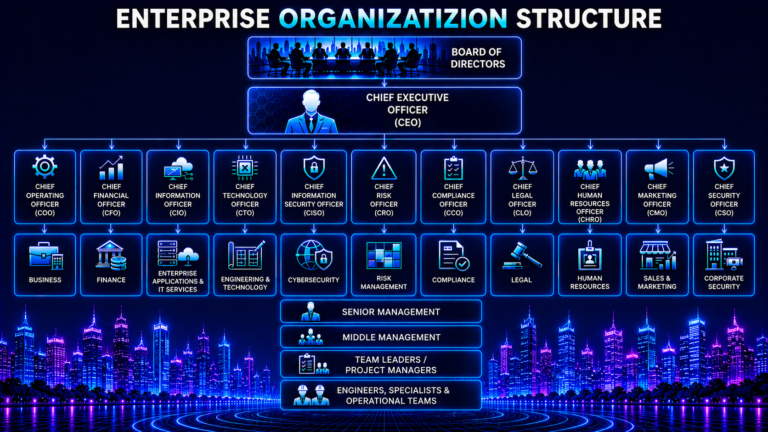
Board of Directors
The Board of Directors provides the highest level of cybersecurity governance by establishing governance direction, overseeing cyber risk, approving security strategies, and ensuring cybersecurity supports business objectives. The Board also ensures adequate resources are available to manage cybersecurity risks and strengthen business resilience.
Executive Management
Executive Management translates the Board’s strategic direction into business priorities and governance objectives. It allocates resources, establishes accountability, approves major security initiatives, and ensures cybersecurity is integrated into business operations and decision-making.
Chief Information Officer (CIO)
The Chief Information Officer (CIO) is responsible for the organization’s information technology strategy, infrastructure, and service delivery. The CIO ensures technology investments support business objectives while working closely with cybersecurity leadership to integrate security into IT planning, implementation, and operations.
Chief Information Security Officer (CISO)
The Chief Information Security Officer (CISO) leads the cybersecurity program and establishes the governance necessary to protect information, systems, and services. The CISO develops cybersecurity strategies, manages cyber risks, establishes security policies and standards, oversees security initiatives, and regularly reports the organization’s cybersecurity posture to executive management and the Board of Directors.
IT Leadership
IT Leadership is responsible for implementing and operating secure IT infrastructure, applications, platforms, and services. Working closely with the CISO, IT leadership ensures governance requirements, security standards, and approved security controls are consistently implemented, monitored, and maintained across the technology environment.
Business Unit Leadership
Business Unit Leadership ensures cybersecurity governance is implemented within individual business functions. Business leaders are responsible for managing business risks, complying with governance requirements, protecting business-owned assets, and ensuring cybersecurity supports operational and strategic objectives.
Business Information Security Officer (BISO)
The Business Information Security Officer (BISO) serves as the bridge between the central cybersecurity function and business units. The BISO works closely with business leadership to understand business objectives, communicate cybersecurity requirements, coordinate risk management activities, and ensure security initiatives align with business priorities. By strengthening collaboration between business and security teams, the BISO helps integrate cybersecurity into business decision-making while supporting governance, compliance, and operational resilience.
Security Governance Committees
Security governance is strengthened through cross-functional committees that provide oversight, review cybersecurity initiatives, evaluate risks, and support strategic decision-making. These committees help ensure cybersecurity remains aligned with business priorities while promoting collaboration across the organization.
Security Steering Committee
The Security Steering Committee provides strategic oversight of the cybersecurity program. It reviews cybersecurity strategies, prioritizes security initiatives, allocates resources, monitors governance objectives, resolves cross-functional issues, and ensures cybersecurity supports business strategy.
Risk Committee
The Risk Committee oversees cyber risk management by reviewing significant cybersecurity risks, evaluating risk treatment plans, monitoring organizational risk exposure, and ensuring cybersecurity risks remain within the organization’s approved risk appetite.
Architecture Review Board
The Architecture Review Board evaluates new technologies, applications, cloud services, and architectural changes to ensure they comply with enterprise architecture principles, security requirements, and governance standards before implementation.
Change Advisory Board (CAB)
The Change Advisory Board (CAB) reviews significant technology and infrastructure changes to ensure operational, business, and security risks are properly assessed before implementation. Security governance ensures cybersecurity considerations remain an integral part of the change management process.
Roles and Responsibilities
Clearly defined roles and responsibilities are essential for effective security governance. Assigning ownership and accountability ensures governance decisions are implemented consistently while enabling effective oversight across people, processes, technologies, and business operations.
Executive Leadership
Executive leadership establishes cybersecurity direction, approves governance policies, allocates resources, accepts business risks, and monitors the overall effectiveness of the cybersecurity program.
Security Leadership
Security leadership develops cybersecurity strategies, establishes security policies and standards, manages cyber risks, monitors governance effectiveness, and drives continual improvement across the cybersecurity program.
IT Leadership
IT leadership implements governance requirements by deploying and managing secure technologies, infrastructure, platforms, and operational processes while ensuring compliance with approved security policies and standards.
Risk Owners
Risk owners are responsible for identifying, assessing, treating, accepting, and continuously monitoring cybersecurity risks associated with their business functions, systems, applications, or services.
Asset Owners
Asset owners are responsible for ensuring information assets are appropriately classified, protected, maintained, and managed throughout their lifecycle in accordance with governance requirements.
Data Owners
Data owners determine how information is classified, accessed, shared, retained, and protected while ensuring compliance with security and privacy requirements.
Control Owners
Control owners are responsible for implementing, operating, monitoring, testing, and maintaining security controls to ensure they remain effective and continue to meet governance objectives.
Employees
Every employee shares responsibility for protecting information by complying with security policies, following established procedures, reporting security incidents, and participating in security awareness and training programs.
Third Parties
Vendors, contractors, consultants, managed service providers, and other third parties must comply with applicable security policies, contractual obligations, and governance requirements when accessing information, systems, applications, or services.
Security Policies, Standards, Baselines, Procedures, and Guidelines
Effective security governance relies on a structured hierarchy of governance documents that establish security expectations, define mandatory requirements, standardize implementation, and provide guidance for consistent execution. Together, Security Policies, Standards, Baselines, Procedures, and Guidelines ensure cybersecurity is implemented, managed, and maintained consistently across the organization.
Security Policies
Security policies define the organization’s cybersecurity objectives, management expectations, and high-level security requirements. They establish the rules and direction for protecting information, systems, and services while ensuring cybersecurity supports business objectives, risk management, and regulatory compliance. Security policies are approved by executive management and provide the foundation for all other governance documents.
Security Standards
Security standards translate security policies into mandatory technical, operational, and administrative requirements. They define the minimum security requirements that must be followed to ensure consistency, reduce risk, and support compliance across the organization.
Security Baselines
Security baselines define the minimum approved security configuration for systems, applications, networks, cloud services, and other technology platforms. They provide a standardized security starting point that reduces configuration weaknesses and ensures consistent implementation of security controls.
Security Procedures
Security procedures provide detailed, step-by-step instructions for implementing security activities and operational tasks. They ensure security processes are performed consistently, accurately, and in accordance with approved policies and standards.
Security Guidelines
Security guidelines provide recommended practices that assist personnel in implementing security requirements where flexibility is appropriate. Unlike standards, guidelines are generally advisory rather than mandatory, enabling teams to adopt security best practices while addressing specific operational or business needs.
Security policies, standards, baselines, procedures, and guidelines work together as a hierarchical governance framework. Policies define what must be achieved, standards define mandatory requirements, baselines establish the minimum acceptable security configuration, procedures describe how activities are performed, and guidelines provide recommended best practices for consistent implementation.
Security Governance Frameworks
Security governance frameworks provide structured methodologies for establishing, implementing, managing, measuring, and continually improving cybersecurity governance. They help organizations adopt recognized best practices, strengthen risk management, support regulatory compliance, and improve the effectiveness of security programs.
ISO/IEC 27001
ISO/IEC 27001 is an internationally recognized information security management standard that provides a risk-based framework for establishing, implementing, maintaining, and continually improving an Information Security Management System (ISMS).
NIST Cybersecurity Framework (CSF)
The NIST Cybersecurity Framework (CSF) provides guidance for identifying, protecting, detecting, responding to, and recovering from cybersecurity threats. It helps organizations manage cybersecurity risk using a flexible and widely adopted framework.
COBIT
COBIT is an enterprise governance and management framework for information and technology. It helps organizations align IT and cybersecurity with business objectives while improving governance, performance, risk management, and compliance.
CIS Controls
The CIS Controls are a prioritized set of cybersecurity best practices designed to help organizations defend against common cyber threats through practical and measurable security controls.
NIST Risk Management Framework (RMF)
The NIST Risk Management Framework (RMF) provides a structured approach for integrating risk management into the system development lifecycle by selecting, implementing, assessing, authorizing, and continuously monitoring security controls.
SABSA
SABSA is a risk-driven enterprise security architecture framework that helps organizations design and implement business-aligned security architectures based on business requirements and risk management.
TOGAF
TOGAF is an enterprise architecture framework that supports the design, planning, implementation, and governance of enterprise architectures. It can be extended to incorporate security architecture and governance throughout the enterprise.
ITIL
ITIL provides best practices for IT Service Management (ITSM), helping organizations integrate cybersecurity governance into service design, service transition, service operation, and continual service improvement.
Security governance frameworks provide proven methodologies and best practices, but no single framework meets every organizational requirement. Many organizations adopt a combination of frameworks to strengthen governance, improve cybersecurity maturity, manage risk, and support business objectives while addressing industry-specific and regulatory requirements.
Security Risk Governance
Security Risk Governance establishes the direction, oversight, and accountability required to manage cybersecurity risks in alignment with business objectives, organizational risk appetite, and regulatory requirements. It ensures cyber risks are governed consistently through defined policies, decision-making processes, executive oversight, and continuous monitoring.
Risk Appetite and Risk Tolerance
Security governance establishes the organization’s risk appetite, which defines the level of cyber risk it is willing to accept in pursuit of its business objectives. It also defines risk tolerance, which specifies the acceptable variation within that risk appetite. Together, they provide the boundaries for consistent and informed risk-based decision-making.
Risk Ownership
Effective risk governance requires clearly defined ownership and accountability. Risk owners are responsible for ensuring cybersecurity risks within their areas are identified, assessed, appropriately treated, and continuously monitored in accordance with governance requirements.
Risk Oversight
Security governance provides executive and board-level oversight of cybersecurity risks through governance committees, management reviews, risk reporting, and regular assessments. This oversight ensures significant risks receive appropriate attention and remain aligned with the organization’s risk appetite.
Risk Treatment
Security governance ensures cybersecurity risks are addressed using appropriate treatment strategies, including risk avoidance, risk mitigation, risk transfer, or risk acceptance. Risk treatment decisions should be based on business objectives, organizational priorities, and the potential impact of identified risks.
Continuous Risk Monitoring
Cybersecurity risks continuously evolve due to changing technologies, business operations, and emerging threats. Security governance ensures risks are regularly monitored, reviewed, reassessed, and reported to verify that risk treatment measures remain effective and aligned with business requirements.
Security Risk Governance provides the oversight and decision-making framework for managing cybersecurity risks across the organization. While governance establishes direction, accountability, and executive oversight, the detailed processes for identifying, assessing, analyzing, treating, and monitoring cybersecurity risks are covered in the Risk Management domain.
Audit and Compliance
Security governance ensures cybersecurity activities comply with applicable laws, regulations, contractual obligations, industry standards, and internal policies. It establishes the governance framework, accountability, oversight, and monitoring necessary to demonstrate compliance, verify the effectiveness of security controls, and support continual improvement. Through regular audits and compliance assessments, security governance helps identify gaps, manage regulatory risks, and maintain stakeholder confidence.
Governance Frameworks
Security governance adopts recognized governance and security frameworks to establish a structured and consistent approach to managing cybersecurity. These frameworks provide best practices, governance models, and control requirements that help align cybersecurity with business objectives, manage risk, and support regulatory compliance.
Regulatory Compliance
Security governance ensures cybersecurity programs comply with applicable laws, regulations, contractual obligations, and industry-specific requirements. Governance establishes the policies, oversight, and accountability necessary to implement and maintain compliance across the organization.
Internal Compliance
Internal compliance ensures employees, business units, and third parties adhere to the organization’s security policies, standards, baselines, procedures, and governance requirements. Continuous monitoring and management oversight help maintain consistent compliance with internal security expectations.
Audits and Assessments
Regular audits and security assessments evaluate the effectiveness of governance processes, security controls, and compliance activities. Audit findings provide assurance to management, identify areas for improvement, and support continual enhancement of the cybersecurity program.
Compliance Reporting
Security governance establishes reporting mechanisms to communicate compliance status, audit results, regulatory obligations, and remediation progress to executive management, governance committees, and the Board of Directors. Effective reporting supports informed decision-making, accountability, and continuous improvement.
Security Architecture
Security governance establishes the architectural principles, standards, and oversight required to build secure, resilient, and scalable technology environments. Security architecture provides the blueprint for integrating security into business processes, information systems, applications, infrastructure, and cloud environments. Through effective governance, organizations ensure security is considered throughout the design, implementation, operation, and continual improvement of technology solutions.
Security Architecture Principles
Security architecture principles define the fundamental rules that guide the design and implementation of secure systems. These principles promote consistency, standardization, and alignment with business objectives while ensuring confidentiality, integrity, availability, and resilience are incorporated into every technology initiative.
Security by Design
Security by Design ensures security requirements are considered from the earliest stages of planning and system development rather than being added after implementation. Security governance establishes policies and design requirements that integrate security into architectures, applications, infrastructure, and business processes throughout their lifecycle.
Defense in Depth
Defense in Depth is a layered security strategy that combines administrative, technical, and physical controls to provide multiple levels of protection. Security governance ensures appropriate layers of security are implemented so that the failure of one control does not result in the compromise of critical information, systems, or services.
Zero Trust
Zero Trust is a security model based on the principle of “Never Trust, Always Verify.” Security governance establishes the policies, standards, and access requirements that support Zero Trust by continuously verifying users, devices, applications, and workloads before granting or maintaining access to organizational resources.
Architecture Reviews
Security governance requires architecture reviews throughout the system lifecycle to ensure new technologies, applications, infrastructure, and cloud services comply with security principles, organizational standards, and business requirements. Regular architecture reviews help identify security gaps early, reduce implementation risks, and ensure security remains aligned with business objectives.
Security architecture provides the foundation for implementing secure technologies and resilient business solutions. Security governance ensures architectural decisions are driven by business objectives, supported by consistent standards, and continuously reviewed to address evolving technologies, risks, and organizational requirements.
Identity and Access Security
Security governance establishes the policies, standards, and oversight required to ensure that only authorized individuals have appropriate access to information, systems, applications, and services. Effective identity and access governance protects organizational assets by enforcing strong authentication, appropriate authorization, controlled privilege management, and continuous oversight of user identities throughout their lifecycle.
Identity Governance
Identity governance establishes the processes and controls for managing digital identities across the organization. It ensures identities are created, maintained, reviewed, and removed in accordance with business requirements while enforcing accountability, regulatory compliance, and security policies.
Authentication
Authentication verifies the identity of users, devices, or services before granting access to organizational resources. Security governance establishes authentication requirements, such as password policies, multi-factor authentication (MFA), and authentication standards, to reduce the risk of unauthorized access.
Authorization
Authorization determines the resources and actions an authenticated user is permitted to access. Security governance ensures access permissions are assigned according to business roles, the principle of least privilege, and the need-to-know principle, minimizing unnecessary or excessive access rights.
Privileged Access Management
Privileged accounts have elevated permissions that can significantly impact business operations and security. Security governance establishes controls for managing privileged accounts, including access approval, credential protection, session monitoring, periodic reviews, and accountability for privileged activities.
Identity Lifecycle Management
Identity lifecycle management governs the complete lifecycle of digital identities, from user onboarding and role changes to temporary access, transfers, and account deprovisioning. Security governance ensures access rights remain accurate and aligned with current business responsibilities throughout the identity lifecycle.
Access Reviews and Certification
Periodic access reviews help verify that users have only the access necessary to perform their job responsibilities. Security governance establishes regular access certification processes to identify excessive, outdated, or unauthorized permissions, ensuring access remains appropriate, compliant, and aligned with business requirements.
Identity and access security is a fundamental component of cybersecurity because it controls who can access organizational resources and under what conditions. Security governance ensures identity and access controls are consistently defined, implemented, monitored, and continuously improved to protect information assets while supporting secure business operations.
Information and Data Security
Security governance establishes the policies, standards, and oversight required to protect information and data throughout their lifecycle. It ensures information assets are appropriately classified, owned, handled, stored, shared, retained, and disposed of according to their business value, sensitivity, and regulatory requirements. Effective governance enables organizations to maintain confidentiality, integrity, availability, and privacy while supporting business operations and compliance.
Information Governance
Information governance establishes the framework for managing information as a valuable business asset. It defines how information is created, used, stored, shared, retained, archived, and disposed of while ensuring compliance with business, legal, and regulatory requirements.
Data Classification
Data classification categorizes information based on its sensitivity, business value, and regulatory requirements. Security governance establishes classification levels, labeling requirements, and handling rules to ensure appropriate security controls are applied according to the importance and criticality of the information.
Data Ownership
Every information asset should have a clearly defined owner who is accountable for its protection. Security governance establishes data ownership responsibilities, ensuring owners determine classification, access requirements, retention periods, and appropriate protection measures throughout the data lifecycle.
Data Handling
Security governance defines how information should be collected, processed, stored, transmitted, shared, archived, and disposed of. Standardized data handling requirements help maintain consistency while reducing the risk of unauthorized access, disclosure, alteration, or loss.
Data Lifecycle
Information passes through multiple stages, from creation and usage to storage, archival, and secure disposal. Security governance ensures appropriate security controls are applied at every stage of the data lifecycle to protect information and maintain compliance with organizational and regulatory requirements.
Data Privacy
Security governance establishes policies and controls to protect personal and sensitive information while ensuring compliance with applicable privacy laws and regulations. Effective data privacy governance supports responsible data processing, safeguards individual privacy rights, and strengthens customer and stakeholder trust.
Information and data are among an organization’s most valuable assets. Security governance ensures they are managed consistently through defined ownership, classification, lifecycle management, and protection requirements, enabling secure business operations while supporting regulatory compliance and organizational resilience.
Physical and Environmental Security
Security governance establishes the policies, standards, and oversight required to protect people, facilities, physical assets, and supporting infrastructure from unauthorized access, theft, damage, and environmental threats. Effective governance ensures physical and environmental security measures are integrated into the organization’s overall cybersecurity strategy, protecting critical facilities and technology environments while supporting business continuity, operational resilience, and regulatory compliance.
Physical Security
Physical security protects facilities, critical infrastructure, equipment, and information assets against unauthorized physical access, theft, vandalism, and physical damage. Security governance establishes requirements for physical access controls, surveillance systems, visitor management, perimeter protection, secure work areas, and facility security to safeguard organizational assets and reduce physical security risks.
Environmental Security
Environmental security protects information systems and supporting infrastructure from environmental hazards that could affect their availability, reliability, or operation. Security governance establishes requirements for fire detection and suppression, power protection, uninterruptible power supplies (UPS), backup generators, heating, ventilation, and air conditioning (HVAC), temperature and humidity monitoring, water leak detection, flood protection, and other environmental safeguards to ensure resilient and continuous operations.
Personnel Security
Personnel security ensures individuals with access to organizational information and systems are trustworthy, understand their security responsibilities, and comply with established security requirements. Security governance defines policies and processes that support secure recruitment, employment, role changes, employee separation, and ongoing personnel security throughout the employment lifecycle.
Background Verification
Background verification helps reduce the risk of insider threats by validating an individual’s identity, qualifications, employment history, and other relevant information before granting access to organizational assets. Security governance establishes the scope, frequency, and requirements for background screening based on business roles, regulatory obligations, and organizational risk.
Security Awareness and Training
Security awareness and training ensure employees understand cybersecurity risks, organizational policies, and their responsibilities for protecting information and systems. Security governance establishes ongoing education and awareness programs that promote secure behaviors, improve cyber awareness, and strengthen the organization’s overall security culture.
Insider Threat Management
Insider threats may arise from malicious intent, negligence, or human error. Security governance establishes policies, monitoring, reporting, and response processes to identify, prevent, detect, and manage insider risks while ensuring appropriate legal, ethical, and privacy considerations are maintained.
Physical, environmental, and personnel security are essential components of a comprehensive cybersecurity program. Security governance ensures appropriate safeguards, responsibilities, and oversight are established to protect people, facilities, technology infrastructure, and organizational assets while supporting business continuity, operational resilience, and regulatory compliance.
IT and Infrastructure Security
Security governance establishes the policies, standards, and oversight required to protect the organization’s IT environment and supporting infrastructure. This includes endpoints, servers, operating systems, virtualization platforms, storage systems, enterprise services, and supporting technologies. Effective governance ensures IT and infrastructure assets are securely managed, continuously maintained, and protected against evolving cyber threats while supporting business operations, resilience, and regulatory requirements.
IT Governance
IT governance ensures information technology supports business objectives while complying with organizational security requirements. Security governance establishes policies, standards, decision-making processes, and oversight to ensure IT services, systems, and infrastructure are securely managed throughout their lifecycle.
IT Asset Management
Effective security begins with knowing what needs to be protected. Security governance establishes processes for identifying, classifying, inventorying, tracking, and managing hardware, software, virtual assets, and supporting infrastructure throughout their lifecycle, ensuring appropriate ownership, accountability, and protection.
Secure Configuration Management
Secure configuration management ensures systems are deployed and maintained using approved security configurations. Security governance establishes configuration baselines, enforces secure configuration standards, and conducts regular configuration reviews to reduce vulnerabilities and maintain a consistent security posture.
Change Management
Technology environments continually evolve through system upgrades, infrastructure changes, software deployments, and configuration updates. Security governance establishes a controlled change management process to ensure changes are properly assessed, approved, tested, documented, and implemented with minimal operational and security risk. Significant changes are typically reviewed through a Change Advisory Board (CAB) to ensure business, operational, and security requirements are adequately addressed.
Backup and Recovery
Security governance establishes backup and recovery requirements to ensure critical information and systems can be restored following accidental loss, system failure, cyber incidents, or disasters. Governance defines backup policies, retention requirements, recovery objectives, testing frequencies, and restoration procedures to support business continuity and operational resilience.
Infrastructure Resilience
Infrastructure resilience ensures critical IT services remain available, reliable, and recoverable during disruptions. Security governance establishes requirements for redundancy, fault tolerance, high availability, disaster preparedness, and continuous monitoring to strengthen the resilience of the organization’s technology infrastructure.
IT and infrastructure provide the technological foundation that supports modern business operations. Security governance ensures these critical assets are managed through effective governance, standardized configurations, controlled changes, resilient infrastructure, and reliable backup and recovery capabilities, enabling secure, stable, and resilient technology services.
Secure Communications and Network Security
Security governance establishes the policies, standards, and oversight required to protect network infrastructure and ensure information is transmitted securely across internal and external communication channels. Effective governance safeguards data in transit by defining secure communication requirements, network security standards, remote access controls, and continuous monitoring to protect against interception, unauthorized access, and cyber threats.
Network Governance
Security governance establishes the policies, standards, and oversight required to securely design, implement, operate, and maintain network infrastructure. It ensures network security aligns with business objectives, risk management requirements, and organizational security policies while supporting secure and reliable connectivity.
Secure Communications
Information transmitted across public and private networks is vulnerable to interception, manipulation, and unauthorized access. Security governance establishes requirements for protecting data in transit through secure communication protocols, encryption, Virtual Private Networks (VPNs), secure remote access solutions, and other communication security controls to maintain confidentiality, integrity, and authenticity.
Network Segmentation
Network segmentation divides the network into logical security zones to reduce the attack surface and limit the lateral movement of threats. Security governance establishes segmentation policies that isolate critical systems, sensitive data, and business services while strengthening the overall security architecture.
Remote Access Security
Remote access enables employees, administrators, vendors, and business partners to securely connect to organizational resources from external locations. Security governance establishes policies for secure remote access using technologies such as VPNs, multi-factor authentication (MFA), device compliance verification, and continuous monitoring to minimize security risks while supporting secure remote work.
Network Monitoring
Continuous monitoring provides visibility into network activities, identifies suspicious behavior, and supports the timely detection of security incidents. Security governance establishes monitoring requirements, logging standards, traffic analysis, alerting mechanisms, and reporting processes to strengthen network visibility and improve incident response capabilities.
Secure communications and network security are fundamental to protecting business operations and information assets. Security governance ensures communication channels and network infrastructure are secured through consistent policies, standardized controls, encrypted communications, secure remote access, and continuous oversight, enabling trusted and resilient connectivity across the organization.
Software and Application Security
Security governance establishes the policies, standards, and oversight required to ensure software and applications are designed, developed, acquired, deployed, and maintained securely throughout their lifecycle. Effective governance integrates security into every stage of software development and application management, reducing vulnerabilities, managing risk, and supporting business objectives while ensuring compliance with organizational and regulatory requirements.
Secure Software Development Lifecycle (SSDLC)
Security governance establishes a Secure Software Development Lifecycle (SSDLC) that integrates security requirements into every phase of software development, from planning and design to development, testing, deployment, maintenance, and retirement. Embedding security throughout the lifecycle helps identify and address security risks early, reducing vulnerabilities and improving software quality.
Secure by Design
Secure by Design ensures security is considered from the earliest stages of application planning and design rather than being added after development. Security governance establishes design principles, architecture requirements, and security objectives that enable applications to be built with security as a fundamental requirement.
Secure Coding Standards
Secure coding standards provide developers with consistent practices for writing secure, reliable, and maintainable code. Security governance establishes coding standards, development guidelines, code review requirements, and security best practices to reduce common software vulnerabilities and improve application security.
DevSecOps Governance
DevSecOps integrates security into modern software development and deployment pipelines. Security governance establishes policies, responsibilities, and automated security practices that ensure security testing, vulnerability management, code quality, and compliance are continuously integrated throughout the software delivery process.
Application Security Testing
Security governance establishes requirements for regularly assessing application security throughout the software lifecycle. Application security testing includes activities such as static application security testing (SAST), dynamic application security testing (DAST), software composition analysis (SCA), interactive application security testing (IAST), and penetration testing to identify vulnerabilities and verify the effectiveness of security controls.
Software and applications are critical business assets that process, store, and transmit sensitive information. Security governance ensures they are developed, deployed, and maintained using consistent security principles, secure development practices, and continuous oversight, enabling resilient and trustworthy business applications.
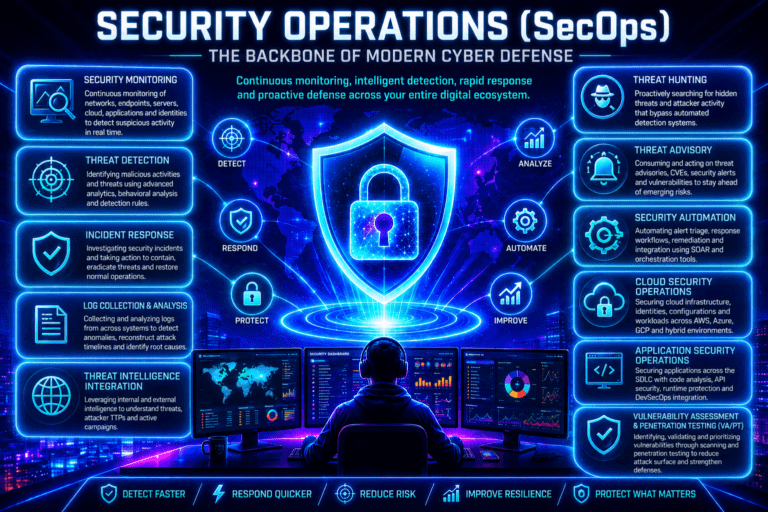
Security Operations
Security governance establishes the policies, standards, and oversight required to effectively monitor, detect, respond to, and recover from cybersecurity threats and security incidents. Effective governance ensures security operations are aligned with business objectives, supported by clearly defined processes, and continuously improved to address evolving cyber threats while maintaining operational resilience.
Security Monitoring
Security monitoring provides continuous visibility into the organization’s security posture by collecting, analyzing, and monitoring security events across systems, networks, applications, and cloud environments. Security governance establishes monitoring requirements, logging standards, alerting mechanisms, and reporting processes to enable timely detection of security events.
Incident Response
Security governance establishes a structured incident response capability to prepare for, detect, contain, eradicate, recover from, and learn from cybersecurity incidents. Clearly defined roles, responsibilities, escalation procedures, communication plans, and response processes help minimize business impact and improve organizational resilience.
Vulnerability Management
Vulnerability management ensures security weaknesses are identified, assessed, prioritized, remediated, and continuously monitored. Security governance establishes vulnerability management policies, remediation timelines, risk-based prioritization, and reporting requirements to reduce the organization’s exposure to cyber threats.
Threat Intelligence
Threat intelligence enables organizations to understand emerging cyber threats, attacker tactics, techniques, and procedures (TTPs), and potential business impacts. Security governance establishes processes for collecting, evaluating, sharing, and applying threat intelligence to strengthen risk management, security operations, and informed decision-making.
Security Metrics and Reporting
Effective security operations require continuous measurement and reporting of operational performance. Security governance establishes key performance indicators (KPIs), key risk indicators (KRIs), dashboards, and reporting mechanisms that provide management with visibility into security operations, incident trends, vulnerabilities, response effectiveness, and overall cybersecurity performance.
Security operations play a critical role in protecting organizational assets against evolving cyber threats. Security governance ensures operational activities are consistently managed through defined policies, effective monitoring, structured incident response, proactive vulnerability management, actionable threat intelligence, and meaningful performance reporting, enabling a resilient and continuously improving cybersecurity program.
Business Continuity and Disaster Recovery
Security governance establishes the policies, standards, and oversight required to ensure critical business operations continue during disruptions and recover efficiently following cyber incidents, system failures, natural disasters, or other unforeseen events. Effective governance integrates business continuity and disaster recovery into the organization’s overall resilience strategy, minimizing operational downtime and ensuring the availability of critical services.
Business Continuity Planning
Business Continuity Planning (BCP) ensures critical business functions can continue operating during and after a disruptive event. Security governance establishes continuity objectives, identifies critical business processes, defines recovery priorities, and ensures continuity plans are regularly reviewed, tested, and updated to support organizational resilience.
Disaster Recovery Planning
Disaster Recovery Planning (DRP) focuses on restoring IT systems, applications, infrastructure, and data following a disruption. Security governance establishes recovery objectives, restoration priorities, recovery procedures, and testing requirements to ensure technology services can be recovered within acceptable business timeframes.
Crisis Management
Effective crisis management enables organizations to coordinate decision-making, communication, and resource management during significant security incidents or business disruptions. Security governance establishes crisis management frameworks, escalation procedures, leadership responsibilities, communication plans, and stakeholder engagement processes to support timely and effective response.
Cyber Resilience
Cyber resilience is the ability to anticipate, withstand, respond to, recover from, and adapt to cybersecurity incidents while maintaining essential business operations. Security governance promotes resilience by integrating risk management, business continuity, disaster recovery, incident response, and continual improvement into a unified resilience strategy.
Business continuity and disaster recovery are essential components of organizational resilience. Security governance ensures continuity and recovery capabilities are strategically planned, regularly tested, continuously improved, and aligned with business priorities, enabling the organization to withstand disruptions and recover with minimal operational impact.
Security Assessment and Testing
Security governance establishes the policies, standards, and oversight required to evaluate the effectiveness of security controls, identify vulnerabilities, and verify compliance with organizational security requirements. Regular security assessments and testing provide assurance that cybersecurity controls continue to protect information assets, support business objectives, and address evolving cyber threats.
Security Assessments
Security assessments evaluate the effectiveness of security policies, processes, technologies, and controls across the organization. Security governance establishes assessment methodologies, assessment frequency, scope, and reporting requirements to ensure security risks are identified and appropriate improvements are implemented.
Vulnerability Assessments
Vulnerability assessments identify security weaknesses within systems, applications, networks, and infrastructure before they can be exploited. Security governance establishes requirements for periodic vulnerability scanning, risk-based prioritization, remediation timelines, and verification to ensure identified vulnerabilities are addressed in a timely manner.
Penetration Testing
Penetration testing validates the effectiveness of security controls by simulating real-world cyberattacks against systems, applications, or infrastructure. Security governance defines the scope, objectives, testing frequency, authorization requirements, and reporting processes to ensure testing is conducted safely and provides meaningful security assurance.
Security Audits
Security audits independently evaluate whether cybersecurity policies, standards, procedures, and controls are implemented effectively and comply with organizational, regulatory, and industry requirements. Security governance establishes audit programs, reporting mechanisms, corrective action processes, and management oversight to support continual improvement.
Continuous Security Validation
Cybersecurity is not a one-time activity but a continuous process of verification and improvement. Security governance establishes ongoing validation activities to confirm that security controls remain effective as technologies, business operations, and threat landscapes evolve. Continuous validation helps identify control gaps, measure security maturity, and strengthen the organization’s overall cybersecurity posture.
Security assessment and testing provide independent assurance that cybersecurity controls are operating as intended and continue to support business objectives. Security governance ensures these activities are planned, executed, monitored, and continually improved, enabling informed decision-making and strengthening the overall effectiveness of the cybersecurity program.
AI Security
Security governance establishes the policies, standards, and oversight required to ensure artificial intelligence (AI) systems are developed, deployed, operated, and managed securely and responsibly. As AI becomes increasingly integrated into business operations, decision-making, and cybersecurity, effective governance helps manage AI-related risks, protect AI assets, ensure regulatory compliance, and maintain trust in AI-driven processes.
AI Governance
AI governance establishes the framework for managing AI systems throughout their lifecycle. It defines the policies, roles, responsibilities, decision-making processes, and oversight required to ensure AI technologies align with business objectives, ethical principles, security requirements, and regulatory obligations.
AI Risk Management
AI introduces unique risks, including data poisoning, adversarial attacks, model manipulation, unauthorized access, privacy concerns, and inaccurate or biased outcomes. Security governance establishes processes for identifying, assessing, treating, monitoring, and reporting AI-related risks to ensure they remain within acceptable risk levels.
Secure AI Development
Security should be integrated throughout the AI lifecycle, from data collection and model training to deployment, monitoring, and retirement. Security governance establishes secure development practices, validation requirements, model protection measures, and testing standards to ensure AI systems are developed and maintained securely.
AI Model Protection
AI models represent valuable organizational assets that require protection against theft, unauthorized modification, reverse engineering, and misuse. Security governance establishes requirements for securing AI models, training data, inference processes, APIs, and supporting infrastructure to preserve the confidentiality, integrity, and availability of AI systems.
Responsible AI
Responsible AI ensures AI systems are developed and used in a manner that is secure, transparent, fair, accountable, and compliant with applicable legal and ethical requirements. Security governance establishes policies and oversight to promote explainability, human oversight, privacy protection, bias mitigation, and responsible decision-making throughout the AI lifecycle.
As AI continues to transform business and cybersecurity, effective governance becomes essential for managing emerging risks while enabling innovation. Security governance ensures AI technologies are implemented responsibly through defined policies, effective oversight, continuous risk management, and ongoing monitoring, allowing organizations to realize the benefits of AI while maintaining security, trust, and regulatory compliance.
Third-Party Security
Security governance establishes the policies, standards, and oversight required to manage cybersecurity risks associated with third parties, including vendors, suppliers, service providers, contractors, consultants, cloud providers, and business partners. As organizations increasingly rely on external parties to deliver products, services, and critical business functions, effective governance ensures third-party relationships are managed securely throughout their lifecycle while protecting organizational assets and maintaining regulatory compliance.
Vendor Governance
Vendor governance establishes the framework for selecting, managing, and overseeing third-party relationships. Security governance defines security expectations, roles, responsibilities, contractual obligations, and oversight mechanisms to ensure vendors meet the organization’s cybersecurity and business requirements.
Third-Party Due Diligence
Before engaging a third party, security governance requires due diligence to evaluate the organization’s security posture, risk profile, regulatory compliance, operational capabilities, and overall suitability. Due diligence helps identify potential risks and enables informed decisions before establishing business relationships.
Security Requirements
Security governance establishes minimum cybersecurity requirements that third parties must meet before accessing organizational systems, information, or services. These requirements may include security policies, access controls, encryption, incident reporting, vulnerability management, compliance obligations, business continuity capabilities, and contractual security clauses.
Third-Party Assessments
Regular security assessments help verify that third parties continue to comply with agreed security requirements throughout the relationship. Security governance establishes assessment methodologies, review frequencies, evidence requirements, and remediation processes to identify and address security gaps before they become significant business risks.
Continuous Vendor Monitoring
Cybersecurity risks associated with third parties change over time due to evolving threats, business operations, technology changes, and regulatory requirements. Security governance establishes continuous monitoring processes to track vendor security performance, identify emerging risks, review compliance, and ensure ongoing adherence to contractual and organizational security expectations.
Third-party relationships can significantly influence an organization’s overall cybersecurity posture. Security governance ensures external partners are selected, assessed, monitored, and managed through consistent policies, effective oversight, and continuous risk management, strengthening supply chain security while supporting secure and resilient business operations.
Conclusion
Security governance is the foundation of an effective cybersecurity program. It provides the leadership, direction, oversight, and accountability required to protect information assets, manage cyber risks, support business objectives, and ensure regulatory compliance. Rather than focusing solely on technology, security governance establishes the policies, standards, processes, roles, and decision-making framework that guide how cybersecurity is planned, implemented, monitored, and continually improved.
Effective security governance extends across every aspect of cybersecurity, including security architecture, identity and access management, information and data protection, IT and infrastructure, software development, security operations, business continuity, AI security, third-party security, and compliance. By integrating governance into these domains, organizations can make consistent, risk-informed decisions while strengthening resilience against an evolving threat landscape.
Cybersecurity is a continuous journey, not a one-time initiative. As technologies, business models, regulatory requirements, and cyber threats continue to evolve, security governance must also adapt through ongoing risk assessment, performance measurement, regular reviews, and continual improvement. A mature governance program enables organizations to respond proactively to change while maintaining alignment with business priorities and stakeholder expectations.
Ultimately, effective security governance transforms cybersecurity from a collection of technical controls into a strategic business capability. By establishing clear leadership, defined responsibilities, robust policies, effective oversight, and a culture of security, organizations can build a resilient cybersecurity program that not only protects critical assets but also enables innovation, business growth, and long-term success.