Enterprise Organizational Structure
Introduction
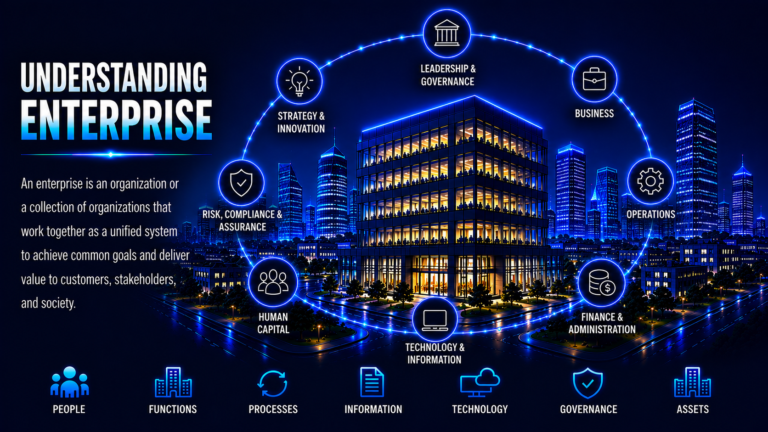
Every enterprise is an organization, but not every organization is an enterprise. Enterprises are typically larger, more complex organizations that operate across multiple business functions, locations, and markets. To achieve their strategic objectives, enterprises rely on a structured approach to managing people, resources, processes, and technology.
An organization consists of individuals and teams working together to accomplish common goals. As organizations grow, they establish departments, management levels, and reporting relationships to improve coordination, accountability, and operational efficiency. This formal arrangement of people, roles, responsibilities, and authority is known as the organizational structure.
Every enterprise, regardless of its size, industry, or geographical presence, requires a well-defined organizational structure to operate efficiently, achieve its strategic objectives, and maintain accountability. As organizations grow, they become increasingly complex, involving multiple business functions, management layers, departments, and teams that must work together toward common goals. An enterprise organizational structure provides the framework that brings order to this complexity.
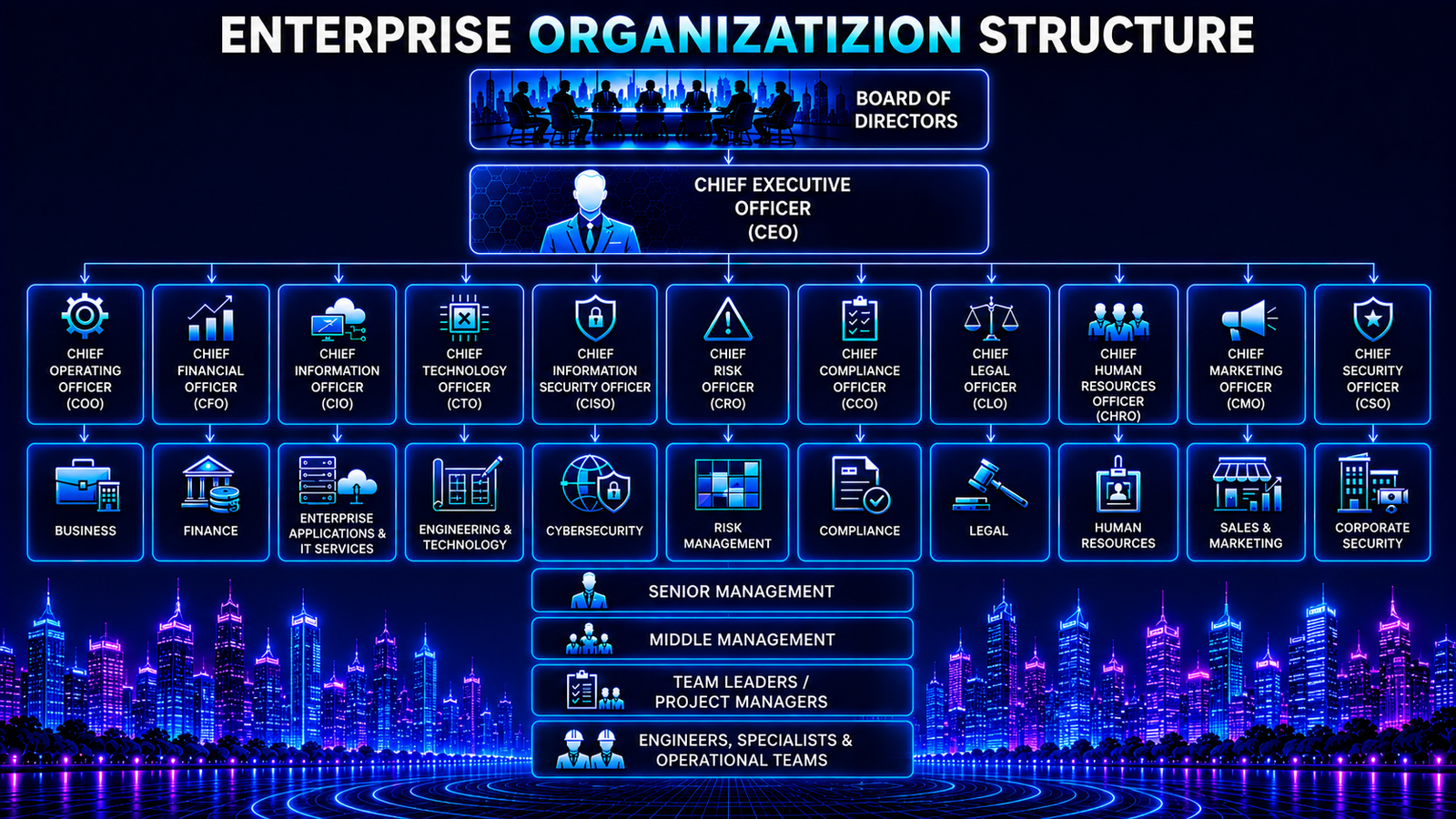
An enterprise organizational structure defines how authority, responsibilities, reporting relationships, and decision-making are distributed across the organization. It establishes a clear hierarchy from the Board of Directors and executive leadership to senior management, middle management, and operational teams, ensuring that every individual and business function understands its role and contribution to the enterprise.
A well-designed enterprise organizational structure establishes the foundation for effective leadership, operational excellence, governance, innovation, resilience, and sustainable organizational success.
For professionals pursuing a career in cybersecurity, understanding an enterprise organizational structure is essential. Cybersecurity is an enterprise-wide function that works closely with executive leadership, information technology, finance, human resources, legal, operations, risk management, compliance, and other business functions. Understanding how an enterprise is organized helps cybersecurity professionals identify stakeholders, reporting relationships, decision-makers, and the business functions they support and protect.
What is an Enterprise Organizational Structure?
An Enterprise Organizational Structure is the formal framework that defines how an enterprise is organized to achieve its strategic objectives. It establishes the hierarchy of authority, reporting relationships, roles, responsibilities, business functions, and communication channels that enable the organization to operate effectively and make informed decisions.
The organizational structure determines how work is divided among departments, how responsibilities are assigned, who has decision-making authority, and how individuals and teams collaborate across the enterprise. It creates a systematic arrangement of people, business functions, and resources to ensure that every activity contributes toward achieving the organization’s mission, vision, and strategic objectives.
A typical enterprise consists of multiple levels of management, business units, functional departments, and operational teams. Each level has clearly defined responsibilities and reporting relationships that ensure accountability, coordination, and effective communication. The organizational structure provides the foundation for these relationships by defining who reports to whom, who is responsible for specific functions, and how decisions are communicated throughout the enterprise.
An enterprise organizational structure also establishes the relationship between leadership, management, employees, and business functions. It provides a clear chain of command, facilitates collaboration across departments, supports governance and risk management, and enables the enterprise to adapt to changing business and technology environments.
Although every enterprise has its own unique structure based on its size, industry, business model, and operating environment, all enterprise organizational structures share the same objective—to establish a clear, efficient, and accountable framework for managing people, resources, and business operations.
Purpose of an Enterprise Organizational Structure
An enterprise organizational structure serves as the foundation upon which an organization operates. It provides clarity regarding leadership, responsibilities, authority, and communication while ensuring that all business functions work together toward common organizational goals.
The primary purposes of an enterprise organizational structure are to:
- Establish a clear leadership hierarchy and decision-making framework.
- Define roles, responsibilities, and accountability across all levels of the enterprise.
- Organize business functions into structured departments and operational teams.
- Facilitate effective communication and collaboration between business functions.
- Support efficient planning, coordination, and execution of business activities.
- Improve operational efficiency by reducing ambiguity and duplication of responsibilities.
- Enable governance, risk management, compliance, and enterprise security.
- Support organizational growth, scalability, and business transformation.
- Align people, processes, and resources with the enterprise’s vision, mission, and strategic objectives.
- Provide a structured environment for performance management and continuous improvement.
Ultimately, an enterprise organizational structure enables the organization to function as a coordinated system where leadership, management, employees, and business functions work together to achieve common business objectives.
Characteristics of an Enterprise Organizational Structure
Although enterprise organizational structures vary depending on the organization’s size, industry, and operating model, they share several common characteristics that enable effective management and organizational success.
Defined Hierarchy
Every enterprise establishes a hierarchy that identifies leadership levels, reporting relationships, and decision-making authority. A clearly defined hierarchy provides structure, accountability, and efficient management throughout the organization.
Clearly Defined Authority
Authority determines who has the power to make decisions, allocate resources, approve initiatives, assign responsibilities, and direct organizational activities. Clearly defined authority minimizes confusion and enables timely and effective decision-making.
Well-Defined Roles and Responsibilities
Every executive, manager, and employee has clearly assigned roles and responsibilities. This clarity improves accountability, eliminates duplication of effort, and ensures that business activities are performed efficiently.
Reporting Relationships
Reporting relationships define the chain of command within the enterprise by establishing who reports to whom. They support effective supervision, communication, performance management, and organizational accountability.
Departmentalization
Enterprises organize related activities into specialized business functions such as Finance, Human Resources, Information Technology, Operations, Legal, Sales, Marketing, Risk Management, Compliance, and Cybersecurity. This specialization enables departments to develop expertise while supporting the overall objectives of the enterprise.
Coordination and Collaboration
Although each department has distinct responsibilities, achieving organizational objectives requires continuous collaboration across business functions. An effective organizational structure promotes coordination, communication, and teamwork while maintaining clear accountability.
Flexibility
Modern enterprises operate in dynamic business environments influenced by technological innovation, regulatory changes, digital transformation, mergers, acquisitions, and evolving market conditions. An effective organizational structure should be flexible enough to adapt to these changes while maintaining stability and operational efficiency.
Alignment with Business Objectives
An enterprise organizational structure should align with the organization’s vision, mission, strategic objectives, and operating model. Leadership roles, reporting relationships, and business functions should all contribute toward achieving the enterprise’s long-term goals efficiently and effectively.
Organizational Hierarchy
Enterprise organizations are structured into multiple levels of leadership, management, and operational teams. This organizational hierarchy establishes the governance and leadership framework through which the enterprise is directed, managed, and operated.
Although organizational hierarchies vary depending on the size, industry, and operating model of the enterprise, most organizations follow a similar top-down structure. The hierarchy begins with the governing body responsible for enterprise oversight and extends through executive leadership, business and technology management, departmental leadership, and operational teams responsible for executing day-to-day business activities.
Each level within the hierarchy has clearly defined roles, responsibilities, authority, and accountability. Together, these levels enable the enterprise to establish strategic direction, govern business operations, manage resources, coordinate business functions, and deliver products and services effectively.
Board of Directors
The Board of Directors is the highest governing body of the enterprise and occupies the top level of the organizational hierarchy. It provides strategic direction, corporate governance, executive oversight, and appoints the Chief Executive Officer (CEO) to lead the organization. The Board represents the interests of shareholders and stakeholders while overseeing the enterprise’s long-term success, performance, and sustainability.
Executive Leadership (C-Suite)
The Executive Leadership Team, commonly known as the C-Suite, consists of the organization’s highest-ranking executives responsible for leading major business functions and executing the strategic direction established by the Board of Directors. While the composition of the C-Suite varies between organizations, it typically includes the following executive roles.
Chief Executive Officer (CEO)
The Chief Executive Officer (CEO) is the highest-ranking executive in the enterprise and serves as the primary link between the Board of Directors and the Executive Leadership Team. The CEO provides overall leadership, executes the organization’s strategy, and oversees the enterprise’s overall performance.
Chief Operating Officer (COO)
The Chief Operating Officer (COO) oversees the enterprise’s day-to-day business operations and ensures that operational activities are aligned with the organization’s strategic objectives.
Chief Financial Officer (CFO)
The Chief Financial Officer (CFO) leads the organization’s financial function and oversees financial planning, budgeting, accounting, financial reporting, investments, and financial governance.
Chief Information Officer (CIO)
The Chief Information Officer (CIO) leads the enterprise’s Information Technology (IT) function. The CIO is responsible for IT strategy, enterprise applications, infrastructure, digital transformation, and ensuring that technology supports business operations and organizational objectives.
Chief Technology Officer (CTO)
The Chief Technology Officer (CTO) leads the organization’s technology strategy and innovation. In technology-driven enterprises, the CTO typically oversees product engineering, software development, research, enterprise architecture, and emerging technologies.
Chief Information Security Officer (CISO)
The Chief Information Security Officer (CISO) leads the enterprise cybersecurity function. The CISO is responsible for cybersecurity strategy, security governance, cyber risk management, information protection, regulatory compliance, and strengthening the organization’s cyber resilience.
Chief Risk Officer (CRO)
The Chief Risk Officer (CRO) leads the enterprise risk management function and oversees the identification, assessment, and management of strategic, operational, financial, regulatory, technology, and cybersecurity risks.
Chief Compliance Officer (CCO)
The Chief Compliance Officer (CCO) is responsible for ensuring that the enterprise complies with applicable laws, regulations, industry standards, and internal policies while promoting ethical business practices and regulatory compliance.
Chief Legal Officer (CLO) / General Counsel
The Chief Legal Officer (CLO), also known as the General Counsel, leads the organization’s legal function and oversees legal matters, contracts, litigation, intellectual property, regulatory issues, and legal risk management.
Chief Human Resources Officer (CHRO)
The Chief Human Resources Officer (CHRO) leads the human resources function and is responsible for workforce planning, talent acquisition, employee development, organizational culture, performance management, and employee engagement.
Chief Marketing Officer (CMO)
The Chief Marketing Officer (CMO) leads the organization’s marketing function and is responsible for brand management, marketing strategy, customer engagement, market positioning, and business growth.
Chief Security Officer (CSO)
The Chief Security Officer (CSO) leads the enterprise’s physical and corporate security function. Depending on the organization, the CSO may oversee physical security, executive protection, facilities security, investigations, and business continuity.
Senior Management
Senior Management leads major business units, departments, or divisions within the enterprise. They translate executive strategy into departmental objectives, oversee organizational performance, allocate resources, and ensure that business goals are effectively implemented.
Middle Management
Middle Management supervises departments and teams while coordinating day-to-day business activities. They bridge executive leadership and operational teams by managing people, processes, and performance within their areas of responsibility.
Team Leaders and Project Managers
Team Leaders and Project Managers provide direct leadership to technical and business teams. They coordinate daily activities, manage projects, supervise team members, and ensure that operational and project objectives are delivered successfully.
Engineers, Specialists, and Operational Teams
Engineers, specialists, analysts, administrators, and operational teams perform the day-to-day activities that enable the enterprise to function. These teams include professionals from cybersecurity, information technology, software engineering, networking, cloud, finance, legal, human resources, operations, customer service, and other business functions responsible for delivering the organization’s products and services.
Technology Organization Powering the Enterprise
Technology plays a critical role in supporting organizational and business functions across the enterprise. Business operations, financial transactions, customer services, manufacturing, supply chains, communications, and decision-making all depend on reliable, secure, and resilient digital systems. Cloud computing, enterprise applications, data analytics, automation, artificial intelligence, and interconnected digital platforms have become fundamental components of enterprise operations.
To manage these digital capabilities, organizations establish a dedicated technology organization led by the Chief Information Officer (CIO) and, in many organizations, the Chief Technology Officer (CTO). Together, they are responsible for planning, delivering, operating, and continuously improving the technology capabilities that enable the organization to achieve its strategic objectives.
Supporting the CIO are senior technology leaders, most notably the IT Head and the Chief Information Security Officer (CISO). Together, they lead specialized technology and cybersecurity teams that ensure digital services remain available, resilient, secure, and aligned with organizational objectives.
Chief Information Officer (CIO)
The Chief Information Officer (CIO) is the senior executive responsible for the organization’s overall technology strategy, governance, and digital transformation. The CIO ensures that technology investments, digital capabilities, and IT services align with organizational goals while enabling innovation, operational efficiency, and long-term growth.
The CIO typically oversees the organization’s technology portfolio, enterprise architecture, digital transformation initiatives, technology governance, and strategic IT investments. In most organizations, the IT Head reports directly to the CIO. The Chief Information Security Officer (CISO) works closely with the CIO and may report to the CIO or another executive depending on the organization’s governance model.
IT Head – Digital Operations
The IT Head, commonly referred to as the Head of IT, Director of IT, or Head of Infrastructure and Operations, typically reports to the Chief Information Officer (CIO). The IT Head is responsible for delivering and operating the organization’s digital infrastructure, platforms, applications, and technology services. Working with specialized technology teams, the IT organization ensures that digital services remain available, reliable, scalable, resilient, and capable of supporting organizational and business functions.
Teams Reporting to the IT Head
Enterprise Architecture
Designs and governs the enterprise technology architecture, ensuring technology solutions align with organizational strategy, standards, and long-term objectives.
IT Operations
Manages the day-to-day operation of enterprise IT services, ensuring systems remain available, reliable, and performant.
Infrastructure Services
Operates enterprise infrastructure, including servers, storage, data centers, virtualization platforms, and core technology resources.
Network and Communications
Designs, implements, and manages enterprise networks, internet connectivity, wireless infrastructure, remote access, and communication services.
Cloud Services
Deploys, manages, secures, and optimizes public, private, and hybrid cloud environments.
Enterprise Applications
Implements, supports, and maintains enterprise business applications such as ERP, CRM, HR, finance, and collaboration platforms.
Database and Data Management
Manages enterprise databases, data platforms, availability, performance, backup, recovery, and data lifecycle activities.
End-User Computing and Endpoint Management
Provides endpoint devices, desktop services, collaboration tools, software deployment, and technical support for users.
IT Service Management (ITSM)
Delivers IT services through structured processes including incident, problem, change, asset, configuration, and service request management.
Backup and Disaster Recovery
Protects enterprise systems and data through backup, recovery, and disaster recovery capabilities.
Digital Workplace and Collaboration
Supports email, unified communications, conferencing, productivity platforms, and digital workplace technologies.
Project and Program Management
Plans, coordinates, and delivers enterprise technology projects and digital transformation initiatives.
Functions
Digital Operations
Ensures the reliable, efficient, and continuous operation of enterprise technology services and digital platforms.
Enterprise Infrastructure
Provides and manages the technology infrastructure that supports enterprise systems, applications, and digital services.
Network and Communications
Delivers secure, resilient, and high-performing network connectivity and communication services.
Cloud Services
Plans, deploys, operates, and optimizes cloud infrastructure, platforms, and services.
Enterprise Applications
Implements, integrates, and supports enterprise applications that enable organizational operations.
End-User Services
Provides endpoint devices, collaboration platforms, workplace technologies, and user support services.
IT Service Management
Delivers and continually improves IT services through standardized service management processes and best practices.
Enterprise Architecture
Develops and governs the organization’s technology architecture, standards, and roadmaps to support organizational strategy.
Technology Projects and Programs
Plans, manages, and delivers technology projects and digital transformation initiatives.
Technology Resilience
Maintains technology availability, performance, service continuity, backup, disaster recovery, and operational resilience.
Chief Information Security Officer (CISO) – Cybersecurity
The Chief Information Security Officer (CISO) leads the organization’s cybersecurity function and is responsible for protecting information assets, technology infrastructure, applications, and digital services from cyber threats. The CISO establishes the cybersecurity strategy, security governance framework, cyber risk management program, and security operations while ensuring cybersecurity supports organizational objectives.
Unlike the IT Head, who typically reports to the Chief Information Officer (CIO), the CISO’s reporting structure varies between organizations. Depending on the organization’s governance model, the CISO may report to the CIO, Chief Executive Officer (CEO), Chief Risk Officer (CRO), Chief Operating Officer (COO), or another senior executive.
Teams Reporting to the CISO
Security Governance, Risk, and Compliance (GRC)
Establishes security governance, manages cyber risks, ensures compliance, develops security policies and standards, and promotes security awareness.
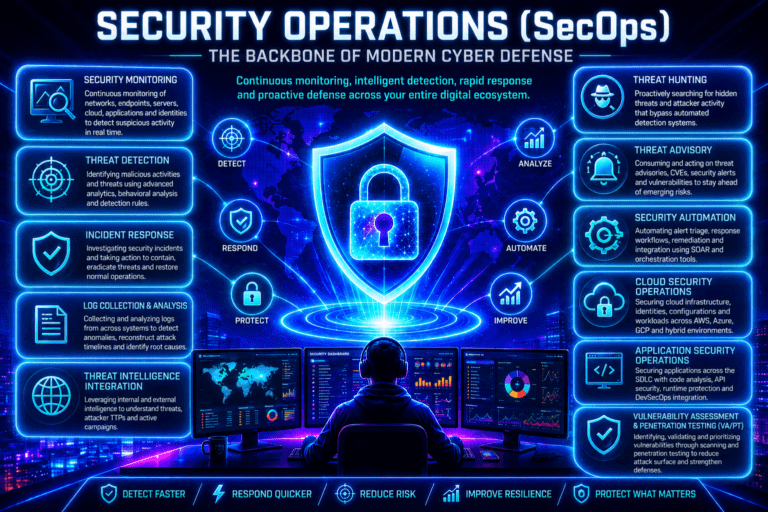
Security Operations Center (SOC)
Continuously monitors the security environment, detects threats, investigates alerts, responds to incidents, and supports threat hunting activities.
Security Architecture and Engineering
Designs, implements, and maintains enterprise security architectures and technical security controls.
Vulnerability Management
Identifies, assesses, prioritizes, and manages security vulnerabilities through continuous assessments, penetration testing, and remediation.
Identity and Access Management (IAM)
Manages digital identities, authentication, authorization, privileged access, and identity governance.
Application Security
Integrates security throughout the software development lifecycle through secure design, security testing, and DevSecOps practices.
Cloud Security
Protects cloud infrastructure, workloads, applications, identities, and cloud-native services.
Data Security
Protects sensitive information through data classification, encryption, data loss prevention, privacy controls, and key management.
Incident Response and Digital Forensics
Coordinates cybersecurity incident response, forensic investigations, evidence preservation, and recovery activities.
Threat Intelligence
Collects, analyzes, and disseminates cyber threat intelligence to improve threat detection and proactive defense.
Security Awareness and Training
Develops education and awareness programs that strengthen the organization’s cybersecurity culture.
Functions
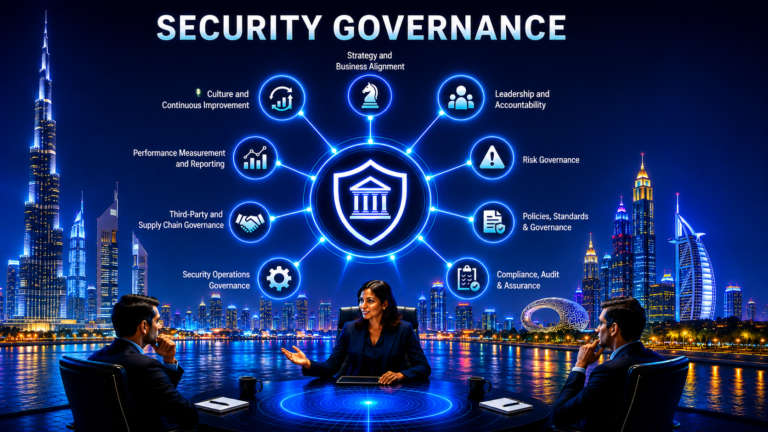
Security Governance
Establishes the cybersecurity strategy, governance framework, policies, standards, roles, responsibilities, and oversight required to manage enterprise cybersecurity.
Cyber Risk Management
Identifies, assesses, evaluates, treats, monitors, and reports cybersecurity risks that may impact organizational objectives.
Security Compliance
Ensures compliance with applicable laws, regulations, industry standards, contractual obligations, and internal security requirements.
Security Architecture
Designs, implements, and governs security architectures and technical controls that protect enterprise systems and information assets.
Security Operations
Continuously monitors the organization’s security environment, detects threats, investigates security events, and coordinates incident response activities.
Identity and Access Security
Protects enterprise identities and manages authentication, authorization, privileged access, and identity governance.
Application Security
Integrates security throughout the software development lifecycle to reduce software vulnerabilities and application risks.
Cloud Security
Protects cloud infrastructure, applications, workloads, identities, and cloud-native services.
Data Security
Protects sensitive information through data classification, encryption, data loss prevention, key management, and privacy controls.
Vulnerability Management
Continuously identifies, assesses, prioritizes, and manages security vulnerabilities to reduce cyber risk.
Incident Response and Digital Forensics
Coordinates the detection, containment, investigation, recovery, and forensic analysis of cybersecurity incidents.
Threat Intelligence
Collects, analyzes, and disseminates cyber threat intelligence to improve threat detection, risk assessment, and proactive defense.
Security Awareness and Training
Builds a security-aware culture through education, awareness programs, and user training.
Cyber Resilience
Strengthens the organization’s ability to prepare for, withstand, respond to, and recover from cyber incidents while maintaining critical organizational operations.
Executive Leadership Collaboration
Effective technology and cybersecurity require close collaboration among executive leaders. The CEO provides the overall strategic direction for the organization. The CIO aligns technology strategy with organizational objectives and oversees digital transformation. The IT Head ensures reliable and resilient digital operations, while the CISO protects the organization’s information assets and manages cybersecurity risks.
The Chief Financial Officer (CFO) oversees technology and cybersecurity investments, budgets, and financial governance. The Chief Risk Officer (CRO) manages enterprise-wide risks, including strategic, operational, financial, legal, regulatory, third-party, business continuity, and cybersecurity risks, working closely with the CISO to integrate cyber risk into the organization’s overall risk management framework.
Together, these executives ensure that technology enables organizational success while maintaining operational resilience, effective governance, strong cybersecurity, regulatory compliance, and sustainable business growth.
Enterprise Governance, Risk and Compliance
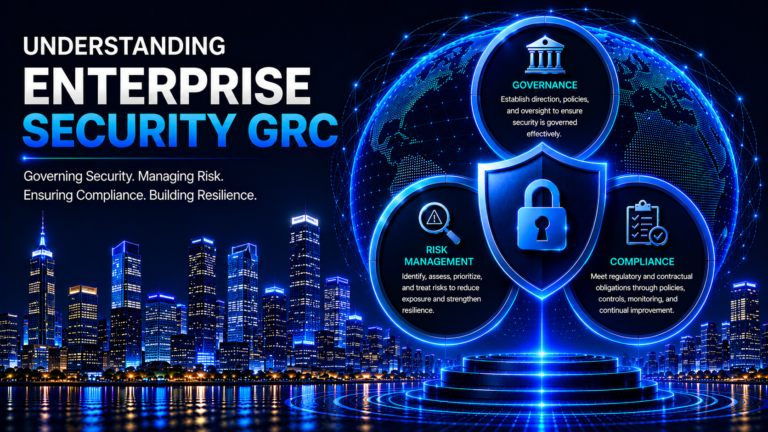
Enterprise Governance, Risk and Compliance (Enterprise GRC) is an integrated management approach that enables organizations to achieve their strategic objectives while effectively governing the enterprise, managing risks, and ensuring compliance with applicable laws, regulations, standards, and internal policies. Rather than operating as separate activities, governance, risk management, and compliance work together to support informed decision-making, organizational resilience, accountability, and sustainable business performance.
Enterprise GRC provides the framework through which executive leadership establishes strategic direction, defines governance structures, manages uncertainty, and ensures that organizational activities are conducted responsibly and in accordance with legal, regulatory, and ethical requirements. It enables organizations to balance business opportunities with potential risks while maintaining stakeholder confidence.
Although the implementation of Enterprise GRC varies between organizations, it is commonly built around three interconnected disciplines.
Governance
Governance establishes the leadership, oversight, decision-making, accountability, and control mechanisms required to direct the organization toward its strategic objectives. It defines organizational structures, roles, responsibilities, policies, and processes that guide decision-making while ensuring transparency, ethical conduct, and effective management oversight.
Risk Management
Risk Management is the systematic process of identifying, assessing, evaluating, treating, monitoring, and reporting risks that may affect the organization’s objectives. It enables informed decision-making by helping leadership understand uncertainties, prioritize risk responses, and maintain risks within the organization’s defined risk appetite.
Compliance
Compliance ensures that the organization adheres to applicable laws, regulations, industry standards, contractual obligations, and internal policies. Compliance programs establish the controls, monitoring activities, reporting mechanisms, and assurance processes necessary to demonstrate that organizational activities are performed in accordance with required obligations.
Together, governance, risk management, and compliance provide an integrated framework that enables organizations to make informed decisions, strengthen accountability, improve operational resilience, protect organizational assets, and achieve strategic objectives while maintaining the trust of customers, regulators, shareholders, employees, and other stakeholders.
Enterprise Architecture
Enterprise Architecture (EA) is a strategic discipline that defines the structure, relationships, and evolution of an organization’s business capabilities, information, applications, and technology. It provides a holistic view of the enterprise, ensuring that business strategy, organizational capabilities, business processes, information, applications, and technology work together to achieve the organization’s strategic objectives.
As organizations grow in size and complexity, technology environments often become fragmented, resulting in duplicated systems, inconsistent processes, increased costs, and operational inefficiencies. Enterprise Architecture provides a structured approach to designing, integrating, and governing the enterprise so that people, processes, information, and technology remain aligned throughout the organization.
Enterprise Architecture enables organizations to translate business strategy into technology capabilities by establishing architectural principles, standards, reference models, and roadmaps. It supports informed decision-making throughout the lifecycle of business and technology initiatives, from strategic planning and solution design to implementation, modernization, integration, and continuous improvement.
By providing a common blueprint for the enterprise, Enterprise Architecture improves business and technology alignment, simplifies complexity, enhances interoperability, strengthens governance, optimizes technology investments, supports digital transformation, and enables organizations to respond more effectively to changing business needs.
Enterprise Security
Enterprise Security is the strategic discipline responsible for protecting an organization’s people, information, technology, physical assets, business operations, and reputation from threats that could impact its objectives. It provides a comprehensive approach to managing security across the enterprise by integrating governance, risk management, security controls, operational processes, and continuous improvement.
As organizations increasingly rely on digital technologies, cloud services, interconnected systems, and third-party ecosystems, the security landscape has become more complex. Enterprise Security helps organizations establish a coordinated and risk-based approach to protecting critical assets while enabling business growth, operational resilience, regulatory compliance, and digital transformation.
Enterprise Security encompasses both physical and digital security, ensuring that appropriate administrative, technical, and physical controls are implemented to prevent, detect, respond to, and recover from security incidents. It also promotes collaboration among executive leadership, business functions, technology teams, and cybersecurity professionals to ensure that security supports organizational objectives rather than operating as an isolated function.
By aligning security with business strategy and enterprise risk management, Enterprise Security enables organizations to reduce risk, strengthen resilience, protect stakeholder trust, and support the secure achievement of strategic objectives.
Conclusion
An enterprise organizational structure provides the foundation for achieving strategic objectives by defining clear leadership, responsibilities, reporting relationships, and organizational functions. It enables people, processes, technology, and resources to work together efficiently while supporting effective governance, informed decision-making, operational resilience, and sustainable growth.
As organizations continue to evolve in an increasingly digital and interconnected world, technology, enterprise architecture, governance, risk management, compliance, and enterprise security have become integral components of organizational success. Understanding how these disciplines interact within the enterprise enables leaders, architects, IT professionals, and cybersecurity practitioners to better align technology with business objectives, manage organizational risks, and protect critical assets.
Understanding an enterprise organizational structure provides the context for understanding how organizations are governed, managed, and operated. It also establishes a strong foundation for exploring related disciplines such as Enterprise Governance, Enterprise Architecture, Enterprise Security, and Enterprise GRC, all of which contribute to achieving the organization’s strategic objectives.