Understanding Enterprise Security GRC
Introduction
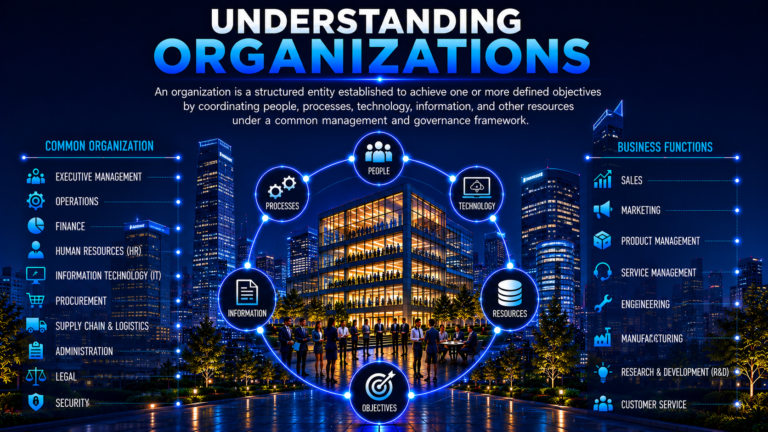
An enterprise is a structured entity established to achieve strategic objectives by coordinating people, processes, technology, and resources under a unified leadership and governance framework. Every enterprise consists of one or more organizations that establish management structures, responsibilities, and operational functions, while its business activities create value by delivering products and services to customers and stakeholders. Together, the enterprise, its organizations, and its business functions operate as an integrated ecosystem that supports the achievement of strategic and operational objectives.
Modern enterprises rely extensively on information technology to support business operations, manage information, enable digital transformation, communicate with stakeholders, and drive innovation. As technology becomes embedded across every aspect of the enterprise, cybersecurity, technology risks, regulatory obligations, and operational resilience have become critical business priorities.
To address these challenges, enterprises establish an Enterprise Security Governance, Risk, and Compliance (Enterprise Security GRC) function that provides the leadership, governance, and management framework to align cybersecurity with business objectives, manage cyber risks, ensure regulatory compliance, govern security investments, and continuously strengthen the enterprise’s overall security posture.
Enterprise Security GRC serves as the foundation for planning, directing, managing, and continuously improving enterprise security. It brings together executive leadership, governance, risk management, compliance, security program management, and collaboration between security, information technology, and business functions to protect information assets, strengthen cyber resilience, support informed decision-making, and enable the enterprise to achieve its strategic objectives securely.
What is Enterprise Security GRC?
Enterprise Security Governance, Risk, and Compliance (Enterprise Security GRC) is the strategic management function responsible for governing, directing, coordinating, and continuously improving an organization’s enterprise security program. It provides the leadership, governance, oversight, and management processes necessary to protect information assets, manage cybersecurity risks, ensure compliance with applicable legal and regulatory requirements, and align security initiatives with business objectives.
Enterprise Security GRC serves as the central management function that integrates security strategy, governance, risk management, compliance, program management, and executive oversight into a unified framework. It enables organizations to establish security objectives, define governance structures, develop security policies and standards, oversee security investments, measure security performance, and ensure that security initiatives support the organization’s mission, strategic goals, and risk appetite.
Unlike operational security functions that focus on implementing, operating, and monitoring security controls, Enterprise Security GRC provides the strategic direction, governance, and accountability required to manage the enterprise security program effectively. It enables executive leadership to make informed decisions regarding security strategy, investments, priorities, risk management, and regulatory compliance while ensuring that security remains aligned with business needs.
Enterprise Security GRC also promotes collaboration between executive leadership, business units, enterprise IT, and security teams to ensure that security is integrated into organizational decision-making, technology initiatives, business processes, and digital transformation programs. Through effective governance and oversight, it enables organizations to manage security proactively rather than reactively.
Enterprise Security GRC is typically led by the Chief Information Security Officer (CISO) and supported by specialized functions such as the Security GRC Team, Security PMO, Security Architecture, Security Engineering, Security Operations Center (SOC), Vulnerability Management, and Enterprise IT teams. Each function plays a distinct role while working together to establish, implement, operate, monitor, and continuously improve the organization’s enterprise security program.
By providing a structured management framework, Enterprise Security GRC enables organizations to protect their information assets, strengthen cyber resilience, support regulatory compliance, optimize security investments, improve operational effectiveness, and build stakeholder confidence while enabling the organization to achieve its business objectives securely and security initiatives are successfully implemented across the organization.
Why Enterprise Security GRC Matters
Modern organizations operate in an increasingly complex digital environment where information technology supports nearly every business function. As organizations adopt cloud computing, digital services, artificial intelligence, remote work, connected devices, and third-party ecosystems, the number of cyber threats, regulatory obligations, and operational risks continues to grow. Managing these challenges requires more than implementing security technologies—it requires a structured management framework that provides strategic direction, governance, oversight, and accountability across the enterprise.
Enterprise Security GRC enables organizations to align security initiatives with business objectives, ensuring that security supports rather than hinders business operations. It helps executive leadership make informed decisions regarding security strategy, investments, priorities, and risk while ensuring that security resources are allocated effectively.
A mature Enterprise Security GRC function enables organizations to:
- Align enterprise security with business strategy and objectives.
- Establish governance, accountability, and executive oversight.
- Identify, assess, and manage cybersecurity risks.
- Ensure compliance with legal, regulatory, contractual, and industry requirements.
- Develop and enforce enterprise security policies and standards.
- Prioritize security initiatives based on business risk.
- Govern security investments, including CAPEX and OPEX.
- Improve coordination between business, IT, and security teams.
- Measure security performance through metrics, KPIs, KRIs, and executive reporting.
- Strengthen cyber resilience and business continuity.
- Build trust with customers, partners, regulators, and other stakeholders.
- Drive continuous improvement of the enterprise security program.
Without an effective Enterprise Security GRC function, organizations often experience fragmented security initiatives, inconsistent policies, poor visibility into cyber risks, inefficient use of security resources, regulatory non-compliance, and weak executive oversight. By providing a structured governance and management framework, Enterprise Security GRC enables organizations to proactively manage security, support informed decision-making, and protect the organization while enabling business growth and innovation.
Enterprise Security Leadership
Enterprise Security Leadership is responsible for establishing the vision, strategy, governance, and direction of the organization’s enterprise security program. It ensures that security supports business objectives, manages cyber risks, protects information assets, and enables the organization to operate securely in an increasingly complex digital environment.
Effective security leadership extends beyond implementing security technologies. It requires executive decision-making, governance, strategic planning, financial management, risk oversight, regulatory compliance, and collaboration across business and technology functions. Security leaders are responsible for building a security program that not only protects the organization but also enables business growth, innovation, digital transformation, and operational resilience.
Enterprise Security Leadership provides the governance and oversight necessary to ensure that security initiatives are aligned with organizational priorities, adequately funded, effectively managed, and continuously improved. It establishes accountability across the enterprise while promoting a culture where security becomes a shared organizational responsibility rather than solely an IT function.
In most organizations, Enterprise Security Leadership is led by the Chief Information Security Officer (CISO) in collaboration with executive leadership, including the Board of Directors, Chief Executive Officer (CEO), Chief Information Officer (CIO), Head of IT, business leaders, and other stakeholders. Together, they define security strategy, allocate resources, establish governance, oversee risk management, ensure regulatory compliance, and measure the effectiveness of the enterprise security program.
A mature Enterprise Security Leadership function is responsible for:
- Establishing the enterprise security vision and strategy
- Aligning security with business objectives
- Establishing enterprise security governance
- Building and managing the enterprise security organization
- Leading the Security PMO and security programs
- Managing cybersecurity risks
- Ensuring regulatory and security compliance
- Developing enterprise security policies and standards
- Governing security architecture and security engineering
- Overseeing the Security Operations Center (SOC)
- Managing vulnerability management and security assurance
- Planning and governing security investments (CAPEX and OPEX)
- Measuring security performance through KPIs, KRIs, and executive dashboards
- Reporting security posture and cyber risks to executive leadership and the Board
- Driving continuous improvement and cyber resilience
Enterprise Security Leadership serves as the foundation for a successful security program by providing strategic direction, executive oversight, governance, funding, and accountability. It enables organizations to make informed security decisions, prioritize investments, manage evolving cyber risks, and continuously strengthen their security posture while supporting long-term business objectives.
Enterprise Organizational Structure
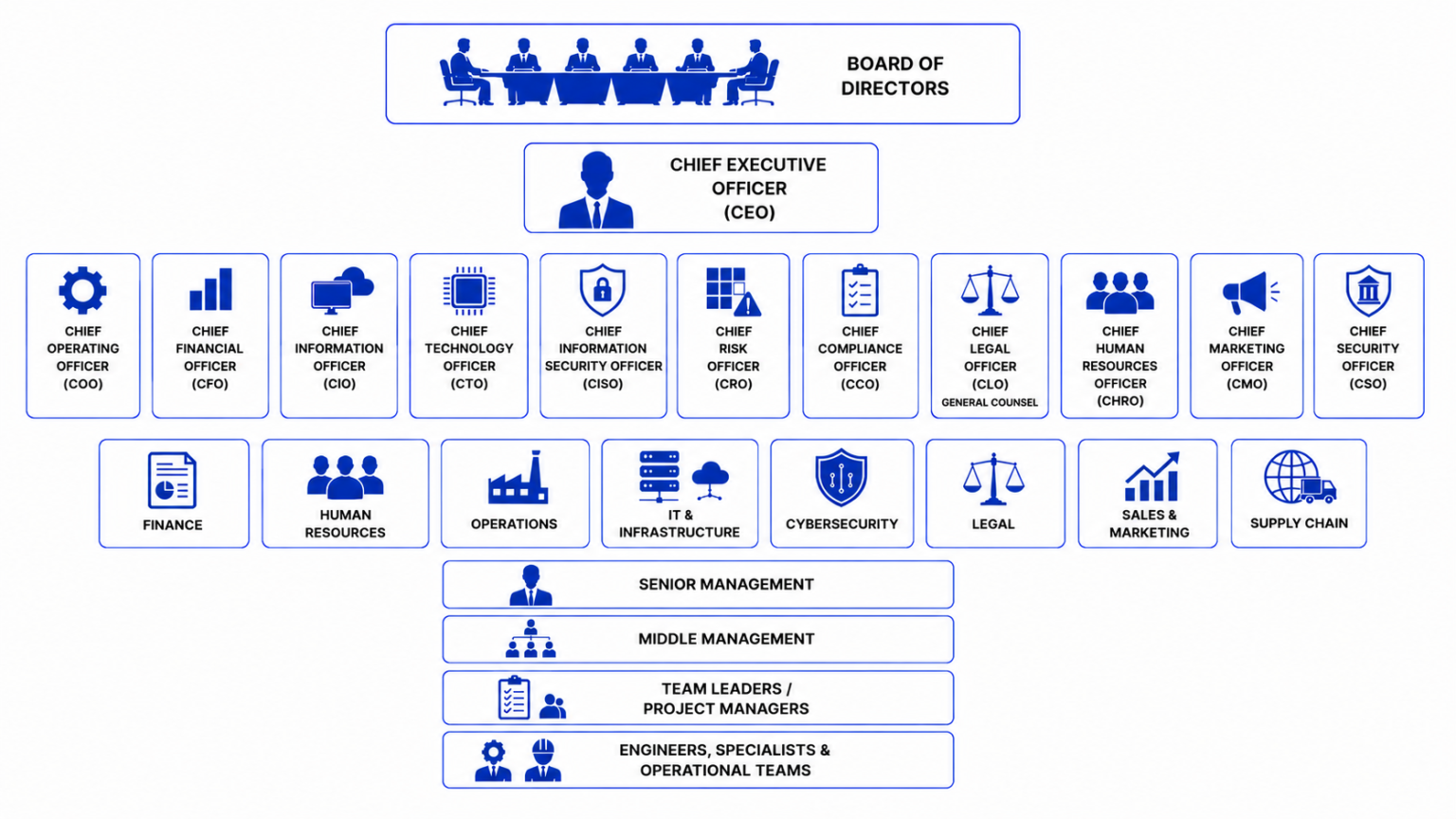
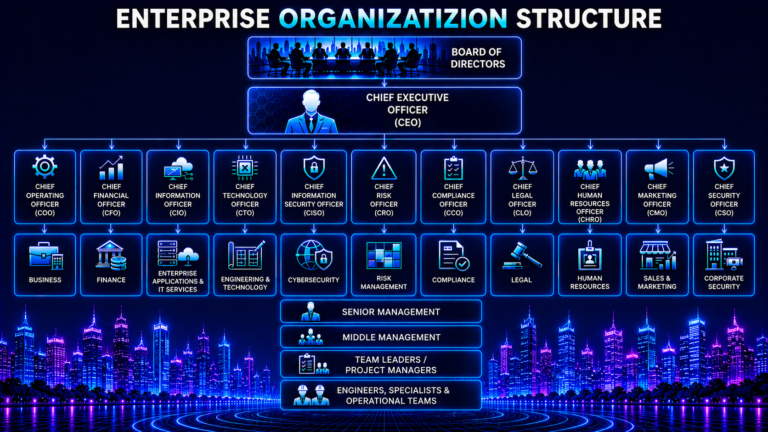
The Enterprise Organizational Structure provides the leadership and governance framework through which Enterprise Security GRC is directed, managed, and executed across the enterprise. It establishes reporting relationships, decision-making authority, accountability, and collaboration between business, security, and information technology functions, ensuring that cybersecurity supports the enterprise’s strategic objectives.
At the highest level, the Board of Directors provides oversight of enterprise governance, risk, and organizational resilience. Reporting to the Board, the Chief Executive Officer (CEO) is responsible for the overall leadership and performance of the enterprise, ensuring that business strategy, corporate governance, financial performance, operational excellence, and enterprise risk management are aligned to achieve strategic objectives.
As enterprises continue to expand their digital capabilities, the Information Technology function has evolved into one of the largest and most critical functions within the enterprise. Enterprise IT comprises multiple technology teams responsible for planning, implementing, operating, securing, and supporting the organization’s technology landscape, including infrastructure, networks, cloud platforms, enterprise applications, databases, endpoint computing, IT operations, and service management. As technology has become the foundation of modern business operations, enterprises require strong executive leadership to govern technology strategy, digital transformation, technology investments, operational resilience, and enterprise-wide technology services. This responsibility is led by the Chief Information Officer (CIO), who oversees the Enterprise IT organization and its technology teams, providing the strategic leadership, governance, and direction necessary to manage the enterprise’s technology ecosystem and support its business objectives.
Reporting to the CEO, the Chief Information Officer (CIO) leads the enterprise’s overall Information Technology function. The CIO is responsible for defining the enterprise IT strategy, driving digital transformation, governing technology investments, modernizing IT capabilities, ensuring technology resilience, and delivering secure, reliable, and efficient technology services that support business operations. The CIO plays a critical role in aligning technology initiatives with business strategy while ensuring that security, resilience, and regulatory requirements are incorporated into enterprise technology decisions.
Given the scale, complexity, and constantly evolving nature of modern cybersecurity, enterprise security has become a specialized leadership function within the enterprise. Working closely with the CIO are two critical leadership functions: the Chief Information Security Officer (CISO) and the Head of Information Technology (Head of IT). While both leaders share the common objective of enabling and protecting the enterprise through technology, they have distinct but complementary responsibilities that together form the operational foundation of Enterprise Security GRC.
The Chief Information Security Officer (CISO) leads the Enterprise Security organization and is responsible for establishing the enterprise security strategy, governance framework, cyber risk management program, security policies and standards, regulatory compliance, security architecture, security operations, vulnerability management, identity and access security, data security, security awareness, third-party security, and the continuous improvement of the enterprise’s cybersecurity posture. These responsibilities are typically delivered through specialized security teams, including:
- Security Program Management Office (Security PMO)
- Security Governance, Risk, and Compliance (Security GRC)
- Security Architecture
- Security Engineering
- Security Operations Center (SOC)
- Vulnerability Management
- Identity and Access Security
- Data Security
- Security Awareness and Training
- Third-Party Security
The Head of Information Technology leads the Enterprise IT organization and is responsible for implementing, operating, and maintaining the enterprise’s technology environment. This includes enterprise infrastructure, networks, servers, cloud platforms, endpoint computing, enterprise applications, databases, IT operations, service management, backup and recovery, and other technology services that enable business operations. Enterprise IT teams ensure that security requirements established by the CISO are implemented effectively across the organization’s technology landscape. Typical Enterprise IT functions include:
- Infrastructure Services
- Network Services
- Server Administration
- Cloud Operations
- Endpoint Management
- Database Administration
- Enterprise Applications
- IT Operations
- IT Service Management
- Backup and Recovery
Enterprise Security GRC extends beyond the CIO organization and requires continuous collaboration with other executive leaders across the enterprise. The Chief Risk Officer (CRO) aligns cyber risks with the enterprise’s risk management strategy and risk appetite. The Chief Technology Officer (CTO) collaborates on secure technology innovation, product development, and emerging technologies. The Chief Financial Officer (CFO) works closely with the CIO and CISO to govern security investments, approve budgets, evaluate business cases, and ensure that cybersecurity initiatives deliver measurable business value. Depending on the enterprise’s organizational structure, collaboration also extends to executives responsible for legal, compliance, privacy, human resources, operations, procurement, and business units to ensure that security, risk, and compliance requirements are consistently integrated into enterprise processes.
Together, the CEO, CIO, CISO, Head of IT, and other executive leaders establish a governance model that combines strategic leadership, technology management, cyber risk management, operational execution, and cross-functional collaboration. This integrated organizational structure enables Enterprise Security GRC to align security with business strategy, support informed executive decision-making, strengthen cyber resilience and organizational resilience, protect the enterprise against evolving cyber threats, and enable sustainable business growth.
CISO and Head of IT Collaboration for Enterprise Security GRC
The Chief Information Security Officer (CISO) and the Head of Information Technology are two of the most important executive leaders responsible for the successful implementation of Enterprise Security Governance, Risk, and Compliance (Enterprise Security GRC). Although they have distinct responsibilities, they share a common objective of ensuring that the enterprise’s technology environment is secure, reliable, resilient, and capable of supporting business objectives. The CISO focuses on protecting the enterprise from cyber threats through effective security governance, risk management, and security controls, while the Head of Information Technology focuses on delivering and maintaining enterprise IT services that are stable, performant, and continuously available. Their close collaboration ensures that security is embedded into every aspect of the enterprise’s technology ecosystem without compromising operational efficiency.
Responsibilities of the CISO
The CISO is responsible for leading the enterprise’s cybersecurity strategy and protecting its information assets, digital services, and technology environment. The role focuses on establishing governance, managing cyber risks, defining security requirements, and overseeing the implementation of security capabilities that safeguard the enterprise against evolving threats.
Typical responsibilities of the CISO include:
- Security Governance, Risk, and Compliance (Security GRC)
- Enterprise Security Strategy
- Security Policies, Standards, and Procedures
- Security Program Management Office (Security PMO)
- Security Architecture
- Security Engineering
- Security Operations Center (SOC)
- Vulnerability Management
- Identity and Access Security
- Data Security and Privacy
- Security Awareness and Training
- Third-Party Security Risk Management
- Security Metrics, Reporting, and Continuous Improvement
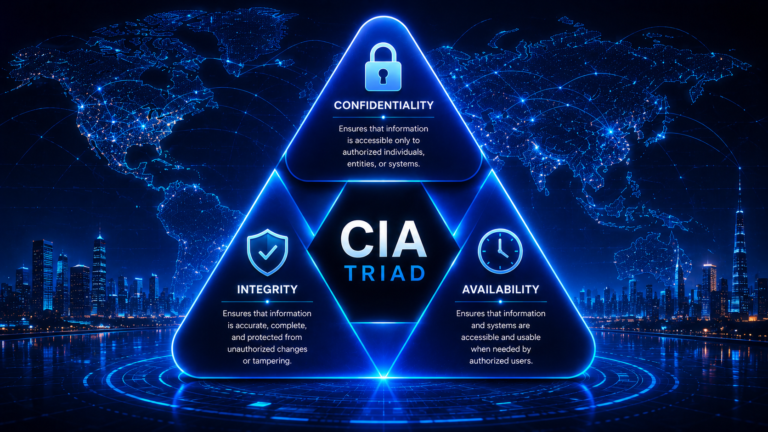
The primary objective of the CISO is to protect the confidentiality, integrity, and availability of enterprise information and technology while ensuring that security supports business objectives, regulatory obligations, and organizational resilience.
Responsibilities of the Head of Information Technology
The Head of Information Technology is responsible for planning, delivering, operating, and maintaining the enterprise’s technology environment. This role ensures that enterprise IT services remain reliable, efficient, resilient, and continuously available to support business operations and strategic initiatives.
Typical responsibilities of the Head of Information Technology include:
- Enterprise IT Strategy and Planning
- IT Infrastructure Services
- Network Services
- Cloud Operations
- Server and Platform Administration
- Endpoint Management
- Enterprise Applications
- Database Administration
- IT Operations
- IT Service Management (ITSM)
- Backup and Recovery
- Availability, Performance, and Capacity Management
- Enterprise IT Service Continuity
The primary objective of the Head of Information Technology is to deliver and maintain enterprise IT services that provide high availability, operational stability, resilience, and continuity, enabling the organization to perform its day-to-day operations without disruption.
Working Together for Enterprise Security
Enterprise Security GRC depends on strong collaboration between the CISO and the Head of Information Technology. While the CISO determines what security is required to protect the enterprise, the Head of Information Technology determines how those requirements are implemented, operated, and maintained within the enterprise technology environment. Together, they ensure that security controls are effectively integrated into enterprise IT services while maintaining operational efficiency, service reliability, and technology resilience.
Their collaboration begins during strategic planning and continues throughout the entire technology lifecycle. The CISO defines security governance, identifies cyber risks, establishes security policies and standards, and specifies security requirements for enterprise technologies. The Head of Information Technology incorporates these requirements into the design, deployment, operation, maintenance, and continual improvement of enterprise IT services, ensuring that security becomes an integral part of technology rather than an afterthought.
The CISO and the Head of Information Technology work closely on initiatives such as enterprise architecture, technology modernization, cloud adoption, infrastructure transformation, vulnerability remediation, patch management, change management, incident response, disaster recovery, and enterprise IT service continuity. Security teams continuously assess threats, monitor risks, and recommend security improvements, while Enterprise IT teams implement technical controls, maintain technology platforms, optimize system performance, and ensure the continuous availability of enterprise IT services.
Regular communication, shared accountability, and coordinated decision-making enable both leaders to align security priorities with technology strategies and business objectives. Governance meetings, executive reporting, risk reviews, architecture assessments, operational planning, and performance monitoring help ensure that enterprise security initiatives are successfully integrated into day-to-day IT operations.
By working together as strategic partners, the CISO and the Head of Information Technology create a balanced approach that combines cybersecurity with operational excellence. The CISO safeguards the enterprise by protecting its information assets and managing cyber risks, while the Head of Information Technology ensures the continuity, reliability, and resilience of enterprise IT services. Together, they establish the leadership foundation that enables Enterprise Security GRC to protect the organization, support digital transformation, maintain operational stability, and drive sustainable business success.
Enterprise Security GRC Operating Model
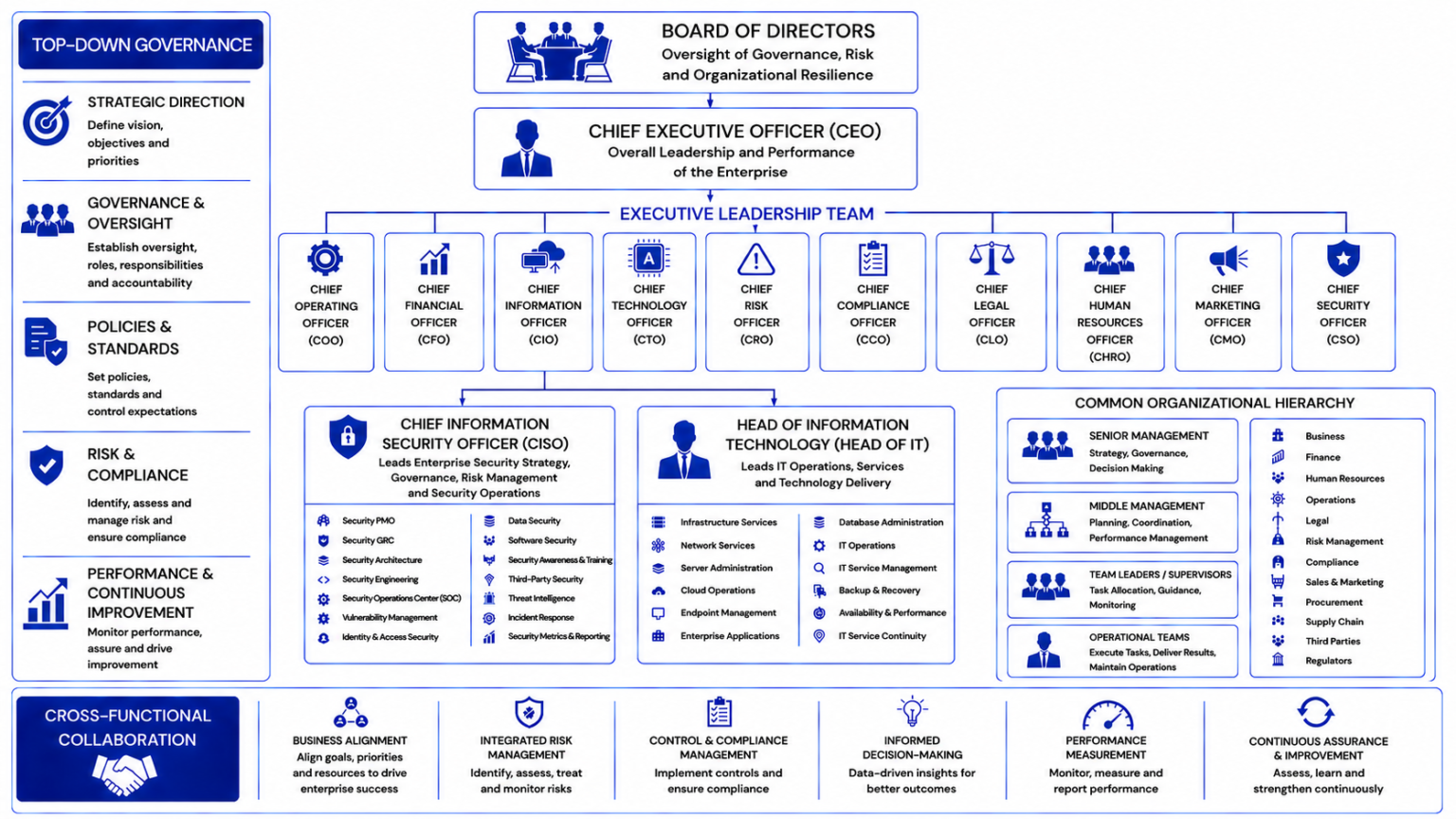
Enterprise Security GRC is an enterprise-wide operating model that integrates executive leadership, security, information technology, business units, and supporting functions to govern security, manage cyber risks, ensure regulatory compliance, and protect organizational assets. Rather than functioning as a standalone department, Enterprise Security GRC establishes a structured approach for translating business objectives into security strategies, governance practices, operational processes, and measurable outcomes.
An effective operating model defines how governance decisions are made, how responsibilities are assigned, how security initiatives are executed, how information flows across the organization, and how different teams collaborate to achieve common security objectives. It provides the framework that enables security to support business growth while maintaining confidentiality, integrity, availability, regulatory compliance, and operational resilience.
Enterprise Security GRC operates through two complementary principles: Top-Down Governance and Cross-Functional Collaboration. Together, these principles ensure that governance decisions are effectively translated into operational execution while maintaining alignment with business objectives and enterprise risk management.
Top-Down Governance
Top-down governance establishes a clear chain of authority, accountability, and decision-making from executive leadership to operational teams. Strategic direction begins with the Board of Directors and executive leadership, who define business objectives, organizational priorities, enterprise risk appetite, and governance expectations.
The CIO translates these strategic objectives into enterprise technology initiatives, while the CISO develops the enterprise security strategy, governance framework, security policies, standards, cyber risk management program, and compliance objectives. Security PMO coordinates security initiatives and projects, Security GRC governs policies, risks, and compliance activities, Security Architecture defines security principles and technical standards, and Security Engineering implements security controls and technologies.
The Head of Information Technology ensures that approved security controls are integrated into enterprise infrastructure, networks, cloud platforms, endpoints, databases, and business applications. Operational teams such as the Security Operations Center (SOC) continuously monitor the environment for security events, while Vulnerability Management identifies, prioritizes, and coordinates the remediation of security weaknesses. This governance model ensures that security objectives established by executive leadership are consistently implemented throughout the organization.
Cross-Functional Collaboration
While governance follows a hierarchical structure, Enterprise Security GRC depends equally on collaboration across organizational functions. Security cannot be achieved by the security organization alone; it requires continuous coordination between executive leadership, business units, Enterprise IT, legal, compliance, privacy, finance, procurement, human resources, internal audit, vendors, and third-party partners.
Within the security organization, Security GRC works closely with Security Architecture to establish technical governance, Security Engineering to implement security controls, SOC to monitor threats and incidents, Vulnerability Management to reduce cyber exposure, and Security PMO to coordinate enterprise security initiatives. At the same time, Enterprise IT collaborates with these security functions to implement and operate secure technology services while maintaining business continuity and operational efficiency.
Cross-functional collaboration ensures that governance decisions are effectively communicated, security requirements are consistently implemented, enterprise risks are managed proactively, compliance obligations are fulfilled, and security initiatives remain aligned with changing business and technology requirements.
Enterprise Security Decision-Making
Enterprise Security GRC establishes a structured decision-making process for managing security across the organization. Strategic decisions involving security policies, enterprise risks, regulatory compliance, technology standards, security investments, and major initiatives are reviewed through executive leadership and governance committees. Operational decisions related to implementation, risk treatment, vulnerability remediation, incident response, and control improvements are coordinated across security and IT teams to ensure timely and consistent execution.
Continuous Governance and Improvement
Enterprise Security GRC is a continuous process that evolves alongside business objectives, technology, regulations, and the threat landscape. Security performance, cyber risks, compliance status, vulnerability trends, audit findings, security incidents, and key performance indicators are continuously monitored and reported to executive leadership. These insights support informed decision-making, drive continuous improvement, strengthen organizational resilience, and ensure that the enterprise security program remains effective and aligned with organizational priorities.
Enterprise Security Governance
Enterprise Security Governance establishes the leadership, strategic direction, organizational structure, and oversight required to manage cybersecurity across the enterprise. It enables organizations to align cybersecurity with business objectives, manage cyber risks, comply with legal and regulatory requirements, and ensure that security investments support business growth, operational resilience, and long-term organizational success.
Enterprise Security Governance comprises several governance components that collectively enable organizations to direct, manage, monitor, and continually improve their cybersecurity program. These governance components establish the foundation for executive oversight, strategic decision-making, governance structures, organizational accountability, security policies, enterprise risk management, security architecture, operational security, and performance measurement. Together, they ensure that cybersecurity is consistently governed across the organization and remains aligned with business priorities, regulatory obligations, and the organization’s risk appetite.
An effective governance program requires collaboration across the organization. The Board of Directors, executive leadership, business units, Information Technology (IT), cybersecurity teams, enterprise risk management, compliance, legal, human resources, finance, procurement, and internal audit all play important roles in governing cybersecurity. By implementing these governance components, organizations can establish a structured governance framework that strengthens cyber resilience, improves regulatory compliance, optimizes security investments, and enables informed decision-making across the enterprise.
Governance Pillars
Governance Pillars establish the strategic foundation of an Enterprise Security Governance program. They define the leadership principles, governance practices, and organizational capabilities that enable cybersecurity to support business objectives while effectively managing enterprise risk. Organizations should establish these pillars to ensure cybersecurity is consistently governed, integrated into business operations, and continuously improved as the organization evolves.
Governance Vision
Every organization should establish a clear governance vision that defines the purpose, strategic direction, and long-term objectives of its Enterprise Security Governance program. The governance vision should align with the organization’s mission, business strategy, digital transformation initiatives, regulatory obligations, and enterprise risk appetite. It should clearly articulate how cybersecurity supports business growth, operational resilience, customer trust, and organizational success.
The governance vision should be formally approved by executive leadership and communicated throughout the organization to ensure cybersecurity is recognized as a strategic business function. It should define measurable governance objectives that guide decision-making, investment planning, governance initiatives, and long-term security planning. A well-defined governance vision establishes a common direction for the organization and ensures governance activities remain aligned with business priorities.
Strategic Business Alignment
Organizations should integrate Enterprise Security Governance into business planning and strategic decision-making to ensure cybersecurity supports organizational objectives. Security governance should become an integral part of corporate governance, business transformation, enterprise architecture, and enterprise risk management rather than operating as an isolated function.
Security leadership should actively participate in strategic planning, digital transformation initiatives, mergers and acquisitions, cloud adoption, artificial intelligence initiatives, product development, and major technology investments. Their involvement enables organizations to identify cyber risks early, define governance requirements, allocate appropriate security resources, and incorporate security considerations throughout the business lifecycle.
Organizations should periodically review governance objectives to ensure they remain aligned with changing business priorities, regulatory requirements, market conditions, customer expectations, and the evolving cyber threat landscape.
Executive Sponsorship
Executive leadership should actively sponsor the Enterprise Security Governance program to ensure cybersecurity receives appropriate organizational priority, executive oversight, funding, and decision-making authority. Strong executive sponsorship demonstrates that cybersecurity is a business responsibility requiring leadership commitment across the enterprise.
The Board of Directors should oversee cybersecurity strategy and enterprise cyber risks, while executive leadership should approve governance objectives, establish strategic priorities, allocate budgets, monitor governance performance, and ensure adequate resources are available to implement the organization’s cybersecurity program. Executives should regularly review governance reports, monitor key performance indicators, evaluate enterprise cyber risks, and support continual improvement initiatives.
Visible executive commitment strengthens governance, promotes cross-functional collaboration, and reinforces accountability throughout the organization.
Governance Operating Model
Organizations should establish a governance operating model that defines how Enterprise Security Governance functions across the enterprise. The operating model should document governance structures, reporting relationships, governance committees, decision-making authority, communication channels, governance processes, and oversight mechanisms.
It should clearly define how business units, Information Technology (IT), cybersecurity, enterprise risk management, compliance, legal, procurement, finance, human resources, and internal audit collaborate to execute governance activities. The operating model should also establish standardized processes for policy management, governance reporting, risk management, security approvals, exception management, and performance monitoring.
A well-defined governance operating model enables consistent governance practices, improves collaboration across organizational functions, and ensures governance activities remain aligned with business objectives.
Decision-Making and Accountability
Organizations should establish formal governance processes that clearly define decision-making authority, ownership, and accountability for cybersecurity activities. Governance decisions should be supported by documented policies, governance procedures, approval workflows, defined responsibilities, and executive oversight to ensure consistency across the enterprise.
Decision-making responsibilities should be assigned for approving security policies, accepting enterprise risks, authorizing policy exceptions, approving security standards, prioritizing security investments, approving security architecture decisions, and overseeing major cybersecurity initiatives. Governance processes should also define escalation procedures to ensure significant cyber risks, compliance issues, and governance concerns are promptly communicated to the appropriate governance bodies and executive management.
Clearly defined accountability improves governance effectiveness, reduces operational ambiguity, and ensures security responsibilities are consistently executed throughout the organization.
Security Culture
Organizations should establish and maintain a security-conscious culture where cybersecurity is recognized as a shared business responsibility. Building a strong security culture requires executive leadership, management commitment, employee engagement, continuous awareness, and effective communication throughout the organization.
Executive leadership should demonstrate commitment by promoting cybersecurity initiatives, participating in awareness campaigns, supporting mandatory security training, and reinforcing compliance with organizational policies. Managers should integrate security responsibilities into day-to-day business operations, while employees should understand their responsibilities for protecting organizational assets, handling sensitive information, reporting security incidents, and complying with established security requirements.
A mature security culture strengthens governance by encouraging accountability, improving compliance, reducing human-related risks, and increasing the organization’s overall cyber resilience.
Governance Maturity
Organizations should regularly assess the maturity of their Enterprise Security Governance program to evaluate its effectiveness and identify opportunities for improvement. Governance maturity assessments should evaluate governance structures, leadership involvement, governance processes, policy management, committee effectiveness, enterprise risk oversight, compliance activities, governance reporting, and performance measurement.
Organizations should establish governance maturity objectives, define measurable success criteria, perform periodic maturity assessments, and develop improvement roadmaps to address identified gaps. Assessment results should be reviewed by executive leadership and governance committees to prioritize investments, improve governance capabilities, and strengthen organizational resilience.
Continual assessment and improvement enable Enterprise Security Governance to adapt to changing business strategies, regulatory requirements, emerging technologies, and evolving cyber threats while maintaining an effective and sustainable governance program.
Security Governance Committees
Enterprise Security Governance requires formal governance committees to provide strategic oversight, facilitate cross-functional collaboration, and support informed decision-making. These committees ensure cybersecurity is governed at the appropriate organizational level and integrated into business operations, risk management, and corporate governance. Each committee should operate under a defined charter with clearly documented objectives, scope, responsibilities, membership, meeting frequency, decision-making authority, and reporting requirements.
Governance committees should include representatives from executive leadership, business units, Information Technology (IT), cybersecurity, enterprise risk management, compliance, legal, finance, human resources, procurement, and internal audit, depending on their scope and responsibilities. Regular meetings, structured reporting, and effective collaboration enable organizations to monitor cybersecurity performance, manage enterprise risks, approve strategic initiatives, and address governance issues in a timely manner.
Governance Structure
Organizations should establish a governance structure that defines the hierarchy of governance bodies, reporting relationships, committee responsibilities, decision-making authority, and escalation paths. The governance structure should clearly identify how cybersecurity governance is integrated with corporate governance and enterprise risk management.
The governance structure should also define reporting relationships between the Board of Directors, executive leadership, governance committees, business units, and cybersecurity functions. A clearly documented governance structure improves accountability, eliminates ambiguity, and ensures governance decisions are made at the appropriate organizational level.
Security Steering Committee
Organizations should establish a Security Steering Committee to provide executive oversight of the cybersecurity program and ensure alignment with business objectives. The committee serves as the primary governance body responsible for reviewing cybersecurity strategies, enterprise risks, regulatory requirements, security investments, and the overall effectiveness of the security program.
The committee should review major security initiatives, approve strategic priorities, monitor cybersecurity performance, evaluate security metrics, oversee enterprise cyber risks, and resolve cross-functional issues affecting the organization’s security posture. Regular meetings should be conducted to review governance reports, risk assessments, compliance status, audit findings, and the progress of strategic security initiatives.
Enterprise Risk Committee
Organizations should integrate cybersecurity into their Enterprise Risk Management (ERM) program by assigning oversight responsibilities to the Enterprise Risk Committee. Cyber risks should be evaluated alongside financial, operational, legal, strategic, and reputational risks to provide a comprehensive view of organizational risk exposure.
The committee should review enterprise cyber risks, evaluate risk treatment strategies, monitor the organization’s risk appetite, review significant residual risks, and ensure appropriate risk reporting to executive management and the Board of Directors. Coordination between the Enterprise Risk Committee and cybersecurity leadership helps ensure cyber risks are managed consistently across the enterprise.
Architecture Review Board (ARB)
Organizations should establish an Architecture Review Board (ARB) to ensure that new technologies, business applications, infrastructure, cloud platforms, and digital transformation initiatives comply with enterprise architecture principles and cybersecurity requirements before implementation.
The ARB should review solution architectures, evaluate security designs, validate compliance with enterprise standards, identify architectural risks, and recommend appropriate security controls. Security architects should actively participate in architecture reviews to ensure cybersecurity requirements are incorporated into technology decisions throughout the solution lifecycle.
Change Advisory Board (CAB)
Organizations should establish a Change Advisory Board (CAB) to oversee changes to production systems and ensure changes are implemented in a controlled and secure manner. Cybersecurity should be represented within the CAB to evaluate the security impact of proposed changes before implementation.
The CAB should review high-risk changes, verify that appropriate security testing has been completed, assess implementation risks, confirm rollback procedures, and ensure compliance with organizational change management processes. Effective change governance reduces operational disruption, minimizes security risks, and maintains the integrity of production environments.
Committee Governance
Each governance committee should operate under a formally approved charter that defines its purpose, objectives, scope, membership, roles, responsibilities, authority, meeting frequency, quorum requirements, and reporting obligations. Committee charters should be reviewed periodically to ensure they remain aligned with organizational objectives and governance requirements.
Organizations should maintain meeting agendas, minutes, attendance records, action items, and decision logs to demonstrate accountability, support regulatory compliance, and track governance activities. Governance committees should also establish mechanisms to monitor action items, follow up on outstanding issues, and report progress to executive leadership.
Reporting and Escalation
Organizations should establish formal reporting and escalation processes to ensure cybersecurity risks, policy violations, audit findings, compliance issues, security incidents, and strategic governance matters are communicated promptly to the appropriate governance bodies and executive leadership.
Governance reporting should include executive dashboards, cybersecurity performance metrics, Key Performance Indicators (KPIs), Key Risk Indicators (KRIs), enterprise risk summaries, compliance status, audit observations, security program updates, and recommendations requiring executive decisions. Clearly defined escalation procedures ensure critical issues receive timely management attention, enabling informed decision-making and strengthening the overall effectiveness of Enterprise Security Governance.
Governance Pillars establish the strategic foundation upon which Enterprise Security Governance is built. They provide the direction, leadership, accountability, and governance mechanisms required to align cybersecurity with business objectives, manage enterprise cyber risks, and support informed decision-making. By establishing a clear governance vision, integrating cybersecurity into business strategy, securing executive sponsorship, defining an effective operating model, promoting accountability, fostering a strong security culture, and continuously improving governance maturity, organizations create a sustainable governance framework that supports long-term business resilience. To effectively execute these governance principles across the enterprise, organizations should establish formal governance committees that provide oversight, coordination, and strategic decision-making.
Security Frameworks, Policies, Standards, Baselines, Procedures, and Guidelines
Enterprise Security Governance requires a structured governance documentation framework that establishes clear direction, consistency, and accountability across the organization. These governance documents define how cybersecurity is governed, implemented, operated, and maintained, ensuring that security expectations are communicated consistently across business units and technology environments.
Organizations should establish a governance hierarchy that clearly defines the purpose and relationship of security frameworks, policies, standards, baselines, procedures, and guidelines. Each document serves a distinct purpose while collectively supporting the organization’s cybersecurity objectives and governance model.
Security Frameworks
Organizations should adopt one or more recognized security frameworks to establish the overall governance model for managing cybersecurity. Frameworks provide structured guidance for governance, risk management, security controls, and continual improvement. The selected framework should align with the organization’s business objectives, industry sector, organizational maturity, and risk profile.
Widely adopted frameworks include the NIST Cybersecurity Framework (CSF) 2.0, ISO/IEC 27001, ISO/IEC 27002, COBIT, CIS Critical Security Controls (CIS Controls), the NIST Risk Management Framework (RMF), and industry-specific frameworks such as the Payment Card Industry Data Security Standard (PCI DSS). Many organizations adopt multiple frameworks to establish a comprehensive governance model.
Security Policies
Security policies establish management’s expectations and define the organization’s cybersecurity principles, objectives, and mandatory requirements. Policies should be formally approved by executive management, communicated throughout the organization, periodically reviewed, and consistently enforced across all business functions.
As management directives, security policies are unique to each organization and should reflect its business objectives, organizational structure, operating model, and risk appetite.
Security Standards
Security standards define the mandatory technical and operational requirements that support organizational policies. Standards establish consistent implementation requirements for technologies, processes, configurations, and security controls, ensuring uniformity across the enterprise.
Organizations should develop their security standards using recognized industry references such as ISO/IEC 27002, NIST Special Publications (SP 800-53, SP 800-171, and SP 800-190), CIS Benchmarks, OWASP Application Security Verification Standard (ASVS), OWASP Top 10, and other recognized security best practices. These standards should be tailored to meet the organization’s operational and business requirements.
Security Baselines
Security baselines establish the minimum acceptable security configuration for systems, networks, applications, cloud platforms, databases, and endpoints. Baselines help ensure consistent deployment of security controls, reduce configuration drift, and strengthen the organization’s overall security posture.
Organizations should develop security baselines using trusted secure configuration references such as CIS Benchmarks, the NIST National Checklist Program (NCP), NIST SP 800-53, DISA Security Technical Implementation Guides (STIGs) where applicable, Microsoft Security Baselines, and cloud provider baseline recommendations from Amazon Web Services (AWS), Microsoft Azure, and Google Cloud Platform (GCP). These baselines should be adapted to the organization’s technology environment and operational requirements.
Security Procedures
Security procedures provide detailed, step-by-step instructions describing how security activities should be performed. Procedures support the implementation of policies and standards by defining operational processes for activities such as user provisioning, vulnerability management, incident response, backup management, security monitoring, and change management.
As operational documents, procedures should be tailored to the organization’s technologies, business processes, operational workflows, and assigned responsibilities to ensure activities are performed consistently and effectively.
Security Guidelines
Security guidelines provide recommended practices that assist employees, administrators, developers, and business users in implementing security requirements effectively. Unlike standards, guidelines are generally advisory and provide flexibility for addressing different business and operational scenarios while supporting organizational security objectives.
Organizations should develop security guidelines based on their operational environment, user responsibilities, and internal best practices to promote consistent and secure behaviors throughout the enterprise.
Effective Enterprise Security Governance relies on a well-defined governance documentation framework that establishes clear direction, accountability, and consistency across the organization. Together, security frameworks, policies, standards, baselines, procedures, and guidelines provide the governance foundation for implementing cybersecurity in a structured and repeatable manner. They enable organizations to communicate management expectations, standardize security practices, and support consistent decision-making across business and technology functions. Building on this governance foundation, organizations should establish a robust Security Architecture that translates governance requirements into secure enterprise designs, technology standards, and architectural principles.
Security Architecture
Security Architecture is a foundational component of Enterprise Security Governance that establishes the principles, standards, and design requirements for building and operating secure business and technology environments. It provides a structured approach to integrating security into enterprise architecture, ensuring that information systems, applications, infrastructure, cloud platforms, and digital services are designed with security as a fundamental requirement rather than an afterthought.
Organizations should establish an enterprise security architecture that aligns with business objectives, governance requirements, risk management strategies, and technology roadmaps. Security architecture should provide a consistent framework for designing secure solutions, evaluating new technologies, reducing architectural risks, and supporting the organization’s long-term cybersecurity strategy.
Security Architecture Principles
Organizations should establish security architecture principles that guide the design, implementation, and operation of secure technology environments. These principles provide the foundation for consistent decision-making and help ensure security requirements are integrated throughout the system lifecycle.
Common architectural principles include Security by Design, Defense in Depth, Least Privilege, Need-to-Know, Zero Trust, Secure Defaults, Fail Securely, Segregation of Duties, Layered Security, and Resilience by Design. These principles should be documented, communicated, and applied consistently across all technology initiatives.
Enterprise Security Architecture
Enterprise Security Architecture should define how security capabilities are integrated across business processes, enterprise applications, infrastructure, cloud environments, networks, endpoints, identities, and data. It provides a holistic view of the organization’s security landscape and establishes standardized architectural patterns that support consistency, interoperability, scalability, and resilience.
Organizations should ensure that enterprise security architecture aligns with the overall enterprise architecture and supports business transformation, digital initiatives, cloud adoption, and emerging technologies.
Security Architecture Standards
Organizations should establish security architecture standards that define mandatory security requirements for enterprise technologies, solution designs, and infrastructure components. These standards provide architects, engineers, developers, and project teams with consistent design expectations while reducing architectural inconsistencies and implementation risks.
Security architecture standards should reference organizational policies, technical standards, approved technologies, and recognized industry best practices where appropriate.
Secure Solution Design
Every new business initiative, technology implementation, application, infrastructure deployment, or cloud service should undergo a structured security architecture review during the design phase. Secure solution design should identify security requirements, evaluate architectural risks, recommend appropriate security controls, and ensure solutions align with enterprise governance requirements before implementation begins.
Integrating security early in the project lifecycle reduces costly redesign efforts, minimizes security gaps, and supports secure digital transformation.
Reference Architectures and Design Patterns
Organizations should develop standardized security reference architectures and reusable design patterns for common enterprise technologies and business services. Reference architectures provide proven implementation models that promote consistency, simplify solution design, accelerate project delivery, and reduce architectural complexity.
Examples include reference architectures for cloud environments, identity and access management, network segmentation, remote access, Zero Trust, secure application development, data protection, and hybrid infrastructure.
Architecture Governance
Security architecture should operate within a formal governance process to ensure new technologies and architectural changes comply with enterprise security requirements. Organizations should establish architecture review processes, technical design reviews, security assessments, and governance checkpoints before approving significant technology initiatives.
Architecture governance should involve collaboration between enterprise architects, security architects, infrastructure teams, application owners, cloud architects, and business stakeholders to ensure balanced technology decisions.
Emerging Technologies
Organizations should continuously evaluate emerging technologies to understand their potential business value and associated cybersecurity risks. Technologies such as Artificial Intelligence (AI), Generative AI, Machine Learning, Internet of Things (IoT), Operational Technology (OT), edge computing, quantum computing, blockchain, and modern cloud-native platforms introduce new architectural considerations that should be incorporated into the organization’s security architecture.
Security architecture should evolve to address changing technology landscapes while maintaining alignment with governance objectives and enterprise risk management.
A well-defined Security Architecture enables organizations to translate governance objectives into secure technology designs that support business innovation, operational resilience, and long-term cybersecurity maturity. By establishing architectural principles, standardized design practices, governance processes, and reusable reference architectures, organizations can build secure and scalable technology environments while reducing architectural risk and improving consistency across the enterprise. As secure architectures are implemented, organizations should establish a structured Security Risk Management program to identify, assess, treat, monitor, and communicate cybersecurity risks throughout the enterprise.
Security Controls
Security controls are the safeguards implemented to protect the organization’s information assets, technology infrastructure, business processes, and services from cybersecurity threats and risks. Within Enterprise Security Governance, security controls translate governance objectives, risk management decisions, and security requirements into practical measures that protect the confidentiality, integrity, and availability of organizational assets.
Organizations should establish a comprehensive control framework that defines, implements, monitors, and continuously improves administrative, technical, and physical controls across the enterprise. Security controls should be selected based on business requirements, risk assessments, regulatory obligations, and industry best practices to ensure consistent protection throughout the organization.
Control Framework
Organizations should establish a structured security control framework that defines the objectives, ownership, implementation requirements, and monitoring processes for all security controls. The framework should provide a consistent approach for selecting, implementing, and managing controls across business processes, information systems, cloud environments, applications, networks, endpoints, and operational technologies.
Common references include ISO/IEC 27001, ISO/IEC 27002, NIST SP 800-53, CIS Critical Security Controls (CIS Controls), NIST Cybersecurity Framework (CSF) 2.0, and COBIT. Organizations should select and tailor controls based on their business objectives, technology landscape, regulatory obligations, and risk profile.
Administrative Controls
Administrative controls are management-directed safeguards that establish the governance, policies, procedures, and organizational practices required to manage cybersecurity effectively. These controls define how security is governed and how people, processes, and technologies operate within the organization.
Examples include governance policies, risk management, security awareness and training, personnel security, asset management, third-party risk management, change management, incident management, business continuity planning, and vendor governance.
Technical Controls
Technical controls are implemented through hardware, software, and technology solutions to protect information systems and digital assets from unauthorized access, misuse, and cyber threats. These controls provide automated protection, monitoring, detection, and response capabilities throughout the enterprise technology environment.
Examples include identity and access management (IAM), multi-factor authentication (MFA), endpoint protection, firewalls, intrusion detection and prevention systems (IDS/IPS), encryption, vulnerability management, security monitoring, Security Information and Event Management (SIEM), Endpoint Detection and Response (EDR), Data Loss Prevention (DLP), secure configuration management, network segmentation, and cloud security controls.
Physical Controls
Physical controls protect facilities, personnel, equipment, and other physical assets from unauthorized access, theft, damage, and environmental threats. These controls complement administrative and technical safeguards by securing the physical environments that support business operations.
Examples include physical access control systems, biometric authentication, security guards, CCTV surveillance, visitor management, perimeter protection, secure data centers, environmental monitoring, fire suppression systems, power protection, and disaster recovery facilities.
Functional Classification of Controls
Organizations should classify security controls according to their operational purpose to ensure comprehensive protection throughout the cybersecurity lifecycle. Functional classifications help organizations understand how individual controls contribute to reducing cyber risks and improving organizational resilience.
Common functional control categories include:
- Preventive Controls – Prevent security incidents before they occur.
- Detective Controls – Identify security events and policy violations.
- Corrective Controls – Restore systems and eliminate identified issues.
- Deterrent Controls – Discourage malicious or unauthorized activities.
- Directive Controls – Guide expected security behavior through documented requirements.
- Compensating Controls – Provide alternative safeguards when primary controls cannot be implemented.
- Recovery Controls – Restore business operations and technology services following a security incident.
Organizations should implement multiple categories of controls to establish a layered defense capable of preventing, detecting, responding to, and recovering from cybersecurity events.
Control Selection and Implementation
Security controls should be selected using a risk-based approach that considers business objectives, asset criticality, regulatory obligations, threat intelligence, and organizational risk appetite. Control implementation should follow standardized design principles and be integrated into business processes, projects, system development, infrastructure deployments, and cloud adoption initiatives to ensure security is embedded throughout the enterprise.
Control Effectiveness
Organizations should regularly evaluate the effectiveness of implemented security controls through security assessments, configuration reviews, vulnerability assessments, penetration testing, continuous monitoring, internal audits, control testing, and performance measurement. Control deficiencies should be documented, prioritized, and remediated through structured improvement initiatives.
Control effectiveness should be periodically reported to executive management and governance committees to support informed decision-making and continual governance improvement.
An effective security control framework enables organizations to consistently protect business operations, technology environments, and information assets while supporting enterprise objectives and reducing cybersecurity risks. By implementing appropriate administrative, technical, and physical controls, together with complementary preventive, detective, corrective, deterrent, directive, compensating, and recovery controls, organizations establish a resilient security posture capable of adapting to evolving threats. To ensure these controls continue to achieve their intended objectives, organizations should measure and monitor their performance through meaningful Security Metrics, Key Performance Indicators (KPIs), and Key Risk Indicators (KRIs) that support governance oversight and strategic decision-making.
Enterprise Security CAPEX and OPEX
Financial planning is an important part of Enterprise Security Governance because security capabilities require both long-term investment and ongoing operational expenditure. Enterprise Security CAPEX and OPEX provide a framework for understanding and governing the financial resources required to establish, operate, maintain, and improve enterprise security capabilities.
Security expenditure can generally be viewed through two broad categories: CAPEX (Capital Expenditure) and OPEX (Operating Expenditure). The classification depends on the nature of the expenditure and the applicable accounting policies and standards.
Security CAPEX
Security CAPEX represents capital expenditure associated with acquiring or improving long-term assets that support an organization’s security capabilities.
Examples may include:
- Physical security infrastructure
- Data center security infrastructure
- Security hardware
- Network security infrastructure
- Technology infrastructure
- Major infrastructure improvements
For example, an organization may allocate a CAPEX budget to purchase security infrastructure because the investment is intended to provide security capabilities over multiple years.
Not every security technology purchase is necessarily CAPEX. The accounting treatment depends on the nature of the expenditure, capitalization criteria, organizational accounting policies, and applicable accounting standards.
Security CAPEX therefore requires governance to ensure that major security investments are properly evaluated, prioritized, approved, and aligned with organizational objectives.
Security OPEX
Security OPEX represents the ongoing expenditure required to operate, maintain, and support security capabilities.
Examples may include:
- Security software subscriptions
- Managed security services
- Security monitoring services
- Maintenance and support
- Security operations
- Cloud-based security services
- Security-related professional services
- Security training and awareness
For example, an organization may incur OPEX for a managed security service because it is paying for an ongoing service that supports its security operations.
Security OPEX is generally associated with maintaining existing security capabilities and supporting day-to-day security operations.
CAPEX vs OPEX in Security
The distinction between CAPEX and OPEX is important when planning and governing security investments.
| Security CAPEX | Security OPEX |
|---|---|
| Generally associated with long-term assets | Generally associated with ongoing operations |
| Supports long-term security capabilities | Supports continuous security operations |
| May involve acquisition or improvement of assets | Generally involves recurring services or operating costs |
| Requires capital investment planning | Requires operational budget planning |
| May be capitalized when applicable criteria are met | Generally recognized as an operating expense |
For example, purchasing qualifying security infrastructure may represent CAPEX, while paying for its recurring maintenance or a managed security service may represent OPEX.
The distinction should not be determined solely by the size of the expenditure. The nature of the expenditure and the applicable accounting requirements must be considered.
Security Budget Planning
Security budget planning involves determining the financial resources required to establish, maintain, and improve security capabilities.
Security budgets may consider:
- Security strategy and objectives
- Risk priorities
- Existing security capabilities
- Technology requirements
- Security operations
- Regulatory and compliance requirements
- Business growth
- Infrastructure changes
- Security improvement initiatives
- Existing contractual commitments
Budget planning should consider both CAPEX and OPEX so that organizations understand the initial investment as well as the ongoing costs associated with maintaining security capabilities.
For example, acquiring a new security platform may require an initial investment, while licensing, maintenance, support, staffing, and operational services may create continuing expenditure.
Security Investment Governance
Security investment governance provides a structured approach for evaluating and prioritizing security-related spending.
Organizations may consider:
- Business requirements
- Security risks
- Regulatory obligations
- Expected security benefits
- Existing capabilities
- Investment priorities
- Total cost of ownership
- Operational requirements
- Financial constraints
Major security investments should be evaluated in the context of the organization’s overall security strategy rather than being treated as isolated technology purchases.
Investment governance also helps organizations avoid unnecessary duplication, identify dependencies, and ensure that security spending contributes to meaningful risk reduction and business objectives.
CFO and Finance Collaboration
The CFO and finance function play an important role in the financial governance of enterprise security expenditure.
Finance may provide oversight of:
- Security budgets
- Capital investment
- Operating expenditure
- Financial planning
- Approval thresholds
- Budget monitoring
- Financial reporting
- Accounting treatment
Security and technology functions generally identify security requirements and investment priorities, while the finance function provides financial governance and oversight.
Effective collaboration helps connect Enterprise Security CAPEX and OPEX decisions with the organization’s broader financial planning and business objectives.
Security Cost Management
Security cost management involves understanding and managing the costs associated with security capabilities throughout their useful and operational life.
Organizations may evaluate:
- Acquisition costs
- Licensing costs
- Maintenance costs
- Support costs
- Staffing requirements
- Service costs
- Infrastructure costs
- Renewal costs
- Upgrade requirements
- Operational consumption
This is particularly important because the initial purchase price of a security capability may represent only part of its overall financial commitment.
For example, a security platform may require ongoing licensing, maintenance, support, infrastructure, and operational resources. Considering these costs provides a more complete view of the investment.
Effective security cost management therefore focuses not simply on reducing expenditure, but on achieving appropriate security outcomes while using financial resources efficiently.
Enterprise Security CAPEX and OPEX are important components of Enterprise Security Governance because effective security requires both long-term investment and ongoing operational support. Organizations should govern these expenditures in alignment with security strategy, business objectives, risk priorities, and financial requirements. By appropriately planning, evaluating, approving, and monitoring security spending, organizations can ensure that financial resources are aligned with enterprise security objectives, organizational priorities, operational requirements, and long-term security capabilities.
Security Metrics, Key Performance Indicators (KPIs), and Key Risk Indicators (KRIs)
Enterprise Security Governance requires meaningful measurement to evaluate the effectiveness of governance activities, security controls, risk management initiatives, and overall cybersecurity performance. Security metrics provide objective evidence that enables executive leadership to monitor performance, assess organizational maturity, support informed decision-making, and drive continual improvement.
Organizations should establish a structured measurement program that defines governance metrics, operational metrics, Key Performance Indicators (KPIs), and Key Risk Indicators (KRIs). Metrics should align with business objectives, cybersecurity strategies, organizational risk appetite, and governance requirements while providing actionable insights to management and governance committees.
Security Metrics
Security metrics are quantitative and qualitative measurements used to evaluate the performance, effectiveness, and maturity of cybersecurity programs, processes, technologies, and governance activities. Effective metrics should be relevant, measurable, consistent, and aligned with organizational objectives.
Organizations should establish metrics across governance, risk management, security operations, compliance, vulnerability management, incident response, identity management, security awareness, third-party security, cloud security, and business resilience to obtain a comprehensive view of the organization’s cybersecurity posture.
Key Performance Indicators (KPIs)
Key Performance Indicators (KPIs) measure how effectively cybersecurity objectives, governance initiatives, and security programs are achieving their intended outcomes. KPIs enable executive management to evaluate operational performance, resource utilization, and progress toward strategic security goals.
Common cybersecurity KPIs include:
- Security awareness training completion rates
- Vulnerability remediation performance
- Patch deployment timelines
- Multi-factor authentication adoption
- Incident response and recovery performance
- Policy compliance rates
- Security assessment completion
- Third-party security assessment completion
- Security project delivery performance
- Security audit closure rates
KPIs should be reviewed regularly to evaluate program effectiveness and identify opportunities for continuous improvement.
Key Risk Indicators (KRIs)
Key Risk Indicators (KRIs) measure changes in the organization’s cybersecurity risk exposure and provide early warning of increasing risk levels. KRIs enable management to proactively identify emerging threats, monitor control effectiveness, and determine whether organizational risks remain within the approved risk appetite.
Common cybersecurity KRIs include:
- Critical vulnerabilities exceeding remediation targets
- High-risk findings from security assessments
- Privileged account exceptions
- Repeated security policy violations
- Third-party cyber risk ratings
- Security incidents affecting critical business services
- Unresolved audit findings
- Critical assets operating outside security baselines
- Compliance deviations
- Increasing phishing success rates
KRIs should include clearly defined thresholds that trigger management attention, escalation, and corrective actions when risk levels exceed acceptable limits.
Governance Dashboards
Organizations should develop executive dashboards that present cybersecurity performance, risk exposure, compliance status, security incidents, and governance activities in a clear and meaningful manner. Dashboards should support strategic decision-making by providing concise visual representations of organizational security performance and emerging risks.
Different stakeholders require different reporting views. Executive leadership should receive strategic governance information, while operational teams should receive detailed technical and operational metrics relevant to their responsibilities.
Reporting and Management Reviews
Security metrics should be reported regularly to executive leadership, governance committees, risk committees, and the Board of Directors through structured governance reporting processes. Reports should highlight organizational performance, significant risks, emerging trends, compliance status, major incidents, control effectiveness, and progress against strategic objectives.
Management reviews should evaluate reported metrics, identify improvement opportunities, prioritize corrective actions, and support informed governance decisions that strengthen the organization’s cybersecurity posture.
Continuous Measurement and Improvement
Organizations should periodically review their security metrics program to ensure reported measurements remain relevant, meaningful, and aligned with changing business objectives, technologies, regulatory requirements, and cyber threats. Metrics that no longer provide decision-making value should be revised or retired, while new metrics should be introduced to address emerging governance priorities.
A mature measurement program enables organizations to demonstrate governance effectiveness, evaluate security performance, monitor enterprise risks, and support evidence-based decision-making. By establishing meaningful security metrics, KPIs, KRIs, executive dashboards, and structured reporting processes, organizations gain the visibility required to continually improve their cybersecurity governance program. These measurements also support independent Security Audits and Assessments, which validate governance effectiveness, verify control implementation, and identify opportunities for continual improvement.
Security Audits and Assessments
Security Audits and Assessments provide organizations with independent assurance that Enterprise Security Governance is operating effectively and that security controls, governance processes, risk management activities, and compliance obligations are being implemented as intended. They enable organizations to identify weaknesses, validate control effectiveness, measure governance maturity, and support continual improvement across the cybersecurity program.
Organizations should establish a structured audit and assessment program that incorporates internal reviews, independent assessments, technical evaluations, management reviews, and external audits. The program should align with organizational objectives, risk priorities, regulatory obligations, and recognized industry standards while providing executive management with objective evidence of governance effectiveness.
Internal Audits
Internal audits provide independent and objective evaluations of the organization’s cybersecurity governance framework, policies, controls, processes, and operational activities. Internal auditors should assess whether governance requirements are being implemented consistently, controls are operating effectively, and identified risks are being appropriately managed.
Internal audit findings should be documented, communicated to management, prioritized based on risk, and tracked until corrective actions have been successfully implemented and verified.
External Audits
External audits are performed by independent organizations to evaluate compliance with applicable regulations, contractual obligations, certification requirements, and recognized industry standards. These audits provide stakeholders with independent assurance regarding the organization’s governance practices and security posture.
Organizations should prepare for external audits by maintaining appropriate governance documentation, security evidence, risk assessments, policies, procedures, and records demonstrating the effective implementation of security controls.
Security Assessments
Security assessments evaluate the effectiveness of cybersecurity programs, governance processes, technologies, and operational controls. Organizations should conduct periodic assessments to identify weaknesses, measure security maturity, evaluate control implementation, and support continuous improvement initiatives.
Assessments may include governance reviews, security architecture assessments, cloud security assessments, application security assessments, infrastructure security assessments, third-party security assessments, and operational security reviews.
Vulnerability Assessments and Penetration Testing
Organizations should perform regular vulnerability assessments and penetration testing to identify technical weaknesses that may expose business systems to cyber threats. Vulnerability assessments help identify known security weaknesses, while penetration testing evaluates how those weaknesses could be exploited under controlled conditions.
These activities should be performed using defined methodologies, appropriate authorization, qualified personnel, and structured remediation processes to improve the organization’s overall security posture.
Security Control Assessments
Organizations should periodically assess the design, implementation, and operational effectiveness of administrative, technical, and physical security controls. Control assessments verify that implemented safeguards continue to meet governance requirements, operate as intended, and adequately mitigate identified risks.
Assessment results should support risk management decisions, governance reporting, audit activities, and continuous control improvement.
Audit Findings and Corrective Actions
Organizations should establish formal processes for documenting, prioritizing, tracking, and resolving audit findings and assessment observations. Each finding should have an assigned owner, defined remediation plan, implementation timeline, and verification process to ensure corrective actions are completed effectively.
Management should regularly review outstanding findings to ensure remediation activities are progressing appropriately and unresolved issues do not introduce unacceptable business risks.
Security Audits and Assessments provide independent validation that governance processes, security controls, and risk management activities are functioning effectively and continue to support organizational objectives. By performing regular audits, technical assessments, control reviews, and governance maturity evaluations, organizations can identify weaknesses, strengthen accountability, and drive continual improvement across the cybersecurity program. The insights gained through these activities also support an effective Compliance Management program by demonstrating adherence to legal, regulatory, contractual, and organizational requirements.
Governance Monitoring and Continuous Improvement
Enterprise Security Governance is not a one-time initiative but an ongoing management process that must continuously evolve to address changing business objectives, emerging cyber threats, technological advancements, regulatory expectations, and organizational priorities. Continuous governance monitoring enables organizations to evaluate governance effectiveness, identify improvement opportunities, strengthen decision-making, and ensure the cybersecurity governance program remains aligned with business strategy.
Organizations should establish formal governance monitoring and continuous improvement processes that regularly evaluate governance performance, organizational maturity, policy effectiveness, security objectives, governance structures, and management oversight. The results of these activities should support strategic planning, governance enhancements, and long-term cybersecurity resilience.
Governance Performance Reviews
Organizations should conduct periodic governance performance reviews to evaluate whether cybersecurity governance objectives, strategies, policies, committees, governance processes, and organizational responsibilities continue to support business priorities and cybersecurity goals. These reviews should consider changes in the business environment, technology landscape, organizational structure, threat landscape, and risk profile.
Performance reviews should involve executive leadership, governance committees, business stakeholders, and cybersecurity teams to ensure governance decisions reflect both business and security requirements.
Governance Maturity Assessments
Organizations should periodically assess the maturity of their Enterprise Security Governance program to identify strengths, capability gaps, and opportunities for improvement. Maturity assessments provide management with an understanding of the organization’s current governance capabilities and help establish realistic roadmaps for advancing governance practices.
Organizations may leverage recognized governance maturity models and industry frameworks to benchmark their governance capabilities and measure progress over time.
Lessons Learned and Organizational Learning
Organizations should establish structured processes for capturing lessons learned from security incidents, audits, risk assessments, governance reviews, projects, technology implementations, business disruptions, and operational experiences. Lessons learned should be documented, analyzed, and incorporated into governance policies, standards, procedures, training programs, and future decision-making.
Promoting organizational learning enables governance processes to continuously mature while reducing the likelihood of recurring issues.
Governance Improvement Initiatives
Organizations should develop governance improvement initiatives based on identified weaknesses, audit findings, performance reviews, maturity assessments, technological advancements, business transformation initiatives, and evolving cybersecurity threats. Improvement initiatives may include policy enhancements, governance process optimization, committee restructuring, increased automation, technology modernization, enhanced reporting capabilities, and workforce development.
Improvement activities should be prioritized based on business value, organizational risk, resource availability, and strategic objectives.
Continuous Governance Monitoring
Organizations should continuously monitor the effectiveness of their cybersecurity governance program through executive dashboards, governance metrics, KPIs, KRIs, management reviews, audit outcomes, and stakeholder feedback. Continuous monitoring enables management to identify governance deficiencies early, measure improvement efforts, and ensure governance activities remain effective as business and technology environments evolve.
Monitoring results should be regularly communicated to executive leadership and governance committees to support informed decision-making and continual governance improvement.
Enterprise Security Governance provides the strategic foundation for establishing, directing, and sustaining an organization’s cybersecurity program. It enables executive leadership to align cybersecurity with business objectives, define governance structures, assign roles and responsibilities, establish security frameworks and policies, implement effective security architectures and controls, measure governance performance, and drive continual improvement across the enterprise. Enterprise Security Governance is most effective when it is continuously monitored, periodically evaluated, and consistently improved to address evolving business priorities, emerging cyber threats, technological advancements, and evolving regulatory requirements. By integrating governance principles, organizational accountability, security oversight, governance documentation, security architecture, risk-informed decision-making, governance performance measurement, organizational learning, and continuous improvement, organizations can build a mature and resilient governance framework that supports secure business operations, protects critical information assets, strengthens stakeholder confidence, and enhances long-term organizational resilience.
Enterprise Security Risk Management
Enterprise Security Risk Management (ESRM) is a strategic and systematic approach to identifying, assessing, evaluating, treating, monitoring, and communicating cybersecurity risks that could impact an organization’s business objectives, operations, information assets, technology, and reputation. As organizations become increasingly dependent on digital technologies, cloud computing, interconnected business ecosystems, and third-party services, cybersecurity risks continue to grow in frequency, sophistication, and potential business impact. Organizations should establish a structured risk management program that enables them to understand their cyber risk landscape, prioritize risks based on business impact, allocate security resources effectively, and make informed decisions that balance business opportunities with acceptable levels of risk. By integrating risk management into enterprise governance, business processes, and strategic planning, organizations can improve operational resilience, strengthen decision-making, protect critical assets, and support sustainable business growth while maintaining an appropriate cybersecurity risk posture.
Risk Management Strategy
Risk Management Strategy establishes the strategic direction for managing cybersecurity risks across the enterprise. It defines how organizations identify, evaluate, prioritize, and manage cyber risks while ensuring that risk management activities align with business objectives, governance requirements, regulatory obligations, and stakeholder expectations. Rather than attempting to eliminate every cybersecurity risk, organizations should adopt a balanced and risk-based approach that enables informed decision-making, optimizes security investments, and supports business growth without exposing the organization to unacceptable levels of risk.
An effective Risk Management Strategy should be embedded within the organization’s governance framework and integrated into strategic planning, business operations, technology initiatives, digital transformation programs, and day-to-day decision-making. Cybersecurity risk management should not operate as an isolated security function but as an enterprise-wide business discipline that enables leadership to understand organizational risk exposure and make informed decisions based on business priorities.
Risk Management Objectives
Organizations should establish clearly defined objectives that provide direction for their Enterprise Security Risk Management program. These objectives ensure that cybersecurity risk management supports business strategy, protects critical assets, strengthens operational resilience, and enables informed decision-making throughout the organization.
The primary objectives of Enterprise Security Risk Management are to identify and understand cybersecurity risks, protect critical business services and information assets, minimize the likelihood and impact of cyber incidents, support regulatory and contractual obligations, optimize security investments, strengthen business resilience, and maintain cyber risks within levels acceptable to the organization. Risk management objectives should be aligned with organizational goals and reviewed regularly to reflect changes in business strategy, technology, regulations, and the evolving threat landscape.
Risk Management Principles
Organizations should establish consistent risk management principles that guide how cybersecurity risks are managed across the enterprise. These principles create a common foundation for decision-making and ensure that risk management activities are consistent, transparent, repeatable, and aligned with enterprise governance.
Enterprise Security Risk Management should be business-driven, risk-based, and integrated into organizational processes rather than treated solely as a technical cybersecurity activity. Risk management should be continuous, proactive, evidence-based, and supported by measurable data to enable timely decision-making. Organizations should also ensure that cybersecurity risks are evaluated in terms of their potential impact on business operations, financial performance, regulatory compliance, customer confidence, and organizational reputation rather than only their technical severity.
Risk Appetite
Organizations should establish and formally approve their cybersecurity risk appetite as part of their enterprise governance framework. Risk appetite defines the amount and type of cybersecurity risk that executive leadership is willing to accept while pursuing strategic and operational business objectives.
A clearly defined risk appetite provides guidance for business leaders when making decisions involving new technologies, digital initiatives, cloud adoption, third-party services, and security investments. It enables organizations to prioritize resources effectively, determine acceptable levels of exposure, and ensure that cybersecurity risks remain aligned with business objectives and stakeholder expectations.
Risk appetite should be documented, communicated across the organization, approved by executive leadership, and reviewed periodically to ensure continued alignment with organizational strategy, regulatory requirements, and the changing cybersecurity landscape.
Risk Tolerance
While risk appetite establishes the overall level of acceptable organizational risk, organizations should also define measurable risk tolerance levels for individual business processes, systems, applications, information assets, projects, and operational activities. Risk tolerance establishes the boundaries within which identified risks can be managed before additional controls, management intervention, or executive escalation become necessary.
Organizations should define risk tolerance by considering factors such as financial loss, operational disruption, legal and regulatory consequences, service availability, confidentiality of information, customer impact, and reputational damage. Clearly established tolerance levels enable consistent risk prioritization, support objective decision-making, and ensure that cybersecurity risks receive appropriate attention before they exceed acceptable business thresholds.
Risk Management Framework
A Risk Management Framework provides the structure, governance, processes, and methodologies that organizations establish to manage cybersecurity risks consistently across the enterprise. While the Risk Management Strategy defines the organization’s direction and objectives, the framework establishes how cybersecurity risks are managed throughout their lifecycle in a systematic, repeatable, and business-aligned manner. It enables organizations to identify, assess, treat, monitor, and report cybersecurity risks while ensuring alignment with enterprise governance, business priorities, and regulatory requirements.
Organizations should establish a formal Risk Management Framework that is integrated into enterprise governance, strategic planning, business operations, project management, technology initiatives, third-party management, and organizational decision-making. A well-defined framework promotes consistency, enhances collaboration across business functions, strengthens organizational resilience, and enables leadership to make informed, risk-based decisions.
Risk Management Policy
A Risk Management Policy establishes the organization’s formal direction for managing cybersecurity risks across the enterprise. It defines the principles, governance, responsibilities, and requirements that guide how cybersecurity risks are identified, assessed, treated, monitored, and reported in a consistent and repeatable manner. The policy provides management with a common framework for risk-based decision-making and ensures that cybersecurity risk management supports business objectives, regulatory obligations, and enterprise governance.
The Risk Management Policy should be approved by executive management or the Board of Directors and communicated throughout the organization. It should apply to all business units, employees, contractors, third-party service providers, information assets, business processes, technologies, and projects that may introduce cybersecurity risks. The policy should also establish accountability for managing risks throughout their lifecycle and promote a culture where cybersecurity risk management is integrated into everyday business operations rather than treated solely as a technical security function.
A typical Enterprise Security Risk Management Policy should define:
- Purpose and scope
- Risk management objectives
- Risk management principles
- Risk governance structure
- Roles and responsibilities
- Risk appetite and risk tolerance
- Risk assessment methodology
- Risk treatment requirements
- Risk monitoring and reporting
- Risk documentation requirements
- Compliance and regulatory obligations
- Policy review and continual improvement
A well-defined Risk Management Policy provides the foundation for the organization’s Risk Management Framework by establishing consistent governance, accountability, and standardized processes for managing cybersecurity risks across the enterprise. It ensures that risk management activities are performed in a structured, transparent, and business-aligned manner while supporting informed decision-making, regulatory compliance, and continual improvement.
Risk Governance
Organizations should integrate Enterprise Security Risk Management into their overall governance framework to ensure that cybersecurity risks receive appropriate executive oversight, strategic direction, and organizational accountability. Effective risk governance establishes the structures, policies, decision-making processes, reporting mechanisms, and oversight responsibilities required to manage cyber risks consistently across the enterprise.
Executive leadership, governance committees, business leaders, cybersecurity teams, IT, legal, compliance, and enterprise risk management functions should work collaboratively to oversee organizational cyber risks, review risk exposure, approve significant risk treatment decisions, monitor organizational risk posture, and ensure that cybersecurity initiatives continue to support business priorities. Risk governance should promote transparency, accountability, and informed decision-making while ensuring that cyber risks remain visible at the appropriate levels of management.
Risk Ownership and Accountability
Organizations should establish clear ownership and accountability for cybersecurity risks throughout the enterprise. Every identified cyber risk should have a designated risk owner who is responsible for understanding the risk, evaluating its potential business impact, implementing appropriate treatment measures, monitoring changes in risk exposure, and reporting significant developments to management.
Risk ownership should extend beyond the cybersecurity function. Business leaders should own risks affecting their business operations, IT teams should manage technology-related risks, project managers should oversee project-specific risks, while executive leadership should maintain accountability for enterprise-level cyber risks that could significantly affect organizational objectives. Clearly defined ownership strengthens accountability, improves cross-functional collaboration, accelerates decision-making, and ensures that cybersecurity risks are actively managed throughout their lifecycle.
A well-defined Risk Management Strategy establishes the strategic direction for managing cybersecurity risks across the enterprise. To ensure that these strategic objectives are implemented consistently, organizations should establish a comprehensive Risk Management Framework that defines the governance processes, lifecycle, methodologies, and organizational integration required to manage cybersecurity risks effectively and consistently across the enterprise.
Risk Management Lifecycle
The Risk Management Lifecycle is the operational component of the Risk Management Framework that provides a structured and continuous approach to managing cybersecurity risks throughout the enterprise. It consists of four interconnected phases: Risk Identification, Risk Assessment and Analysis, Risk Treatment, and Risk Monitoring and Review.
These phases work together as a continuous cycle, with the output of one phase becoming the input for the next. Risks are first identified, then evaluated to determine their likelihood and business impact, followed by the implementation of appropriate treatment strategies. The effectiveness of these treatments is continuously monitored and reviewed to ensure risks remain within the organization’s defined risk appetite and risk tolerance.
Since business objectives, technologies, regulatory requirements, and the cyber threat landscape continually evolve, the Risk Management Lifecycle should be performed as an ongoing process rather than a one-time activity. Continuous execution of the lifecycle enables organizations to proactively manage emerging risks, improve the effectiveness of security controls, and strengthen their overall cybersecurity resilience.
Collectively, these four phases form the foundation of Enterprise Security Risk Management, enabling organizations to manage cybersecurity risks consistently, align security initiatives with business objectives, and strengthen organizational resilience in an evolving threat landscape.
Risk Identification
Risk Identification is the first phase of the Risk Management Lifecycle and forms the foundation of effective Enterprise Security Risk Management. It is the process of systematically identifying cybersecurity risks that could affect the organization’s ability to achieve its business objectives. This involves identifying valuable assets, potential threats, existing vulnerabilities, security control weaknesses, and the risk scenarios that may arise from their interaction.
The objective of Risk Identification is to establish a comprehensive understanding of the organization’s cybersecurity risk landscape before risks are assessed, prioritized, and treated. An incomplete or ineffective identification process may result in significant risks remaining undetected, preventing appropriate security controls and treatment measures from being implemented.
Risk Identification should be performed continuously rather than as a one-time exercise. As business processes, technologies, cloud environments, applications, third-party relationships, regulatory requirements, and cyber threats evolve, organizations must continually identify new risks and reassess existing ones. This ensures that the organization’s Risk Register accurately reflects its current cybersecurity risk profile.
Effective Risk Identification is built upon several key elements, including risk sources, realistic risk scenarios, appropriate identification approaches, and maintaining a comprehensive Risk Register.
Risk Sources
Cybersecurity risks originate from multiple sources across an organization. Understanding these sources enables organizations to identify where risks may arise and helps ensure that appropriate security controls are implemented to reduce potential business impact.
The primary sources of cybersecurity risks include assets, threats, vulnerabilities, and existing security controls.
Assets
Assets are anything of value that supports business operations and therefore require protection. They include information, people, business processes, applications, infrastructure, cloud services, networks, facilities, and other resources that enable the organization to achieve its objectives.
Identifying critical assets helps organizations understand what requires protection and prioritize security efforts based on business importance.
Threats
Threats are individuals, events, or circumstances capable of exploiting vulnerabilities and causing harm to organizational assets. Threats may originate from malicious attackers, insider activities, human error, natural disasters, system failures, supply chain compromises, or geopolitical events.
Understanding the organization’s threat landscape enables security teams to anticipate potential attack vectors and implement appropriate defensive measures.
Vulnerabilities
Vulnerabilities are weaknesses in systems, applications, processes, people, or physical environments that may be exploited by threats. Common vulnerabilities include software flaws, weak authentication mechanisms, misconfigured systems, unpatched operating systems, insecure business processes, and insufficient security awareness.
Identifying vulnerabilities allows organizations to reduce their attack surface before they can be exploited.
Security Controls
Security controls are the administrative, technical, and physical safeguards implemented to reduce cybersecurity risks. During Risk Identification, organizations should evaluate existing controls to determine whether they are effective, insufficient, outdated, or missing entirely.
Control weaknesses often become significant sources of organizational risk and should be identified early in the risk management process.
Risk Scenarios
After identifying assets, threats, vulnerabilities, and existing security controls, organizations should develop realistic risk scenarios that describe how a cybersecurity event could occur and affect business operations.
A risk scenario establishes the relationship between a threat exploiting a vulnerability that impacts a business asset due to ineffective or missing security controls. Well-defined risk scenarios provide meaningful business context and enable more accurate risk assessment.
Examples include:
- A ransomware attack encrypting critical production servers because unsupported operating systems remain unpatched.
- Unauthorized access to sensitive customer information due to excessive privileged user permissions.
- Business disruption caused by failure of physical security controls protecting the data center.
- Customer account compromise resulting from the absence of Multi-Factor Authentication on public-facing applications.
Developing realistic risk scenarios enables organizations to understand potential business consequences rather than focusing solely on technical vulnerabilities.
Risk Identification Approaches
Organizations use multiple approaches to identify cybersecurity risks. No single approach is sufficient, and an effective risk identification process typically combines several techniques to obtain a comprehensive understanding of organizational risks.
Common approaches include:
- Asset inventories and data classification
- Security architecture and design reviews
- Vulnerability assessments
- Penetration testing
- Security audits
- Compliance assessments
- Threat intelligence
- Security monitoring and incident analysis
- Business Impact Analysis (BIA)
- Third-party and supply chain risk assessments
- Workshops and stakeholder interviews
- Lessons learned from previous security incidents
Combining these approaches helps organizations identify technical, operational, strategic, and business risks across the enterprise.
Effective Risk Identification forms the foundation of Enterprise Security Risk Management by enabling organizations to recognize and document cybersecurity risks before they can be properly evaluated and treated. By identifying risk sources, developing realistic risk scenarios, adopting appropriate identification approaches, and maintaining an up-to-date Risk Register, organizations gain a comprehensive understanding of their cybersecurity risk landscape. Once risks have been identified and documented, they should be systematically evaluated through Risk Assessment and Analysis to determine their likelihood, potential business impact, overall risk level, and appropriate treatment strategy.
Risk Assessment and Analysis
Once cybersecurity risks have been identified and documented, the organization should systematically assess and analyze each risk to understand its significance and determine the appropriate course of action. Risk Assessment and Analysis is the second phase of the Risk Management Lifecycle and enables organizations to evaluate identified risks based on their likelihood of occurrence, potential business impact, and overall level of risk.
Organizations should establish a consistent and repeatable risk assessment methodology that can be applied across business units, technologies, applications, third parties, and operational environments. A standardized approach ensures that cybersecurity risks are evaluated using common criteria, enabling management to compare risks objectively, prioritize remediation activities, and allocate resources effectively.
Risk Assessment and Analysis should be an ongoing activity rather than a one-time exercise. As the organization’s business objectives, technologies, threat landscape, regulatory requirements, and operational environment evolve, previously identified risks should be reassessed to ensure that risk ratings remain accurate and that emerging risks are identified in a timely manner.
An effective Risk Assessment and Analysis process typically includes Risk Assessment, Risk Analysis, Risk Analysis Techniques, Risk Discovery Techniques, Risk Matrix, Risk Rating, and Risk Evaluation. Together, these activities provide management with the information required to make informed risk treatment decisions while ensuring that cybersecurity risks remain within the organization’s defined risk appetite and risk tolerance.
Risk Assessment
Organizations should perform Risk Assessment to evaluate the significance of each identified cybersecurity risk and understand its potential effect on business operations. This process should consider the relationship between business assets, threats, vulnerabilities, existing security controls, and the potential consequences of a successful cyberattack or security incident.
To ensure consistency across the enterprise, organizations should establish predefined assessment criteria that can be applied uniformly across all business units. The assessment should involve both technical teams and business stakeholders, as the impact of a cybersecurity risk extends beyond technology and may affect financial performance, regulatory compliance, operational continuity, customer trust, and organizational reputation.
During Risk Assessment, organizations should evaluate factors such as:
- Business criticality of affected assets
- Likelihood of threat occurrence
- Severity and exploitability of vulnerabilities
- Effectiveness of existing security controls
- Financial impact
- Operational disruption
- Regulatory and legal consequences
- Reputational damage
- Health and safety implications, where applicable
The outcome of the Risk Assessment provides the information required to perform detailed Risk Analysis and determine the organization’s overall level of risk.
Risk Analysis
Following the assessment, organizations should analyze each identified risk to determine its overall severity and business significance. Risk Analysis enables management to understand the likelihood of a risk occurring, the potential impact on business operations, and the level of attention the risk requires.
Organizations should establish a consistent methodology for analyzing risks across the enterprise so that similar risks are evaluated using the same criteria. This enables security teams, risk owners, business leaders, and executive management to compare risks objectively, prioritize remediation activities, and allocate cybersecurity investments where they provide the greatest value.
Risk Analysis should consider multiple factors, including business context, asset criticality, threat intelligence, vulnerability severity, existing security controls, historical security incidents, regulatory obligations, and the organization’s defined risk appetite and tolerance.
Depending on business requirements, available data, and organizational maturity, risk analysis may be performed using qualitative, quantitative, or semi-quantitative techniques.
Risk Analysis Techniques
Organizations should adopt Risk Analysis techniques that align with their business objectives, regulatory obligations, industry requirements, and the availability of reliable data. While no single technique is suitable for every situation, many organizations use a combination of qualitative, quantitative, and semi-quantitative approaches to obtain a balanced and consistent assessment of cybersecurity risks.
Qualitative Analysis
Organizations commonly use Qualitative Analysis when numerical data is unavailable or when a rapid assessment of cybersecurity risks is required. Rather than assigning financial values, risks are evaluated using predefined categories such as Low, Medium, and High based on their likelihood and potential business impact.
To ensure consistency across the enterprise, organizations should establish clear evaluation criteria for each risk rating and ensure that all business units follow the same assessment methodology. This enables management to compare risks consistently across the organization and prioritize remediation efforts based on business priorities.
The following table illustrates how organizations may evaluate risks using a qualitative approach.
| Risk Scenario | Business Impact | Likelihood | Overall Risk Rating |
|---|---|---|---|
| Administrator account compromise | High | High | High |
| Unpatched critical server vulnerability | High | Medium | High |
| Phishing email targeting employees | Medium | High | High |
Qualitative Analysis is particularly effective during enterprise risk workshops, business impact assessments, compliance reviews, and initial cybersecurity risk assessments where rapid decision-making is required.
Quantitative Analysis
Organizations should perform Quantitative Analysis when sufficient historical, operational, and financial data is available to estimate the potential business impact of cybersecurity risks. Unlike Qualitative Analysis, this approach assigns measurable financial values to cybersecurity risks, enabling organizations to estimate potential losses, justify security investments, and support informed business decisions.
Quantitative Analysis is widely adopted by medium and large enterprises because it provides a financial perspective of cyber risk that can be easily understood by executive management, boards of directors, auditors, insurers, and regulators. Since many multinational organizations report financial exposure in US Dollars (USD), quantitative risk assessments are commonly expressed in USD to provide a consistent basis for enterprise risk reporting.
The following table illustrates a typical quantitative risk assessment.
| Risk Scenario | Estimated Financial Impact (USD) | Annual Likelihood | Annual Risk Exposure (USD) |
|---|---|---|---|
| Ransomware attack | $2,500,000 | 20% | $500,000 |
| Customer data breach | $5,000,000 | 10% | $500,000 |
| Cloud service outage | $750,000 | 40% | $300,000 |
Organizations may further quantify financial exposure using industry-recognized metrics such as:
- Single Loss Expectancy (SLE) – Estimated financial loss resulting from a single cybersecurity incident.
- Annualized Rate of Occurrence (ARO) – Estimated number of times the incident is expected to occur within a year.
- Annualized Loss Expectancy (ALE) – Estimated annual financial loss, calculated as SLE × ARO.
For example:
| Metric | Value |
|---|---|
| Single Loss Expectancy (SLE) | $2,500,000 |
| Annualized Rate of Occurrence (ARO) | 0.20 |
| Annualized Loss Expectancy (ALE) | $500,000 |
These financial estimates enable organizations to compare the expected annual loss against the cost of implementing additional security controls, helping management determine whether a proposed security investment is economically justified.
Semi-Quantitative Analysis
Organizations that require greater consistency than qualitative assessments, but do not have sufficient financial data for quantitative analysis, often adopt a Semi-Quantitative approach. This method combines descriptive ratings with numerical scoring to provide a structured and repeatable process for evaluating cybersecurity risks.
Organizations typically assign numerical values to likelihood and business impact, with the combined score used to calculate the overall level of risk. Standardized scoring improves consistency across departments while reducing subjectivity during risk assessments.
An example of a semi-quantitative scoring model is shown below.
| Business Impact | Score | Likelihood | Score | Total Risk Score |
|---|---|---|---|---|
| High | 3 | High | 3 | 9 |
| High | 3 | Medium | 2 | 6 |
| Medium | 2 | Medium | 2 | 4 |
| Medium | 2 | Low | 1 | 2 |
| Low | 1 | Low | 1 | 1 |
Organizations may then classify the calculated scores into predefined risk categories, for example:
- 1–2: Low Risk
- 3–4: Medium Risk
- 5–6: High Risk
- 7–9: Critical Risk
Semi-Quantitative Analysis provides a practical balance between simplicity and accuracy, making it one of the most commonly adopted approaches within enterprise cybersecurity risk management programs.
Risk Discovery Techniques
Organizations should use multiple Risk Discovery Techniques to identify, validate, and analyze cybersecurity risks across their business environment. These techniques provide evidence to support risk assessments, uncover previously unidentified risks, and validate the effectiveness of existing security controls.
Common Risk Discovery Techniques include:
- Vulnerability Assessments
- Penetration Testing
- Security Audits
- Configuration Reviews
- Architecture Reviews
- Compliance Assessments
- Threat Intelligence
- Security Monitoring
- Incident Analysis
- Red Team Exercises
- Purple Team Exercises
- Business Impact Analysis (BIA)
- Third-Party Risk Assessments
Using multiple discovery techniques enables organizations to develop a more comprehensive understanding of their cybersecurity risk landscape and supports more accurate risk assessment and decision-making.
Risk Matrix
Organizations should use a Risk Matrix to consistently evaluate and prioritize cybersecurity risks by combining the likelihood of a risk occurring with its potential business impact. A standardized Risk Matrix enables management to compare risks across business units and establish a common basis for prioritization.
Risk Matrices typically classify risks into categories such as Low, Medium, High, and Critical, allowing organizations to focus resources on risks that exceed their defined risk appetite or pose significant threats to business objectives.
A typical 3×3 Risk Matrix is shown below.
| Business Impact \ Likelihood | Low | Medium | High |
|---|---|---|---|
| High | Medium | High | High |
| Medium | Low | Medium | High |
| Low | Low | Low | Medium |
Organizations with more mature cybersecurity risk management programs may adopt a 5×5 Risk Matrix to provide greater granularity for risk evaluation. The selected matrix should align with the organization’s risk management methodology, risk appetite, and reporting requirements.
Risk Rating
Organizations should assign a Risk Rating to every identified risk after completing the assessment and analysis process. The Risk Rating represents the overall level of risk and provides a standardized method for comparing cybersecurity risks across the enterprise.
Consistent risk ratings help management prioritize remediation activities, allocate resources effectively, monitor changes over time, and support enterprise-level risk reporting.
Typical risk ratings include:
- Low
- Medium
- High
- Critical
Risk Evaluation
Organizations should evaluate analyzed risks against their defined risk appetite, risk tolerance, business objectives, and regulatory obligations to determine whether additional action is required. Risk Evaluation enables management to decide whether a risk should be accepted or requires treatment.
Based on the outcome of the evaluation, organizations typically decide to:
- Accept the risk
- Mitigate the risk
- Transfer the risk
- Avoid the risk
Effective Risk Evaluation enables organizations to prioritize cybersecurity risks based on their business significance, determine whether identified risks are acceptable, and make informed decisions on the most appropriate response. This provides the foundation for Risk Treatment, where organizations implement appropriate strategies to accept, mitigate, transfer, or avoid risks while ensuring that residual risk remains within the organization’s defined risk appetite and risk tolerance.
Risk Treatment
Once cybersecurity risks have been assessed and evaluated, organizations should determine the most appropriate treatment strategy for each identified risk. Risk Treatment is the third phase of the Risk Management Lifecycle and focuses on selecting and implementing appropriate actions to reduce cybersecurity risks to an acceptable level while supporting business objectives.
Organizations should establish a structured and consistent Risk Treatment process that aligns with their cybersecurity strategy, business priorities, regulatory obligations, available resources, and defined risk appetite. Not every identified risk requires the same response; therefore, each risk should be evaluated individually to determine the most appropriate treatment option.
Risk Treatment should balance business objectives with cybersecurity requirements. The cost, complexity, operational impact, and effectiveness of proposed security controls should be considered before selecting a treatment strategy. The objective is not to eliminate every risk, but to reduce risks to a level that the organization is willing and able to accept.
An effective Risk Treatment process typically includes Risk Acceptance, Risk Mitigation, Risk Transfer, Risk Avoidance, Risk Treatment Planning, Residual Risk Management, and Risk Acceptance Sign-Off. Together, these activities ensure that cybersecurity risks are managed consistently, treatment decisions are appropriately authorized, and remaining risks are continuously monitored.
Risk Acceptance
Organizations may decide to accept a cybersecurity risk when the potential business impact is considered acceptable, the likelihood of occurrence is low, or the cost of implementing additional security controls exceeds the expected benefit. Risk Acceptance should always be a conscious business decision rather than the result of inaction or oversight.
Accepted risks should be documented in the Risk Register together with the business justification, risk owner, approval authority, review frequency, and any conditions associated with the acceptance. Organizations should periodically review accepted risks to ensure they remain within the organization’s defined risk appetite and risk tolerance as business conditions evolve.
Risk Mitigation
Risk Mitigation is the most commonly adopted treatment strategy in enterprise cybersecurity. Organizations should implement administrative, technical, and physical security controls to reduce either the likelihood of a cybersecurity event occurring, its potential business impact, or both.
Typical mitigation activities include implementing multi-factor authentication, patch management, vulnerability remediation, network segmentation, endpoint protection, security monitoring, data encryption, security awareness training, backup and recovery capabilities, and incident response procedures.
Organizations should prioritize mitigation activities based on risk severity, business criticality, regulatory obligations, and available resources to ensure that investments deliver the greatest reduction in cybersecurity risk.
Risk Transfer
Organizations may transfer certain cybersecurity risks to another party when it is practical and commercially appropriate. Risk Transfer does not eliminate the risk itself; rather, it shifts some or all of the financial or operational consequences to another organization through contractual or financial arrangements.
Common Risk Transfer mechanisms include cyber insurance, managed security service providers (MSSPs), cloud service agreements, outsourcing contracts, supplier agreements, and indemnification clauses. Although risks may be transferred contractually, organizations remain accountable for protecting their information assets and ensuring compliance with applicable regulatory and contractual obligations.
Risk Avoidance
Organizations should consider Risk Avoidance when a cybersecurity risk cannot be reduced to an acceptable level or when the potential business consequences significantly outweigh the expected benefits of continuing the activity. Risk Avoidance involves eliminating the activity, technology, process, or business function that gives rise to the identified risk.
Examples include discontinuing unsupported software, avoiding deployment of insecure technologies, terminating high-risk third-party relationships, or cancelling projects that introduce unacceptable cybersecurity exposure. Risk Avoidance is generally reserved for situations where no practical mitigation measures can reduce the risk to an acceptable level.
Risk Treatment Plan
Organizations should develop a formal Risk Treatment Plan for risks requiring mitigation or other treatment actions. The plan should clearly define the actions required to reduce risk, assign ownership, establish implementation timelines, identify required resources, and define measurable success criteria.
A Risk Treatment Plan typically includes:
- Risk identifier
- Risk description
- Selected treatment strategy
- Planned security controls
- Risk owner
- Action owner
- Target completion date
- Required resources
- Current implementation status
- Residual risk after implementation
The Risk Treatment Plan should be reviewed regularly to monitor progress, identify implementation delays, and ensure that planned security improvements are completed within agreed timeframes.
Residual Risk
After implementing the selected treatment strategy, some level of cybersecurity risk usually remains. This remaining exposure is known as Residual Risk. Organizations should reassess treated risks to determine whether the remaining level of risk falls within their defined risk appetite and risk tolerance.
If Residual Risk remains unacceptably high, organizations should consider implementing additional security controls, selecting an alternative treatment strategy, or escalating the risk to senior management for further review and decision-making.
Residual Risk should continue to be documented, monitored, and periodically reassessed as part of the organization’s ongoing Risk Monitoring and Review activities.
Risk Acceptance Sign-Off
Organizations should establish a formal approval process for accepting significant cybersecurity risks. Risk Acceptance Sign-Off ensures that business owners and executive management understand the remaining exposure and consciously accept responsibility for the decision.
Approval authority should be aligned with the organization’s governance structure and delegated authority framework. Depending on the level of risk, approval may be provided by business unit leaders, executive management, the Chief Information Security Officer (CISO), the Chief Risk Officer (CRO), executive risk committees, or the Board of Directors.
All accepted risks should be formally documented, including the approval date, approving authority, business justification, review period, and any conditions associated with the acceptance decision.
Effective Risk Treatment enables organizations to implement appropriate response strategies, reduce cybersecurity risks to acceptable levels, and ensure that remaining risks are formally understood, documented, and managed. This provides the foundation for Risk Monitoring and Review, where organizations continuously monitor changes in the threat landscape, evaluate the effectiveness of implemented controls, reassess residual risks, and ensure that cybersecurity risks remain within the organization’s defined risk appetite and risk tolerance.
Risk Monitoring and Review
Cybersecurity risk management is a continuous process rather than a one-time activity. Once risks have been treated, organizations should continuously monitor their risk environment to ensure that implemented controls remain effective, existing risks remain within acceptable limits, and newly emerging risks are identified in a timely manner. Risk Monitoring and Review is the final phase of the Risk Management Lifecycle and enables organizations to maintain an up-to-date understanding of their cybersecurity risk posture.
Organizations should establish a structured Risk Monitoring and Review process that continuously evaluates changes in business operations, technologies, threat landscapes, regulatory requirements, and organizational objectives. As these factors evolve, previously identified risks may change in likelihood, impact, or overall risk rating, requiring reassessment and appropriate management action.
An effective Risk Monitoring and Review process typically includes Continuous Risk Monitoring, Key Risk Indicators (KRIs), Risk Reporting, Risk Reviews, Risk Register Maintenance, and Lessons Learned and Continuous Improvement. Together, these activities help organizations ensure that cybersecurity risks remain effectively managed throughout the lifecycle.
Continuous Risk Monitoring
Organizations should continuously monitor their cybersecurity environment to identify changes that could affect existing risks or introduce new risks. Continuous monitoring provides ongoing visibility into the effectiveness of security controls, compliance status, system configurations, vulnerabilities, threat activity, and overall organizational risk exposure.
Continuous monitoring should leverage security technologies, automated monitoring tools, vulnerability management platforms, threat intelligence, security operations, audit findings, and operational metrics to provide timely insight into the organization’s cybersecurity posture.
Organizations should define monitoring frequencies based on business criticality, regulatory requirements, and the level of risk associated with specific assets, systems, or business processes.
Risk Reporting
Organizations should establish regular Risk Reporting processes to communicate cybersecurity risks to business stakeholders, executive management, risk committees, and the Board of Directors. Risk reports should provide accurate, timely, and meaningful information that supports informed decision-making and demonstrates the organization’s overall cybersecurity risk posture.
Risk reports may include:
- Top enterprise cybersecurity risks
- High and critical risks
- Risk trends
- Residual risk status
- Risk treatment progress
- KRI performance
- Emerging threats
- Compliance status
- Third-party risks
- Significant security incidents
Reporting frequency should align with organizational governance requirements and management expectations.
Risk Reviews
Organizations should conduct periodic Risk Reviews to validate that identified risks, implemented controls, and treatment decisions remain appropriate. Reviews help ensure that changes in technology, business operations, regulations, or the threat landscape are reflected within the organization’s Risk Register.
Risk Reviews should be performed:
- Periodically (monthly, quarterly, or annually)
- Following significant business changes
- After major security incidents
- Following regulatory changes
- After completion of major projects
- When new threats emerge
Review outcomes may result in changes to risk ratings, treatment strategies, ownership, or monitoring requirements.
Risk Register Maintenance
Organizations should maintain an accurate and up-to-date Risk Register throughout the Risk Management Lifecycle. The Risk Register serves as the central repository for documenting identified risks, risk owners, treatment decisions, implementation status, residual risks, review dates, and approval records.
The Risk Register should be reviewed regularly to:
- Add newly identified risks
- Update existing risk ratings
- Record completed treatment activities
- Remove retired risks
- Update residual risk levels
- Record management approvals
- Schedule future reviews
Maintaining an accurate Risk Register improves enterprise visibility, supports governance activities, facilitates audits, and demonstrates regulatory compliance.
Lessons Learned and Continuous Improvement
Organizations should continually improve their Risk Management program by incorporating lessons learned from security incidents, audits, assessments, risk reviews, regulatory findings, penetration tests, and operational experience. Continuous improvement helps organizations strengthen their cybersecurity capabilities, improve decision-making, and adapt to evolving threats and business requirements.
Improvement activities may include:
- Updating risk assessment methodologies
- Enhancing security controls
- Revising risk treatment strategies
- Improving governance processes
- Updating policies and procedures
- Providing additional security awareness and training
- Implementing new technologies
- Refining monitoring and reporting processes
Continuous improvement enables organizations to enhance the maturity and effectiveness of their Enterprise Cybersecurity Risk Management program over time.
Effective Risk Monitoring and Review enables organizations to maintain continuous visibility into their cybersecurity risk posture, evaluate the effectiveness of implemented controls, identify emerging risks, and ensure that risk management remains aligned with changing business objectives, regulatory requirements, and the evolving threat landscape. As cybersecurity is an ongoing business function, the Risk Management Lifecycle repeats continuously, ensuring that new and existing risks are identified, assessed, treated, monitored, and reviewed throughout the organization’s operations.
Risk Management Documentation
Enterprise cybersecurity risk management relies on accurate and well-maintained documentation to support governance, decision-making, regulatory compliance, and continuous improvement. Organizations should establish standardized documentation practices to ensure that cybersecurity risks are consistently identified, assessed, treated, monitored, and reported throughout the organization.
Risk management documentation should be maintained throughout the Risk Management Lifecycle and updated whenever significant changes occur to business operations, technology, regulatory requirements, or the threat landscape. Well-maintained documentation improves accountability, facilitates audits, supports management reporting, and provides evidence of due diligence.
An effective Risk Management Documentation process typically includes the Risk Register, Risk Treatment Plan, Risk Assessment Reports, Risk Dashboards, and Risk Reporting.
Risk Register
A Risk Register is the primary repository used to document, manage, and track identified cybersecurity risks throughout their lifecycle. It provides a centralized view of organizational risks, enabling management to prioritize treatment activities, assign ownership, monitor progress, and support informed risk-based decision-making.
While the structure and level of detail may vary between organizations, a Risk Register typically includes sufficient information to identify, assess, prioritize, treat, and monitor cybersecurity risks throughout their lifecycle.
The following table illustrates a sample Enterprise Security Risk Register.
| ID | Risk Title | Asset | Likelihood | Impact | Rating | Treatment | Status | Comments |
|---|---|---|---|---|---|---|---|---|
| R-001 | Excessive Privileged User Access | Active Directory | High | High | High | Mitigate | 🟧 In Progress | Privileged access review underway; least privilege implementation in progress. |
| R-002 | Unsupported Legacy Operating System | Finance Application Server | Medium | Critical | High | Accept | 🟩 Completed | Risk formally accepted until planned server replacement is completed. |
| R-003 | Data Center CCTV Surveillance Failure | Data Center | Low | Critical | Medium | Mitigate | 🟥 On Hold | CCTV replacement delayed pending vendor procurement and facility approval. |
| R-004 | MFA Not Enabled for Public Web Portal | Customer Portal | High | Critical | Critical | Mitigate | 🟧 In Progress | Multi-Factor Authentication deployment currently underway for external users. |
Status Legend: 🟩 Completed 🟧 In Progress 🟥 On Hold
The sample Risk Register demonstrates how identified cybersecurity risks can be systematically documented and tracked throughout their lifecycle. However, documenting risks alone does not determine their significance or treatment priority. Each identified risk should be evaluated to determine its likelihood of occurrence, potential business impact, and overall level of risk before appropriate treatment decisions can be made.
Risk Treatment Plan
The Risk Treatment Plan documents the actions required to reduce identified cybersecurity risks to an acceptable level. It provides a structured roadmap for implementing selected security controls and tracking progress until treatment activities are completed.
A typical Risk Treatment Plan includes:
- Risk reference
- Selected treatment option
- Planned security controls
- Action owner
- Target completion date
- Required resources
- Budget (if applicable)
- Current implementation status
- Residual risk
- Validation and closure
The Risk Treatment Plan should be monitored regularly to ensure that agreed actions are completed within approved timelines.
Risk Assessment Reports
Risk Assessment Reports summarize the results of completed cybersecurity risk assessments and provide management with an understanding of identified risks, assessment methodology, key findings, and recommended treatment actions.
Typical contents include:
- Assessment scope
- Assessment methodology
- Assets assessed
- Key threats and vulnerabilities
- Risk ratings
- Recommended treatment actions
- Residual risks
- Management recommendations
These reports support management decisions and provide evidence during internal and external audits.
Risk Dashboards
Organizations should implement Risk Dashboards to provide executive management with a real-time or periodic view of the organization’s cybersecurity risk posture. Dashboards enable management to monitor trends, identify areas requiring attention, and measure the effectiveness of risk management activities.
Typical dashboard metrics include:
- Total identified risks
- High and Critical risks
- Risks by business unit
- Risks by category
- Risk treatment progress
- Overdue treatment actions
- Residual risks
- Key Risk Indicators (KRIs)
- Compliance status
Dashboards should present information in a concise and easily understandable format suitable for executive reporting.
Risk Reports
Organizations should establish formal Risk Reporting processes to communicate cybersecurity risks to business stakeholders, executive management, risk committees, and the Board of Directors. Reports should be tailored to the intended audience and provide meaningful information that supports strategic and operational decision-making.
Typical cybersecurity risk reports include:
- Enterprise risk summary
- High and Critical risks
- Emerging threats
- Risk treatment status
- Residual risk profile
- KRI performance
- Regulatory compliance status
- Third-party risks
- Significant security incidents
- Overall cybersecurity risk posture
Effective Risk Management Documentation enables organizations to maintain accurate records, support governance activities, demonstrate regulatory compliance, improve management visibility, and facilitate informed decision-making. Comprehensive documentation also provides the evidence required to demonstrate that cybersecurity risks are being managed consistently, transparently, and in accordance with the organization’s risk management framework.
Risk Metrics and Measurement
Effective cybersecurity risk management requires organizations to measure, monitor, and report the performance of their risk management program. Risk metrics provide objective information that helps management understand the organization’s cybersecurity risk posture, evaluate the effectiveness of security controls, identify emerging risks, and support informed decision-making.
Organizations should establish measurable risk metrics that align with their risk management framework and enterprise governance processes. These metrics should be reviewed regularly to monitor trends, identify areas requiring improvement, and ensure that cybersecurity risks remain within the organization’s defined risk appetite and risk tolerance.
An effective Risk Metrics and Measurement program typically includes Key Risk Indicators (KRIs), Key Performance Indicators (KPIs), Risk Trending, Control Effectiveness, and Management Reporting.
Key Risk Indicators (KRIs)
Key Risk Indicators (KRIs) are measurable values that provide early warning signs of increasing cybersecurity risk. KRIs help organizations identify changes in the risk environment before they result in significant security incidents.
Common cybersecurity KRIs include:
- Number of Critical vulnerabilities
- Number of High-risk vulnerabilities
- Percentage of overdue security patches
- Failed privileged access attempts
- Phishing success rate
- Malware infection trends
- Third-party High-risk findings
- Critical security incidents
- Compliance exceptions
- Residual High-risk findings
Organizations should define threshold values for KRIs and establish escalation procedures when thresholds are exceeded.
Key Performance Indicators (KPIs)
Key Performance Indicators (KPIs) measure the effectiveness and performance of the cybersecurity risk management program. Unlike KRIs, which indicate increasing risk, KPIs measure how effectively the organization is managing cybersecurity risks.
Common cybersecurity KPIs include:
- Percentage of risks assessed
- Percentage of treatment plans completed
- Percentage of Critical vulnerabilities remediated within SLA
- Risk assessment completion rate
- Security awareness training completion rate
- Third-party assessments completed
- Risk review completion rate
- Policy compliance rate
- Mean Time to Detect (MTTD)
- Mean Time to Respond (MTTR)
Regular monitoring of KPIs enables organizations to evaluate program maturity and identify opportunities for continuous improvement.
Risk Trending
Organizations should analyze cybersecurity risk trends over time to identify recurring issues, emerging threats, and changes in overall risk exposure. Trend analysis enables management to determine whether cybersecurity risks are increasing, decreasing, or remaining stable.
Risk trends may be analyzed by:
- Risk category
- Business function
- Geographic location
- Business unit
- Technology platform
- Third-party suppliers
- Regulatory requirements
- Time period
Trend analysis supports proactive risk management and strategic planning.
Control Effectiveness
Organizations should periodically evaluate the effectiveness of administrative, technical, and physical security controls to determine whether implemented controls continue to reduce cybersecurity risks to acceptable levels.
Control effectiveness assessments may consider:
- Control implementation status
- Control operating effectiveness
- Audit findings
- Vulnerability assessment results
- Penetration testing results
- Security monitoring outcomes
- Incident trends
- Compliance assessment results
The results should be used to strengthen existing controls, address deficiencies, and improve overall cybersecurity resilience.
Management Reporting
Organizations should establish regular reporting mechanisms to communicate cybersecurity risk metrics to executive management, enterprise risk committees, and the Board of Directors. Reports should present meaningful information using dashboards, trend analysis, and performance indicators to support governance and decision-making.
Management reports may include:
- Enterprise cybersecurity risk posture
- KRI status and trends
- KPI performance
- High and Critical risks
- Residual risks
- Risk treatment progress
- Control effectiveness
- Compliance status
- Emerging cybersecurity risks
- Executive recommendations
Effective Risk Metrics and Measurement enables organizations to monitor the performance of their cybersecurity risk management program, evaluate the effectiveness of risk treatment activities, strengthen governance, and support continual improvement. By using meaningful metrics and performance indicators, organizations can maintain visibility into cybersecurity risks and make informed decisions to enhance their overall enterprise cybersecurity resilience.
Integration with Enterprise Risk Management (ERM)
Cybersecurity risk should not be managed in isolation. Organizations should integrate cybersecurity risk management with the broader Enterprise Risk Management (ERM) program to ensure that cybersecurity risks are evaluated alongside strategic, operational, financial, legal, compliance, and reputational risks. This integration enables executive management and the Board of Directors to make informed decisions based on a comprehensive view of enterprise risk.
Organizations should establish governance processes that align cybersecurity risk management with enterprise risk policies, governance frameworks, and organizational priorities. Cybersecurity risks should be assessed, monitored, and reported using the same risk terminology, assessment methodology, and reporting structure adopted across the enterprise to enable consistent evaluation, prioritization, and oversight.
An effective integration with Enterprise Risk Management typically includes Risk Governance Alignment, CISO and CRO Collaboration, Executive Reporting, Risk-Based Decision Making, Regulatory Compliance, Third-Party Risk Integration, and Continuous Risk Improvement. Together, these activities help organizations manage cybersecurity risks consistently across the enterprise while strengthening governance, accountability, and organizational resilience.
Risk Governance Alignment
Organizations should align cybersecurity risk management with enterprise governance structures to ensure that cybersecurity risks are managed using the same governance principles applied to other enterprise risks.
Governance alignment should clearly define:
- Board oversight
- Executive management responsibilities
- Risk committee responsibilities
- Business risk ownership
- Chief Information Security Officer (CISO) responsibilities
- Risk escalation procedures
- Risk approval authority
This alignment promotes accountability, improves governance, and ensures that cybersecurity risks receive appropriate executive oversight throughout the organization.
CISO and CRO Collaboration
The Chief Information Security Officer (CISO) and the Chief Risk Officer (CRO) perform complementary roles in managing enterprise cybersecurity risk. While the CISO is responsible for establishing, implementing, and overseeing the organization’s cybersecurity program, the CRO provides enterprise-wide oversight to ensure that cybersecurity risks are managed consistently alongside other enterprise risks.
Organizations should establish clear collaboration between the CISO and CRO to ensure that cybersecurity risks are identified, assessed, treated, monitored, and reported within the Enterprise Risk Management (ERM) framework. Regular communication between both functions enables consistent risk assessments, effective governance, and informed decision-making by executive management and the Board of Directors.
A typical division of responsibilities is shown below.
| Chief Information Security Officer (CISO) | Chief Risk Officer (CRO) |
|---|---|
| Leads the enterprise cybersecurity program | Leads the Enterprise Risk Management (ERM) program |
| Identifies and assesses cybersecurity risks | Oversees enterprise-wide risk governance |
| Recommends and implements cybersecurity controls | Reviews enterprise risk exposure and risk appetite |
| Develops cybersecurity policies, standards, and procedures | Establishes enterprise risk policies and frameworks |
| Monitors cybersecurity threats and security posture | Monitors the organization’s overall risk profile |
| Reports cybersecurity risks to executive management | Consolidates enterprise risk reporting for executive management and the Board |
| Advises on cybersecurity strategy and investments | Ensures cybersecurity risks are integrated into enterprise governance |
Effective collaboration between the CISO and CRO strengthens enterprise governance by ensuring that cybersecurity risks are managed as strategic enterprise risks rather than isolated technology concerns. Together, they improve risk visibility, strengthen governance, support executive oversight, and ensure that cybersecurity risk management is fully integrated into the organization’s Enterprise Risk Management program.
Executive Reporting
Organizations should provide regular cybersecurity risk reports to executive management, enterprise risk committees, and the Board of Directors. Reports should focus on enterprise risk exposure rather than technical details and clearly communicate the organization’s overall cybersecurity risk posture.
Executive reports may include:
- Top enterprise cybersecurity risks
- High and Critical risks
- Emerging cybersecurity threats
- Residual risks
- Risk treatment progress
- Key Risk Indicator (KRI) trends
- Regulatory compliance status
- Third-party cybersecurity risks
- Significant security incidents
Regular executive reporting enables management to understand the organization’s cybersecurity risk profile, monitor risk trends, and support informed governance decisions.
Risk-Based Decision Making
Organizations should incorporate cybersecurity risk considerations into enterprise decision-making processes. Cybersecurity risks should be evaluated whenever new technologies, applications, cloud services, business initiatives, mergers and acquisitions, infrastructure changes, or third-party services are introduced.
Integrating cybersecurity risk into enterprise decision-making enables organizations to evaluate potential risks before implementation, prioritize security investments appropriately, and ensure that risk decisions are aligned with the organization’s defined risk appetite and risk tolerance.
Regulatory Compliance
Organizations should ensure that cybersecurity risk management supports applicable legal, regulatory, contractual, and industry requirements. Risk management activities should demonstrate due diligence and provide evidence that cybersecurity risks are being identified, assessed, treated, monitored, and reported using a structured and repeatable process.
Integrating cybersecurity risk management with compliance activities helps organizations reduce regulatory exposure, improve audit readiness, and strengthen enterprise governance.
Third-Party Risk Integration
Organizations should integrate third-party and supply chain cybersecurity risks into their Enterprise Risk Management program. Vendors, suppliers, cloud service providers, managed service providers, and business partners may introduce cybersecurity risks that affect enterprise operations, information assets, regulatory obligations, and overall organizational resilience.
Third-party cybersecurity risks should be assessed, monitored, treated, and reported using the same governance processes and risk management methodology applied to internal cybersecurity risks.
Continuous Risk Improvement
Organizations should continually improve their cybersecurity risk management capabilities by incorporating lessons learned from security incidents, audits, risk reviews, regulatory findings, threat intelligence, vulnerability assessments, and organizational changes.
Continuous improvement activities may include:
- Refining risk assessment methodologies
- Improving governance processes
- Enhancing security controls
- Updating policies, standards, and procedures
- Strengthening risk reporting
- Improving executive oversight
- Increasing cybersecurity awareness
- Adopting new security technologies
Continual improvement enables organizations to enhance the maturity and effectiveness of their Enterprise Cybersecurity Risk Management program while adapting to evolving threats, technologies, and regulatory requirements.
Effective integration with Enterprise Risk Management enables organizations to manage cybersecurity as a strategic enterprise risk rather than solely as a technology concern. By integrating cybersecurity into enterprise governance and risk management processes, organizations improve risk visibility, strengthen cyber resilience, support regulatory compliance, and ensure that cybersecurity risks are identified, assessed, treated, monitored, and reviewed consistently across the enterprise.
Enterprise Security Risk Management is a continuous governance process that enables organizations to identify, assess, treat, monitor, and review cybersecurity risks in a structured and systematic manner. As cyber threats, technologies, regulatory requirements, and business environments continue to evolve, organizations must regularly adapt their risk management practices to maintain an effective security posture. By integrating cybersecurity risk management into enterprise governance, establishing clear accountability, implementing appropriate security controls, and fostering continual improvement, organizations can strengthen cyber resilience, support informed decision-making, meet regulatory obligations, and protect their critical information assets. An effective Enterprise Security Risk Management program not only reduces cybersecurity risk but also enhances organizational resilience and ensures that cybersecurity remains an integral component of enterprise governance.
Enterprise Security Compliance
Enterprise Security Compliance is the process of ensuring that an organization’s people, business processes, information assets, technologies, and cybersecurity practices comply with applicable legal, regulatory, contractual, and internal requirements. It establishes a structured approach for identifying compliance obligations, implementing appropriate administrative, technical, and physical controls, monitoring compliance activities, addressing non-compliance, and demonstrating due diligence to regulators, customers, business partners, auditors, and other stakeholders.
As organizations increasingly depend on digital technologies, cloud computing, interconnected business ecosystems, and third-party service providers, they must comply with an expanding range of cybersecurity laws, regulations, industry standards, contractual commitments, and internal governance requirements. Failure to comply may result in regulatory penalties, legal action, financial losses, operational disruption, reputational damage, loss of customer confidence, and increased cybersecurity risk exposure. Organizations should therefore establish a comprehensive Enterprise Security Compliance program that enables them to identify applicable requirements, implement appropriate security controls, continuously monitor compliance, and adapt to evolving legal, regulatory, contractual, and business requirements.
Enterprise Security Compliance should not be viewed solely as a legal, regulatory, or audit function. It is a continuous business discipline that supports enterprise governance, strengthens cybersecurity risk management, improves accountability, protects organizational assets, and demonstrates that cybersecurity activities are performed in accordance with established legal, regulatory, contractual, and organizational requirements.
Compliance Objectives
Organizations should establish clearly defined compliance objectives that provide strategic direction for their Enterprise Security Compliance program. These objectives ensure that cybersecurity activities consistently support enterprise governance, satisfy applicable compliance obligations, protect critical information assets, strengthen operational resilience, and promote informed business decision-making.
The primary objectives of Enterprise Security Compliance are to identify applicable legal, regulatory, contractual, and organizational requirements; establish policies, standards, and controls that support compliance; demonstrate due diligence through documented evidence; reduce the likelihood of compliance violations; support internal and external audits; strengthen stakeholder confidence; and promote continual improvement of the organization’s compliance posture. Compliance objectives should be reviewed regularly to reflect changes in legislation, regulations, contractual obligations, industry standards, organizational priorities, and the evolving cybersecurity landscape.
Compliance Principles
Organizations should establish consistent compliance principles that define how compliance activities are managed across the enterprise. These principles provide a common foundation for decision-making and ensure that compliance activities are consistent, transparent, measurable, repeatable, and aligned with enterprise governance and cybersecurity objectives.
Enterprise Security Compliance should be integrated into business operations rather than treated as a periodic audit exercise. Compliance activities should be proactive, risk-informed, evidence-based, continuously monitored, and supported by clearly defined policies, processes, and accountability. Organizations should also recognize that compliance is an enterprise-wide responsibility involving executive leadership, business units, cybersecurity teams, information technology, legal, human resources, procurement, internal audit, and third-party service providers working together to achieve and maintain compliance.
Compliance Obligations
Organizations are required to comply with a wide range of internal and external obligations that influence how information is protected, cybersecurity risks are managed, and business operations are conducted. These obligations establish the requirements that organizations must satisfy to meet legal, regulatory, contractual, industry, and organizational expectations while maintaining trust with customers, partners, regulators, and other stakeholders.
Compliance obligations may originate from multiple sources, including:
- Cybersecurity laws and regulations
- Privacy and data protection legislation
- Industry-specific regulatory requirements
- International and national standards
- Contractual security requirements
- Customer and supplier security obligations
- Internal policies, standards, and procedures
- Corporate governance requirements
- Ethical and professional responsibilities
Organizations should maintain a comprehensive understanding of their compliance obligations and regularly review them to identify new or changing requirements. This enables compliance activities to remain aligned with evolving legislation, regulations, contractual commitments, industry standards, and organizational objectives.
Compliance Governance
Effective compliance management requires clear governance, defined responsibilities, and active oversight from executive leadership. Governance ensures that compliance activities remain aligned with organizational objectives while providing accountability for decision-making, resource allocation, policy approval, and compliance performance.
Compliance governance typically involves:
- Board oversight
- Executive management
- Compliance function
- Legal and regulatory teams
- Information Security
- Internal Audit
- Business units
- Risk Management
- Third-party oversight
Strong governance promotes accountability, transparency, and consistent implementation of compliance activities across the enterprise.
Compliance Culture
Effective compliance depends not only on policies, procedures, and security controls but also on the commitment and behavior of people throughout the organization. A strong compliance culture encourages employees, contractors, and third parties to understand their responsibilities, follow established requirements, report compliance concerns, and support ethical decision-making in their daily activities.
Executive leadership plays a critical role in establishing and maintaining a positive compliance culture by demonstrating commitment, promoting accountability, allocating appropriate resources, and reinforcing the importance of compliance across the organization. Regular awareness programs, training initiatives, clear communication, and clearly defined responsibilities help ensure that compliance becomes an integral part of organizational culture rather than a reactive response to audits or regulatory inspections.
Organizations should encourage transparency and provide mechanisms for reporting suspected non-compliance without fear of retaliation. A mature compliance culture reduces the likelihood of intentional and unintentional violations, improves organizational accountability, strengthens governance, and contributes to a more resilient cybersecurity posture.
Benefits of Enterprise Security Compliance
An effective Enterprise Security Compliance program enables organizations to demonstrate accountability while supporting secure, resilient, and well-governed business operations. Beyond satisfying legal and regulatory requirements, compliance strengthens governance, supports cybersecurity risk management, improves operational consistency, enhances stakeholder confidence, and enables organizations to respond effectively to evolving business and regulatory expectations.
Key benefits of Enterprise Security Compliance include:
- Improved compliance with legal and regulatory requirements
- Reduced regulatory, legal, and contractual exposure
- Stronger enterprise governance and accountability
- Better alignment between cybersecurity and business objectives
- Improved protection of information assets
- Enhanced stakeholder confidence and trust
- Increased audit readiness
- More consistent implementation of security controls
- Improved operational resilience
- Support for continual improvement
Enterprise Security Compliance is therefore more than a regulatory obligation. It is a strategic business capability that enables organizations to demonstrate due diligence, strengthen governance, reduce compliance-related risks, support informed decision-making, and maintain trust in an increasingly regulated and interconnected digital environment.
Enterprise Security Compliance Framework
The Enterprise Security Compliance Framework provides a structured and systematic approach for establishing, implementing, maintaining, monitoring, and continually improving compliance across the organization. It enables organizations to identify applicable legal, regulatory, contractual, and internal requirements, implement appropriate administrative, technical, and physical controls, demonstrate due diligence, and maintain compliance with evolving business and regulatory expectations.
An effective compliance framework integrates governance, risk management, cybersecurity, business operations, and internal controls into a unified approach that supports organizational objectives while reducing compliance-related risks. Rather than treating compliance as a periodic audit exercise, organizations should adopt a continuous framework that promotes accountability, consistency, transparency, and continual improvement.
The framework begins with a Compliance Policy, which establishes management direction, defines organizational expectations, and demonstrates the organization’s commitment to compliance. It is supported by a continuous Compliance Lifecycle that guides organizations through identifying compliance requirements, assessing their current compliance posture, implementing appropriate controls, monitoring compliance activities, reporting compliance status, managing exceptions, and continually improving the effectiveness of the compliance program.
Compliance Policy
The Compliance Policy establishes management direction and defines the organization’s commitment to meeting applicable legal, regulatory, contractual, and internal compliance requirements. It serves as the foundation of the Enterprise Security Compliance Framework by communicating management expectations, assigning responsibilities, establishing accountability, and providing guidance for implementing and maintaining compliance throughout the enterprise.
A comprehensive Compliance Policy typically addresses the following areas:
- Purpose
- Scope
- Objectives
- Compliance Commitments
- Roles and Responsibilities
- Compliance Governance
- Policy Enforcement
- Policy Review and Approval
Together, these elements provide a consistent foundation for planning, implementing, monitoring, and continually improving the organization’s compliance program while ensuring alignment with business objectives and enterprise governance.
Compliance Lifecycle
Enterprise Security Compliance is not a one-time initiative or an activity performed only during audits. It is a continuous lifecycle that enables organizations to identify compliance obligations, evaluate their compliance posture, implement appropriate controls, monitor ongoing compliance activities, report compliance performance, manage exceptions, and continually improve the effectiveness of the compliance program.
The Enterprise Security Compliance Lifecycle typically includes the following stages:
- Identify Compliance Requirements
- Compliance Assessment
- Gap Analysis
- Compliance Implementation
- Compliance Monitoring
- Compliance Reporting
- Compliance Exception Management
- Continuous Improvement
Each stage builds upon the previous one to create a repeatable and sustainable compliance process that enables organizations to adapt to evolving legal, regulatory, contractual, technological, and business requirements.
Identify Compliance Requirements
The first stage of the compliance lifecycle involves identifying all applicable compliance obligations that affect the organization. These obligations may originate from legal and regulatory authorities, industry standards, contractual agreements, internal governance requirements, customer expectations, and third-party relationships. Establishing a comprehensive understanding of these requirements ensures that the organization can implement appropriate policies, controls, and processes to meet its compliance obligations.
Organizations should identify and maintain requirements related to:
- Laws and regulations
- Industry standards
- Contractual obligations
- Customer requirements
- Internal policies and standards
- Third-party requirements
- Compliance obligations register
Compliance Assessment
After identifying compliance requirements, organizations should assess their existing policies, procedures, processes, and security controls to determine whether they satisfy applicable compliance obligations. Compliance assessments help organizations understand their current compliance posture, identify strengths and weaknesses, validate control effectiveness, and establish priorities for improvement.
Compliance assessments typically include:
- Current state assessment
- Control assessment
- Evidence collection
- Compliance validation
- Compliance maturity assessment
Gap Analysis
Gap analysis compares the organization’s current compliance posture with applicable compliance requirements to identify deficiencies that require remediation. It enables organizations to understand where improvements are needed, evaluate the potential business impact of non-compliance, prioritize corrective actions, and develop remediation plans that align with business objectives and risk tolerance.
Gap analysis commonly includes:
- Identification of compliance gaps
- Root cause analysis
- Business impact assessment
- Prioritization
- Remediation planning
Compliance Implementation
Compliance implementation involves establishing and integrating the policies, standards, procedures, and security controls necessary to satisfy identified compliance requirements. Successful implementation requires collaboration across business units, information technology, cybersecurity, legal, human resources, procurement, and other organizational functions to ensure that compliance requirements become part of normal business operations.
Implementation activities typically include:
- Policies
- Standards
- Procedures
- Administrative controls
- Technical controls
- Physical controls
- Security awareness and training
- Documentation updates
Compliance Monitoring
Compliance monitoring ensures that implemented controls continue to operate effectively and that the organization remains compliant as regulations, technologies, business operations, and cybersecurity threats evolve. Continuous monitoring enables organizations to identify emerging compliance issues early, verify ongoing control effectiveness, and support timely corrective actions.
Compliance monitoring activities typically include:
- Continuous compliance monitoring
- Compliance reviews
- Compliance testing
- Control effectiveness monitoring
- KPI and KCI monitoring
- Exception monitoring
Compliance Reporting
Compliance reporting provides management and other stakeholders with timely, accurate, and meaningful information regarding the organization’s compliance posture. Regular reporting supports informed decision-making, demonstrates accountability, facilitates regulatory reporting, and provides evidence of due diligence during audits and assessments.
Compliance reporting commonly includes:
- Executive reporting
- Management reporting
- Regulatory reporting
- Audit reporting
- Compliance dashboards
- Compliance status reporting
Compliance Exception Management
Organizations may encounter situations where specific compliance requirements cannot be fully implemented because of technical limitations, business constraints, operational challenges, or financial considerations. Compliance Exception Management establishes a formal process for requesting, evaluating, approving, documenting, monitoring, and periodically reviewing approved exceptions while ensuring that associated risks remain appropriately managed.
Exception management typically includes:
- Exception requests
- Business justification
- Risk assessment
- Approval workflow
- Compensating controls
- Exception register
- Review and expiration
Compliance Process Improvement
Enterprise Security Compliance should continually evolve to address changes in laws, regulations, industry standards, technologies, business operations, cybersecurity threats, and organizational objectives. Continuous improvement enables organizations to strengthen their compliance capabilities, improve operational efficiency, enhance governance, and maintain long-term regulatory readiness.
Continuous improvement activities typically include:
- Lessons learned
- Audit findings
- Regulatory changes
- Policy updates
- Process optimization
- Compliance maturity improvement
- Continual improvement initiatives
By following a structured Enterprise Security Compliance Framework, organizations can transform compliance from a reactive, audit-driven activity into a proactive and continuous business capability. Through well-defined policies, a disciplined compliance lifecycle, ongoing monitoring, and continual improvement, organizations can demonstrate due diligence, strengthen governance, reduce compliance-related risks, improve operational resilience, and maintain trust with regulators, customers, business partners, and other stakeholders.
Enterprise Security Compliance Management
Enterprise Security Compliance is not complete once policies have been established and compliance processes have been implemented. Organizations must continuously manage, measure, review, and improve their compliance program to ensure that it remains effective, aligned with evolving business objectives, and responsive to changing legal, regulatory, contractual, and cybersecurity requirements. Effective compliance management enables organizations to maintain accountability, demonstrate due diligence, support informed decision-making, and foster a culture of continual improvement.
Enterprise Security Compliance Management encompasses the documentation, measurement, auditing, governance, and continuous improvement activities that sustain the organization’s compliance program over time.
Compliance Documentation
Compliance documentation provides the evidence necessary to demonstrate that the organization has established, implemented, maintained, and monitored its compliance program. Well-maintained documentation supports regulatory inspections, internal and external audits, management reviews, incident investigations, and continual improvement activities.
Typical compliance documentation includes:
- Compliance Register
- Policies
- Standards
- Procedures
- Guidelines
- Compliance Evidence
- Exception Register
- Audit Reports
- Assessment Reports
- Management Review Records
Organizations should ensure that documentation is accurate, current, protected, version controlled, and readily available for authorized personnel.
Compliance Metrics and Measurement
Organizations should establish measurable indicators to evaluate the effectiveness of their Enterprise Security Compliance program. Compliance metrics enable management to monitor performance, identify emerging issues, measure progress, and support informed decision-making.
Common compliance metrics include:
- Compliance KPIs
- Key Compliance Indicators (KCIs)
- Percentage of compliant controls
- Number of compliance exceptions
- Outstanding remediation actions
- Audit findings
- Regulatory observations
- Policy review status
- Compliance training completion
- Third-party compliance status
Compliance metrics should be regularly reviewed and reported to management to support continual improvement.
Compliance Audits and Assessments
Regular audits and assessments provide independent assurance that the organization’s compliance program is operating effectively and continues to satisfy applicable requirements. Audit findings also identify opportunities to strengthen controls, improve governance, and enhance overall compliance maturity.
Compliance assessments commonly include:
- Internal audits
- External audits
- Regulatory inspections
- Certification assessments
- Self-assessments
- Control effectiveness reviews
- Third-party assessments
Audit findings should be documented, prioritized, tracked, and resolved through formal corrective action processes.
Integration with Enterprise Security GRC
Enterprise Security Compliance should operate as an integrated component of the organization’s Governance, Risk, and Compliance (GRC) program. Governance establishes strategic direction and accountability, Risk Management identifies and manages uncertainty, while Compliance ensures that organizational activities satisfy applicable legal, regulatory, contractual, and internal requirements.
Effective integration enables organizations to:
- Improve decision-making
- Eliminate duplicate activities
- Strengthen enterprise governance
- Enhance risk-informed compliance
- Improve operational efficiency
- Support business resilience
- Strengthen organizational trust
An integrated GRC approach enables organizations to manage compliance more effectively while supporting overall enterprise objectives.
Compliance Program Improvement
Enterprise Security Compliance should evolve continuously in response to changing regulations, technologies, business operations, cybersecurity threats, audit findings, and stakeholder expectations. Organizations should regularly review their compliance program, evaluate its effectiveness, identify improvement opportunities, and implement enhancements that strengthen governance and operational resilience.
Continual improvement activities may include:
- Regulatory change management
- Policy updates
- Process optimization
- Control improvements
- Lessons learned
- Audit recommendations
- Technology enhancements
- Training improvements
- Compliance maturity assessments
A commitment to continual improvement enables organizations to maintain an effective, sustainable, and resilient compliance program.
Enterprise Security Compliance enables organizations to demonstrate accountability, protect information assets, satisfy legal and regulatory obligations, and maintain stakeholder trust. By establishing a structured compliance framework, implementing effective policies and processes, maintaining comprehensive documentation, measuring performance, conducting regular audits, and continually improving compliance capabilities, organizations can transform compliance from a reactive obligation into a strategic business capability. When integrated with Enterprise Security Governance and Enterprise Security Risk Management, Enterprise Security Compliance becomes a key pillar of Enterprise Security GRC, supporting resilient, well-governed, and secure business operations.
Conclusion
Enterprise Security Governance, Risk Management, and Compliance (GRC) provide a comprehensive and structured approach to protecting organizational assets, managing cybersecurity risks, and ensuring compliance with applicable legal, regulatory, contractual, industry, and internal requirements. While each discipline serves a distinct purpose, together they enable organizations to align cybersecurity with business objectives, strengthen decision-making, and support long-term organizational resilience.
An effective Enterprise Security GRC program integrates governance, risk management, and compliance into everyday business operations through well-defined policies, processes, controls, oversight, and continual improvement. By establishing clear accountability, managing cybersecurity risks proactively, and demonstrating compliance with applicable obligations, organizations can enhance operational resilience, build stakeholder confidence, and support informed business decisions in an increasingly complex digital environment.
As organizations continue to embrace digital transformation, cloud computing, artificial intelligence, and interconnected technologies, Enterprise Security GRC will remain a critical business capability. A mature and integrated GRC program enables organizations to adapt to evolving cyber threats, changing regulatory expectations, and emerging business challenges while protecting critical assets and supporting sustainable business growth.
Enterprise Security GRC is therefore more than a governance, risk, or compliance initiative. It is a strategic business capability that enables organizations to achieve their business objectives securely, manage uncertainty effectively, demonstrate due diligence, and build a resilient, trusted, and sustainable enterprise.