Understanding Privilege Escalation
Introduction
Privilege escalation is the process of obtaining permissions or capabilities beyond those originally assigned to a user, process, application, or service. In a cyber attack, initial access may provide an attacker with only limited privileges, restricting access to protected resources and administrative functions. Privilege escalation attempts to cross these security boundaries and obtain greater authority, potentially enabling further activities such as credential access, discovery, lateral movement, persistence, or access to sensitive information.
What Is Privilege Escalation?
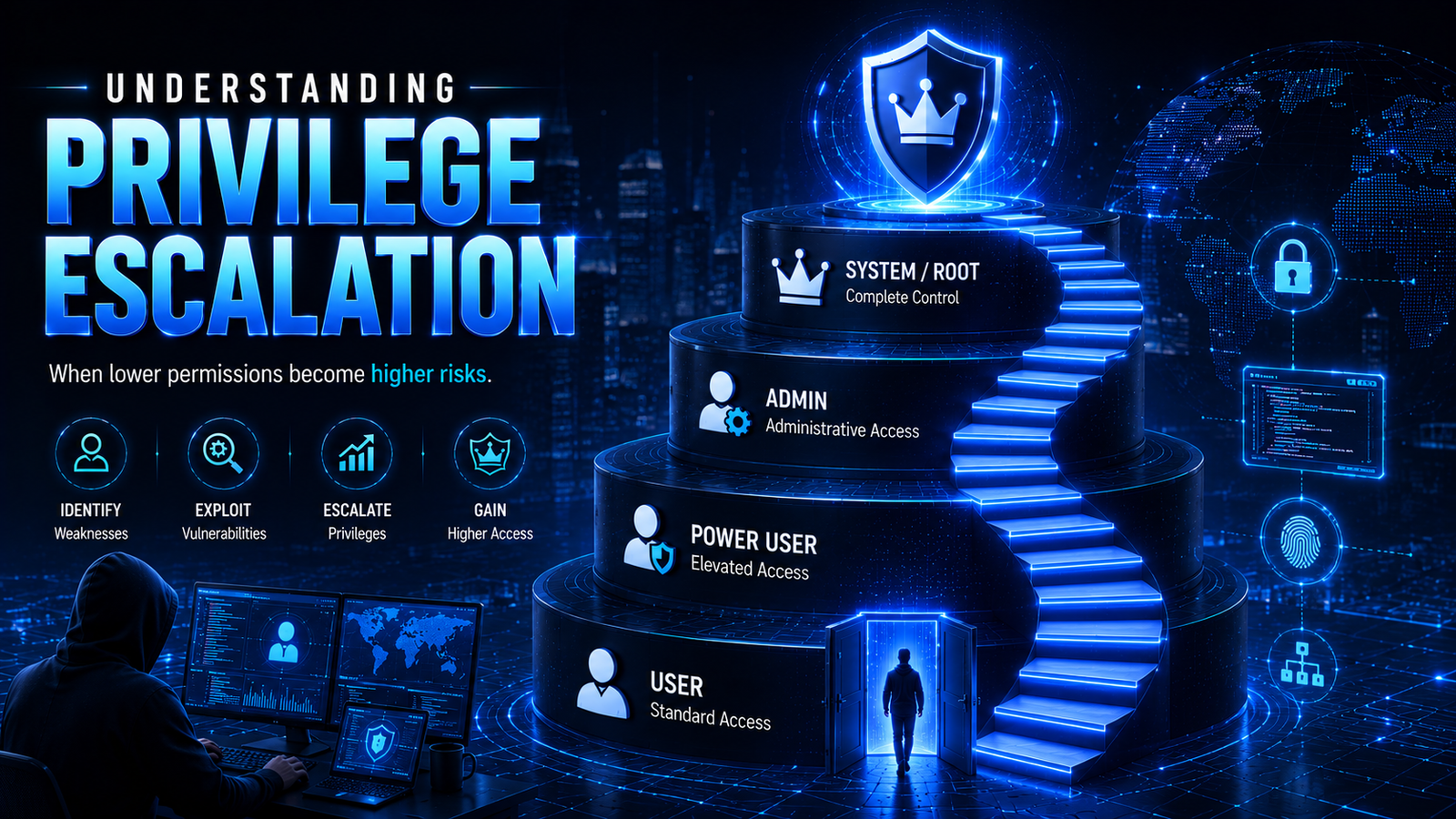
Privilege escalation is the process through which a user, process, application, or service obtains permissions or capabilities beyond those originally assigned to it. In cybersecurity, it represents a breach or bypass of an intended privilege boundary, allowing an entity to perform actions that should require a higher or different level of authorization.
Every identity or process operates within a defined security context. This context determines which resources it can access and which operations it can perform. A standard user, for example, may be authorized to use applications and access permitted information but may not be allowed to modify protected system settings or manage other users.
Privilege escalation occurs when a vulnerability, misconfiguration, excessive permission, compromised credential, or other security weakness allows that security context to be expanded or changed.
Privilege Escalation in the Cyber Attack Lifecycle
A cyber attack can be understood as a series of activities through which an attacker identifies a target, gains access, establishes control, expands their capabilities, and attempts to achieve an intended objective. The exact activities and their order can vary between attacks, but a lifecycle provides a useful conceptual framework for understanding how an attack progresses.
Cyber Attack Life Cycle
A Cyber Attack Life Cycle describes the progression of an attack from the initial planning and information gathering through gaining access, expanding control, accessing or manipulating resources, and ultimately achieving the attacker’s objective. It provides a conceptual view of the different activities that may take place during an attack and helps explain how one activity can enable or support another.
A typical cyber attack lifecycle can be represented through the following phases:
- Reconnaissance – The attacker gathers information about the target, including users, systems, applications, services, and potential weaknesses.
- Initial Access – The attacker obtains an initial foothold in the target environment through a compromised account, vulnerability, exposed service, or another means.
- Execution – The attacker executes code, commands, or other actions within the compromised environment.
- Persistence – The attacker establishes a means of maintaining access to the target environment over time.
- Privilege Escalation – The attacker attempts to obtain privileges beyond those available through the initial access.
- Credential Access – The attacker seeks credentials, authentication information, tokens, or other authentication material that may provide access to additional resources.
- Discovery – The attacker identifies systems, users, applications, services, data, and other resources within the target environment.
- Lateral Movement – The attacker attempts to extend access from the initially compromised system or account to additional systems or resources.
- Collection – The attacker gathers information of interest from the target environment.
- Command and Control (C2) – The attacker establishes and maintains communication with compromised systems to coordinate and control further activities.
- Exfiltration – The attacker transfers collected information outside the target environment when data theft is part of the objective.
- Impact – The attacker carries out activities intended to affect systems, information, or business operations, including disruption, manipulation, destruction, or other forms of damage.
Where Privilege Escalation Comes In
In this conceptual lifecycle, privilege escalation comes after persistence. By this point, an attacker may have obtained initial access and established continued access to the target environment, but the privileges associated with that access may still be insufficient for the intended objective.
The attacker may encounter restrictions that prevent access to protected resources, administrative functions, security-sensitive configurations, or other privileged operations. Privilege escalation becomes relevant when the attacker attempts to overcome these restrictions by obtaining greater authority.
The attacker may seek greater authority through a vulnerability, misconfiguration, excessive permission, compromised credential, or another security weakness that provides an opportunity to cross an existing privilege boundary.
The lifecycle should not be interpreted as a rigid sequence. Attackers may move between activities, repeat certain activities, or perform them concurrently. Privilege escalation may also occur more than once as an attacker encounters additional privilege boundaries during an intrusion.
Why Privilege Escalation Is Required
Initial access does not necessarily provide the level of authority required to achieve an attacker’s objective. A compromised account, process, application, or service may operate with limited permissions and therefore be unable to perform certain activities.
For example, a standard user account may provide access to permitted applications and information while preventing the modification of protected configurations, control of privileged services, access to restricted resources, or management of other accounts.
Privilege escalation is therefore an enabling activity that can provide the additional authority required for subsequent activities. Depending on the attack, elevated privileges may support credential access, discovery, persistence, lateral movement, access to sensitive information, or actions affecting critical systems.
Escalation is not always required. If the initial access already provides sufficient privileges for the attacker’s objective, there may be no need to obtain additional authority.
Types of Privilege Escalation
Privilege escalation can broadly be classified according to the direction in which unauthorized access or authority is obtained.
Vertical Privilege Escalation
Vertical privilege escalation occurs when an entity obtains privileges associated with a higher level of authority than its original privilege level.
For example, a standard user gaining administrative capabilities represents vertical privilege escalation. The defining characteristic is an increase in authority from a lower privilege level to a higher one.
Vertical escalation can occur in operating systems, applications, cloud environments, databases, and other technologies where different levels of authority are defined.
Horizontal Privilege Escalation
Horizontal privilege escalation occurs when an entity obtains unauthorized access to resources or functions belonging to another entity at a similar privilege level.
For example, a user who is authorized to access their own account information should not be able to access another user’s account information merely because both users have the same general role. If such access is possible without authorization, the application or system has failed to properly enforce the boundary between those users.
Unlike vertical escalation, horizontal escalation does not necessarily involve gaining a higher level of privilege. Instead, it involves expanding access beyond the resources originally authorized to the entity.
The distinction between vertical and horizontal privilege escalation helps establish whether an unauthorized access event involves an increase in privilege or an expansion of access within the same general privilege level.
Understanding Privileges and Access
Privilege escalation is closely related to the way authority and access are assigned to identities, processes, applications, and services. Understanding these concepts helps explain how privilege boundaries are established and how they can be violated.
Privilege and Access Levels
Privileges represent the authority granted to an identity, process, application, or service. The level of authority depends on its role, responsibilities, and the resources or operations it is authorized to access.
Different environments can implement different levels and scopes of privilege. These may range from ordinary user access to administrative or otherwise highly privileged access.
The specific privilege structure depends on the technology and its access-control model. What constitutes privileged access in an operating system may differ from privileged access in an application, database, cloud environment, or enterprise identity system.
The important principle is that privileges should correspond to legitimate business or technical requirements. When an entity obtains capabilities beyond its authorized level, the additional authority can create a privilege-escalation risk.
Privilege Boundary
A privilege boundary separates different levels or scopes of authority within a system or environment.
For example, an application may allow a normal user to view their own information while restricting administrative functions to authorized administrators. The controls separating these capabilities form part of the privilege boundary.
Privilege escalation occurs when an attacker or unauthorized entity is able to cross such a boundary.
Privilege boundaries may exist between a normal user and an administrator, between different application roles, between limited and highly privileged cloud identities, between service accounts and privileged accounts, or between users and protected system resources.
The effectiveness of these boundaries depends on the proper implementation of authentication, authorization, access controls, configuration, and other security mechanisms.
How Privilege Escalation Occurs
Privilege escalation can occur when a security weakness allows an entity to obtain authority beyond what was originally intended.
Vulnerabilities
Software and system vulnerabilities can allow an attacker to obtain privileges that should not be available to the compromised account, process, or application.
Misconfigurations
Incorrect security configurations can create unintended paths to greater privileges. Examples include overly permissive permissions, insecure services, or incorrectly configured administrative functions.
Excessive Privileges
Users, applications, and services may be assigned more privileges than necessary for their intended functions. Excessive privileges increase the potential impact of a compromise and can make unauthorized privilege expansion easier.
Weak Access Controls
Poorly implemented authorization controls can allow users or applications to access functions or resources beyond their intended permissions.
Credential and Token Abuse
Compromised credentials, authentication tokens, or other authentication material associated with privileged identities can provide access to a higher level of authority.
Insecure Applications and Services
Applications and services may contain weaknesses in authentication, authorization, configuration, or privilege handling that allow unauthorized users or processes to obtain additional capabilities.
Privilege Escalation Across Technology Environments
Privilege escalation is not limited to a particular technology. The underlying concept applies wherever different levels of authority and access are enforced.
Operating Systems
Operating systems implement privilege boundaries between users, processes, services, and protected system functions. Weaknesses in these controls can allow unauthorized elevation of authority.
Platform-specific privilege escalation techniques for Windows and Linux are addressed separately.
Applications
Applications commonly implement roles and permissions that determine which users can access particular functions and resources. Weak authorization controls can allow users to obtain access beyond their assigned role.
Databases
Database environments use accounts, roles, permissions, and other controls to restrict access to data and administrative functions. Excessive privileges or weaknesses in these controls can create escalation opportunities.
Directory Services
Directory services manage identities, groups, roles, and permissions across enterprise environments. Improper privilege assignments or weaknesses in identity relationships can result in unauthorized elevation of access.
Cloud Environments
Cloud platforms use identities, roles, policies, and permissions to control access to resources and management functions. Misconfigured or excessive permissions can create privilege-escalation paths.
Containers and Virtualization
Containers and virtualized environments introduce additional privilege boundaries between workloads, hosts, management components, and users. Weak isolation or excessive permissions can increase the risk of unauthorized privilege expansion.
Network and Infrastructure Devices
Network and infrastructure devices commonly provide different administrative roles and levels of access. Weak credentials, excessive permissions, or configuration weaknesses can allow unauthorized access to higher-privileged functions.
Privilege Escalation in Ethical Hacking
In ethical hacking, privilege escalation is assessed within an explicitly authorized scope to determine whether an attacker with an existing foothold could obtain greater privileges.
Identifying the Initial Privilege Level
The assessment begins by determining the permissions and security context associated with the authorized access.
Identifying Privilege Boundaries
The tester identifies the controls that separate the existing level of access from more privileged resources and functions.
Assessing Escalation Opportunities
The assessment considers whether vulnerabilities, misconfigurations, excessive permissions, weak authorization, or other weaknesses could allow those boundaries to be crossed.
Validating Security Impact
Where an escalation weakness is identified, the tester evaluates its potential impact and determines what additional resources or capabilities could become accessible.
Reporting Findings
The finding should document the affected asset or control, the nature of the privilege boundary, the security weakness, its potential impact, and appropriate remediation recommendations.
Ethical hacking assessments should remain within the agreed scope and avoid unnecessary disruption or access to unrelated resources.
Privilege Escalation and Access Management
Privilege escalation is closely related to how organizations assign, manage, review, and protect access.
Least Privilege
The principle of least privilege requires users, processes, applications, and services to receive only the permissions necessary to perform their authorized functions.
Access Control Models
Access-control models provide different approaches for determining who or what can access particular resources. Models such as discretionary, mandatory, role-based, rule-based, and attribute-based access control can be used to establish and enforce privilege boundaries.
Privilege Creep
Privilege creep occurs when an identity accumulates permissions over time that are no longer required. Role changes, transfers, new responsibilities, and inadequate access reviews can contribute to excessive privileges.
Service Accounts
Service accounts are often required for applications and automated processes, but excessive privileges assigned to them can create significant security risks. Their permissions should be limited to the functions they need to perform and reviewed periodically.
Privileged Access Management
Privileged Access Management (PAM) provides controls for managing privileged accounts and access. Depending on the environment, PAM may include credential protection, controlled privilege elevation, privileged-session monitoring, approval mechanisms, and auditing.
Detecting, Preventing, and Responding to Privilege Escalation
Effective protection requires organizations to prevent unauthorized privilege changes, identify suspicious activity, and respond appropriately when escalation occurs.
Detection and Monitoring
Monitoring should identify significant changes to privileges, administrative group membership, roles, permissions, privileged sessions, authentication activity, and security-sensitive configurations.
Preventive Controls
Preventive measures include least privilege, strong authentication, secure configuration, vulnerability management, access reviews, separation of duties, and appropriate authorization controls.
Privileged Account Protection
Privileged accounts should receive stronger controls than ordinary accounts. Organizations can use dedicated administrative accounts, multi-factor authentication, controlled elevation, privileged access management, and regular access reviews.
Incident Response
When unauthorized privilege escalation is detected, security teams should investigate the activity, determine its scope, contain affected accounts or systems, preserve relevant evidence, remove unauthorized access, and address the underlying weakness.
Risk and Impact
The significance of privilege escalation depends on the level of authority obtained and the resources that become accessible.
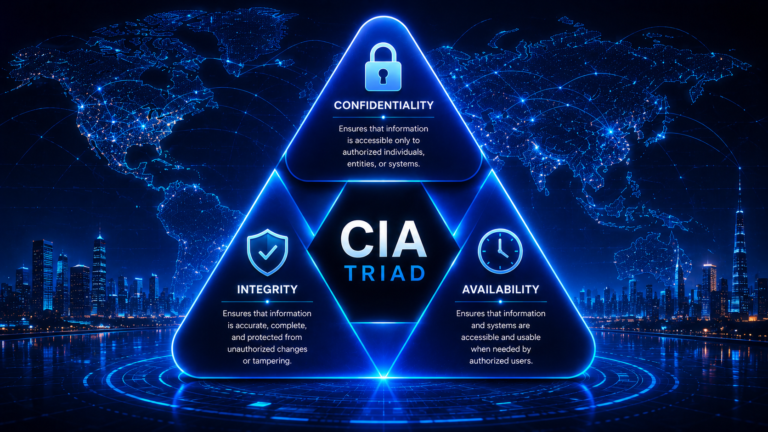
Confidentiality
Elevated privileges may provide access to information that was previously protected from the compromised account or process.
Integrity
Greater authority may allow an attacker to modify configurations, applications, data, or security controls.
Availability
Privileged access may provide capabilities that can disrupt services, disable systems, or affect critical operations.
Data and System Access
Privilege escalation can expand access to sensitive information, administrative functions, infrastructure components, and other protected resources.
Lateral Movement and Further Attack Activity
Higher privileges can make it easier for an attacker to access additional systems or accounts and continue the intrusion across the environment.
Conclusion
Privilege escalation represents an unauthorized expansion of authority beyond the privileges originally assigned to an identity, process, application, or service. It commonly becomes relevant when initial access provides insufficient authority for an attacker’s intended activities.
Understanding privilege boundaries, the different forms of escalation, the weaknesses that can enable it, and the controls used to prevent and detect it is important for both ethical hackers and defenders. Effective access management, least privilege, privileged-access controls, secure configuration, monitoring, and timely response can reduce the opportunity and potential impact of privilege escalation.
References
MITRE – Privilege Escalation – Tactic TA0004
Defines privilege escalation as obtaining higher-level permissions and documents the techniques adversaries use to achieve it.
NIST – Least Privilege – CSRC Glossary
Defines least privilege as restricting users and processes to the minimum access privileges necessary to perform their assigned tasks.
MITRE – Exploitation for Privilege Escalation – T1068
Describes exploitation of software and system vulnerabilities as a means of obtaining higher-level privileges.
MITRE – Abuse Elevation Control Mechanism – T1548
Documents techniques for circumventing mechanisms designed to control privilege elevation across supported technology environments.
MITRE – Valid Accounts – T1078
Explains how adversaries may abuse legitimate accounts and associated permissions to obtain or extend access within an environment.