Linux Enumeration
Introduction
Linux Enumeration is the systematic process of gathering detailed information about a Linux-based target during the Reconnaissance stage of the Cyber Attack Lifecycle. It helps establish what a target exposes through its hosts, services, applications, protocols, and externally accessible interfaces.
Enumeration goes beyond identifying that a Linux host exists. It attempts to understand what services are available, what technologies they use, what information they disclose, and what additional characteristics can be learned from those services.
Enumeration can be performed using information that is already publicly available or through direct interaction with an authorized target.
Cyber Attack Lifecycle
A Cyber Attack Lifecycle is a structured model that describes the different phases an attacker may progress through during a cyber attack, from gathering information about a target to achieving the intended objective or impact.
The lifecycle helps security professionals understand how an attack can develop across multiple stages and where security controls can be applied to prevent, detect, or respond to attack activity.
The following are the phases of the Cyber Attack Lifecycle:
| Phase | Description |
|---|---|
| Reconnaissance | Gathering information about the target and its externally observable attack surface. |
| Initial Access | Obtaining an initial foothold in the target environment. |
| Execution | Executing commands, code, or other actions within the environment. |
| Persistence | Maintaining access to the environment. |
| Privilege Escalation | Obtaining higher levels of access or permissions. |
| Credential Access | Obtaining credentials or authentication-related information. |
| Discovery | Gathering information about systems, accounts, resources, and the internal environment. |
| Lateral Movement | Moving from one system or environment to another. |
| Collection | Gathering information or data of interest. |
| Command and Control (C2) | Establishing or maintaining communication with compromised systems. |
| Exfiltration | Transferring collected data out of the target environment. |
| Impact | Performing actions intended to disrupt, damage, manipulate, or otherwise affect the target. |
Enumeration as Part of Reconnaissance
Reconnaissance is the initial part of the Cyber Attack Lifecycle in which information about a target is gathered before subsequent attack activity.
Reconnaissance can be broadly understood through three sub-phases:
Footprinting
Footprinting establishes a broad profile of the target using publicly available information such as domains, IP addresses, DNS records, websites, certificates, and other externally available information.
Scanning
Scanning examines identified infrastructure to determine reachable hosts, open ports, and accessible network services.
Enumeration
Enumeration goes deeper into identified hosts and services to gather more detailed information about service types, implementations, versions, applications, protocols, and other technical characteristics.
What Is Enumeration?
Enumeration is the systematic process of gathering detailed information about a target from available sources and exposed interfaces. It builds upon information identified during Reconnaissance and helps develop a more detailed understanding of the target’s technical attack surface.
During an authorized Vulnerability Assessment or Penetration Testing (VA/PT) engagement, enumeration is performed with the appropriate authorization, consent, and defined scope of the target owner. It helps security professionals identify exposed information and services and evaluate the security implications of that exposure.
In a real-world cyber attack, attackers may also perform enumeration after identifying a target and its infrastructure. The information gathered can help them understand the target in greater detail and identify potential opportunities for subsequent attack activity.
Enumeration therefore has different purposes depending on the context. In authorized security testing, it supports security assessment and evaluation. In a real-world attack, it may support target profiling and subsequent attack activity.
Types of Enumeration
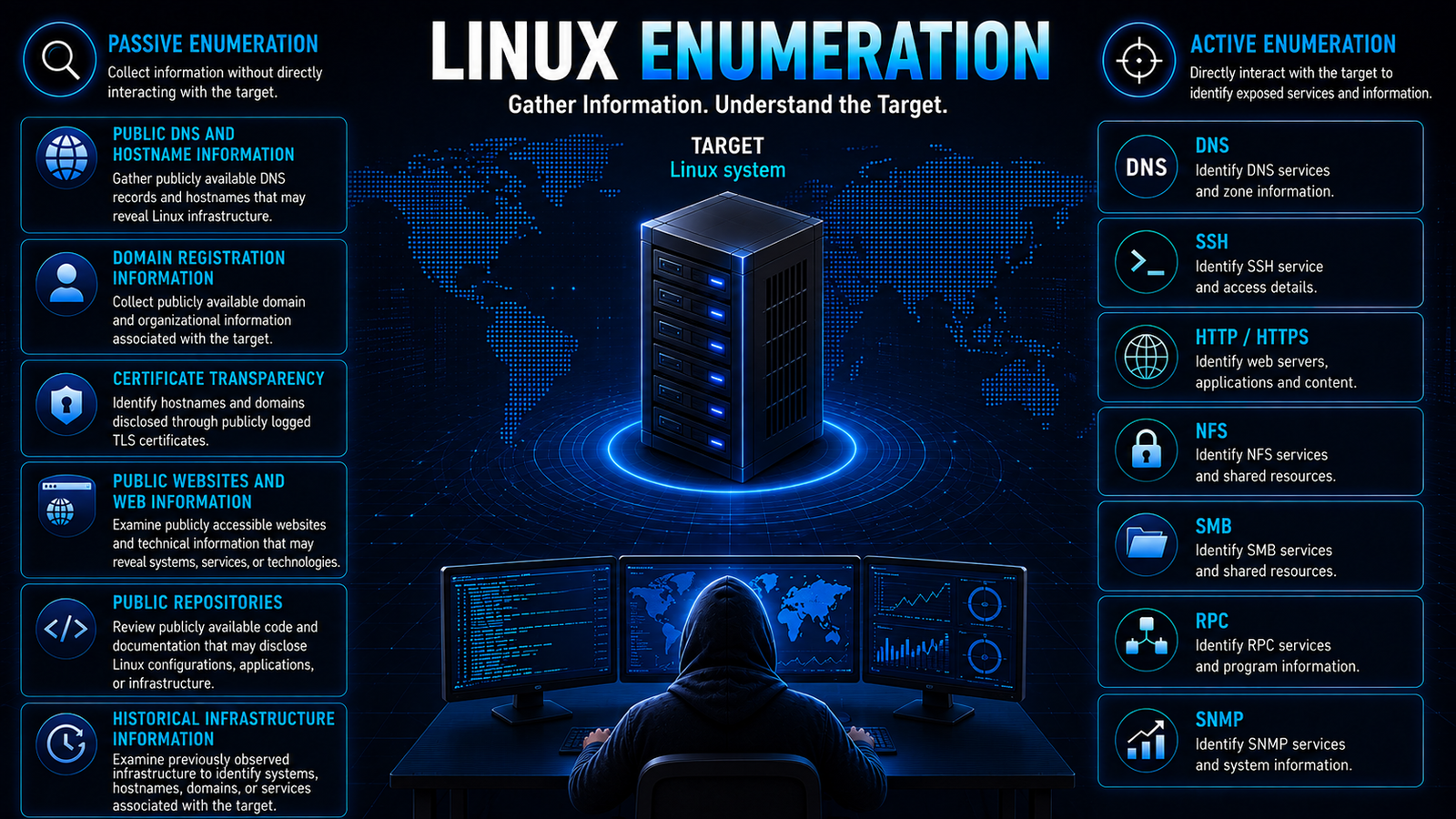
Enumeration can broadly be categorized into:
- Passive Enumeration
- Active Enumeration
Passive Enumeration
Passive Enumeration gathers information from publicly available or previously collected sources without directly probing the target’s infrastructure.
Examples include:
- Public DNS information
- Domain registration information
- Certificate Transparency records
- Public websites
- Public repositories
- Technical documentation
- Historical infrastructure information
- Publicly discoverable subdomains
Active Enumeration
Active Enumeration involves directly interacting with an authorized target host or its exposed services to gather additional information.
Examples include:
- Identifying accessible ports
- Identifying services
- Determining service implementations and versions
- Examining web services
- Querying DNS services
- Examining SNMP services
- Identifying NFS services
- Mapping RPC services
- Examining externally observable security configurations
What Is Linux Enumeration?
Linux Enumeration applies the broader concept of enumeration specifically to Linux-based targets. It is the process of systematically gathering information about a Linux host and the systems, services, applications, protocols, and resources associated with it.
A strong understanding of Linux Fundamentals is critical for performing effective enumeration, because interpreting enumeration results requires familiarity with Linux users and groups, permissions, processes, filesystems, services, networking, packages, configuration files, and system architecture.
Enumeration can begin with information that is publicly available about Linux infrastructure and continue with information disclosed by services that are directly accessible from an authorized assessment environment.
Linux Enumeration may involve identifying:
- Whether a target is running Linux
- Possible Linux distribution and version characteristics
- Hostnames and IP addresses
- Open and accessible services
- Service implementations and versions
- SSH services
- Web services
- DNS infrastructure
- SNMP services
- NFS services
- RPC services
- Applications hosted on the system
- Authentication mechanisms exposed by services
- Network resources
- Externally observable security characteristics
- Information unnecessarily disclosed by the Linux environment
The depth of information available depends on the target’s configuration, exposed services, and security controls.
Linux Enumeration can be categorized into Passive Linux Enumeration and Active Linux Enumeration.
Passive Linux Enumeration
Passive Linux Enumeration gathers information about Linux infrastructure from publicly available or previously collected sources without directly probing the target’s infrastructure.
Public DNS and Hostname Information
Public DNS information can reveal hostnames, IP addresses, name servers, mail servers, aliases, and other records associated with infrastructure. Hostnames may also provide clues about the role of individual systems.
dig, nslookup, and WHOIS are long-established tools that can be used to obtain publicly available DNS and hostname information.
For example, the dig command can retrieve a publicly available DNS record:
alice@linux-vapt:~$ dig example.com A

;; ANSWER SECTION:
example.com.        300     IN      A       203.0.113.20
The classification of DNS activity depends on how the query is performed. Retrieving publicly available DNS information without directly probing the target’s host or service infrastructure can be treated as passive from the target-assessment perspective.
Public DNS information may reveal hostnames such as:
web01.example.com
mail01.example.com
vpn01.example.com
git01.example.com
These names can provide an initial indication of the systems and services associated with the target.
Domain Registration Information
Domain registration information can provide publicly available details about a domain, including its registrar, name servers, and registration-related information.
WHOIS is a long-established method for obtaining publicly available domain registration information.
alice@linux-vapt:~$ whois example.com

Domain Name: EXAMPLE.COM
Registrar: Example Registrar
Name Server: NS1.EXAMPLE.COM
Name Server: NS2.EXAMPLE.COM
The information available depends on the domain registry, registrar, privacy settings, and applicable registration policies.
Certificate Transparency
Certificate Transparency records can reveal hostnames that have appeared in publicly logged TLS certificates. This can expose additional hostnames associated with an organization’s infrastructure.
crt.sh can be used to search publicly available Certificate Transparency records.
For example, a search may reveal:
example.com
www.example.com
api.example.com
vpn.example.com
These hostnames can provide additional information about externally visible infrastructure without directly connecting to the identified systems.
Public Websites and Technical Information
Public websites, technical documentation, job postings, architecture information, and other published material can reveal technologies and infrastructure used by an organization.
Google, Bing, and Netcraft can be used to gather publicly available information about technologies and Internet-facing infrastructure.
For example, publicly available information may indicate:
Ubuntu
Nginx
Docker
PostgreSQL
This provides useful context about the technology environment but does not establish that a particular production server currently uses those technologies.
Public Repositories and Documentation
Public repositories and documentation may contain deployment information, configuration examples, Dockerfiles, infrastructure-as-code, scripts, and other technical material that reveals Linux-related technologies.
GitHub and GitLab are commonly used sources for publicly available repositories and technical documentation.
For example, publicly available material may contain references such as:
/etc/nginx/
systemd
Ubuntu Server
Docker
This information can provide insight into the technology environment without directly interacting with the production Linux host.
Historical Infrastructure Information
Historical infrastructure information can reveal systems, hostnames, IP addresses, technologies, or services that were previously associated with an organization.
Netcraft can provide information about previously observed Internet infrastructure and technologies associated with websites.
For example, historical information may identify:
old-vpn.example.com
legacy-api.example.com
mail01.example.com
203.0.113.25
Such information can provide context about infrastructure that may have changed or been retired.
Public Subdomain Information
Public subdomain information can reveal additional hosts and services associated with a domain. Subdomain names may also provide clues about the function of individual systems.
crt.sh, DNS search services, and search engines can be used to identify publicly discoverable subdomains.
For example:
www.example.com
api.example.com
git.example.com
vpn.example.com
mail.example.com
These names can help build an understanding of the organization’s externally visible infrastructure and may guide subsequent authorized active enumeration.
Active Linux Enumeration
Active Linux Enumeration gathers information by directly interacting with an authorized Linux host and its exposed services.
Host and Operating System Enumeration
Nmap can be used to examine a host and make a probabilistic assessment of its operating-system characteristics.
alice@linux-vapt:~$ nmap -O linux-server

Starting Nmap 7.95

Nmap scan report for linux-server
Host is up.

Device type: general purpose
Running: Linux 5.X
OS details: Linux 5.4 - 6.5
Network Distance: 1 hop
Operating-system detection is probabilistic and should be treated as an indication rather than absolute proof of the operating system.
Port and Service Enumeration
Nmap can identify accessible ports and determine the services associated with those ports.
alice@linux-vapt:~$ nmap -sV linux-server

Starting Nmap 7.95

Nmap scan report for linux-server
Host is up.

PORT    STATE SERVICE VERSION
22/tcp  open  ssh     OpenSSH 9.6
80/tcp  open  http    nginx 1.24.0
443/tcp open  https   nginx 1.24.0
This information helps establish which network services are externally accessible.
Service Version Enumeration
Nmap can collect service implementation and version information from exposed services.
alice@linux-vapt:~$ nmap -sV -p 22 linux-server

PORT   STATE SERVICE VERSION
22/tcp open  ssh     OpenSSH 9.6p1 Ubuntu 3ubuntu13
A disclosed version should not automatically be treated as evidence of a vulnerability. Patch levels, backported fixes, configuration, and other factors must also be considered.
SSH Enumeration
SSH is one of the most common remote-access services found on Linux systems.
Nmap can identify the SSH implementation and version exposed by a host.
alice@linux-vapt:~$ nmap -sV -p 22 linux-server

PORT   STATE SERVICE VERSION
22/tcp open  ssh     OpenSSH 9.6p1 Ubuntu 3ubuntu13
SSH enumeration can provide information about:
- SSH implementation
- Version
- Protocol characteristics
- Authentication mechanisms
- Cryptographic capabilities
The objective during an authorized assessment is to understand the externally exposed SSH service rather than attempt unauthorized authentication.
Web Service Enumeration
Web services hosted on Linux systems may disclose information about web servers, frameworks, applications, technologies, and other components.
WhatWeb can be used to identify technologies associated with an exposed web service.
alice@linux-vapt:~$ whatweb https://linux-server

https://linux-server [200 OK]
HTTPServer[Nginx]
HTML5
Title[Example Application]
This information can help identify the technologies exposed through the web service.
Application Enumeration
Applications hosted on Linux may expose information about application frameworks, technologies, APIs, authentication interfaces, and other components.
Nmap and WhatWeb can be used to identify characteristics of externally accessible applications.
alice@linux-vapt:~$ nmap -sV -p 80,443 linux-server

PORT    STATE SERVICE VERSION
80/tcp  open  http    nginx 1.24.0
443/tcp open  https   nginx 1.24.0
Application enumeration helps determine what software and technologies are exposed through the Linux host.
DNS Enumeration
DNS services can disclose host addresses, name servers, aliases, and other DNS records.
dig and nslookup can be used to query DNS services during authorized enumeration.
C:\Users\pentest>nslookup linux-server

Server:  dns.example.com
Address:  192.0.2.53

Name:    linux-server
Address: 203.0.113.20
The dig command can provide more detailed DNS information:
alice@linux-vapt:~$ dig linux-server.example.com A

;; ANSWER SECTION:
linux-server.example.com. 300 IN A 203.0.113.20
DNS Zone Enumeration
A DNS zone transfer can expose a large amount of DNS information when a DNS server is incorrectly configured to permit unauthorized transfers.
dig supports DNS zone-transfer queries using AXFR.
During an authorized assessment, a zone-transfer test can be performed against an approved DNS server:
alice@linux-vapt:~$ dig @ns1.example.com example.com AXFR

; Transfer failed.
A correctly restricted server may reject the request. If a zone transfer is permitted, the response may contain multiple DNS records.
SNMP Enumeration
SNMP can expose information about Linux systems and network infrastructure when it is enabled and insufficiently restricted.
snmpwalk can query accessible SNMP information during an authorized assessment.
alice@linux-vapt:~$ snmpwalk -v2c -c public linux-server

SNMPv2-MIB::sysName.0 = STRING: linux-server
SNMPv2-MIB::sysDescr.0 = STRING: Linux server
SNMPv2-MIB::sysLocation.0 = STRING: Data Center
The information available depends on the SNMP configuration and access permissions.
NFS Enumeration
NFS, or Network File System, is widely used in Linux and Unix environments to share filesystems across systems.
Nmap can be used to determine whether the standard NFS service port is exposed.
alice@linux-vapt:~$ nmap -p 2049 linux-server

PORT     STATE SERVICE
2049/tcp open  nfs
Further authorized NFS enumeration can determine what network file resources are exposed, subject to the target’s permissions and configuration.
RPC Enumeration
Linux environments may expose RPC services associated with NFS and other system services.
rpcinfo can identify RPC programs, versions, protocols, and associated ports.
alice@linux-vapt:~$ rpcinfo -p linux-server

program vers proto   port
100000    4   tcp    111
100003    4   tcp   2049
This information can help establish which RPC services are exposed by the Linux host.
Security Configuration Enumeration
Some security characteristics can be examined through externally observable behavior, including TLS configuration, supported protocols, security headers, authentication requirements, and exposed management interfaces.
Nmap and OpenSSL can be used to examine selected externally observable security characteristics.
For example:
alice@linux-vapt:~$ openssl s_client -connect linux-server:443 -servername linux-server

subject=CN=linux-server.example.com
issuer=CN=Example CA
Protocol  : TLSv1.3
Cipher    : TLS_AES_256_GCM_SHA384
Such information can help establish characteristics of the security configuration exposed by the Linux-hosted service.
Conclusion
Linux Enumeration is a focused Reconnaissance activity used to develop a detailed understanding of Linux-based targets. It examines information exposed through hosts, services, applications, protocols, DNS, authentication mechanisms, and other externally accessible interfaces.
Linux Enumeration can be categorized into Passive Linux Enumeration and Active Linux Enumeration. Passive techniques use publicly available information such as DNS records, domain information, certificates, repositories, documentation, and historical infrastructure. Active techniques directly examine authorized Linux hosts and their exposed services.
The distinction between passive and active enumeration depends on how information is obtained. Publicly available information can often be gathered without directly probing the target infrastructure, while active enumeration involves direct interaction with an authorized target or its exposed services.
For security professionals, enumeration helps identify and evaluate information exposure across Linux infrastructure. In real-world attacks, the same information may be used to develop a more detailed understanding of the target and identify potential opportunities for subsequent attack activity.
References
MITRE – Reconnaissance
Provides the Reconnaissance tactic and techniques used to gather information about targets before subsequent attack activity.
MITRE – Gather Victim Network Information, T1590
Covers techniques for gathering information about target network infrastructure, including domains, IP addresses, DNS information, and network details.
MITRE – Gather Victim Host Information, T1592
Covers techniques for gathering information about target hosts, including technical characteristics and software-related information.
Nmap – Nmap Reference Guide
Provides official documentation for host discovery, port scanning, service detection, version detection, and operating-system detection.