Understanding Clock Generator?
Introduction
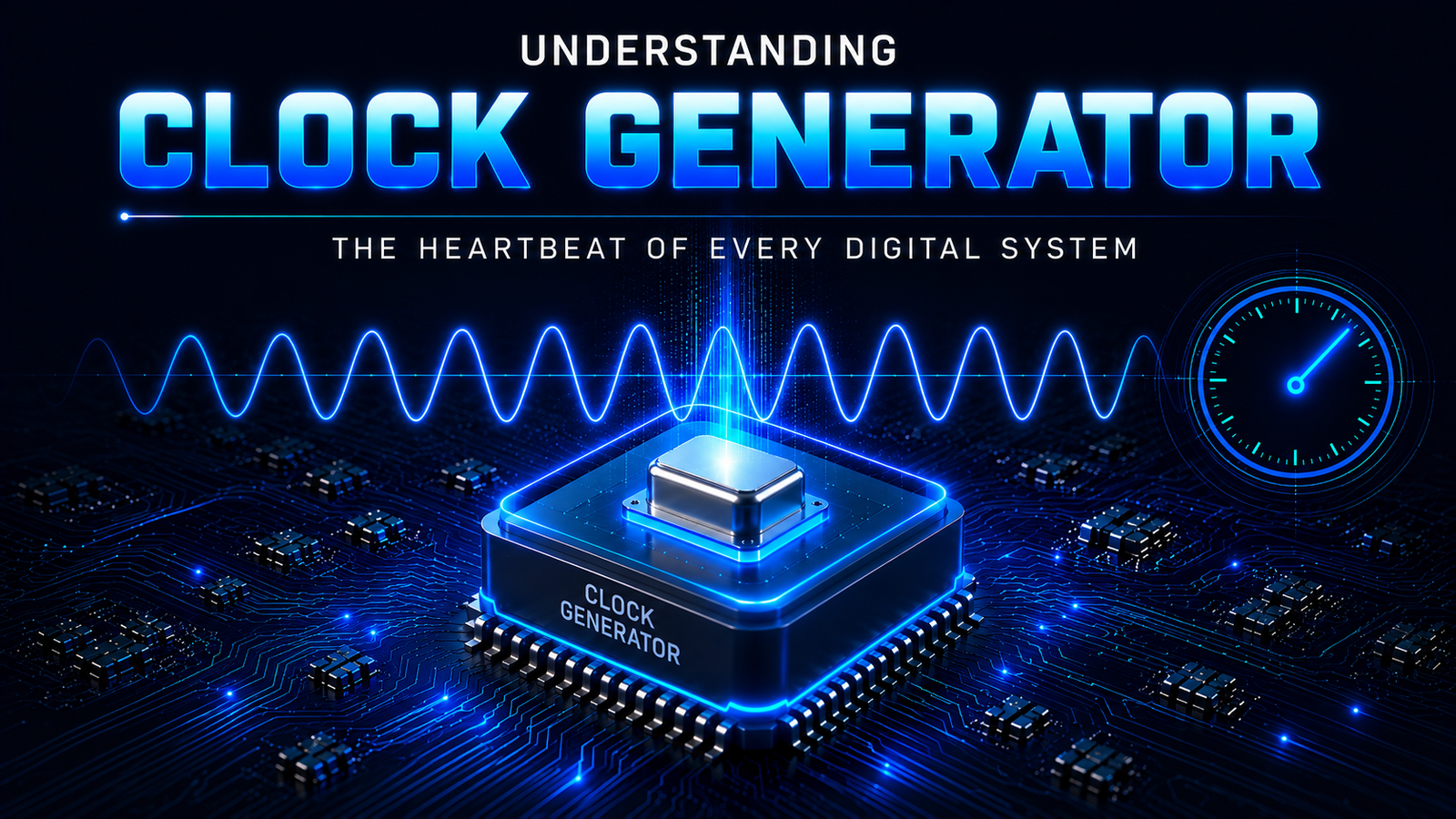
A clock generator is an electronic circuit or device that produces periodic electrical signals used to provide timing and synchronization for digital circuits. In computer systems, clock signals establish regular timing intervals that coordinate the operation of processors, memory, buses, and other digital components.
Clock generators can produce a clock signal directly or derive one or more clock signals from a reference frequency. A crystal oscillator is commonly used as a frequency reference because of the stable oscillation characteristics of piezoelectric materials such as quartz.
Clock Signal
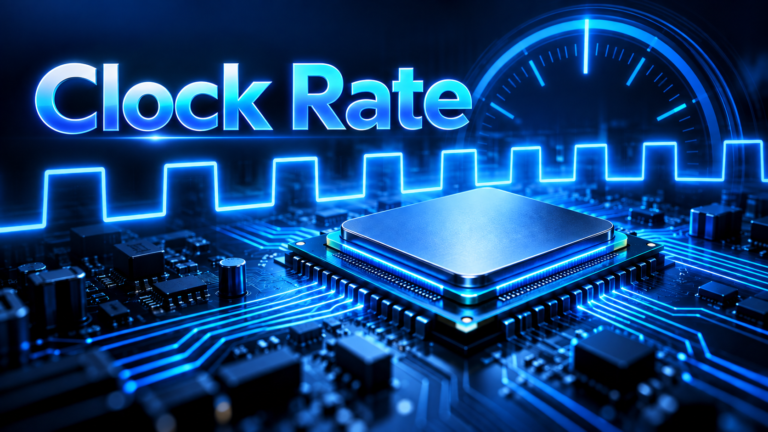
A clock signal is a periodic electrical signal that alternates between defined voltage levels. In digital systems, the transitions of the clock signal provide timing references for circuits that perform operations at specific points in the clock cycle.
A clock signal is commonly represented as a square wave, although the physical waveform produced by a clock circuit may differ depending on the circuit design and electrical characteristics.
The frequency of a clock signal determines how frequently its cycles occur and is commonly expressed in hertz (Hz). For example, a clock operating at 1 gigahertz (GHz) has one billion cycles per second.
Role of a Clock Generator
The primary role of a clock generator is to provide stable and appropriately timed clock signals to digital circuits. A computer system may require multiple clock signals with different frequencies or timing relationships for different components.
A clock generator can therefore perform functions such as generating a reference clock, producing multiple clock frequencies, dividing or multiplying a reference frequency, and maintaining defined timing relationships between clock signals.
Clock Generator Architecture and Operation
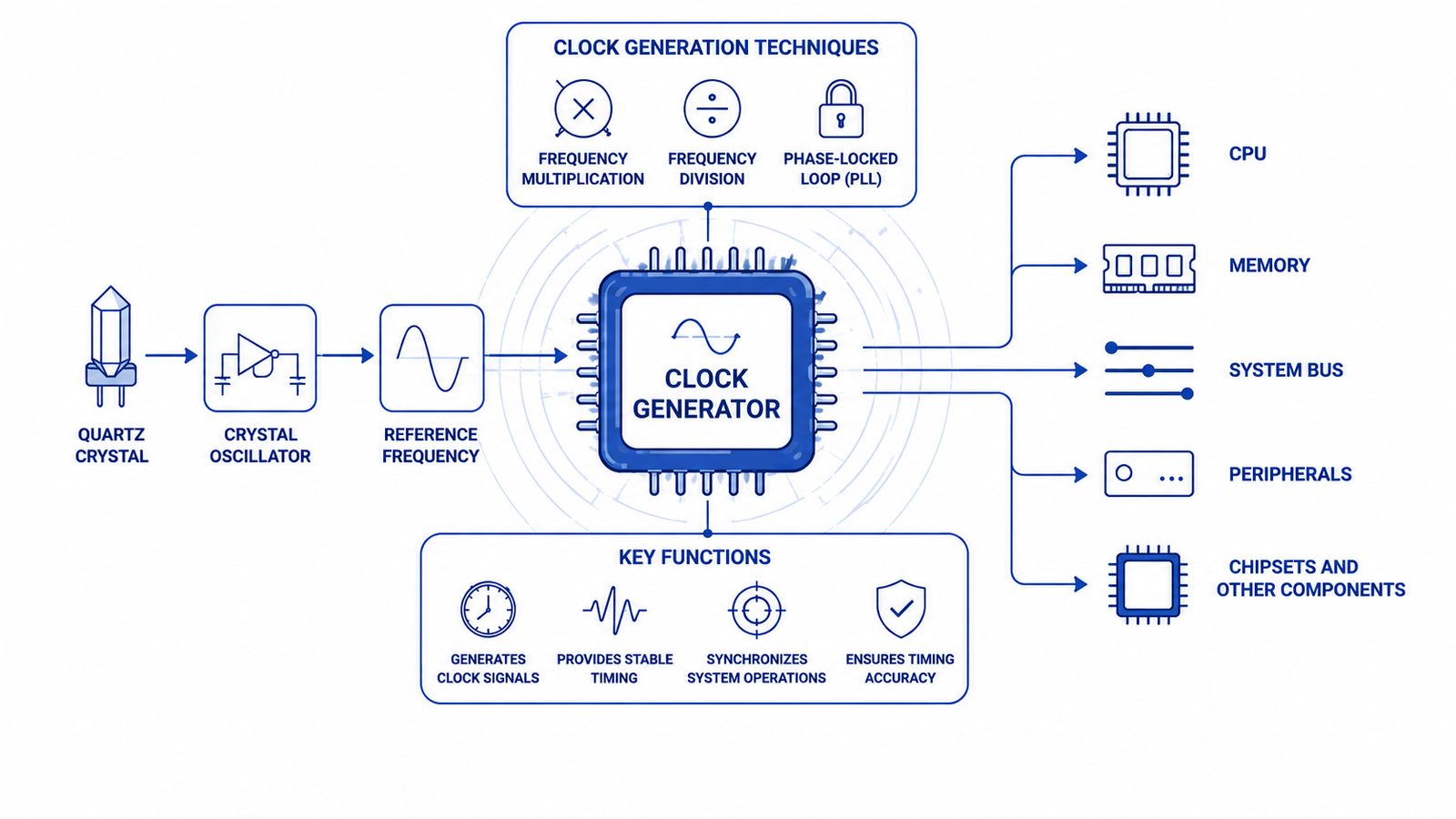
A clock generator typically receives a stable reference frequency and uses it to produce one or more clock signals required by different parts of a digital system. The reference may be provided by a crystal oscillator or another timing source, while additional circuits can modify the reference frequency through frequency multiplication, frequency division, or phase-locked loops (PLLs).
The generated clock signals may have different frequencies or defined timing relationships depending on the requirements of the system. These signals can be distributed to processors, memory, system buses, peripherals, chipsets, and other digital components to provide coordinated timing for their operations.
The architecture of a clock generator therefore involves both frequency generation and clock distribution. The reference source establishes the initial timing basis, the clock-generation circuitry produces the required frequencies, and the resulting clock signals are supplied to the components that depend on them.
Crystal Oscillator
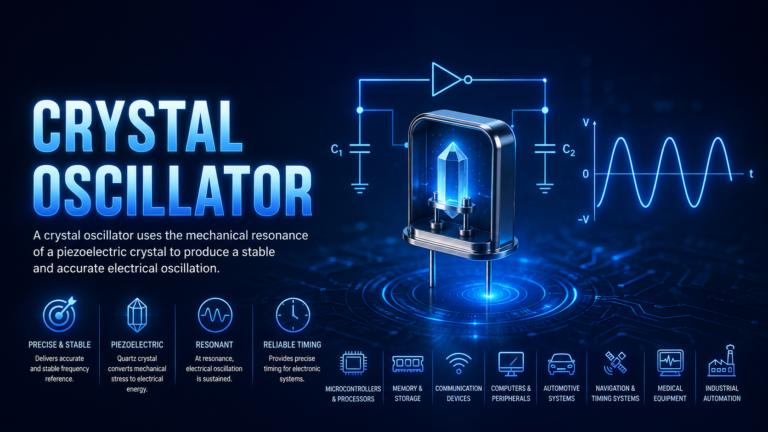
A crystal oscillator is an electronic oscillator that uses the mechanical resonance of a piezoelectric crystal to establish a stable oscillation frequency. Quartz is commonly used because its mechanical properties and ability to exhibit piezoelectricity allow it to provide a predictable and relatively stable frequency reference.
When an alternating electrical signal is applied to a suitable quartz crystal, the crystal undergoes mechanical vibration. At a characteristic resonant frequency, the interaction between the electrical and mechanical properties of the crystal supports stable oscillation.
The piezoelectricity of quartz is therefore important in many timing and frequency-control applications.
Clock Generation Using a Reference Frequency
A clock generator can use a reference frequency to produce the clock signals required by a digital system. The reference may come from a crystal oscillator, another oscillator, or an external timing source.
The generator can process the reference signal to obtain different output frequencies. Depending on its design, it may use frequency multiplication, frequency division, or other forms of clock synthesis.
For example, a reference frequency can be multiplied to produce a higher-frequency clock or divided to produce a lower-frequency clock.
Phase-Locked Loop
A phase-locked loop (PLL) is commonly used in clock-generation and frequency-synthesis circuits. A PLL is a feedback system that adjusts an oscillator so that its output maintains a defined phase and frequency relationship with a reference signal.
In computer systems, PLL-based circuits can generate clock frequencies that differ from the original reference frequency while maintaining a controlled timing relationship.
A simplified PLL-based clock-generation system may contain a reference clock, phase detector, loop filter, voltage-controlled oscillator, and frequency-divider components.
Clock Multiplication and Division
Clock generators can modify the frequency of a reference signal to produce the frequencies required by different parts of a system.
Clock multiplication produces an output frequency higher than the reference frequency. This is commonly used when a processor or another component requires a higher operating frequency than the available reference clock.
Clock division produces a lower-frequency output by reducing the number of clock cycles relative to the reference signal. This can be used for components that operate at lower frequencies.
These techniques allow different parts of a digital system to operate using clock frequencies appropriate to their design.
Clock Distribution
Generating a clock signal is only one part of a computer’s timing system. The signal must also be distributed to the circuits that use it.
Clock-distribution networks are designed to deliver clock signals with controlled timing characteristics. Differences in the arrival time of a clock signal at different components can introduce clock skew, which can affect the timing of synchronous digital circuits.
The design of clock-distribution networks therefore considers factors such as signal propagation, load, delay, power consumption, and timing relationships.
Clock Frequency
Clock frequency describes the number of complete clock cycles occurring per second. It is measured in hertz.
Common units include:
- Kilohertz (kHz) — one thousand cycles per second.
- Megahertz (MHz) — one million cycles per second.
- Gigahertz (GHz) — one billion cycles per second.
Clock frequency is one factor that influences the operating speed of digital circuits, but it does not by itself determine overall computer performance. Architecture, instruction execution, memory behavior, parallelism, cache design, and other factors also influence system performance.
Clock Generators in Computer Systems
Computer systems can contain several timing domains operating at different frequencies. A clock generator or related clock-generation circuitry can provide the required signals for processors, memory interfaces, buses, storage interfaces, communication circuits, and other components.
Modern systems may therefore use multiple related clocks rather than relying on a single clock signal for every component. Clock-generation circuits can establish the frequencies and timing relationships required by these different domains.
Clock Generator and CPU Synchronization
The CPU contains many synchronous digital circuits whose operations depend on defined timing relationships. Clock signals provide the timing reference that allows sequential logic elements to change state in a coordinated manner.
At each relevant clock transition, processor circuits can capture data, update internal states, and initiate subsequent operations according to their design. The clock therefore provides a common timing reference rather than directly controlling the logical function of every CPU operation.
Clock Generator and Crystal Oscillator
A crystal oscillator and a clock generator are related but distinct concepts.
A crystal oscillator provides a stable oscillating frequency using the resonant properties of a piezoelectric crystal. A clock generator uses a reference frequency to produce one or more clock signals with the required frequency and timing characteristics.
In some systems, these functions may be integrated into a single device or subsystem. In other systems, the crystal oscillator and clock-generation circuitry are separate components.
Importance of Timing in Digital Systems
Digital circuits require controlled timing because signals must be available at appropriate points during the operation of sequential logic. Clock signals provide a predictable timing reference that helps coordinate these operations.
Without suitable timing relationships, digital circuits can experience incorrect data capture, timing violations, synchronization problems, or unstable behavior. Clock-generation and clock-distribution circuits are therefore important parts of digital system design.
Conclusion
A clock generator is an electronic circuit or device that produces periodic clock signals for timing and synchronization in digital systems. It can use a stable reference such as a crystal oscillator and may employ techniques such as frequency multiplication, frequency division, and phase-locked loops to generate the required clock signals. In computer systems, clock-generation and distribution circuitry provides the timing framework that coordinates the operation of processors and other synchronous digital components.
References
References
NIST – SI Units – Time
Provides information on the hertz (Hz) as the SI unit of frequency and its relationship to cycles per second.
Intel – Intel® 64 and IA-32 Architectures Software Developer’s Manual
Provides technical documentation on Intel processor architecture and the processor environment in which clock and timing concepts are relevant.