AI Shaping the Industry, Cyber Security Protecting It
Introduction
Industry has undergone continuous transformation as new technologies, energy sources, production methods, and organizational approaches have emerged. The Industrial Revolution began with mechanization and progressively evolved through electrification, mass production, automation, digitalization, and connected industrial systems.
Today, industrial environments are increasingly dependent on Information Technology (IT). Computing systems, networks, software, data platforms, cloud infrastructure, and digital technologies connect industrial operations with business and information systems. This digital foundation has changed how industries monitor processes, manage resources, communicate, and make decisions.
The growing availability of industrial data and computing capabilities has created new opportunities for Artificial Intelligence (AI). AI can analyze large volumes of information, identify patterns, support decisions, automate complex activities, optimize processes, and enable new forms of interaction between people and machines.
At the same time, increasing connectivity and intelligence introduce new security requirements. Industrial systems are increasingly exposed to risks involving networks, applications, data, operational technology, connected devices, and AI systems. Cyber Security is therefore becoming an essential part of industrial transformation, helping protect the availability, integrity, confidentiality, safety, and resilience of industrial environments.
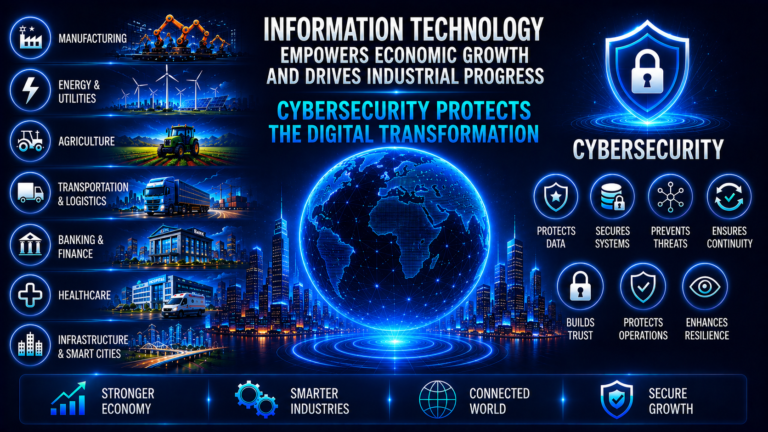
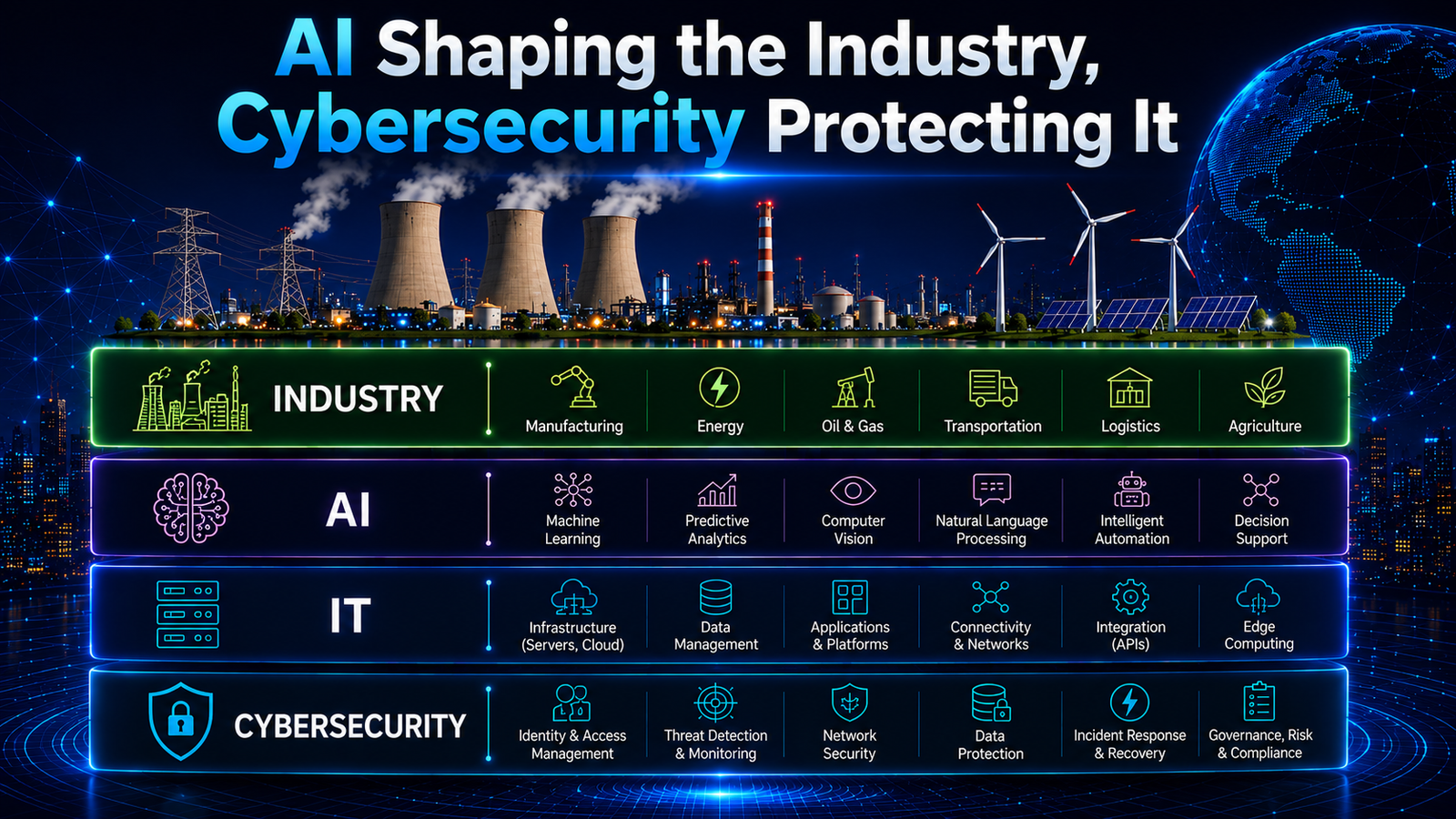
The relationship between these technologies can be viewed through three complementary roles: Information Technology provides the digital foundation, Artificial Intelligence shapes new industrial capabilities, and Cyber Security protects the systems and trust required for those capabilities to operate.
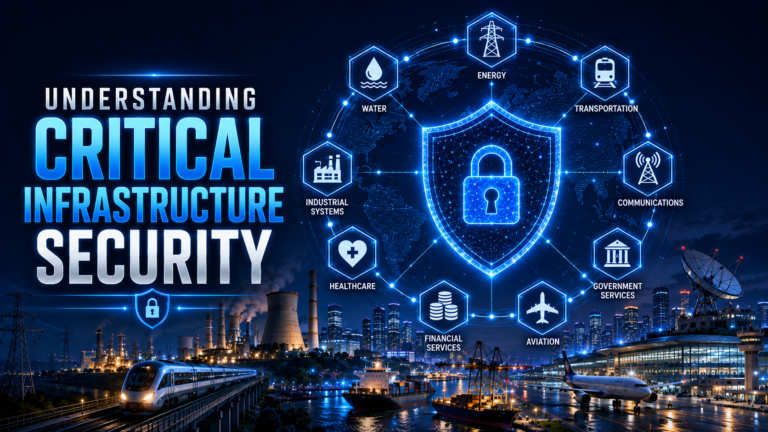
This transformation is not limited to manufacturing. It increasingly affects energy, transportation, healthcare, logistics, agriculture, financial services, utilities, infrastructure, and other sectors that depend on interconnected digital and physical systems.
Understanding this relationship provides a foundation for examining how IT is transforming industry, how AI is shaping its future, and how Cyber Security helps protect an increasingly connected and intelligent industrial environment.
Evolution of Industry
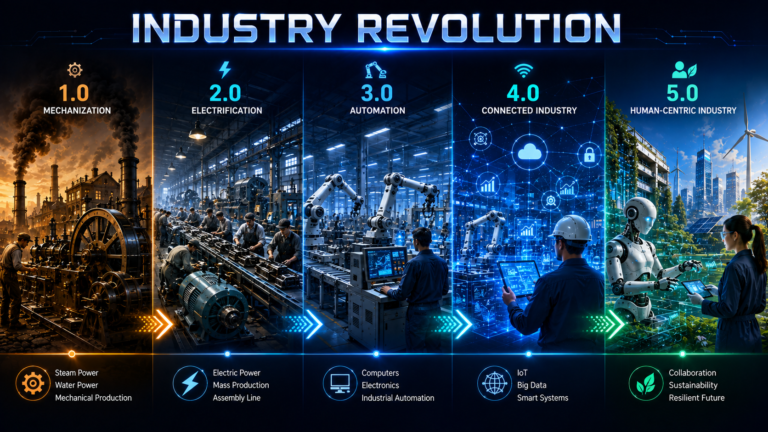
Industrial development has progressed through several major phases, with each phase introducing new capabilities that changed how industries operate. This progression provides the context for understanding how Information Technology became increasingly integrated into industrial environments and eventually enabled connected, intelligent, and data-driven operations.
Industry 1.0: Mechanization
Industry 1.0 introduced mechanized production through water and steam power, reducing dependence on manual production and establishing the foundation of factory-based industry.
Industry 2.0: Electrification and Mass Production
Industry 2.0 introduced electricity and mass-production methods, enabling industries to increase production scale, standardization, efficiency, and consistency.
Industry 3.0: Automation and Digitalization
Industry 3.0 introduced electronics, computers, information technology, and programmable automation. Industrial systems increasingly gained the ability to process information and control processes digitally.
Industry 4.0: Connected and Intelligent Industry
Industry 4.0 expanded digitalization by connecting machines, systems, sensors, networks, and data. Industrial environments became increasingly integrated, connected, data-driven, and capable of intelligent monitoring and decision-making.
Industry 5.0: Human-Centric and Sustainable Industry
Industry 5.0 builds upon connected and intelligent industrial capabilities while placing greater emphasis on human-machine collaboration, sustainability, resilience, personalization, and responsible use of technology.
This progression established the foundation for the increasing role of Information Technology in industry. As industrial systems became more digital and connected, IT became a core part of their infrastructure. This digital foundation now enables Artificial Intelligence to shape new industrial capabilities, while Cyber Security helps protect the systems, data, and operations on which increasingly intelligent industries depend.
Information Technology Transforming Industry
Information Technology has become a fundamental part of industrial operations, extending the role of technology beyond physical machinery and production equipment. Computing, software, networks, data systems, and digital infrastructure now support many of the activities required to operate, manage, and optimize industrial environments.
IT as the Foundation of Industrial Systems
IT provides the computing and information-processing capabilities that support industrial operations. Servers, workstations, operating systems, databases, applications, and enterprise platforms enable organizations to collect, process, store, and exchange information across different functions.
Industrial organizations increasingly depend on IT for activities such as production planning, resource management, engineering, inventory management, supply-chain coordination, financial operations, workforce management, and business decision-making.
Industrial IT Infrastructure
Industrial IT infrastructure includes the hardware, software, networks, computing platforms, storage systems, and applications that support digital industrial operations.
Data centers, servers, virtualization, cloud platforms, enterprise applications, databases, and network infrastructure provide the underlying environment for industrial information processing and communication.
This infrastructure connects business systems with operational environments and enables information to move between different parts of an organization.
Connectivity and Networking
Networking has enabled industrial systems to communicate across machines, facilities, organizations, and geographic locations.
Industrial networks, enterprise networks, wireless technologies, Internet connectivity, and machine-to-machine communication allow systems to exchange operational information. Increasing connectivity also enables remote monitoring, centralized management, distributed operations, and collaboration across locations.
As connectivity expands, industrial environments become increasingly dependent on reliable and resilient communication infrastructure.
Data and Digital Systems
Data has become an important industrial resource. Digital systems can collect information from production processes, equipment, supply chains, logistics operations, customers, and other sources.
Organizations can use this data to monitor operations, identify trends, measure performance, support planning, and improve decision-making.
The growing volume and variety of industrial data also create opportunities for advanced analytics and Artificial Intelligence, which can extract patterns and insights that may not be easily identified through conventional analysis.
Cloud Computing and Industrial Computing
Cloud computing has expanded the availability of computing, storage, platforms, and applications without requiring every organization to operate all infrastructure locally.
Industrial organizations can use cloud and distributed computing environments for data processing, analytics, collaboration, application delivery, monitoring, and other digital services.
At the same time, industrial computing can involve edge and local processing where information needs to be analyzed close to machines or processes. Combining centralized and distributed computing allows organizations to balance performance, latency, availability, scalability, and operational requirements.
IT and Connected Industry
The increasing integration of computing, networking, data, and digital applications has transformed industrial environments from largely isolated systems into increasingly connected ecosystems.
IT enables information to move across organizational boundaries and supports integration between business systems, industrial systems, and digital services. This creates a foundation on which advanced analytics, automation, Artificial Intelligence, and other emerging capabilities can operate.
As industry becomes more dependent on this digital foundation, the reliability, availability, integrity, and protection of IT infrastructure become increasingly important. This creates the environment in which AI can shape industrial capabilities while Cyber Security helps protect the systems and data that support them.
AI Shaping the Industry
Artificial Intelligence is extending the capabilities of digital industrial systems by enabling machines and software to analyze information, recognize patterns, make predictions, support decisions, and perform increasingly complex tasks.
Unlike traditional automation, which generally follows predefined rules and instructions, AI can use data and learned patterns to support activities that require analysis, prediction, classification, optimization, or adaptation. This makes AI an important component of increasingly intelligent industrial environments.
AI in Industrial Operations
AI can be applied across different stages of industrial operations, including production, maintenance, quality management, logistics, supply chains, energy management, and resource planning.
Industrial AI systems can analyze information from equipment, processes, sensors, enterprise systems, and other sources to identify patterns and provide insights. These capabilities can help organizations improve operational efficiency, identify potential problems, optimize resources, and support more informed decisions.
Intelligent Automation
AI can extend traditional automation by enabling systems to make decisions based on data and changing conditions.
Traditional automation typically follows predefined rules, while AI-enabled automation can evaluate patterns, predictions, and contextual information to determine appropriate actions. This can support more adaptive production processes, automated quality inspection, intelligent scheduling, and dynamic resource allocation.
AI therefore does not replace automation; it can make automated systems more capable of handling complex and variable situations.
Predictive Maintenance
AI can analyze equipment data to identify patterns associated with degradation, abnormal behavior, or potential failure.
By combining historical maintenance information with operational data, AI models can help estimate when equipment may require attention. This supports a shift from maintenance based primarily on fixed schedules or reactive repairs toward more condition- and prediction-based approaches.
Predictive maintenance can help reduce unexpected downtime, improve equipment utilization, and support more effective maintenance planning.
Industrial Analytics and Decision-Making
Industrial environments generate large volumes of operational and business data. AI can analyze this information to identify relationships, trends, anomalies, and patterns that may be difficult to detect through conventional analysis.
AI-supported analytics can assist with production planning, demand forecasting, quality management, supply-chain analysis, energy optimization, and operational decision-making.
Human decision-makers remain important because industrial decisions often involve business objectives, safety requirements, operational constraints, regulatory considerations, and contextual knowledge that cannot always be represented by data alone.
Robotics and Autonomous Systems
AI can increase the capabilities of industrial robots and autonomous systems by enabling perception, navigation, object recognition, decision-making, and adaptation.
Robotic systems can use AI to interpret information from cameras and sensors, respond to changing environments, and perform increasingly complex tasks. Autonomous systems can similarly use AI to make decisions based on their surroundings and operational objectives.
The combination of robotics, sensors, computing, and AI is creating new possibilities for manufacturing, logistics, inspection, transportation, and other industrial activities.
Generative AI in Industry
Generative AI introduces additional capabilities by allowing systems to generate and work with text, images, code, designs, summaries, and other forms of content.
In industrial environments, Generative AI can support technical documentation, knowledge management, engineering assistance, training, operational support, software development, data interpretation, and human-machine interaction.
Its role is likely to expand as organizations integrate foundation models and AI assistants with industrial data, applications, and workflows. However, industrial use requires appropriate controls for accuracy, reliability, data protection, intellectual property, safety, and security.
AI and Human-Machine Collaboration
AI does not necessarily imply the replacement of human workers. In many industrial environments, its greater value may come from augmenting human capabilities.
AI can process large amounts of information, identify patterns, provide recommendations, and automate repetitive activities, while people contribute experience, judgment, creativity, contextual understanding, and accountability.
This combination supports the human-machine collaboration associated with Industry 5.0 and creates opportunities for more flexible, personalized, and knowledge-intensive industrial operations.
AI and the Future of Industry
The increasing integration of AI with industrial IT, operational technology, robotics, data platforms, and connected systems is creating increasingly intelligent industrial environments.
The future direction of industrial AI will depend not only on advances in algorithms and computing capabilities but also on the quality of industrial data, infrastructure, human expertise, governance, safety, and Cyber Security.
As AI becomes more deeply integrated into industrial operations, protecting the models, data, applications, infrastructure, and decisions that depend on AI becomes increasingly important. This makes Cyber Security an essential part of the transition toward intelligent industry.
Cyber Security Protecting It
As industrial environments become increasingly connected, digital, and intelligent, Cyber Security becomes essential to protecting the systems that support industrial operations. The expansion of IT infrastructure, connected devices, industrial networks, cloud platforms, data systems, and AI introduces a broader technology environment that must be protected against disruption, misuse, compromise, and unauthorized access.
Cyber Security in industry extends beyond protecting conventional IT systems. It also involves protecting Operational Technology (OT), Industrial Control Systems (ICS), connected devices, industrial applications, data, and AI-enabled capabilities while maintaining operational continuity and safety.
Cyber Security in Connected Industrial Environments
Connected industrial environments increase the number of systems, devices, networks, applications, and communication paths that require protection.
Industrial organizations must consider security across interconnected IT and OT environments, remote connections, industrial networks, cloud services, third-party systems, and connected devices.
Security therefore needs to be incorporated into industrial architecture rather than treated only as a separate layer added after systems have been deployed.
IT and OT Security
Information Technology and Operational Technology have traditionally operated with different objectives and technical characteristics.
IT environments primarily support information processing, communication, business applications, and data management. OT environments control or monitor physical processes and industrial operations.
As these environments become increasingly connected, their security requirements become increasingly interdependent. A compromise of IT systems can affect industrial operations, while weaknesses in OT environments can create operational, safety, or business consequences.
Protecting converged IT and OT environments requires an understanding of both information security and operational requirements.
Industrial Control Systems Security
Industrial Control Systems include technologies used to monitor and control industrial processes. These environments may include Programmable Logic Controllers, Distributed Control Systems, Supervisory Control and Data Acquisition systems, Human-Machine Interfaces, sensors, and related industrial networks.
Security measures must account for the characteristics of these environments, including operational availability, system reliability, safety requirements, specialized protocols, legacy technologies, and the potential consequences of disrupting physical processes.
Protecting Industrial Data
Data is increasingly central to industrial decision-making, automation, analytics, and AI. Protecting industrial data therefore becomes important throughout its lifecycle.
Security considerations include protecting data during collection, transmission, processing, storage, sharing, and disposal. Organizations also need to maintain data integrity because inaccurate or manipulated information can lead to incorrect operational decisions.
Confidentiality remains important for sensitive industrial, commercial, engineering, and intellectual property information, while integrity and availability can be particularly critical for operational systems.
Protecting AI Systems
As AI becomes integrated into industrial operations, the AI environment itself becomes part of the security landscape.
AI systems may depend on models, training data, operational data, applications, APIs, computing infrastructure, and external services. These components can introduce security risks involving unauthorized access, data manipulation, model misuse, compromised dependencies, and malicious inputs.
Protecting AI therefore requires security considerations across the AI lifecycle, from data and model development through deployment, operation, monitoring, and retirement.
Cyber Resilience
Industrial Cyber Security is not limited to preventing attacks. Industrial organizations also need the ability to continue operating, respond to incidents, recover affected systems, and restore trusted operations.
Cyber resilience combines preventive, detective, response, recovery, and continuity capabilities to reduce the impact of cyber incidents.
For industrial environments, resilience is particularly important because a cyber incident can potentially affect physical processes, production, safety, supply chains, and essential services.
Security for AI and AI for Security
The relationship between AI and Cyber Security works in both directions.
Security for AI focuses on protecting AI systems, models, data, infrastructure, and applications from threats and misuse.
AI for Security uses AI to strengthen Cyber Security capabilities. AI can assist with threat detection, anomaly identification, security analytics, incident investigation, vulnerability analysis, and security operations.
As AI and industrial systems become increasingly integrated, these two perspectives will become increasingly important.
Cyber Security therefore serves as a critical protection and trust layer for intelligent industry. The objective is not simply to prevent attacks but to enable industrial organizations to adopt digital and AI capabilities while maintaining security, resilience, safety, and confidence in their operations.
The Convergence of IT, AI and Cyber Security
The transformation of industry is increasingly shaped by the convergence of Information Technology, Artificial Intelligence, and Cyber Security. These capabilities are no longer developing independently. They increasingly operate together as part of interconnected industrial environments.
Information Technology provides the computing, networking, data, and digital infrastructure required to connect and operate industrial systems. Artificial Intelligence uses this digital foundation to analyze information, support decisions, automate complex activities, and create new industrial capabilities. Cyber Security protects the infrastructure, data, systems, and AI capabilities that enable this transformation.
IT as the Digital Foundation
IT provides the underlying digital environment through which industrial information is collected, processed, stored, transmitted, and accessed.
Computing infrastructure, networks, applications, databases, cloud platforms, and digital services enable industrial organizations to connect operational processes with enterprise functions and external services.
Without this digital foundation, many of the connected and intelligent capabilities associated with today’s industrial environments would not be possible.
AI as the Intelligence Layer
AI builds upon the data and computing capabilities provided by IT.
By analyzing industrial data and identifying patterns, AI can support prediction, optimization, automation, decision-making, and human-machine collaboration. It can transform large volumes of operational information into insights and actions that support industrial objectives.
AI therefore adds an intelligence layer to increasingly digital industrial environments.
Cyber Security as the Protection Layer
Cyber Security provides the protection and trust required for IT and AI capabilities to operate safely and reliably.
Security controls help protect industrial infrastructure, networks, applications, data, connected devices, AI systems, and operational environments from unauthorized access, manipulation, disruption, and other threats.
Cyber Security also supports resilience by helping organizations detect incidents, respond to them, recover affected systems, and maintain trusted operations.
Secure and Intelligent Industrial Ecosystems
The convergence of IT, AI, and Cyber Security creates an industrial ecosystem in which digital infrastructure, intelligent capabilities, and security mechanisms need to work together.
For example, industrial sensors can generate data, IT infrastructure can transport and process that data, AI can analyze it and generate predictions or recommendations, and Cyber Security can help protect the systems and information involved throughout the process.
This integration requires organizations to consider security and resilience during the design and deployment of digital and AI capabilities rather than treating security as a separate activity.
The Future of Technology-Driven Industry
The continued development of computing, connectivity, AI, robotics, automation, and other emerging technologies will further expand what industrial systems can accomplish.
Future industrial environments are likely to become increasingly connected, intelligent, automated, adaptive, and human-centric. At the same time, their dependence on digital infrastructure will make security, resilience, governance, and responsible technology use increasingly important.
The future of industry will therefore not be determined by AI alone. It will depend on the effective integration of IT as the digital foundation, AI as a source of intelligence, and Cyber Security as a protection and trust layer.
This convergence provides a foundation for industries to pursue greater productivity, innovation, adaptability, and resilience while maintaining the security and reliability required for sustainable industrial operations.
Conclusion
The transformation of industry has progressed from mechanization and electrification to automation, digitalization, connectivity, and intelligent systems. Each stage has expanded the capabilities of industrial organizations while creating new opportunities and challenges.
Information Technology has become the digital foundation of this transformation by providing the computing, networking, data, and infrastructure required to connect industrial operations. Artificial Intelligence builds upon this foundation by enabling greater intelligence, prediction, automation, optimization, and human-machine collaboration.
As these capabilities become increasingly integrated into industrial environments, Cyber Security becomes essential to protecting the systems, data, infrastructure, and AI capabilities that support them. Security and resilience are therefore not separate from industrial transformation but important conditions for its sustainable adoption.
The future of industry will continue to be shaped by the interaction between technology, people, economic requirements, environmental considerations, and societal needs. IT provides the foundation, AI shapes new industrial capabilities, and Cyber Security helps protect the connected and intelligent industry.