What is Graph Theory?
Introduction
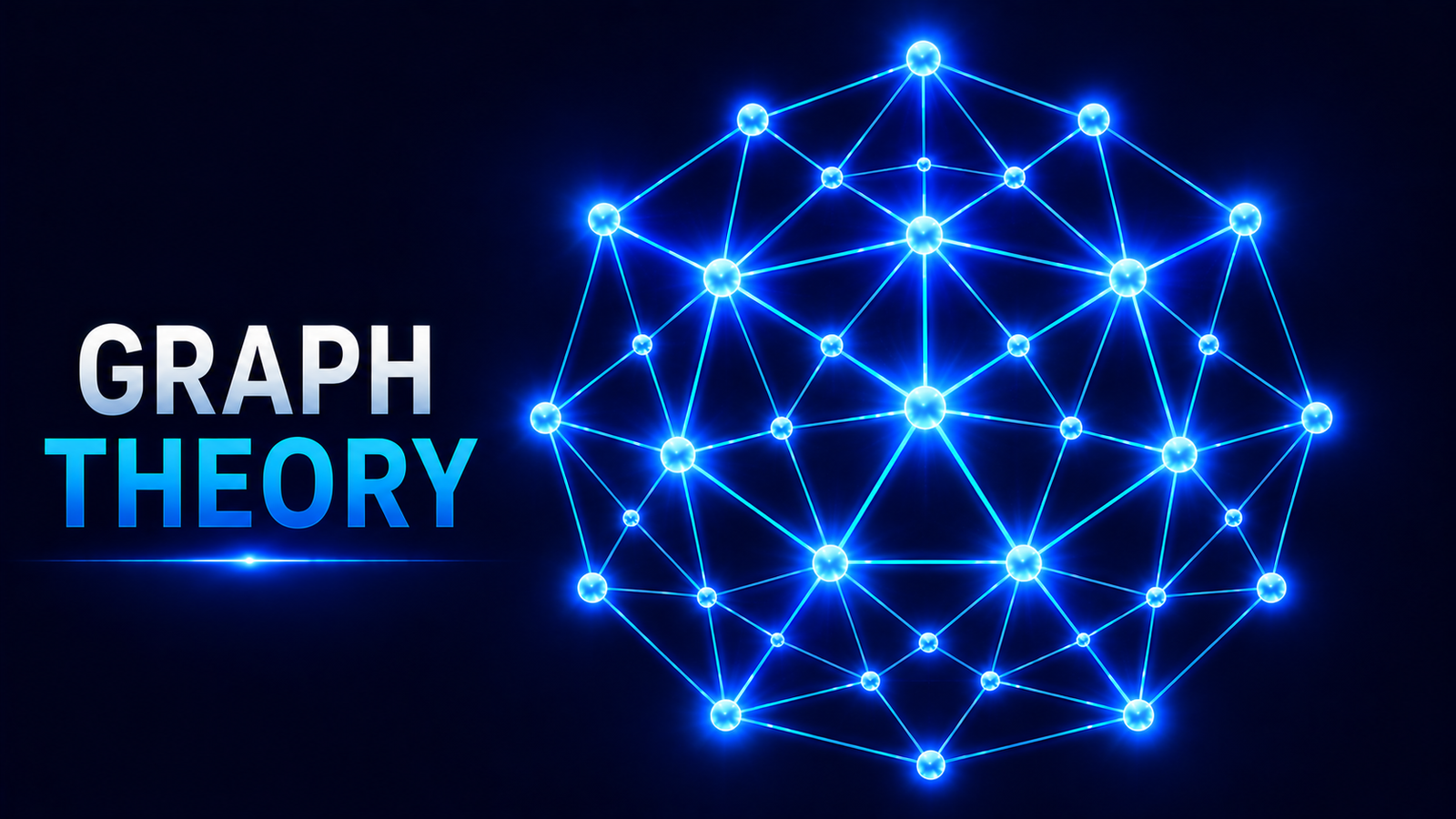
Graph Theory is a branch of Discrete Mathematics that studies graphs, which are mathematical structures used to represent relationships between interconnected entities. By modeling objects as vertices (nodes) and the relationships between them as edges (links), Graph Theory provides a systematic framework for analyzing connectivity, communication, dependencies, and interactions.
Although Graph Theory originated as a mathematical discipline, it has become one of the fundamental building blocks of computer science and engineering. It is extensively applied in computer networking, routing algorithms, artificial intelligence, cybersecurity, transportation systems, social networks, electrical power grids, biology, logistics, and many other fields where interconnected systems must be represented and analyzed.
What Is Graph Theory?
Graph Theory is the study of graphs, which are mathematical models consisting of a set of vertices (nodes) connected by edges (links).
A graph is formally represented as:
G = (V, E)
where:
- G represents the graph.
- V represents the set of vertices (nodes).
- E represents the set of edges (links) connecting the vertices.
The simplicity of this model makes Graph Theory one of the most powerful mathematical tools for representing interconnected systems.
History of Graph Theory
Graph Theory originated in 1736 through the work of the Swiss mathematician Leonhard Euler.
Euler solved the famous Seven Bridges of Königsberg problem, which asked whether it was possible to cross each of the city’s seven bridges exactly once without crossing any bridge more than once.
Instead of focusing on the geographical layout of the city, Euler simplified the problem into a mathematical model by representing land masses as vertices and bridges as edges. This abstraction led to the birth of Graph Theory and introduced the fundamental concepts that continue to be used today.
Euler’s work established Graph Theory as a mathematical discipline and laid the foundation for analyzing interconnected systems across numerous scientific and engineering domains.
Fundamental Components of a Graph
Every graph consists of two primary components.
Vertices (Nodes)
A vertex, also called a node, represents an entity within a graph.
Depending on the application, a vertex may represent:
- A computer
- A router
- A switch
- A person
- A city
- A railway station
- An airport
- A web page
- A database
- A cloud service
Edges (Links)
An edge, also called a link, represents the relationship or connection between two vertices.
Depending on the application, an edge may represent:
- A communication link
- A road
- A railway
- A friendship
- A dependency
- A network cable
- A wireless connection
- A flight route
Edges define how vertices are interconnected within the graph.
Types of Edges
Directed Edges
A directed edge represents a relationship that has a specific direction.
Example:
A → B
Data or communication flows from A to B.
Directed graphs are commonly used for routing, workflow analysis, dependency graphs, and web page links.
Undirected Edges
An undirected edge represents a bidirectional relationship.
Example:
A — B
Both vertices have an equal relationship.
Undirected graphs are commonly used to represent physical network connectivity and social relationships.
Weighted Edges
Weighted edges contain a numerical value that represents characteristics such as:
- Cost
- Distance
- Delay
- Bandwidth
- Time
- Reliability
Weighted graphs are widely used by routing protocols to determine optimal communication paths.
Unweighted Edges
Unweighted edges simply indicate whether a relationship exists without assigning a numerical value.
Basic Graph Terminology
Several terms are commonly used in Graph Theory.
Degree
The degree of a vertex is the number of edges connected to that vertex.
Adjacent Vertices
Two vertices are adjacent if they are connected by an edge.
Path
A path is a sequence of connected vertices that allows movement from one vertex to another.
Cycle
A cycle is a path that begins and ends at the same vertex without repeating edges.
Connected Graph
A graph is connected if every vertex can be reached from every other vertex.
Disconnected Graph
A graph is disconnected if one or more vertices cannot be reached from the others.
Types of Graphs
Graph Theory defines several graph structures for modeling different types of relationships.
- Simple Graph
- Multigraph
- Directed Graph (Digraph)
- Undirected Graph
- Weighted Graph
- Unweighted Graph
- Complete Graph
- Bipartite Graph
- Cyclic Graph
- Acyclic Graph
- Tree
- Forest
Each graph type is designed to model different characteristics of interconnected systems.
Graph Representation
Computers store graphs using several common data structures.
Adjacency Matrix
Represents the graph as a two-dimensional matrix indicating whether vertices are connected.
Adjacency List
Stores each vertex together with a list of its neighboring vertices.
Edge List
Represents the graph as a list of edges connecting pairs of vertices.
Incidence Matrix
Represents the relationship between vertices and edges using a matrix.
The choice of representation depends on memory requirements, graph density, and algorithm efficiency.
Graph Traversal
Graph traversal is the process of systematically visiting every vertex within a graph.
The two most common traversal techniques are:
Breadth-First Search (BFS)
Breadth-First Search explores neighboring vertices level by level before moving deeper into the graph.
It is commonly used for:
- Shortest path in unweighted graphs
- Broadcasting
- Network discovery
Depth-First Search (DFS)
Depth-First Search explores one path as deeply as possible before backtracking.
It is commonly used for:
- Connectivity analysis
- Cycle detection
- Topological sorting
- Dependency analysis
Common Graph Algorithms
Graph Theory provides numerous algorithms for solving network and optimization problems.
Some of the most widely used algorithms include:
- Dijkstra’s Shortest Path Algorithm
- Bellman-Ford Algorithm
- Floyd-Warshall Algorithm
- Prim’s Minimum Spanning Tree Algorithm
- Kruskal’s Minimum Spanning Tree Algorithm
- Topological Sorting
- Connected Component Algorithms
- Cycle Detection Algorithms
These algorithms form the basis of many computer science and networking technologies.
Graph Theory in Computer Networking
Graph Theory provides one of the mathematical foundations for computer networking.
A computer network can be represented as a graph where:
- Vertices (Nodes) represent computing devices and networking devices such as routers, switches, servers, firewalls, wireless access points, and hosts.
- Edges (Links) represent the physical or logical communication paths connecting those devices.
This mathematical representation enables network engineers to:
- Model network topologies.
- Analyze network connectivity.
- Calculate shortest communication paths.
- Detect routing loops.
- Design redundant and fault-tolerant networks.
- Optimize routing decisions.
- Evaluate network scalability.
- Improve network resilience.
Many networking technologies and protocols rely on graph-theoretic principles, including:
- Spanning Tree Protocol (STP)
- Rapid Spanning Tree Protocol (RSTP)
- Multiple Spanning Tree Protocol (MSTP)
- Shortest Path Bridging (SPB)
- Open Shortest Path First (OSPF)
- Intermediate System to Intermediate System (IS-IS)
- Multiprotocol Label Switching (MPLS) Traffic Engineering
Applications of Graph Theory
Graph Theory is widely used across numerous disciplines.
Some of its major applications include:
- Computer Networking
- Computer Science
- Artificial Intelligence
- Cybersecurity
- Transportation Networks
- Social Networks
- Electrical Power Systems
- Geographic Information Systems (GIS)
- Supply Chain and Logistics
- Biology and Genomics
- Telecommunications
- Cloud Computing
Its ability to model relationships between interconnected entities makes Graph Theory one of the most versatile mathematical disciplines.
Advantages of Graph Theory
Graph Theory provides several advantages:
- Simple representation of complex interconnected systems.
- Efficient analysis of connectivity and relationships.
- Supports optimization and shortest-path calculations.
- Enables scalable modeling of large networks.
- Forms the basis of numerous algorithms used in computing and engineering.
- Applicable across many scientific and engineering disciplines.
Limitations of Graph Theory
Despite its strengths, Graph Theory has certain limitations.
- Very large graphs may require significant computational resources.
- Dynamic graphs require continuous updates as relationships change.
- Some graph problems are computationally complex.
- Mathematical models may simplify real-world systems and omit operational details.
Conclusion
Graph Theory provides a mathematical framework for representing and analyzing interconnected systems through vertices and edges. Originating from Leonhard Euler’s work in the eighteenth century, it has become one of the foundational disciplines supporting computer science, networking, artificial intelligence, cybersecurity, transportation, and many other fields.