Understanding Cybersecurity Threats
Introduction
Cybersecurity threats are potential events, conditions, or activities that may compromise the confidentiality, integrity, or availability of information systems, networks, applications, and digital services. They may originate from malicious actors, accidental actions, technical failures, environmental conditions, or weaknesses in organizational processes.
Understanding cybersecurity threats is essential for individuals, businesses, government institutions, and critical infrastructure operators. It helps them identify possible sources of harm, evaluate exposure, prioritize security controls, and prepare effective prevention, detection, response, and recovery strategies.
What Is a Cybersecurity Threat?
Definition of a Threat
A threat is any potential cause of an unwanted incident that could negatively affect an asset, system, organization, or individual. In cybersecurity, a threat represents the possibility that a weakness may be exploited or that an adverse event may occur.
A threat does not necessarily mean that an attack has already taken place. It describes the potential for harm.
Examples include:
- A criminal attempting to steal sensitive information.
- An employee accidentally disclosing confidential data.
- A natural disaster damaging a data center.
- A compromised account being used to access business systems.
- A software flaw creating an opportunity for unauthorized access.
Threats in Information Security
Information security threats may affect information in storage, in transit, or during processing. They can target:
- User identities and credentials.
- Business applications.
- Servers and endpoints.
- Network infrastructure.
- Databases and files.
- Cloud services.
- Industrial control systems.
- Physical facilities.
- Third-party services and suppliers.
The nature of a threat depends on the asset being targeted, the source of the threat, the available capabilities, and the potential consequences.
Threats and the CIA Triad
The CIA triad represents three fundamental information security objectives:
- Confidentiality — preventing unauthorized disclosure of information.
- Integrity — protecting information from unauthorized alteration or destruction.
- Availability — ensuring that information and services remain accessible when required.
A threat may affect one or more of these objectives. For example, data theft affects confidentiality, unauthorized modification affects integrity, and a denial-of-service event affects availability.
Sources of Cybersecurity Threats
Natural and Environmental Threats
Not all cybersecurity threats are caused by people. Natural and environmental events can disrupt technology and affect the availability or integrity of systems.
Examples include:
- Floods.
- Earthquakes.
- Cyclones.
- Lightning.
- Fire.
- Extreme temperatures.
- Power failures.
- Water leakage.
- Environmental contamination.
These events may damage hardware, interrupt connectivity, affect cooling systems, or make facilities inaccessible.
Accidental and Unintentional Threats
Accidental threats result from mistakes, misunderstandings, or unintended actions.
Examples include:
- Sending confidential information to the wrong recipient.
- Deleting important files.
- Misconfiguring a firewall.
- Exposing a cloud storage resource.
- Using weak passwords.
- Connecting unauthorized devices.
- Applying an incorrect system change.
- Failing to renew a security certificate.
Although these actions may not be malicious, they can create significant security exposure.
Deliberate and Malicious Threats
Deliberate threats are intentionally created by individuals or groups seeking to cause harm, obtain information, gain unauthorized access, disrupt services, or achieve political or financial objectives.
Examples include:
- Malware deployment.
- Credential theft.
- Data exfiltration.
- Ransomware.
- Espionage.
- Sabotage.
- Fraud.
- Extortion.
- Unauthorized system access.
Internal and External Threat Sources
Threat sources may exist inside or outside an organization.
Internal threat sources include employees, contractors, administrators, temporary workers, and other authorized users. External threat sources include cybercriminals, nation-state groups, hacktivists, competitors, and independent attackers.
An internal threat is not always intentional. An authorized user may accidentally create exposure through an error or unsafe action.
Threat Actors
Cybercriminals
Cybercriminals conduct illegal activities for financial or personal gain. Their activities may include credential theft, fraud, ransomware, data theft, extortion, and the sale of stolen information.
They may operate individually, as organized groups, or through criminal service networks.
Nation-State Actors
Nation-state actors are supported or directed by governments. Their objectives may include espionage, intelligence collection, political influence, military advantage, disruption, or strategic access to important systems.
They may target government agencies, defense organizations, telecommunications providers, energy systems, research institutions, and critical infrastructure.
Hacktivists
Hacktivists use cyber activities to promote political, ideological, or social causes. Their activities may include website defacement, service disruption, information disclosure, and online campaigns.
Their objectives are often associated with visibility, protest, publicity, or pressure.
Insider Threat Actors
Insider threats originate from individuals who have legitimate access to organizational systems or information.
They may be:
- Malicious insiders seeking personal benefit.
- Negligent users who disregard security requirements.
- Compromised users whose accounts are controlled by an external attacker.
- Disgruntled employees seeking revenge.
- Contractors or partners misusing access.
Script Kiddies
Script kiddies are individuals who use existing tools, scripts, or publicly available techniques without necessarily understanding their underlying operation.
Although their technical capability may be limited, their activities can still cause disruption, unauthorized access, or accidental damage.
Cyber Terrorists
Cyber terrorists seek to create fear, disruption, or significant social and political impact through cyber activities. Potential targets may include public services, transportation, healthcare, energy, communications, and other critical systems.
Threat Categories
Malware Threats
Malware is malicious software designed to disrupt operations, damage systems, obtain information, or gain unauthorized access.
Common categories include:
- Viruses.
- Worms.
- Trojans.
- Ransomware.
- Spyware.
- Rootkits.
- Keyloggers.
- Botnet malware.
- Remote access malware.
Social Engineering Threats
Social engineering manipulates people into revealing information, performing unsafe actions, or granting unauthorized access.
Examples include:
- Phishing.
- Spear phishing.
- Business email compromise.
- Vishing.
- Smishing.
- Pretexting.
- Baiting.
- Impersonation.
- Tailgating.
These threats exploit human trust, urgency, fear, curiosity, or authority.
Network and Communication Threats
Network and communication threats target the movement of information between systems and users.
Examples include:
- Eavesdropping.
- Traffic interception.
- Spoofing.
- Man-in-the-middle activity.
- Denial-of-service.
- Distributed denial-of-service.
- DNS-related abuse.
- Routing manipulation.
- Wireless network attacks.
Application and Software Threats
Application threats arise from weaknesses in software design, development, configuration, deployment, or maintenance.
Examples include:
- Injection vulnerabilities.
- Broken authentication.
- Insecure authorization.
- Poor input validation.
- Insecure APIs.
- Vulnerable dependencies.
- Improper error handling.
- Insecure software configuration.
- Supply-chain compromise.
Identity and Access Threats
Identity and access threats target accounts, credentials, authentication mechanisms, and authorization controls.
Examples include:
- Credential theft.
- Password spraying.
- Brute-force attempts.
- Session hijacking.
- Privilege misuse.
- Account takeover.
- Excessive permissions.
- Unauthorized privilege escalation.
Data Security Threats
Data security threats affect the confidentiality, integrity, availability, or reliability of information.
Examples include:
- Data theft.
- Data leakage.
- Unauthorized disclosure.
- Data tampering.
- Data destruction.
- Accidental exposure.
- Improper retention.
- Insecure disposal.
- Loss of data provenance.
Physical and Environmental Threats
Physical threats target facilities, equipment, devices, or the surrounding environment.
Examples include:
- Unauthorized facility access.
- Theft of equipment.
- Hardware tampering.
- Device loss.
- Cable damage.
- Fire.
- Flooding.
- Power interruption.
- Cooling failure.
Cloud Security Threats
Cloud security threats may arise from shared responsibility gaps, insecure configurations, weak identity controls, exposed services, or compromised cloud accounts.
Examples include:
- Publicly exposed storage.
- Excessive cloud permissions.
- Compromised access keys.
- Insecure interfaces.
- Misconfigured security groups.
- Inadequate tenant isolation.
- Uncontrolled cloud resource deployment.
- Cloud service provider dependency risks.
Artificial Intelligence Security Threats
AI systems introduce threats related to models, data, infrastructure, users, and outputs.
Examples include:
- Prompt injection.
- Training data poisoning.
- Model theft.
- Adversarial inputs.
- Sensitive data disclosure.
- Insecure AI integrations.
- Model manipulation.
- Supply-chain risks.
- Excessive trust in AI-generated output.
Threats, Vulnerabilities, Risks, and Attacks
What Is a Vulnerability?
A vulnerability is a weakness in a system, process, configuration, application, device, or human practice that could be exploited or misused. Vulnerabilities may exist in software, hardware, network architecture, security controls, operational procedures, or user behavior.
A vulnerability does not automatically result in a security incident. It becomes dangerous when a threat source can discover, access, and exploit the weakness.
Examples of vulnerabilities include:
- Unpatched software.
- Weak or reused passwords.
- Insecure default configurations.
- Excessive user privileges.
- Poor network segmentation.
- Unsupported operating systems.
- Insecure application code.
- Missing encryption.
- Inadequate backup arrangements.
- Weak security policies.
- Poor access control.
- Insufficient security monitoring.
- Untrained employees.
- Exposed administrative interfaces.
Vulnerabilities can be introduced during system design, development, deployment, configuration, operation, or maintenance. They may also emerge when the surrounding environment changes. For example, a previously acceptable configuration may become vulnerable after a new service is connected to the network.
What Is a Cybersecurity Risk?
Cybersecurity risk is the possibility that a threat will exploit a vulnerability and cause harm to an organization, system, individual, or information asset.
Risk is commonly evaluated by considering:
- The likelihood that a threat event will occur.
- The potential impact if the event occurs.
- The value and importance of the affected asset.
- The effectiveness of existing security controls.
- The organization’s exposure to the threat.
A commonly used conceptual relationship is:
Cybersecurity Risk = Likelihood × Impact
This expression is a simplified way to explain risk assessment. In practice, organizations may use qualitative ratings, quantitative models, risk matrices, business impact analysis, or other assessment methods.
For example, an internet-facing application with a serious unpatched vulnerability may represent a high risk if it processes sensitive information and is accessible to many users. The same vulnerability on an isolated, non-production system may represent a lower risk because the exposure and potential impact are limited.
Risk can be reduced by:
- Removing the vulnerability.
- Reducing the likelihood of exploitation.
- Limiting access to the affected asset.
- Implementing additional security controls.
- Reducing the potential impact.
- Transferring some risk through contracts or insurance.
- Accepting the risk based on an approved business decision.
What Is a Cybersecurity Attack?
A cybersecurity attack is a deliberate action intended to compromise the confidentiality, integrity, or availability of information, systems, services, or infrastructure.
An attack may attempt to:
- Obtain unauthorized access.
- Steal sensitive information.
- Modify or destroy data.
- Disrupt business operations.
- Disable systems or services.
- Deploy malicious software.
- Abuse legitimate privileges.
- Damage an organization’s reputation.
- Cause financial or operational loss.
Examples of cybersecurity attacks include:
- Phishing.
- Malware infection.
- Ransomware.
- Password attacks.
- Denial-of-service attacks.
- Exploitation of software vulnerabilities.
- Web application attacks.
- Man-in-the-middle attacks.
- Supply chain attacks.
- Insider misuse.
- Data exfiltration.
- Account takeover.
Not every threat becomes an attack. A threat describes the potential for harm, while an attack is an action or attempt to cause that harm. Similarly, an attack does not always succeed. Security controls may detect, block, or contain the attack before the intended objective is achieved.
Understanding the Relationship Between Threats, Vulnerabilities, Risks, and Attacks
Threats, vulnerabilities, risks, and attacks are closely related, but they describe different aspects of cybersecurity.
A threat is a potential source of harm. It may be a malicious actor, natural event, technical failure, human mistake, or environmental condition.
A vulnerability is a weakness that can be exploited, misused, or triggered by a threat.
A risk is the potential for loss or damage when a threat can take advantage of a vulnerability.
An attack is an attempt to exploit a vulnerability or otherwise compromise an asset.
The relationship can be understood through an example. An organization operates a web application that contains an unpatched software flaw. The flaw is the vulnerability. A cybercriminal who discovers the flaw is the threat source. The possibility that the criminal could gain unauthorized access and steal customer data represents the risk. The criminal’s attempt to exploit the flaw is the attack.
The same relationship can exist outside malicious activity. A power failure may be a threat to availability. The absence of backup power may be a vulnerability. The possibility of prolonged service disruption represents the risk. The actual power failure and resulting interruption become the event that affects the organization.
Understanding these distinctions helps security teams avoid treating every security concern as an attack. It also supports better risk assessment and control selection.
Threats and vulnerabilities do not always create the same level of risk. Risk depends on exposure, asset value, threat capability, existing controls, and the possible consequences. A vulnerability that cannot be reached by a threat source may present limited risk, while a similar vulnerability on a public-facing critical system may require immediate attention.
Security controls help break the relationship between threats and vulnerabilities. Preventive controls can remove weaknesses or reduce exposure. Detective controls can identify suspicious activity. Corrective controls can limit damage and restore affected services. Governance, policies, monitoring, and periodic assessments help ensure that these controls remain effective.
How Cybersecurity Threats Affect Organizations
Impact on Confidentiality
Threats may expose confidential information such as:
- Personal data.
- Financial records.
- Customer information.
- Intellectual property.
- Business strategies.
- Authentication credentials.
- Government or defense information.
Loss of confidentiality may lead to fraud, identity theft, legal consequences, and reputational damage.
Impact on Integrity
Threats may modify, corrupt, delete, or manipulate information. Incorrect data can affect business decisions, financial reporting, system operations, and safety-related processes.
Integrity threats are especially important in healthcare, finance, industrial environments, and critical infrastructure.
Impact on Availability
Threats may make systems, applications, networks, or information unavailable.
Availability impacts may include:
- Service interruption.
- Production delays.
- Loss of revenue.
- Missed business commitments.
- Emergency response difficulties.
- Customer dissatisfaction.
- Disruption of essential services.
Financial and Operational Impact
Cybersecurity threats may result in:
- Direct financial theft.
- Incident response expenses.
- Recovery costs.
- Legal expenses.
- Regulatory penalties.
- Lost productivity.
- Business interruption.
- Increased insurance costs.
- Loss of customer confidence.
Legal, Regulatory, and Reputational Impact
Organizations may have legal and regulatory obligations concerning privacy, data protection, reporting, and service availability.
A security incident may result in investigations, contractual disputes, regulatory action, and damage to the organization’s reputation.
Impact on Critical Infrastructure
Threats affecting critical infrastructure may have consequences beyond a single organization. Disruption to energy, transportation, healthcare, telecommunications, water, or financial services may affect communities and national resilience.
Threat Identification and Analysis
Identifying Threat Sources
Threat identification begins by understanding the organization’s assets, services, users, dependencies, and operating environment.
Relevant questions include:
- Who may want to target the organization?
- What information or services may be valuable?
- Which systems are exposed?
- What access is available to internal and external users?
- Which suppliers or partners have connectivity?
- What environmental events may cause disruption?
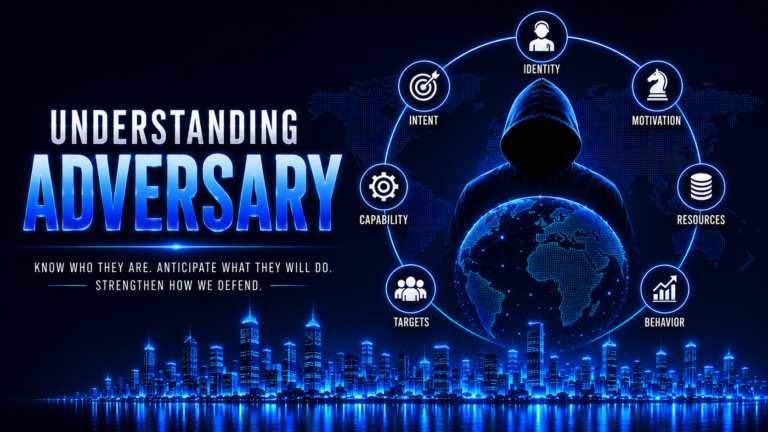
Understanding Threat Intent and Capability
Threat analysis considers the possible motivation and capability of a threat source.
Important factors include:
- Financial motivation.
- Political objectives.
- Espionage.
- Ideological beliefs.
- Technical expertise.
- Available resources.
- Access to tools.
- Persistence.
- Knowledge of the target environment.
Assessing Threat Likelihood
Likelihood describes the possibility that a threat event may occur.
Assessment may consider:
- Exposure of the target.
- Attractiveness of the asset.
- History of similar events.
- Threat actor capability.
- Existing vulnerabilities.
- Strength of security controls.
- Ease of exploitation.
- Changes in the operating environment.
Evaluating Potential Impact
Impact assessment considers the consequences if a threat becomes an incident.
Potential impacts include:
- Data loss.
- Service disruption.
- Financial loss.
- Safety consequences.
- Legal exposure.
- Reputational damage.
- Loss of trust.
- National or societal impact.
Threat Scenarios
A threat scenario describes a plausible situation in which a threat source could affect an asset or business service.
A scenario should identify:
- The threat source.
- The targeted asset.
- The possible weakness.
- The expected event.
- The potential consequence.
- The existing controls.
- The required response.
Cyber Threat Intelligence
What Is Cyber Threat Intelligence?
Cyber threat intelligence is the collection, processing, analysis, and use of information about threats, threat actors, their motivations, capabilities, activities, and likely targets.
Threat intelligence supports decision-making by helping organizations understand what threats may affect them and how those threats may develop.
Strategic, Tactical, Operational, and Technical Intelligence
Strategic intelligence supports leadership and business decisions. It focuses on broad trends, geopolitical developments, business exposure, and long-term priorities.
Tactical intelligence explains how threat actors operate and the methods they may use.
Operational intelligence focuses on specific campaigns, threat activities, targets, and expected actions.
Technical intelligence includes technical information such as indicators, malicious files, domains, IP addresses, and observed behaviors.
Threat Intelligence Sources
Threat intelligence may be collected from:
- Internal security monitoring.
- Incident investigations.
- Security vendors.
- Government advisories.
- Industry groups.
- Open-source intelligence.
- Information-sharing communities.
- Vulnerability disclosures.
- Threat research organizations.
- Partner and supplier notifications.
Indicators of Compromise
Indicators of compromise are observable signs that may indicate malicious activity or a security incident.
Examples include:
- Suspicious IP addresses.
- Malicious domains.
- File hashes.
- Unusual processes.
- Unexpected account activity.
- Abnormal network traffic.
- Unauthorized configuration changes.
- Repeated authentication failures.
Indicators should be evaluated in context because a single indicator may not be sufficient to confirm malicious activity.
Threat Intelligence in Security Operations
Threat intelligence helps security teams improve:
- Monitoring.
- Detection rules.
- Alert prioritization.
- Incident investigation.
- Threat hunting.
- Vulnerability prioritization.
- Security awareness.
- Incident response planning.
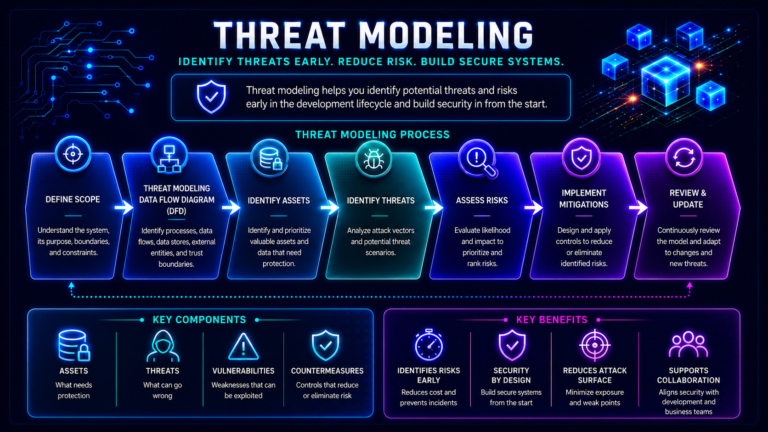
Threat Modeling
What Is Threat Modeling?
Threat Modeling is a structured method for identifying potential threats to a system, application, process, or environment during design and assessment.
It helps organizations understand what needs protection, how a system may be misused, and which controls should be implemented.
Identifying Assets and Trust Boundaries
Threat modeling begins by identifying:
- Important assets.
- Users and roles.
- System components.
- Data flows.
- External dependencies.
- Entry points.
- Trust boundaries.
- Administrative interfaces.
Identifying Potential Threats
Potential threats may be identified by considering:
- Unauthorized access.
- Data disclosure.
- Data modification.
- Service disruption.
- Privilege misuse.
- Malicious insiders.
- Third-party compromise.
- Physical disruption.
- Environmental failure.
Threat Modeling Methodologies
STRIDE
STRIDE is a threat modeling methodology developed to help identify common security threats in software and system designs. It examines six threat categories:
- Spoofing – Impersonating a user, system, or other entity.
- Tampering – Modifying data, code, or system components without authorization.
- Repudiation – Denying an action without sufficient evidence to establish accountability.
- Information Disclosure – Exposing information to unauthorized individuals or systems.
- Denial of Service – Reducing or preventing the availability of a system or service.
- Elevation of Privilege – Gaining permissions beyond those legitimately authorized.
STRIDE helps development and security teams examine trust boundaries, data flows, and system components from different threat perspectives.
DREAD
DREAD is a risk-rating approach that can be used to assess and prioritize identified threats. It considers five factors:
- Damage – The potential harm caused by the threat.
- Reproducibility – How consistently the threat can be carried out.
- Exploitability – The effort or skill required to exploit the weakness.
- Affected Users – The number of users or systems that could be impacted.
- Discoverability – How easily the weakness can be identified.
The factors can be scored to support comparative risk analysis. However, DREAD is not universally adopted, and organizations may use other risk-rating methods.
PASTA
PASTA, or Process for Attack Simulation and Threat Analysis, is a risk-centric threat modeling methodology. It connects business objectives, application architecture, threats, vulnerabilities, and potential attack scenarios.
PASTA generally involves:
- Defining business objectives and security requirements.
- Establishing the technical scope of the application.
- Decomposing the application and identifying its assets.
- Analyzing threats and vulnerabilities.
- Developing and examining attack scenarios.
- Evaluating risk and identifying appropriate countermeasures.
This approach helps connect technical security findings with business impact and risk management.
OCTAVE
OCTAVE, or Operationally Critical Threat, Asset, and Vulnerability Evaluation, is a risk-based approach for identifying and evaluating information security risks. It focuses on critical assets, their associated threats, and the organizational consequences of compromise.
OCTAVE helps organizations:
- Identify important information assets.
- Understand how assets are used and protected.
- Identify threats and vulnerabilities.
- Evaluate the potential impact of security incidents.
- Develop risk mitigation strategies.
It is particularly useful when threat modeling must be connected with organizational risk management and business priorities.
Attack Trees
Attack trees represent how a threat objective may be achieved through different conditions or combinations of events.
The root of an attack tree represents the attacker’s objective. Branches describe alternative or related conditions that could contribute to achieving that objective. Logical relationships, such as AND and OR, can be used to show whether multiple conditions are required or whether any one condition may be sufficient.
Attack trees help teams examine possible paths to an unwanted outcome and identify controls that could interrupt those paths.
MITRE ATT&CK
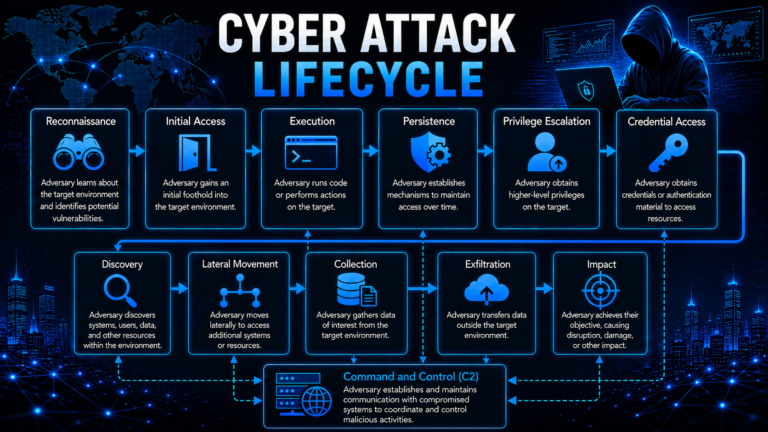
MITRE ATT&CK is a knowledge base that describes adversary tactics and techniques observed in real-world activity. It supports threat-informed analysis, detection planning, security operations, threat hunting, and defensive improvement.
MITRE ATT&CK can be used during threat modeling to examine how an adversary might behave after gaining access to a system or environment. It can also help teams map potential attack techniques to security controls, detection capabilities, and response procedures.
Threat Modeling in Software and System Design
Threat modeling is most effective when incorporated early in system design. It helps identify security requirements before implementation and can reduce the cost of correcting weaknesses later.
Threat modeling may be applied to:
- Applications.
- APIs.
- Cloud architectures.
- Network designs.
- Industrial systems.
- Identity platforms.
- Data processing environments.
- AI systems.
- Third-party integrations.
The depth of analysis depends on the system’s complexity, business importance, data sensitivity, exposure, and potential impact. Threat modeling should also be revisited when significant changes are made to architecture, functionality, dependencies, or operating conditions.
Managing Cybersecurity Threats
Threat Prevention
Prevention aims to reduce the likelihood that threats will become successful incidents.
Preventive measures include:
- Security policies.
- Secure architecture.
- Access control.
- Network segmentation.
- Security awareness.
- Secure development.
- Patch management.
- Encryption.
- Configuration management.
- Backup planning.
Threat Detection
Detection identifies suspicious activity or security events.
Detection capabilities may include:
- Security monitoring.
- Log analysis.
- Intrusion detection.
- Endpoint monitoring.
- Identity analytics.
- Network traffic analysis.
- Threat intelligence.
- User behavior analysis.
Threat Response
Response involves taking coordinated action when a threat or security incident is identified.
Activities may include:
- Validation.
- Triage.
- Containment.
- Investigation.
- Communication.
- Evidence preservation.
- Eradication.
- Recovery coordination.
Threat Mitigation
Mitigation reduces the likelihood or impact of a threat when complete prevention is not possible.
Examples include:
- Limiting privileges.
- Isolating affected systems.
- Applying compensating controls.
- Reducing exposure.
- Strengthening monitoring.
- Improving resilience.
- Updating response procedures.
Threat Monitoring and Continuous Assessment
Threat conditions change as systems, technologies, business processes, and threat actors change.
Organizations should periodically reassess:
- New assets.
- New vulnerabilities.
- Changes in threat activity.
- Third-party exposure.
- Cloud deployments.
- User access.
- Security control effectiveness.
- Incident trends.
Security Controls for Threat Management
Security controls may be administrative, technical, or physical.
Administrative controls include policies, governance, risk assessments, training, and procedures.
Technical controls include identity management, firewalls, endpoint protection, encryption, monitoring, and backup systems.
Physical controls include access barriers, surveillance, environmental protection, and facility security.
Cybersecurity Threats Across Different Environments
Enterprise IT Environments
Enterprise IT environments face threats involving endpoints, servers, networks, applications, identities, data, and business services.
Threat management requires coordination between business units, IT teams, security teams, risk functions, and leadership.
Cloud Environments
Cloud environments require attention to identity, configuration, workload security, data protection, interfaces, logging, and shared responsibility.
Organizations must understand which security responsibilities belong to the cloud provider and which remain with the customer.
Operational Technology and Industrial Control Systems
Operational technology environments may control physical processes and industrial equipment. Threats affecting these environments may create operational, safety, environmental, and economic consequences.
Security considerations include availability, safety, reliability, segmentation, remote access, and the relationship between IT and operational systems.
Critical Infrastructure
Critical infrastructure depends on interconnected systems and services that support society and the economy.
Threat management must consider:
- Service continuity.
- Public safety.
- Interdependencies.
- Supply chains.
- Emergency response.
- National resilience.
- Recovery priorities.
Internet of Things
Internet of Things environments may contain large numbers of connected devices with limited processing power, inconsistent security controls, and long operating lifetimes.
Threats may include weak credentials, insecure interfaces, outdated firmware, poor device visibility, and unauthorized device access.
Artificial Intelligence Systems
AI systems require protection of models, training data, inference services, infrastructure, user inputs, and outputs.
Threat management should consider both traditional cybersecurity risks and AI-specific risks such as data poisoning, prompt injection, model extraction, and unintended disclosure.
Cybersecurity Threats and Security Governance
Threat Management Policies
Organizations should define policies covering:
- Threat identification.
- Threat intelligence.
- Vulnerability management.
- Security monitoring.
- Incident reporting.
- Access management.
- Third-party security.
- Business continuity.
- Security responsibilities.
Threats in Enterprise Risk Management
Threat management should be integrated with enterprise risk management. This allows cybersecurity risks to be evaluated alongside financial, operational, legal, strategic, and reputational risks.
Risk ownership should be clearly assigned, and significant threats should be reported through established governance channels.
Threat Reporting and Escalation
Threat reporting should provide sufficient information for decision-making.
Reports may include:
- Threat description.
- Affected assets.
- Threat source.
- Likelihood.
- Potential impact.
- Existing controls.
- Recommended actions.
- Risk owner.
- Escalation requirements.
Roles and Responsibilities in Threat Management
Threat management involves multiple roles.
The board and senior leadership provide direction and oversight. The CISO and security governance functions establish policies, risk priorities, and security strategy. IT and infrastructure teams implement and operate technical controls. Security operations teams monitor and respond to threats. Business owners identify critical services and accept or treat risks.
Employees, contractors, suppliers, and partners also have responsibilities for following security requirements and reporting suspicious activity.
Conclusion
Cybersecurity threats represent potential causes of harm to information, systems, networks, applications, infrastructure, and business services. They may arise from malicious actors, accidental actions, technical weaknesses, environmental events, or failures in governance.
Understanding threats requires more than identifying attack methods. It involves examining threat sources, actors, motivations, capabilities, vulnerabilities, risk exposure, business impact, and the effectiveness of security controls.
Threat intelligence, threat modeling, security governance, and continuous assessment help organizations understand their exposure and prepare appropriate safeguards. A structured approach enables individuals and organizations to improve prevention, detection, response, resilience, and recovery across enterprise IT, cloud, operational technology, critical infrastructure, and AI environments.
References
Online Sources
NIST – Cybersecurity Framework
Provides a structured approach for managing and reducing cybersecurity risk.
NIST – Guide for Conducting Risk Assessments
Explains methods for identifying, analyzing, and evaluating information security risks.
MITRE – MITRE ATT&CK
Provides a knowledge base of adversary tactics and techniques based on observed cyber activity.