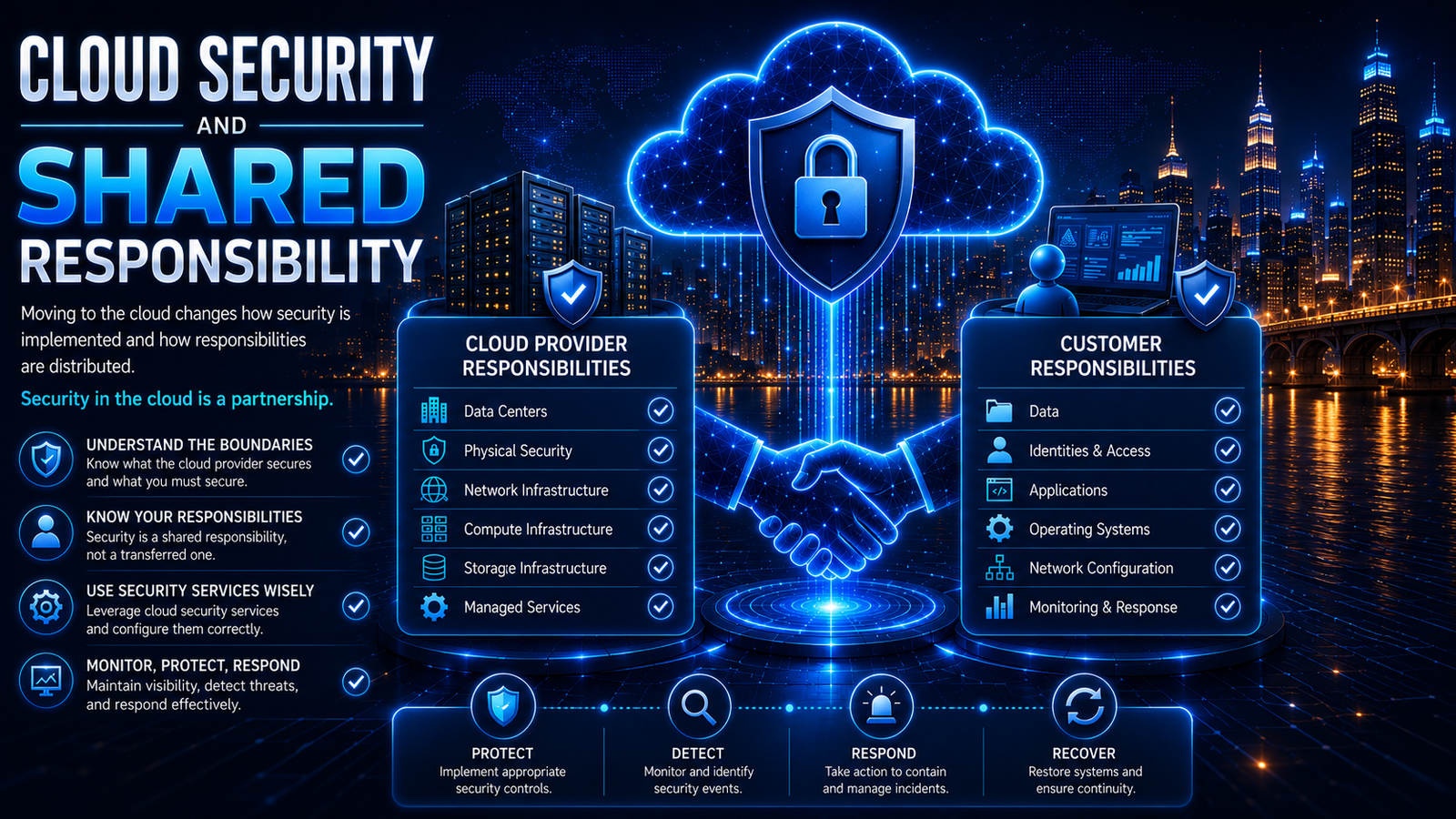
Cloud Security and Shared Responsibility
Introduction
Cloud computing has changed how applications, data, infrastructure, and digital services are delivered and managed. Cloud environments can provide scalable computing resources, flexible service delivery, and access to shared technologies without requiring every component to be operated locally.
However, moving to the cloud does not remove the need for security. It changes how security is implemented and how responsibilities are distributed.
Cloud service providers operate and protect the underlying cloud infrastructure and services they provide, while the users of those services remain responsible for security aspects that depend on their configuration, access, applications, data, and use of the cloud environment.
This principle is commonly described through the Shared Responsibility Model.
Understanding shared responsibility is therefore essential to understanding cloud security. A cloud environment can have strong underlying infrastructure security while still being exposed through weak configurations, excessive permissions, insecure applications, or poor protection of data and identities.
Cloud Security Does Not End with the Cloud Provider
One of the common misconceptions about cloud computing is that moving systems and data to a cloud service automatically transfers security responsibility to the cloud provider.
Cloud providers play a critical role in securing the infrastructure and services they operate. However, security responsibilities remain with the parties using those services.
The exact division of responsibility depends on factors such as the cloud service model, architecture, services being consumed, and the way those services are configured and used.
This means that adopting cloud services changes the security boundary, but it does not eliminate the need to manage security.
Security must still address areas such as:
- Identity and access
- Data protection
- Application security
- Resource configuration
- Network security
- Workload security
- Monitoring and logging
- Vulnerability management
- Incident response
- Backup and recovery
- Governance and compliance
The cloud therefore changes the way these responsibilities are implemented rather than removing them.
Understanding the Shared Responsibility Model
The Shared Responsibility Model describes how security responsibilities are divided between a cloud service provider and the users of its services.
The provider is generally responsible for protecting the infrastructure and services that make up the cloud platform. Depending on the service being consumed, users may remain responsible for the security of their data, identities, configurations, applications, workloads, and other resources they control.
The boundary between these responsibilities is not always identical across cloud services.
For example, a service that provides underlying computing resources can leave more security responsibilities with the user than a fully managed application service. As the level of service abstraction increases, some operational responsibilities move to the provider, while other responsibilities remain with the user.
Understanding this boundary is important because a security control that is managed by the provider for one service may require direct management by the user for another.
Identity Remains a Security Responsibility
Cloud environments can provide access to users, administrators, applications, services, and automated processes from many locations and devices.
Identity therefore becomes a critical part of cloud security.
Even when the underlying cloud infrastructure is securely operated, compromised credentials or excessive permissions can provide unauthorized access to cloud resources.
Security responsibilities may include:
- Authentication
- Authorization
- Multi-factor authentication
- Access control
- Privileged access management
- Role and permission management
- Identity governance
- Account lifecycle management
The principle of least privilege is particularly important because users and systems should receive only the access required for their intended activities.
Data Protection Remains Essential
Cloud services can provide extensive capabilities for storing and processing information, but placing data in the cloud does not remove responsibility for protecting it.
Data security can involve:
- Data classification
- Access controls
- Encryption
- Key management
- Backup
- Recovery
- Retention
- Data loss prevention
- Secure sharing
- Data lifecycle management
The appropriate controls depend on the nature and sensitivity of the information, the services being used, and applicable requirements.
Cloud security therefore requires an understanding of both where data resides and how it is accessed, processed, transferred, and protected.
Configuration Can Become a Security Responsibility
Cloud environments are highly configurable. Resources, services, permissions, networks, storage, applications, and security controls can often be created or changed through management interfaces and APIs.
This flexibility is valuable, but incorrect configurations can introduce significant security exposure.
Examples include:
- Excessive permissions
- Publicly accessible storage
- Unnecessary network exposure
- Weak authentication settings
- Insecure application configurations
- Unrestricted administrative access
- Inadequate logging
- Incorrect security policies
A secure cloud platform can therefore still contain insecure resources if the services are configured incorrectly.
Configuration management is consequently an important part of shared responsibility.
Applications and Workloads Still Require Protection
Cloud platforms provide infrastructure and services for running applications and workloads, but the security of those applications cannot simply be delegated to the cloud provider.
Application and workload security can involve:
- Secure development
- Application security testing
- API security
- Vulnerability management
- Dependency security
- Secure deployment
- Workload configuration
- Runtime protection
Security needs to be considered throughout the application and workload lifecycle.
The cloud provides the environment in which an application operates, but the security of the application itself can remain the responsibility of its developers, operators, and users depending on the service model.
Monitoring and Incident Response Remain Important
Cloud environments can change rapidly. Resources may be created and removed, configurations can change, and users and applications can access services from different locations.
Security therefore requires continuous visibility.
Monitoring and operational security can include:
- Logging
- Security event monitoring
- Threat detection
- Configuration monitoring
- Vulnerability management
- Incident investigation
- Incident response
- Recovery activities
Cloud providers may supply security logs, monitoring capabilities, and other security services, but users still need to determine what should be monitored, how events should be analyzed, and how incidents should be handled within the scope of their responsibilities.
Governance and Compliance Do Not Move to the Cloud Provider
Cloud adoption also does not remove governance, risk, compliance, privacy, or regulatory responsibilities.
Policies and requirements still need to address:
- Cloud usage
- Security standards
- Risk management
- Data protection
- Privacy
- Compliance
- Third-party risk
- Access management
- Incident management
- Business continuity
Organizations and other users of cloud services must understand their obligations and ensure that the services they use can support the required security and compliance objectives.
Cloud providers can provide relevant security capabilities, certifications, documentation, and contractual commitments, but these do not automatically make every use of the service compliant or secure.
Shared Responsibility Depends on the Service Model
The distribution of security responsibility varies according to the cloud service model.
Infrastructure as a Service
With Infrastructure as a Service (IaaS), users typically have greater responsibility for the operating systems, applications, configurations, identities, data, and workloads they deploy.
The provider manages the underlying cloud infrastructure, while users manage a larger portion of the resources operating above that infrastructure.
Platform as a Service
With Platform as a Service (PaaS), the provider manages a greater portion of the underlying infrastructure and platform components.
Users remain responsible for areas such as their applications, data, identities, configurations, and how the platform services are used.
Software as a Service
With Software as a Service (SaaS), the provider manages most of the underlying infrastructure and application platform.
Users still have responsibilities related to accounts, access, data, configuration options, permissions, and appropriate use of the service.
The exact boundary varies by provider and service. The important principle is that the level of provider management does not eliminate all user responsibilities.
Shared Responsibility Is a Security Partnership
The Shared Responsibility Model should not be viewed simply as a division of tasks between two parties.
It represents a broader security relationship in which different participants contribute to the protection of cloud-based services.
Cloud providers are responsible for the security of the infrastructure and services they operate. Users are responsible for securing the resources and activities that remain under their control.
Developers, administrators, security teams, service operators, and individual users may also have specific responsibilities depending on the environment and services involved.
Effective cloud security therefore depends on understanding:
- What the provider secures
- What the user must secure
- Which controls are available
- Which controls must be configured
- Who monitors security events
- Who responds to incidents
- Who is accountable for security outcomes
Clearly defining these responsibilities helps reduce security gaps and prevents assumptions that a particular security task is being handled by someone else.
Why Shared Responsibility Matters
The Shared Responsibility Model matters because security failures can occur when responsibilities are misunderstood, overlooked, or incorrectly assumed.
A cloud provider may securely operate the infrastructure while a customer leaves sensitive data publicly accessible.
A service may provide strong authentication capabilities while users fail to enable appropriate protections.
A cloud platform may provide extensive logging while important events are not monitored.
These examples demonstrate an important principle:
Cloud security depends not only on the security capabilities provided by the cloud platform, but also on how those capabilities are configured and used.
Understanding shared responsibility allows security controls to be placed at the appropriate points and helps ensure that important responsibilities are not left unaddressed.
Conclusion
Cloud computing changes how technology is delivered, but it does not remove the need for security. Instead, it changes the security environment and distributes responsibilities across the cloud provider and the parties using its services.
Cloud providers play an essential role in protecting the infrastructure and services they operate. Users remain responsible for the security of the data, identities, configurations, applications, workloads, and activities that fall within their control.
The exact division of responsibility depends on the cloud service model, architecture, and services being used. Understanding these boundaries is therefore essential for effective cloud security.
Shared responsibility is ultimately about knowing what must be protected, who is responsible for protecting it, and how those responsibilities work together.
This principle provides an important foundation for understanding the broader Cloud Security domain.