Understanding Intelligence
Introduction
Intelligence is a broad and complex concept that has been observed, studied, and interpreted across different forms of life and disciplines. It is commonly associated with capabilities such as learning, adaptation, problem-solving, reasoning, and responding to changing circumstances. Although human intelligence is the most extensively studied form, intelligence and intelligence-like capabilities can be examined across the living world.
The study of intelligence raises fundamental questions about how living organisms interact with their environments, acquire and use information, respond to changes, learn from experience, and adapt to their circumstances. These capabilities can differ substantially among organisms because different forms of life have different biological structures, environments, and evolutionary histories. Consequently, intelligence may not be expressed in the same way across all forms of life.
Humans have also developed broader uses of the concept. Intelligence is used in different disciplines to describe the development of understanding from information and the analysis of situations to support decision-making. The concept has also been extended into computing through Artificial Intelligence (AI), where computational systems are designed to perform tasks associated with capabilities commonly linked to intelligence.
Understanding intelligence therefore requires examining both its natural foundations and the ways humans have studied, interpreted, and applied the concept. This article explores these perspectives, beginning with the meaning of intelligence and its common characteristics before examining how it manifests across living systems and how humans have subsequently extended the concept.
What Is Intelligence?
There is no single definition of intelligence that is universally accepted across all disciplines or forms of life. Different fields approach the concept from different perspectives, and definitions may emphasize particular capabilities such as learning, reasoning, problem-solving, adaptation, or the ability to respond effectively to environmental challenges.
The difficulty in defining intelligence becomes particularly apparent when comparing different forms of life. The capabilities that may be relevant to intelligence in humans cannot necessarily be applied in exactly the same way to animals, birds, or other organisms. Each organism has its own biological characteristics, sensory capabilities, environmental conditions, and evolutionary history.
Although definitions vary, a common pattern can be identified in discussions of intelligence. Living organisms encounter changes and challenges in their environments, receive or detect information, process or respond to that information, and may modify their behavior or biological processes as circumstances change. The mechanisms involved can be very different. Humans may use complex reasoning and planning, while other organisms may rely on different forms of perception, learning, memory, communication, or behavioral adaptation.
Intelligence is closely related to information, but the two concepts are not synonymous. Organisms continuously receive information from their internal and external environments, but simply detecting information or producing a response does not necessarily establish intelligence. The way information is used, interpreted, learned from, or incorporated into subsequent responses can be relevant when examining intelligent behavior.
Intelligence is also closely associated with adaptation, particularly from an evolutionary perspective. Learning from experience, modifying behavior, solving problems, and adjusting responses can contribute to an organism’s ability to deal with changing conditions. However, adaptation alone does not necessarily demonstrate intelligence, because biological systems can also produce effective responses through inherited mechanisms, physiological processes, or automatic responses.
The specific expression of intelligence can therefore differ considerably among living systems. What constitutes intelligent behavior in one organism may not be an appropriate measure for another. At the same time, recurring capabilities such as acquiring or detecting information, responding to circumstances, learning or adjusting, and dealing with environmental challenges provide a basis for examining intelligence across different forms of life.
Humans have subsequently extended the concept beyond biological intelligence. Intelligence can refer to the development of understanding from information for analytical and decision-making purposes, while Artificial Intelligence applies related concepts to computational systems. These uses represent human interpretations and applications of intelligence rather than replacing the broader question of intelligence in living systems.
Intelligence in Living Organisms
Intelligence is expressed differently across living organisms because organisms have different biological structures, sensory capabilities, environments, and evolutionary histories. The capabilities associated with intelligence therefore cannot necessarily be assessed using a single standard across all forms of life. Examining intelligence across humans, animals, and plants provides a broader perspective on how organisms interact with and respond to their environments.
Human Intelligence
Human intelligence is the most extensively studied form of biological intelligence. It encompasses a broad range of capabilities, including learning, memory, reasoning, language, problem-solving, planning, abstract thinking, creativity, and decision-making.
Human intelligence also has a strong social and cultural dimension. Humans can learn from one another, communicate complex ideas, accumulate knowledge, use tools and technologies, and transmit knowledge across generations. These capabilities allow humans to respond to immediate environmental conditions as well as increasingly complex social, technological, and cultural environments.
Animal Intelligence
Animals demonstrate a wide range of cognitive and behavioral capabilities, although these capabilities vary considerably among species. Depending on the species, researchers have observed forms of learning, memory, communication, navigation, problem-solving, social interaction, behavioral flexibility, and tool use.
These capabilities can be found across different groups of animals, including mammals, birds, fish, reptiles, amphibians, and invertebrates. For example, some mammals demonstrate complex social learning and problem-solving, some birds demonstrate sophisticated navigation and tool use, some fish demonstrate learning and spatial behavior, and certain invertebrates, such as octopuses and bees, demonstrate notable learning and problem-solving capabilities.
Animal intelligence should therefore not be viewed simply as a reduced or simplified version of human intelligence. Different species have evolved different capabilities in response to the particular environmental and ecological challenges they encounter. The appropriate way to examine these capabilities is therefore in relation to the organism, its environment, and the behaviors being studied.
Plant Intelligence
Plants demonstrate sophisticated abilities to sense and respond to their environments. They can detect changes in factors such as light, gravity, temperature, water availability, touch, chemicals, and biological threats. They can also use chemical and electrical signaling and modify growth and physiological processes in response to environmental conditions.
Some researchers use terms such as plant cognition or plant intelligence to describe aspects of these capabilities. Other researchers use such terminology cautiously or reject the classification of these processes as intelligence because plants lack a nervous system and brain, and their responses can arise through biochemical, physiological, and developmental mechanisms.
Consequently, whether plants should be considered intelligent remains a subject of scientific discussion. Recognizing the complexity of plant sensing, signaling, and adaptive responses does not by itself establish that these processes constitute intelligence.
Intelligence and Evolution
The differences in intelligence-related capabilities among living organisms are closely connected to evolution. Organisms have evolved under different environmental conditions and face different challenges related to obtaining resources, avoiding threats, reproducing, interacting with other organisms, and responding to changes in their surroundings.
Evolution can therefore result in different forms of intelligence-related capability among different organisms. An ability that provides an advantage in one environment may have little relevance in another. Intelligence does not necessarily follow a single evolutionary path or produce the same capabilities across species.
This evolutionary perspective also makes direct comparisons between very different organisms difficult. A capability should be considered in relation to the organism’s biology, environment, and ecological requirements. The forms and mechanisms associated with intelligence can therefore vary substantially while still exhibiting common patterns such as responding to information, learning, adjusting, and dealing with environmental challenges.
The study of intelligence across living organisms consequently involves both common patterns and biological differences. Humans, animals, and plants interact with their environments through very different mechanisms, and the extent to which particular capabilities should be classified as intelligence depends on the definitions, evidence, and criteria applied.
Characteristics of Intelligence
There is no universally accepted set of characteristics that defines intelligence across all forms of life. However, research and discussion across psychology, biology, cognitive science, and related fields commonly associate intelligence with a range of capabilities. These capabilities can occur in different combinations and levels of complexity depending on the organism, its environment, and the context in which intelligence is being considered.
Perception
Perception involves detecting and interpreting information from the environment or from within an organism. It allows an organism to identify changes, objects, signals, or conditions that may be relevant to its needs or activities.
Different organisms perceive their environments through different sensory and biological mechanisms. Humans rely on senses such as vision, hearing, touch, taste, and smell, while other organisms may possess specialized sensory capabilities that allow them to detect information unavailable to humans. Perception provides an important basis for responding to environmental conditions.
Learning
Learning involves acquiring or modifying knowledge, behavior, or responses as a result of experience or interaction with the environment. It allows an organism to use previous experience to influence subsequent responses.
Learning can take different forms and can vary considerably among organisms. It may involve association, observation, repetition, feedback, or interaction with other members of a species. The ability to modify responses based on experience is an important characteristic considered in the study of intelligence.
Memory
Memory involves retaining and subsequently using information or experience. It allows an organism to make use of previous experiences rather than responding only to immediate conditions.
Memory can support learning, recognition, navigation, problem-solving, and decision-making. Its mechanisms and complexity vary across organisms, and different forms of memory may serve different biological and behavioral functions.
Reasoning
Reasoning involves using available information to reach conclusions, establish relationships, evaluate possibilities, or determine an appropriate course of action. It is particularly prominent in the study of human intelligence but aspects of reasoning-like behavior have also been investigated in other organisms.
The complexity of reasoning can vary substantially. Some forms may involve relatively simple relationships between conditions and responses, while others may involve multiple pieces of information, inference, planning, or evaluation of alternatives.
Problem-Solving
Problem-solving involves dealing with a situation in which an existing response may not be sufficient to achieve a desired outcome. It can require an organism to identify a challenge, use available information, modify its behavior, or develop a new response.
Problem-solving has been observed in different forms across living organisms. The nature of the problems and the strategies used to address them are strongly influenced by the organism’s environment, physical capabilities, and ecological requirements.
Adaptation
Adaptation involves adjusting to conditions in ways that improve an organism’s ability to function within its environment. In the context of intelligence, adaptation can involve modifying behavior or responses based on experience or changing circumstances.
However, adaptation should not automatically be equated with intelligence. Some adaptations are inherited biological characteristics or automatic physiological processes that do not involve learning, reasoning, or flexible information use. The distinction is therefore important when considering adaptation as a characteristic associated with intelligence.
Decision-Making
Decision-making involves selecting or producing a response from available possibilities based on information, circumstances, internal conditions, or previous experience. In humans, decision-making can involve complex reasoning, evaluation of alternatives, prediction, and consideration of future consequences.
Other organisms also make choices or exhibit behavior that can be interpreted as decision-making, although the underlying mechanisms can differ significantly. The complexity of decision-making therefore varies across organisms and should be considered in relation to their biological and environmental context.
Taken together, these characteristics provide a framework for examining intelligence rather than a universal checklist. An organism does not necessarily need to demonstrate every characteristic, and the presence of one characteristic alone does not establish intelligence. The combination, complexity, flexibility, and underlying mechanisms of these capabilities are important when intelligence is evaluated.
Intelligence Development Process
Intelligence develops and operates through a combination of processes that allow living organisms to interact with their environments, use information, learn from experience, make responses, and adjust to changing conditions. There is no universally standardized lifecycle that applies identically to every form of life. However, perception, learning, memory, decision-making, adaptation, and feedback are commonly studied as related processes in understanding intelligent behavior.
These processes are not necessarily strictly sequential. They can influence one another continuously, with the outcome of one interaction providing information that affects subsequent perception, learning, memory, and responses. The complexity and mechanisms involved vary considerably among organisms.
Perception
Perception involves detecting and interpreting information from the environment or from within an organism. It provides the initial basis for responding to changes, conditions, objects, signals, or other relevant stimuli.
Different organisms perceive their surroundings through different biological mechanisms. Humans use sensory systems such as vision, hearing, touch, taste, and smell, while other organisms may have different or specialized mechanisms for detecting environmental conditions.
Perception by itself does not establish intelligence. Its significance lies in how detected information can subsequently influence learning, responses, and adaptation.
Learning
Learning involves changes in knowledge, behavior, or responses resulting from experience or interaction with the environment. Through learning, an organism can use previous experiences to influence future responses.
Learning varies considerably among organisms. It can involve association, observation, repetition, feedback, or interaction with other organisms. The ability to modify responses based on experience is an important process in the development of many forms of intelligent behavior.
Memory
Memory enables information or experience to be retained and used subsequently. It allows an organism to benefit from previous interactions rather than responding only to immediate conditions.
Memory can support learning, recognition, navigation, problem-solving, and decision-making. Its form, capacity, duration, and underlying mechanisms differ among organisms.
Memory also provides continuity between experiences. Information retained from earlier interactions can influence how an organism responds when a similar or related situation occurs again.
Decision-Making
Decision-making involves selecting or producing a response based on available information, previous experience, internal conditions, or environmental circumstances.
In humans, decision-making can involve complex reasoning, comparison of alternatives, prediction, planning, and consideration of future consequences. Other organisms can also exhibit choice and response patterns, although the mechanisms involved may be very different.
The complexity of decision-making therefore varies across organisms and should be considered in relation to their biological capabilities and environmental conditions.
Adaptation
Adaptation involves adjusting to environmental conditions in ways that can improve an organism’s ability to function and survive. In the context of intelligence, adaptation can involve changes in behavior or responses based on information and experience.
Adaptation can occur at different levels. Some adaptations are inherited across generations, while others can occur within an individual’s lifetime through learning or changes in behavior and physiological responses.
Adaptation should not automatically be equated with intelligence. Some biological adaptations occur through inherited or automatic mechanisms without requiring learning or complex information processing.
Feedback
Feedback occurs when the outcome of a response provides information that can influence subsequent responses. It can allow an organism to determine whether a particular response was effective and adjust future behavior or biological processes accordingly.
For example, an organism may respond to an environmental condition, experience the outcome of that response, and subsequently modify its behavior when a similar condition occurs. In more complex systems, feedback can continuously influence learning, memory, decision-making, and adaptation.
Feedback therefore makes the process dynamic rather than strictly linear.
This should not be interpreted as a universal biological sequence. Different organisms may use different mechanisms, skip or combine processes, or exhibit them at very different levels of complexity. The model provides a conceptual framework for examining how information and experience can contribute to adaptive responses associated with intelligence.
Intelligence, Cognition, and Behavior
Intelligence, cognition, and behavior are closely related concepts, but they describe different aspects of how organisms interact with their environments.
Intelligence and Cognition
Cognition generally refers to processes involved in acquiring, processing, storing, and using information. These processes can include perception, memory, learning, reasoning, and problem-solving.
Intelligence is often examined through these cognitive capabilities, particularly when an organism must use information to deal with new or changing circumstances. However, cognition and intelligence are not identical concepts. Cognition describes processes involved in information processing, while intelligence is commonly concerned with the ability to use such capabilities effectively in particular contexts.
Intelligence and Learning
Learning and intelligence are closely connected because learning allows experience to influence future responses.
An organism may encounter a situation, receive information about the outcome, and modify its subsequent behavior. The ability to learn can therefore contribute to flexible responses and adaptation.
However, learning by itself does not necessarily establish intelligence. Learning can occur through relatively simple mechanisms, and the nature and complexity of learning differ across organisms.
Intelligence and Behavior
Behavior refers to the actions or responses of an organism. Intelligence can influence behavior when an organism uses information, experience, or learned responses to determine how to respond to a situation.
Behavior can therefore provide evidence for studying intelligence, particularly when responses demonstrate flexibility, learning, problem-solving, or adjustment to changing conditions.
At the same time, not all complex behavior necessarily indicates intelligence. Some behaviors are inherited, automatic, or produced by physiological mechanisms.
Intelligence and Consciousness
Consciousness and intelligence are related but distinct concepts. Intelligence generally concerns capabilities such as learning, reasoning, problem-solving, adaptation, and decision-making, while consciousness concerns subjective experience and awareness.
The relationship between intelligence and consciousness remains an area of scientific and philosophical investigation. Intelligent behavior does not necessarily provide direct evidence of subjective conscious experience, and consciousness cannot simply be equated with intelligence.
Forms of Intelligence
Intelligence can be discussed in different forms depending on the capabilities being examined and the context in which intelligence is studied. These forms are not necessarily separate or mutually exclusive.
Individual Intelligence
Individual intelligence refers to capabilities associated with an individual organism, such as learning, memory, problem-solving, reasoning, and adaptation.
The nature and complexity of these capabilities vary substantially among organisms. In humans, individual intelligence can involve a broad range of cognitive abilities.
Social Intelligence
Social intelligence refers to capabilities involved in understanding and responding to other individuals and social situations.
It can include recognizing social signals, communicating, cooperating, responding to social relationships, and adjusting behavior within a group.
Social intelligence is particularly relevant to species that live in social environments, where interactions with other individuals can influence survival and reproduction.
Collective Intelligence
Collective intelligence refers to the way groups of individuals can produce or use knowledge, information, or problem-solving capabilities collectively.
A group can sometimes achieve outcomes that depend on the contributions and interactions of multiple individuals rather than the capabilities of one individual alone.
Collective intelligence can be observed in different biological and social systems and is also used as a concept in human organizations and computational systems.
Adaptive Intelligence
Adaptive intelligence refers to the ability to respond effectively to changing conditions and adjust behavior or responses according to circumstances.
Adaptation can involve learning from experience, modifying strategies, and responding differently when environmental conditions change.
The concept is particularly useful when examining intelligence as an interaction between an organism and its environment.
Human Intelligence
Human intelligence is the most extensively studied form of biological intelligence. It includes a broad range of capabilities associated with learning, reasoning, memory, language, problem-solving, planning, abstract thinking, and decision-making.
Human intelligence is also influenced by social and cultural environments. Humans can communicate complex information, learn from one another, accumulate knowledge, create tools, and transmit knowledge across generations.
Cognitive Abilities
Cognitive abilities are the mental capabilities involved in acquiring, processing, retaining, and using information.
They include abilities such as attention, memory, reasoning, language, problem-solving, learning, and planning. Different individuals can demonstrate different patterns of strengths and weaknesses across these abilities.
Human intelligence therefore cannot be adequately represented by a single cognitive capability.
Emotional Intelligence
Emotional intelligence generally refers to capabilities associated with recognizing, understanding, using, and managing emotions in oneself and in interactions with others.
The concept has been developed through different psychological models, and researchers have used different approaches to define and measure it.
Emotional intelligence is therefore best understood as a particular area of human capability rather than a complete definition of human intelligence.
Social Intelligence
Social intelligence refers to capabilities involved in understanding social situations and interacting effectively with other people.
It can involve interpreting social signals, understanding relationships, communicating, cooperating, and adapting behavior to different social contexts.
Social intelligence overlaps with other human capabilities, including communication, emotional processing, learning, and decision-making.
Intelligence and Knowledge
Intelligence and knowledge are closely related but are not the same.
Knowledge consists of information, understanding, and experience that an individual has acquired. Intelligence involves capabilities that can be used to learn, reason, solve problems, and respond to situations.
Knowledge can contribute to intelligent performance, while intelligence can influence the ability to acquire and apply knowledge. A person may therefore possess extensive knowledge in one area without necessarily demonstrating the same level of capability in every other area.
Intelligence, IQ, and Cognitive Testing
Intelligence quotient (IQ) is a score derived from standardized psychological tests designed to measure particular cognitive abilities.
IQ tests can assess areas such as reasoning, problem-solving, working memory, processing speed, and other cognitive capabilities, depending on the assessment used.
IQ should not be treated as a complete measurement of every aspect of intelligence. Human capabilities also include areas such as knowledge, creativity, emotional and social capabilities, practical skills, and other characteristics that may not be fully represented by a particular IQ score.
Intelligence and Decision-Making
Decision-making is an important area in the study and application of intelligence because information and experience can influence the selection of responses or actions.
An organism may use information about its environment, previous experience, internal conditions, and possible outcomes when responding to a situation. The complexity of this process varies considerably among organisms.
In humans, decision-making can involve perception, memory, reasoning, evaluation of alternatives, prediction, and planning. Decisions can also be influenced by emotions, social conditions, prior knowledge, uncertainty, and available information.
Intelligence can therefore contribute to decision-making, but intelligent decision-making does not mean that every decision will produce the desired outcome. Decisions are made under varying levels of information, uncertainty, and environmental constraints.
Human Understanding and Application of Intelligence
Humans have not only studied intelligence as a natural phenomenon but have also developed ways to apply the concept to different activities.
One important application is the development of understanding from information. Information can be collected, organized, analyzed, interpreted, and used to support decisions. In this context, intelligence can become an analytical product rather than referring directly to the natural intelligence of an organism.
Humans have developed structured approaches for applying intelligence in areas such as science, business, government, security, and other fields. The specific meaning of intelligence depends on the purpose, sources of information, analytical methods, and decisions being supported.
This human application represents an extension of the concept of intelligence. It does not replace biological intelligence but demonstrates how humans have studied, interpreted, and applied intelligence to solve problems and understand situations.
Artificial Intelligence
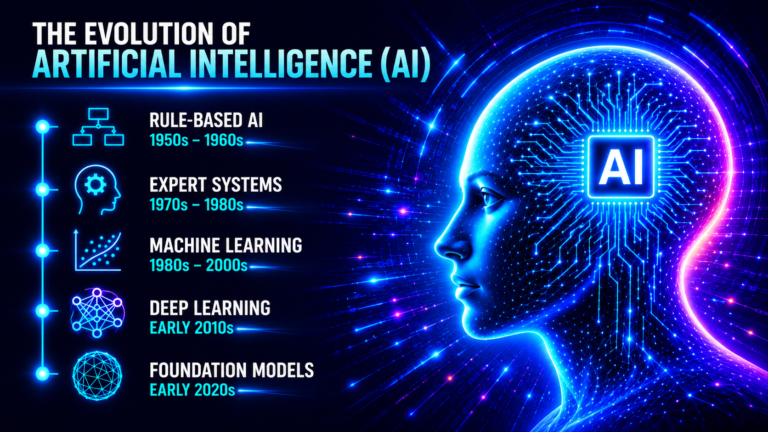
Artificial Intelligence (AI) represents a human-developed approach to creating computational systems that perform tasks associated with capabilities commonly linked to intelligence.
AI is not biological intelligence. It is a field of computing and related disciplines concerned with developing systems capable of performing particular tasks using computational methods.
What Is Artificial Intelligence?
Artificial Intelligence generally refers to computational systems designed to perform functions such as learning from data, recognizing patterns, reasoning, making predictions, understanding language, or supporting decision-making.
Different definitions of AI exist across academic, technical, and standards communities. The scope of AI has also changed as computational techniques and applications have developed.
AI should therefore be understood as a human-developed field that seeks to reproduce or implement selected capabilities associated with intelligent behavior in computational systems.
Biological Intelligence and Artificial Intelligence
Biological intelligence and artificial intelligence share some conceptual similarities, particularly in areas such as learning, perception, problem-solving, and decision-making. However, their underlying mechanisms are fundamentally different.
Biological intelligence emerges from living organisms and their biological systems. Artificial intelligence is implemented through computational systems, algorithms, data, and hardware.
An AI system can perform a task associated with intelligence without possessing the biological structures or processes found in living organisms. Consequently, artificial intelligence should not simply be treated as biological intelligence implemented in a machine.
Machine Learning and Intelligent Systems
Machine learning is an important approach within Artificial Intelligence in which computational systems learn patterns or relationships from data and use what they have learned to perform particular tasks.
Machine-learning systems can be used for activities such as classification, prediction, pattern recognition, recommendation, and language processing.
Intelligent systems can combine machine learning with other computational techniques to perform more complex tasks. Their capabilities remain dependent on their design, data, objectives, computational methods, and operating environment.
Conclusion
Intelligence is a broad concept with no single definition that applies universally across all forms of life and all disciplines.
Across living organisms, intelligence is commonly examined through capabilities such as perception, learning, memory, reasoning, problem-solving, adaptation, and decision-making. These capabilities can interact as organisms respond to their environments and use experience to influence subsequent responses.
Human intelligence represents a particularly complex form of biological intelligence, involving cognitive, social, emotional, and other capabilities. Humans have also studied intelligence and developed ways to apply it to analytical and decision-making activities.
Artificial Intelligence represents a further human development in which computational systems are designed to perform selected tasks associated with intelligent behavior. Although biological and artificial intelligence share some conceptual characteristics, their underlying mechanisms are fundamentally different.
Understanding these distinctions provides a foundation for examining the many specialized uses of intelligence in science, business, government, security, cybersecurity, and other fields.
References
Online Sources
Johns Hopkins Medicine – Q&A – What Is Intelligence?
Provides an accessible discussion of intelligence, its definition, evolutionary context, differences across life forms, and the relationship between biological and artificial intelligence.
American Psychological Association – APA Dictionary of Psychology
Provides established psychological terminology and definitions relevant to intelligence, cognition, learning, memory, behavior, and related concepts.