Threat Intelligence Life Cycle
Introduction
The Threat Intelligence Life Cycle is an organized framework for managing threat intelligence activities from initial planning through continuous improvement. It establishes how intelligence work is coordinated, how requirements guide collection and analysis, and how the resulting intelligence is evaluated and refined.
The framework helps ensure that intelligence work remains focused on organizational priorities and supports the needs of the people responsible for making security decisions.
What Is the Threat Intelligence Life Cycle?
The Threat Intelligence Life Cycle is a structured process used to transform raw information into meaningful intelligence that supports security decisions.
Raw information may include security alerts, threat reports, vulnerability information, indicators of compromise, incident records, adversary activities, and information received from external sources. By itself, this information may be incomplete, duplicated, outdated, or lacking context.
The life cycle provides a method for converting this information into intelligence that can help security teams:
- Understand relevant threats.
- Identify potential risks.
- Prioritize security activities.
- Improve detection and response.
- Support risk management.
- Inform security architecture and controls.
- Make operational, tactical, and strategic decisions.
The life cycle is iterative. After intelligence is delivered and reviewed, the lessons learned can be used to update intelligence requirements and guide the collection and analysis activities of the next cycle.
Purpose of the Threat Intelligence Life Cycle
The main purpose of the life cycle is to ensure that threat intelligence is relevant, reliable, timely, and useful to its intended audience.
A structured life cycle helps organizations:
- Define what intelligence is required.
- Avoid collecting unnecessary information.
- Organize and validate collected data.
- Separate useful information from noise.
- Identify relationships and patterns.
- Produce intelligence with appropriate context.
- Deliver findings to the correct stakeholders.
- Improve intelligence activities through feedback.
Without a defined life cycle, threat intelligence activities may become focused on collecting large amounts of information without a clear understanding of how that information will support security decisions.
Threat Intelligence Life Cycle Phases
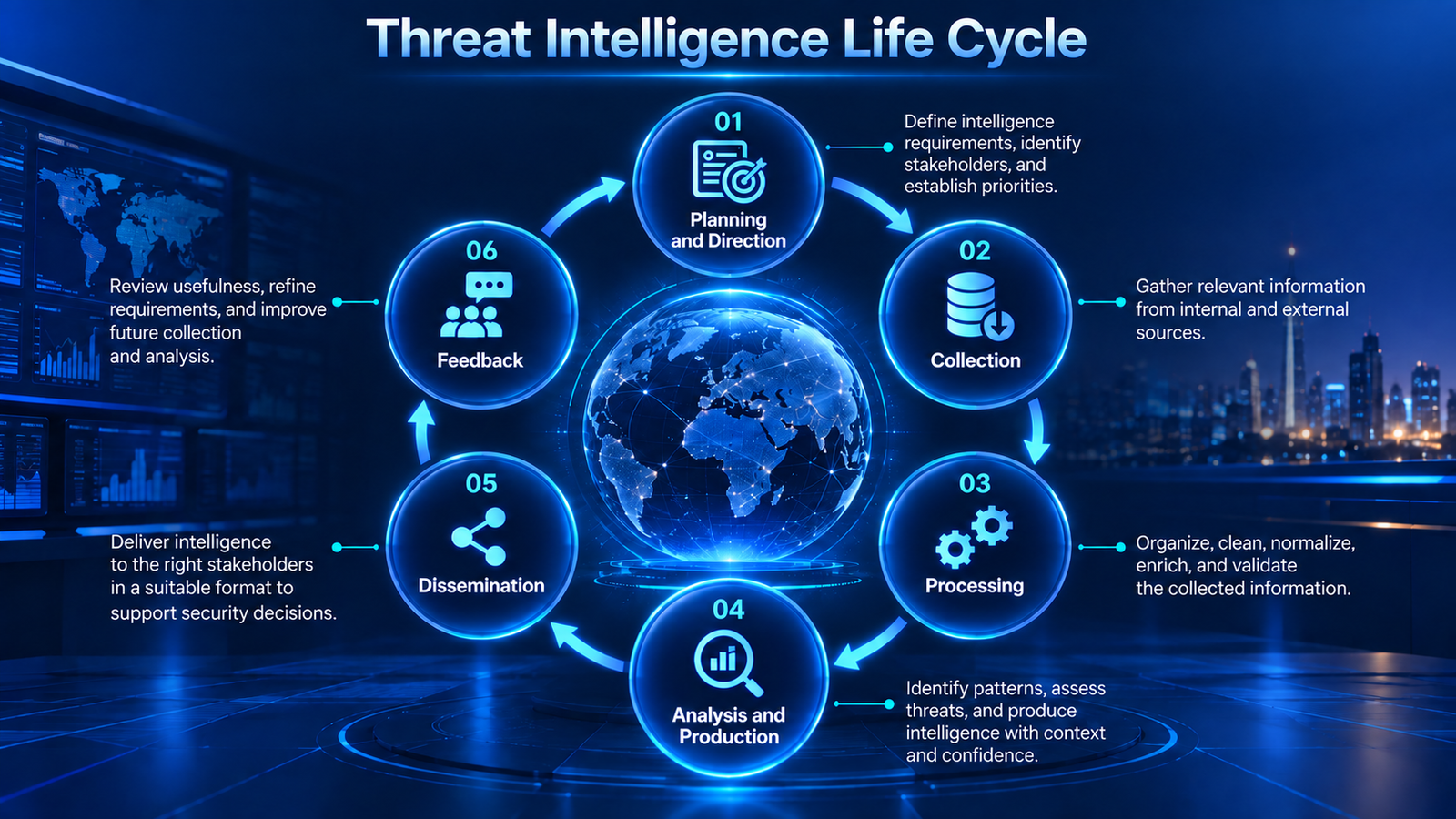
The generic Threat Intelligence Life Cycle consists of six phases:
- Planning and Direction
- Collection
- Processing
- Analysis and Production
- Dissemination
- Feedback
Each phase has a specific purpose, but the phases are closely connected. The process is repeated as intelligence requirements change and new information becomes available.
Planning and Direction
Planning and Direction is the first phase of the Threat Intelligence Life Cycle. It establishes why intelligence is required, what questions need to be answered, and how the intelligence activity will support organizational objectives.
The direction phase prevents intelligence collection from becoming an unstructured search for information. It ensures that collection and analysis activities are guided by defined requirements.
Defining Intelligence Requirements
Intelligence requirements describe the information that an organization needs to understand a threat or support a security decision.
Examples include:
- Which threat actors may target the organization?
- Which industries or technologies are being targeted?
- Which vulnerabilities are being actively exploited?
- Which attack techniques are relevant to the organization?
- Which assets are exposed to a particular threat?
- What indicators should security teams monitor?
- What changes could affect the organization’s risk position?
Requirements should be specific enough to guide collection and analysis.
Identifying Stakeholders
The intelligence requirements depend on the intended audience. Different stakeholders need different types of information.
Potential stakeholders include:
- Security operations teams.
- Incident response teams.
- Vulnerability management teams.
- Security architects.
- Risk management teams.
- Governance, risk, and compliance teams.
- IT infrastructure teams.
- Business leaders.
- Executive management.
For example, a security operations team may need technical indicators, while executive management may need information about business impact, exposure, and risk.
Establishing Priorities and Objectives
Not every threat requires the same level of attention. Planning should establish priorities based on factors such as:
- Business criticality.
- Asset exposure.
- Threat likelihood.
- Potential impact.
- Threat actor capability.
- Relevance to the organization.
- Regulatory or contractual requirements.
- Availability of reliable intelligence.
The outcome of this phase is a clear set of intelligence requirements and priorities.
Collection
The Collection phase involves gathering information that can help answer the intelligence requirements established during Planning and Direction.
Collection should be purposeful. Information should be selected based on its relevance, reliability, availability, and usefulness for the intended analysis.
Identifying Collection Requirements
Collection requirements translate intelligence requirements into specific information needs.
For example, an intelligence requirement may ask whether a particular threat actor is targeting the organization’s industry. Collection requirements may then include:
- Known threat actor names.
- Associated malware.
- Known attack techniques.
- Targeted sectors.
- Exploited vulnerabilities.
- Reported campaigns.
- Relevant indicators of compromise.
Gathering Relevant Information
Information may be collected from internal and external sources.
Internal information may include:
- Security event logs.
- SIEM records.
- Endpoint alerts.
- Network monitoring data.
- Incident response reports.
- Vulnerability assessment results.
- Firewall and proxy records.
- Identity and access events.
- Cloud security alerts.
- Previous investigation findings.
External information may include:
- Public threat reports.
- Government advisories.
- Industry information-sharing groups.
- Security research.
- Vulnerability disclosures.
- Threat intelligence providers.
- Malware analysis reports.
- Dark web monitoring services, where legally and appropriately used.
Selecting Appropriate Intelligence Sources
Sources should be evaluated according to:
- Relevance.
- Reliability.
- Accuracy.
- Timeliness.
- Source reputation.
- Collection method.
- Potential bias.
- Level of supporting evidence.
A large quantity of information does not necessarily produce better intelligence. High-quality and relevant information is more valuable than excessive information with limited context.
Processing
The Processing phase converts collected information into a structured and usable form.
Collected information may contain duplicate records, inconsistent formats, incomplete fields, irrelevant content, or technical data that cannot be analyzed directly. Processing prepares the information for analysis.
Organizing Collected Information
Information should be organized according to its type, source, time, relevance, and intended use.
Examples include:
- Grouping indicators by type.
- Organizing reports by threat actor.
- Categorizing vulnerabilities by affected technology.
- Separating internal observations from external reporting.
- Recording the source and collection date.
- Associating events with affected assets.
Removing Duplicates and Irrelevant Data
The same indicator or threat event may appear in several sources. Duplicate information can increase workload and create the impression that multiple independent sources have confirmed the same finding.
Processing may therefore involve:
- Removing duplicate records.
- Filtering irrelevant information.
- Identifying repeated reports.
- Excluding unsupported claims.
- Removing expired or obsolete data.
- Separating background information from actionable findings.
Normalizing and Enriching Information
Normalization converts information into consistent formats.
For example:
- IP addresses are stored in a consistent format.
- Domain names are normalized.
- Malware names are mapped to known aliases.
- Timestamps are converted to a common time standard.
- Vulnerability identifiers are recorded consistently.
- Attack techniques are mapped to recognized classifications.
Enrichment adds context to the collected information. This may include:
- Geolocation.
- Domain registration information.
- Malware family details.
- Vulnerability severity.
- Asset ownership.
- Threat actor associations.
- Related attack techniques.
- Historical activity.
- Confidence levels.
Validating Information Quality
Processing should also assess whether the information is sufficiently reliable for analysis.
Validation may consider:
- Whether the source is trustworthy.
- Whether the information is supported by evidence.
- Whether the indicator is still active.
- Whether multiple sources provide confirmation.
- Whether the information is relevant to the organization.
- Whether the data contains contradictions or errors.
The output of Processing is organized and enriched information that is ready for analysis.
Analysis and Production
The Analysis and Production phase transforms processed information into intelligence findings.
Analysis is more than collecting facts. It involves examining relationships, identifying patterns, assessing significance, and determining what the information means for the organization.
Identifying Patterns and Relationships
Analysts examine information to identify connections between events, indicators, vulnerabilities, threat actors, and attack techniques.
Examples include:
- Connecting several alerts to the same campaign.
- Identifying repeated activity from related infrastructure.
- Linking a vulnerability to observed exploitation.
- Associating malware with a known threat actor.
- Identifying a pattern of targeting against a specific sector.
- Mapping observed behavior to attack techniques.
Assessing Threats and Risks
The analysis should determine the significance of the findings.
This may involve considering:
- Threat actor capability.
- Threat actor intent.
- Likelihood of targeting.
- Potential business impact.
- Exposure of organizational assets.
- Exploitability of vulnerabilities.
- Existing security controls.
- Relevance to the organization’s environment.
The same threat may have different levels of significance for different organizations.
Developing Intelligence Findings
The result of analysis should be expressed as clear intelligence findings.
A useful finding may explain:
- What happened.
- What threat is involved.
- Who may be responsible.
- Which assets or sectors are affected.
- How the threat operates.
- Why the threat matters.
- What evidence supports the assessment.
- What actions may be appropriate.
The finding should distinguish confirmed facts from assumptions, estimates, and analytical judgments.
Establishing Context and Confidence
Intelligence should include enough context for the recipient to understand its meaning.
Context may include:
- Source information.
- Date and time.
- Affected technologies.
- Geographic relevance.
- Threat actor background.
- Related events.
- Confidence level.
- Intelligence gaps.
- Potential impact.
Confidence indicates how strongly the available evidence supports the assessment. It helps stakeholders understand whether the finding is confirmed, probable, possible, or uncertain.
Dissemination
The Dissemination phase delivers intelligence to the stakeholders who need it.
Intelligence must reach the appropriate audience in a suitable format and within a useful time frame. Even accurate intelligence has limited value if it is delivered too late or to people who cannot act on it.
Delivering Intelligence to Stakeholders
Different stakeholders require different forms of intelligence.
Security operations teams may need:
- Indicators of compromise.
- Detection recommendations.
- Threat actor activity.
- Relevant attack techniques.
- Urgent security advisories.
Incident response teams may need:
- Evidence related to an incident.
- Adversary behavior.
- Malware information.
- Investigation leads.
- Containment considerations.
Security leadership may need:
- Threat trends.
- Business impact.
- Exposure assessments.
- Risk implications.
- Recommended priorities.
Selecting Appropriate Intelligence Formats
Intelligence may be disseminated through:
- Threat advisories.
- Intelligence reports.
- Security briefings.
- Dashboards.
- SIEM integrations.
- Threat intelligence platforms.
- Incident notifications.
- Risk reports.
- Executive summaries.
- Indicator feeds.
The format should match the purpose and audience. Technical teams generally require detailed information, while business stakeholders usually require summarized findings and implications.
Supporting Security Decisions
Disseminated intelligence should support a decision or action.
Examples include:
- Blocking malicious infrastructure.
- Prioritizing a vulnerability.
- Updating detection rules.
- Investigating suspicious activity.
- Adjusting monitoring coverage.
- Reviewing security architecture.
- Revising risk assessments.
- Improving incident response plans.
- Informing executive risk decisions.
Dissemination should therefore focus on usefulness rather than simply distributing information.
Feedback
The Feedback phase evaluates whether the intelligence met the original requirements and whether it was useful to the recipients.
Feedback helps determine whether the intelligence process should be adjusted for future cycles.
Reviewing Intelligence Usefulness
Stakeholders may provide feedback about:
- Relevance.
- Accuracy.
- Timeliness.
- Clarity.
- Level of detail.
- Ease of use.
- Actionability.
- Missing information.
For example, a security operations team may report that an intelligence feed contains too many false positives, while a risk team may request more information about business impact.
Refining Intelligence Requirements
Feedback may identify new questions or changes in organizational priorities.
Intelligence requirements may need to be updated when:
- The threat environment changes.
- New technologies are introduced.
- Business operations change.
- A major incident occurs.
- A new threat actor becomes relevant.
- A vulnerability affects critical assets.
- Existing intelligence is no longer useful.
Refined requirements help ensure that future collection and analysis activities remain focused.
Improving Future Collection and Analysis
Feedback can improve the quality of the overall life cycle.
Possible improvements include:
- Adding new intelligence sources.
- Removing unreliable sources.
- Improving data processing.
- Updating enrichment methods.
- Refining analytical techniques.
- Adjusting dissemination formats.
- Improving stakeholder communication.
- Reducing duplicate or irrelevant information.
- Increasing the speed of intelligence delivery.
Feedback connects the end of one cycle with the planning of the next cycle.
Conclusion
The Threat Intelligence Life Cycle provides a structured method for converting raw information into useful intelligence. Its six phases are Planning and Direction, Collection, Processing, Analysis and Production, Dissemination, and Feedback.
Planning establishes intelligence requirements. Collection gathers relevant information. Processing organizes and validates that information. Analysis and Production develop meaningful findings. Dissemination delivers the findings to stakeholders, and Feedback improves future intelligence activities.
The life cycle is not a strictly one-time sequence. It is a continuing process in which intelligence requirements, sources, analysis, and outputs are refined as organizational needs and threat conditions change.
References
Online Sources
NIST – Guide to Cyber Threat Information Sharing
Provides guidance on collecting, sharing, and using cyber threat information to support organizational security activities.
CISA – Assessing the Potential Value of Cyber Threat Intelligence Feeds
Explains how to assess threat intelligence feeds based on relevance, usability, applicability, and actionability. (cisa.gov)
MITRE – Threat Intelligence
Explains how the ATT&CK framework can be used to structure, compare, and analyze threat intelligence and connect findings with adversary behaviors.