International Organization for Standardization (ISO)
Introduction
The International Organization for Standardization (ISO) is an independent, non-governmental international standards organization that develops and publishes globally recognized standards across a broad range of industries and technical disciplines. ISO brings together national standards bodies from around the world to develop consensus-based standards that promote quality, safety, interoperability, innovation, and international cooperation.
ISO standards provide common requirements, specifications, terminology, guidelines, and best practices for products, services, processes, management systems, and technologies. They help organizations, industries, and governments improve quality, efficiency, safety, sustainability, and operational consistency while supporting the reliable development and use of products, services, and systems across different countries and markets.
ISO covers a broad range of sectors, including manufacturing, engineering, healthcare, environmental management, information technology, cybersecurity, transportation, energy, agriculture, and artificial intelligence. Through international collaboration and technical expertise, ISO provides a framework for developing consistent standards that support interoperability, trust, quality, and cooperation across industries and nations.
What Is the International Organization for Standardization (ISO)?
The International Organization for Standardization (ISO) is an independent, non-governmental international standards organization that develops and publishes globally recognized standards across nearly every industry and technical discipline. Established in 1947 and headquartered in Geneva, Switzerland, ISO brings together national standards bodies from countries around the world to create consensus-based standards that improve quality, safety, reliability, efficiency, interoperability, and consistency.
Unlike regulatory agencies, ISO does not create laws or enforce compliance. Instead, it develops voluntary international standards that organizations, governments, manufacturers, and professionals can adopt to achieve consistent and reliable practices. Many governments and regulatory authorities reference ISO standards within their own legal or regulatory frameworks, making them influential even though they are not legally mandatory by default.
ISO standards cover a wide range of subjects, including quality management, environmental management, healthcare, manufacturing, information technology, artificial intelligence, energy, food safety, transportation, agriculture, engineering, and risk management. These standards provide common terminology, technical specifications, management frameworks, testing methods, and best practices that facilitate international cooperation, interoperability, and continual improvement.
History and Evolution of ISO
The need for international standardization became increasingly apparent during the early twentieth century as global trade, industrialization, and technological innovation expanded across national borders. Manufacturers often developed products using different specifications, measurements, and technical requirements, making international compatibility and trade difficult. To address these challenges, countries recognized the importance of creating common standards that could be accepted worldwide.
The origins of ISO can be traced to earlier international standardization efforts, particularly the International Federation of the National Standardizing Associations (ISA), established in 1926. Although ISA contributed to the development of international standards, its activities ceased during the Second World War.
Following the war, representatives from national standards organizations met in London in 1946 to establish a new international body dedicated to global standardization. Their efforts resulted in the formation of the International Organization for Standardization (ISO), which officially began operations on 23 February 1947.
Initially, ISO focused primarily on industrial manufacturing and engineering standards. As international cooperation expanded and technology evolved, ISO broadened its scope to include sectors such as healthcare, environmental management, transportation, agriculture, energy, information technology, manufacturing, and many other technical and professional disciplines.
Over the decades, ISO has collaborated with national standards bodies, international organizations, governments, industries, and subject matter experts to develop globally recognized standards that support quality, safety, interoperability, innovation, and international trade.
Today, ISO has published more than 25,000 international standards, making it one of the largest and most influential standards organizations in the world. Its standards continue to evolve to address emerging technologies, changing industries, environmental challenges, and the growing needs of an interconnected global economy.
Mission and Objectives of ISO
The primary mission of ISO is to develop internationally accepted standards that improve the quality, safety, efficiency, interoperability, and reliability of products, services, systems, and processes across industries. By bringing together experts from around the world, ISO creates consensus-based standards that promote innovation while reducing technical barriers to international trade.
ISO seeks to establish common technical languages and best practices that can be consistently applied across different countries, industries, and technologies. These standards enable organizations to operate more efficiently, improve customer confidence, and ensure that products and services meet internationally recognized levels of quality and performance.
The key objectives of ISO include:
- Developing internationally recognized standards through global collaboration.
- Promoting interoperability between products, services, and technologies.
- Supporting international trade by reducing technical barriers.
- Improving quality, safety, and reliability across industries.
- Encouraging innovation through standardized approaches and best practices.
- Supporting sustainable development and responsible business practices.
- Providing management frameworks for continual improvement and risk management.
- Facilitating global cooperation among governments, industries, academia, and standards organizations.
As industries and technologies continue to evolve, ISO develops standards that address new challenges while maintaining consistency, compatibility, and international acceptance across a broad range of disciplines.
Why International Standards Matter
In an increasingly connected world, organizations, governments, and individuals depend on products, systems, and services that can work together regardless of where they are designed or manufactured. Without internationally accepted standards, differences in technical specifications, terminology, measurements, and processes would create significant barriers to interoperability, trade, innovation, and collaboration.
International standards provide a common foundation that enables consistency across industries and countries. They establish agreed-upon requirements, technical specifications, testing methods, and best practices that manufacturers, service providers, developers, and other stakeholders can follow. This consistency allows products and services from different organizations to operate together while meeting expected levels of quality, safety, reliability, and performance.
International standards also contribute to improved governance, quality assurance, risk management, operational efficiency, and continual improvement. They help organizations establish repeatable processes, improve compatibility, facilitate international trade, and build confidence among customers, partners, regulators, and other stakeholders.
Ultimately, international standards promote global collaboration, technological compatibility, economic growth, and innovation by creating a common framework that supports cooperation across industries and nations.
How ISO Develops International Standards
ISO develops standards through a transparent, collaborative, and consensus-based process involving experts from national standards bodies around the world. Rather than creating standards independently, ISO coordinates international participation to ensure that standards reflect broad technical expertise and global agreement.
The standards development process typically begins when a need for a new standard is identified by industry, governments, consumers, or other stakeholders. A proposal is submitted to the relevant Technical Committee (TC), where participating member countries evaluate whether the proposed work should proceed.
Once approved, a Working Group (WG) consisting of subject matter experts is established to prepare an initial draft. The draft undergoes multiple rounds of technical review, discussion, revision, and international consultation to ensure that it addresses the needs of different industries and regions.
As the draft matures, it progresses through formal voting stages in which participating member bodies review and comment on the proposed standard. Comments received during these stages are carefully evaluated, and revisions are made until broad international consensus is achieved.
After successful approval, the standard is published as an official ISO standard and made available for adoption worldwide. ISO also periodically reviews published standards to ensure they remain current with technological advancements, industry practices, regulatory changes, and emerging needs. Standards may be revised, updated, or withdrawn based on these reviews to maintain their relevance and effectiveness.
This rigorous development process ensures that ISO standards are technically sound, globally applicable, and supported by a broad international community of experts.
ISO Organizational Structure
ISO operates through a well-defined governance and technical structure that enables experts from around the world to collaboratively develop international standards. Its organizational framework ensures that standards are developed transparently, through consensus, and with representation from national standards bodies across diverse industries and technical disciplines.
The governance structure provides strategic direction for the organization, while technical committees and working groups are responsible for developing, reviewing, maintaining, and updating international standards. This collaborative approach ensures that ISO standards remain technically sound, globally applicable, and internationally accepted.
The primary components of ISO’s organizational structure include the General Assembly, the ISO Council, the Technical Management Board (TMB), Technical Committees (TCs), Subcommittees (SCs), and Working Groups (WGs).
General Assembly
The General Assembly is the highest governing body of ISO and consists of representatives from all ISO member bodies. It meets annually to establish the organization’s strategic direction, review major initiatives, and discuss matters affecting international standardization.
The General Assembly provides a forum where member countries participate in high-level discussions regarding ISO’s priorities, governance, policies, and future direction. Although it does not develop technical standards directly, it plays a vital role in shaping the organization’s long-term vision.
ISO Council
The ISO Council oversees the governance of the organization between meetings of the General Assembly. It is responsible for ensuring that ISO’s strategic objectives are implemented effectively and that the organization operates in accordance with its statutes and policies.
The Council supervises financial management, approves strategic initiatives, monitors organizational performance, and provides overall governance oversight. It also works closely with the Technical Management Board to ensure that technical activities align with ISO’s strategic priorities.
Technical Management Board (TMB)
The Technical Management Board (TMB) manages ISO’s technical work. It oversees the standards development process, establishes Technical Committees, approves new technical projects, and coordinates technical activities across different subject areas.
The TMB ensures that standards are developed consistently, efficiently, and in accordance with ISO’s established procedures. It also promotes coordination and cooperation between committees working on related disciplines.
Technical Committees (TCs)
Technical Committees (TCs) are the primary bodies responsible for developing ISO standards. Each committee focuses on a specific technical field or industry and is composed of experts nominated by ISO member bodies.
Technical Committees identify the need for new standards, review existing standards, establish Working Groups, evaluate technical proposals, and oversee standards throughout their lifecycle. Each committee specializes in a defined area such as manufacturing, healthcare, environmental management, quality management, information technology, transportation, food safety, or engineering.
Subcommittees (SCs)
Large Technical Committees are often divided into Subcommittees (SCs) to manage specialized subject areas. Each Subcommittee is responsible for standards within its assigned scope and reports to its parent Technical Committee.
This structure allows technical experts to concentrate on specific disciplines while maintaining coordination with related committees, resulting in more focused and efficient standards development.
Working Groups (WGs)
Working Groups (WGs) are established within Technical Committees or Subcommittees to develop individual standards or address specific technical topics. They consist of subject matter experts nominated by participating member countries.
Working Groups conduct technical research, prepare draft standards, review comments received during the consultation process, and recommend revisions before a standard progresses through the formal approval stages. Their collaborative efforts form the foundation of ISO’s consensus-based standards development process.
ISO Membership
ISO is a global federation of national standards bodies, with one member representing each participating country. Rather than allowing individual organizations or companies to become members directly, ISO membership is based on recognized national standards organizations that represent their respective countries.
This structure ensures balanced international participation and enables countries to contribute to the development of standards through a coordinated national process. Member bodies nominate experts, participate in technical committees, review draft standards, and vote on proposed international standards.
ISO membership is divided into three categories:
- Member Bodies – National standards organizations with full voting rights that actively participate in governance and technical work.
- Correspondent Members – Countries that observe ISO activities and access standards information while participating on a limited basis.
- Subscriber Members – Countries with smaller economies that maintain limited involvement while benefiting from access to ISO standards and publications.
With members representing more than 170 countries, ISO is one of the world’s largest and most representative international standards organizations, bringing together experts from governments, industry, academia, and standards communities.
Types of ISO Standards
ISO develops standards for a wide range of purposes, reflecting the diverse needs of industries, governments, and society. While each standard addresses a specific subject, they generally fall into several broad categories.
Management System Standards (MSS)
Management System Standards provide frameworks for establishing, implementing, maintaining, and continually improving organizational management systems. They help organizations adopt structured approaches to governance, planning, performance evaluation, continual improvement, and achieving organizational objectives.
Examples include ISO 9001 for quality management, ISO 14001 for environmental management, ISO 22301 for business continuity, ISO/IEC 27001 for information security, and ISO/IEC 42001 for artificial intelligence management.
Technical Standards
Technical Standards define technical specifications, product requirements, testing methods, performance criteria, engineering practices, and design requirements that promote compatibility, interoperability, quality, and safety.
Terminology Standards
Terminology Standards establish common definitions, vocabulary, symbols, and classifications that enable consistent communication across industries, professions, and technical disciplines.
Guidelines and Best Practice Standards
These standards provide recommendations, principles, and implementation guidance to help organizations adopt internationally recognized best practices without prescribing mandatory requirements.
Testing and Measurement Standards
Testing and Measurement Standards define standardized methods for evaluating products, systems, materials, processes, and services to ensure consistent quality, safety, reliability, and performance.
Together, these categories demonstrate the breadth of ISO’s standardization activities and its role in supporting virtually every industry and technical discipline.
ISO Standards Numbering System
ISO standards are identified using a structured numbering system that uniquely distinguishes each published standard. Each standard is assigned a numerical designation that generally reflects its subject area rather than its publication date.
Examples include:
- ISO 9001 — Quality Management Systems
- ISO 14001 — Environmental Management Systems
- ISO 22301 — Business Continuity Management Systems
- ISO 31000 — Risk Management
- ISO 45001 — Occupational Health and Safety Management Systems
- ISO 50001 — Energy Management Systems
When a standard is jointly developed with another standards organization, the collaborating organization’s abbreviation appears before the standard number. For example, ISO/IEC indicates joint development with the International Electrotechnical Commission (IEC).
Many standards belong to larger families that address related topics. Examples include the ISO 9000 family for quality management, the ISO 14000 family for environmental management, and the ISO/IEC 27000 family for information security management.
The numbering system enables standards to be identified, referenced, and managed consistently worldwide while making it easier to recognize related standards within the same family.
ISO and Other International Standards Bodies
ISO works closely with numerous international organizations to develop globally recognized standards and avoid duplication of effort. Collaboration between standards bodies promotes consistency, interoperability, harmonization, and international cooperation across industries and technologies.
Some of the most significant organizations that collaborate with or complement ISO include:
- International Electrotechnical Commission (IEC) – Develops international standards for electrical, electronic, and related technologies.
- International Telecommunication Union (ITU) – Develops international standards for telecommunications and global communication networks.
- Institute of Electrical and Electronics Engineers (IEEE) – Publishes technical standards covering computing, electronics, networking, wireless communications, and software engineering.
- Internet Engineering Task Force (IETF) – Develops Internet protocols and technical standards that support the operation of the Internet.
- National Institute of Standards and Technology (NIST) – Develops standards, frameworks, guidelines, and technical publications across science, engineering, manufacturing, and information technology.
- Information Systems Audit and Control Association (ISACA) – Develops guidance and frameworks for governance, risk management, auditing, information systems, and digital trust.
Although each organization has its own mission, scope, and responsibilities, their work often complements one another, contributing to the development and adoption of internationally recognized standards and best practices.
ISO in Information Technology
Information technology is one of the many technical fields in which ISO develops international standards. As digital technologies have evolved, the need for globally accepted standards has increased to ensure that computer systems, software, networks, cloud platforms, and digital services can operate consistently, reliably, and interoperably across different environments.
To support this rapidly evolving field, ISO collaborates with the International Electrotechnical Commission (IEC) through ISO/IEC Joint Technical Committee 1 (JTC 1). Established in 1987, JTC 1 is responsible for developing international standards for information technology and coordinates the work of numerous technical experts from participating member countries.
ISO/IEC JTC 1 develops standards covering a broad range of information technology disciplines, including:
- Artificial Intelligence (AI)
- Cloud Computing
- Software Engineering
- Systems Engineering
- Data Management
- Internet of Things (IoT)
- Digital Identity
- Biometrics
- Smart Cities
- Big Data
- Blockchain and Distributed Ledger Technologies
- Information Security
These standards provide common terminology, technical specifications, reference architectures, management frameworks, and best practices that promote interoperability, compatibility, reliability, and international cooperation throughout the global information technology ecosystem.
By developing internationally recognized IT standards, ISO helps organizations, technology providers, governments, and researchers adopt consistent approaches that support innovation, digital transformation, and global interoperability.
ISO and the OSI Reference Model
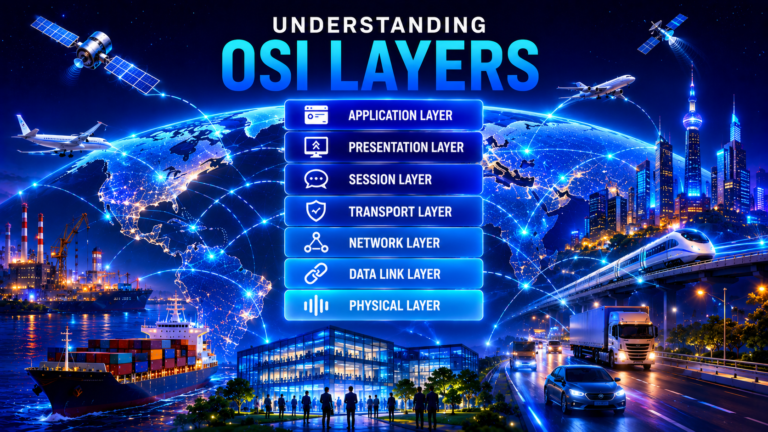
One of ISO’s most significant contributions to information technology is the development of the Open Systems Interconnection (OSI) Reference Model, published as ISO 7498 in 1984. The OSI model introduced a standardized seven-layer conceptual framework that describes how data is transmitted between networked systems.
The primary objective of the OSI model was to promote interoperability by providing a common reference architecture that vendors, developers, engineers, and standards organizations could use when designing communication protocols and networking technologies. Each layer performs a specific function while communicating with adjacent layers through clearly defined interfaces.
Although the Internet ultimately adopted the TCP/IP protocol suite as its operational networking architecture, the OSI model remains the universal conceptual framework for understanding computer networking. It continues to be widely used in education, protocol design, documentation, network analysis, and troubleshooting.
The OSI model has influenced the design of numerous networking technologies and continues to provide a common language for describing network communication, protocols, devices, and layered architectures. It remains one of ISO’s most enduring contributions to the field of networking.
Benefits of ISO Standards
ISO standards provide a globally recognized foundation for improving the quality, safety, reliability, interoperability, efficiency, and consistency of products, services, systems, and processes. By adopting internationally accepted standards, organizations can establish common practices that support operational excellence and continual improvement.
Some of the key benefits of ISO standards include:
- Establishing internationally recognized best practices.
- Improving product and service quality.
- Promoting interoperability and compatibility.
- Supporting innovation and technological advancement.
- Facilitating international trade and market access.
- Improving operational efficiency and consistency.
- Supporting governance and risk management.
- Building confidence among customers, partners, and stakeholders.
- Supporting regulatory and contractual requirements.
- Encouraging continual improvement.
Because ISO standards are developed through international collaboration and consensus, they provide trusted frameworks that can be adopted across organizations of different sizes, industries, and geographical regions. Their broad applicability enables governments, industries, educational institutions, and professionals to work within a common framework that promotes consistency, reliability, and global cooperation.
Conclusion
The International Organization for Standardization (ISO) is a global standards organization that develops international standards across a wide range of technical, industrial, economic, and societal fields. Through its international membership and structured standards-development process, ISO provides common frameworks, specifications, and practices that support consistency and interoperability across countries and industries.
ISO standards address diverse areas, including information technology, information security, quality management, environmental management, manufacturing, healthcare, and many other fields. Their broad scope makes ISO an important part of the international standards ecosystem.
Understanding ISO, its organizational structure, standards-development process, and different types of standards provides a foundation for understanding how internationally recognized standards are developed and applied across different fields.
References
ISO – About ISO
Provides an authoritative overview of ISO, its purpose, structure, membership, and role in international standardization.