Threat Intelligence-Led Testing vs. Proactive Security Testing
Introduction
Security testing is an essential practice for identifying security weaknesses, understanding exposure to cyber threats, analyzing potential attack paths, and evaluating the effectiveness of security controls. It examines whether systems, applications, networks, infrastructure, and digital environments can withstand potential attacks and whether defensive capabilities can prevent, detect, respond to, and recover from malicious activities.
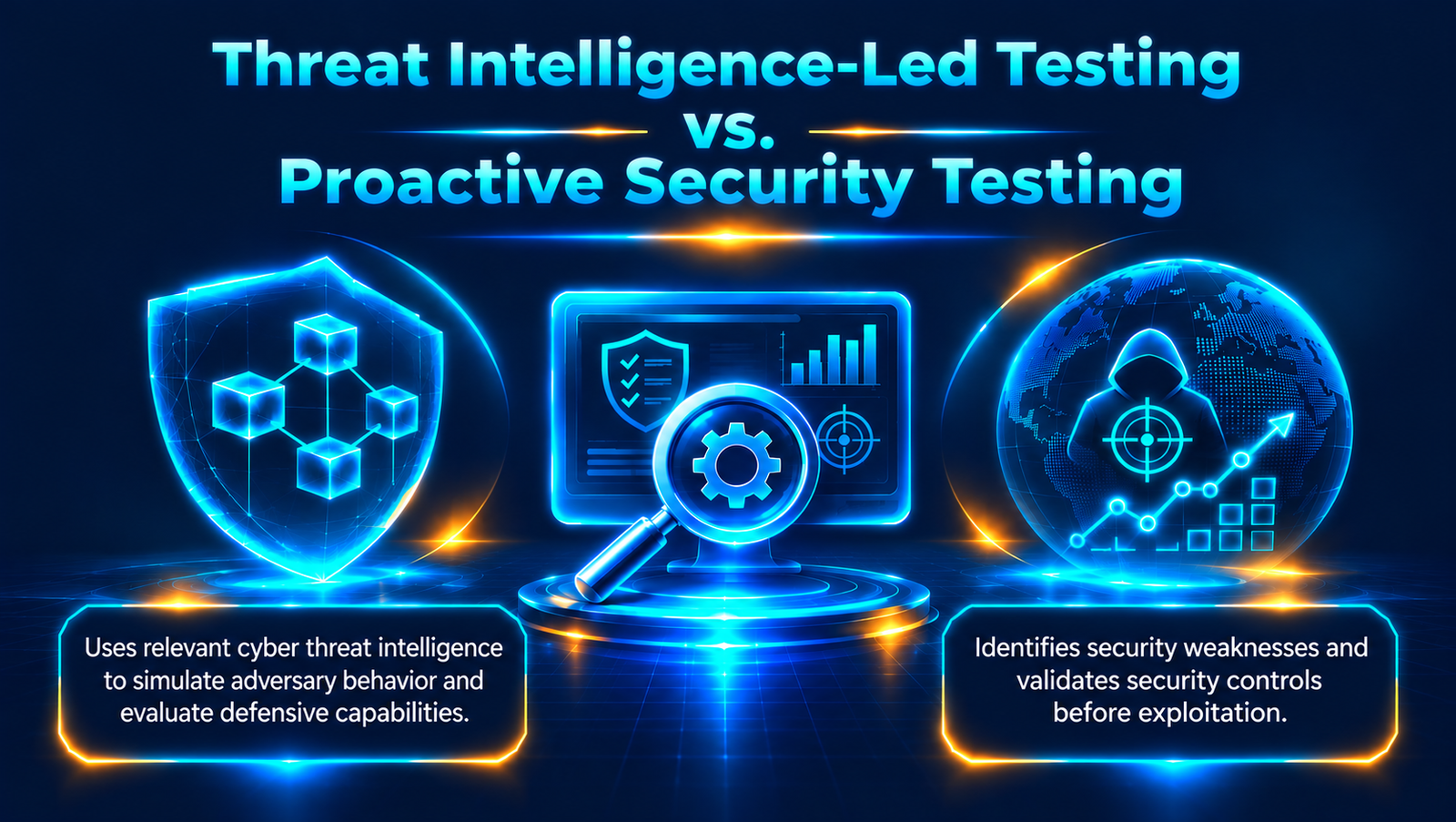
Security testing encompasses different approaches and methodologies. Proactive Security Testing focuses on identifying weaknesses and validating security controls before exploitation, while Threat Intelligence-Led Testing uses relevant cyber threat intelligence to develop adversary-based scenarios and evaluate defensive capabilities. Although both contribute to security preparedness, they differ in their starting points, information requirements, testing scenarios, and areas of emphasis.
Understanding these approaches helps establish how security testing can identify technical weaknesses, assess exposure, and evaluate the ability to defend against relevant cyber threats.
Understanding Security Testing
Security Testing is the systematic assessment of systems, applications, networks, infrastructure, and security controls to identify vulnerabilities, evaluate security exposure, analyze potential attack paths, and validate security effectiveness.
It extends beyond vulnerability identification and penetration testing. Security testing also involves understanding the attack surface, examining potential attack paths, assessing threat scenarios, validating security controls, and evaluating the ability to detect and respond to malicious activities.
Security testing can be performed at different stages of the IT lifecycle and across different technology environments. Its scope may include individual devices and applications, enterprise infrastructure, cloud environments, industrial control systems, critical infrastructure, connected devices, and wider digital ecosystems.
Purpose of Security Testing
The primary purpose of security testing is to understand the security condition of an environment and identify opportunities to improve its protection and resilience. It provides evidence about weaknesses, exposures, attack possibilities, and the effectiveness of existing security measures.
Security testing first establishes what needs to be protected and where potential exposure exists. This involves identifying known and unknown assets, applications, APIs, networks, cloud resources, endpoints, identities, third-party connections, and other components that could be exposed to attacks. It also examines vulnerabilities, insecure configurations, exposed services, outdated software, compromised credentials, excessive privileges, and other conditions that could be exploited.
Beyond identifying individual weaknesses, security testing examines how an attacker could combine them to compromise an environment. Attack path analysis considers possible sequences of activities, from initial access and privilege escalation to lateral movement and access to sensitive or critical assets.
Security testing also considers the threat landscape. It examines threat actors, campaigns, motivations, capabilities, targeting patterns, and adversary behaviors. Emerging vulnerabilities, exploitation trends, and changes in attack techniques can be assessed to identify new exposure. Threat intelligence, historical patterns, and behavioral analysis may also support the assessment of plausible future attack scenarios, although they cannot establish with certainty which attacks will occur.
Another important purpose is to validate the effectiveness of security controls. This includes examining preventive controls such as firewalls and endpoint protection, detective controls such as security monitoring and detection systems, and responsive controls such as incident response and containment mechanisms. Adversary simulation, control validation, and detection testing help determine whether these capabilities perform as intended under selected attack conditions.
Finally, security testing evaluates whether technology environments can withstand attacks, limit their impact, maintain essential services, and support recovery. Repeating assessments as systems, configurations, applications, and threats change supports continuous security validation.
Security Testing and Security Assurance
Security testing contributes to security assurance by providing evidence that security requirements, controls, and protective measures are implemented and operating as intended.
Security assurance is broader than testing. It includes governance, risk management, security policies, architecture reviews, compliance assessments, control assessments, audits, and other activities that establish confidence in the security of systems and environments.
Security testing supports this broader assurance process by examining actual technical conditions and validating security capabilities through practical assessment. Its findings can be used to improve security architecture, prioritize remediation, strengthen controls, and inform risk management decisions.
Security Testing Across the IT Lifecycle
Security testing is not limited to a particular stage of technology deployment or operation. It can be performed throughout the IT lifecycle, from initial engineering and design to delivery, deployment, and ongoing operations.
Understanding the IT lifecycle helps establish where security requirements should be incorporated, where testing activities should take place, and how security validation can continue as technology environments evolve.
Understanding the IT Engineering, Delivery, and Operations Lifecycle
The IT lifecycle can be understood through the related activities of IT Engineering, IT Delivery, and IT Operations. These are practical groupings of technology activities rather than a universally prescribed lifecycle standard.
IT Engineering
IT Engineering covers the activities involved in defining, designing, and developing technology solutions. It includes understanding requirements, evaluating technology options, designing architectures, selecting platforms, developing applications, and engineering infrastructure and services.
Security considerations should be incorporated during this stage rather than postponed until a solution is ready for deployment. Architecture decisions, technology selection, application design, identity requirements, data handling, and network design can significantly influence the security of the resulting environment.
IT Delivery
IT Delivery covers the activities involved in integrating, testing, preparing, and deploying technology solutions into their intended environments. It includes system integration, quality assurance, functional testing, security validation, release management, deployment, documentation, and operational transition.
Security testing during delivery helps identify weaknesses before systems and services enter production. It also verifies that security requirements and configurations defined during engineering have been implemented correctly.
IT Operations
IT Operations covers the ongoing administration, management, monitoring, and maintenance of technology environments and services. It includes service management, infrastructure administration, configuration management, patching, vulnerability management, availability monitoring, incident management, and operational security.
Security testing during operations helps identify weaknesses introduced by configuration changes, technology upgrades, new integrations, evolving threats, and changes in the attack surface. It also helps determine whether security controls remain effective throughout the operational life of a system.
Security Testing Across the Lifecycle Phases
Security requirements, engineering practices, and testing activities are incorporated differently across the IT lifecycle. Some practices are established primarily during engineering, while others are implemented during delivery or maintained throughout operations.
Security Testing During IT Engineering
During IT Engineering, security focuses on incorporating protection requirements into technology architecture, system design, and development. Security should be considered from the beginning of the engineering process rather than introduced only after a solution has been developed.
Security by Design incorporates security requirements and considerations into the design and engineering of systems, applications, infrastructure, and services. Potential threats, vulnerabilities, trust boundaries, access requirements, data protection, and security controls are considered when making architecture and design decisions.
Secure Architecture focuses on designing technology environments with appropriate security structures, components, boundaries, and controls. It considers how systems interact, how access is controlled, how data is protected, and how security responsibilities are distributed across technology components. Architecture decisions may incorporate network segmentation, identity and access controls, encryption, secure communication, isolation, monitoring, and defense in depth.
Threat Modeling is used to identify potential threats, understand how systems could be attacked, and determine appropriate security measures. It examines system architecture, data flows, trust boundaries, assets, entry points, and potential attack scenarios. Threat modeling helps identify security requirements and design weaknesses before systems are implemented or deployed.
Privacy by Design incorporates privacy and personal data protection requirements into the design and development of systems, applications, services, and business processes. It considers how personal data is collected, processed, stored, shared, retained, and deleted.
Secure Software Development incorporates security practices throughout software development. It includes defining security requirements, reviewing application architecture, applying secure coding practices, analyzing software components, and testing applications. Secure coding practices such as input validation, output encoding, secure authentication, authorization checks, and secure session management help reduce vulnerabilities introduced during development.
Security testing activities during IT Engineering may include security requirements reviews, architecture and design assessments, threat modeling, secure code reviews, static application security testing, and software composition analysis to identify vulnerable or insecure dependencies. These activities help identify weaknesses before they become embedded in the solution and more expensive to address.
Security Testing During IT Delivery
During IT Delivery, security testing focuses on validating the implementation, configuration, integration, and deployment readiness of technology solutions.
Secure by Default is relevant during the preparation and deployment of technology solutions. It aims to ensure that systems and services are configured to provide an appropriate level of security when first deployed or used. This includes enabling protective settings, restricting unnecessary access, disabling unused services, and avoiding insecure default configurations.
DevSecOps integrates security practices into development, testing, release, deployment, and operations. It encourages collaboration among development, security, and operations teams and incorporates security checks into delivery pipelines. Examples include automated code analysis, software composition analysis, infrastructure-as-code scanning, container security assessment, and deployment security checks.
Security testing during IT Delivery may involve vulnerability assessment, penetration testing, dynamic application security testing, API testing, infrastructure and network configuration assessment, and security testing of system integrations and external interfaces. Cloud configurations, identity and access controls, and deployment security requirements should also be validated before production release.
These activities help determine whether the implemented solution meets its security requirements and whether identified weaknesses have been addressed before operational handover.
Security Testing During IT Operations
During IT Operations, security testing focuses on continuously assessing exposure, identifying newly introduced weaknesses, and validating the effectiveness of security controls under operational conditions.
Security Configuration Management helps maintain secure configurations throughout the operational life of technology environments. It involves monitoring configuration changes, identifying deviations from approved security baselines, and correcting insecure settings.
Defense in Depth is applied across the operational environment through multiple layers of preventive, detective, and responsive controls. It helps ensure that the failure or bypass of one security control does not automatically result in the compromise of an entire environment.
Continuous Security Validation involves repeatedly assessing whether security controls and defensive capabilities continue to operate effectively as technology environments, configurations, and threats change.
Security testing during operations may include attack surface assessment, vulnerability and configuration assessments, penetration testing, Threat Intelligence-Led Testing, adversary emulation, red team exercises, breach and attack simulation, security control validation, detection engineering, threat hunting, and incident response exercises. Cyber resilience and recovery testing can also evaluate the ability to maintain essential services and recover from disruption.
Operational security testing should be performed periodically and when significant changes occur, such as technology upgrades, infrastructure migrations, new integrations, changes in access privileges, or the introduction of new services.
Some practices, such as DevSecOps, Shift Left Security, and Defense in Depth, extend across multiple lifecycle phases. They should not be treated as activities exclusive to a single phase. Their application depends on the technology, implementation approach, and security objectives.
Understanding Proactive Security Testing
Proactive Security Testing is an approach to identifying security weaknesses, assessing potential exposure, and validating security controls before those weaknesses are exploited or security incidents occur.
It involves systematically examining technology environments to understand their security condition, identify possible attack paths, and evaluate whether existing defensive measures provide the intended level of protection.
Proactive Security Testing does not necessarily depend on cyber threat intelligence. It can be initiated using asset information, vulnerability data, architecture documentation, security requirements, risk assessments, configuration information, and predefined testing objectives.
Objectives of Proactive Security Testing
The primary objective is to identify and address security weaknesses before they can be exploited. This includes assessing the exposure of systems, applications, networks, and infrastructure, identifying potential attack paths, and evaluating the effectiveness of preventive security controls.
It also helps validate detection and response capabilities, assess security architecture and implementation, and identify weaknesses introduced through technology changes and integrations. The resulting findings provide actionable information for remediation, risk reduction, and improvement of defensive capabilities.
Approach to Proactive Security Testing
Proactive Security Testing typically begins by defining the scope, identifying the assets and environments to be assessed, and establishing the objectives of the assessment.
The testing approach is selected according to the environment, the risks being examined, and the level of assurance required. It may involve automated scanning, manual assessment, controlled exploitation, attack simulation, or a combination of these methods.
The findings are analyzed to determine the nature and severity of weaknesses, their potential impact, and the remediation required. Where appropriate, testing is repeated after remediation to validate whether the identified weaknesses have been addressed.
Types of Proactive Security Testing
Proactive Security Testing encompasses multiple testing and assessment activities. The selection of methods depends on the environment, objectives, and required level of validation.
Attack Surface Assessment
Attack Surface Assessment identifies and examines the points through which an attacker could potentially interact with or gain access to a technology environment. It includes externally exposed assets, internal systems, applications, APIs, network services, cloud resources, identities, endpoints, and third-party connections.
It also helps identify unknown or unmanaged assets that may introduce security exposure.
Vulnerability Assessment
Vulnerability Assessment identifies known security weaknesses in systems, applications, network devices, operating systems, software components, and infrastructure.
It may use automated scanning, configuration analysis, software vulnerability databases, and manual verification. The results help identify vulnerabilities that require remediation and provide information for prioritizing security risks.
Penetration Testing
Penetration Testing is a controlled security assessment in which testers attempt to exploit identified weaknesses to determine whether unauthorized access or other security impacts can be achieved.
It helps establish the practical exploitability of vulnerabilities and demonstrates how weaknesses may be combined to compromise systems, applications, or data.
Attack Path Analysis
Attack Path Analysis examines the possible sequences of actions an attacker could take to move from an initial access point toward sensitive or critical assets.
It may consider exposed services, vulnerable systems, excessive privileges, identity relationships, network connectivity, and trust relationships to identify paths that could lead to compromise.
Security Configuration Assessment
Security Configuration Assessment examines whether systems, applications, network devices, cloud services, and infrastructure components are configured according to established security requirements and recommended baselines.
It helps identify insecure settings, unnecessary services, weak access configurations, and deviations from approved security standards.
Security Architecture Assessment
Security Architecture Assessment examines the security design and implementation of technology environments. It evaluates security boundaries, trust relationships, access controls, network segmentation, encryption, monitoring, and the placement of security controls.
It helps identify architectural weaknesses that may create opportunities for compromise or limit the effectiveness of defensive measures.
Threat Intelligence-Led Testing
Threat Intelligence-Led Testing uses cyber threat intelligence to develop relevant adversary-based testing scenarios. It provides a threat-informed perspective that complements broader proactive security testing and is discussed in detail in the following section.
Red Teaming and Adversary Emulation
Red teaming and adversary emulation simulate selected adversarial activities to evaluate how effectively an environment can prevent, detect, and respond to attacks. Their scope and objectives vary according to the exercise. These methods can be used in proactive assessments, including intelligence-led exercises.
Breach and Attack Simulation
Breach and Attack Simulation (BAS) uses automated techniques to simulate selected attack behaviors and evaluate the effectiveness of security controls. It can help validate whether controls such as endpoint protection, email security, network security, and detection technologies respond as expected.
BAS supports repeatable security validation, although its results depend on the quality and coverage of the simulated techniques and the accuracy of the testing environment.
Security Control Validation
Security Control Validation examines whether implemented security controls operate as intended. It may involve testing preventive controls, evaluating detection rules, validating alert generation, and assessing response procedures.
It helps establish whether security controls provide the expected protection against selected attack scenarios.
Detection and Response Testing
Detection and Response Testing evaluates whether security monitoring and incident response capabilities can identify and address malicious activities.
It may involve testing security event collection, correlation rules, alerts, investigation procedures, escalation mechanisms, containment actions, and incident response workflows.
Application, Cloud, and Identity Security Testing
Specialized testing may be performed across particular technology domains. Application Security Testing examines application code, interfaces, authentication, authorization, and data handling. Cloud Security Testing evaluates cloud configurations, identities, workloads, services, and exposed resources. Identity Security Testing examines authentication mechanisms, access privileges, identity lifecycle processes, and privileged access controls.
These testing activities help assess the security of technology environments according to their specific architectures and risks.
Scope of Proactive Security Testing
Proactive Security Testing can cover a wide range of technology environments and security capabilities. These include IT infrastructure, networks, servers, endpoints, applications, APIs, software platforms, digital services, cloud environments, containers, and virtualized infrastructure.
It can also extend to identity systems, authentication and authorization mechanisms, privileged access, data repositories, industrial control systems, operational technology, connected devices, third-party services, and supply chain connections. Security monitoring, incident response, and recovery capabilities may also be included in the assessment.
The scope may be broad or targeted depending on the assessment objectives. It can focus on discovering weaknesses across an entire environment or validating specific security controls and attack scenarios.
Understanding Threat Intelligence-Led Testing
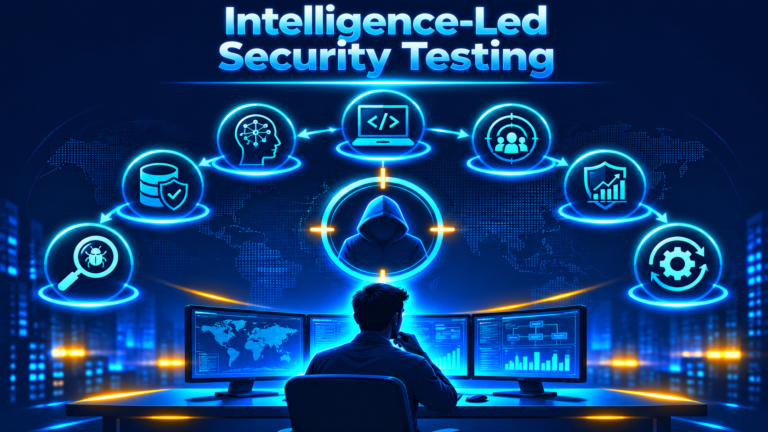
Threat Intelligence-Led Testing is a security testing approach that uses relevant and actionable cyber threat intelligence to design and execute realistic attack scenarios.
It incorporates information about threat actors, their motivations, capabilities, targeting patterns, campaigns, and observed tactics, techniques, and procedures (TTPs). The objective is to determine how effectively security controls, monitoring capabilities, and defensive teams can prevent, detect, investigate, and respond to threats relevant to the environment being assessed.
Threat Intelligence-Led Testing connects knowledge about adversary behavior with practical security validation. It helps move testing beyond the question of whether a vulnerability exists toward examining whether the environment can withstand attack methods that are relevant to its threat exposure.
Role of Cyber Threat Intelligence in Testing
Cyber Threat Intelligence provides the context needed to select and develop relevant attack scenarios. It helps establish which threat actors or campaigns may be relevant, what assets or sectors they target, and which techniques they use to achieve their objectives.
Threat intelligence may include information about threat actors and their associated groups, motivations, capabilities, targeting patterns, cyber threat campaigns, attack objectives, TTPs, indicators of compromise (IOCs), exploited vulnerabilities, malware, tools, attack infrastructure, and observed adversary behavior.
This information is analyzed and evaluated before being used in testing. Not every intelligence report or observed attack technique is suitable for a particular environment. Relevance depends on the threat actor’s targeting, the technology in use, the exposed assets, and the potential impact.
Objectives of Threat Intelligence-Led Testing
Threat Intelligence-Led Testing aims to assess exposure to relevant threat actors and campaigns and evaluate whether defensive capabilities can withstand their associated attack behaviors.
It helps determine whether preventive controls can block relevant attack techniques, whether security monitoring can detect adversary activities, and whether security teams can investigate and respond to simulated attacks. The results can reveal gaps in detection coverage, security controls, and incident response processes.
Ultimately, the objective is to improve defensive capabilities by testing against threats that are relevant to the environment rather than relying exclusively on generic attack scenarios.
Intelligence Requirements and Threat Relevance
Threat Intelligence-Led Testing begins with establishing the intelligence requirements for the assessment. These requirements determine what information is needed to understand the relevant threats and develop suitable testing scenarios.
The assessment considers the nature of the environment, its technology footprint, critical assets, sector, exposure, and potential threat impact. Intelligence sources may include government advisories, industry information-sharing communities, commercial intelligence providers, security research, incident reports, and internal security observations.
The collected intelligence is evaluated for reliability, relevance, timeliness, and applicability. The purpose is not to reproduce every activity described in an intelligence report but to identify the adversary behaviors that are meaningful for the environment being tested.
Threat Actor and Campaign Identification
Threat actor and campaign identification helps determine which adversaries and attack activities should inform the testing exercise.
The analysis may consider an actor’s objectives, motivations, capabilities, preferred targets, access methods, and historical operations. For example, a threat actor known for targeting financial institutions may use techniques involving credential theft, exploitation of internet-facing services, and lateral movement.
The relevance of a threat actor depends on the environment being assessed. A threat actor targeting a particular industry may be relevant to organizations in that sector, but the same intelligence may have limited applicability to environments with different technology, exposure, or operational characteristics.
Tactics, Techniques, and Procedures
Tactics, Techniques, and Procedures (TTPs) describe how adversaries conduct their activities.
- Tactics describe the adversary’s tactical objectives or the reason for performing an action, such as gaining initial access, maintaining persistence, or exfiltrating data.
- Techniques describe the methods used to achieve those objectives, such as phishing, exploiting public-facing applications, or using valid accounts.
- Procedures describe the specific implementation of techniques by an adversary, including the tools, commands, configurations, and sequence of actions used.
Threat Intelligence-Led Testing uses relevant TTPs to develop attack scenarios that reflect observed or assessed adversary behavior.
The MITRE ATT&CK framework provides a knowledge base of adversary tactics and techniques based on observed real-world behavior. It can help organize intelligence findings, identify relevant techniques, and map testing scenarios to adversary behaviors. It is not itself a threat intelligence provider, nor does it prescribe a complete testing methodology.
Threat-Informed Scenario Development
Threat-informed scenario development translates intelligence findings into practical testing objectives and activities.
A scenario may represent a threat actor’s attempt to gain initial access, establish persistence, escalate privileges, move laterally, access sensitive information, or disrupt services.
The scenario should be adapted to the technology environment and the objective of the exercise. This may involve selecting relevant ATT&CK techniques, defining the expected adversary actions, identifying the security controls that should prevent or detect those actions, and establishing the evidence required to evaluate the results.
A realistic scenario should also consider the limitations and safety requirements of the testing environment. Testing activities must be authorized and controlled to avoid unintended disruption or damage.
Approach to Threat Intelligence-Led Testing
Threat Intelligence-Led Testing typically involves a sequence of related activities:
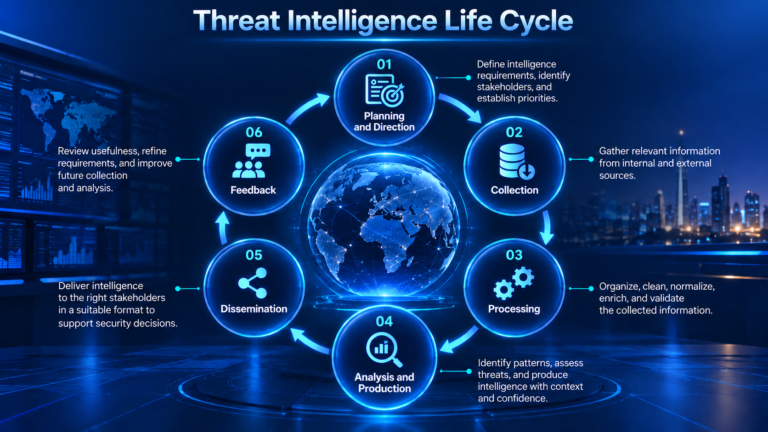
Threat Intelligence Collection: Relevant information is collected from internal and external intelligence sources to understand threat actors, campaigns, attack methods, and potential targets.
Intelligence Analysis: Collected information is analyzed to establish its credibility, relevance, and applicability. The objective is to identify the adversary behaviors that could meaningfully affect the environment.
Threat and Scenario Selection: Relevant threat actors, campaigns, and TTPs are selected to develop realistic testing scenarios. The selected scenarios should reflect the environment’s technology, exposure, and security objectives.
Test Planning: The testing scope, objectives, rules of engagement, execution methods, safety constraints, and expected outcomes are established.
Test Execution: The selected attack scenarios are simulated through controlled testing activities, such as adversary emulation, threat-informed penetration testing, or red team exercises.
Detection and Response Evaluation: The performance of security controls, monitoring systems, and defensive teams is assessed against the simulated activities.
Reporting and Improvement: Findings are documented, gaps are prioritized, and recommendations are developed to improve preventive, detective, and responsive capabilities.
The process may be repeated as threat intelligence, technology environments, and security capabilities change.
Red Teaming and Adversary Emulation in Threat Intelligence-Led Testing
In Threat Intelligence-Led Testing, red teaming and adversary emulation provide ways to execute intelligence-derived scenarios and evaluate defensive capabilities.
Threat intelligence informs the selection of adversary behaviors, the techniques to be simulated, and the objectives of the exercise. For example, intelligence about a threat actor’s use of credential theft, privilege escalation, and lateral movement can be translated into a controlled scenario to assess whether the environment can prevent or detect those activities.
The scope of the exercise determines how these methods are applied. Adversary emulation may focus on reproducing selected behaviors of a known threat actor, while a red team exercise may evaluate broader adversarial objectives across people, processes, and technology. The important distinction is that threat intelligence provides the context for selecting and prioritizing the activities being tested.
Proactive Security Testing vs. Threat Intelligence-Led Testing
Proactive Security Testing and Threat Intelligence-Led Testing both aim to improve security preparedness, but they differ in their primary focus, information requirements, and approach to scenario development.
| Comparison Dimension | Proactive Security Testing | Threat Intelligence-Led Testing |
|---|---|---|
| Primary objective | Identify security weaknesses, assess exposure, and validate security controls | Evaluate defensive capabilities against relevant threats and adversary behaviors |
| Starting point | Assets, vulnerabilities, attack surfaces, risk assessments, and testing objectives | Cyber threat intelligence, threat actors, campaigns, and adversary intelligence |
| Intelligence dependency | Does not necessarily depend on threat intelligence | Driven by relevant and credible threat intelligence |
| Scenario development | Based on vulnerabilities, security objectives, technology configurations, and predefined or emerging scenarios | Based on threat actors, campaigns, motivations, capabilities, and observed TTPs |
| Testing focus | Weaknesses, exposure, attack paths, and control effectiveness | Ability to prevent, detect, and respond to relevant adversary behaviors |
| Methods | Attack surface assessment, vulnerability assessment, penetration testing, attack path analysis, configuration assessment, and control validation | Threat-informed penetration testing, intelligence-led red teaming, and adversary emulation |
| Scope | May cover systems, applications, networks, infrastructure, attack surfaces, and security controls | Often tailored to relevant threats, critical functions, assets, and technology environments |
| Use of TTPs | May use generic techniques, established testing cases, and selected adversary techniques | Uses relevant adversary TTPs derived from threat intelligence |
| Outcomes | Vulnerability and exposure findings, attack paths, control gaps, and remediation recommendations | Assessment of defensive capabilities, threat-relevant detection gaps, and response weaknesses |
| Role of threat intelligence | Helpful input, but not mandatory | Central input to scenario selection and test design |
Both approaches contribute to security assurance, but they provide different perspectives. Proactive Security Testing offers a broader means of identifying weaknesses, assessing attack surfaces, examining potential attack paths, and validating security controls across technology environments. Threat Intelligence-Led Testing builds on this approach by incorporating intelligence about relevant threats to make testing more targeted and representative of actual adversary behavior. While proactive testing may assess security using known vulnerabilities, exposure information, and predefined or emerging scenarios, intelligence-led testing uses information about threat actors, campaigns, and TTPs to develop realistic adversarial scenarios. Consequently, Threat Intelligence-Led Testing can be considered a threat-contextualized approach within the broader proactive security testing landscape, rather than an entirely separate testing discipline.
Methodology and Execution Considerations
Although the specific methodology depends on the testing objectives and environment, both approaches require structured planning, controlled execution, and meaningful evaluation.
Proactive Security Testing may begin with asset discovery, vulnerability assessment, attack surface analysis, or a defined security objective. The testing method is then selected based on the weaknesses or capabilities being examined.
Threat Intelligence-Led Testing adds an intelligence analysis and scenario development process. The selected intelligence must be relevant to the environment, and the testing scenarios must represent plausible adversary activities rather than simply reproducing information from an intelligence report.
Regardless of the approach, testing should include clear scope definition, authorization, rules of engagement, safety requirements, evidence collection, reporting, and remediation tracking. Testing teams must establish which assets and systems are in scope, define permitted activities, and ensure that execution does not cause unintended disruption, data loss, or operational impact.
Findings should be supported by appropriate evidence and assessed according to their severity, exploitability, and potential impact. Remediation recommendations should be prioritized, assigned, and tracked. Retesting, where appropriate, helps establish whether corrective measures have addressed the identified weaknesses.
Frameworks and Reference Models
Several frameworks, knowledge bases, and regulatory testing approaches can support Proactive Security Testing and Threat Intelligence-Led Testing. They serve different purposes and should not be treated as interchangeable methodologies.
MITRE ATT&CK
MITRE ATT&CK is a globally recognized knowledge base of adversary tactics and techniques based on observed real-world behavior. It provides a structured way to understand adversary activities and organize information about how attacks are conducted.
In Threat Intelligence-Led Testing, ATT&CK can be used to map intelligence-derived TTPs, select relevant techniques, develop emulation scenarios, and assess defensive detection coverage. It can also support proactive testing activities that examine specific attack techniques.
MITRE Adversary Emulation Plans
MITRE Adversary Emulation Plans provide structured information for reproducing selected adversary behaviors. They can include the techniques, procedures, and supporting details needed to emulate particular threat actors.
These plans can help testing teams develop realistic scenarios and assess whether defensive capabilities can identify and respond to the simulated behaviors.
TIBER-EU
TIBER-EU stands for Threat Intelligence-Based Ethical Red Teaming. Developed by the European Central Bank, it provides a framework for controlled, intelligence-led red team testing within the financial sector.
It uses threat intelligence to develop targeted testing scenarios and assesses how effectively financial entities can withstand attacks from relevant threat actors. It is a specific framework for threat intelligence-based testing, not a universal requirement for every intelligence-led exercise.
CBEST
CBEST is a framework developed by the Bank of England for intelligence-led penetration testing within the UK financial sector. It uses threat intelligence and controlled penetration testing to assess the resilience of financial institutions against relevant cyber threats.
CBEST emphasizes the use of realistic threat scenarios to evaluate defensive capabilities.
Digital Operational Resilience Act (DORA) Threat-Led Penetration Testing
The European Union’s Digital Operational Resilience Act (DORA) establishes requirements for digital operational resilience across covered financial entities. Article 26 addresses advanced testing based on threat-led penetration testing (TLPT) for entities identified as being subject to the relevant requirements.
DORA’s associated regulatory technical standards provide further requirements concerning the conduct of TLPT. This is a regulatory context for threat-led testing within the financial sector rather than a general-purpose security testing framework.
NIST Technical Guide to Information Security Testing and Assessment
NIST Special Publication 800-115, Technical Guide to Information Security Testing and Assessment, provides guidance on planning and conducting technical security testing and assessments.
It discusses techniques such as testing, examination, and interviewing, and provides guidance for identifying vulnerabilities and evaluating security controls. It can support the planning and execution of broader proactive security testing activities.
Technologies Supporting Security Testing
Security testing is supported by multiple technologies and platforms. These tools help discover assets, identify weaknesses, analyze threats, simulate attacks, validate controls, and evaluate detection and response capabilities.
Attack Surface Management
Attack Surface Management technologies help discover and monitor externally exposed assets, services, applications, and infrastructure. They support the identification of unknown or unmanaged assets and changes in external exposure.
Vulnerability Management
Vulnerability Management platforms identify, classify, prioritize, and track vulnerabilities across systems, applications, networks, and infrastructure. They support remediation planning and continuous assessment of known security weaknesses.
Penetration Testing and Security Assessment Tools
Penetration testing and security assessment tools support controlled testing of applications, networks, systems, and infrastructure. They may help identify weaknesses, validate exploitability, and examine possible attack paths.
Threat Intelligence Platforms
Threat Intelligence Platforms (TIPs) help collect, aggregate, normalize, enrich, correlate, analyze, and distribute threat intelligence. They can support the identification of relevant indicators, threat actors, campaigns, and TTPs used to develop intelligence-led testing scenarios.
Security Information and Event Management
Security Information and Event Management (SIEM) platforms collect and correlate security events from different sources. They support security monitoring, alerting, investigation, and detection validation.
During threat-informed testing, SIEM capabilities can be evaluated to determine whether simulated adversary activities generate the expected events and alerts and whether security teams can investigate them effectively.
Extended Detection and Response
Extended Detection and Response (XDR) technologies correlate security telemetry across multiple technology layers, such as endpoints, networks, email, and cloud environments. They can support detection validation and help evaluate the visibility of selected adversary activities.
Breach and Attack Simulation Platforms
Breach and Attack Simulation platforms automate the execution of selected attack techniques to evaluate the effectiveness of security controls. They can provide repeatable validation of preventive and detective security capabilities.
Application Security Testing Tools
Application Security Testing technologies help identify vulnerabilities in application code, dependencies, APIs, and running applications. Examples include static application security testing, dynamic application security testing, software composition analysis, and interactive application security testing.
Cloud Security Assessment Tools
Cloud security assessment technologies evaluate cloud configurations, workloads, identities, services, and exposed resources. They help identify misconfigurations, excessive privileges, insecure services, and other cloud-related weaknesses.
These technologies may be used individually or together. A tool does not itself establish whether an assessment is proactive or intelligence-led. That distinction depends on the testing objective, the information used to develop the scenarios, and the methodology applied.
Applications and Use Cases
Proactive Security Testing and Threat Intelligence-Led Testing can be applied across different environments and sectors. The selection of an approach depends on the security objectives, threat exposure, technology environment, and level of assurance required.
Proactive Security Testing is useful for identifying exposed assets, vulnerabilities, misconfigurations, and weaknesses across infrastructure, applications, networks, and cloud environments. Its findings can support remediation planning and help reduce the overall attack surface. It can also be used to validate security controls against defined requirements and selected attack scenarios.
Threat Intelligence-Led Testing is particularly useful when there is a need to understand whether security capabilities can withstand specific threat actors, campaigns, or attack techniques. It helps identify gaps in prevention, detection, investigation, and response by testing against adversary behaviors relevant to the environment.
Both approaches can be applied to critical infrastructure and operational technology environments, where security incidents may affect physical processes, public services, safety, and essential operations. Proactive testing can assess technical weaknesses, configurations, network segmentation, and security controls. Threat Intelligence-Led Testing adds threat context by evaluating relevant adversary behaviors and their potential impact. Testing must be carefully controlled to avoid disrupting safety-critical processes.
Financial services and other regulated environments may use advanced testing approaches to assess resilience against relevant cyber threats. TIBER-EU and CBEST provide examples of structured intelligence-led testing approaches for the financial sector.
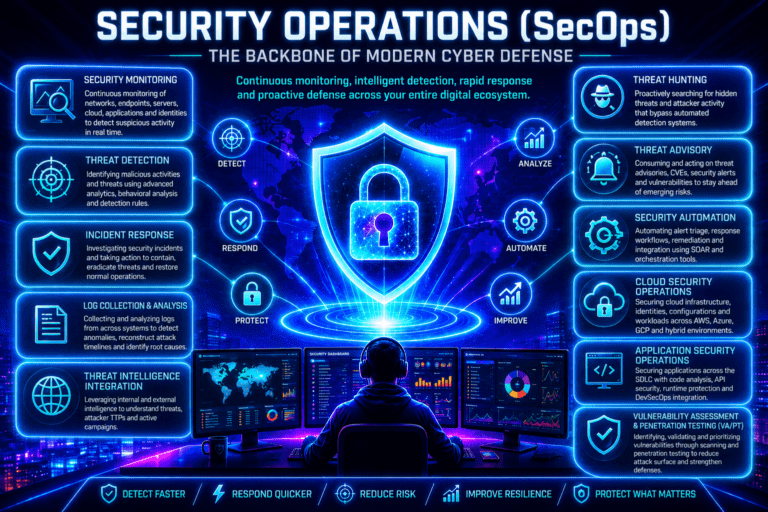
Security testing also supports security operations by evaluating monitoring, detection engineering, threat hunting, incident response, and containment capabilities. Threat-informed scenarios can help determine whether security operations teams recognize and respond to activities associated with relevant adversaries.
When introducing new applications, infrastructure, cloud services, integrations, or major technology changes, proactive testing can identify security weaknesses before and after deployment. Testing can also evaluate whether systems and services can withstand attacks, limit operational impact, maintain essential functions, and recover from disruption. This may include security control testing, incident response exercises, backup validation, disaster recovery testing, and business continuity assessments.
Challenges and Considerations
Both approaches provide valuable security insights, but their effectiveness depends on the quality of planning, execution, and interpretation.
Quality and Relevance of Information
Proactive Security Testing depends on accurate asset information, vulnerability data, architecture details, and defined assessment objectives. Threat Intelligence-Led Testing additionally depends on the quality and relevance of threat intelligence.
Incomplete, outdated, or irrelevant information can lead to testing scenarios that do not accurately represent the environment’s exposure or threat conditions.
Testing Scope and Coverage
Large and complex environments can make it difficult to achieve complete testing coverage. Assets may be distributed across on-premises infrastructure, cloud platforms, third-party services, and operational environments.
Testing scope must be defined carefully to ensure that important assets, interfaces, and security controls are not overlooked.
Realism of Testing Scenarios
Generic scenarios may not represent the actual threats affecting a particular environment. Conversely, intelligence-derived scenarios may be unsuitable if the associated adversary behavior is not relevant to the technology or exposure being assessed.
Scenario selection should be based on evidence, relevance, and clear testing objectives.
Operational and Business Impact
Certain testing activities, particularly exploitation, adversary emulation, and red team exercises, can create operational risks if they are not properly controlled.
Testing should have appropriate authorization, safety measures, rules of engagement, and coordination with relevant operational stakeholders. Additional safeguards may be necessary for critical infrastructure, industrial systems, and other environments where disruption could have significant consequences.
Skills and Expertise
Effective security testing requires technical expertise in areas such as vulnerability assessment, penetration testing, application security, infrastructure security, threat intelligence analysis, adversary behavior, and security operations.
Threat Intelligence-Led Testing requires additional capabilities to evaluate intelligence, identify relevant TTPs, develop realistic scenarios, and translate testing results into defensive improvements.
Translating Findings into Improvements
Identifying weaknesses is only one part of security testing. Findings must be assessed, prioritized, assigned, remediated, and validated.
Threat Intelligence-Led Testing should also result in improvements to security monitoring, detection logic, incident response procedures, and defensive coverage. Without an effective remediation and improvement process, testing may identify gaps without producing sustained improvements in security capability.
Conclusion
Proactive Security Testing and Threat Intelligence-Led Testing are complementary approaches that help improve security preparedness and assurance.
Proactive Security Testing provides a broad approach to identifying vulnerabilities, assessing attack surfaces, examining attack paths, and validating security controls across technology environments. It can be performed without threat intelligence and is applicable throughout the IT lifecycle.
Threat Intelligence-Led Testing adds an intelligence-driven perspective by incorporating information about relevant threat actors, campaigns, and adversary behaviors into the testing process. It helps determine whether defensive capabilities can prevent, detect, and respond to attack scenarios that are meaningful to the environment being assessed.
The two approaches should not be viewed as competing or mutually exclusive disciplines. Threat Intelligence-Led Testing can be considered a threat-contextualized approach within the broader proactive security testing landscape. Together, they provide a more comprehensive understanding of security weaknesses, threat exposure, and the effectiveness of defensive capabilities.
References
Online Sources
National Institute of Standards and Technology (NIST) – Technical Guide to Information Security Testing and Assessment (SP 800-115)
Provides guidance on planning, conducting, and analyzing technical information security testing and assessment activities.
MITRE – MITRE ATT&CK
Provides a knowledge base of adversary tactics and techniques based on observed real-world behavior, supporting threat analysis, adversary emulation, and defensive assessment.
MITRE – Adversary Emulation Plans
Provides resources for emulating selected adversary behaviors and developing testing scenarios based on documented threat activity.
European Central Bank (ECB) – TIBER-EU Framework
Describes the framework for threat intelligence-based ethical red teaming in the European financial sector.
Bank of England – CBEST (Critical National Infrastructure Banking Supervision and Evaluation Testing)
Explains the UK’s threat intelligence-led penetration testing framework for assessing the cyber resilience of financial institutions and Financial Market Infrastructures (FMIs).
European Union – Digital Operational Resilience Act (DORA), Regulation (EU) 2022/2554
Establishes digital operational resilience requirements for covered financial entities, including provisions concerning threat-led penetration testing under Article 26.
National Institute of Standards and Technology (NIST) – Secure Software Development Framework (SSDF), SP 800-218
Provides a set of secure software development practices that can be integrated into software development processes to reduce vulnerabilities and address their root causes.
National Institute of Standards and Technology (NIST) – Cybersecurity Framework (CSF) 2.0
Provides a framework for managing cybersecurity risks through the Govern, Identify, Protect, Detect, Respond, and Recover functions.