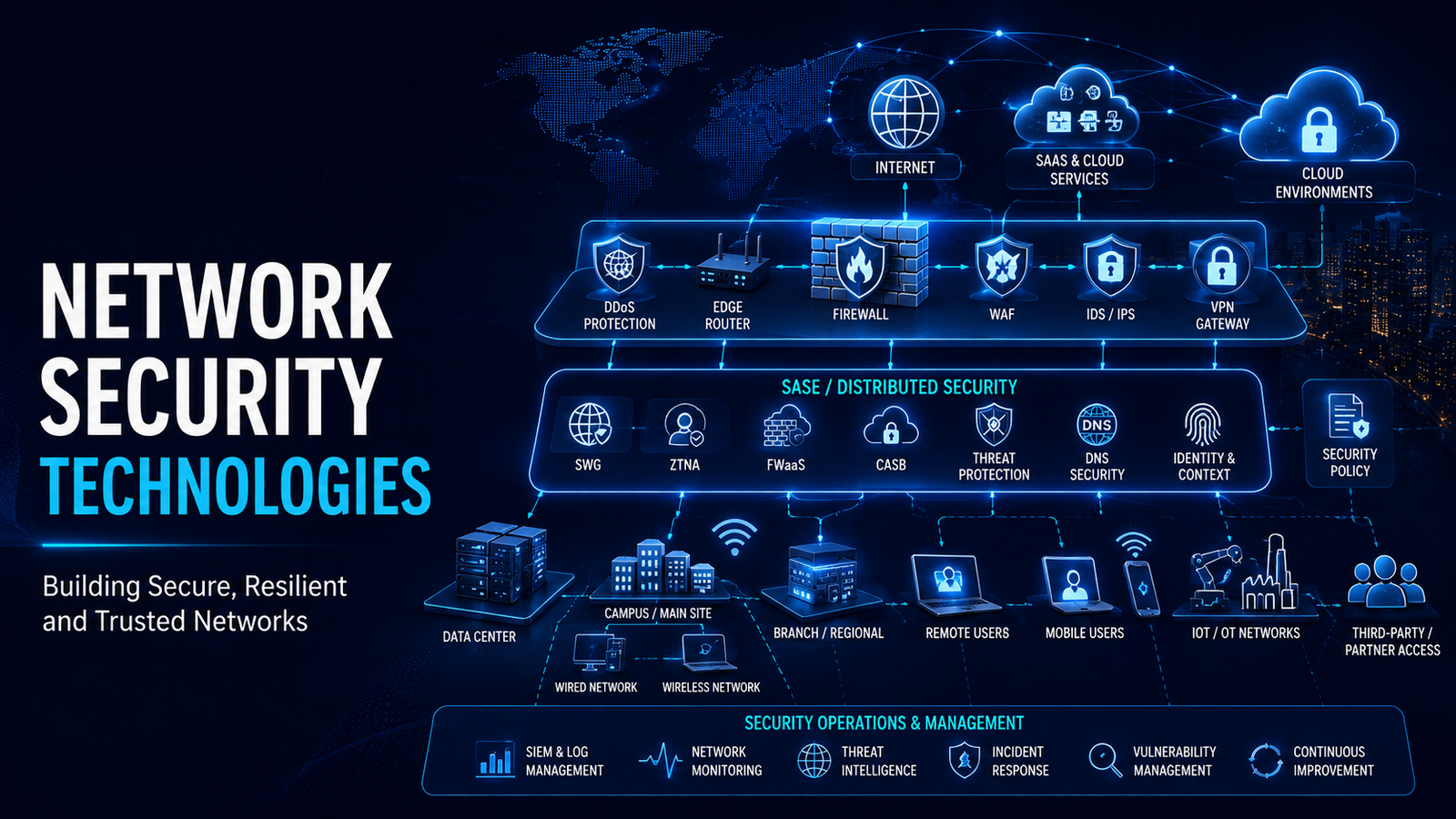
Understanding Network Security Technologies
Introduction
Network security technologies are technical mechanisms used to protect networks, network communications, connected systems, and the information exchanged between them. They provide capabilities for controlling access, filtering traffic, protecting communications, detecting malicious activity, preventing attacks, monitoring network activity, and supporting the availability of network services.
Network security is not represented by a single technology. It consists of multiple technologies that perform different security functions and operate at different points within a network architecture.
Understanding network security technologies therefore requires more than knowing what individual technologies such as firewalls, VPNs, IDS, IPS, or network access control do. A broader understanding requires examining the security objectives they support, the controls they implement, and the cybersecurity domains with which they are associated.
What Are Network Security Technologies?
Network security technologies are hardware, software, protocols, platforms, and technical mechanisms designed to protect network infrastructure and network communications from unauthorized access, misuse, interception, modification, disruption, and other security threats.
They provide capabilities such as:
- Network traffic filtering
- Access control
- Authentication
- Communication protection
- Network segmentation
- Threat detection
- Threat prevention
- Security monitoring
- Traffic analysis
- Availability protection
- Security policy enforcement
Different technologies provide different combinations of these capabilities.
For example, a firewall can enforce traffic-control policies, a VPN can protect communications, Network Access Control can regulate device and user access, and an Intrusion Detection System can identify suspicious network activity.
The technology itself is only one part of the security picture. Its value depends on the security objective being addressed, the control being implemented, its architectural placement, and how it is operated.
Relationship With the CIA Triad
The CIA Triad represents three fundamental security objectives:
- Confidentiality — protecting information from unauthorized disclosure.
- Integrity — protecting information and systems from unauthorized modification or destruction.
- Availability — ensuring that authorized users and systems can access resources when required.
Network security technologies contribute to one or more of these objectives.
Confidentiality
Network security technologies support confidentiality by restricting unauthorized access and protecting information while it travels across networks.
Technologies that can contribute to confidentiality include:
- Firewalls
- Network Access Control
- VPNs
- Encryption
- Secure communication protocols
- Network segmentation
- Zero Trust Network Access
For example, encryption can protect information from unauthorized disclosure if network traffic is intercepted.
Network segmentation can also contribute to confidentiality by restricting access to sensitive network environments and limiting unnecessary communication between systems.
Integrity
Network security technologies support integrity by controlling unauthorized communication, protecting data in transit, and detecting or preventing malicious activity.
Examples include:
- Firewalls
- Intrusion Detection Systems
- Intrusion Prevention Systems
- Network authentication
- Cryptographic integrity mechanisms
- Network segmentation
- Network monitoring
Secure communication mechanisms can help detect unauthorized modification of transmitted information, while intrusion detection and prevention technologies can identify or block activity that may compromise systems or data.
Availability
Network security technologies support availability by preventing disruptive activity, controlling malicious traffic, detecting attacks, and supporting resilient network operation.
Examples include:
- Firewalls
- Intrusion Prevention Systems
- DDoS protection
- Traffic filtering
- Network monitoring
- Network redundancy
- Network segmentation
DDoS protection is a clear example of a technology primarily associated with availability because its purpose is to help maintain access to network services during disruptive traffic attacks.
Technologies Can Support Multiple CIA Objectives
A network security technology should not necessarily be associated with only one element of the CIA Triad.
A firewall, for example, can contribute to:
- Confidentiality by restricting unauthorized access.
- Integrity by limiting unauthorized communications that could be used to compromise systems.
- Availability by blocking malicious or excessive traffic.
The actual contribution depends on how the technology is designed, configured, deployed, and used.
Therefore, the relationship between network security technologies and the CIA Triad is not fixed. The same technology can support different security objectives in different environments.
Relationship With Security Controls
Security controls are safeguards or countermeasures used to reduce security risk.
Network security technologies primarily implement technical controls, although their operation can support broader security requirements.
It is important to distinguish between a technology and a security control.
A technology provides a mechanism or capability.
A security control represents the safeguard or protection that is implemented through that mechanism.
For example, a firewall is a technology, while network traffic filtering and access restriction are security control functions provided by that technology.
Similarly, an IDS is a technology that implements a network intrusion detection capability, while an IPS can provide both detection and prevention capabilities.
Preventive Controls
Preventive controls are designed to prevent unauthorized or undesirable activity from occurring.
Network security technologies that can provide preventive capabilities include:
- Firewalls
- Network Access Control
- Intrusion Prevention Systems
- Network segmentation
- Access-control mechanisms
- DDoS filtering
- Security gateways
A firewall, for example, can prevent unauthorized network connections by enforcing predefined traffic policies.
Detective Controls
Detective controls identify suspicious, unauthorized, or potentially malicious activity.
Network security technologies providing detective capabilities include:
- Intrusion Detection Systems
- Network Detection and Response
- Network monitoring
- Traffic analysis
- DNS monitoring
- Network security logging
Detection does not necessarily prevent an event from occurring. Its purpose is to provide visibility and identify activity that may require investigation or response.
Corrective Controls
Corrective controls help contain or remediate the effects of a security event.
Network security technologies can support corrective activities such as:
- Network isolation
- Blocking malicious communication
- Network quarantine
- Dynamic policy changes
- Traffic diversion
For example, a compromised device may be isolated from other network resources to prevent further unauthorized activity.
Deterrent Controls
Deterrent controls are intended to discourage unauthorized or undesirable activity.
Network security technologies can contribute to deterrence through mechanisms such as:
- Network access restrictions
- Authentication requirements
- Connection controls
- Security monitoring
- Logging and visibility
The presence of monitoring and enforcement mechanisms can make unauthorized activity more difficult and more likely to be identified.
Compensating Controls
Compensating controls provide an alternative means of reducing risk when a preferred control cannot be implemented.
Network security technologies can sometimes provide compensating protection through additional:
- Segmentation
- Monitoring
- Traffic filtering
- Access restrictions
- Authentication
- Network isolation
A compensating control should still address the relevant security requirement and provide an appropriate level of risk reduction.
Recovery Controls
Recovery controls help restore systems, services, or capabilities following a disruption.
Network security technologies can support recovery through:
- Network redundancy
- Failover mechanisms
- Alternate communication paths
- Traffic rerouting
- Resilient network architectures
- DDoS mitigation and service restoration
Availability-focused network architecture is particularly important where interruption of connectivity can affect critical services.
A Technology Can Support Multiple Control Types
The relationship between a technology and a control type is not always exclusive.
For example, an IPS can provide:
- Detective capability by identifying suspicious traffic.
- Preventive capability by blocking selected malicious traffic.
Similarly, network segmentation can provide preventive protection while also helping contain an incident after a compromise has occurred.
Therefore, technologies should be evaluated according to the security capabilities they actually provide, rather than being assigned permanently to a single control category.
on security requirements and risk rather than simply because a particular technology is available.
Why Network Security Technologies Are Important
Networks provide the communication foundation for users, applications, servers, devices, cloud services, and other computing resources.
The connectivity that enables legitimate communication can also create opportunities for unauthorized access and attack.
Threat actors may attempt to:
- Gain unauthorized network access
- Intercept communications
- Exploit exposed services
- Deliver malicious content
- Establish unauthorized connections
- Move between systems
- Disrupt network services
- Exfiltrate information
- Establish command-and-control communications
Network security technologies provide technical mechanisms for reducing these risks.
They can restrict access, protect communications, detect suspicious activity, prevent selected attacks, limit unauthorized movement, and support the availability of network services.
The objective is not simply to deploy more technologies. The objective is to establish appropriate security controls that address relevant risks and security requirements.
This makes an understanding of network security technologies important not only for network security specialists, but also for professionals working across cybersecurity architecture, identity, cloud security, security operations, risk management, and other cybersecurity domains.
Major Categories of Network Security Technologies
Network security technologies can be grouped according to the security capabilities they provide. These categories help organize the technology landscape and provide a conceptual foundation for understanding the different technologies used to protect networks and communications.
The major categories include:
- Network Access Control — controls which users, devices, and systems can connect to network resources.
- Network Traffic Control and Filtering — controls, allows, restricts, or blocks network traffic according to security policies.
- Communication Protection — protects information and communications while they are transmitted across networks.
- Threat Detection — identifies suspicious, malicious, or unauthorized network activity.
- Threat Prevention — attempts to block or prevent identified malicious or unauthorized activity.
- Network Security Monitoring — provides visibility into network traffic, connections, devices, and security events.
- Application and Content Protection — protects applications, web traffic, email, and other content carried across networks.
- Network Segmentation — separates network environments and restricts communication between different security zones.
- Availability Protection — protects network services and resources against disruption and denial-of-service conditions.
- Identity-Aware Network Security — incorporates user and device identity into network access and security decisions.
These categories are not mutually exclusive. A single network security technology can provide capabilities across multiple categories.
For example, a firewall can provide traffic filtering, access control, application control, threat prevention, logging, and identity-aware policy enforcement. Similarly, a Secure Web Gateway can provide traffic filtering, content inspection, malware protection, application control, and security monitoring.
Network Access Control
Network access control technologies regulate access to network resources based on security policies.
They may consider:
- User identity
- Device identity
- Authentication status
- Device security posture
- Network location
- Access privileges
- Security policy
Network Access Control (NAC) is a primary example of this category.
Network Traffic Control and Filtering
Traffic control and filtering technologies regulate network communication according to defined policies.
They can evaluate characteristics such as:
- Source
- Destination
- Protocol
- Port
- Application
- User
- Device
- Connection state
Firewalls, proxies, Secure Web Gateways, and other security gateways can provide traffic control and filtering capabilities.
Communication Protection
Communication protection technologies protect information while it is transmitted across networks.
They can provide:
- Confidentiality
- Integrity
- Authentication
- Secure communication channels
Examples include:
- VPNs
- Network encryption
- TLS-based communication
- Secure remote access technologies
- Cryptographic communication mechanisms
Threat Detection
Threat detection technologies identify suspicious or potentially malicious activity.
They may use:
- Signatures
- Rules
- Anomaly detection
- Behavioral analysis
- Threat intelligence
- Traffic analysis
Examples include:
- Intrusion Detection Systems
- Network Detection and Response
- Network monitoring
- DNS monitoring
Detection technologies primarily provide visibility and identification of potentially harmful activity.
Threat Prevention
Threat prevention technologies attempt to stop malicious or unauthorized activity.
They may:
- Block traffic
- Drop packets
- Terminate connections
- Restrict access
- Isolate systems
- Filter malicious content
Examples include:
- Intrusion Prevention Systems
- Firewalls
- Network Access Control
- DDoS protection
- Security gateways
- Network segmentation
Network Security Monitoring
Network security monitoring technologies provide visibility into network activity.
They can collect and analyze information about:
- Network connections
- Traffic flows
- Devices
- Protocols
- Applications
- DNS activity
- Communication patterns
- Security events
Monitoring provides information that can support detection, investigation, incident response, troubleshooting, and security analysis.
Application and Content Protection
Some network security technologies focus on applications and the content transmitted through network communications.
Examples include:
- Web Application Firewalls
- Secure Web Gateways
- Email Security Gateways
- Application proxies
- DNS security technologies
These technologies provide greater awareness of application protocols, content, and communication behavior than basic network traffic filtering.
Network Segmentation
Network segmentation separates systems and resources into different logical or physical network environments.
Segmentation can be implemented using:
- VLANs
- Routing controls
- Firewalls
- Access-control mechanisms
- Software-defined networking
- Microsegmentation
The purpose is to restrict unnecessary communication and limit the potential movement of threats between systems and environments.
Availability Protection
Availability protection technologies are designed to protect network services and resources from disruption.
They can address conditions such as:
- Distributed denial-of-service attacks
- Excessive traffic
- Network failures
- Infrastructure failures
- Service interruptions
Examples include:
- DDoS protection
- Traffic filtering
- Network redundancy
- Failover mechanisms
- Resilient network architectures
Identity Aware Network Security
Identity-aware network security incorporates information about users and devices into network security decisions.
Traditional network controls may rely heavily on network addresses, ports, and protocols. Identity-aware security can add context such as:
- User identity
- Device identity
- Authentication status
- Device posture
- Application access
- Contextual information
Examples include:
- Network Access Control
- Identity-aware firewalls
- Zero Trust Network Access
- Identity-based network policies
This category creates a strong relationship between Network & Communications Security and Identity & Access Security.
Categories Can Overlap
The categories of network security technologies should be viewed as functional groupings rather than rigid classifications.
A single technology may perform several security functions.
For example, an advanced firewall may provide:
- Network traffic filtering
- Access control
- Application control
- Threat prevention
- Identity-aware policies
- Logging and monitoring
Similarly, an NDR platform may provide:
- Network visibility
- Threat detection
- Behavioral analysis
- Investigation support
- Security analytics
Understanding these categories therefore provides a way to organize network security technologies according to what they do, rather than simply according to their product or technology names.
Key Network Security Technologies
Firewalls
A firewall is a network security technology that controls network traffic according to defined security policies. It can regulate communication between networks, systems, applications, or security zones.
Firewall capabilities can include:
- Packet filtering
- Stateful inspection
- Application-aware inspection
- Access control
- Application control
- Network address translation
- Traffic logging
- Policy enforcement
Firewalls can be deployed at network boundaries, between internal security zones, within data center environments, in cloud environments, or directly on hosts.
The fundamental purpose of a firewall is to enforce a defined communication policy.
Network Access Control
Network Access Control (NAC) regulates which users and devices can connect to a network and what level of access they receive.
NAC may evaluate:
- User identity
- Device identity
- Authentication status
- Device security posture
- Network location
- Security policy
A device may be granted normal access, restricted access, placed into a separate network segment, or denied access depending on the applicable policy.
NAC therefore provides a mechanism for enforcing network access requirements before or during network connectivity.
Intrusion Detection Systems
An Intrusion Detection System (IDS) monitors network or system activity to identify potentially malicious or unauthorized behavior.
Network-based IDS technologies inspect network traffic, while host-based IDS technologies monitor activity on individual systems.
Detection methods may include:
- Signature-based detection
- Rule-based detection
- Anomaly detection
- Behavioral analysis
- Protocol analysis
An IDS primarily provides detection and visibility. It generates alerts or other security events that can be investigated by security operations.
Intrusion Prevention Systems
An Intrusion Prevention System (IPS) extends intrusion detection by providing the capability to actively prevent selected malicious or unauthorized activity.
An IPS can inspect network traffic and take actions such as:
- Blocking traffic
- Dropping packets
- Terminating connections
- Resetting sessions
- Applying security policies
IPS technologies may use signatures, rules, behavioral indicators, protocol analysis, and other detection techniques.
The primary distinction is that an IDS focuses on detecting and reporting, while an IPS can detect and actively prevent selected activity.
Virtual Private Networks
A Virtual Private Network (VPN) provides protected communication across an underlying network.
VPN technologies commonly use encryption and authentication to establish a protected communication channel.
VPNs can support:
- Remote user connectivity
- Site-to-site connectivity
- Protected communication across untrusted networks
- Secure access to private resources
The security provided by a VPN depends on its protocols, cryptographic mechanisms, authentication, configuration, and endpoint security.
Network Encryption and Secure Communication Protocols
Network encryption protects information while it is transmitted across networks.
Secure communication protocols can provide combinations of:
- Confidentiality
- Integrity
- Authentication
- Secure session establishment
Encryption is particularly important when communications pass through networks or infrastructure that cannot be completely trusted.
Examples include technologies used for:
- Secure web communication
- Remote administration
- Email communication
- Application communication
- Network tunneling
Encryption protects communications, but it does not by itself protect compromised endpoints or vulnerable applications.
Secure Web Gateways
A Secure Web Gateway (SWG) provides security controls for web traffic.
It can act as a security enforcement point between users or systems and web resources.
Depending on its capabilities, an SWG may provide:
- URL filtering
- Web access control
- Malware detection
- Content inspection
- Application control
- Threat intelligence integration
- Data protection capabilities
- User-based policies
SWG capabilities may be delivered through network appliances, software, cloud services, or distributed security architectures.
Web Application Firewalls
A Web Application Firewall (WAF) is designed specifically to protect web applications and APIs from malicious application-layer traffic.
A WAF analyzes HTTP and HTTPS requests and can identify traffic patterns associated with attacks against web applications.
Its capabilities can include:
- Request filtering
- Application-layer inspection
- Malicious payload detection
- Access control
- Bot-related controls
- API protection
A WAF differs from a traditional network firewall because its primary focus is application-layer traffic rather than general network connectivity.
Email Security Gateways
Email security gateways inspect and regulate email traffic to reduce threats delivered through email.
Capabilities may include:
- Spam filtering
- Malware detection
- Attachment analysis
- URL inspection
- Sender reputation analysis
- Domain authentication
- Message filtering
Email security technologies protect an important communication channel and can contribute to the detection and prevention of phishing, malicious attachments, malicious links, and other email-based threats.
Network Segmentation
Network segmentation separates systems and resources into different logical or physical network environments.
Segmentation can be implemented using:
- VLANs
- Routing controls
- Firewalls
- Access-control mechanisms
- Software-defined networking
- Microsegmentation
The objective is to control communication between network segments.
Segmentation can restrict unnecessary connectivity and reduce the ability of an attacker to move between systems after gaining an initial foothold.
Segmentation can also separate environments according to:
- Security requirements
- Sensitivity
- Function
- Trust level
- Regulatory requirements
- Operational requirements
Proxy Technologies
A proxy acts as an intermediary between a client and another network service.
Instead of communicating directly with a destination, traffic is routed through the proxy, allowing security policies to be applied.
Security proxy capabilities can include:
- Traffic filtering
- Access control
- Content inspection
- User authentication
- Logging
- Application control
- Policy enforcement
Proxies can provide greater visibility and control over specific types of network communication.
Network Detection and Response
Network Detection and Response (NDR) technologies analyze network activity to identify suspicious behavior and support security investigation.
NDR can analyze information such as:
- Network traffic
- Network flows
- Connection patterns
- DNS activity
- Communication behavior
- Threat intelligence
- Behavioral indicators
NDR technologies can help identify activity associated with:
- Lateral movement
- Command-and-control communication
- Data exfiltration
- Malware activity
- Unauthorized communication
- Anomalous behavior
NDR primarily supports network visibility, detection, investigation, and response.
Distributed Denial-of-Service Protection
Distributed Denial-of-Service (DDoS) protection technologies help protect services against malicious traffic intended to exhaust network or system resources.
DDoS attacks may target:
- Network bandwidth
- Connection capacity
- Network infrastructure
- Application resources
- Service availability
DDoS protection can involve:
- Traffic filtering
- Rate limiting
- Traffic diversion
- Distributed filtering
- Anomaly detection
- Traffic scrubbing
DDoS protection is primarily associated with the Availability objective of the CIA Triad.
DNS Security
The Domain Name System (DNS) provides name resolution that allows systems to locate network services.
DNS security technologies can protect DNS infrastructure and use DNS activity as a source of security information.
Capabilities may include:
- Malicious-domain blocking
- DNS filtering
- Domain reputation analysis
- DNS monitoring
- Suspicious-domain detection
- Policy enforcement
DNS security can help prevent connections to known malicious destinations and can provide useful indicators for security monitoring.
Network Authentication Technologies
Network authentication technologies verify the identity of users, devices, or systems before access is granted.
Authentication mechanisms may include:
- Password-based authentication
- Digital certificates
- Multifactor authentication
- Device identity
- Public-key infrastructure
- Centralized authentication services
Network authentication provides an important foundation for access control because security policies frequently depend on knowing who or what is requesting access.
Zero Trust Network Access
Zero Trust Network Access (ZTNA) provides controlled access to applications and resources based on identity, authentication, device context, policy, and other security conditions.
ZTNA does not assume that a user or device should automatically be trusted simply because it is connected to a particular network.
Access can instead be evaluated according to:
- User identity
- Device identity
- Authentication status
- Device security posture
- Application being accessed
- Context
- Security policy
ZTNA therefore creates a strong relationship between Network & Communications Security, Identity & Access Security, and Security Architecture & Engineering.
Secure Access Service Edge
Secure Access Service Edge (SASE) combines networking and security capabilities through a distributed service-based architecture.
Depending on the implementation, SASE can incorporate capabilities such as:
- Secure Web Gateway
- Firewall capabilities
- Zero Trust Network Access
- Cloud access security
- Network connectivity
- Security policy enforcement
SASE represents the convergence of networking and security capabilities, particularly in distributed environments where users, applications, and services operate across different locations and infrastructure environments.
Key Network Security Technologies
Firewalls
A firewall is a network security technology that controls network traffic according to defined security policies. It can regulate communication between networks, systems, applications, or security zones.
Firewall capabilities can include:
- Packet filtering
- Stateful inspection
- Application-aware inspection
- Access control
- Application control
- Network address translation
- Traffic logging
- Policy enforcement
Firewalls can be deployed at network boundaries, between internal security zones, within data center environments, in cloud environments, or directly on hosts.
The fundamental purpose of a firewall is to enforce a defined communication policy.
Network Access Control
Network Access Control (NAC) regulates which users and devices can connect to a network and what level of access they receive.
NAC may evaluate:
- User identity
- Device identity
- Authentication status
- Device security posture
- Network location
- Security policy
A device may be granted normal access, restricted access, placed into a separate network segment, or denied access depending on the applicable policy.
NAC therefore provides a mechanism for enforcing network access requirements before or during network connectivity.
Intrusion Detection Systems
An Intrusion Detection System (IDS) monitors network or system activity to identify potentially malicious or unauthorized behavior.
Network-based IDS technologies inspect network traffic, while host-based IDS technologies monitor activity on individual systems.
Detection methods may include:
- Signature-based detection
- Rule-based detection
- Anomaly detection
- Behavioral analysis
- Protocol analysis
An IDS primarily provides detection and visibility. It generates alerts or other security events that can be investigated by security operations.
Intrusion Prevention Systems
An Intrusion Prevention System (IPS) extends intrusion detection by providing the capability to actively prevent selected malicious or unauthorized activity.
An IPS can inspect network traffic and take actions such as:
- Blocking traffic
- Dropping packets
- Terminating connections
- Resetting sessions
- Applying security policies
IPS technologies may use signatures, rules, behavioral indicators, protocol analysis, and other detection techniques.
The primary distinction is that an IDS focuses on detecting and reporting, while an IPS can detect and actively prevent selected activity.
Virtual Private Networks
A Virtual Private Network (VPN) provides protected communication across an underlying network.
VPN technologies commonly use encryption and authentication to establish a protected communication channel.
VPNs can support:
- Remote user connectivity
- Site-to-site connectivity
- Protected communication across untrusted networks
- Secure access to private resources
The security provided by a VPN depends on its protocols, cryptographic mechanisms, authentication, configuration, and endpoint security.
Network Encryption and Secure Communication Protocols
Network encryption protects information while it is transmitted across networks.
Secure communication protocols can provide combinations of:
- Confidentiality
- Integrity
- Authentication
- Secure session establishment
Encryption is particularly important when communications pass through networks or infrastructure that cannot be completely trusted.
Examples include technologies used for:
- Secure web communication
- Remote administration
- Email communication
- Application communication
- Network tunneling
Encryption protects communications, but it does not by itself protect compromised endpoints or vulnerable applications.
Secure Web Gateways
A Secure Web Gateway (SWG) provides security controls for web traffic.
It can act as a security enforcement point between users or systems and web resources.
Depending on its capabilities, an SWG may provide:
- URL filtering
- Web access control
- Malware detection
- Content inspection
- Application control
- Threat intelligence integration
- Data protection capabilities
- User-based policies
SWG capabilities may be delivered through network appliances, software, cloud services, or distributed security architectures.
Web Application Firewalls
A Web Application Firewall (WAF) is designed specifically to protect web applications and APIs from malicious application-layer traffic.
A WAF analyzes HTTP and HTTPS requests and can identify traffic patterns associated with attacks against web applications.
Its capabilities can include:
- Request filtering
- Application-layer inspection
- Malicious payload detection
- Access control
- Bot-related controls
- API protection
A WAF differs from a traditional network firewall because its primary focus is application-layer traffic rather than general network connectivity.
Email Security Gateways
Email security gateways inspect and regulate email traffic to reduce threats delivered through email.
Capabilities may include:
- Spam filtering
- Malware detection
- Attachment analysis
- URL inspection
- Sender reputation analysis
- Domain authentication
- Message filtering
Email security technologies protect an important communication channel and can contribute to the detection and prevention of phishing, malicious attachments, malicious links, and other email-based threats.
Network Segmentation
Network segmentation separates systems and resources into different logical or physical network environments.
Segmentation can be implemented using:
- VLANs
- Routing controls
- Firewalls
- Access-control mechanisms
- Software-defined networking
- Microsegmentation
The objective is to control communication between network segments.
Segmentation can restrict unnecessary connectivity and reduce the ability of an attacker to move between systems after gaining an initial foothold.
Segmentation can also separate environments according to:
- Security requirements
- Sensitivity
- Function
- Trust level
- Regulatory requirements
- Operational requirements
Proxy Technologies
A proxy acts as an intermediary between a client and another network service.
Instead of communicating directly with a destination, traffic is routed through the proxy, allowing security policies to be applied.
Security proxy capabilities can include:
- Traffic filtering
- Access control
- Content inspection
- User authentication
- Logging
- Application control
- Policy enforcement
Proxies can provide greater visibility and control over specific types of network communication.
Network Detection and Response
Network Detection and Response (NDR) technologies analyze network activity to identify suspicious behavior and support security investigation.
NDR can analyze information such as:
- Network traffic
- Network flows
- Connection patterns
- DNS activity
- Communication behavior
- Threat intelligence
- Behavioral indicators
NDR technologies can help identify activity associated with:
- Lateral movement
- Command-and-control communication
- Data exfiltration
- Malware activity
- Unauthorized communication
- Anomalous behavior
NDR primarily supports network visibility, detection, investigation, and response.
Distributed Denial-of-Service Protection
Distributed Denial-of-Service (DDoS) protection technologies help protect services against malicious traffic intended to exhaust network or system resources.
DDoS attacks may target:
- Network bandwidth
- Connection capacity
- Network infrastructure
- Application resources
- Service availability
DDoS protection can involve:
- Traffic filtering
- Rate limiting
- Traffic diversion
- Distributed filtering
- Anomaly detection
- Traffic scrubbing
DDoS protection is primarily associated with the Availability objective of the CIA Triad.
DNS Security
The Domain Name System (DNS) provides name resolution that allows systems to locate network services.
DNS security technologies can protect DNS infrastructure and use DNS activity as a source of security information.
Capabilities may include:
- Malicious-domain blocking
- DNS filtering
- Domain reputation analysis
- DNS monitoring
- Suspicious-domain detection
- Policy enforcement
DNS security can help prevent connections to known malicious destinations and can provide useful indicators for security monitoring.
Network Authentication Technologies
Network authentication technologies verify the identity of users, devices, or systems before access is granted.
Authentication mechanisms may include:
- Password-based authentication
- Digital certificates
- Multifactor authentication
- Device identity
- Public-key infrastructure
- Centralized authentication services
Network authentication provides an important foundation for access control because security policies frequently depend on knowing who or what is requesting access.
Zero Trust Network Access
Zero Trust Network Access (ZTNA) provides controlled access to applications and resources based on identity, authentication, device context, policy, and other security conditions.
ZTNA does not assume that a user or device should automatically be trusted simply because it is connected to a particular network.
Access can instead be evaluated according to:
- User identity
- Device identity
- Authentication status
- Device security posture
- Application being accessed
- Context
- Security policy
ZTNA therefore creates a strong relationship between Network & Communications Security, Identity & Access Security, and Security Architecture & Engineering.
Secure Access Service Edge
Secure Access Service Edge (SASE) combines networking and security capabilities through a distributed service-based architecture.
Depending on the implementation, SASE can incorporate capabilities such as:
- Secure Web Gateway
- Firewall capabilities
- Zero Trust Network Access
- Cloud access security
- Network connectivity
- Security policy enforcement
SASE represents the convergence of networking and security capabilities, particularly in distributed environments where users, applications, and services operate across different locations and infrastructure environments.
Network Security Technology Architecture
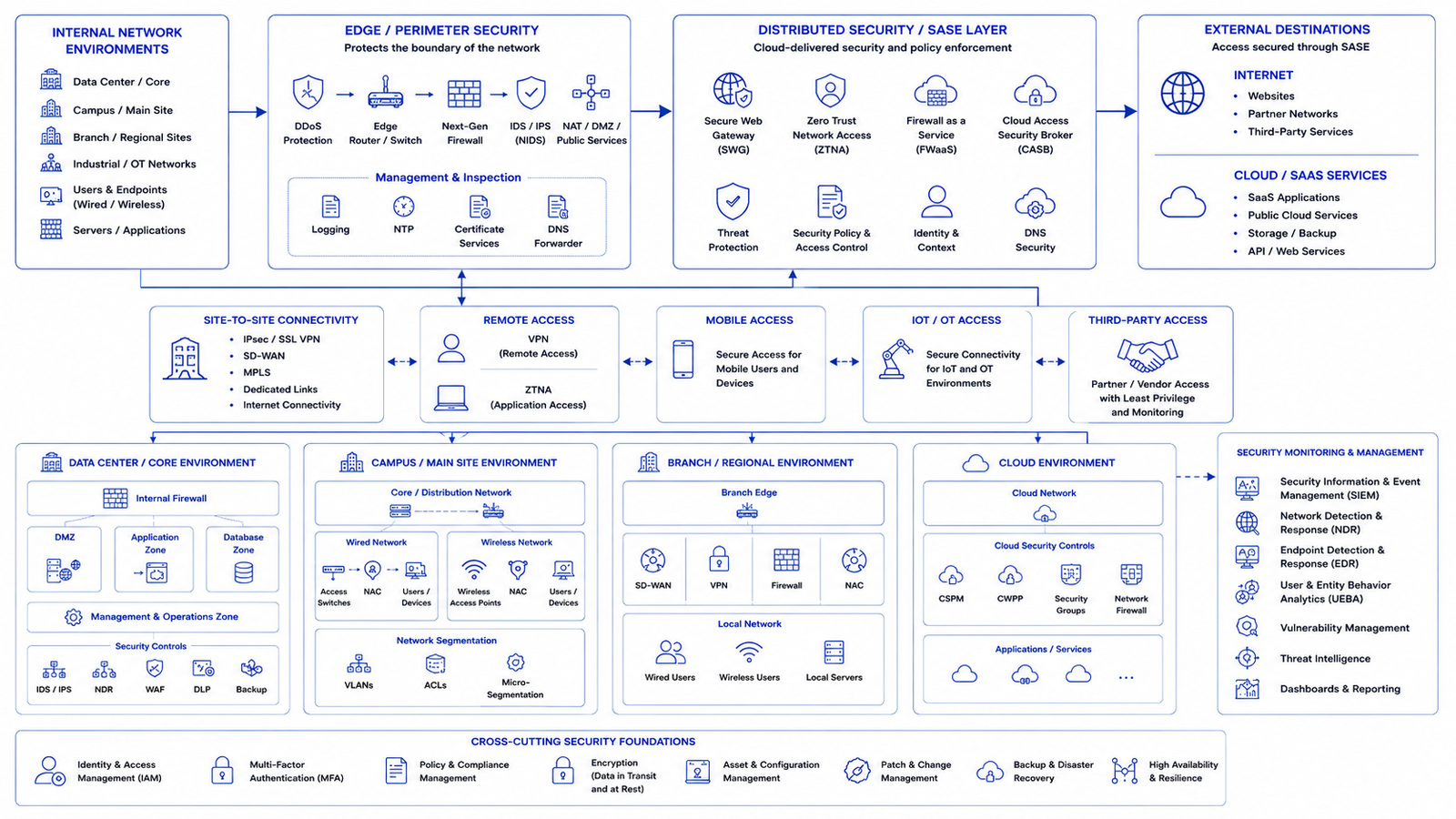
Network security technology architecture describes the structure, organization, connectivity, and interaction of network infrastructure and security technologies used to protect network communication, systems, applications, and information.
A network security architecture is not simply a collection of security technologies. It defines how network and security elements are organized, where security controls are positioned, how different environments are connected, how traffic flows between them, and how the overall design supports security policy, security requirements, risk, availability, and operational needs.
Network environments can include traditional data centers, campus networks, branch locations, remote users, cloud environments, SaaS applications, wired networks, wireless networks, and other distributed resources. Network security architecture can therefore combine perimeter security with distributed security enforcement.
Network Security Elements
Network security elements are the fundamental components that make up a network security architecture.
Key elements include:
- Network Segments and Zones — logical or physical areas used to separate systems and resources according to security requirements.
- Network Devices — routers, switches, wireless infrastructure, gateways, and other devices that provide network connectivity and traffic forwarding.
- Security Controls — mechanisms used to restrict, protect, detect, prevent, or monitor network activity.
- Network Security Technologies — firewalls, WAFs, proxies, NAC, VPNs, IDS, IPS, NDR, DNS security, SASE, and other technologies that implement security capabilities.
- Connectivity — Internet, internal, remote, branch, data center, cloud, wireless, and third-party connections.
- Security Boundaries — points where different trust levels, security requirements, or network environments meet.
- Traffic Flows — communication paths between users, devices, applications, services, and external networks.
- Monitoring and Management — capabilities for collecting security events, monitoring network activity, managing security technologies, and maintaining visibility.
- High Availability and Resilience — mechanisms such as redundancy, failover, and alternate connectivity that help maintain network and security service availability.
These elements provide the building blocks from which the network security architecture is designed.
Network Security Design
Network security design describes how the elements of the architecture are organized, positioned, connected, and configured to provide secure network communication and enforce security requirements.
A typical network security design can combine traditional perimeter security with distributed security services.
Perimeter and Edge Security
The perimeter remains an important security boundary for networks and environments that require controlled external connectivity.
A typical perimeter may include:
- Internet connectivity
- Edge routers
- DDoS protection
- Perimeter firewalls
- Security gateways
- WAF
- VPN gateways
- DNS security
- Other edge security controls
The perimeter controls and monitors communication between external networks and protected environments.
The existence of a perimeter does not mean that all security enforcement must occur at that perimeter. Distributed environments require additional security controls closer to users, devices, applications, and services.
SASE and Distributed Security
SASE provides a distributed security architecture in which security capabilities can be delivered closer to users, devices, applications, and locations rather than relying entirely on a central network perimeter.
SASE can incorporate capabilities such as:
- Secure Web Gateway
- Zero Trust Network Access
- Firewall as a Service
- Cloud Access Security Broker
- Security policy enforcement
- Threat protection
- Identity and context-based access
The SASE layer can provide security services across different network environments, including:
- Data centers
- Branches
- Divisions
- Campus networks
- Remote users
- Cloud environments
- SaaS applications
- Internet access
This allows security policies to be applied across distributed environments while retaining traditional perimeter controls where they are required.
Data Center Connectivity
Data centers can remain connected through traditional network infrastructure and security controls while also integrating with distributed security services.
A data center architecture may include:
- Edge routers
- Perimeter firewalls
- Internal firewalls
- Network segmentation
- Application zones
- Database zones
- Management networks
- WAF
- IDS/IPS
- NDR
- Network monitoring
Communication between the data center and other locations can be controlled through appropriate network and security mechanisms.
Divisional and Branch Connectivity
Different divisions, branches, or geographical locations may have their own network infrastructure and security requirements.
These environments can connect through:
- WAN connectivity
- Internet connectivity
- SD-WAN
- VPN
- SASE services
- Dedicated connectivity
Security policies can be applied consistently while allowing individual locations to maintain appropriate local network controls.
Wired Network Architecture
A typical wired network contains endpoint devices connected through access switches. Network Access Control can authenticate users and devices and determine the appropriate level of network access.
VLANs and other segmentation mechanisms can place devices into appropriate network zones. Switch ACLs can provide additional access restrictions, while internal firewalls and other security controls can regulate communication between different zones and protected applications or services.
The wired architecture should therefore integrate connectivity, authentication, access control, segmentation, traffic filtering, and monitoring rather than treating each capability as an isolated function.
Wireless Network Architecture
A wireless network uses access points and wireless infrastructure to provide connectivity to users and devices.
Authentication and Network Access Control can establish identity and determine the appropriate level of access. Corporate, guest, and specialized wireless environments can be separated through appropriate network segmentation and security policies.
Wireless traffic can then be monitored and controlled as it communicates with internal applications, services, or external resources.
Wireless architecture should therefore be integrated with the same security principles used for wired environments while accounting for the additional risks associated with wireless communication and mobility.
Security Zones and Segmentation
Network zones provide logical or physical separation between environments with different security requirements.
A typical architecture may contain:
- Internet zone
- DMZ
- User zone
- Server zone
- Application zone
- Database zone
- Management zone
- Guest zone
- Restricted zone
- IoT zone
Firewalls, ACLs, routing controls, NAC, and other security mechanisms can regulate communication between these zones.
Segmentation reduces unnecessary connectivity and can limit lateral movement following a compromise.
Security Control Placement
Security controls should be positioned according to the traffic they need to control, the resources they protect, and the security requirements they enforce.
Examples include:
- Perimeter firewall at the external boundary
- WAF protecting Internet-facing applications
- Proxy or SWG controlling Internet access
- NAC controlling network access
- Internal firewalls controlling communication between zones
- IDS/IPS inspecting relevant traffic
- NDR providing network visibility
- DNS security controlling and monitoring DNS activity
- ZTNA controlling access to applications and resources
- SASE providing distributed security enforcement
There is no single location where every security technology must be deployed. Placement should be determined by the architecture, traffic flows, security requirements, and control objectives.
Traffic Flows
Traffic flows describe how communication moves between network elements, security zones, applications, services, and external networks.
Traffic should be evaluated according to factors such as:
- Source
- Destination
- User
- Device
- Application
- Protocol
- Direction
- Trust relationship
- Security requirement
For example, traffic originating from a user network and destined for a protected application may cross an internal security boundary where firewall policies and other access controls are applied before the communication is permitted.
Outbound Internet traffic may be subject to proxy or Secure Web Gateway policies before reaching external services.
Remote users may receive application access through identity-aware security controls and SASE services rather than receiving unrestricted access to an internal network.
Traffic-flow analysis therefore helps determine where security controls are required and what policies those controls should enforce.
Security Control Integration
Network security technologies should not operate as isolated systems.
They may exchange information and work together to provide broader security capabilities.
For example:
- Firewall events can be sent to security monitoring systems.
- NAC can provide device and access information.
- IDS and IPS can generate security alerts.
- NDR can identify suspicious network behavior.
- Identity systems can provide user context.
- Threat intelligence can inform filtering and detection.
- SASE services can apply identity- and context-based policies.
- Security operations can use information from multiple technologies for investigation and response.
Integration allows the architecture to function as a coordinated security system.
Logging and Monitoring
Network security architecture should provide appropriate visibility into security-relevant activity.
Monitoring can include:
- Firewall events
- Authentication events
- NAC events
- IDS and IPS alerts
- DNS activity
- Proxy activity
- VPN connections
- Network flows
- Wireless activity
- SASE security events
- Security policy violations
This information can support:
- Threat detection
- Investigation
- Incident response
- Troubleshooting
- Security assessment
- Compliance activities
- Performance analysis
Logging and monitoring should therefore be considered integral components of the security architecture.
High Availability and Resilience
Security technologies can themselves become critical components of network availability.
A failure of a firewall, gateway, authentication service, wireless infrastructure component, or SASE connectivity path can affect network access.
Architecture may therefore require:
- Redundant security devices
- Failover
- Multiple Internet connections
- Redundant network paths
- High-availability firewalls
- Resilient wireless infrastructure
- Multiple connectivity paths
- Backup communication mechanisms
- Recovery mechanisms
Security controls should provide protection without unnecessarily becoming single points of failure.
Performance and Capacity
Security technologies inspect traffic, authenticate users and devices, analyze content, enforce policies, and generate security telemetry.
Architecture should therefore consider:
- Network bandwidth
- Traffic volume
- Peak traffic
- Processing capacity
- Latency
- Encryption overhead
- Inspection requirements
- Storage requirements
- SASE service capacity
- Future growth
Security controls that cannot process the required traffic volume may become performance bottlenecks or availability risks.
Hybrid Perimeter and Distributed Security Architecture
A complete network security architecture does not require choosing between perimeter security and distributed security.
The perimeter remains important for controlling external connectivity and protecting specific network environments.
SASE extends security enforcement across distributed users, branches, divisions, data centers, cloud environments, and applications.
The resulting architecture can therefore combine:
- Perimeter security
- Internal network security
- Network segmentation
- Identity and access controls
- Wired security
- Wireless security
- Cloud security
- SASE
- Security monitoring
- High availability and resilience
The architecture should determine where each control is most effective and how the different controls work together.
The objective is to create a network security design in which network elements, security technologies, security controls, connectivity, and traffic flows are deliberately organized and interconnected according to security policy, security requirements, risk, and operational needs.
Conclusion
Network security technologies provide the technical capabilities required to protect network communication, control access, prevent and detect threats, protect applications and services, and maintain the availability of network resources.
Their effectiveness does not depend solely on the technology itself. Security policy establishes the security expectations, security requirements define what protection is needed, security controls provide the safeguards, and technologies provide mechanisms for implementing those controls.
Network security technologies also contribute differently to the Confidentiality, Integrity, and Availability (CIA) objectives. A single technology may support multiple objectives depending on its purpose, configuration, placement, and integration with other controls.
Effective network security requires a combination of complementary technologies and controls. Firewalls, NAC, VPN, IDS, IPS, WAF, segmentation, DNS security, NDR, ZTNA, SASE, and other technologies address different security requirements and work together as part of a broader defense-in-depth strategy.
Network security architecture provides the structure in which these technologies operate. It defines the network elements, security boundaries, zones, connectivity, traffic flows, control placement, monitoring, and relationships between security technologies. Traditional perimeter security remains relevant, while distributed security architectures such as SASE extend security enforcement across users, locations, applications, cloud environments, and other distributed resources.
Understanding network security technologies therefore requires more than understanding individual technologies. It requires understanding why a technology is needed, what security control it implements, which CIA objectives it supports, where it belongs within the architecture, and how it works with other security controls to provide overall protection.
References
NIST – Guidelines on Firewalls and Firewall Policy, SP 800-41 Rev. 1
Provides guidance on firewall technologies, firewall policy, deployment, configuration, testing, and management, making it a foundational reference for network perimeter security.
NIST – Guide to Intrusion Detection and Prevention Systems (IDPS), SP 800-94
Provides guidance on intrusion detection and prevention technologies and their design, implementation, configuration, monitoring, and maintenance.
NIST – Guide to IPsec VPNs, SP 800-77 Rev. 1
Provides guidance on using IPsec and IKE to protect communications across IP networks and support secure VPN connectivity.
NIST – Secure Domain Name System (DNS) Deployment Guide, SP 800-81 Rev. 3
Provides guidance for securing DNS infrastructure and using DNS security as an additional layer of network protection, including within Zero Trust and defense-in-depth architectures.
NIST – Zero Trust Architecture, SP 800-207
Defines Zero Trust Architecture and explains the shift from static network-based perimeters toward protection centered on users, assets, and resources.
NIST – Guide to a Secure Enterprise Network Landscape, SP 800-215
Addresses distributed network environments and discusses technologies and architectures including SASE, ZTNA, SD-WAN, VPN, CASB, SWG, firewalls, and microsegmentation.
NIST – The NIST Cybersecurity Framework (CSF) 2.0
Provides a broad framework for managing cybersecurity risk and organizing security outcomes supported by network security technologies.
OWASP – Web Application Firewall
Provides foundational guidance on WAFs and their role in inspecting HTTP traffic and protecting web applications against common application-layer attacks.
IETF – The Transport Layer Security (TLS) Protocol Version 1.3, RFC 9846
Defines TLS 1.3 for protecting client/server communications against eavesdropping, tampering, and message forgery.