The CIA Triad: The Foundation of Cybersecurity
Introduction to the CIA Triad
The world has evolved into a highly connected digital ecosystem powered by information technology and the Internet. Today, communication, banking, healthcare, education, commerce, government services, critical infrastructure, and countless aspects of everyday life depend on digital systems that continuously create, process, store, and exchange information. As digital technologies continue to evolve, information has become one of the world’s most valuable assets, making its protection more important than ever.
Protecting information goes beyond preventing unauthorized access. Information must remain confidential, accurate, trustworthy, and available whenever it is needed. A compromise in any of these areas can lead to financial losses, operational disruptions, reputational damage, legal consequences, and a loss of trust. Whether information is stored on a personal device, within an enterprise network, or in the cloud, maintaining its security is fundamental to the reliable operation of today’s digital world.
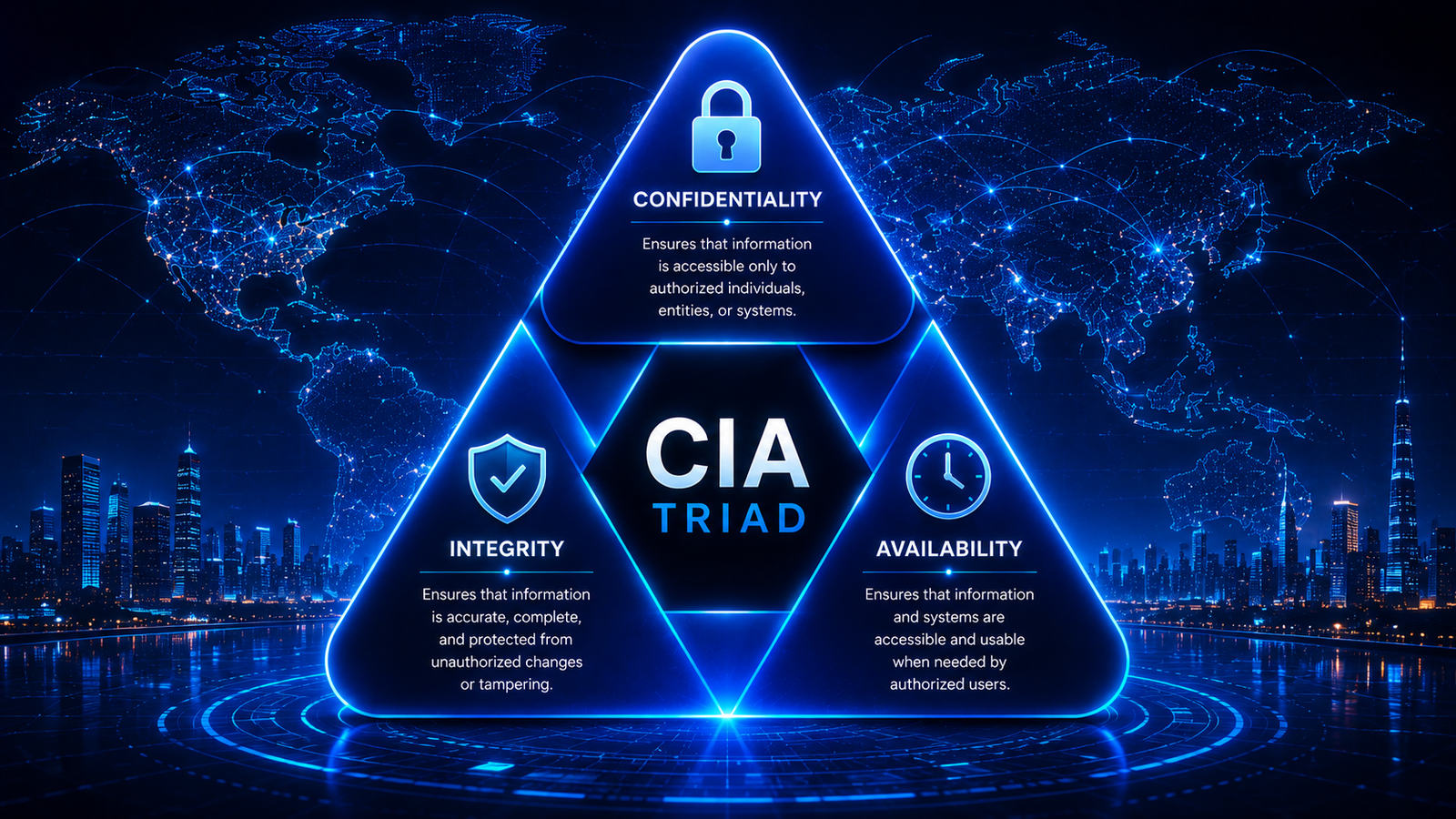
The CIA Triad provides the foundation for protecting information by defining three essential security objectives: Confidentiality, Integrity, and Availability. These principles form the cornerstone of information security and continue to serve as one of the most important models in modern cybersecurity.
Rather than representing a technology, product, or security framework, the CIA Triad defines the security objectives that guide cybersecurity strategies, security architecture, risk management, security controls, and security operations. Regardless of how technologies evolve, the principles of confidentiality, integrity, and availability remain constant, making the CIA Triad one of the most enduring and universally accepted concepts in cybersecurity.
What Is the CIA Triad?
The CIA Triad is a foundational information security model that defines the three primary objectives of protecting information and information systems:
- Confidentiality ensures that information is accessible only to authorized individuals, systems, or processes.
- Integrity ensures that information remains accurate, complete, consistent, and protected from unauthorized modification.
- Availability ensures that information, systems, and services remain accessible and operational whenever they are required by authorized users.
Together, these three principles provide a balanced approach to protecting information. They help security professionals design secure systems, evaluate risks, implement appropriate safeguards, and measure the effectiveness of security practices. Every cybersecurity initiative, regardless of its scope or technology, ultimately aims to preserve one or more elements of the CIA Triad.
The three principles are closely interconnected. Weakness in one pillar can affect the others. For example, a ransomware attack may expose confidential information, alter or encrypt data, and prevent legitimate users from accessing critical systems. Maintaining an effective balance between confidentiality, integrity, and availability is therefore essential for achieving comprehensive information security.
Why the CIA Triad Matters
The CIA Triad serves as the foundation for making informed security decisions throughout the information lifecycle. It provides a simple and universally accepted framework for defining security objectives, assessing risks, designing secure solutions, and evaluating how effectively information is protected.
The CIA Triad is applicable across every industry and technology environment. Whether protecting personal information, financial systems, healthcare records, cloud services, industrial control systems, or critical infrastructure, the same three objectives remain relevant: keeping information confidential, ensuring its integrity, and making it available whenever authorized users need it.
The principles of the CIA Triad influence every aspect of cybersecurity. They guide the development of security strategies, support governance and risk management, shape secure architectures, drive the implementation of security controls, strengthen security operations, and improve cyber resilience. Because these objectives remain constant regardless of technological change, the CIA Triad continues to be one of the most important and enduring foundations of modern cybersecurity.
The Three Pillars of the CIA Triad
The CIA Triad is built upon three fundamental security principles: Confidentiality, Integrity, and Availability. These principles are commonly referred to as the three pillars of the CIA Triad because they collectively define the essential objectives of information security. While each pillar has a distinct purpose, they are closely interconnected and must be maintained together to provide effective protection for information and information systems.
Confidentiality
Confidentiality is the principle of ensuring that information is accessible only to authorized individuals, systems, or processes. It protects sensitive information from unauthorized disclosure, whether accidental or intentional, and helps preserve privacy, trust, and regulatory compliance.
Confidentiality applies to every type of information, including personal data, financial records, healthcare information, intellectual property, business documents, government information, and classified data. Only those with a legitimate need and appropriate authorization should be able to view or access such information.
For example, a customer’s banking information should only be accessible to the customer and authorized banking personnel. If an attacker gains access to this information or it is accidentally disclosed, confidentiality has been compromised.
Maintaining confidentiality reduces the risk of identity theft, financial fraud, espionage, privacy violations, and unauthorized disclosure of sensitive information.
Integrity
Integrity is the principle of ensuring that information remains accurate, complete, consistent, and trustworthy throughout its lifecycle. It protects information from unauthorized modification, corruption, deletion, or destruction, ensuring that users can rely on the information for decision-making and business operations.
Integrity applies not only to stored data but also to information being processed or transmitted. Whether updating customer records, processing financial transactions, or maintaining healthcare records, the information must remain accurate and unchanged unless modified through authorized and legitimate processes.
For example, if an attacker alters the amount of an online financial transaction or modifies a patient’s medical record without authorization, the integrity of the information has been compromised.
Maintaining integrity helps ensure the reliability of information, supports informed decision-making, and preserves trust in digital systems and services.
Availability
Availability is the principle of ensuring that information, systems, applications, and services are accessible whenever they are needed by authorized users. Information has little value if it cannot be accessed at the right time, even if it remains confidential and accurate.
Availability requires systems to remain operational despite hardware failures, software faults, cyber attacks, natural disasters, or unexpected disruptions. Critical services should continue functioning or recover quickly to minimize downtime and business impact.
For example, if an online banking platform becomes unavailable because of a distributed denial-of-service (DDoS) attack, customers cannot access their accounts or perform transactions. Although the information may remain confidential and accurate, the loss of availability disrupts essential services.
Maintaining availability ensures business continuity, supports operational resilience, and enables users to access information and services whenever they are required.
Balancing the Three Pillars
The three pillars of the CIA Triad are interdependent and should never be considered in isolation. Focusing exclusively on one principle while neglecting the others can create security gaps and increase organizational risk.
For example, encrypting sensitive information helps maintain confidentiality, but if authorized users cannot access the encrypted information when needed, availability is affected. Similarly, making information widely accessible may improve availability but could weaken confidentiality if appropriate safeguards are not in place. Information that is confidential and readily available also loses its value if it has been altered or can no longer be trusted, compromising its integrity.
An effective cybersecurity program seeks to achieve an appropriate balance between confidentiality, integrity, and availability based on the value of the information, business requirements, regulatory obligations, and the level of acceptable risk. Maintaining this balance enables information to remain protected, accurate, and accessible throughout its lifecycle while supporting the secure and reliable operation of digital systems.
Real-World Examples of the CIA Triad
The principles of the CIA Triad are applied across virtually every digital environment. Whether protecting personal information, financial transactions, healthcare records, cloud services, or critical infrastructure, the objective remains the same: to ensure information remains confidential, accurate, and available whenever it is needed.
Consider the following examples:
Online Banking: A customer logs into an online banking application to transfer funds. The customer’s account information and transaction details must remain confidential, account balances and transaction records must remain accurate and unaltered, and the banking service must be available whenever customers need to perform financial transactions.
Healthcare Systems: Hospitals and healthcare providers store electronic medical records containing highly sensitive patient information. Medical records should only be accessible to authorized healthcare professionals, the information must remain accurate to support patient care, and healthcare systems must remain available to ensure timely treatment and emergency response.
E-Commerce Platforms: Online retailers process customer accounts, payment information, and purchase orders every day. Customer data must remain confidential, order details and payment records must maintain their integrity, and the shopping platform must remain available throughout the purchasing process.
Cloud Services: Cloud platforms host applications, databases, and business workloads that support organizations around the world. Information stored in the cloud must be protected from unauthorized access, remain accurate throughout its lifecycle, and be continuously available to users regardless of their location.
Critical Infrastructure: Essential services such as energy, transportation, telecommunications, and water systems rely on digital technologies to support daily operations. Protecting operational information, maintaining accurate system data, and ensuring uninterrupted service availability are essential for public safety, economic stability, and national resilience.
These examples demonstrate that although technologies and industries differ, the underlying security objectives remain the same. Every digital service depends on maintaining the confidentiality, integrity, and availability of information and systems.
Common Threats to the CIA Triad
Cyber threats continue to evolve in sophistication and scale, targeting information, systems, and services in different ways. While some threats focus on a single pillar of the CIA Triad, many attacks compromise multiple pillars simultaneously.
Threats to Confidentiality
Confidentiality is threatened whenever unauthorized individuals gain access to sensitive information. Common examples include phishing attacks, credential theft, insider threats, data breaches, social engineering, eavesdropping, and unauthorized disclosure of confidential information. These attacks may expose personal data, financial records, intellectual property, or other sensitive information to unauthorized parties.
Threats to Integrity
Integrity is compromised when information is modified, deleted, corrupted, or manipulated without authorization. Examples include malware that alters files, unauthorized database modifications, website defacement, fraudulent financial transactions, and software supply chain attacks. When integrity is lost, information can no longer be trusted, leading to incorrect decisions and operational failures.
Threats to Availability
Availability is threatened when information or services become inaccessible to authorized users. Distributed Denial-of-Service (DDoS) attacks, ransomware, hardware failures, software failures, natural disasters, and power outages can all disrupt normal operations. Even temporary service interruptions can significantly affect productivity, customer confidence, and critical business functions.
Threats Affecting Multiple Pillars
Many modern cyber attacks target more than one element of the CIA Triad at the same time. For example, a ransomware attack may steal confidential information before encrypting files. This compromises Confidentiality by exposing sensitive data, Integrity by altering or encrypting files, and Availability by preventing legitimate users from accessing information and services. Similarly, a sophisticated supply chain attack may modify software without authorization, expose sensitive information, and disrupt critical business operations.
Understanding how threats impact the CIA Triad helps security professionals identify risks, prioritize protective measures, and develop comprehensive cybersecurity strategies. Recognizing these threats is the first step toward implementing the appropriate security domains, security controls, and security practices needed to protect information and maintain cyber resilience.
Security Domains
The CIA Triad defines the three fundamental security objectives that every organization strives to achieve: Confidentiality, Integrity, and Availability. However, protecting information in today’s digital world requires much more than understanding these three principles. It requires a structured approach that addresses every aspect of cybersecurity, from governance and risk management to identity management, network security, cloud security, software security, operations, and resilience.
This structured approach is provided through security domains. A security domain represents a specialized area of cybersecurity that focuses on a specific set of responsibilities, knowledge, processes, and best practices. Each domain addresses a unique aspect of protecting information, systems, applications, networks, and digital services while collectively contributing to an organization’s overall cybersecurity posture.
Although each security domain has its own objectives and responsibilities, no domain operates in isolation. They complement one another by addressing different areas of cybersecurity, creating a comprehensive and layered approach to protecting information throughout its lifecycle. Together, the security domains provide the knowledge, governance, architecture, operational capabilities, and resilience required to build an effective cybersecurity program.
The following are the primary security domains that collectively form a comprehensive cybersecurity framework.
Cybersecurity Foundations establish the fundamental concepts, principles, terminology, technologies, security models, and best practices that provide the essential knowledge required to understand, implement, and advance cybersecurity across all domains.
Security Governance establishes the strategic direction for cybersecurity by defining governance structures, security policies, standards, procedures, roles, responsibilities, and oversight mechanisms that guide security across the organization.
Cyber Risk Management identifies, analyzes, evaluates, and manages cybersecurity risks affecting information assets, systems, business operations, and digital services, enabling informed security decisions.
Audit & Compliance evaluates the effectiveness of security programs and ensures compliance with legal, regulatory, contractual, and organizational requirements through audits, assessments, and continuous monitoring.
Security Architecture & Engineering designs secure systems, applications, networks, and technology infrastructures by integrating security principles throughout planning, implementation, and ongoing maintenance.
Identity & Access Security manages digital identities and controls access to information systems, applications, networks, and digital resources by ensuring only authorized users, devices, and services receive appropriate access.
Information & Data Security protects information throughout its lifecycle, including its creation, classification, storage, processing, transmission, sharing, archiving, and secure disposal.
Physical & Environmental Security safeguards facilities, personnel, equipment, and supporting infrastructure from physical threats, unauthorized access, theft, environmental hazards, and operational disruptions.
IT & Infrastructure Security protects the underlying computing infrastructure that supports business operations, including operating systems, servers, endpoints, virtualization platforms, storage systems, and other critical IT components.
Cryptography applies cryptographic principles and techniques to protect sensitive information, secure communications, verify identities, preserve data integrity, and establish digital trust.
Network & Internet Security protects network infrastructure, internet connectivity, communication protocols, and network services to ensure secure, reliable, and resilient communications.
Cloud Governance & Security secures cloud platforms, cloud services, workloads, applications, and cloud-based information through effective governance, architecture, configuration, and operational security practices.
Software & Application Security integrates security throughout the software development lifecycle, ensuring applications are securely designed, developed, tested, deployed, and maintained.
Security Operations continuously monitors, detects, investigates, responds to, and recovers from cybersecurity incidents while maintaining visibility across the organization’s security environment.
Security Assessment & Testing evaluates the effectiveness of security controls and security practices through assessments, vulnerability management, penetration testing, configuration reviews, and other validation activities.
Business Continuity & Disaster Recovery ensures that essential business functions, information, and technology services continue operating during disruptions and recover efficiently following incidents or disasters.
Cybersecurity Attacks & Threats examines cyber threat actors, attack techniques, vulnerabilities, threat intelligence, and the evolving threat landscape to strengthen defensive capabilities and improve cyber resilience.
Cybersecurity Laws & Regulations addresses the legal, regulatory, contractual, and privacy requirements governing the protection of information, digital systems, and organizational security practices.
Artificial Intelligence Security focuses on protecting AI systems, AI models, AI data, and AI-enabled applications while addressing the unique security risks, governance requirements, and emerging threats associated with artificial intelligence.
Together, these security domains provide a structured and comprehensive approach to cybersecurity. While each domain focuses on a specific area of expertise, they collectively help organizations build secure systems, protect information, manage risk, strengthen resilience, and support the security objectives defined by the CIA Triad.
Security Controls
While the CIA Triad defines the security objectives and the security domains provide the areas of expertise required to protect information, security controls are the safeguards that implement these objectives in practice. They consist of the policies, processes, technologies, and physical measures used to protect information, reduce risk, and maintain the confidentiality, integrity, and availability of information and systems.
Security controls are commonly classified into three control categories based on how they are implemented and seven functional control types based on the role they perform within a cybersecurity program.
Security Control Categories
Administrative Controls establish the governance, policies, standards, procedures, and management practices that direct and support cybersecurity throughout the organization. They define how security should be implemented, managed, and maintained while ensuring that personnel understand their security responsibilities. Examples include security policies, risk assessments, security awareness training, vendor management, personnel security, change management, and incident response planning.
Technical Controls are technology-based safeguards that protect information systems, applications, networks, and digital assets. They automatically enforce security requirements and help prevent, detect, and respond to cyber threats. Examples include authentication systems, multi-factor authentication (MFA), encryption, firewalls, intrusion detection and prevention systems (IDS/IPS), endpoint protection, SIEM, VPNs, and access control mechanisms.
Physical Controls protect facilities, personnel, equipment, and supporting infrastructure from unauthorized physical access, theft, environmental hazards, and other physical threats. Examples include security guards, locks, access cards, biometric authentication, CCTV surveillance, perimeter fencing, fire suppression systems, environmental monitoring, and backup power systems.
Functional Security Controls
Preventive Controls are designed to stop security incidents before they occur by reducing vulnerabilities, preventing unauthorized activities, and minimizing the likelihood of successful attacks.
Detective Controls identify and report suspicious activities, security events, policy violations, and potential cyber attacks, enabling timely investigation and response.
Corrective Controls restore systems to a secure state after a security incident by removing the cause of the incident, correcting vulnerabilities, and minimizing the impact of the attack.
Directive Controls provide guidance by establishing policies, standards, procedures, and security requirements that define how individuals and organizations should protect information and systems.
Deterrent Controls discourage unauthorized activities by increasing the perceived risk of detection or punishment, thereby reducing the likelihood of malicious actions.
Compensating Controls provide alternative safeguards when a primary control cannot be implemented, ensuring that an acceptable level of security is maintained despite operational or technical limitations.
Recovery Controls restore information, systems, and business operations following a security incident, system failure, or disaster, helping organizations resume normal operations with minimal disruption.
Together, these control categories and functional control types provide the practical mechanisms for implementing cybersecurity. By applying the appropriate combination of administrative, technical, physical, preventive, detective, corrective, directive, deterrent, compensating, and recovery controls, organizations can effectively protect information and support the objectives of the CIA Triad.
How Do Cybersecurity Domains and Security Controls Work Together to Achieve the CIA Triad?
The CIA Triad defines the three fundamental security objectives that every organization strives to achieve: Confidentiality, Integrity, and Availability. Cybersecurity domains provide the specialized knowledge, governance, processes, and capabilities required to protect different aspects of the digital environment, while security controls provide the practical safeguards that implement those protections. Together, cybersecurity domains and security controls translate the principles of the CIA Triad into effective cybersecurity practices.
For example, the Identity & Access Security domain focuses on managing digital identities and controlling access to systems and information. To achieve the objectives of the CIA Triad, organizations implement technical controls such as multi-factor authentication (MFA), role-based access control (RBAC), privileged access management (PAM), and single sign-on (SSO). Administrative controls such as access management policies and user provisioning procedures help ensure that only authorized users receive appropriate access, protecting the confidentiality of information, preserving the integrity of access permissions, and maintaining secure access to critical systems.
Similarly, the Information & Data Security domain protects information throughout its lifecycle. Controls such as data classification, encryption, data loss prevention (DLP), hashing, digital signatures, secure backups, and data recovery mechanisms help maintain the confidentiality, integrity, and availability of information.
The Network & Internet Security domain protects communication networks and internet-facing services. Controls such as firewalls, intrusion detection and prevention systems (IDS/IPS), network segmentation, virtual private networks (VPNs), secure communication protocols, and continuous network monitoring help secure data in transit, prevent unauthorized access, maintain communication integrity, and ensure reliable network availability.
Within the Cloud Governance & Security domain, organizations implement controls including identity and access management, encryption, secure configuration management, workload protection, cloud security monitoring, and governance policies. These controls protect cloud-hosted information, preserve the integrity of cloud services, and ensure the continuous availability of cloud resources.
The Software & Application Security domain integrates security throughout the software development lifecycle. Secure coding practices, application security testing, code reviews, vulnerability management, and patch management help reduce software vulnerabilities, protect application data, maintain application integrity, and improve application availability.
The Security Operations domain continuously monitors and protects the organization’s security environment. Controls such as Security Information and Event Management (SIEM), Endpoint Detection and Response (EDR), Security Orchestration, Automation and Response (SOAR), threat intelligence, security monitoring, and incident response processes enable organizations to rapidly detect, investigate, contain, and recover from cyber incidents while supporting all three objectives of the CIA Triad.
The remaining cybersecurity domains also contribute by implementing security controls appropriate to their areas of responsibility. Security Governance establishes the policies and oversight that direct security implementation, Risk Management determines which controls are required based on organizational risk, Audit & Compliance verifies that controls are operating effectively, Business Continuity & Disaster Recovery ensures services can continue and recover following disruptions, while Physical & Environmental Security, IT & Infrastructure Security, Cryptography, Security Assessment & Testing, Cybersecurity Attacks & Threats, Cybersecurity Laws & Regulations, and Artificial Intelligence Security each implement specialized controls that collectively strengthen the organization’s cybersecurity posture.
Ultimately, the CIA Triad defines what cybersecurity aims to achieve, cybersecurity domains define where cybersecurity activities are performed, and security controls define how those objectives are implemented. Together, they provide a comprehensive and structured approach to protecting information, systems, applications, and digital services while ensuring the confidentiality, integrity, and availability of information.
Achieving the CIA Triad Through Cybersecurity Domains and Security Controls
The CIA Triad defines the three fundamental security objectives that every organization strives to achieve: Confidentiality, Integrity, and Availability. Cybersecurity domains provide the specialized knowledge, governance, processes, and capabilities required to protect different aspects of the digital environment, while security controls provide the practical safeguards that implement those protections. Together, cybersecurity domains and security controls translate the principles of the CIA Triad into effective cybersecurity practices.
For example, the Identity & Access Security domain focuses on managing digital identities and controlling access to systems and information. To achieve the objectives of the CIA Triad, organizations implement technical controls such as multi-factor authentication (MFA), role-based access control (RBAC), privileged access management (PAM), and single sign-on (SSO). Administrative controls such as access management policies and user provisioning procedures help ensure that only authorized users receive appropriate access, protecting the confidentiality of information, preserving the integrity of access permissions, and maintaining secure access to critical systems.
Similarly, the Information & Data Security domain protects information throughout its lifecycle. Controls such as data classification, encryption, data loss prevention (DLP), hashing, digital signatures, secure backups, and data recovery mechanisms help maintain the confidentiality, integrity, and availability of information.
The Network & Internet Security domain protects communication networks and internet-facing services. Controls such as firewalls, intrusion detection and prevention systems (IDS/IPS), network segmentation, virtual private networks (VPNs), secure communication protocols, and continuous network monitoring help secure data in transit, prevent unauthorized access, maintain communication integrity, and ensure reliable network availability.
Within the Cloud Governance & Security domain, organizations implement controls including identity and access management, encryption, secure configuration management, workload protection, cloud security monitoring, and governance policies. These controls protect cloud-hosted information, preserve the integrity of cloud services, and ensure the continuous availability of cloud resources.
The Software & Application Security domain integrates security throughout the software development lifecycle. Secure coding practices, application security testing, code reviews, vulnerability management, and patch management help reduce software vulnerabilities, protect application data, maintain application integrity, and improve application availability.
The Security Operations domain continuously monitors and protects the organization’s security environment. Controls such as Security Information and Event Management (SIEM), Endpoint Detection and Response (EDR), Security Orchestration, Automation and Response (SOAR), threat intelligence, security monitoring, and incident response processes enable organizations to rapidly detect, investigate, contain, and recover from cyber incidents while supporting all three objectives of the CIA Triad.
The remaining cybersecurity domains also contribute by implementing security controls appropriate to their areas of responsibility. Security Governance establishes the policies and oversight that direct security implementation, Risk Management determines which controls are required based on organizational risk, Audit & Compliance verifies that controls are operating effectively, Business Continuity & Disaster Recovery ensures services can continue and recover following disruptions, while Physical & Environmental Security, IT & Infrastructure Security, Cryptography, Security Assessment & Testing, Cybersecurity Attacks & Threats, Cybersecurity Laws & Regulations, and Artificial Intelligence Security each implement specialized controls that collectively strengthen the organization’s cybersecurity posture.
Ultimately, the CIA Triad defines what cybersecurity aims to achieve, cybersecurity domains define where cybersecurity activities are performed, and security controls define how those objectives are implemented. Together, they provide a comprehensive and structured approach to protecting information, systems, applications, and digital services while ensuring the confidentiality, integrity, and availability of information.
Conclusion
The CIA Triad remains one of the most fundamental and enduring concepts in cybersecurity. By defining the three essential security objectives—Confidentiality, Integrity, and Availability—it provides the foundation for protecting information, information systems, and digital services across every industry and technology environment.
Achieving these objectives requires more than understanding the principles themselves. Cybersecurity domains provide the specialized knowledge, governance, processes, and operational capabilities needed to address different aspects of cybersecurity, while security controls provide the administrative, technical, and physical safeguards that implement those capabilities in practice. Together, they transform the principles of the CIA Triad into a comprehensive and effective cybersecurity program.
Whether securing personal information, enterprise systems, cloud environments, critical infrastructure, or emerging technologies such as artificial intelligence, the CIA Triad continues to guide cybersecurity strategies, influence security decisions, and shape the implementation of security controls. As technologies evolve and cyber threats become increasingly sophisticated, the principles of confidentiality, integrity, and availability remain constant, making the CIA Triad the cornerstone of modern cybersecurity and the foundation upon which effective security programs are built.