Proactive Threat Intelligence vs. Predictive Threat Intelligence
Introduction
Cyber Threat Intelligence (CTI) plays an important role in understanding the cyber threat landscape, identifying malicious activities, analyzing adversary behavior, and supporting informed security decisions. It involves collecting, processing, analyzing, and disseminating information about threat actors, their capabilities, motivations, infrastructure, attack methods, and activities.
Understanding threats only after they have materialized or resulted in security incidents is insufficient. The ability to identify emerging threats, recognize changes in adversary behavior, and anticipate potential malicious activities is essential for improving cybersecurity preparedness.
Proactive Threat Intelligence and Predictive Threat Intelligence represent two approaches to addressing these requirements. Proactive Threat Intelligence focuses on identifying and analyzing threats early to support preventive action, whereas Predictive Threat Intelligence uses historical information, behavioral patterns, analytical techniques, and forecasting capabilities to anticipate potential future threats.
Although both approaches aim to provide forward-looking security insights, they differ in their objectives, analytical methods, information requirements, and intelligence outputs. Understanding these differences helps individuals, governments, industries, economies, and digital ecosystems make better-informed decisions about cybersecurity risks and emerging threats.
Understanding Cyber Threat Intelligence
Cyber Threat Intelligence is the knowledge derived from the collection and analysis of information about existing and potential cyber threats. It provides context about threat actors, their intentions, capabilities, infrastructure, tactics, techniques, procedures, and targeting patterns.
Threat intelligence transforms raw threat information into meaningful insights that can support security planning, threat identification, risk assessment, detection, prevention, and incident response.
Threat intelligence can originate from multiple sources, including open-source intelligence, commercial intelligence providers, government advisories, industry information-sharing communities, security research, incident investigations, malware analysis, and internal security monitoring.
The value of threat intelligence depends not only on the availability of information but also on its relevance, reliability, accuracy, timeliness, and analytical context.
Types of Cyber Threat Intelligence
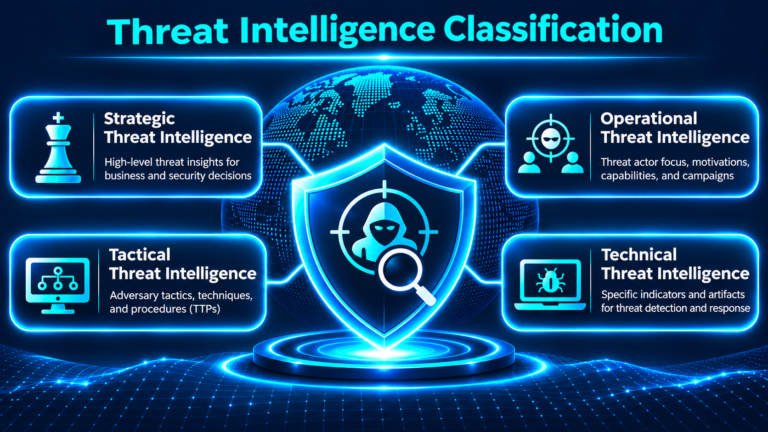
Cyber Threat Intelligence is commonly categorized according to its intended audience, level of detail, and purpose.
Strategic Threat Intelligence
Strategic Threat Intelligence provides a high-level understanding of the cyber threat landscape, including geopolitical developments, economic motivations, industry-specific threats, adversary objectives, and emerging risks.
It supports long-term planning, cybersecurity strategy, risk management, and informed decision-making by leadership and policymakers.
Operational Threat Intelligence
Operational Threat Intelligence provides information about specific threat campaigns, planned attacks, adversary activities, targeting patterns, and operational objectives.
It helps understand who may be conducting an attack, why particular targets are being selected, and how campaigns are being organized.
Tactical Threat Intelligence
Tactical Threat Intelligence focuses on adversary tactics, techniques, and procedures (TTPs). It provides information about how threat actors conduct their operations, gain access, move through environments, maintain persistence, and achieve their objectives.
It supports security architecture, defensive planning, detection engineering, threat hunting, and adversary emulation.
Technical Threat Intelligence
Technical Threat Intelligence focuses on technical indicators associated with malicious activities, including IP addresses, domain names, URLs, file hashes, email addresses, and other Indicators of Compromise (IOCs).
It supports technical detection, investigation, threat correlation, and security monitoring.
These intelligence categories describe the purpose and level of intelligence. Proactive and Predictive Threat Intelligence, in contrast, describe different approaches to identifying, analyzing, and anticipating threats. Both approaches can make use of strategic, operational, tactical, and technical intelligence.
Understanding Proactive Threat Intelligence
Definition and Objectives
Proactive Threat Intelligence is an approach to identifying, collecting, analyzing, and interpreting threat-related information before malicious activities result in security incidents or significant damage.
It focuses on identifying potential threats, monitoring adversary activities, understanding emerging attack patterns, and recognizing indicators that may suggest malicious intent or future targeting.
Rather than waiting for confirmed attacks or security incidents, proactive intelligence activities continuously examine available information to identify relevant threats and provide early warning.
For example, monitoring threat actor activities, identifying newly disclosed vulnerabilities, analyzing attack campaigns, and tracking malicious infrastructure can help identify threats that may affect particular technologies, industries, or digital environments.
The primary objective is to provide timely and actionable intelligence that enables preventive security measures, improves preparedness, and reduces exposure to potential threats.
Principles of Proactive Threat Intelligence
Proactive Threat Intelligence is guided by several important principles.
Early Threat Identification: Identify emerging threats, malicious activities, and adversary behaviors before they result in security incidents.
Continuous Threat Monitoring: Monitor relevant intelligence sources, threat actors, campaigns, vulnerabilities, and malicious infrastructure to recognize changes in the threat landscape.
Threat Context and Relevance: Establish the relevance of identified threats by understanding their capabilities, motivations, targeting patterns, and potential impact.
Timely Intelligence Dissemination: Provide relevant intelligence to the appropriate stakeholders so that preventive and defensive measures can be implemented.
Continuous Intelligence Improvement: Incorporate new information, security findings, and feedback to improve intelligence collection, analysis, and dissemination.
Proactive Threat Intelligence Activities
Proactive Threat Intelligence involves several activities that help identify and understand threats before they result in security incidents.
Threat Actor Tracking: Monitor known threat actors, their motivations, capabilities, targeting preferences, and changes in their operational activities.
Vulnerability Intelligence: Monitor newly disclosed vulnerabilities, exploit availability, exploitation trends, and vulnerability-related threat information to identify potential exposure.
Attack Campaign Analysis: Examine ongoing and emerging attack campaigns to understand their targets, objectives, techniques, and potential relevance to different environments.
External Threat Monitoring: Monitor external sources for exposed assets, leaked credentials, malicious domains, impersonation attempts, and other information that may indicate potential threats.
Threat Discovery, Monitoring, Hunting, and Adversary Behavior Analysis
Threat discovery involves identifying potential threats through the continuous examination of available intelligence sources and security information.
This may include identifying new threat actors, malicious infrastructure, emerging malware families, exploitation campaigns, suspicious domains, and changes in adversary behavior. Early identification is particularly important when threat information indicates that a technology, industry, or geographical region is becoming a target of malicious activity.
Threat monitoring and threat hunting are complementary activities that support proactive threat identification. Threat monitoring involves continuously examining intelligence sources and security information to identify known threats, emerging campaigns, malicious infrastructure, and relevant indicators.
Threat hunting involves actively searching for suspicious or previously unidentified activities that may not have triggered existing security alerts. While monitoring is generally continuous and intelligence-source driven, hunting is often hypothesis-driven and involves investigating specific questions about potential malicious activities.
Threat intelligence can improve hunting effectiveness. For example, information about adversary techniques can help develop hypotheses and search for related behaviors in available security telemetry. Threat hunting is a security detection activity informed by threat intelligence; it is not limited to the collection or production of intelligence itself.
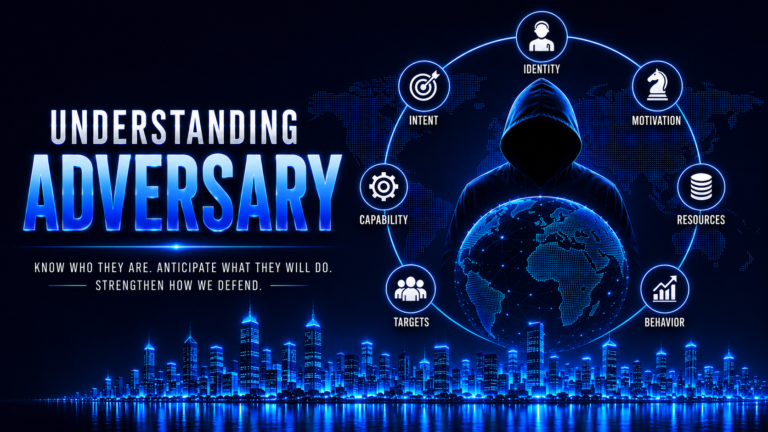
Adversary behavior analysis involves examining how threat actors operate, including their objectives, tactics, techniques, procedures, tools, infrastructure, and targeting patterns. Understanding these behaviors helps identify potential attack methods and recognize changes in how malicious activities are conducted.
The MITRE ATT&CK framework provides a structured knowledge base of adversary tactics and techniques based on real-world observations. It can support the analysis of adversary behavior and the development of relevant defensive measures.
Threat Intelligence Sources and Collection
Proactive Threat Intelligence depends on collecting information from a broad range of sources.
Open-Source Intelligence (OSINT): Publicly available information from security research publications, technical blogs, news reports, social media, public threat intelligence repositories, and security advisories can help identify emerging threats and malicious activities.
Commercial Cyber Threat Intelligence Feeds: Specialized cybersecurity providers supply threat information, including IOCs, threat actor profiles, malware information, attack campaigns, vulnerability intelligence, and adversary TTPs.
Government and Law Enforcement Advisories: Cybersecurity advisories, threat warnings, vulnerability notifications, and technical reports published by government agencies and law enforcement organizations provide information about emerging threats, cybercrime activities, and targeted attacks.
Information Sharing and Analysis Centers (ISACs): Industry information-sharing communities facilitate the exchange of sector-specific threat information to help understand threats, vulnerabilities, and attack campaigns affecting particular industries.
Computer Emergency Response Teams (CERTs): Security advisories, vulnerability notifications, incident reports, and technical alerts published by CERTs help identify newly disclosed vulnerabilities, malicious activities, and emerging threats.
Security Research and Vulnerability Disclosures: Security research publications, vulnerability disclosures, malware analysis, proof-of-concept exploits, and technical investigations provide information about security weaknesses and potential exploitation activities.
Dark Web and Underground Forum Monitoring: Monitoring underground marketplaces, forums, and communication channels can reveal information about stolen credentials, compromised systems, leaked data, malware distribution, exploit trading, and planned malicious activities.
Internal Security Monitoring and Incident Investigations: Security alerts, system logs, network activities, endpoint telemetry, and incident investigation findings can help identify suspicious behavior, previously unknown threats, and adversary activities within monitored environments.
The collected information must be assessed for reliability, relevance, accuracy, and timeliness before it is converted into actionable intelligence.
Understanding Predictive Threat Intelligence
Definition and Objectives
Predictive Threat Intelligence is an analytical approach that uses historical threat information, observed patterns, behavioral indicators, statistical methods, and predictive technologies to anticipate potential future cyber threats and malicious activities.
It attempts to identify what threats may emerge, which technologies or environments may become targets, how adversary activities may evolve, and where future threat exposure may increase.
Unlike conventional threat analysis, which primarily examines existing or observed threat information, predictive intelligence places greater emphasis on identifying relationships, trends, patterns, and signals that may indicate future threat developments.
For example, analyzing historical exploitation patterns, vulnerability characteristics, threat actor targeting behavior, and technology exposure may help estimate which types of vulnerabilities or technologies could become attractive targets.
The primary objective is to provide forward-looking intelligence that supports threat anticipation, risk prioritization, strategic planning, and preventive decision-making.
Predictive Threat Intelligence does not establish that a particular attack will occur. Its outputs represent assessments or forecasts based on available evidence, assumptions, and analytical confidence.
Principles of Predictive Threat Intelligence
Historical Data Analysis: Use historical threat information and observed activities to identify recurring patterns, relationships, and trends.
Pattern and Behavior Recognition: Identify changes in adversary behavior, targeting preferences, attack techniques, and operational patterns.
Forward-Looking Analysis: Use analytical methods to estimate potential future threats and changes in the threat landscape.
Risk and Threat Forecasting: Assess the likelihood and potential impact of future threat developments using available evidence and relevant contextual information.
Continuous Model Evaluation: Review analytical methods and predictive models against new observations to evaluate their accuracy and relevance.
Uncertainty and Confidence Assessment: Communicate the assumptions, limitations, and confidence associated with predictive findings.
Predictive Threat Intelligence Activities
Predictive Threat Intelligence involves activities that examine existing information to develop assessments about potential future threat developments.
Threat Forecasting and Anticipation: Analyze available threat information, historical observations, and emerging signals to estimate potential future threats and changes in adversary activities.
Historical Threat Data Analysis: Examine historical attack records, vulnerability exploitation data, incident reports, and adversary activities to identify recurring patterns and relationships.
Threat Trend and Pattern Analysis: Identify changes in attack frequency, targeting preferences, exploitation methods, malware activity, and threat actor behavior to understand how the threat landscape may evolve.
Predictive Modeling and Risk Assessment: Apply statistical techniques, analytical models, and, where appropriate, machine learning to estimate potential threat developments and changes in exposure.
Threat Forecasting and Anticipation
Threat forecasting involves analyzing available intelligence to assess potential future developments in the cyber threat landscape.
It may include estimating which technologies could attract increased adversary attention, which vulnerabilities may experience greater exploitation, or how particular threat actors may change their targeting patterns.
Forecasting draws on multiple forms of evidence, including historical observations, current threat activity, vulnerability characteristics, adversary behavior, and contextual information.
The resulting assessments can support early planning and prioritization. However, forecasts should be treated as informed estimates rather than definitive statements about future events.
Historical Threat Data Analysis
Historical threat data provides the foundation for identifying recurring activities and understanding how threats have evolved over time.
Such information may include past cyber incidents, vulnerability exploitation records, malware campaigns, threat actor activities, attack techniques, and changes in targeting patterns.
Analyzing this information can reveal recurring relationships and trends. For example, historical records may show that particular vulnerability classes, technologies, or services have repeatedly been targeted by specific threat actors.
When combined with current threat information and relevant exposure data, historical analysis can help develop assessments about potential future exploitation and targeting.
Threat Trend and Pattern Analysis
Threat trend and pattern analysis examines changes and recurring characteristics in threat-related information over time.
It may involve examining the frequency of attacks, changes in targeting preferences, exploitation trends, malware distribution patterns, and the adoption of particular attack techniques.
Identifying these patterns can help assess whether certain threats are becoming more prominent or whether adversary activities are changing.
However, the presence of a historical trend does not guarantee that it will continue. Analysts must consider changes in technology, adversary objectives, defensive capabilities, and the wider threat environment.
Artificial Intelligence and Machine Learning in Threat Prediction
Artificial Intelligence (AI) and Machine Learning (ML) can support predictive threat intelligence by analyzing large volumes of historical and current threat information.
Machine learning models can identify patterns, relationships, and anomalies that may be difficult to identify through manual analysis alone. Depending on the data and model, these capabilities can support malware classification, threat actor clustering, vulnerability analysis, behavioral analysis, and predictive modeling.
AI and ML can improve the speed and scale of analysis, but they do not independently establish that a future attack will occur. Their outputs depend on data quality, model design, validation, and the context in which the results are interpreted.
Human expertise remains essential for validating findings, assessing uncertainty, and converting analytical outputs into meaningful intelligence.
Proactive Threat Intelligence vs. Predictive Threat Intelligence
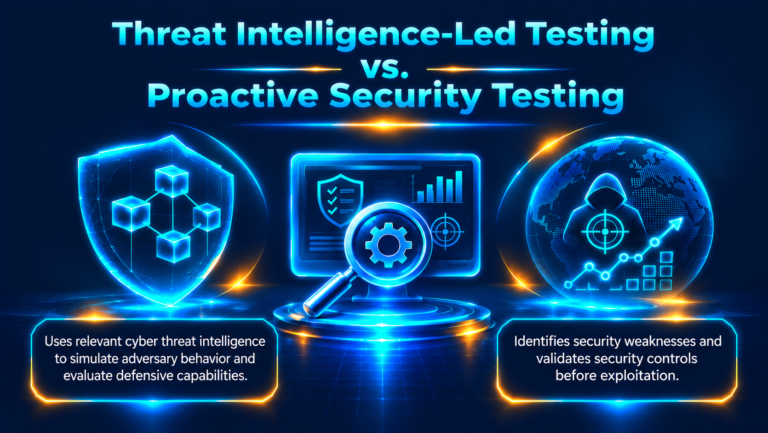
Proactive Threat Intelligence and Predictive Threat Intelligence are closely related approaches that contribute to understanding and anticipating cyber threats. Proactive intelligence focuses on identifying and analyzing threats early enough to enable preventive action, while predictive intelligence uses historical information, analytical models, and behavioral patterns to estimate potential future threat developments.
Proactive intelligence can provide the current threat context and emerging signals that contribute to predictive analysis. Predictive intelligence, in turn, extends the analytical process by examining how these signals and historical patterns may evolve. Both approaches complement each other, but neither guarantees that all threats will be identified or accurately anticipated.
Comparative Overview
| Comparison Area | Proactive Threat Intelligence | Predictive Threat Intelligence |
|---|---|---|
| Primary objective | Identify and understand threats early to support preventive action | Anticipate potential future threats and changes in the threat landscape |
| Analytical focus | Existing and emerging threats, adversary activities, and early warning signals | Historical patterns, trends, relationships, and potential future developments |
| Time orientation | Primarily focused on current and emerging threats | Primarily forward-looking |
| Information requirements | Timely threat information, IOCs, TTPs, vulnerabilities, and campaign information | Historical and current datasets, longitudinal observations, and contextual information |
| Analytical approaches | Threat monitoring, intelligence correlation, adversary behavior analysis, and threat hunting support | Statistical analysis, trend analysis, behavioral modeling, and forecasting |
| Technology capabilities | Threat Intelligence Platforms, OSINT tools, monitoring capabilities, and intelligence-sharing technologies | Advanced analytics, data science tools, statistical models, and machine learning where appropriate |
| Intelligence outputs | Threat advisories, early warnings, threat actor profiles, campaign analysis, and recommended defensive actions | Threat forecasts, exploitation likelihood assessments, anticipated targeting trends, and predictive risk assessments |
| Expected outcomes | Earlier threat awareness and timely defensive action | Better-informed anticipation and preparation for potential future threats |
Differences in Objectives and Scope
Proactive Threat Intelligence primarily aims to identify and understand threats before they result in security incidents. Its scope includes threat monitoring, adversary tracking, vulnerability intelligence, campaign analysis, and early identification of malicious activities.
Predictive Threat Intelligence focuses on anticipating potential future threat developments. Its scope extends to historical pattern analysis, behavioral modeling, threat forecasting, and predictive risk assessment.
While proactive intelligence emphasizes early awareness and preventive action, predictive intelligence emphasizes forward-looking assessment and anticipation.
Differences in Intelligence Collection and Analysis
Proactive Threat Intelligence relies on continuous collection and examination of information from intelligence feeds, government advisories, security research, threat actor monitoring, vulnerability disclosures, and information-sharing communities.
Its analytical activities focus on identifying relevant threats, examining adversary behavior, correlating intelligence, and producing actionable insights.
Predictive Threat Intelligence requires access to historical and current information that can be analyzed to identify patterns, relationships, and trends.
Its analytical activities may involve statistical techniques, machine learning, behavioral modeling, trend analysis, and forecasting.
The two approaches can use many of the same intelligence sources. The main distinction lies in how the information is analyzed and the type of intelligence output being produced.
Differences in Data and Information Requirements
Proactive Threat Intelligence can use a broad range of current threat information, including indicators of compromise, threat actor activities, attack campaigns, vulnerability disclosures, and adversary TTPs.
The emphasis is on obtaining relevant and timely information that can support early threat identification.
Predictive Threat Intelligence places greater emphasis on historical datasets, longitudinal observations, recurring patterns, and information that can be used to develop analytical models.
For example, current vulnerability disclosures and exploit reports can support proactive intelligence activities, while historical vulnerability exploitation records combined with vulnerability characteristics and exposure information can support predictive assessments.
Both approaches benefit from accurate, contextualized, and reliable information.
Differences in Analytical Approaches
Proactive Threat Intelligence primarily uses intelligence analysis, threat correlation, adversary behavior analysis, threat hunting support, and contextual assessment to identify and understand threats.
Predictive Threat Intelligence uses additional analytical techniques to estimate possible future developments. These may include statistical forecasting, trend analysis, anomaly detection, machine learning, and behavioral modeling.
However, predictive analysis does not necessarily require AI or machine learning. Statistical methods, structured analytical techniques, and expert assessments can also support forecasting.
Differences in Technologies and Capabilities
Proactive Threat Intelligence commonly uses Threat Intelligence Platforms (TIPs), open-source intelligence tools, threat monitoring capabilities, threat hunting platforms, and intelligence-sharing technologies.
These technologies help collect, organize, correlate, analyze, and disseminate threat information.
Predictive Threat Intelligence may use additional capabilities such as machine learning platforms, advanced analytics, data science tools, behavioral analytics, and predictive modeling technologies.
These capabilities help examine large datasets, identify patterns, and generate forward-looking assessments.
The technologies are not mutually exclusive. A Threat Intelligence Platform can support both approaches, depending on the analytical capabilities and use cases implemented.
Differences in Intelligence Outputs
Proactive Threat Intelligence produces actionable information that helps identify and understand threats requiring attention.
Its outputs may include threat advisories, early warnings, threat actor profiles, campaign analysis, vulnerability intelligence, IOCs, TTPs, and recommended defensive actions.
Predictive Threat Intelligence produces forward-looking assessments about potential future threats and changes in the threat landscape.
Its outputs may include threat forecasts, exploitation likelihood assessments, anticipated targeting trends, predictive risk assessments, and potential emerging threat scenarios.
Both types of intelligence should communicate their sources, confidence levels, assumptions, limitations, and relevance to the intended audience.
Relationship Between the Two Approaches
Proactive Threat Intelligence and Predictive Threat Intelligence are complementary rather than mutually exclusive approaches.
Proactive intelligence provides early awareness of emerging threats and adversary activities. Predictive intelligence builds on available information by analyzing historical patterns, behavioral trends, and other signals to anticipate possible future developments.
For example, consider a newly disclosed vulnerability affecting a widely deployed software platform.
Proactive Threat Intelligence may identify the vulnerability, monitor exploit availability, examine threat actor discussions, and track emerging exploitation attempts.
Predictive Threat Intelligence may analyze historical exploitation patterns, vulnerability characteristics, technology exposure, and previous threat actor behavior to assess the likelihood of increased exploitation and identify technologies that may face greater exposure.
The findings from both approaches can support vulnerability prioritization, threat monitoring, security planning, and preventive action.
Together, they provide a more comprehensive understanding of the current and potential future threat landscape.
Threat Intelligence Data and Analytical Capabilities
Both proactive and predictive approaches depend on relevant threat information and appropriate analytical capabilities. Their effectiveness, however, depends on how different data elements are correlated, enriched, and interpreted in relation to the intelligence objective.
Historical and Real-Time Threat Data
Real-time and near-real-time threat information helps identify current malicious activities, emerging vulnerabilities, new indicators, and developing attack campaigns.
Historical information provides the context needed to examine recurring attack patterns, changes in adversary behavior, exploitation trends, and long-term threat developments.
Proactive intelligence often places greater emphasis on timely threat information, while predictive intelligence makes extensive use of historical datasets and patterns. However, both approaches can use current and historical information together. Combining them provides a more complete view of existing threats and potential future developments.
Indicators of Compromise (IOCs)
Indicators of Compromise are technical observations associated with potentially malicious activities. Examples include malicious IP addresses, domain names, URLs, and file hashes.
Within threat intelligence analysis, IOCs help identify suspicious activity, correlate observations from different sources, support investigations, and inform detection capabilities.
Their value increases when they are examined alongside contextual information. For example, correlating an IP address with associated domains, malware samples, and observed attack activity may help establish relationships between infrastructure, campaigns, and threat actors.
IOCs can be time-sensitive and may change as adversaries modify their infrastructure and tools. They should therefore be interpreted alongside behavioral intelligence rather than treated as complete descriptions of an adversary.
Tactics, Techniques, and Procedures (TTPs)
TTPs provide behavioral context for understanding how adversaries conduct their activities. They help analysts examine recurring methods, compare observed activity with known adversary behavior, and identify changes in attack patterns.
This behavioral perspective supports threat hunting, detection engineering, adversary profiling, and the assessment of potential future threat developments. Unlike individual technical indicators, adversary techniques can provide insights into broader patterns of operation, although their use does not necessarily identify a specific threat actor.
Threat Intelligence Analytics
Threat intelligence analytics involves examining information from multiple sources to identify relationships, patterns, anomalies, and meaningful threat indicators.
Analytical capabilities may include data correlation, enrichment, clustering, behavioral analysis, statistical analysis, and threat modeling.
Correlation helps establish relationships among indicators, vulnerabilities, threat actors, campaigns, and observed activities. Enrichment adds contextual information that improves the interpretation of individual observations. Statistical and behavioral analysis can reveal recurring patterns, changes in activity, and relationships that may support forward-looking assessments.
These capabilities help transform large volumes of information into intelligence that supports early threat identification and predictive analysis.
AI and Machine Learning Capabilities
AI and ML can support threat intelligence analysis by processing large datasets, identifying patterns, correlating information, and detecting behavioral changes.
Their applications may include malware classification, anomaly detection, threat actor clustering, vulnerability analysis, and predictive modeling. These capabilities can improve the speed and scale of analysis, particularly when examining large and diverse datasets.
However, analytical outputs require validation and contextual interpretation. An anomaly does not automatically indicate malicious activity, and a detected pattern does not establish that a future attack will occur. Human expertise remains necessary to interpret findings, validate assumptions, assess uncertainty, and produce meaningful intelligence.
Proactive and Predictive Threat Intelligence Methodology
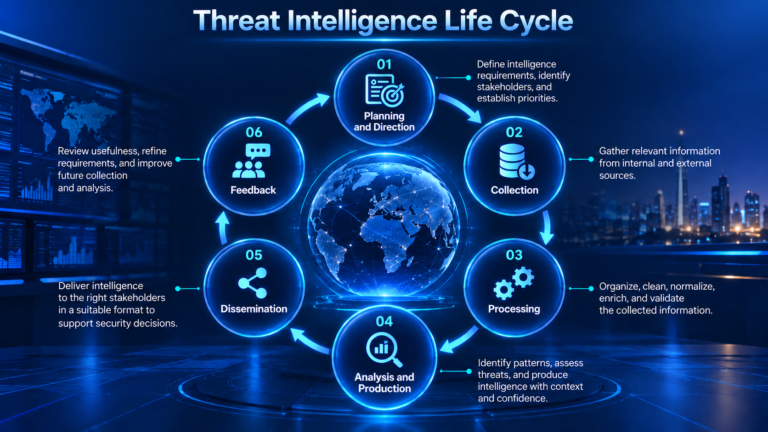
Although the analytical objectives differ, both approaches can operate within a common Threat Intelligence Lifecycle.
The following methodology describes how intelligence can be collected, analyzed, transformed into insights, and disseminated to support proactive identification and predictive assessment.
Threat Intelligence Requirements
The process begins by defining intelligence requirements.
These requirements establish what information needs to be collected, why it is needed, which threats are relevant, and who will use the resulting intelligence.
Requirements may relate to threat actors, targeted technologies, emerging vulnerabilities, attack campaigns, geographical regions, industries, or anticipated threat developments.
Clearly defined requirements help ensure that intelligence collection and analysis remain focused and relevant.
Threat Data Collection and Acquisition
Threat data is collected from relevant internal and external sources.
This may include threat intelligence feeds, open-source information, government advisories, security research, vulnerability databases, incident reports, and information-sharing communities.
For predictive analysis, historical datasets and previously observed threat activities may also be required.
Data Processing and Normalization
Collected information may contain duplicate records, inconsistent formats, incomplete details, and irrelevant information.
Processing involves validating, filtering, deduplicating, normalizing, and enriching the collected information so that it can be analyzed effectively.
Structured threat intelligence formats such as STIX can help represent and exchange threat information in a consistent manner.
Threat Analysis and Correlation
The processed information is examined to identify threat actors, malicious infrastructure, attack campaigns, vulnerabilities, adversary techniques, and relationships among different observations.
Correlation helps establish whether apparently unrelated indicators or activities may be associated with the same threat actor, campaign, or operational pattern.
This stage supports proactive threat identification and provides the analytical foundation for predictive assessment.
Threat Identification and Forecasting
Based on the analysis, relevant threats are identified and evaluated.
Proactive intelligence focuses on recognizing current and emerging threats and determining their relevance.
Predictive intelligence extends the analysis by examining historical patterns, behavioral trends, and other indicators to develop assessments about potential future threat developments.
Forecasts should include appropriate assumptions, confidence levels, and limitations.
Intelligence Production and Dissemination
The analyzed information is transformed into intelligence products appropriate for their intended audiences.
These may include strategic assessments, operational threat reports, tactical intelligence, technical indicators, early warnings, and predictive threat assessments.
Intelligence should be communicated in a timely and understandable manner so that relevant stakeholders can take appropriate action.
Intelligence Validation and Feedback
Intelligence products should be reviewed to evaluate their accuracy, relevance, timeliness, and usefulness.
Feedback from security teams, incident investigations, threat monitoring, and subsequent observations can help improve intelligence requirements, collection methods, analytical approaches, and predictive models.
Predictive assessments should also be evaluated against subsequent developments to understand whether their assumptions and forecasts were reasonable.
This feedback contributes to continuous improvement of the overall Threat Intelligence capability.
Applications of Proactive and Predictive Threat Intelligence
Proactive and Predictive Threat Intelligence can support different cybersecurity activities across individuals, governments, industries, economies, and interconnected digital ecosystems.
Threat Identification and Early Warning
Proactive intelligence helps identify emerging malicious activities, threat actors, vulnerabilities, and attack campaigns before they cause significant damage.
Predictive intelligence can extend this capability by examining patterns and trends to anticipate potential future developments.
Emerging Threat and Vulnerability Identification
Intelligence about newly disclosed vulnerabilities, exploit availability, threat actor interest, and exploitation patterns can help identify technologies that may become attractive targets.
Proactive intelligence helps monitor these developments, while predictive analysis can estimate potential exploitation trends and future exposure.
Threat Actor Tracking and Profiling
Tracking threat actors provides insights into their motivations, capabilities, infrastructure, targeting preferences, and operational behavior.
Predictive analysis can use historical targeting patterns and behavioral observations to assess potential changes in their future activities.
Attack Campaign Analysis
Campaign analysis examines the objectives, targets, infrastructure, tools, and techniques associated with coordinated malicious activities.
Proactive intelligence supports the identification and monitoring of ongoing campaigns, while predictive intelligence can examine recurring campaign patterns to anticipate potential developments.
Attack Surface and Exposure Prioritization
Threat intelligence can help identify technologies, services, and assets that are attracting adversary attention.
When combined with asset exposure and vulnerability information, predictive analysis can support the prioritization of potential future attack exposure.
Cyber Risk Assessment and Prioritization
Proactive intelligence provides current and emerging threat information that can improve risk assessments.
Predictive intelligence adds forward-looking insights that may help evaluate how threat likelihood and exposure could change over time.
These insights can support security investments, resource allocation, and risk management decisions. Predictive threat assessments should be considered alongside asset criticality, vulnerabilities, exposure, existing controls, and potential impact rather than used as standalone risk measurements.
Security Strategy and Decision Support
Strategic and predictive threat intelligence can help decision-makers understand potential changes in the cyber threat landscape.
It can support long-term security planning, technology investment decisions, resilience planning, and the prioritization of cybersecurity capabilities.
Frameworks, Standards and Technologies
Several frameworks, standards, and technologies support the collection, representation, analysis, and application of threat intelligence. They provide structured approaches for understanding adversary behavior, exchanging threat information, and developing intelligence capabilities.
NIST Cyber Threat Intelligence Guidance
NIST Special Publication 800-150, Guide to Cyber Threat Information Sharing, provides guidance on establishing and participating in cyber threat information-sharing relationships.
It addresses information-sharing requirements, sources, sharing communities, and the protection and use of cyber threat information.
It provides useful guidance for building threat intelligence collection and sharing capabilities that can support proactive and predictive analysis.
MITRE ATT&CK Framework
MITRE ATT&CK is a knowledge base of adversary tactics and techniques based on real-world observations.
It provides a structured representation of adversary behavior across different technology environments.
ATT&CK supports threat actor analysis, adversary profiling, threat hunting, detection engineering, and understanding how adversaries conduct their operations.
It can also provide behavioral context for identifying recurring attack patterns. However, ATT&CK is not itself a predictive threat intelligence framework or a threat intelligence provider.
Cyber Kill Chain
The Cyber Kill Chain, developed by Lockheed Martin, describes stages commonly associated with an intrusion, from reconnaissance and weaponization through delivery, exploitation, installation, command and control, and actions on objectives.
It provides a model for understanding the progression of cyber attacks and identifying opportunities for defensive intervention.
It can support the analysis of attack campaigns and the examination of adversary activities.
STIX and TAXII
Structured Threat Information Expression (STIX) is a standardized language for representing and exchanging cyber threat intelligence.
Trusted Automated Exchange of Intelligence Information (TAXII) is an application-layer protocol designed to support the exchange of cyber threat information.
Together, STIX and TAXII facilitate structured threat intelligence representation and sharing between systems. They support intelligence collection, processing, correlation, and dissemination, which can contribute to both proactive and predictive intelligence activities.
Threat Intelligence Platforms
Threat Intelligence Platforms (TIPs) help collect, aggregate, normalize, enrich, correlate, analyze, and disseminate threat intelligence from multiple sources.
They can support IOC management, threat actor tracking, campaign analysis, intelligence sharing, and integration with security technologies.
Depending on their capabilities and integrations, some platforms also provide analytical features that support behavioral analysis and predictive assessments.
AI and Machine Learning for Threat Intelligence
AI and ML technologies can support advanced threat intelligence analysis through automated data processing, pattern recognition, anomaly detection, classification, and predictive modeling.
They can help identify relationships among large volumes of threat information and support the generation of forward-looking assessments.
Their effectiveness depends on data quality, model validation, analytical context, and appropriate human oversight.
Challenges and Considerations
Proactive and Predictive Threat Intelligence provide valuable insights into the cyber threat landscape. However, their effectiveness depends on the quality of information, analytical capabilities, and the ability to interpret intelligence within the appropriate context.
Threat Intelligence Quality and Reliability
Threat intelligence may contain incomplete, inaccurate, outdated, or misleading information.
Poor-quality intelligence can result in incorrect threat assessments and inappropriate security decisions.
Information should be evaluated based on source reliability, credibility, relevance, accuracy, and timeliness.
Data Availability and Completeness
Predictive analysis depends on sufficient historical and current information to identify meaningful patterns and trends.
Incomplete datasets, limited visibility, inconsistent formats, and missing observations can affect analytical accuracy.
Access to diverse and relevant intelligence sources is therefore important.
Accuracy of Threat Prediction
Predictive assessments involve uncertainty because future adversary activities cannot be determined with certainty.
Historical patterns may not continue, threat actors may change their methods, and previously unknown vulnerabilities or attack techniques may emerge.
Predictive outputs should therefore be expressed as assessments with appropriate confidence levels rather than guaranteed outcomes.
False Positives and Predictive Uncertainty
Analytical models may identify patterns that do not represent genuine threats or may incorrectly associate unrelated activities.
False positives can lead to unnecessary investigations and resource consumption, while false negatives may result in missed threats.
Validation, contextual analysis, and human oversight are important for managing these limitations.
Intelligence Integration and Interoperability
Threat intelligence is often distributed across multiple systems, formats, providers, and information-sharing communities.
Integrating information from different sources can be challenging due to differences in data structures, terminology, quality, and sharing restrictions.
Standards such as STIX and TAXII can support interoperability and structured information exchange.
Continuous Intelligence Improvement
The threat landscape changes as adversaries develop new techniques, technologies evolve, and vulnerabilities emerge.
Threat intelligence capabilities must therefore continuously improve their collection, processing, analytical methods, and dissemination processes.
Regular evaluation of intelligence products and predictive assessments helps maintain their relevance and effectiveness.
Conclusion
Proactive Threat Intelligence and Predictive Threat Intelligence provide complementary approaches to understanding and anticipating cyber threats.
Proactive Threat Intelligence focuses on identifying and analyzing emerging threats, monitoring adversary activities, and producing timely intelligence that supports preventive action.
Predictive Threat Intelligence extends this analytical capability by using historical information, behavioral patterns, statistical methods, and advanced analytics to anticipate potential future threats and developments in the threat landscape.
Both approaches contribute to improved threat awareness, risk prioritization, security planning, and preparedness. However, predictive assessments involve uncertainty and should be interpreted as evidence-based forecasts rather than definitive predictions.
An effective Threat Intelligence capability can combine proactive identification with predictive analysis to develop a broader understanding of existing, emerging, and potential future threats. This enables more informed decisions and supports the continuous improvement of cybersecurity preparedness across interconnected digital environments.
References
Online Sources
National Institute of Standards and Technology (NIST) – Guide to Cyber Threat Information Sharing (NIST SP 800-150)
Provides guidance on identifying cyber threat information sources, establishing information-sharing relationships, and using indicators of compromise (IOCs), adversary tactics, techniques and procedures (TTPs), and incident analysis findings.
MITRE – MITRE ATT&CK
Provides a knowledge base of adversary tactics and techniques based on real-world observations. It supports adversary behavior analysis, threat modeling, detection development, and understanding attack patterns.
Cybersecurity and Infrastructure Security Agency (CISA) – Cybersecurity Advisories
Publishes technical advisories and analysis covering threat actors, vulnerabilities, malware, exploitation activity, and recommended defensive measures.
Indian Computer Emergency Response Team (CERT-In) – Advisories
Publishes cybersecurity advisories covering vulnerabilities, malicious activities, threat campaigns, and security recommendations relevant to India’s digital ecosystem.
National Institute of Standards and Technology (NIST) – National Vulnerability Database (NVD)
Provides vulnerability information, including CVE records, product configurations, severity metrics, and related security references. It is a useful source for vulnerability intelligence and analyzing vulnerability exploitation trends.
National Institute of Standards and Technology (NIST) – Incident Response Recommendations and Considerations for Cybersecurity Risk Management (NIST SP 800-61 Rev. 3)
Provides guidance on integrating incident response into cybersecurity risk management. It supports the use of incident findings and response activities to improve threat identification, detection, and preparedness.
OASIS Open – Structured Threat Information Expression (STIX)
Provides documentation for STIX, a standard language for representing cyber threat intelligence in a structured and machine-readable format.
OASIS Open – Trusted Automated Exchange of Intelligence Information (TAXII)
Provides documentation for TAXII, a protocol for exchanging cyber threat intelligence represented using STIX and supporting automated information sharing.