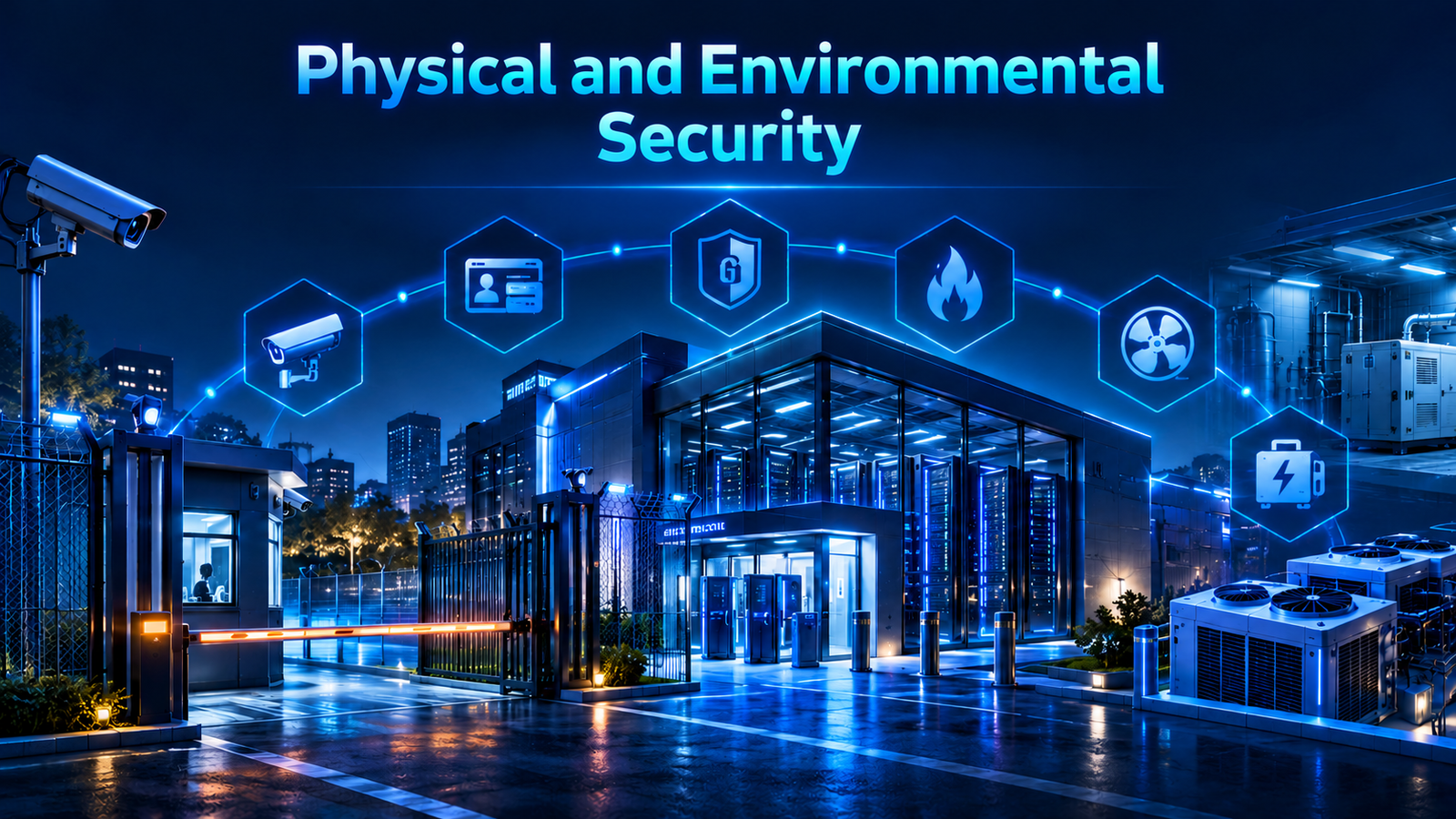
Understanding Physical and Environmental Security
Introduction
Physical and Environmental Security is a fundamental component of Cybersecurity that protects people, facilities, equipment, information, and supporting infrastructure from physical and environmental threats. While cybersecurity often focuses on logical controls such as identity, access, networks, and software, these controls ultimately depend on a secure physical environment in which systems and operations are located.
Physical Security focuses on preventing and detecting unauthorized physical access, theft, tampering, damage, and other physical threats to facilities, equipment, and information. It includes measures such as site security, perimeter protection, access control, surveillance, intrusion detection, security personnel, and protection of critical areas and assets.
Environmental Security focuses on protecting facilities, equipment, and operations from environmental conditions and hazards that can cause damage or disruption. These include fire, water leakage and flooding, temperature and humidity, power failures, ventilation and HVAC issues, lightning, and natural disasters.
Physical and Environmental Security protects information, information systems, people, facilities, and supporting infrastructure from physical threats and environmental hazards that can disrupt operations or affect the Confidentiality, Integrity, and Availability (CIA) of information and information systems. Effective protection requires security considerations to be incorporated into site selection, facility design, physical access controls, environmental safeguards, monitoring, assessment, and ongoing management.
The domain applies across a wide range of environments, including offices, data centers, server rooms, network facilities, industrial and operational technology environments, critical infrastructure, and remote locations. It also requires coordination among cybersecurity, information technology, physical security, facilities management, and business continuity functions.
Understanding Physical and Environmental Security provides the foundation for designing and maintaining a secure physical environment that supports the protection and reliable operation of information systems and business operations.
Physical Security
What Is Physical Security?
Physical Security is a fundamental component of cybersecurity that protects people, facilities, equipment, information, and supporting infrastructure from unauthorized physical access, theft, tampering, sabotage, damage, and other physical threats.
While logical security controls protect information systems against cyber threats, physical security addresses the physical environments in which these systems operate. Unauthorized physical access to a server, network device, workstation, or storage medium can undermine even well-designed logical security controls.
Physical security combines administrative, technical, and physical measures to establish multiple layers of protection. These measures are designed to deter, prevent, detect, delay, and respond to physical security threats.
Purpose of Physical Security
The primary purpose of physical security is to protect people, facilities, information, and technology assets while supporting the secure and reliable operation of an organization.
Physical security serves several important purposes:
- Personnel Protection: Protect employees, contractors, visitors, and other individuals from physical threats.
- Facility Protection: Prevent unauthorized entry, damage, and disruption affecting buildings and restricted areas.
- Asset Protection: Protect equipment, information, storage media, and supporting infrastructure against theft, damage, and tampering.
- Access Protection: Restrict physical access to authorized individuals according to their responsibilities and access requirements.
- Threat Detection: Identify suspicious activities, unauthorized access attempts, and physical security incidents.
- Operational Protection: Reduce the likelihood of physical incidents disrupting information systems and business operations.
The level of protection should reflect the criticality of the assets, identified threats, operational requirements, and the organization’s risk tolerance.
Physical Security Threats
Physical security threats are activities, events, or conditions that can compromise the physical protection of people, facilities, equipment, and information.
Common physical security threats include:
| Threat | Description |
|---|---|
| Unauthorized Access | Entry into facilities or restricted areas without permission |
| Theft | Unauthorized removal of equipment, information, or physical media |
| Tampering | Unauthorized modification or interference with physical assets |
| Sabotage | Deliberate damage intended to disrupt systems or operations |
| Vandalism | Intentional damage to facilities, equipment, or infrastructure |
| Tailgating | Following an authorized individual through a controlled entry point without independently obtaining authorization |
| Insider Threats | Physical security threats originating from individuals with legitimate access |
| Workplace Violence | Threatening or violent behavior affecting personnel and workplace security |
| Accidental Damage | Unintentional damage caused by human activities, maintenance, or operational errors |
Physical threats may originate inside or outside an organization. Effective protection requires identifying relevant threats, understanding vulnerabilities, and implementing appropriate security controls.
Physical Security Planning
Physical security planning establishes a systematic approach to protecting people, facilities, equipment, information, and supporting infrastructure.
It involves identifying security requirements, evaluating physical threats, selecting appropriate controls, defining responsibilities, and establishing procedures for maintaining protection throughout the facility lifecycle.
Physical Security Requirements
Physical security requirements define the level of protection necessary for facilities, assets, personnel, and business operations.
Requirements should consider asset criticality, information sensitivity, operational dependencies, applicable regulations, and physical security risks.
Typical requirements include controlled access, restricted areas, surveillance, intrusion detection, emergency access, asset protection, and incident response capabilities.
Physical Security Planning Process
The physical security planning process translates security requirements into a coordinated protection strategy.
It generally involves:
- Identifying facilities, personnel, and assets requiring protection.
- Assessing physical threats, vulnerabilities, and associated risks.
- Defining security requirements and protection priorities.
- Designing appropriate physical security measures.
- Establishing monitoring and incident response capabilities.
- Evaluating the effectiveness of implemented controls.
Physical security planning should be reviewed whenever significant changes occur in facilities, operations, threats, or business requirements.
Physical Security Program
A physical security program provides the organizational framework for managing physical security across facilities and operational environments.
It establishes security policies, procedures, responsibilities, governance arrangements, operational requirements, and performance monitoring.
A physical security program typically coordinates activities involving physical security personnel, facilities management, information technology, cybersecurity, human resources, and business continuity teams.
It should also establish arrangements for security awareness, incident reporting, investigations, assessments, and continual improvement.
Secure Facility Plan
A secure facility plan translates physical security requirements into the design and operational protection of a specific facility.
It identifies protected areas, access points, security zones, physical barriers, surveillance requirements, emergency arrangements, and supporting security infrastructure.
The plan should address the facility’s intended use, operational dependencies, occupancy, surrounding environment, and potential physical threats.
Asset Protection
Asset protection involves identifying and safeguarding physical assets according to their importance, sensitivity, and operational requirements.
Protected assets may include servers, network equipment, workstations, communications infrastructure, removable media, documents, and specialized operational equipment.
Protection measures can include restricted access, secure storage, asset inventories, physical monitoring, equipment tracking, and controlled removal procedures.
Asset protection should extend throughout the asset lifecycle, including acquisition, installation, operation, maintenance, relocation, and disposal.
Site and Facility Design
Site and facility design incorporates physical security considerations into the selection, planning, construction, and organization of buildings and surrounding areas.
Integrating security requirements during the design stage helps establish effective protection while reducing the need for expensive modifications after construction.
Site Selection
Site selection evaluates potential locations according to their suitability for business operations and physical security requirements.
Considerations include surrounding activities, accessibility, crime exposure, proximity to emergency services, transportation infrastructure, natural hazards, and dependencies on external utilities.
Sites supporting critical operations may require additional consideration of geographical risks and infrastructure resilience.
Facility Location
Facility location considers the positioning of buildings and critical operational areas within a selected site.
Buildings and sensitive facilities should be positioned to reduce unnecessary exposure to unauthorized access, physical threats, and operational disruption.
The location of entrances, loading areas, parking facilities, utilities, and critical infrastructure should support appropriate separation and controlled movement.
Facility Layout and Design
Facility layout and design determine how buildings and internal spaces are organized to support security requirements.
Facilities should establish appropriate separation between public, operational, restricted, and highly sensitive areas.
The design should consider controlled entrances, secure circulation routes, loading areas, equipment rooms, emergency exits, and the placement of physical security infrastructure.
Visibility and Lighting
Visibility and lighting support physical security by improving observation, discouraging unauthorized activity, and assisting security personnel.
Appropriate lighting should be provided around entrances, access points, parking areas, perimeter boundaries, and other locations requiring observation.
Facility design should minimize unnecessary blind spots while balancing security, operational requirements, privacy, and energy efficiency.
Secure Facility Design
Secure facility design integrates physical security measures into the architectural and operational characteristics of a building.
It may include reinforced construction, protected entrances, security zones, controlled access points, secure equipment rooms, protective barriers, and provisions for surveillance and intrusion detection.
Security measures should be proportionate to the facility’s risk profile and compatible with emergency evacuation and life-safety requirements.
Natural Disaster Considerations
Natural hazards should be evaluated during site selection and facility design because they can damage facilities and disrupt critical operations.
Relevant hazards may include earthquakes, flooding, severe storms, landslides, and other location-dependent events.
Facility design should consider structural resilience, safe evacuation, critical infrastructure protection, and coordination with environmental security and business continuity planning.
Crime Prevention Through Environmental Design (CPTED)
Crime Prevention Through Environmental Design (CPTED) is an approach to reducing opportunities for crime and improving safety through the planning, design, use, and management of the built environment. It considers how buildings, public spaces, access routes, lighting, boundaries, and shared areas can influence human behavior and opportunities for unwanted activity.
CPTED has evolved beyond its initial emphasis on the physical environment to include social and community factors that contribute to safety. This evolution is commonly discussed through First-Generation and Second-Generation CPTED.
First-Generation CPTED
First-Generation CPTED focuses primarily on the physical environment and how its design and management can reduce opportunities for crime. It emphasizes shaping spaces to improve visibility, guide movement, establish territorial boundaries, encourage legitimate activities, and maintain effective environmental management.
Key strategies include:
Natural Surveillance
Natural surveillance involves designing and arranging spaces so that people can observe their surroundings and activities. Building orientation, windows, lighting, open sightlines, and the placement of entrances can improve visibility and make suspicious activities more noticeable.
Natural Access Control
Natural access control uses the design of entrances, pathways, doors, gates, boundaries, and landscaping to guide movement and discourage unauthorized access. It helps distinguish intended access routes from restricted areas and reduces opportunities for people to enter spaces without authorization.
Territorial Reinforcement
Territorial reinforcement establishes a clear sense of ownership and responsibility for a space. Physical boundaries, landscaping, signage, changes in paving, and the layout of buildings can help distinguish public, semi-public, and private areas, making it easier to recognize when a space is being used inappropriately.
Image and Management/Maintenance
Image and management/maintenance focuses on keeping an environment clean, functional, and well maintained. Proper lighting, repaired fences, maintained entrances, clear signage, and prompt correction of physical deficiencies communicate care and oversight while reducing opportunities created by neglected surroundings.
Activity Support
Activity support encourages legitimate and appropriate use of spaces by placing or facilitating activities that bring people into an area. Residential common areas, community facilities, pedestrian routes, and shared public spaces can be designed to support regular use and improve natural observation, provided the activities suit the location and its operating conditions.
Site Hardening
Site hardening strengthens physical elements to make unauthorized entry, damage, or interference more difficult. Measures may include reinforced doors, secure windows, appropriate locks, protective barriers, and controlled entry points. These measures provide a direct layer of physical protection and should be selected according to the risks and security requirements of the site.
These strategies can be applied to residential developments, commercial facilities, educational campuses, public spaces, and other environments. Their selection depends on the intended use of the site, the identified risks, and the operational requirements. The six strategies above provide a practical structure for explaining physical-design measures; they should not be interpreted as an exact, universally prescribed list of First-Generation CPTED principles.
Second-Generation CPTED
Second-Generation CPTED extends the focus beyond the physical environment to consider the social relationships, community characteristics, and patterns of interaction that influence safety. It recognizes that environmental design can be strengthened by communities that are connected, engaged, and able to support legitimate activities.
Four concepts commonly associated with Second-Generation CPTED are:
Social Cohesion
Social cohesion refers to the relationships, trust, cooperation, and shared sense of responsibility among people who live in or use an area. Stronger social relationships can encourage people to look out for one another, report concerns, and participate in maintaining safe surroundings.
Community Culture
Community culture concerns the shared values, local identity, customs, and practices that influence how people interact with and care for their environment. Understanding these characteristics helps ensure that safety initiatives are appropriate to the community and encourage positive participation.
Connectivity
Connectivity refers to the relationships and connections among residents, community groups, local organizations, and supporting services. Strong connections can improve communication, encourage cooperation, and help communities respond collectively to safety concerns.
Threshold Capacity
Threshold capacity concerns the ability of a community to accommodate activities, population levels, and social demands without undermining the conditions that support safety and community life. It encourages consideration of whether the scale and intensity of activity within an area remain compatible with the community’s capacity and available resources.
Second-Generation CPTED complements physical-design measures with attention to the social conditions that influence how an environment is used, managed, and experienced.
Applying CPTED Across Environments
First-Generation and Second-Generation CPTED offer complementary perspectives on crime prevention. Physical-design strategies can improve visibility, guide access, establish territorial boundaries, and strengthen protective measures. Social and community approaches can encourage cooperation, positive use of shared spaces, and collective responsibility.
For example, a residential development may use controlled entrances, appropriate lighting, clear boundaries, and well-maintained common areas as physical-design measures. Resident engagement, communication between community members, and cooperation with local organizations can complement these measures.
In a commercial facility, the physical layout, access routes, lighting, and protective barriers can help reduce opportunities for unauthorized activity. Clear responsibilities for maintaining the premises, along with appropriate coordination among occupants and facility managers, can further support a safe environment.
The appropriate combination depends on the environment, the risks being addressed, the people who use the space, and the resources available. CPTED should therefore be applied as a context-sensitive approach rather than as a fixed checklist that is identical for every location.
Perimeter Security
Perimeter security establishes protective boundaries around facilities, buildings, and restricted areas to control access and reduce exposure to external physical threats.
An effective perimeter combines physical barriers, access controls, monitoring technologies, and security personnel according to the organization’s risk requirements.
Perimeter Protection
Perimeter protection establishes the physical boundary between protected and unprotected areas.
Protective measures may include fences, walls, gates, natural barriers, security lighting, surveillance, and intrusion detection systems.
The level of perimeter protection should reflect the facility’s criticality, surrounding environment, and identified threats.
External Boundary Protection
External boundary protection secures the outer limits of a property or facility.
It may include boundary fencing, perimeter walls, protected entrances, controlled vehicle access, and monitoring of vulnerable external locations.
Boundary protection should consider unauthorized pedestrian access, vehicle intrusion, and opportunities to bypass established entry points.
Security Barriers
Security barriers prevent, restrict, or delay unauthorized physical movement.
Examples include fences, walls, bollards, reinforced doors, vehicle barriers, and protective partitions.
Barrier selection should consider the expected threats, required resistance, operational requirements, accessibility, and emergency access.
Gates and Entry Points
Gates and entry points provide controlled movement through a protected perimeter.
They may incorporate security personnel, electronic access controls, vehicle inspection arrangements, surveillance, and intrusion detection.
Entry points should be designed to support legitimate movement while reducing opportunities for unauthorized entry.
Perimeter Access Control
Perimeter access control regulates the entry and exit of individuals and vehicles.
Access may be managed through security checkpoints, electronic credentials, identification procedures, visitor authorization, and vehicle access systems.
Access requirements should reflect the sensitivity of the facility and the operational needs of authorized users.
Intrusion Detection Systems
Perimeter intrusion detection systems identify potential unauthorized entry or attempts to cross protected boundaries.
Technologies may include motion sensors, infrared sensors, fence-mounted sensors, microwave detection, and other perimeter detection mechanisms.
Detection systems should be appropriately configured, monitored, maintained, and integrated with incident response procedures.
Security Monitoring
Perimeter security monitoring provides visibility into activities occurring along facility boundaries and external access points.
Monitoring may combine video surveillance, intrusion detection, alarms, access events, and security personnel observations.
Security events should be assessed according to established procedures to determine whether investigation or intervention is necessary.
Security Guards and Patrols
Security guards and patrols provide a human element to perimeter protection.
Their responsibilities may include monitoring entry points, conducting patrols, verifying access authorization, identifying suspicious activities, and responding to security incidents.
Security personnel should operate according to defined responsibilities, escalation procedures, and applicable legal requirements.
Canine Security
Canine security may supplement physical security arrangements in environments requiring specialized detection, patrol, or deterrence capabilities.
Trained security dogs and handlers may support perimeter patrols, searches, and other authorized security activities.
Their use should be based on operational requirements, applicable laws, safety considerations, and appropriate training.
Internal Security
Internal security protects people, assets, information, and restricted areas within a facility.
It establishes controls governing movement and access after an individual has entered the external perimeter.
Internal security is particularly important because authorization to enter a building does not automatically provide authorization to access every room, department, system, or restricted area.
Facility Access Control
Facility access control regulates entry into buildings, operational areas, and protected spaces.
Controls may include electronic access systems, security checkpoints, controlled doors, reception procedures, and access authorization mechanisms.
Access should be granted according to legitimate business requirements and periodically reviewed.
Personnel Access Control
Personnel access control determines which individuals are permitted to enter particular areas.
It considers employment responsibilities, contractor requirements, visitor authorization, and the sensitivity of protected facilities.
Access privileges should be updated when individuals change responsibilities or no longer require access.
Identification and Authentication
Physical identification establishes the claimed identity of an individual, while authentication verifies that identity before access is granted.
Physical authentication methods may include access cards, PINs, biometric systems, and other credentials.
Higher-risk areas may require multiple authentication factors.
Access Authorization
Access authorization determines which physical areas an authenticated individual is permitted to enter.
Authorization should follow the principles of least privilege and need-to-access.
Restricted areas should be accessible only to individuals whose responsibilities justify entry.
Visitor Management
Visitor management establishes procedures for registering, authorizing, monitoring, and managing individuals who do not have regular access privileges.
Procedures may include identity verification, visitor registration, temporary credentials, access restrictions, and recording entry and exit.
Visitor access should be appropriate to the purpose and duration of the visit.
Escort Requirements
Escort Requirements define when visitors, contractors, and other non-authorized individuals must be accompanied by authorized personnel while accessing controlled or restricted areas.
Authorized escorts monitor the visitor’s movement, ensure access remains within approved areas, and help enforce applicable physical security requirements.
Escort requirements should be based on the sensitivity of the facility, the areas being accessed, the nature of the visit, and the level of access granted.
Keys and Locks
Keys and locks provide mechanical or electronic protection for doors, cabinets, equipment enclosures, and restricted areas.
Key management should address issuance, authorization, storage, duplication, replacement, recovery, and revocation.
Electronic locking systems may provide additional capabilities such as centralized management, access logging, and time-based authorization.
Restricted Areas
Restricted areas contain assets, systems, information, or operations requiring additional protection.
Examples include server rooms, communications rooms, data centers, security operations centers, and secure storage facilities.
Protection may include additional access controls, monitoring, visitor restrictions, and physical barriers.
Access Monitoring and Logging
Physical access monitoring and logging provide records of entry, exit, access attempts, and other relevant activities.
Electronic access control systems can record credential usage, access decisions, and associated timestamps.
Access records should be protected against unauthorized modification and retained according to organizational requirements and applicable privacy obligations.
Facilities Security
Facilities security focuses on protecting buildings, rooms, and specialized physical environments that support information systems and business operations.
Security requirements should reflect the sensitivity, criticality, and operational dependencies of each facility.
Communications and Server Rooms
Communications and server rooms contain information technology equipment and supporting infrastructure that require controlled physical access.
Protection may include restricted entry, secure equipment racks, surveillance, environmental monitoring, and appropriate power arrangements.
Access should be limited to authorized personnel with legitimate operational responsibilities.
Network and Wiring Closets
Network and wiring closets contain telecommunications equipment, network connections, distribution systems, and structured cabling.
Unauthorized access can expose network infrastructure to tampering, interception, accidental disconnection, or service disruption.
These areas should be secured, appropriately maintained, and accessible only to authorized personnel.
Restricted and Work Areas
Restricted and work areas support activities that require additional physical protection.
Examples include sensitive operational departments, secure processing areas, research facilities, and locations where confidential information is handled.
Security measures should consider access requirements, information sensitivity, operational activities, and personnel safety.
Data Center Security
Data centers contain concentrated information technology infrastructure and supporting systems that are critical to organizational operations.
Physical security measures may include layered access controls, secure perimeters, restricted equipment areas, surveillance, intrusion detection, and controlled maintenance access.
Data center protection should be coordinated with environmental security, infrastructure resilience, incident response, and business continuity requirements.
Media Storage Facilities
Media storage facilities protect physical information storage media, backup devices, and other information-bearing assets.
Controls may include restricted access, secure cabinets, inventory management, environmental safeguards, and documented handling procedures.
Protection requirements should reflect the sensitivity and importance of the stored information.
Evidence Storage
Evidence storage facilities protect physical evidence and information collected during investigations, audits, or security incidents.
Security measures should preserve the integrity, confidentiality, availability, and traceability of stored evidence.
Access restrictions, secure storage, evidence handling procedures, and documented chain-of-custody arrangements are important considerations.
Utilities and Supporting Services
Facilities depend on supporting services such as electrical power, telecommunications, water, ventilation, and environmental control systems.
Physical protection should prevent unauthorized access, tampering, and damage to critical supporting infrastructure.
The environmental protection and resilience of these services are addressed in the Environmental Security section of the article.
Equipment Protection and Security
Equipment protection safeguards physical technology assets and information-bearing devices throughout their operational lifecycle.
Security requirements should account for equipment location, sensitivity, accessibility, operational importance, and exposure to physical threats.
Equipment Location and Placement
Equipment should be positioned to reduce unauthorized access, accidental damage, theft, and interference.
Critical equipment may require restricted rooms, secure racks, controlled workspaces, or additional physical barriers.
Placement should also consider maintenance access, environmental conditions, and operational dependencies.
Equipment Security
Equipment security establishes physical controls that protect devices against unauthorized handling, manipulation, theft, and damage.
Controls may include equipment locks, secure enclosures, tamper-evident mechanisms, physical access restrictions, and asset identification.
Protection should reflect the importance and sensitivity of the equipment.
Server and Network Equipment
Servers and network devices require protection because unauthorized physical access can compromise information systems and supporting infrastructure.
Security measures may include locked racks, restricted equipment rooms, controlled console access, surveillance, and documented maintenance procedures.
Physical access should be limited to authorized personnel.
Cabling and Connectivity
Cabling infrastructure should be protected against unauthorized interception, tampering, accidental damage, and disruption.
Controls may include protected cable routes, secure conduits, locked telecommunications rooms, controlled patch panels, and appropriate separation of critical connections.
Sensitive connections may require additional physical protection.
Media Protection
Physical media containing information should be protected throughout its lifecycle.
Protection may include secure storage, controlled transportation, access restrictions, inventory management, and secure handling procedures.
Media protection requirements should reflect the classification and sensitivity of the information stored.
Equipment Failure
Equipment failure can affect the availability of information systems and business operations.
Physical equipment protection should therefore consider maintenance arrangements, equipment condition, physical wear, handling practices, and protection against accidental damage.
Environmental causes of equipment failure, such as overheating and power disturbances, should be addressed through environmental security controls.
Equipment Removal
Equipment removal procedures help prevent unauthorized movement, theft, and loss of organizational assets.
Removal may require authorization, asset verification, documented transfer, and appropriate handling procedures.
Special attention should be given to devices and media containing sensitive information.
Secure Disposal
Secure disposal ensures that retired equipment and physical media do not expose sensitive information or create unnecessary security risks.
Disposal procedures should include asset identification, authorization, appropriate data sanitization or destruction, and documentation.
The selected disposal method should reflect the sensitivity of the information and the characteristics of the equipment or media.
Physical Security Monitoring
Physical security monitoring provides continuous or periodic observation of protected facilities, assets, and activities to identify potential security incidents.
Monitoring should combine appropriate technologies, personnel, operational procedures, and response capabilities.
Video Surveillance
Video surveillance provides visual monitoring of facilities, entrances, restricted areas, and other locations requiring observation.
Surveillance systems may support deterrence, incident detection, investigation, and evidence collection.
Camera placement, recording retention, access to footage, and monitoring practices should comply with applicable legal and privacy requirements.
Intrusion Detection
Intrusion detection identifies potential unauthorized entry or physical security violations.
Detection technologies may include motion sensors, door contacts, glass-break detectors, and other sensors appropriate to the protected environment.
Intrusion detection should be integrated with alarm management and incident response procedures.
Security Alarms
Security alarms provide notifications when predefined security conditions or events occur.
Alarm systems may be triggered by unauthorized entry, intrusion detection, emergency conditions, or other monitored events.
Alarm management procedures should establish notification, verification, escalation, and response requirements.
Physical Access Monitoring
Physical access monitoring tracks activities involving controlled entrances, exits, and restricted areas.
Monitoring may include access control events, credential usage, denied access attempts, and unusual access patterns.
These records can support investigations, access reviews, and the identification of potential security violations.
Security Personnel
Security personnel support the operation and monitoring of physical security controls.
Their responsibilities may include access verification, surveillance monitoring, incident response, security inspections, and coordination with emergency services.
Personnel should receive appropriate training and operate according to established security procedures.
Patrols
Security patrols provide periodic or targeted observation of facilities, perimeters, and restricted areas.
Patrols can identify suspicious activity, damaged barriers, malfunctioning controls, and other security concerns.
Patrol frequency and coverage should reflect the facility’s risk profile and operational requirements.
Security Event Investigation
Security event investigation examines suspected or confirmed physical security incidents to establish what occurred, identify affected assets, and determine appropriate corrective actions.
Investigations may use surveillance recordings, access logs, alarm records, witness accounts, and other relevant evidence.
Investigation procedures should preserve evidence integrity and follow applicable organizational and legal requirements.
Physical Security Assessment and Testing
Physical security assessment and testing evaluate whether implemented controls provide the intended protection and remain effective as facilities, operations, and threats change.
Assessment activities should be risk-based, documented, and conducted at appropriate intervals.
Physical Security Auditing
Physical security auditing evaluates compliance with established security policies, procedures, regulatory obligations, and control requirements.
Audits may examine access control arrangements, security documentation, facility protection, monitoring practices, and operational procedures.
Audit findings should be documented and assigned for appropriate remediation.
Physical Access Reviews
Physical access reviews verify that individuals retain only the access privileges required for their responsibilities.
Reviews should consider employees, contractors, visitors, privileged personnel, and individuals whose roles or employment status have changed.
Unnecessary or unauthorized access privileges should be promptly revoked.
Security Control Testing
Security control testing determines whether physical security mechanisms operate according to their intended design.
Testing may include electronic access controls, intrusion detection systems, alarms, surveillance equipment, and physical barriers.
Tests should be authorized, appropriately planned, and conducted without creating unnecessary operational or safety risks.
Vulnerability Assessments
Physical security vulnerability assessments identify weaknesses that could expose facilities, personnel, equipment, or information to physical threats.
Assessments may examine facility layouts, access points, barriers, restricted areas, monitoring coverage, and operational procedures.
Identified vulnerabilities should be evaluated according to their likelihood, potential impact, and available mitigation measures.
Security Drills and Exercises
Security drills and exercises evaluate the organization’s ability to respond to physical security incidents and emergencies.
Exercises may involve unauthorized access scenarios, security alarms, evacuation procedures, coordination with emergency responders, and other relevant events.
Results should be used to improve procedures, personnel readiness, and coordination among responsible teams.
Corrective Actions
Corrective actions address weaknesses identified through audits, assessments, testing, exercises, and security incidents.
Actions may include improving physical controls, updating procedures, adjusting access privileges, repairing equipment, or strengthening monitoring capabilities.
Corrective actions should be prioritized according to risk, assigned to responsible personnel, tracked to completion, and verified for effectiveness.
Personnel Safety and Security
Personnel Safety and Security protects employees, contractors, visitors, and other individuals from physical threats, unsafe conditions, and emergencies within or around organizational facilities. It combines physical security measures, environmental safeguards, emergency procedures, and workplace security practices to reduce risks to people.
Personnel safety should be considered during facility design, access control planning, emergency preparedness, security operations, and environmental risk management.
Workplace Violence
Workplace Violence includes threatening, aggressive, or violent behavior that can cause harm to personnel or disrupt workplace operations. It may involve employees, contractors, visitors, customers, or other individuals who enter or interact with the workplace.
Organizations should assess workplace violence risks and establish appropriate preventive and response measures. These may include controlled access, visitor management, security personnel, surveillance, emergency communication, reporting mechanisms, and procedures for responding to threats or incidents.
Personnel should understand how to report suspicious behavior, threats, or security concerns without unnecessarily escalating situations.
Examples:
- Controlled access to employee-only areas.
- Visitor identification and registration.
- Security personnel at higher-risk facilities.
- Emergency communication mechanisms.
- Procedures for reporting threats or suspicious behavior.
- Video surveillance in appropriate areas.
- Defined procedures for responding to workplace violence incidents.
Personnel Safety
Personnel Safety focuses on protecting individuals from physical hazards associated with facilities, equipment, security controls, and operational activities.
Safety considerations should be incorporated into facility design and day-to-day operations. This includes safe access routes, appropriate lighting, emergency exits, protective barriers, equipment placement, signage, and controls for hazardous areas.
Physical security measures should also be designed so that they do not introduce unnecessary safety risks. For example, security barriers, access controls, and restricted areas should allow safe evacuation during emergencies.
Examples:
- Clearly marked emergency exits and escape routes.
- Adequate lighting around entrances, walkways, and parking areas.
- Safety barriers around hazardous equipment or restricted areas.
- Appropriate signage for physical and environmental hazards.
- Safe separation of pedestrians and vehicles.
- Emergency communication systems.
- Regular inspection of facilities for physical safety hazards.
Emergency Procedures
Emergency Procedures define the actions personnel should take when an event threatens people, facilities, or operations.
Procedures should address relevant scenarios such as fire, security threats, workplace violence, natural disasters, power failures, hazardous environmental conditions, and other emergencies identified through risk assessment.
Emergency procedures should define responsibilities, communication methods, escalation processes, evacuation requirements, assembly locations, and coordination with emergency services.
Procedures should be documented, communicated to personnel, periodically reviewed, and exercised where appropriate.
Examples:
- Fire emergency procedures.
- Security incident response procedures.
- Emergency notification and communication procedures.
- Medical emergency procedures.
- Natural disaster response procedures.
- Evacuation and shelter-in-place procedures.
- Procedures for contacting emergency services.
Evacuation and Emergency Response
Evacuation and Emergency Response ensures that personnel can safely leave or respond to an affected area during an emergency.
Facilities should provide clearly identified evacuation routes, emergency exits, assembly areas, emergency lighting, and appropriate communication mechanisms. Evacuation plans should consider employees, visitors, contractors, people with disabilities, and others who may require assistance.
Emergency response should also define responsibilities for security personnel, facility management, emergency response teams, and other designated personnel. Procedures should be coordinated with applicable emergency services where appropriate.
Evacuation drills and other exercises can help identify weaknesses in procedures, communication, access routes, personnel accountability, and emergency coordination.
Examples:
- Clearly marked and unobstructed emergency exits.
- Posted evacuation routes and floor plans.
- Designated emergency assembly areas.
- Emergency lighting and exit signage.
- Procedures for accounting for personnel after evacuation.
- Assistance arrangements for individuals requiring additional support.
- Periodic evacuation drills and emergency exercises.
Physical Controls with Administrative and Technical Controls
Physical Controls do not operate as an isolated layer of protection. They work together with Administrative Controls and Technical Controls to protect people, facilities, equipment, information systems, infrastructure, and other assets.
Administrative Controls establish the policies, standards, procedures, responsibilities, and authorization requirements that define how security should operate. Technical Controls implement and enforce these requirements through technology, while Physical Controls apply security requirements to facilities, equipment, access points, and other physical elements of the environment.
Let’s consider an example where an organization needs to control access to its infrastructure and resources throughout the identity lifecycle.
The organization’s Administrative Controls define requirements for identity management, onboarding, access authorization, access reviews, role changes, and termination. These requirements establish who can receive access, what approvals are required, what resources can be accessed, and how access should be reviewed and removed.
When an individual is authorized to access the environment, their identity is provisioned in the organization’s centralized identity platform. The identity platform provides a foundation for Technical Controls that authenticate and authorize access to systems and resources.
Based on the individual’s role and authorization, the identity can be used to access laptops, applications, servers, network infrastructure, firewalls, management interfaces, operational systems, or other resources. Authentication verifies the individual’s identity, while authorization determines which resources and functions the individual is permitted to access.
The same authorization requirements can extend to the Physical Controls protecting the environment. Depending on the individual’s role, physical access may be provided through access cards, biometrics, keys, secure doors, gates, or other physical access mechanisms. Additional authorization can be required for sensitive locations such as server rooms, data centers, network rooms, control rooms, laboratories, or other restricted areas.
Physical and technical controls can also work together for monitoring and investigation. Physical access systems can record entry and exit events, while technical systems can record authentication, system access, and administrative activities. These records can provide complementary information when investigating security events or reviewing access.
When an individual’s role or authorization changes, the administrative process can initiate an access review. Technical access can then be modified according to the new authorization, while physical access permissions can also be updated to reflect the individual’s new requirements.
When access is no longer required, the same process can be used to revoke both technical and physical access. Technical controls can disable accounts, credentials, or permissions, while physical controls can revoke access cards, biometric permissions, keys, or other physical access mechanisms.
This creates an integrated security process:
Administrative Controls define the security requirements, responsibilities, approvals, and authorization.
Technical Controls authenticate, authorize, enforce, monitor, and record logical access.
Physical Controls enforce and protect access to physical locations, facilities, equipment, and infrastructure.
The integration ensures that access remains aligned with an individual’s identity, role, authorization, and current requirements, regardless of the type of infrastructure being protected.
This approach can be applied across enterprise infrastructure, data centers, cloud and technology facilities, critical infrastructure, operational technology environments, offices, laboratories, remote facilities, and other physical or technology environments. Physical security therefore forms part of the broader security architecture, working together with administrative and technical controls rather than operating as an independent layer.
Environmental Security
Environmental Security protects facilities, information systems, equipment, people, and supporting infrastructure from environmental conditions and hazards that can damage assets, interrupt operations, or affect the Confidentiality, Integrity, and Availability (CIA) of information and information systems. It includes controls for fire, temperature, humidity, air quality, water, electrical power, lightning, natural hazards, and other environmental conditions.
Effective Environmental Security requires appropriate controls to be incorporated into facility design, infrastructure planning, monitoring, maintenance, emergency preparedness, and ongoing risk management.
What Is Environmental Security?
Environmental Security is the protection of facilities, equipment, information systems, people, and supporting infrastructure against environmental conditions and hazards that could cause physical damage, service disruption, safety incidents, or loss of availability.
Environmental conditions can affect technology and facilities in different ways. Excessive heat can cause equipment to overheat, humidity can contribute to condensation or static electricity, water can damage electrical and computing equipment, and power disturbances can interrupt or damage systems.
Environmental Security therefore combines preventive controls, detection mechanisms, protective systems, backup capabilities, monitoring, and response procedures to maintain a safe and controlled operating environment.
Purpose of Environmental Security
The purpose of Environmental Security is to reduce the likelihood and impact of environmental events that could damage assets or disrupt business and technology operations.
Effective Environmental Security helps organizations:
- Protect information systems, equipment, facilities, and supporting infrastructure.
- Reduce damage caused by fire, water, temperature, humidity, and other hazards.
- Maintain suitable environmental conditions for technology and equipment.
- Protect personnel from environmental and facility-related hazards.
- Maintain the availability and resilience of critical systems.
- Detect environmental conditions before they develop into significant incidents.
- Support business continuity and disaster recovery requirements.
- Reduce potential operational disruption and financial loss.
Environmental Threats
Environmental threats are conditions or events that can adversely affect facilities, equipment, people, or information systems. They may originate inside or outside the facility and may occur gradually or suddenly.
Common environmental threats include:
| Threat | Description |
|---|---|
| Fire and Smoke | Fire and smoke can damage facilities, equipment, information systems, and physical media, while also creating significant safety risks. |
| Excessive Heat or Cold | Extreme temperatures can affect equipment performance, reliability, batteries, and other infrastructure. |
| High or Low Humidity | Excessive humidity can cause condensation and corrosion, while very low humidity can increase the risk of electrostatic discharge. |
| Water Leakage and Flooding | Water from leaks, plumbing failures, rainfall, or flooding can damage equipment, electrical systems, structures, and other assets. |
| HVAC Failure | Failure of heating, ventilation, or air-conditioning systems can cause temperature, humidity, and air-quality conditions to move outside acceptable limits. |
| Electrical Power Interruption | Loss of electrical power can disrupt information systems, security controls, environmental systems, and other critical operations. |
| Voltage Fluctuations and Power Surges | Unstable or excessive voltage can damage electrical and electronic equipment and cause system failures. |
| Lightning | Lightning can cause electrical surges, equipment damage, fires, power disruption, and infrastructure failures. |
| Earthquakes | Earthquakes can cause structural damage, equipment movement, falling objects, utility failures, and disruption to facility operations. |
| Storms and Severe Weather | Severe weather can cause wind damage, flooding, lightning, power outages, communication disruptions, and restricted facility access. |
| Airborne Contaminants and Pollutants | Dust, smoke, chemicals, and other airborne contaminants can affect personnel health and damage or degrade sensitive equipment. |
| Structural or Infrastructure Failures | Failures involving buildings, utilities, supporting infrastructure, or critical facility components can disrupt operations and damage assets. |
| Other Natural or Environmental Hazards | Location-specific hazards such as landslides, volcanic activity, pollution, or other environmental conditions may affect facilities and operations. |
Environmental Protection
Environmental Protection establishes the controls required to maintain suitable environmental conditions and protect facilities, systems, equipment, and personnel from environmental hazards.
Environmental protection should be based on the nature of the facility, the criticality of the assets, operational requirements, geographic location, and identified risks.
Environmental Control Requirements
Environmental Control Requirements define the conditions and protective measures necessary for the safe and reliable operation of facilities and equipment.
Requirements may address temperature, humidity, ventilation, air quality, fire protection, water protection, electrical power, lighting, and other environmental conditions.
Critical environments may require tighter environmental tolerances and additional monitoring or redundancy compared with ordinary office environments.
Environmental requirements should be documented and periodically reviewed to ensure they remain appropriate as facilities, equipment, technologies, and business requirements change.
Environmental Monitoring
Environmental Monitoring observes environmental conditions that could affect facilities, equipment, or operations.
Monitoring may include temperature, humidity, smoke, water leakage, air quality, power conditions, and other relevant parameters.
Monitoring systems can generate alerts when conditions exceed defined thresholds, allowing personnel to investigate and respond before an environmental condition causes significant damage.
Monitoring should cover critical areas and should be integrated with appropriate operational and security response procedures.
Environmental Risk Management
Environmental Risk Management identifies, assesses, and treats environmental hazards that could affect facilities, systems, equipment, people, or business operations.
The process should consider the likelihood of environmental events, potential impact, existing controls, dependencies, and recovery requirements.
Risk treatment may include preventive controls, detection systems, redundant infrastructure, physical protection, emergency procedures, backup facilities, and recovery capabilities.
Environmental risks should be reviewed periodically and after significant changes to facilities, infrastructure, equipment, or business operations.
Fire Protection
Fire Protection protects people, facilities, information systems, equipment, and other assets from fire and its associated effects, including smoke, heat, and water or other suppression agents.
An effective fire protection program combines prevention, detection, alarm, suppression, emergency response, evacuation, testing, and maintenance.
Fire Prevention
Fire Prevention focuses on reducing the likelihood that a fire will start or spread within a facility.
Controls include proper electrical installation and maintenance, appropriate storage of combustible materials, safe handling of flammable substances, housekeeping, separation of ignition sources, and compliance with applicable fire safety requirements.
Fire prevention also includes controlling activities that could introduce unnecessary fire risks and ensuring that fire protection equipment and systems are properly maintained.
Fire Detection
Fire Detection identifies smoke, heat, flame, or other indicators of a potential fire as early as possible.
Detection systems may use smoke detectors, heat detectors, flame detectors, and other appropriate sensing technologies.
Early detection provides additional time for occupants to evacuate, security or facility personnel to respond, and suppression systems to operate.
Detection systems should be appropriately positioned and regularly tested to ensure reliable operation.
Fire Alarm Systems
Fire Alarm Systems provide audible, visual, or other notifications when a fire or smoke condition is detected.
Alarm systems help occupants recognize an emergency and initiate evacuation or other predefined response procedures.
Depending on the facility, alarms may also transmit notifications to security personnel, facility management, emergency response teams, or monitoring centers.
Fire alarm systems should be regularly inspected, tested, maintained, and protected against accidental or unauthorized disablement.
Fire Suppression
Fire Suppression controls or extinguishes a fire to reduce damage to people, facilities, equipment, and information systems.
Suppression methods may include portable fire extinguishers, sprinkler systems, gaseous suppression systems, foam systems, or other systems appropriate for the environment.
The suppression method should consider the type of fire risk and the assets being protected. For example, specialized suppression systems may be appropriate for areas containing sensitive electronic equipment where conventional water-based suppression could cause additional damage.
Fire Response and Evacuation
Fire Response and Evacuation defines the actions required when a fire or potential fire is detected.
Procedures should identify evacuation routes, emergency exits, assembly areas, notification processes, responsibilities, and coordination with emergency services.
Personnel should understand evacuation procedures and should not re-enter a facility until authorized by appropriate emergency or facility personnel.
Fire response procedures should be periodically exercised to identify weaknesses and improve preparedness.
Temperature and Humidity Control
Temperature and Humidity Control maintains environmental conditions within acceptable ranges for people, equipment, and facility operations.
Temperature and humidity outside acceptable ranges can affect equipment reliability, increase failure rates, cause condensation, contribute to corrosion, or create electrostatic discharge risks.
Temperature Management
Temperature Management maintains appropriate temperatures for facilities, equipment, and occupied spaces.
Critical technology environments may require controlled temperature ranges and continuous monitoring. Excessive heat can cause equipment to overheat, while excessively low temperatures may affect equipment operation or create other environmental problems.
Temperature controls should include appropriate HVAC capacity, monitoring, alarms, maintenance, and redundancy where required.
Humidity Management
Humidity Management controls moisture levels within a facility to prevent conditions that could damage equipment or affect operations.
Excessive humidity can contribute to condensation, corrosion, and biological growth, while very low humidity can increase the risk of electrostatic discharge.
Critical environments should use appropriate humidity monitoring and control systems, with alerts for conditions outside defined thresholds.
Environmental Monitoring
Environmental Monitoring provides visibility into temperature and humidity conditions across protected areas.
Sensors can be positioned in locations where environmental conditions are most critical, including equipment rooms, data centers, server rooms, and other restricted technical areas.
Monitoring systems should provide appropriate alerts when predefined thresholds are exceeded and should support investigation and corrective action.
HVAC (Heating, Ventilation, and Air Conditioning)
HVAC systems maintain appropriate temperature, humidity, airflow, and air quality within facilities. They are an important component of Environmental Security because environmental conditions can directly affect personnel, facilities, equipment, and information systems.
HVAC systems are particularly important in environments containing critical technology because equipment can generate significant heat and may require continuous environmental control. A failure of HVAC systems can cause environmental conditions to exceed acceptable limits and potentially result in equipment damage or operational disruption.
HVAC Functions
HVAC systems regulate temperature, humidity, and airflow to maintain suitable operating conditions within a facility. Depending on the facility and its requirements, HVAC systems may also support ventilation, air circulation, filtration, and air-quality management.
Critical facilities may require redundant HVAC capacity, independent cooling systems, backup power, or other resilience measures to maintain environmental conditions during equipment failures, maintenance activities, or utility disruptions.
HVAC systems should be appropriately designed, regularly inspected, maintained, monitored, and tested to ensure reliable operation.
Air Quality and Contamination
Air Quality and Contamination controls protect people and equipment from dust, smoke, chemicals, pollutants, and other airborne contaminants.
Airborne particles can accumulate inside equipment, restrict airflow, and reduce cooling efficiency. Corrosive or chemical contaminants can also damage electronic components and other sensitive equipment.
Appropriate filtration, ventilation, air-quality monitoring, housekeeping, and contamination controls should be applied according to the facility’s risk profile and operational requirements.
HVAC Security and Availability
HVAC Security and Availability ensures that environmental control systems remain available, reliable, and protected against failures or unauthorized changes.
Critical HVAC systems may require redundancy, backup power, environmental monitoring, alarms, restricted access to HVAC controls, preventive maintenance, and appropriate recovery procedures.
HVAC systems should also be considered as part of the facility’s overall security and resilience because their failure can affect temperature, humidity, air quality, equipment operation, and ultimately the availability of critical services.
Water and Flood Protection
Water and Flood Protection reduces the risk of damage caused by water leakage, flooding, plumbing failures, drainage problems, or external water intrusion.
Water can cause electrical hazards, equipment damage, structural damage, mold growth, and extended service interruptions.
Water Leakage
Water Leakage controls address leaks from plumbing, roofs, cooling systems, pipes, tanks, and other sources.
Critical equipment should be positioned away from known water sources where practical. Water detection sensors can be installed in vulnerable areas to provide early warning.
Flood Protection
Flood Protection reduces the potential impact of external or internal flooding.
Measures may include facility location considerations, physical barriers, raised equipment, waterproofing, drainage improvements, flood detection, and appropriate emergency procedures.
Critical equipment should be positioned above potential water accumulation levels where feasible.
Drainage and Water Management
Drainage and Water Management ensures that water can be safely collected and directed away from critical areas.
Facilities should consider roof drainage, floor drainage, external drainage, plumbing infrastructure, and potential water accumulation points.
Drainage systems should be inspected and maintained to reduce the likelihood of blockages and uncontrolled water accumulation.
Water Detection
Water Detection identifies leaks or water accumulation before they cause significant damage.
Sensors may be installed beneath raised floors, near cooling equipment, around plumbing, near external walls, and in other locations identified through risk assessment.
Alerts should be routed to appropriate personnel so that leaks can be investigated and controlled promptly.
Electrical Power and Backup Power
Electrical Power and Backup Power protect facilities and information systems against power interruptions, instability, and electrical failures.
Power protection is particularly important for critical systems that require continuous availability.
Electrical Power Protection
Electrical Power Protection reduces the impact of electrical disturbances such as outages, voltage fluctuations, electrical faults, and other power-related events.
Controls may include appropriate electrical distribution systems, protective devices, surge protection, UPS systems, generators, grounding, and monitoring.
Power Distribution
Power Distribution provides reliable delivery of electrical power to facilities, equipment, and critical systems.
Critical environments may use redundant power paths or separate distribution arrangements to reduce the impact of a single failure.
Electrical distribution equipment should be appropriately protected, maintained, monitored, and accessible only to authorized personnel.
Uninterruptible Power Supply
An Uninterruptible Power Supply (UPS) provides temporary backup power when the primary electrical supply is interrupted or becomes unstable.
UPS systems can maintain critical equipment while backup generators start or provide sufficient time for controlled shutdown procedures.
UPS capacity, battery condition, runtime, load, and maintenance requirements should be periodically evaluated.
Backup Generators
Backup Generators provide longer-duration electrical power when the primary utility supply is unavailable.
Generators supporting critical facilities should have appropriate fuel arrangements, automatic or controlled startup capabilities, maintenance procedures, and regular testing.
Generator capacity should be aligned with the critical loads that need to remain operational during an outage.
Emergency Power
Emergency Power ensures that critical systems and safety-related equipment continue operating during power failures.
Emergency power requirements may include life-safety systems, fire protection, emergency lighting, security systems, communications, environmental controls, and critical technology infrastructure.
Emergency power arrangements should be tested periodically to verify that systems operate as intended during a loss of normal power.
Lightning and Surge Protection
Lightning and Surge Protection reduces the risk of damage caused by lightning strikes, electrical surges, and transient voltage events.
These events can damage electrical and electronic equipment and may cause service interruptions or fires.
Lightning Protection
Lightning Protection provides a controlled path for lightning energy to reach ground while reducing the potential for damage to buildings, equipment, and infrastructure.
Protection may include lightning protection systems, grounding arrangements, bonding, and other measures appropriate to the facility and its location.
Surge Protection
Surge Protection limits the impact of transient voltage events on electrical and electronic equipment.
Surge protective devices can be used at appropriate points within electrical distribution systems to reduce the energy reaching sensitive equipment.
Protection should consider incoming power, internal electrical distribution, and connected infrastructure where applicable.
Grounding and Earthing
Grounding and Earthing provide appropriate paths for fault currents, electrical energy, and transient events to reach ground safely.
Proper grounding supports electrical safety and can help protect equipment from electrical disturbances.
Grounding systems should be designed, inspected, tested, and maintained according to applicable electrical requirements and facility needs.
Natural and Environmental Hazards
Natural and Environmental Hazards include naturally occurring events and environmental conditions that can damage facilities, equipment, people, or supporting infrastructure.
Risk exposure depends heavily on the facility’s geographic location, construction, surrounding environment, infrastructure dependencies, and operational requirements.
Earthquakes
Earthquakes can cause structural damage, equipment movement, falling objects, power failures, communication disruptions, and loss of critical services.
Facilities in earthquake-prone areas should consider structural resilience, equipment anchoring, utility protection, emergency procedures, and recovery arrangements.
Storms and Severe Weather
Storms and severe weather can cause wind damage, flooding, lightning, power outages, communication failures, and restricted access to facilities.
Facilities should consider weather exposure and establish appropriate monitoring, emergency procedures, backup power, and recovery capabilities.
Floods
Floods can result from heavy rainfall, rivers, coastal events, drainage failures, infrastructure failures, or other sources of water accumulation.
Flood risk should be considered during site selection and facility planning. Where exposure exists, organizations should implement appropriate barriers, drainage, detection, equipment placement, emergency procedures, and recovery measures.
Extreme Temperatures
Extreme temperatures can affect people, electrical systems, HVAC infrastructure, batteries, and technology equipment.
Facilities exposed to extreme heat or cold should consider appropriate insulation, HVAC capacity, environmental monitoring, backup systems, and emergency response procedures.
Other Environmental Hazards
Other environmental hazards may include dust, smoke, chemical contamination, biological hazards, landslides, volcanic activity, pollution, and other location-specific conditions.
Organizations should identify hazards relevant to each facility through environmental and business risk assessments and implement controls appropriate to the potential impact.
Environmental Security Assessment and Testing
Environmental Security Assessment and Testing evaluates whether environmental controls are appropriately designed, implemented, maintained, and capable of operating when required.
Assessments should consider both individual controls and dependencies between systems. For example, a fire suppression system may depend on electrical power, monitoring, communications, and maintenance.
Environmental Control Testing
Environmental Control Testing verifies that environmental systems operate within their required parameters.
Testing may include temperature and humidity controls, HVAC systems, water detection, environmental sensors, fire protection systems, power protection, and other environmental controls.
Testing should be documented and performed at defined intervals appropriate to the risk and applicable requirements.
Fire and Emergency Drills
Fire and Emergency Drills evaluate the organization’s ability to respond to fire and other facility emergencies.
Drills can assess alarm operation, evacuation procedures, emergency communication, personnel responsibilities, assembly processes, and coordination with relevant response teams.
Lessons identified during drills should be documented and used to improve emergency procedures.
Power Failure Testing
Power Failure Testing evaluates the organization’s ability to maintain critical operations when normal electrical power is unavailable.
Testing may include UPS operation, generator startup, transfer mechanisms, emergency power distribution, and controlled shutdown or recovery procedures.
Testing should be carefully planned to avoid unnecessary disruption and should be performed in accordance with applicable safety and operational requirements.
Environmental Monitoring Review
Environmental Monitoring Review evaluates whether environmental monitoring systems provide accurate, timely, and actionable information.
The review should consider sensor coverage, thresholds, alerts, system availability, logging, escalation procedures, and response effectiveness.
Monitoring systems should also be reviewed when facility layouts, equipment, environmental requirements, or operational conditions change.
Corrective Actions
Corrective Actions address weaknesses identified through assessments, testing, monitoring, drills, inspections, incidents, or audits.
Each corrective action should identify the issue, risk, responsible owner, required remediation, priority, and target completion date.
Completed corrective actions should be validated to confirm that the underlying weakness has been appropriately addressed and that the environmental security control is operating as intended.
Physical and Environmental Security and the CIA Triad
Physical and Environmental Security directly supports the Confidentiality, Integrity, and Availability (CIA) of information, information systems, facilities, equipment, and supporting infrastructure. Physical and environmental threats can affect one or more elements of the CIA Triad, so controls should be designed to address their potential impact across the entire environment.
Confidentiality
Physical and Environmental Security supports Confidentiality by preventing unauthorized individuals from gaining physical access to information, systems, equipment, storage media, and restricted areas.
Physical access can provide an opportunity to view, copy, remove, modify, or otherwise access information without authorization. Protecting physical locations is therefore an important part of maintaining information confidentiality.
Controls that support confidentiality may include:
- Secure facility boundaries and restricted areas.
- Physical access controls.
- Access cards and biometric authentication.
- Security guards and visitor management.
- Escort requirements for visitors and contractors.
- Secure server and network rooms.
- Secure storage for physical media and sensitive documents.
- Video surveillance and physical access monitoring.
- Secure disposal of equipment and media.
Environmental controls can also indirectly support confidentiality. For example, protecting equipment from fire, water, excessive temperature, or other environmental events helps prevent situations in which damaged equipment or displaced media could expose sensitive information.
Integrity
Physical and Environmental Security supports Integrity by protecting information systems, equipment, infrastructure, and physical media from unauthorized modification, tampering, damage, or destruction.
Unauthorized physical access can allow an individual to manipulate equipment, disconnect systems, alter physical connections, replace components, or access storage media. Environmental events can also affect the integrity of systems and data by damaging equipment or causing uncontrolled system conditions.
Controls that support integrity may include:
- Restricted access to critical equipment and facilities.
- Locks, barriers, and secure equipment enclosures.
- Access monitoring and logging.
- Security guards and surveillance.
- Tamper-resistant or tamper-evident protections where appropriate.
- Protection of network and cabling infrastructure.
- Environmental monitoring.
- Fire, water, temperature, and humidity controls.
- Controlled equipment maintenance and removal procedures.
For example, restricting access to a network room helps prevent unauthorized individuals from disconnecting network equipment or modifying physical connections that could affect the integrity of communications and systems.
Availability
Physical and Environmental Security supports Availability by protecting facilities, equipment, utilities, and supporting infrastructure from conditions that could interrupt or prevent access to information systems and services.
Environmental events such as fire, flooding, excessive heat, HVAC failure, power interruption, lightning, and severe weather can cause system outages or make facilities unavailable.
Controls that support availability may include:
- Fire detection and suppression.
- HVAC and environmental controls.
- Water detection and flood protection.
- Uninterruptible Power Supply (UPS).
- Backup generators.
- Emergency power systems.
- Lightning and surge protection.
- Redundant infrastructure.
- Environmental monitoring and alerting.
- Emergency procedures and evacuation planning.
- Physical security monitoring and response.
For example, a data center may use HVAC systems to maintain appropriate operating temperatures, UPS systems to provide temporary power during an outage, and backup generators to maintain critical operations during prolonged power interruptions.
Physical and Environmental Security therefore contributes to all three elements of the CIA Triad. Physical controls help protect confidentiality and integrity by controlling physical access and preventing unauthorized interference, while physical and environmental controls support availability by protecting facilities, equipment, utilities, and operating conditions. Effective protection requires these controls to work together with administrative and technical controls as part of the organization’s overall security architecture.
Conclusion
Physical and Environmental Security is an essential component of a comprehensive cybersecurity program. It protects facilities, personnel, equipment, information systems, infrastructure, and supporting services from unauthorized physical access, physical threats, and environmental hazards.
Effective protection requires more than securing building entrances. It involves secure facility design, perimeter and internal access controls, equipment protection, surveillance, personnel safety, environmental controls, fire protection, power resilience, and protection against natural and environmental hazards.
Physical and Environmental Security should be integrated with administrative and technical controls and managed throughout the lifecycle of facilities, assets, systems, and personnel. Regular monitoring, assessment, testing, maintenance, and corrective actions help ensure that physical and environmental safeguards continue to support the Confidentiality, Integrity, and Availability (CIA) of information and information systems.
References
Online Sources
International Organization for Standardization (ISO) – ISO 22341:2021 – Crime Prevention Through Environmental Design (CPTED)
Provides guidance on Crime Prevention Through Environmental Design (CPTED), including the use of planning, design, use, and management of the built environment to reduce crime opportunities and improve security.
International CPTED Association (ICA) – Crime Prevention Through Environmental Design (CPTED)
Provides resources and information on CPTED principles, practices, and the application of environmental design to crime prevention and community safety.
National Institute of Standards and Technology (NIST) – SP 800-34 Rev. 1 – Contingency Planning Guide for Federal Information Systems
Provides guidance for contingency planning and recovery considerations related to disruptions affecting information systems, facilities, equipment, power, environmental conditions, and supporting infrastructure.