What Is Identification?
Introduction
Identification is a fundamental concept in Identity and Access Security. It is the process through which an individual, device, application, service, or other entity presents or provides an identifier to establish which identity it claims to represent.
In a typical interaction with an information system, identification occurs before authentication and authorization. A user may provide a username, employee ID, email address, account number, or another identifier. The system uses this information to determine the corresponding identity before authentication mechanisms verify the claim and access controls determine what that identity is permitted to do.
Identification is therefore concerned with establishing or presenting an identity claim, while authentication is concerned with verifying that claim.
Understanding this distinction is important because identification, authentication, and authorization perform different functions within an Identity and Access Security architecture.
What Is Identification?
Identification is the process of recognizing or distinguishing an entity by using an identifier or other identity information to determine which identity is being claimed.
An identifier is information used to distinguish one identity from another within a particular context.
Examples include:
- Username
- User ID
- Email address
- Employee ID
- Customer ID
- Account number
- Device ID
- Application ID
- Service account name
- Digital identity identifier
An identifier does not, by itself, prove that the entity presenting it is the legitimate owner or subject of that identity.
For example, a user may enter:
alice@company.com
This information identifies the identity being claimed. It does not establish that the person entering it is actually Alice. The system must perform authentication to verify that claim.
Identification can therefore be understood as the process of stating or presenting which identity is being claimed.
Authentication subsequently determines whether the entity can demonstrate control of the credentials or authenticators associated with that identity.
Authorization determines what the authenticated identity is permitted to access or perform.
Identity and Identifier
Identity and identifier are related concepts, but they are not the same.
An identity represents an entity within a particular context. The entity may be a person, device, application, service, or other object recognized by a system or organization. An identity can be associated with multiple attributes that describe the entity.
An identifier is a value or attribute used to distinguish or reference an identity within that context.
For example, an organization may maintain an identity for Alice Smith. That identity may have several associated identifiers, such as:
- Username:
alice - Employee ID:
EMP30456 - Email address:
alice@example.com
These identifiers can be used by different systems to reference or distinguish Alice’s identity.
The relationship can therefore be understood as:
- Identity — the representation of an entity within a particular context.
- Identifier — a value used to distinguish or reference that identity.
- Identify — the act of determining or recognizing the identity associated with an identifier.
- Identification — the process of determining or recognizing an identity.
An identity may have multiple identifiers, and the identifier used to reference an identity may differ between systems. For example, an HR system may primarily use an employee ID, while an application may use a username or email address.
It is also important to distinguish an identifier from authentication. An identifier can indicate which identity is being claimed, but it does not by itself prove that the entity presenting it is the legitimate subject of that identity. Authentication provides the mechanism for verifying the identity claim.
Identification in Identity and Access Security
Identification provides an initial association between an entity and a recognized identity within an Identity and Access Security system.
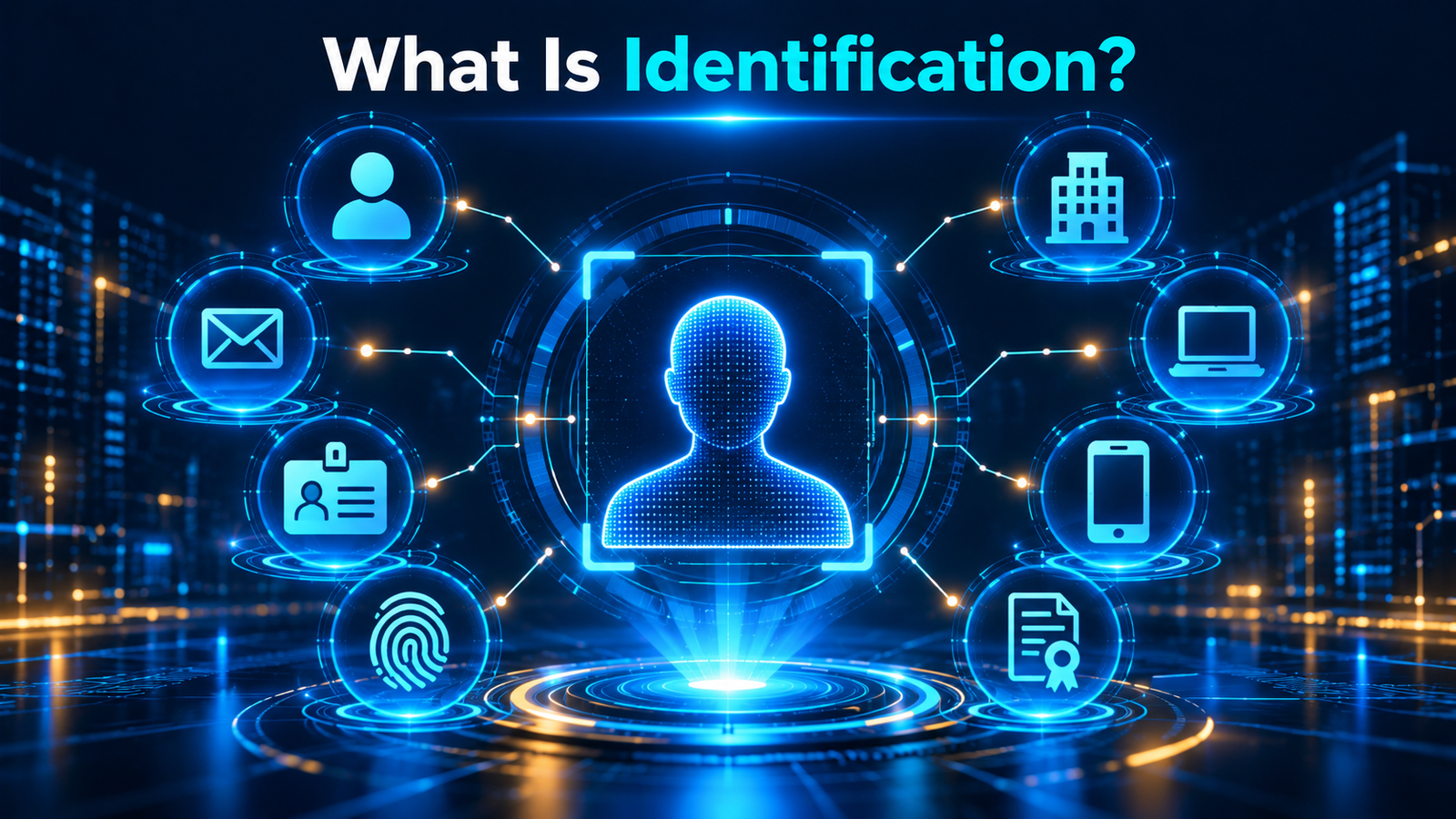
An organization may maintain identities for many types of entities, including:
- Employees
- Contractors
- Partners
- Customers
- Administrators
- Service accounts
- Applications
- Devices
- Workloads
Each identity may have one or more identifiers depending on the environment.
For example, an employee could have:
- Employee ID:
EMP30456 - Username:
alice - Email address:
alice@example.com - Directory identifier: a unique directory object identifier
These identifiers can be used by different systems while referring to the same underlying identity.
Identification is closely associated with identity management because identity management establishes how identities are created, maintained, associated with attributes, and managed throughout their use within an organization.
Identification also provides a foundation for authentication, access control, auditing, and accounting.
How Identification Works
Identification generally involves presenting an identifier and associating that identifier with a recognized identity.
Presenting an Identifier
The first step is the presentation of an identifier.
Depending on the system, an entity may provide:
- Username
- User ID
- Email address
- Employee number
- Customer number
- Device identifier
- Application identifier
- Service account name
- Digital certificate identity information
For example, when a user enters a username into a login interface, the username represents the identity being claimed.
In some environments, the identifier may be supplied automatically rather than manually entered. A device, application, certificate, or federated identity provider may provide identity information as part of an access request.
Associating the Identifier with an Identity
The system uses the identifier to locate the corresponding identity record.
For example:
alice may be associated with an employee identity such as Alice Smith, employee ID EMP30456.
The identity record may contain attributes such as:
- Name
- Employee ID
- Email address
- Department
- Job role
- Organizational unit
- Employment status
- Group memberships
- Assigned applications
The identifier acts as a reference to the identity within the relevant system or identity directory.
A single person can have different identifiers across different systems. Identity management processes may therefore be required to associate those identifiers with the appropriate identity.
Resolving the Identity
Identity resolution involves determining which identity a particular identifier or set of attributes represents.
For example, an organization may receive the identifier:
alice@company.com
The identity system may use it to locate a specific identity record belonging to an employee.
Identity resolution becomes particularly important in large environments where multiple identities may contain similar attributes or where identities exist across multiple directories, applications, and services.
Accurate identity resolution helps prevent identities from being duplicated, incorrectly associated, or assigned to the wrong entity.
Identification vs. Authentication vs. Authorization
Identification, authentication, and authorization are separate but closely related security concepts within Identity and Access Security. They address different aspects of an entity’s interaction with a system. Identification establishes which identity an entity is claiming or presenting, typically through an identifier such as a username, user ID, email address, employee ID, or other identity attribute. Authentication verifies the claimed identity by requiring evidence that demonstrates the entity’s association with that identity, such as a password, cryptographic credential, security key, or biometric factor. Authorization determines what the authenticated identity is permitted to access or perform based on applicable permissions, roles, policies, or other access-control decisions.
These distinctions are important because an identifier alone does not establish that an entity is legitimate, and successful authentication does not automatically grant unrestricted access. For example, when Alice enters the username alice, the system identifies the identity or account she is claiming. When she provides a password and completes multifactor authentication, the system verifies that identity claim. After successful authentication, the system evaluates her permissions to determine which applications, resources, or operations she is authorized to use. Keeping these functions distinct helps organizations design and implement appropriate Identity and Access Security controls.
| Concept | Primary Question | Purpose | Example |
|---|---|---|---|
| Identification | Which identity is being claimed? | Establishes the identity being presented | Username |
| Authentication | Can the identity claim be verified? | Verifies the claimed identity | Password + MFA |
| Authorization | What is the identity permitted to access or do? | Determines permitted access | Read access to an HR application |
Consider an employee accessing a corporate application.
The employee provides a username. This represents identification.
The employee then provides a password and completes an MFA challenge. This represents authentication.
After successful authentication, the application evaluates the employee’s roles, permissions, or other access policies. This represents authorization.
Although these processes are commonly implemented together within an access or login experience, they perform different security functions.
Types of Identifiers
Identifiers can take different forms depending on the type of entity, system, and environment. An identifier provides a value that allows a system to distinguish or reference a particular identity within its relevant context.
Username
A username is a commonly used identifier for a user account.
For example:
alice
The username allows a system to associate an access request with a particular account.
A username generally does not provide proof of identity. Authentication mechanisms are required to verify the person or entity using the account.
User ID
A user ID is an identifier assigned to a user within a particular system or organization.
For example:
USR10425
User IDs are often unique within their respective systems and can be used to distinguish one account from another.
Email Address
An email address can serve as an identifier for an account or digital identity.
For example:
alice@example.com
Many cloud services and applications use an email address as the primary login identifier.
An email address can identify an account, but it should not automatically be treated as proof of ownership of that identity.
Employee ID
Organizations commonly assign unique employee identifiers.
For example:
EMP30456
An employee ID can be used across HR, identity management, physical access, and other enterprise systems to associate records with an employee identity.
Account Number
Financial services, customer portals, and other systems may use account numbers or customer numbers as identifiers.
For example:
CUST784521
Such identifiers distinguish customer records within the relevant system.
Digital Identifier
Digital environments use identifiers to distinguish users, devices, applications, services, and other entities.
Examples include:
- Directory object identifiers
- Device identifiers
- Application identifiers
- Service identifiers
- Certificate-related identifiers
- Federated identity identifiers
The format and scope of a digital identifier depend on the technology and identity system in which it is used.
Biometric Information
Biometric information consists of measurable characteristics associated with an individual that can be used to distinguish or recognize that individual in certain systems.
Examples include:
- Fingerprints
- Facial characteristics
- Iris characteristics
- Voice characteristics
Biometric information requires particular consideration because it is closely associated with an individual and cannot be changed in the same way as a password.
In practical Identity and Access Security systems, biometric information is frequently used as part of authentication rather than as a standalone identification mechanism. The exact role depends on the system architecture and implementation.
Identification Methods
The method used for identification depends on the environment and the type of entity being identified.
Identifier-Based Identification
A system may use a unique identifier directly associated with an identity.
Examples include:
- Employee ID
- Customer ID
- User ID
- Device ID
- Application ID
This approach is common in enterprise directories and identity management systems.
The identifier provides a reference through which the system can distinguish or locate the associated identity.
Certificate-Based Identification
Digital certificates can contain information that identifies an entity and binds a public key to an identity.
Certificates may be used by:
- Users
- Devices
- Applications
- Servers
- Services
Certificate information may therefore provide identity information, while the associated cryptographic mechanisms can be used for authentication.
Federated Identification
In a federated identity environment, an identity provider can communicate identity information to another service or relying party.
For example, a user may access an application through an organization’s identity provider rather than maintaining a separate identity directly within every application.
Federated identity allows participating systems to establish relationships between identities across organizational or system boundaries.
Identification Across IT Environments
Identification exists across virtually every environment in which entities interact with information systems.
Enterprise Systems
Enterprise environments commonly identify employees, contractors, administrators, and service accounts through centralized directories and identity platforms.
An employee may have a common organizational identity that is referenced by multiple systems.
Identification can therefore provide a common starting point for:
- Authentication
- Access control
- Application access
- Privileged access
- Auditing
- Identity management
Networks
Network infrastructure uses identifiers to distinguish users, devices, services, endpoints, and other entities participating in network communication.
Examples include:
- Usernames
- Device identifiers
- IP addresses
- MAC addresses
- Network identities
- Certificate identities
Not all network identifiers represent a person. An IP address, for example, identifies a network endpoint or address assignment rather than necessarily identifying the individual using that endpoint.
Similarly, a MAC address generally identifies a network interface rather than the person operating the associated device.
Applications
Applications commonly maintain their own identities or integrate with centralized identity providers.
An application may identify a user through:
- Username
- Email address
- Customer ID
- Application-specific account ID
- Federated identity
Applications can then use authentication and authorization mechanisms to determine whether the identified entity should be granted access.
Cloud Environments
Cloud platforms rely heavily on digital identities.
Cloud environments may identify:
- Human users
- Administrators
- Applications
- Workloads
- Services
- Devices
- Automation processes
Cloud identity systems may use identifiers associated with users, service principals, roles, accounts, or other identity objects.
Because cloud environments can span multiple services and organizations, consistent identity management is particularly important.
Privileged Access
Privileged identities represent accounts or entities with elevated access to systems and resources.
Examples include:
- System administrators
- Database administrators
- Network administrators
- Cloud administrators
- Security administrators
- Privileged service accounts
Identification allows a privileged access system to determine which privileged identity or user is requesting access to a protected resource before authentication and authorization controls are applied.
Identification and Identity Management
Identification is closely connected to identity management.
Identity management deals with the administration of identities and their associated attributes and access relationships.
An identity may be created when an employee joins an organization. Identifiers can then be assigned to the identity and used across enterprise systems.
When an employee changes roles, relevant identity attributes and access relationships may also change.
When an employee leaves the organization, the associated identity and access should be appropriately disabled or removed according to organizational processes.
Accurate identification throughout the identity lifecycle helps ensure that access is associated with the correct identity.
Identification and the AAA Model
Identification is closely related to the AAA model, which consists of Authentication, Authorization, and Accounting. Although identification is not one of the three AAA components, it provides an important identity context for the activities performed by these security controls. Identification establishes which identity an entity is claiming, while AAA controls subsequently verify the identity, determine its permitted access, and record relevant activity.
Authentication
Authentication verifies the identity claimed by an entity. Identification provides the identity being claimed, while authentication verifies whether the entity can demonstrate its association with that identity.
Authentication may use mechanisms such as:
- Passwords
- Multifactor Authentication (MFA)
- Security keys
- Digital certificates
- Biometric authenticators
For example, when Alice provides the username alice, the username identifies the identity or account being claimed. When she provides a password and completes an MFA challenge, the authentication mechanism verifies the claim associated with that identifier.
Identification therefore provides the identity being claimed, while authentication provides the verification of that claim.
Authorization
Authorization determines what an authenticated identity is permitted to access or perform.
Authorization decisions may be based on factors such as:
- User roles
- Permissions
- Groups
- Access policies
- Resource ownership
- Organizational attributes
- Security requirements
For example, after Alice has been authenticated, an application may determine that she can view a particular business application but cannot modify administrative settings.
Identification provides the identity context used during the access process, while authentication establishes that the entity is associated with the claimed identity. Authorization then uses the authenticated identity and applicable access policies to determine the permitted actions.
Accounting
Accounting involves recording and maintaining information about relevant activities performed by authenticated identities.
Accounting information may include:
- Login events
- Access attempts
- Resource access
- Administrative activities
- Configuration changes
- Privileged operations
- Session information
For example, when Alice accesses an application, the system may record her identity, the time of access, the resource accessed, and relevant actions performed during the session.
Identification provides an important reference for associating recorded activity with the appropriate identity. Accurate identification therefore supports reliable auditing, monitoring, investigation, and security reporting.
Relationship Between Identification and AAA
Identification is not a fourth component of AAA. Instead, it provides the identity context that supports the AAA functions.
An entity presents an identifier to indicate the identity it claims. Authentication then verifies that claim. Authorization determines what the authenticated identity is permitted to access or perform, while accounting records relevant activity associated with that identity.
Maintaining this distinction is important because an identifier alone does not prove an identity, authentication does not determine permissions, and authorization does not itself establish who an entity claims to be. Each function addresses a different security requirement while working together as part of Identity and Access Security.
Conclusion
Identification is a foundational process in Identity and Access Security. It establishes or presents the identity that an entity claims to represent within a particular system or context.
Identifiers such as usernames, user IDs, email addresses, employee IDs, account numbers, device identifiers, and digital identity identifiers allow systems to distinguish one identity from another.
Identification should not be confused with authentication or authorization. Identification establishes the identity claim, authentication verifies the claim, and authorization determines what the verified identity is permitted to access or perform.
Identification also provides an important foundation for identity management, access control, IAM, PAM, IGA, auditing, and accounting.
A clear understanding of identification therefore helps establish the conceptual foundation for the broader Identity and Access Security domain.
References
Online Sources
NIST CSRC Glossary – Identification
Defines identification in the context of distinguishing or recognizing an entity from a set of identities.
NIST CSRC Glossary – Identification and Authentication
Describes identification and authentication as related processes used to establish and verify the identity of an entity interacting with a system.
NIST – Digital Identity Guidelines (SP 800-63-4)
Provides guidance on digital identity, including identity proofing, enrollment, authentication, and federation.
NIST – Digital Identity Guidelines: Identity Proofing and Enrollment (SP 800-63A-4)
Describes identity resolution, identity evidence, validation, verification, and enrollment processes used to establish digital identities.
NIST – Digital Identity Guidelines: Authentication and Authenticator Management (SP 800-63B-4)
Provides guidance on authentication and authenticator management and supports the distinction between identification and authentication.
ISO – ISO/IEC 24760-1:2025 — Identity Management
Defines core concepts and terminology for identity management, including identity, identifiers, attributes, identification, and verification.