
Introduction
Artificial Intelligence (AI) has become one of the most transformative technologies of the modern era. From healthcare and finance to manufacturing and transportation, AI is helping organizations improve efficiency, automate processes, make better decisions, and solve complex problems.
At its core, Artificial Intelligence refers to the ability of computer systems to perform tasks that typically require human intelligence. These tasks may include learning from data, recognizing patterns, understanding language, making predictions, solving problems, and interacting with the environment.
Although AI has recently become a popular topic of discussion, it is not a new technology. AI has been evolving for decades and has already been integrated into countless systems that people use every day, often without realizing it.
AI Is Already Everywhere
Many people associate AI with chatbots and virtual assistants. While these are certainly examples of AI, they represent only a small portion of the broader AI ecosystem.
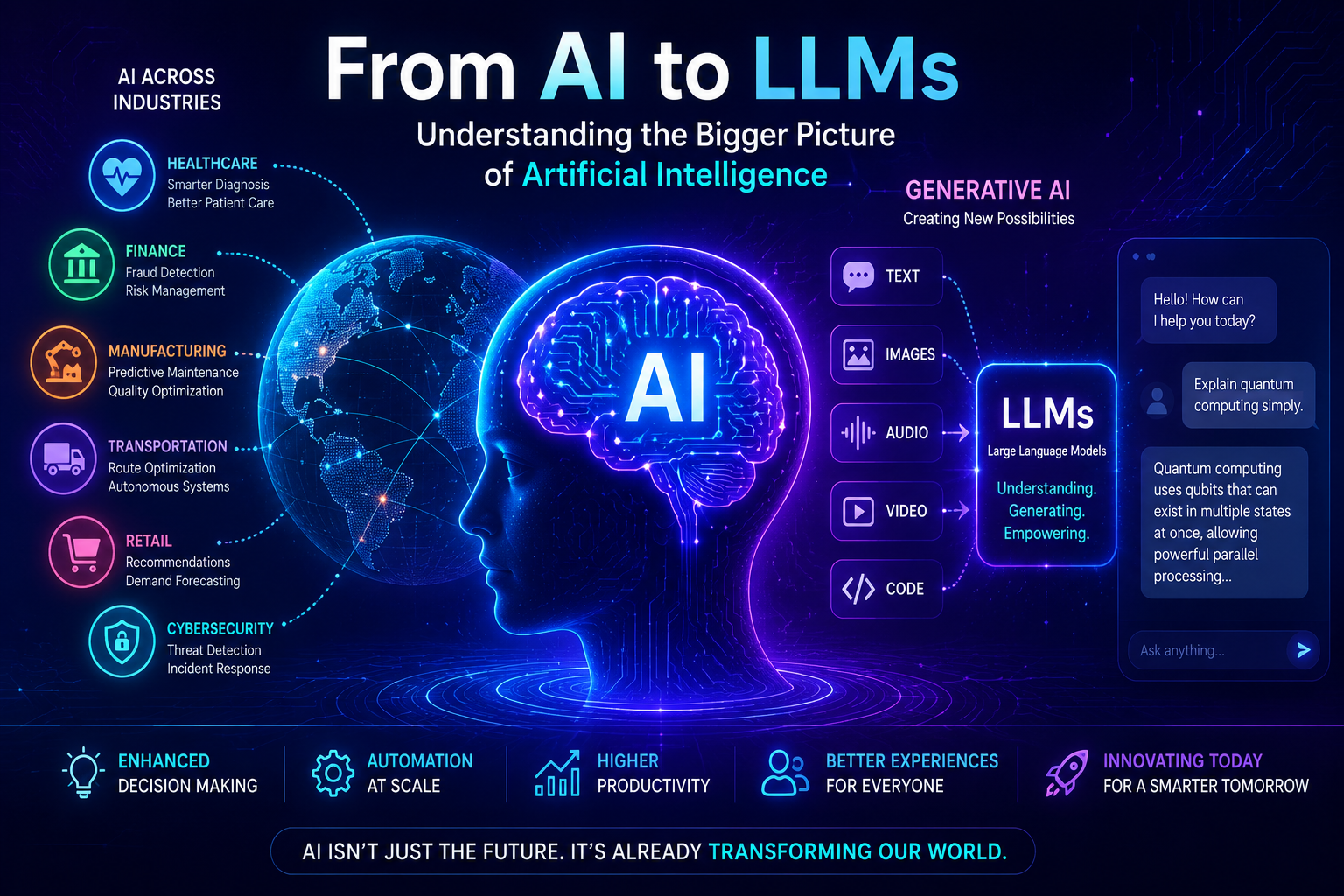
Today, AI is being used across numerous industries:
Healthcare
Healthcare organizations use AI to assist in medical imaging, disease prediction, drug discovery, patient monitoring, and clinical decision support.
Finance
Financial institutions use AI for fraud detection, risk assessment, credit scoring, algorithmic trading, and customer service automation.
Manufacturing
Manufacturers leverage AI for quality inspection, predictive maintenance, production optimization, and supply chain management.
Transportation and Logistics
AI helps optimize delivery routes, improve fleet management, forecast demand, and support autonomous vehicle technologies.
Retail and E-Commerce
Retail businesses use AI for product recommendations, inventory optimization, demand forecasting, customer analytics, and personalized shopping experiences.
Cybersecurity
Security teams use AI to detect threats, identify suspicious activities, analyze large volumes of security data, and improve incident response capabilities.
These examples demonstrate that AI has been creating value across industries long before the recent rise of chat-based AI systems.
Why Is Everyone Talking About Generative AI?
If AI has been around for many years, why does it seem like the entire world is suddenly talking about AI now?
The answer lies largely in the emergence of Generative AI.
Traditional AI systems typically work behind the scenes. They analyze data, identify patterns, make predictions, classify information, or automate specific tasks. While these capabilities are extremely valuable, they are often invisible to the average user.
Generative AI changed this dynamic by allowing people to interact directly with AI systems.
For the first time, millions of users could simply type a question or instruction and receive an intelligent response in seconds.
Users could ask AI to:
- Write articles and emails
- Summarize documents
- Generate computer code
- Translate languages
- Create images
- Brainstorm ideas
- Explain complex concepts
This accessibility made AI more visible and approachable than ever before.
As a result, Generative AI became the most publicly recognized branch of Artificial Intelligence, even though many other AI technologies continue to play critical roles across industries.
What Is Generative AI?
Generative AI is a category of Artificial Intelligence that focuses on creating new content.
Unlike traditional AI systems that primarily analyze or predict, Generative AI produces original outputs based on patterns learned from training data.
Depending on the model, Generative AI can generate:
- Text
- Images
- Audio
- Music
- Video
- Computer code
This ability to create content has opened new possibilities for businesses, educators, developers, researchers, and everyday users.
The Rise of Large Language Models (LLMs)
Among the various forms of Generative AI, Large Language Models (LLMs) have become the most widely adopted and recognizable.
Large Language Models are AI models specifically designed to understand and generate human language.
They are trained on vast amounts of textual data, including books, articles, websites, documentation, and other publicly available content. Through this training process, they learn grammar, context, language patterns, relationships between concepts, and many forms of human communication.
The term “Large Language Model” can be understood as follows:
Large
Refers to the enormous amount of training data and the billions of parameters used by modern models.
Language
Indicates that the model specializes in processing and generating human language.
Model
Refers to the mathematical representation that has learned patterns from the training data.
Why Have LLMs Become So Popular?
The popularity of LLMs stems from their versatility.
Unlike traditional AI systems that are typically designed for a specific task, LLMs can perform a wide range of language-related activities through natural conversation.
A single LLM can:
- Answer questions
- Generate content
- Summarize reports
- Translate text
- Explain technical concepts
- Assist with programming
- Draft emails
- Analyze documents
This flexibility allows individuals and organizations to apply LLMs across many different scenarios.
Common Applications of LLMs
Conversational Assistants
LLMs power modern AI assistants that can engage in natural conversations and answer user queries.
Content Creation
Writers, marketers, educators, and businesses use LLMs to generate articles, blogs, reports, and marketing content.
Software Development
Developers use LLMs to generate code, explain programming concepts, review code snippets, and assist with troubleshooting.
Customer Support
Organizations use LLM-powered assistants to handle routine customer inquiries and provide support at scale.
Knowledge Management
Businesses use LLMs to help employees search, summarize, and retrieve information from large knowledge repositories.
Research and Learning
Students, researchers, and professionals use LLMs to explore topics, summarize information, and accelerate learning.
Looking Beyond Generative AI
While Generative AI and Large Language Models currently receive significant attention, they represent only one part of the broader AI ecosystem.
Advancements continue to occur across many other AI domains, including computer vision, predictive analytics, robotics, speech processing, optimization, and autonomous systems. These technologies continue to drive innovation across industries and often operate behind the scenes to solve critical business challenges.
Generative AI has simply made AI more accessible to the general public by enabling direct interaction through natural language.
Conclusion
Artificial Intelligence is a vast field that encompasses numerous technologies and applications. From healthcare and finance to cybersecurity and manufacturing, AI has been transforming industries for many years.
The recent rise of Generative AI has brought unprecedented public attention to AI because it allows users to interact directly with intelligent systems and create new content. At the heart of this transformation are Large Language Models, which have made natural language interaction with computers easier and more powerful than ever before.
Understanding LLMs is important, but it is equally important to recognize that they are part of a much larger AI landscape. Together with other AI technologies, LLMs are helping shape the future of how humans interact with information, technology, and intelligent systems.