Introduction
The Industrial Revolution marks one of the most transformative periods in human history. It changed the way people live, work, and produce goods by shifting societies from manual systems to machine-driven and technology-enabled economies.
Over time, each industrial phase introduced breakthrough innovations that reshaped production, communication, and global development. Today, with the rise of Information Technology (IT), Artificial Intelligence (AI), and Cyber Security, the industrial world is entering a new era of intelligent and secure transformation.
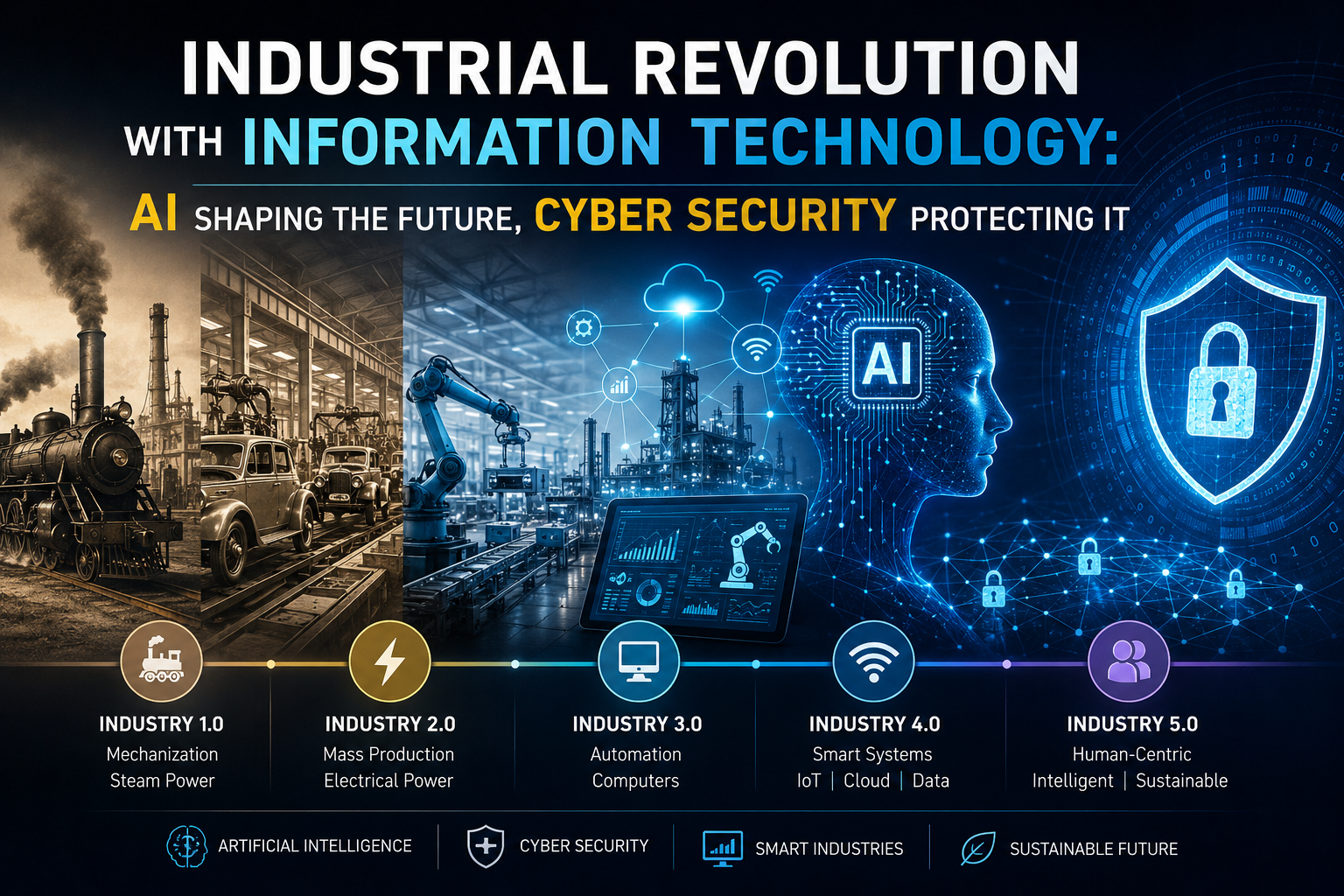
Industry 1.0: The Age of Mechanization
The First Industrial Revolution began in the late 18th century in England. It marked the shift from manual labor and hand production to machine-based manufacturing.
Steam engines powered by coal became the primary source of energy, enabling factories to scale production and improve efficiency.
Key highlights:
- Steam engine innovation
- Mechanized textile manufacturing
- Coal-powered industrial systems
- Emergence of factory-based production
This era laid the foundation for modern industrial systems.
Industry 2.0: The Age of Electrification
The Second Industrial Revolution introduced electricity into industrial operations during the late 19th century.
Electric power replaced steam engines, enabling faster, more efficient, and continuous production. Assembly lines revolutionized manufacturing processes, making mass production possible.
Key highlights:
- Electricity and electric motors
- Assembly line production systems
- Expansion of steel and chemical industries
- Telegraph and telephone communication
This phase significantly improved productivity and industrial scalability.
Industry 3.0: The Digital Revolution
The Third Industrial Revolution began in the mid-20th century with the introduction of electronics, computers, and automation systems.
This era marked the beginning of modern Information Technology, where machines became programmable and capable of processing data.
Key highlights:
- Computers and microprocessors
- Programmable Logic Controllers (PLCs)
- Industrial automation systems
- Early digital communication networks
Industry 3.0 introduced the shift from mechanical systems to digital intelligence.
Industry 4.0: The Age of Smart Industries
Industry 4.0 represents the integration of digital technologies into industrial ecosystems. It focuses on connectivity, data exchange, automation, and intelligent decision-making.
Information Technology became the backbone of industrial transformation during this phase.
Key technologies:
- Internet of Things (IoT)
- Artificial Intelligence (AI)
- Cloud computing
- Big data analytics
- Digital twins
- Cyber-Physical Systems
- Autonomous robotics
Industries evolved into smart, interconnected systems capable of real-time decision-making.
However, this increased connectivity also introduced new risks, making Cyber Security essential.
Cyber Security: Protecting the Connected World
As industries became more digital and interconnected, the risk of cyber threats increased significantly.
Cyber Security emerged as a critical requirement to protect industrial systems, data, and infrastructure.
Key focus areas:
- Industrial Control Systems (ICS) security
- Cloud infrastructure protection
- IoT device security
- Operational Technology (OT) security
- Data integrity and privacy
Cyber Security ensures that digital transformation remains safe, reliable, and resilient against threats.
Artificial Intelligence: Driving the Next Evolution
Artificial Intelligence is playing a central role in shaping the future of industries. It enables machines to learn from data, make predictions, and automate complex decision-making processes.
AI applications in industry:
- Predictive maintenance
- Smart manufacturing
- Supply chain optimization
- Real-time analytics
- Autonomous systems
AI is not only improving efficiency but also redefining industrial capabilities.
The Convergence of IT, AI, and Cyber Security
The modern industrial world is built on the convergence of three powerful pillars:
- Information Technology (IT): Provides infrastructure and connectivity
- Artificial Intelligence (AI): Enables intelligence and automation
- Cyber Security: Ensures protection and trust
Together, they form the foundation of intelligent, secure, and data-driven industries.
This convergence enables:
- Smart factories
- Intelligent industrial ecosystems
- Secure digital infrastructure
- Real-time decision systems
Industry 5.0: Human-Centric Innovation
Industry 5.0 focuses on collaboration between humans and intelligent machines rather than replacing human intelligence.
It emphasizes sustainability, personalization, and human-centric development.
Core principles:
- Human-machine collaboration
- Ethical AI usage
- Sustainable industrial growth
- Cyber-resilient systems
- Personalized production
Industry 5.0 represents a balanced integration of technology and human creativity.
Conclusion
The journey from Industry 1.0 to Industry 5.0 reflects continuous technological evolution driven by innovation.
While early revolutions were powered by steam and electricity, modern industries are driven by data, intelligence, and connectivity.
Today, Information Technology forms the backbone of industrial systems, Artificial Intelligence drives innovation forward, and Cyber Security ensures safety and trust in an increasingly digital world.
The future of industry is not only about automation and intelligence but also about building a secure, sustainable, and human-centered technological ecosystem.