Trustworthy AI: We Should Shape AI Before AI Shapes the World
Introduction
Artificial Intelligence is rapidly becoming one of the most influential technologies in human history. It is already helping people make decisions, generate knowledge, detect cyber threats, create content, automate business processes, and accelerate scientific discovery. As AI capabilities continue to advance, its influence on businesses, governments, and society will continue to grow.
AI is also becoming part of daily life. People increasingly interact with AI through search, communication, education, entertainment, work, healthcare, financial services, and many other activities.
As AI becomes more capable and more widely used, how we design, develop, govern, and use these systems becomes increasingly important.
The data, objectives, safeguards, feedback, and oversight we provide today will influence how AI behaves tomorrow.
An AI system does not suddenly become trustworthy after deployment. Trustworthiness needs to be considered from the beginning, through the data it learns from, the principles that guide it, the controls that govern it, and the people who oversee it.
This is why Trustworthy AI matters.
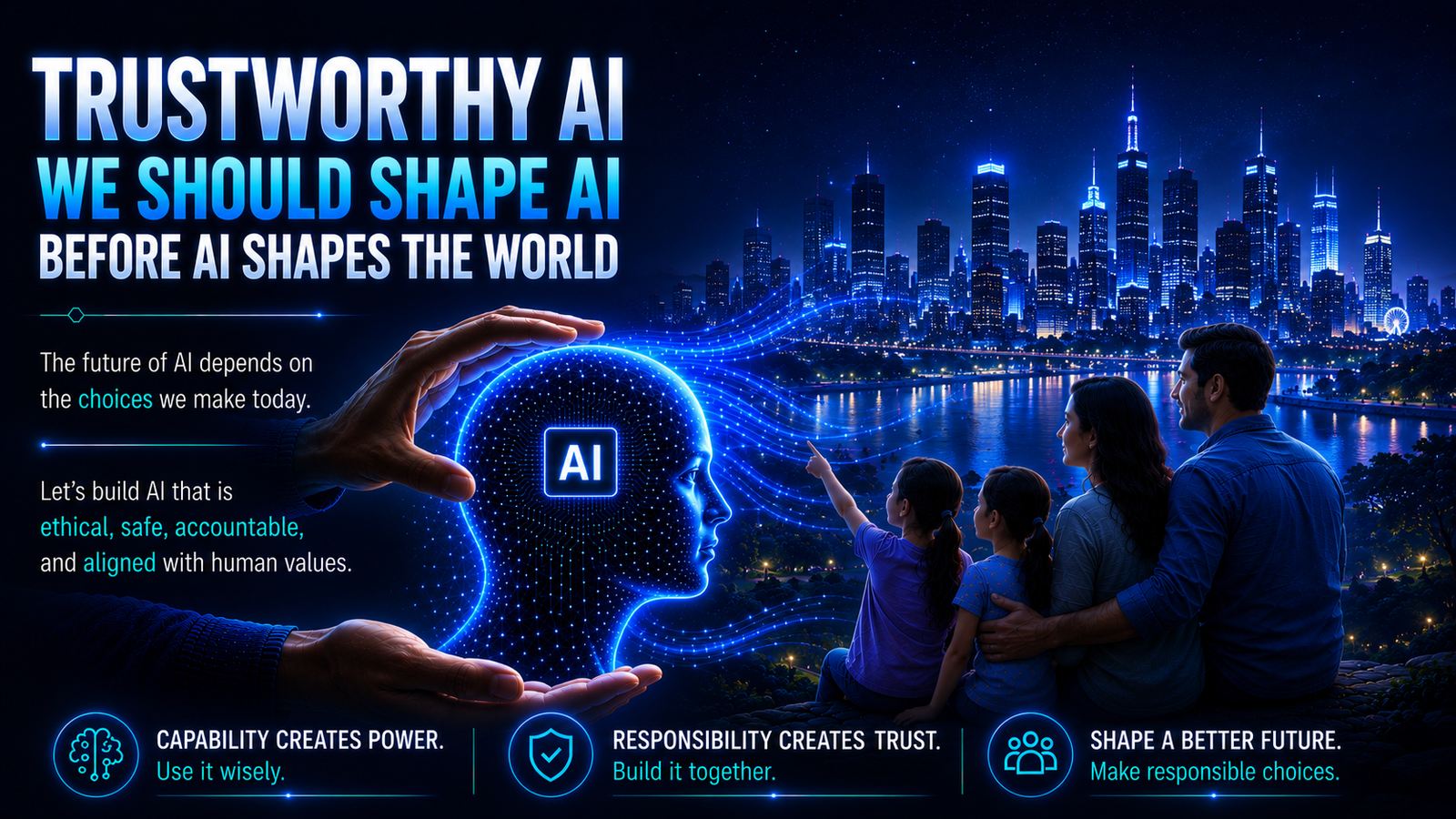
Before AI shapes the world, we should shape AI responsibly.
AI Is Becoming Part of Daily Life
AI is no longer limited to research laboratories or specialized technical environments. It is increasingly becoming part of the systems and services people use every day.
People interact with AI when searching for information, using digital assistants, creating content, receiving recommendations, learning new subjects, communicating with others, and performing tasks at work.
AI is also being integrated into areas such as healthcare, finance, cybersecurity, transportation, manufacturing, education, and public services.
In many cases, people may not even realize how much AI is involved in the systems they use.
This growing presence means that AI is no longer only a question for technology professionals. Its development and use can affect individuals, organizations, communities, and society as a whole.
As AI becomes part of daily life, the way it is designed and used becomes increasingly important.
The question is no longer simply whether AI can perform a particular task.
We also need to consider how that capability is introduced into the world around us.
AI Is Becoming More Capable
AI is not only becoming more common. It is also becoming more capable.
AI systems can generate and analyze information, identify patterns, support decisions, automate activities, interact with people, and perform increasingly complex tasks.
The capabilities of AI continue to expand as models become more sophisticated and are integrated with other technologies and systems.
Greater capability creates greater opportunity.
AI can help people solve problems, improve productivity, accelerate research, support professionals, and create new ways of working.
But greater capability also means greater potential influence.
A system that only provides information has a different level of influence from a system that recommends decisions. A system that recommends a decision has a different level of influence from one that can take action.
As AI moves into more important activities, the consequences of how it is designed and used also become greater.
AI Capability Comes With Responsibility
The most important aspect of AI is responsibility.
AI does not determine its own purpose, objectives, boundaries, or acceptable uses. These are determined by people.
People decide what problems AI should solve, what information it should use, where it should be deployed, what authority it should have, and what safeguards should surround it.
Developers make design and engineering decisions.
Organizations decide how AI is integrated into their operations.
Leaders decide how much reliance should be placed on AI.
Governments establish laws and regulatory requirements.
Users decide how AI is used in their daily activities.
Society as a whole influences the expectations and boundaries surrounding the technology.
Responsibility therefore does not belong to one group alone.
The more capable and influential AI becomes, the more important it is for everyone involved to understand the consequences of their decisions.
If an AI system produces an incorrect result, causes an unintended consequence, exposes sensitive information, or contributes to a harmful decision, responsibility cannot simply be assigned to the technology.
There must be people who understand what happened, why it happened, and what should be done about it.
AI capability should therefore be accompanied by human responsibility.
How We Should Shape AI
If we are responsible for AI, then we also have a responsibility to shape it properly.
AI is shaped by many factors.
The data used to develop and operate AI systems influences their behavior. Objectives influence what systems are expected to achieve. Training and feedback influence how they respond. Design decisions establish how they operate. Security controls protect them from misuse and manipulation. Governance establishes rules, responsibilities, and oversight.
How and where AI is deployed also matters.
A system designed for one purpose may not be appropriate for another. A capability that is useful in a low-risk environment may require much stronger controls when used in a high-impact situation.
This means that shaping AI is not limited to building the model.
It includes deciding how the technology should be developed, what information it should process, what boundaries should apply, where it should be used, and how its performance and behavior should be monitored.
It also means recognizing that AI systems can change over time as their data, environment, users, integrations, and intended purposes change.
Trustworthiness therefore cannot be treated as something that is checked once.
It needs to remain part of the way we develop and use AI.
Why Trust Matters
The more AI becomes part of daily life, the more important trust becomes.
People need confidence that AI systems are reliable enough for their intended purposes, that their information is handled appropriately, that important risks are considered, and that there is accountability when something goes wrong.
Trust does not mean believing that an AI system is always correct.
No AI system should be assumed to be perfect.
Trust means understanding what a system is intended to do, recognizing its limitations, managing its risks, and establishing appropriate safeguards around its use.
A trustworthy AI system should be developed and used with appropriate attention to safety, security, reliability, fairness, privacy, transparency, and accountability.
These characteristics are connected to the choices made by the people and organizations responsible for AI.
Trust is therefore not something that AI creates by itself.
It is something we build around AI.
Our Responsibility in Shaping AI
Our responsibility begins with understanding that AI is not separate from the decisions we make.
Every stage of AI involves choices.
We choose the data.
We define objectives.
We determine how systems are developed and tested.
We decide where they are deployed.
We establish safeguards.
We determine who can use them and what they are allowed to do.
We decide how much human involvement is required.
We decide what happens when the system produces an unexpected result.
These choices shape the technology and its impact.
This responsibility applies differently to different people, but the underlying principle remains the same.
A developer has responsibility for the system they build.
An organization has responsibility for how it deploys and uses AI.
A leader has responsibility for decisions about AI adoption and risk.
A user has responsibility for how the technology is used.
Governments and regulators have responsibility for establishing appropriate legal and regulatory environments.
No single group can carry the entire responsibility for AI.
Trustworthy AI requires responsibility across the wider ecosystem.
Due Care and Due Diligence
Responsibility also means exercising due care and due diligence.
As AI becomes increasingly capable and influential, people should not use or deploy AI without understanding what they are dealing with.
Due diligence involves taking reasonable steps to understand an AI system, its capabilities, limitations, intended purpose, risks, dependencies, and potential consequences.
This is particularly important before adopting an AI capability or using it for activities that may significantly affect people or organizations.
Due care involves acting responsibly based on that understanding.
It means taking reasonable precautions, applying appropriate safeguards, monitoring the system, addressing identified risks, and responding when problems occur.
Due care and due diligence are therefore practical expressions of responsibility.
They help move responsibility from a principle into action.
We should not assume that an AI system is trustworthy simply because it is widely used, highly capable, or provided by a reputable source.
We should understand it, evaluate it, use it appropriately, and take reasonable steps to manage the risks associated with it.
The greater the potential impact of an AI system, the greater the need for appropriate care and diligence.
As AI Evolves, So Does Our Responsibility
AI will continue to evolve.
Today’s AI systems may primarily assist people with information, analysis, creation, and decision support.
Future systems may perform increasingly complex tasks, interact with other systems, make recommendations, take actions, and operate with greater levels of autonomy.
As this happens, our responsibility must evolve as well.
The more authority an AI system has, the more carefully we need to consider its boundaries.
The more important the decision it influences, the more important appropriate oversight becomes.
The more sensitive the information it processes, the more important security and privacy become.
The more people affected by its outcomes, the more important fairness, accountability, and transparency become.
Increasing AI capability should therefore not mean decreasing human responsibility.
It should mean the opposite.
Greater capability should encourage greater care, stronger governance, better safeguards, and clearer accountability.
AI Will Shape the World Around Us
AI is becoming part of daily life today, but its influence may become much greater in the future.
It may influence how people work, learn, communicate, make decisions, access information, and interact with digital services.
It may influence how organizations operate and how governments deliver services.
It may become increasingly embedded in the systems and processes that surround us.
This means that AI will not simply be a technology that we use.
It may increasingly become part of the environment in which we live and make decisions.
That is why the choices we make today matter.
The data we provide, the objectives we define, the boundaries we establish, the safeguards we implement, and the oversight we maintain will all contribute to how AI develops and how it affects the world.
We are shaping AI today.
And the AI we shape may influence the world tomorrow.
The relationship is therefore not simply about humans using AI.
We are also creating systems that may increasingly influence us.
That is why Trustworthy AI should be considered a responsibility shared across the people, organizations, governments, and communities involved in shaping its future.
Conclusion
Artificial Intelligence will continue to become more capable and more deeply integrated into daily life.
Its potential is significant, but capability alone is not enough.
The way AI affects the world will depend greatly on how responsibly we develop, deploy, govern, secure, and use it.
Trustworthiness begins before deployment.
It begins with the data we provide, the objectives we define, the safeguards we establish, the decisions we make, and the people who remain responsible for the outcomes.
It also requires due care and due diligence.
We may not be able to predict everything AI will eventually become. But we can influence how we shape it today.
As AI becomes more capable, our responsibility should become greater—not smaller.
The future of AI will depend not only on how intelligent these systems become, but also on how wisely and responsibly we choose to shape them.
Before AI shapes the world, we should shape AI.