Artificial Intelligence and it’s building block
Introduction
Artificial Intelligence (AI) is the capability of computing systems to perform tasks that typically require human intelligence. These tasks include learning from data, reasoning, recognizing patterns, solving problems, understanding natural language, making decisions, and generating content. AI enables computing systems to analyze information, adapt to new inputs, and perform tasks with varying levels of autonomy.
Artificial Intelligence encompasses a broad ecosystem of concepts, methods, and technologies that collectively enable intelligent behavior in computing systems. Rather than representing a single technology, AI consists of multiple interconnected disciplines that have evolved to solve increasingly complex problems. These disciplines have expanded the capabilities of computing systems from executing predefined instructions to learning from experience, recognizing complex patterns, generating original content, and interacting with humans using natural language.
Machine Learning, Deep Learning, Neural Networks, Generative AI, Foundation Models, and Large Language Models (LLMs) are among the most important building blocks of modern Artificial Intelligence. Although these terms are often used interchangeably, they represent distinct concepts with different roles within the AI ecosystem. Each builds upon the capabilities of the preceding technologies, collectively enabling intelligent systems to perform a wide range of cognitive tasks.
Artificial Intelligence is applied across individuals, organizations, industries, governments, critical infrastructure, and society to support automation, improve decision-making, enhance productivity, accelerate scientific research, strengthen cybersecurity, optimize business processes, and enable innovative products and services. As AI capabilities continue to evolve, understanding the relationship between its foundational building blocks has become essential for professionals, researchers, students and anyone seeking to understand intelligent computing systems.
Together, Machine Learning, Deep Learning, Neural Networks, Generative AI, Foundation Models, and Large Language Models form a progression of technologies that define much of today’s AI landscape. Understanding how these concepts relate to one another provides the foundation for understanding how intelligent systems are designed, trained, deployed, and continuously improved.
What Is Artificial Intelligence?
Artificial Intelligence (AI) is a broad field of computer science that encompasses the concepts, methods, techniques, and technologies that enable computing systems to perform tasks typically associated with human intelligence. Rather than representing a single technology or product, Artificial Intelligence comprises a diverse collection of computational models, algorithms, and approaches that enable systems to analyze information, learn from data, reason, solve problems, make decisions, understand language, recognize patterns, and generate outputs.
The term intelligence in Artificial Intelligence refers to the ability of computing systems to perform cognitive functions that have traditionally been associated with human intelligence. Depending on their design, purpose, and underlying technologies, AI systems may exhibit one or more of these capabilities to varying degrees. Some AI systems are designed to perform highly specialized tasks, while others combine multiple capabilities to address increasingly complex challenges across different domains.
Artificial Intelligence consists of interconnected technologies that collectively enable these capabilities. Machine Learning, Deep Learning, Neural Networks, Generative AI, Foundation Models, and Large Language Models (LLMs) are among the most significant technologies within this ecosystem. Together, these technologies build upon one another to expand the capabilities of intelligent computing systems and represent the foundational building blocks of modern Artificial Intelligence.
Capabilities of Artificial Intelligence
Artificial Intelligence systems are designed to perform one or more capabilities commonly associated with human intelligence. These capabilities are achieved through various Artificial Intelligence techniques and technologies, including rule-based systems, Machine Learning, Deep Learning, knowledge representation, search algorithms, and optimization methods. The combination and extent of these capabilities vary depending on the system’s purpose, architecture, algorithms, and data.
Learning
Learning is the ability of an AI system to acquire knowledge from data, experience, or feedback without being explicitly programmed for every situation. By identifying patterns and relationships within data, AI systems can continuously improve their performance and produce more accurate outcomes over time.
Reasoning
Reasoning is the ability of an AI system to analyze information, apply logical principles, and draw conclusions. It enables AI systems to evaluate relationships, infer outcomes, and support decision-making in both structured and unstructured environments.
Problem Solving
Problem solving is the ability of an AI system to identify challenges, evaluate possible solutions, and determine appropriate actions to achieve a desired outcome. AI systems may use predefined rules, learned knowledge, search techniques, or optimization methods to solve problems efficiently.
Decision-Making
Decision-making is the ability of an AI system to evaluate available information, assess alternatives, and select an appropriate course of action. AI systems support decision-making by analyzing data, estimating potential outcomes, and recommending or executing actions based on predefined criteria or learned knowledge.
Pattern Recognition
Pattern recognition is the ability of an AI system to identify relationships, similarities, trends, and anomalies within structured and unstructured data. This capability enables applications such as image recognition, speech recognition, fraud detection, anomaly detection, and predictive analytics.
Perception
Perception is the ability of an AI system to acquire and interpret data from images, audio, video, sensors, and other input sources. This capability enables AI systems to recognize objects, understand speech, detect events, and derive meaningful information about their surrounding environment.
Natural Language Processing
Natural Language Processing (NLP) is the ability of an AI system to understand, interpret, generate, and interact using human language. It enables applications such as conversational assistants, language translation, text summarization, sentiment analysis, question answering, and information extraction.
Knowledge Representation
Knowledge representation is the ability of an AI system to organize facts, concepts, relationships, and rules in a structured form that supports reasoning and decision-making. It enables AI systems to utilize stored knowledge when solving problems or responding to queries.
Memory
Memory is the ability of an AI system to store, retrieve, and use information during processing and learning. Depending on the architecture of the AI system, memory may include temporary context, learned knowledge, or long-term information that supports future tasks.
Planning
Planning is the ability of an AI system to determine a sequence of actions required to achieve specific goals. It involves evaluating available resources, constraints, and possible outcomes to identify an effective path toward the desired result.
Prediction
Prediction is the ability of an AI system to estimate future events, behaviors, or outcomes based on historical and real-time data. Predictive capabilities are widely used in forecasting, risk assessment, anomaly detection, and trend analysis.
Generation
Generation is the ability of an AI system to generate novel and contextually relevant outputs based on learned patterns, predefined rules, or computational models. Depending on the underlying techniques and models, AI systems can generate text, images, audio, video, software code, designs, recommendations, predictions, and other forms of content or information.
Adaptation
Adaptation is the ability of an AI system to modify its behavior or improve its performance in response to new information, feedback, or changing conditions. This capability enables AI systems to respond more effectively to dynamic environments and continuously refine their outputs over time.
Interaction
Interaction is the ability of an AI system to communicate with humans or other computing systems through text, speech, visual interfaces, or other communication methods. Effective interaction enables AI systems to exchange information, provide assistance, answer questions, and support collaborative activities.
Autonomous Operations
Autonomous operation is the ability of an AI system to perform tasks with varying levels of independence while minimizing or eliminating continuous human intervention. Depending on its design, an AI system may monitor its environment, make decisions, and execute actions autonomously within defined operational boundaries.
The capabilities described above are realized through a combination of Artificial Intelligence techniques and technologies. While early AI systems relied primarily on explicitly programmed rules and logical reasoning, modern AI increasingly depends on Machine Learning and Deep Learning to enable capabilities such as learning, perception, pattern recognition, prediction, adaptation, and generation. As a result, Machine Learning has become one of the foundational building blocks of contemporary Artificial Intelligence, enabling computing systems to learn from data rather than relying solely on manually programmed rules.
What Is Machine Learning?
Machine Learning (ML) is a branch of Artificial Intelligence that enables computing systems to learn from data without being explicitly programmed for every possible situation. Instead of relying solely on predefined rules and instructions, Machine Learning uses algorithms and computational models to identify patterns, relationships, and statistical characteristics within data. These learned patterns enable computing systems to make predictions, classify information, detect anomalies, generate recommendations, and support decision-making.
Machine Learning enables computing systems to improve their performance through experience gained from data. Rather than manually defining every rule required to solve a problem, developers train Machine Learning models using representative datasets. During this process, the models learn relationships within the data that can later be applied to previously unseen information. As additional data becomes available, models can be retrained to improve their accuracy, adapt to changing conditions, and produce more reliable outcomes.
Machine Learning forms the foundation of many modern Artificial Intelligence applications. It enables intelligent systems to solve problems involving large volumes of data, complex relationships, and continuously changing environments, providing the basis for more advanced Artificial Intelligence technologies such as Deep Learning.
Working of Machine Learning
Machine Learning follows a systematic process that enables computing systems to learn from data and apply the acquired knowledge to new situations. Although the implementation varies depending on the learning algorithm, computational model, and application, the overall workflow generally consists of several stages that transform raw data into intelligent predictions and decisions.
Data Collection
The Machine Learning process begins by collecting data relevant to the problem being solved. The data may include text, images, audio, video, sensor readings, financial transactions, documents, network traffic, or other forms of structured and unstructured information. The quality, quantity, and relevance of the collected data significantly influence the accuracy and effectiveness of the resulting Machine Learning model.
Data Preparation
Before model training begins, the collected data is prepared for analysis. This stage typically involves removing duplicate records, correcting inaccuracies, handling missing values, transforming data into appropriate formats, selecting relevant features, and organizing the dataset for training. Proper data preparation improves the accuracy, efficiency, and reliability of the Machine Learning model.
Model Training
Model training is the stage where the Machine Learning algorithm analyzes the prepared data to identify patterns, relationships, and statistical characteristics. During this process, the algorithm adjusts its internal parameters based on the training data, gradually learning how to perform tasks such as prediction, classification, recommendation, or anomaly detection.
Model Evaluation
After training, the Machine Learning model is evaluated using a separate dataset that was not used during training. This evaluation measures the model’s accuracy, precision, reliability, and overall effectiveness in solving the intended problem. If the model does not satisfy the required performance criteria, it may be retrained using different algorithms, parameters, or datasets until the desired level of performance is achieved.
Model Deployment
Once the Machine Learning model has been successfully trained and evaluated, it is deployed to a production environment where it can process real-world data. Deployment involves integrating the trained model into applications, cloud platforms, web services, enterprise systems, mobile applications, edge devices, or other operational environments, making it available for practical use.
Inference
After deployment, the Machine Learning model processes new input data and applies the knowledge acquired during training to generate predictions, classifications, recommendations, or other outputs. This operational process is known as inference, during which the model performs its intended task without learning from the incoming data.
Model Improvement
Machine Learning models are continuously monitored throughout their operational lifecycle to maintain their accuracy, reliability, and overall performance. As new data becomes available or operational requirements change, models may be validated, optimized, retrained, and redeployed to improve performance, adapt to changing environments, address model drift, and maintain consistent results over time.
Machine Learning Methods
Machine Learning models learn from data using different learning methods. The choice of learning method depends on the type of data available, the nature of the problem being solved, and the expected outcome. The four primary Machine Learning methods are Supervised Learning, Unsupervised Learning, Semi-Supervised Learning, and Reinforcement Learning.
Supervised Learning
Supervised Learning trains Machine Learning models using labeled data, where each training example includes both the input data and the expected output. During training, the model learns the relationship between inputs and outputs so it can accurately predict outcomes for previously unseen data. Supervised Learning is commonly used for classification and regression problems such as spam detection, medical diagnosis, image classification, fraud detection, and credit risk assessment.
Unsupervised Learning
Unsupervised Learning trains Machine Learning models using unlabeled data, where the expected output is not known. Instead of predicting predefined outcomes, the model identifies hidden patterns, relationships, structures, or groupings within the data. Common applications include customer segmentation, anomaly detection, clustering, market basket analysis, and data exploration.
Semi-Supervised Learning
Semi-Supervised Learning combines a relatively small amount of labeled data with a much larger amount of unlabeled data during training. This approach improves model accuracy while reducing the effort and cost associated with labeling large datasets. Semi-Supervised Learning is widely used in image recognition, speech recognition, healthcare, and natural language processing.
Reinforcement Learning
Reinforcement Learning enables an intelligent agent to learn by interacting with an environment. Rather than learning from labeled examples, the agent performs actions, receives rewards or penalties based on those actions, and continuously adjusts its behavior to maximize long-term rewards. Reinforcement Learning is commonly used in robotics, autonomous vehicles, industrial automation, game playing, intelligent resource optimization, and decision-making systems.
Each Machine Learning method is designed to solve different categories of problems and may use different algorithms, computational models, and training techniques. Selecting the appropriate learning method depends on factors such as data availability, learning objectives, problem complexity, and the intended application.
Capabilities of Machine Learning
Machine Learning systems exhibit several capabilities that enable them to learn from data and perform intelligent tasks across a wide range of applications.
Learning from Data
Learning from data is the fundamental capability of Machine Learning. Instead of relying entirely on manually programmed rules, Machine Learning systems analyze data to identify patterns, relationships, and statistical characteristics that enable them to perform specific tasks and improve their performance over time.
Pattern Recognition
Pattern recognition enables Machine Learning systems to identify similarities, relationships, trends, and anomalies within structured and unstructured data. This capability supports applications such as image recognition, speech recognition, fraud detection, cybersecurity threat detection, anomaly detection, and predictive analytics.
Prediction
Prediction is the ability of a Machine Learning model to estimate future events, behaviors, or outcomes based on patterns learned from historical and real-time data. Predictive models are widely used in forecasting, recommendation systems, financial analysis, healthcare, demand planning, weather forecasting, and risk assessment.
Classification
Classification enables Machine Learning systems to categorize data into predefined classes or groups based on learned characteristics. Common applications include email spam filtering, malware detection, sentiment analysis, medical diagnosis, document classification, image recognition, and product categorization.
Decision Support
Machine Learning supports human or automated decision-making by analyzing data, identifying meaningful insights, and providing predictions, recommendations, or risk assessments. Depending on the application, the final decision may be made by either a human or an automated system.
Adaptation
Adaptation enables Machine Learning models to improve their performance by learning from new data. As additional information becomes available, models can be retrained to adapt to changing environments, evolving trends, and previously unseen scenarios.
Automation
Machine Learning automates tasks that would otherwise require extensive manual analysis or complex rule-based programming. It enables computing systems to process information, identify patterns, and perform repetitive or data-intensive tasks with minimal human intervention.
Scalability
Machine Learning enables computing systems to efficiently process and analyze large volumes of structured and unstructured data. This scalability allows organizations to extract meaningful insights from datasets that would be impractical or impossible to analyze manually.
Continuous Improvement
Continuous improvement enables Machine Learning models to become more accurate and effective through retraining, model optimization, and the availability of higher-quality data. This capability allows Machine Learning systems to evolve as new information becomes available and operational requirements change.
Machine Learning represented a significant advancement in Artificial Intelligence by enabling computing systems to learn directly from data instead of relying solely on explicitly programmed rules. As the availability of large datasets, computational power, and advanced algorithms continued to increase, researchers developed more sophisticated learning techniques capable of solving increasingly complex problems. This progression led to the emergence of Deep Learning, a specialized branch of Machine Learning that uses multi-layered neural networks to learn highly complex patterns from massive volumes of data.
What Is Deep Learning?
Deep Learning (DL) is a specialized branch of Machine Learning that enables computing systems to learn complex patterns and representations from large volumes of data using Artificial Neural Networks with multiple hidden layers. By automatically learning hierarchical features from data, Deep Learning can solve problems that are difficult or impractical using traditional Machine Learning techniques.
Unlike conventional Machine Learning, which often requires manually selecting and engineering relevant features, Deep Learning automatically learns these features during training. This capability enables Deep Learning models to process highly complex and unstructured data such as images, audio, video, natural language, and sensor data with remarkable accuracy and efficiency.
Deep Learning has significantly advanced Artificial Intelligence by enabling breakthroughs in computer vision, speech recognition, natural language processing, autonomous systems, scientific research, and many other intelligent applications. It has become one of the most influential technologies driving modern Artificial Intelligence.
Working of Deep Learning
Deep Learning follows a structured learning process that enables models to learn from large datasets and continuously improve their performance.
Data Collection
Deep Learning begins by collecting large volumes of relevant training data. Depending on the application, the data may include images, text, audio, video, sensor readings, documents, or other forms of structured and unstructured information.
Data Preparation
The collected data is prepared before training begins. This stage typically involves cleaning the data, handling missing values, labeling datasets where required, transforming formats, normalizing values, and organizing the data into a format suitable for training.
Model Training
The prepared data is used to train the Deep Learning model. During training, the model analyzes the data, learns patterns and relationships, and gradually improves its ability to perform the intended task by repeatedly processing the training data.
Model Evaluation
After training, the model is evaluated using data that was not part of the training process. This evaluation measures the model’s accuracy, reliability, and overall performance, helping determine whether it is suitable for deployment or requires further optimization.
Inference
Once the model has been successfully trained and evaluated, it processes new data to generate predictions, classifications, recommendations, or other outputs. This stage is known as inference because the model applies previously learned knowledge without additional learning.
Model Improvement
Deep Learning models continue to improve through retraining, fine-tuning, optimization, and the availability of additional high-quality data. This continuous improvement enables models to adapt to changing environments and maintain high levels of performance over time.
Characteristics of Deep Learning
Deep Learning possesses several characteristics that distinguish it from traditional Machine Learning.
Multi-Layer Learning
Deep Learning models learn information through multiple computational layers, enabling them to identify increasingly complex patterns and representations within data.
Automatic Feature Learning
Deep Learning automatically discovers relevant features directly from raw data, reducing the need for manual feature engineering and enabling more efficient learning.
Learning from Large Datasets
Deep Learning performs most effectively when trained using large and diverse datasets. Larger datasets enable the model to learn richer representations and improve prediction accuracy.
Processing Unstructured Data
Deep Learning excels at processing unstructured data such as images, speech, natural language, video, and sensor information, significantly expanding the range of problems that Artificial Intelligence can solve.
High Computational Requirements
Training Deep Learning models requires substantial computational resources, including high-performance CPUs, Graphics Processing Units (GPUs), Tensor Processing Units (TPUs), or other specialized AI accelerators capable of efficiently processing large datasets.
High Accuracy
Deep Learning has achieved state-of-the-art performance in numerous Artificial Intelligence tasks, including image recognition, speech recognition, natural language understanding, recommendation systems, and many other complex applications.
Scalability
Deep Learning models can scale by increasing the amount of training data, computational resources, and model complexity, enabling them to address increasingly sophisticated problems.
Continuous Improvement
Deep Learning models continuously improve through retraining, optimization, and fine-tuning as additional data becomes available, allowing them to maintain accuracy and adapt to evolving requirements.
Deep Learning derives its learning capability from Artificial Neural Networks, which provide the computational architecture used to process data, learn patterns, and generate predictions.
What Are Neural Networks?
Artificial Neural Networks (ANNs), commonly referred to as Neural Networks, are computational models inspired by the structure and functioning of the human brain. They consist of interconnected processing units called artificial neurons that work together to process information, identify patterns, learn relationships, and generate meaningful outputs.
Neural Networks provide the computational architecture that enables Deep Learning. By organizing artificial neurons into multiple interconnected layers, Neural Networks enable computing systems to learn from data, recognize increasingly complex patterns, and solve problems involving prediction, classification, image recognition, speech recognition, natural language processing, recommendation systems, and many other Artificial Intelligence applications.
Although inspired by biological neural networks, Artificial Neural Networks are mathematical and computational models rather than biological replicas. They use mathematical operations, optimization algorithms, and learning techniques to continuously improve their performance based on training data.
Components of Neural Networks
A Neural Network consists of several interconnected components that work together to process information and learn from data.
Input Layer
The input layer is the first layer of a Neural Network. It receives data from external sources and passes it into the network for processing. Depending on the application, the input may consist of numerical values, text, images, audio, video, sensor readings, or other forms of structured and unstructured data.
Hidden Layers
Hidden layers perform the computational processing within a Neural Network. Each hidden layer receives information from the previous layer, performs mathematical operations, extracts increasingly complex features, and forwards the processed information to the next layer. Deep Learning models typically contain multiple hidden layers, enabling them to solve highly sophisticated problems.
Artificial Neurons
Artificial neurons are the fundamental computational units of a Neural Network. Each neuron receives one or more inputs, performs mathematical calculations, applies an activation function, and generates an output that is transmitted to neurons in subsequent layers.
Weights
Weights are numerical parameters assigned to the connections between neurons. They determine the importance or influence that each input has on the output of a neuron. During training, the Neural Network continuously adjusts these weights to improve prediction accuracy.
Bias
Bias is an additional parameter associated with a neuron that enables the network to shift its output independently of the input values. Bias improves the flexibility of the model and enables Neural Networks to learn more effectively.
Activation Functions
Activation functions determine whether and how a neuron passes information to the next layer. They introduce non-linearity into the network, enabling Neural Networks to learn complex relationships that cannot be represented using simple linear mathematical models.
Output Layer
The output layer is the final layer of a Neural Network. It produces the result generated by the model, which may be a prediction, classification, recommendation, probability score, translated text, generated content, or another application-specific output.
Working of Neural Networks
Neural Networks learn by processing data through multiple interconnected layers while continuously refining their internal parameters based on training data.
Receiving Input
The process begins when the input layer receives data from an external source. Before processing, the input data is converted into numerical values that the Neural Network can interpret and process.
Forward Propagation
The input data flows through the hidden layers of the Neural Network. At each layer, artificial neurons perform mathematical computations using weights and bias values, apply activation functions, and pass the resulting outputs to the next layer. As information progresses through the network, increasingly complex features and relationships are learned.
Generating Output
After passing through all computational layers, the output layer produces the final prediction, classification, recommendation, probability score, or other application-specific result.
Error Calculation
During training, the generated output is compared with the expected output. The difference between the predicted and expected result, known as the loss or error, is measured using a loss function to evaluate the model’s performance.
Backpropagation
The calculated error is propagated backward through the Neural Network using an optimization technique known as backpropagation. During this process, the weights and bias values are adjusted to minimize future prediction errors and improve overall model accuracy.
Continuous Learning
The training process is repeated over many iterations using large datasets until the Neural Network achieves the desired level of accuracy. As new training data becomes available, the model can be retrained and optimized to improve performance and adapt to changing conditions.
Characteristics of Neural Networks
Neural Networks possess several characteristics that enable them to solve complex computational problems across a wide range of Artificial Intelligence applications.
Learning from Data
Neural Networks learn by identifying patterns and relationships within data instead of relying solely on manually programmed rules. Their ability to learn from examples enables continuous improvement through training.
Automatic Feature Extraction
Neural Networks automatically discover meaningful features and representations from raw data, significantly reducing the need for manual feature engineering.
Non-Linear Processing
Neural Networks can model highly complex and non-linear relationships that cannot be effectively represented using conventional linear algorithms, making them suitable for solving sophisticated Artificial Intelligence problems.
Adaptability
Neural Networks continuously improve through training, retraining, and optimization, enabling them to adapt to new data, changing environments, and evolving requirements.
Scalability
Neural Networks can be designed with varying numbers of neurons and layers, allowing them to scale from relatively simple architectures to highly sophisticated Deep Learning models capable of solving increasingly complex problems.
Support for Multiple Data Types
Neural Networks can process structured and unstructured data, including numerical values, text, images, audio, video, sensor readings, and time-series data. This flexibility makes them suitable for a wide range of Artificial Intelligence applications across different domains.
Neural Networks provide the computational architecture that powers Deep Learning. By organizing artificial neurons into multiple interconnected layers, they enable Deep Learning models to learn increasingly complex representations from data, making many of today’s advanced Artificial Intelligence capabilities possible.
What Are Foundation Models?
Foundation Models are large Artificial Intelligence models that are pre-trained on massive volumes of diverse data and can be adapted to perform a wide variety of tasks. Rather than being developed for a single purpose, they provide a common foundation that can be reused across multiple applications and domains.
Foundation Models are built using advanced Deep Learning techniques and large Artificial Neural Networks. During pre-training, they learn general patterns, relationships, and representations from extensive datasets containing text, images, audio, video, software code, and other forms of digital information. Once trained, these models can be adapted to perform specific tasks through techniques such as fine-tuning, prompting, or other adaptation methods.
Unlike traditional AI models that are designed for a single task, Foundation Models support multiple tasks without requiring a completely new model for each application. The same model can be used for language understanding, text generation, image analysis, software development, question answering, summarization, translation, reasoning, and many other Artificial Intelligence capabilities.
Foundation Models have significantly accelerated the development of modern Artificial Intelligence by providing reusable models that serve as the basis for numerous AI applications and services. Many of today’s advanced AI systems, including Large Language Models (LLMs), Large Vision Models (LVMs), multimodal models, and other specialized models, are built upon the concept of Foundation Models.
Characteristics of Foundation Models
Large-Scale Pre-Training
Foundation Models are trained using massive datasets that enable them to learn broad knowledge and general representations across multiple domains.
General-Purpose Learning
Instead of being limited to a single task, Foundation Models can perform a wide variety of tasks and can be adapted to different use cases.
Transfer Learning
Knowledge acquired during pre-training can be transferred to new tasks, reducing the amount of additional training data and computational resources required.
Adaptability
Foundation Models can be customized for specific applications through fine-tuning, prompting, instruction tuning, or other adaptation techniques.
Multi-Domain Capability
Depending on the training data and model architecture, Foundation Models can process text, images, audio, video, software code, and other forms of structured and unstructured information.
Scalability
Foundation Models can be deployed across numerous applications and industries, enabling organizations to reuse the same underlying model for multiple Artificial Intelligence tasks.
Foundation Models represent a significant advancement in the evolution of Artificial Intelligence by providing reusable models that can be adapted for a wide range of applications. One of the most widely adopted types of Foundation Models is the Large Language Model (LLM), which specializes in understanding and generating human language. The next section explores Large Language Models and their role in modern Artificial Intelligence.
Types of Foundation Models
Foundation Models can be trained and optimized for different types of data and Artificial Intelligence tasks. Depending on their architecture, training data, and intended purpose, they can be categorized into several model families.
Large Language Models (LLMs)
Large Language Models are Foundation Models trained primarily on text. They specialize in understanding, processing, and generating human language, supporting tasks such as question answering, summarization, translation, content generation, reasoning, and conversational AI.
Large Vision Models (LVMs)
Large Vision Models are designed to understand and analyze visual information, including images and photographs. They support applications such as image classification, object detection, scene understanding, visual reasoning, and image analysis.
Vision-Language Models (VLMs)
Vision-Language Models combine visual and language understanding within a single model. They can interpret images together with text, generate image descriptions, answer questions about visual content, and perform multimodal reasoning.
Speech Foundation Models
Speech Foundation Models are trained to process spoken language and audio. They enable capabilities such as speech recognition, speech synthesis, speaker identification, voice interaction, and audio understanding.
Code Foundation Models
Code Foundation Models specialize in understanding, generating, explaining, and optimizing programming code. They support software development tasks such as code generation, debugging, documentation, code completion, and software maintenance.
Multimodal Foundation Models
Multimodal Foundation Models are trained using multiple data types, including text, images, audio, video, and software code. They can understand, process, and generate information across different modalities, enabling more comprehensive Artificial Intelligence capabilities.
Foundation Models continue to evolve through advancements in model architectures, training techniques, computational capabilities, and the availability of large-scale datasets. Their ability to support multiple specialized model families has established them as a cornerstone of modern Artificial Intelligence, enabling a wide range of intelligent systems and applications.
Relationship Between Artificial Intelligence and Its Building Blocks
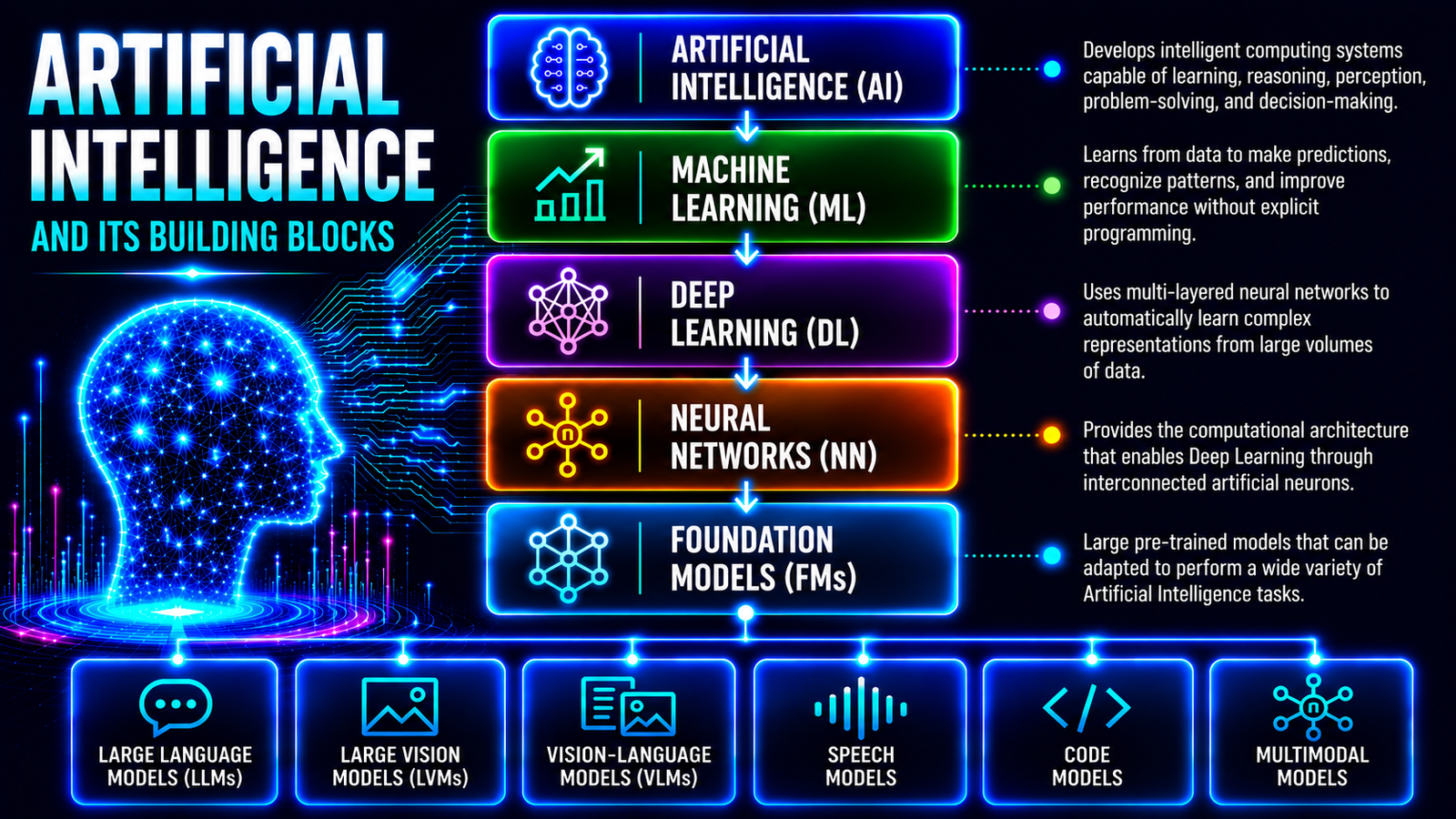
Artificial Intelligence has evolved through a series of technological advancements, with each major development building upon the capabilities of its predecessor. Rather than existing as independent technologies, Artificial Intelligence, Machine Learning, Deep Learning, Artificial Neural Networks, and Foundation Models form a hierarchical technology stack that collectively powers many modern Artificial Intelligence systems.
Artificial Intelligence is the broad discipline focused on developing intelligent computing systems capable of performing tasks typically associated with human intelligence. Within this discipline, Machine Learning enables computing systems to learn from data instead of relying entirely on explicitly programmed rules.
Deep Learning extends Machine Learning by enabling computing systems to learn increasingly complex patterns and representations from large volumes of data. It achieves this by using Artificial Neural Networks, which provide the computational architecture responsible for learning, recognizing patterns, and continuously improving through training.
Building upon these technologies, Foundation Models represent a significant advancement in Artificial Intelligence. Unlike traditional AI models designed for specific tasks, Foundation Models are pre-trained on massive and diverse datasets, enabling them to support multiple Artificial Intelligence capabilities and serve as the foundation for numerous specialized applications.
Together, these technologies form a hierarchical relationship in which each layer builds upon the previous one. Artificial Intelligence provides the overarching discipline, Machine Learning introduces learning from data, Deep Learning advances Machine Learning through multi-layered Artificial Neural Networks, and Foundation Models extend these capabilities by providing large, reusable models that can be adapted to a wide variety of Artificial Intelligence tasks.
Conclusion
Artificial Intelligence has evolved through continuous advancements in learning techniques, computational models, and data-driven approaches. From Machine Learning and Deep Learning to Artificial Neural Networks and Foundation Models, each technology builds upon the capabilities of the previous one, collectively forming the technological foundation of modern Artificial Intelligence.
Understanding these building blocks provides a clear perspective on how intelligent computing systems learn, recognize patterns, make decisions, and perform increasingly complex tasks. These foundational technologies continue to shape the development of Artificial Intelligence across individuals, organizations, industries, governments, and critical infrastructure.
As Artificial Intelligence continues to advance, new architectures, specialized models, and innovative applications will emerge. A solid understanding of these core concepts provides the foundation for exploring more advanced topics and understanding the rapidly evolving Artificial Intelligence landscape.