Understanding Cybersecurity Domains
Introduction
Cybersecurity has become a critical discipline in today’s digital world. Individuals, businesses, governments, educational institutions, healthcare providers, financial institutions, and critical infrastructure all rely on digital technologies to communicate, deliver services, store information, and support daily operations. As digital transformation continues to accelerate, cyber threats have become more frequent, sophisticated, and impactful, making cybersecurity essential for protecting digital systems, networks, applications, devices, and information.
Cybersecurity extends beyond protecting computers from unauthorized access. It encompasses the protection of identities, information, software, cloud environments, IT infrastructure, communication networks, and digital services. It also includes establishing governance, managing cyber risks, ensuring regulatory compliance, responding to security incidents, and maintaining business continuity and operational resilience.
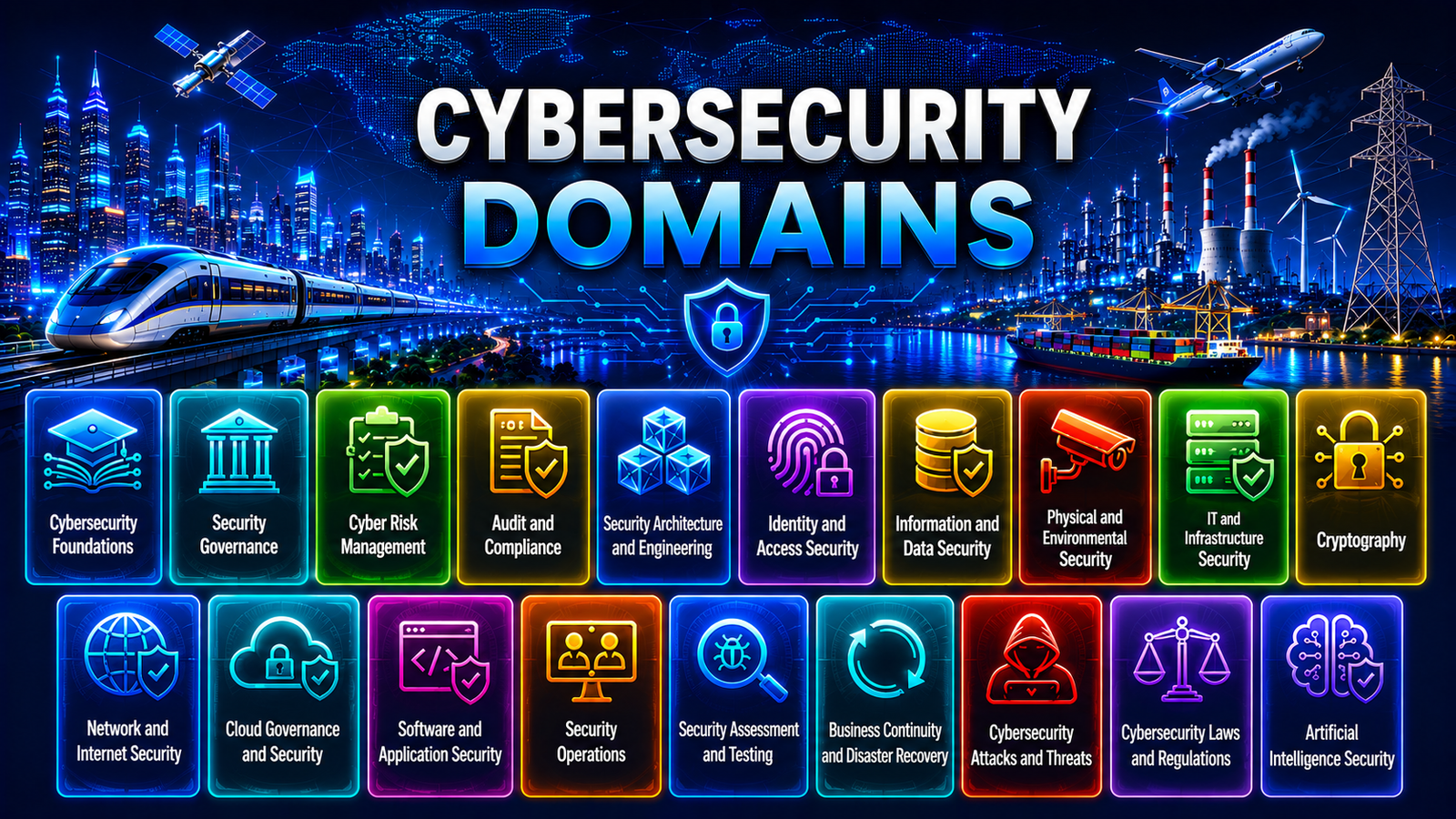
Because cybersecurity is a broad and multidisciplinary field, it is organized into specialized areas known as cybersecurity domains. Each domain focuses on a specific aspect of cybersecurity while contributing to the common objective of creating a secure, resilient, and trustworthy digital environment. Together, these domains provide a structured framework for understanding, implementing, managing, and continuously improving cybersecurity.
Before exploring these domains, it is helpful to understand two fundamental concepts that support every cybersecurity program: the CIA Triad and Security Controls. The CIA Triad defines the primary objectives of cybersecurity, while Security Controls provide the safeguards used to achieve those objectives. Cybersecurity domains bring these concepts together by organizing security responsibilities into specialized areas of practice.
CIA Triad
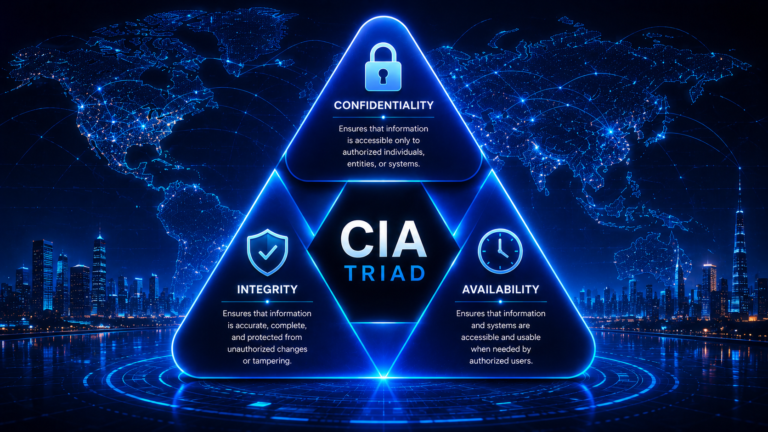
The Confidentiality, Integrity, and Availability (CIA) Triad forms the foundation of cybersecurity. These three principles define the primary security objectives that every cybersecurity domain, security control, technology, and security practice aims to achieve.
Confidentiality ensures that information is accessible only to authorized users, systems, or processes. It protects sensitive information from unauthorized disclosure through measures such as authentication, authorization, encryption, and access control. For example, the Identity & Access Security domain protects confidentiality by ensuring that only authorized users can access sensitive business applications and information.
Integrity ensures that information remains accurate, complete, and protected from unauthorized modification throughout its lifecycle. It helps maintain trust in data by preventing accidental or malicious alterations. For example, the Information & Data Security domain uses hashing, digital signatures, and data validation to ensure that important files and records remain accurate and trustworthy.
Availability ensures that information, systems, applications, and services remain accessible whenever authorized users need them. It focuses on minimizing disruptions caused by cyber attacks, hardware failures, software faults, or natural disasters. For example, the Business Continuity & Disaster Recovery domain helps restore systems and services quickly after a ransomware attack or major system outage.
Together, Confidentiality, Integrity, and Availability establish the security objectives that guide every cybersecurity initiative. Every cybersecurity domain contributes to protecting one or more of these principles through appropriate policies, processes, technologies, and security controls.
Security Controls
Security controls are the safeguards implemented to protect digital assets and reduce cybersecurity risks. They translate the objectives of the CIA Triad into practical measures that prevent, detect, respond to, and recover from cyber threats. Every cybersecurity domain applies a combination of security controls based on the risks it is designed to address.
Administrative Controls are management and procedural measures that establish how cybersecurity is governed and managed. They include policies, standards, procedures, risk management, security awareness, and compliance activities that guide secure practices. For example, the Security Governance domain develops security policies and standards that define how cybersecurity is implemented across an organization.
Technical Controls are technology-based safeguards that protect systems, applications, networks, and information from cyber threats. They include authentication mechanisms, encryption, firewalls, endpoint protection, intrusion detection systems, and security monitoring solutions. For example, the Computer Networks & Internet Security domain implements firewalls, intrusion prevention systems, and network segmentation to secure enterprise networks.
Physical Controls protect people, facilities, equipment, and supporting infrastructure against physical threats and unauthorized access. They include access control systems, surveillance cameras, security guards, environmental monitoring, and data center protection. For example, the Physical & Environmental Security domain uses biometric access control and CCTV surveillance to secure data centers and other critical facilities.
Security controls can also be classified according to the role they perform in protecting digital assets.
Preventive Controls are designed to stop security incidents before they occur by reducing vulnerabilities and blocking unauthorized activities. They form the first line of defense against cyber threats and help minimize the likelihood of successful attacks. For example, the Identity & Access Security domain uses multi-factor authentication to prevent unauthorized access to critical systems.
Detective Controls identify and report security incidents that have occurred or are currently taking place. They provide visibility into suspicious activities and enable timely investigation and response. For example, the Security Operations domain uses SIEM platforms and continuous monitoring to detect malicious activities across the enterprise.
Corrective Controls restore systems and reduce the impact of a security incident after it has occurred. They help eliminate vulnerabilities, repair damage, and return systems to a secure state. For example, the Security Assessment & Testing domain validates security improvements after vulnerabilities have been identified and remediated.
Deterrent Controls discourage individuals from attempting unauthorized or malicious activities by increasing the perceived risk of detection or punishment. Although they may not physically prevent attacks, they encourage secure behavior and reduce the likelihood of misuse. For example, the Security Governance domain establishes warning banners and acceptable use policies that discourage unauthorized activities.
Directive Controls establish security expectations by defining policies, standards, procedures, and guidelines for users and administrators. They provide clear direction on how security should be implemented and maintained. For example, the Security Governance domain publishes information security policies that define responsibilities and expected security practices.
Compensating Controls provide alternative safeguards when a recommended or primary security control cannot be implemented. They reduce risk by providing an equivalent level of protection under specific circumstances. For example, the Cybersecurity Architecture & Engineering domain may implement network segmentation to reduce risk when a legacy application cannot support modern authentication methods.
Recovery Controls help restore systems, services, and information following a cyber incident or operational disruption. They minimize downtime and support the timely recovery of critical business functions. For example, the Business Continuity & Disaster Recovery domain restores systems and data from secure backups following a ransomware attack.
Together, administrative, technical, physical, and functional security controls provide a layered approach to protecting digital environments. These controls are implemented across the cybersecurity domains to achieve the objectives of Confidentiality, Integrity, and Availability.
What Are Cybersecurity Domains?
Cybersecurity domains are specialized areas of knowledge, practice, and responsibility within the broader field of cybersecurity. Each domain focuses on protecting a specific aspect of the digital environment, such as governance, risk management, identity, networks, cloud platforms, software, or security operations. Together, these domains provide a structured framework for organizing cybersecurity activities and implementing appropriate security controls.
Although every domain has a distinct purpose, they are closely interconnected. Security Governance establishes direction, Risk Management identifies priorities, Cybersecurity Architecture & Engineering designs secure solutions, Security Operations monitors threats, and Business Continuity & Disaster Recovery ensures resilience during disruptive events. Collectively, the domains work together to strengthen cybersecurity and reduce cyber risk.
Why Are Cybersecurity Domains Important?
Cybersecurity domains simplify the complexity of cybersecurity by dividing it into specialized areas of expertise. This structured approach helps individuals understand the broad scope of cybersecurity while enabling organizations to implement comprehensive security programs that address governance, technology, operations, compliance, and resilience.
The domains also provide a clear learning pathway for students and cybersecurity professionals. Rather than studying cybersecurity as a single subject, they can build knowledge in specific disciplines while understanding how each domain contributes to the overall protection of digital systems and information.
The following sections introduce the major cybersecurity domains and explain the role each domain plays in protecting today’s interconnected digital environment.
Cybersecurity Domains
Cybersecurity Foundations
Cybersecurity Foundations establish the fundamental knowledge and core principles upon which the field of cybersecurity is built. It provides an understanding of cybersecurity concepts, security objectives, cyber threats, vulnerabilities, attacks, risk, and the safeguards used to protect digital systems, information, and infrastructure. This foundational knowledge enables individuals to understand and apply the principles, practices, and technologies that underpin every other cybersecurity domain.
Security Governance
Security Governance establishes the strategic direction for cybersecurity by aligning security objectives with organizational goals, business requirements, and regulatory obligations. It defines the policies, standards, roles, responsibilities, and oversight mechanisms that guide how cybersecurity is managed across the organization.
This domain includes security governance frameworks, policies, standards, procedures, governance committees, security leadership, performance measurement, security metrics, risk oversight, security awareness, and continual improvement. Effective governance ensures that cybersecurity remains aligned with organizational objectives while promoting accountability, informed decision-making, and a strong security culture.
Cyber Risk Management
Risk Management focuses on identifying, assessing, evaluating, and treating cybersecurity risks that could affect digital assets, business operations, or organizational objectives. It enables informed decision-making by helping organizations understand potential threats, vulnerabilities, and business impacts while determining appropriate risk treatment strategies.
This domain includes risk identification, risk assessment, risk analysis, risk evaluation, risk treatment, risk acceptance, risk monitoring, third-party risk management, enterprise risk integration, and continual risk assessment. Effective risk management enables organizations to prioritize security investments and reduce cyber risks to acceptable levels.
Audit and Compliance
Audit and Compliance evaluates whether cybersecurity practices comply with organizational policies, industry standards, legal requirements, and regulatory obligations. It verifies the effectiveness of security controls while supporting governance, accountability, transparency, and continual improvement.
This domain includes internal audits, external audits, compliance assessments, regulatory compliance, security reviews, control validation, evidence management, corrective action plans, compliance reporting, and continuous compliance monitoring. Effective audit and compliance activities help organizations demonstrate trust, maintain regulatory conformity, and strengthen their cybersecurity posture.
Cybersecurity Architecture and Engineering
Cybersecurity Architecture and Engineering focuses on designing, implementing, and maintaining secure technology environments. It integrates security into systems, applications, networks, and infrastructure to build resilient, scalable, and secure digital solutions.
This domain includes security architecture, enterprise security architecture, secure system design, infrastructure engineering, security-by-design principles, zero trust architecture, platform security, technology integration, secure configuration, and engineering best practices. Strong security architecture provides the technical foundation upon which modern cybersecurity programs are built.
Identity and Access Security
Identity and Access Security ensures that users, devices, applications, and services can access only the resources they are authorized to use. It protects digital identities while enforcing authentication, authorization, and access governance throughout the organization.
This domain includes identity management, authentication, authorization, identity governance, privileged access management (PAM), identity lifecycle management, multi-factor authentication (MFA), single sign-on (SSO), federation, password management, and periodic access reviews. Effective identity and access security significantly reduces the risk of unauthorized access while strengthening organizational security.
Information and Data Security
Information and Data Security protects information throughout its lifecycle by ensuring its confidentiality, integrity, and availability. It safeguards sensitive information regardless of where it is created, stored, processed, transmitted, shared, archived, or disposed.
This domain includes data classification, information governance, encryption, privacy protection, secure storage, data loss prevention (DLP), backup, retention, archival, secure sharing, and secure disposal. Effective information and data security enables organizations to protect valuable information assets while supporting business operations and regulatory compliance.
Physical and Environmental Security
Physical and Environmental Security protects people, facilities, equipment, and supporting infrastructure against unauthorized physical access, theft, damage, sabotage, and environmental threats. It safeguards the physical environments that support digital operations and helps ensure the continued availability of critical systems.
This domain includes physical access control, surveillance systems, visitor management, security guards, environmental monitoring, fire detection and suppression, power management, heating, ventilation and air conditioning (HVAC) protection, secure facilities, and data center security. Protecting the physical environment is essential for maintaining the confidentiality, integrity, and availability of digital systems.
IT and Infrastructure Security
IT and Infrastructure Security protects the computing platforms that support digital operations, including servers, operating systems, endpoints, virtualization platforms, storage systems, and core infrastructure services. It helps ensure that critical IT environments remain secure, reliable, resilient, and continuously available.
This domain includes server security, operating system hardening, endpoint security, virtualization security, storage security, infrastructure monitoring, configuration management, patch management, backup, and infrastructure resilience. A secure IT infrastructure provides the trusted foundation upon which modern digital services and cybersecurity capabilities operate.
Cryptography
Cryptography protects digital information using mathematical techniques that ensure confidentiality, integrity, authentication, and non-repudiation. It forms the foundation of secure communication, secure transactions, and trusted digital interactions across modern information systems.
This domain includes symmetric encryption, asymmetric encryption, hashing, digital signatures, public key infrastructure (PKI), digital certificates, cryptographic protocols, key management, cryptographic algorithms, and cryptographic lifecycle management. Effective cryptography protects sensitive information from unauthorized access, tampering, impersonation, and data compromise.
Network and Internet Security
Network and Internet Security protects network infrastructure, internet-connected systems, communication protocols, and data transmitted across wired, wireless, and public networks. It focuses on securing connectivity, controlling network access, defending against network-based attacks, and maintaining the confidentiality, integrity, and availability of communications.
This domain includes network architecture, network segmentation, firewalls, intrusion detection and prevention systems (IDS/IPS), wireless security, virtual private networks (VPNs), Domain Name System (DNS) security, email security, secure remote access, network access control (NAC), and network monitoring. Effective network and internet security provides the foundation for secure communication across today’s interconnected digital environments.
Cloud Governance and Security
Cloud Governance and Security focuses on the secure adoption, governance, and operation of cloud computing environments. It ensures that cloud services are designed, deployed, managed, and monitored securely while meeting business, regulatory, and operational requirements.
This domain includes cloud security architecture, cloud identity and access management, workload protection, cloud configuration management, cloud data security, container security, Kubernetes security, cloud-native security controls, cloud compliance, and continuous monitoring across public, private, hybrid, and multi-cloud environments. Effective cloud governance and security enable organizations to securely leverage cloud technologies while maintaining visibility, resilience, and compliance.
Software and Application Security
Software and Application Security integrates security throughout the software development lifecycle to reduce vulnerabilities and improve application resilience. It focuses on building secure applications by incorporating security into design, development, testing, deployment, and ongoing maintenance.
This domain includes secure software development, secure coding practices, application security, application security testing, API security, DevSecOps, software supply chain security, vulnerability management, code review, software assurance, and secure software deployment. Integrating security throughout the software development lifecycle helps reduce cyber risks, improve software quality, and strengthen the resilience of modern applications.
Security Operations
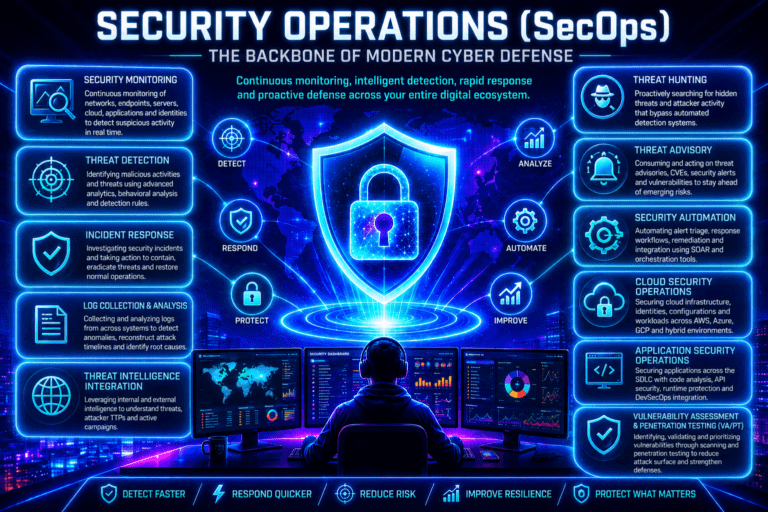
Security Operations focuses on continuously monitoring, detecting, investigating, responding to, and recovering from cybersecurity threats and security incidents. It combines people, processes, and technologies to maintain visibility across the digital environment and strengthen an organization’s ability to defend against evolving cyber threats.
This domain includes security monitoring, threat detection, threat intelligence, incident response, digital forensics, malware analysis, threat hunting, Security Information and Event Management (SIEM), Security Orchestration, Automation, and Response (SOAR), Security Operations Center (SOC) activities, and continuous security improvement. Effective security operations enable organizations to rapidly identify, contain, and recover from cyber incidents while strengthening their overall cyber resilience.
Security Assessment and Testing
Security Assessment and Testing evaluates the effectiveness of cybersecurity controls by identifying vulnerabilities, validating security measures, and assessing an organization’s overall security posture. It helps identify weaknesses before they can be exploited by cyber attackers while supporting continual security improvement.
This domain includes security assessments, vulnerability assessments, penetration testing, configuration reviews, security audits, red team exercises, blue team exercises, purple team exercises, security control validation, continuous security testing, and remediation verification. Regular security assessments help organizations measure security effectiveness, reduce cyber risk, and maintain a resilient security posture.
Business Continuity and Disaster Recovery
Business Continuity and Disaster Recovery ensures that critical business functions continue during disruptive events and that systems, services, and data can be restored efficiently following cyber incidents, system failures, or disasters. It minimizes operational disruption while strengthening organizational resilience.
This domain includes business continuity planning, disaster recovery planning, backup and recovery, resilience testing, crisis management, recovery exercises, continuity strategies, disaster recovery orchestration, business impact analysis (BIA), and recovery validation. Effective continuity and recovery planning enable organizations to restore operations quickly while maintaining essential business services.
Cybersecurity Attacks and Threats
Cybersecurity Attacks and Threats examines the evolving threat landscape, including threat actors, attack techniques, vulnerabilities, malware, ransomware, phishing, social engineering, insider threats, and emerging cyber threats. Understanding these threats enables organizations to implement effective preventive, detective, and responsive security strategies.
This domain includes threat intelligence, threat actors, attack vectors, malware analysis, ransomware, phishing, denial-of-service attacks, advanced persistent threats (APTs), exploit techniques, vulnerability research, cyber threat trends, and attack frameworks. Understanding how cyber adversaries operate enables organizations to strengthen prevention, detection, response, and cyber resilience.
Cybersecurity Laws and Regulations
Cybersecurity Laws and Regulations explores the legal, regulatory, and compliance requirements governing cybersecurity, cybercrime, privacy, and data protection. It helps organizations understand and fulfill their legal obligations while promoting the secure, ethical, and responsible use of digital technologies.
This domain includes cybersecurity legislation, privacy laws, data protection regulations, cybercrime laws, digital evidence, regulatory compliance, breach notification requirements, cross-border data regulations, industry-specific regulations, and international cybersecurity requirements. Understanding these legal and regulatory obligations helps organizations maintain compliance, reduce legal risk, and strengthen trust with customers, partners, and regulators.
Artificial Intelligence Security
Artificial Intelligence Security focuses on protecting AI systems, machine learning models, training data, and AI-driven applications throughout their lifecycle. It addresses the unique security challenges associated with developing, deploying, operating, and governing artificial intelligence securely and responsibly.
This domain includes AI model security, adversarial machine learning, prompt injection, data poisoning, model protection, AI governance, AI infrastructure security, privacy protection, responsible AI practices, secure AI deployment, AI risk management, and AI security monitoring. As artificial intelligence continues to transform the digital world, securing AI systems has become an essential discipline for building trustworthy, resilient, and secure intelligent technologies.
Conclusion
Cybersecurity is a multidisciplinary field composed of several specialized domains, each addressing a unique aspect of protecting digital systems, networks, applications, information, identities, infrastructure, and services. Although every domain has its own objectives, responsibilities, and areas of focus, they work together to create a comprehensive cybersecurity program that protects against an evolving threat landscape.
The CIA Triad defines the fundamental security objectives, while security controls provide the safeguards needed to achieve those objectives. Cybersecurity domains bring these concepts together by organizing security responsibilities into specialized disciplines that support effective planning, implementation, operation, and continuous improvement.
Understanding these domains provides a strong foundation for learning cybersecurity and helps individuals, professionals, and organizations develop the knowledge needed to build secure, resilient, and trusted digital environments. As technology continues to evolve, these cybersecurity domains will remain fundamental to protecting the digital ecosystem and enabling the safe adoption of emerging technologies.