
Career growth is an important aspect of professional life, whether we work as employees in an organization or are self-employed. Continuous knowledge upskilling in our field of work is essential for career advancement. Knowledge grows alongside experience and helps professionals become more effective in their roles.
There are many industries, including Information Technology (IT), Manufacturing, Agriculture, Retail, Transportation, Finance, Construction, and Healthcare. Each industry requires a combination of practical experience and domain-specific knowledge.
Academic Knowledge vs. Industry Knowledge
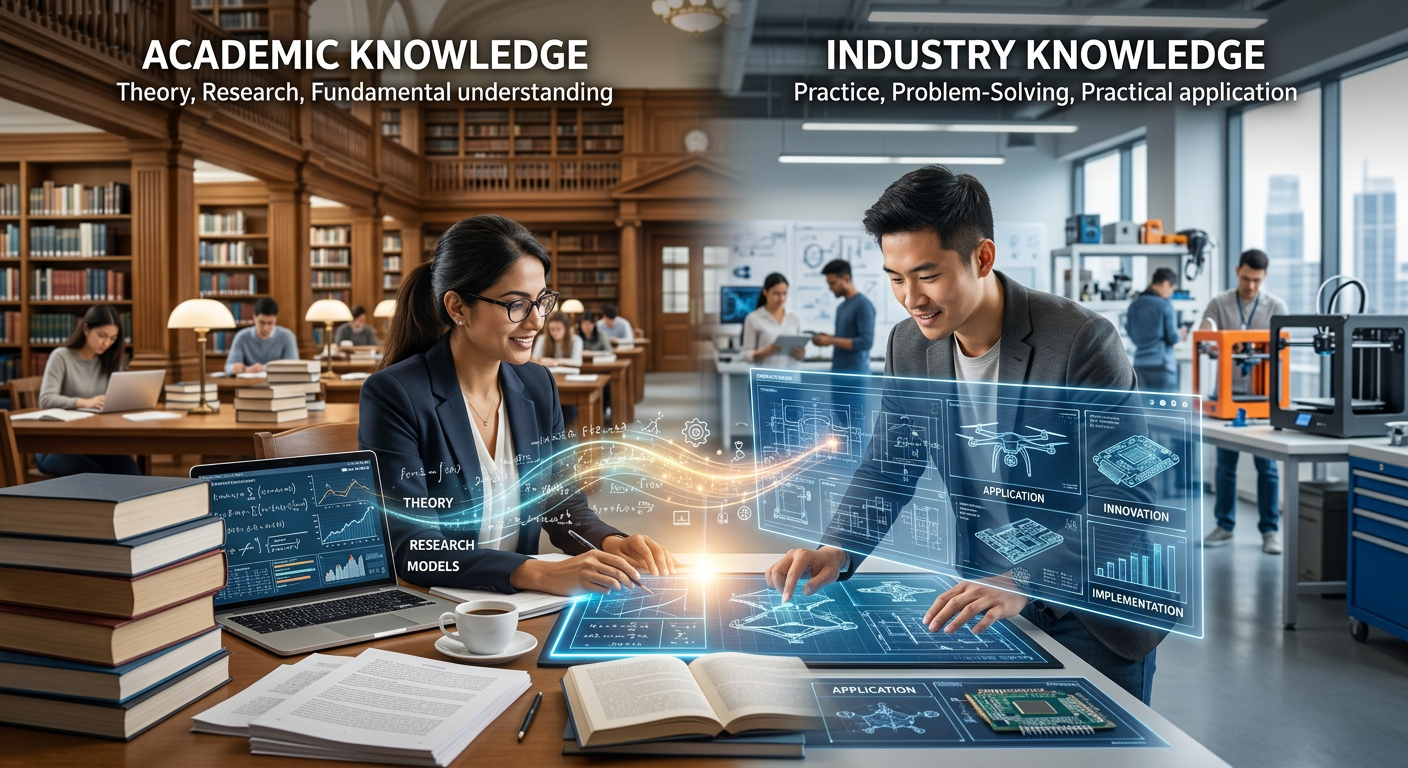
Academic knowledge is the knowledge we gain through schools, colleges, and universities. It emphasizes abstract concepts, research, critical thinking, and scientific principles. Academic learning can be broadly categorized into:
- Pure Science – Research driven by curiosity and the desire to expand human understanding.
- Applied Science – The application of scientific principles to solve real-world problems, develop technologies, and create practical solutions.
Industry knowledge, on the other hand, refers to the operational processes, technologies, methodologies, and practical expertise used within a specific industry. Much of modern technology is built upon the foundations of applied science.
The Gap in the IT Industry
In industries such as Healthcare, Agriculture, Manufacturing, and Engineering, professionals regularly use both academic and industry knowledge in their daily work. However, in the Information Technology sector, many professionals gradually shift their focus almost entirely toward technology and tools, often moving away from the scientific and mathematical foundations behind them.
As a result, they may become highly skilled in using technologies but have limited understanding of the underlying principles that make those technologies work.
Some may question whether this deeper scientific knowledge is necessary. However, understanding the science behind technology often leads to better decision-making, improved problem-solving abilities, and greater innovation.
Learning Beyond Technology
Consider the healthcare industry. A doctor evaluates a patient’s heart rate, blood parameters, and medical history while also understanding the scientific composition of medicines before prescribing treatment. Both academic knowledge and industry expertise are essential for effective patient care.
A similar principle applies to Information Technology.
For example, a Virtual Private Network (VPN) is a technology used to secure data transmitted over the internet. Most people understand that a VPN uses cryptography to encrypt data and protect privacy. However, cryptography itself is built upon mathematical concepts and algorithms.
By understanding the mathematics and science behind encryption, IT professionals can better evaluate:
- When a VPN should be used
- Which type of VPN is appropriate for a specific use case
- The strengths and limitations of different encryption methods
- How security solutions can be implemented effectively
This deeper understanding leads to more informed decisions and stronger technical expertise.
Conclusion
Technology skills are essential for success in an IT career, but they should not replace the academic knowledge that forms their foundation. Maintaining an understanding of the relevant scientific principles behind the technologies you use can improve your effectiveness, creativity, and problem-solving capabilities.
Continue learning new technologies, but also invest time in understanding the science, mathematics, and theories that support them. Explore research in your domain of work whenever possible. Doing so will not only strengthen your professional capabilities but also make your career more engaging and intellectually rewarding.