
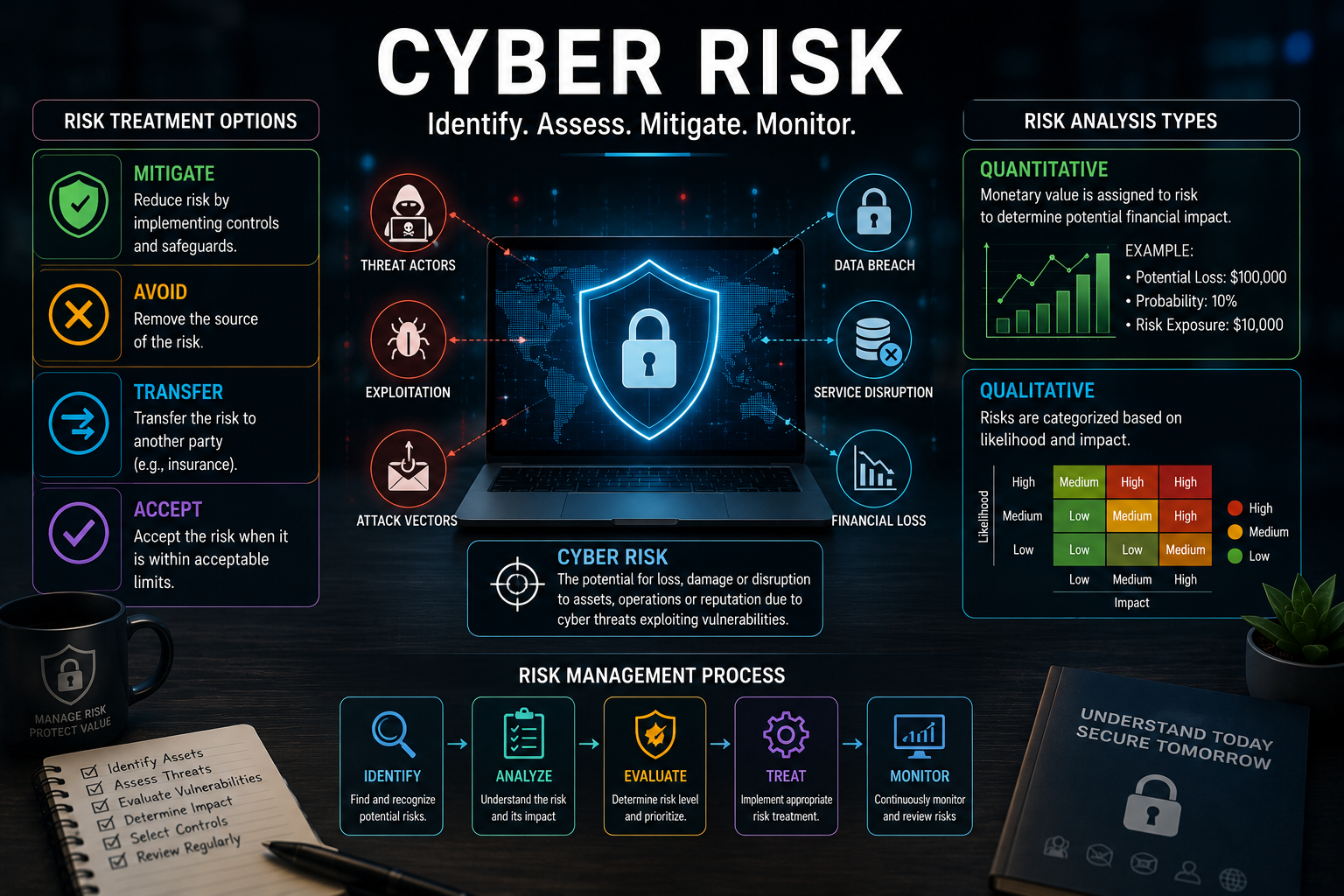
Risk in Cyber Security is the probability of exploitation of a vulnerability by a threat actor that would lead to loss of confidentiality, integrity, or availability of data, or disruption of services.
A cyber risk exists when there is a threat, a vulnerability, and an asset that can be impacted.
Risk can be represented as:
Risk = Threat × Vulnerability
The higher the threat capability and the higher the vulnerability exposure, the greater the risk.
We can add the impact attribute to enhance the risk calculation and provide a better understanding of the effect on the target asset if the threat is successfully realized.
Risk = Threat × Vulnerability × Impact
The impact can be financial loss, operational disruption, reputational damage, regulatory penalties, or any other adverse effect on the organization.
The total risk calculation can also consider the value of the target asset.
Total Risk = Threat × Vulnerability × Asset Value
The higher the value of the asset, the higher the overall risk to the organization if the asset is compromised.
Risk Treatment Methods
The risk can be addressed using one or more of the following methods.
Risk Mitigation
Risk Mitigation reduces the probability or impact of a risk by implementing security controls.
Examples include:
- Firewall
- Anti-Virus
- Endpoint Detection and Response (EDR)
- Multi-Factor Authentication (MFA)
- Security Monitoring Solutions
These controls help protect vulnerable assets from threat actors and reduce the likelihood of successful exploitation.
Risk Avoidance
Risk Avoidance completely removes the source that is causing the risk.
Examples include:
- Removing vulnerable software
- Decommissioning unsupported systems
- Disabling unnecessary services
- Eliminating risky business processes
By removing the source of the risk, the associated risk is eliminated.
Risk Transfer
Risk Transfer is the process of transferring the impact of a risk to another party.
Cyber Insurance is a common example where the financial loss resulting from a cyber incident is transferred to the insurer according to the terms of the insurance policy.
Risk transfer does not eliminate the risk itself, but transfers part of the financial burden associated with the risk.
Risk Acceptance
Risk Acceptance is the decision to accept a risk without implementing additional controls.
This approach is typically taken when:
- The risk level is low
- The cost of mitigation is higher than the potential loss
- There are no practical options available to address the risk
The accepted risk should be documented and approved by the appropriate management authority.
Residual Risk
The risk remaining after applying risk treatment measures is known as Residual Risk.
Residual Risk = Total Risk − Control Effectiveness
Residual Risk can never be completely eliminated. The objective of Cyber Security is to reduce the risk to an acceptable level that aligns with the organization’s risk appetite.
Organizations should continuously monitor residual risks and reassess them whenever there are changes to the threat landscape, vulnerabilities, or business environment.
Risk Analysis Methods
Risk analysis can be performed using the following methods.
Quantitative Risk Analysis
Quantitative Risk Analysis is a method in which a monetary value is assigned to risk. The impact of a risk is measured in currency, allowing organizations to estimate potential financial losses.
Example:
- Estimated loss from a ransomware attack: $100,000
- Annual probability of occurrence: 10%
- Annual Risk Exposure: $10,000
This method helps organizations perform cost-benefit analysis and justify investments in security controls.
Qualitative Risk Analysis
Qualitative Risk Analysis is a method in which risks are categorized based on their severity.
Common categories include:
- High
- Medium
- Low
Some organizations may also use categories such as Critical, High, Medium, Low, and Informational.
This method is widely used because it is simple to implement and does not require detailed financial calculations.
Conclusion
Cyber Risk is the possibility that a threat actor may exploit a vulnerability and negatively impact an organization’s assets, data, or services. Effective risk management involves identifying risks, assessing their likelihood and impact, implementing appropriate risk treatment methods, and continuously monitoring residual risks. A well-managed risk program helps organizations make informed security decisions and improve their overall security posture.